
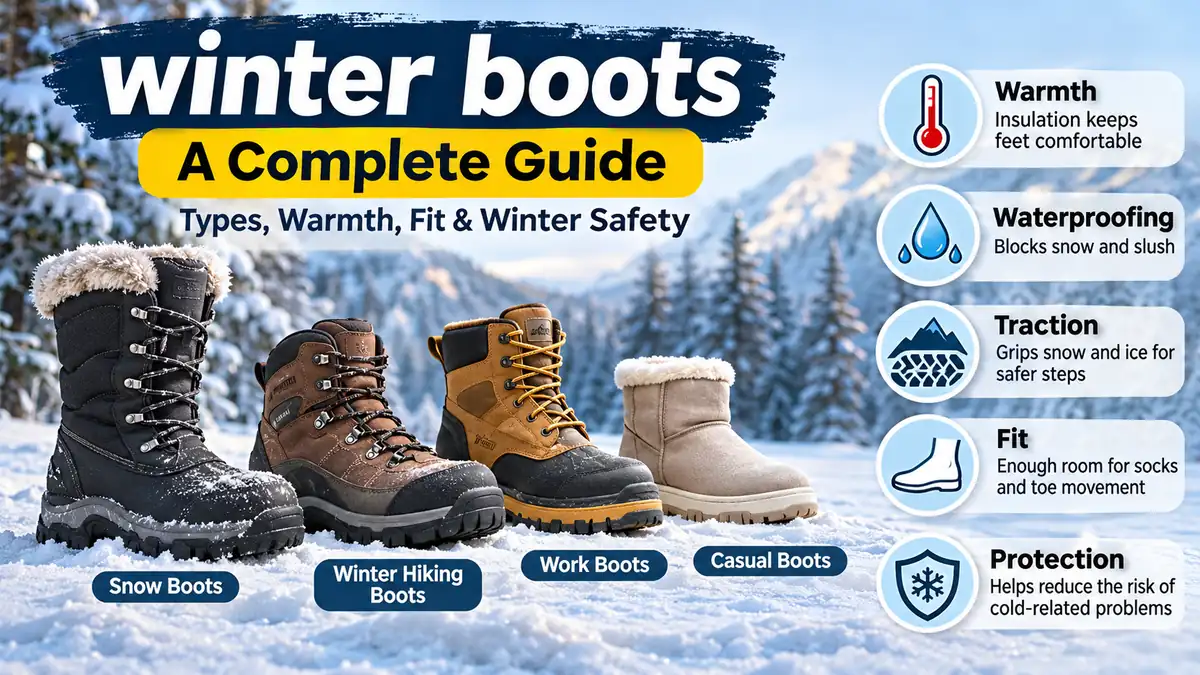
Cold feet can turn an enjoyable winter walk into an uncomfortable experience. Snow, freezing rain, icy sidewalks, and slush create different challenges for footwear, and ordinary shoes often lack the insulation, moisture protection, and traction needed to handle them.
winter boots are protective footwear designed to keep feet warm, dry, and supported in cold-weather conditions. They typically combine insulating materials, water-resistant or waterproof construction, durable outsoles, and higher ankle coverage. The right design depends on temperature, activity level, snow depth, and whether the wearer encounters wet surfaces or slippery ice.
Understanding how these features work makes it easier to choose appropriate footwear, prevent common winter foot problems, and maintain boots throughout the season.
What Are winter boots and How Do They Work?
Winter boots are footwear specifically constructed for cold environments. Unlike ordinary sneakers or fashion boots, they address several problems at once: heat loss, moisture exposure, unstable footing, and contact with snow.
A typical winter boot contains several functional layers:
- Outer shell: Protects against snow, wind, and moisture.
- Insulation: Slows heat transfer from the foot to the surrounding environment.
- Lining: Provides comfort and helps manage moisture.
- Midsole: Adds cushioning and separates the foot from cold ground.
- Outsole: Provides grip on snow, wet pavement, and uneven surfaces.
- Collar and closure: Help reduce snow entry and secure the boot around the ankle.
These components work together, but their effectiveness depends on the conditions.
For example, thick insulation may help during stationary outdoor activities but cause excessive sweating during strenuous hiking. Similarly, a waterproof boot can protect against slush while still feeling damp inside if perspiration cannot escape.
How winter boots differ from regular boots
| Feature | Winter boots | Regular boots |
|---|---|---|
| Insulation | Often included | May be absent |
| Waterproofing | Common in snow-ready designs | Varies considerably |
| Outsole | Designed for cold-weather traction | Often general-purpose |
| Ankle coverage | Frequently medium to high | Low to high |
| Cold-weather comfort | Central design consideration | Depends on construction |
| Weight | Often heavier | Varies |
| Snow protection | Usually better | Not always suitable |
Not every winter boot offers all these features. Some prioritize urban comfort, while others are engineered for deep snow, outdoor work, or demanding winter trails.
Types of winter boots and Their Uses
Different winter environments require different footwear designs. Understanding the main categories helps explain why one pair may perform well in a city but struggle during a mountain hike.
Insulated snow boots
Snow boots are designed for prolonged contact with snow and freezing temperatures.
They commonly feature a tall shaft, protective rubber or synthetic lower shell, insulated lining, and an aggressive tread pattern.
Some traditional designs use removable felt liners that can be taken out and dried separately.
These boots are particularly useful for snow shoveling, winter recreation, and activities involving deep snow.
Their main disadvantages are bulk, weight, and reduced breathability during high-intensity movement.
Winter hiking boots
What Are Winter Hiking Boots And Their Key Features? Stay Safe And Warm On The Trail – 3515
Winter hiking boots balance warmth with walking efficiency.
They often include waterproof membranes, supportive midsoles, reinforced toe protection, and lugged rubber outsoles.
Compared with traditional snow boots, hiking-oriented designs generally provide better flexibility and control on uneven terrain.
However, outsole traction on rock or packed snow does not automatically guarantee safe grip on smooth ice.
For technical winter hiking, compatible traction devices may be necessary.
Pac boots
Pac boots typically combine a weather-resistant outer shell with a thick, often removable insulating liner.
This construction is associated with traditional cold-weather footwear used in snowy regions.
Their roomy interiors can accommodate substantial insulation, making them useful for low-activity situations where maintaining warmth is more important than agility.
They can feel cumbersome for long-distance walking.
Winter work boots
Winter work boots are intended for outdoor occupations such as construction, utility maintenance, forestry, and snow removal.
Depending on the workplace, they may include protective toe caps, puncture-resistant components, electrical-hazard protection, and slip-resistant outsoles.
Safety footwear requirements depend on occupational hazards. In the United States, relevant standards include ASTM F2413 for protective footwear.
Insulation alone does not make a boot suitable for hazardous workplaces.
Casual winter boots
Antique Brown Premium Waterproof Leather Chelsea Boots, Men’s All-Terrain Thermal 2250 – Blundstone
Casual winter boots emphasize everyday comfort, appearance, and convenience.
They are often suitable for commuting, shopping, and short outdoor walks where sidewalks are regularly cleared.
Leather, suede, synthetic leather, and textile uppers are common.
Some models provide useful weather resistance, but decorative stitching, low collars, and smooth soles can limit their effectiveness in deep snow or icy conditions.
Rubber winter boots
Rubber boots with insulated liners are useful when the main concern is wet snow, mud, or slush.
Their impermeable shells can keep external water out, provided water does not enter over the top.
However, rubber generally offers limited breathability. Without effective moisture management, feet can become damp from perspiration.
How Warm Should winter boots Be?
Warmth is one of the most misunderstood footwear characteristics.
A boot that feels warm while standing outdoors may become uncomfortable during vigorous walking, and a lightweight insulated design may perform adequately during activity but poorly during prolonged inactivity.
The key factors are insulation, circulation, moisture, ground contact, and exposure duration.
Understanding insulation materials
Common insulating materials include synthetic fibers, wool, felt, and specialized thermal constructions.
Synthetic insulation traps air within fine fibers, reducing heat transfer. Products marketed under technologies such as 3M Thinsulate use synthetic insulation systems intended to provide warmth without excessive bulk.
Wool and felt provide thermal protection through their fibrous structure and are commonly used in liners.
Foam insulation can help reduce heat loss through the sole and lower shell.
No single material guarantees warmth in every situation.
Insulation thickness, construction, compression, and the rest of the boot all affect performance.
What does 200g or 400g insulation mean?
Some footwear manufacturers describe insulation using values such as 200g, 400g, 600g, or 800g.
These figures usually refer to the insulation material’s specified weight per unit area, rather than the total weight of insulation inside the boot.
| Insulation rating | Typical application | Main consideration |
|---|---|---|
| Uninsulated | Mild winter conditions and active movement | Relies more on socks and activity |
| 200g | Everyday cold-weather walking | Balance between warmth and mobility |
| 400g | Colder conditions and moderate activity | More thermal protection |
| 600g | Prolonged exposure in colder environments | Increased bulk and possible overheating |
| 800g and above | Specialized severe-cold use | Fit and moisture control remain essential |
These categories are general guidance, not standardized temperature guarantees.
A 400g boot from one manufacturer may perform differently from another because of differences in insulation distribution, outsole construction, and overall design.
Can temperature ratings be trusted?
Manufacturers sometimes advertise footwear as suitable for temperatures such as −20°F or −40°F.
Such ratings can be useful for understanding a product’s intended application, but they are not universally standardized across all winter footwear.
Actual comfort depends on several variables:
- Whether the wearer is walking or standing still
- Wind and environmental exposure
- Sock material and thickness
- Individual circulation and cold sensitivity
- Moisture inside the boot
- Length of time outdoors
A temperature rating should therefore be treated as a manufacturer-specific indication rather than a guarantee of comfort or safety.
Why tight boots can make feet colder
A common mistake is choosing heavily insulated boots that fit too tightly.
Excessive pressure can compress insulation and restrict comfortable circulation. Both effects can reduce warmth.
There should be sufficient room to move the toes while keeping the heel secure.
Adding multiple thick socks to a snug boot can make the situation worse rather than better.
Waterproof vs. Water-Resistant winter boots
Water protection is essential because moisture accelerates heat loss and increases discomfort.
However, waterproof and water-resistant footwear are not interchangeable.
Waterproof construction
Waterproof winter footwear is designed to prevent external liquid water from reaching the interior under specified conditions.
Manufacturers may achieve this through molded rubber shells, sealed seams, waterproof membranes, or combinations of these methods.
GORE-TEX is one well-known membrane technology used in certain footwear designs.
A waterproof membrane can block liquid water while allowing some water vapor to move outward.
Nevertheless, breathability depends on temperature, humidity, outer materials, and activity level.
A waterproof boot can still become wet inside because of sweat or water entering over the collar.
Water-resistant construction
Water-resistant boots are intended to tolerate limited moisture exposure.
They may use treated leather, tightly woven textiles, or durable water-repellent finishes.
These designs can be suitable for light snowfall and brief exposure to damp surfaces.
They are generally less reliable during extended contact with wet snow, standing water, or deep slush.
Waterproof vs. water-resistant comparison
| Characteristic | Waterproof | Water-resistant |
|---|---|---|
| Light snowfall | Suitable | Often suitable |
| Wet slush | Generally better protection | Limited protection |
| Prolonged water exposure | Depends on construction and boot height | Usually unsuitable |
| Breathability | Varies by material | Often less restrictive |
| Drying time | Can be lengthy | Material-dependent |
| Maintenance | Seams, membranes, and finishes need care | Surface treatments may need renewal |
Why seam sealing matters
Water can penetrate footwear through stitching holes, joints, and poorly sealed construction points.
This is why a waterproof upper material does not necessarily mean the complete boot is waterproof.
Look for descriptions of sealed seams, waterproof bootie construction, or molded waterproof shells when evaluating weather protection.
The tongue and lacing system also matter. A gusseted tongue helps prevent snow and water from entering through the front opening.
Winter Boot Traction: Snow, Ice, and Slippery Surfaces
Traction is one of the most important safety features of cold-weather footwear.
Unfortunately, no ordinary outsole provides reliable grip on every winter surface.
Fresh snow, packed snow, wet pavement, and smooth ice create different friction conditions.
How winter outsoles work
A winter outsole uses its rubber compound and tread geometry to create traction.
Deep lugs can penetrate softer snow and help release loose material.
Wide grooves can improve movement through slush, while certain rubber compounds remain more flexible at low temperatures.
Specialized winter traction technologies, including Vibram Arctic Grip and other cold-weather rubber systems, are designed to improve grip on particular icy or wet surfaces.
Their performance still depends on the exact surface and conditions.
Why deep tread does not guarantee ice grip
Choosing Snow Boots – Walk Comfortably with Winter Boots
Deep tread patterns are useful on loose snow but may offer limited traction on smooth, hard ice.
Ice traction depends heavily on the outsole compound, contact characteristics, and surface conditions.
For severe icy conditions, removable traction aids such as microspikes or ice cleats can provide additional mechanical grip.
However, traction aids must be appropriate for the activity and surface. Metal spikes can become slippery on hard indoor floors and may damage some surfaces.
Are winter boots slip-resistant?
Some manufacturers describe boots as slip-resistant, but the phrase should be interpreted carefully.
Slip resistance depends on testing methods, surface materials, and contaminants.
For workplace footwear, relevant testing may include ASTM F2913, a method used to measure footwear slip performance.
A favorable test result on one surface does not establish equivalent performance on all types of snow and ice.
How to walk more safely on ice
Footwear is only one part of winter slip prevention.
On icy surfaces:
- Take shorter, slower steps.
- Keep your center of gravity over your feet.
- Avoid sudden turns or rapid changes in direction.
- Use handrails when available.
- Keep your hands free for balance when possible.
- Choose cleared or treated walking routes.
Even specialized winter footwear cannot eliminate the risk of falling.
How to Find the Correct Winter Boot Fit
Proper fit affects warmth, comfort, walking stability, and long-term foot health.
Winter footwear should accommodate thicker socks without allowing excessive movement inside the boot.
Measure your feet correctly
Foot size can change over time, and footwear sizing differs among manufacturers.
For a more accurate fit:
- Measure both feet while standing.
- Measure later in the day, when feet may be slightly larger.
- Wear the winter socks you intend to use.
- Choose a size that accommodates the larger foot.
- Check the manufacturer’s specific sizing chart.
- Walk on a safe surface to evaluate comfort and heel stability.
A numerical size alone cannot establish whether a boot fits correctly.
How much toe room is necessary?
Your toes should be able to move freely without touching the front of the boot during normal walking.
The heel should remain reasonably secure, with minimal slipping.
When walking downhill, the toes should not repeatedly strike the front.
Excessive empty space can also cause problems by allowing the foot to slide and creating friction.
Wide feet and winter footwear
People with wider feet should consider boots offered in dedicated wide sizes rather than automatically selecting a longer size.
A longer boot may create heel instability without providing sufficient width across the forefoot.
Look for a roomy toe box, adjustable lacing, and a shape that accommodates the natural width of the foot.
Should winter boots be one size bigger?
Not necessarily.
Some people need additional space for thick socks, but increasing by a full size can compromise stability.
Sizing depends on the manufacturer’s last, the boot’s insulation, and the socks being worn.
The best approach is to assess actual fit rather than follow a universal sizing rule.
Materials Used in Winter Footwear
The materials used in winter boots influence their durability, weight, flexibility, breathability, and maintenance requirements.
Leather
Full-grain leather is valued for durability and structural support.
When properly treated and maintained, it can provide useful resistance to moisture and abrasion.
However, leather may require conditioning and periodic water-repellent treatment.
Untreated or poorly maintained leather can absorb water, become stiff, or deteriorate over time.
Synthetic fabrics
Nylon, polyester, and engineered textile uppers are common in lightweight winter footwear.
These materials can reduce weight and provide flexibility.
Their weather protection depends on coatings, membranes, and overall construction rather than the fabric name alone.
Rubber
Rubber is frequently used in outsoles, toe caps, and waterproof lower shells.
It provides a barrier against external moisture and can be formulated for different traction requirements.
Some rubber compounds become harder as temperatures fall, which can reduce flexibility and affect grip.
EVA and polyurethane midsoles
Ethylene-vinyl acetate (EVA) and polyurethane (PU) are commonly used in footwear cushioning systems.
EVA is generally lightweight, while polyurethane can offer durable support depending on its formulation.
Cold temperatures can affect the flexibility and cushioning behavior of midsole materials.
A comfortable boot should provide sufficient underfoot protection without feeling excessively rigid for its intended activity.
Choosing winter boots for Different Conditions
The most suitable footwear depends on where it will be worn and what the wearer will be doing.
Typical winter conditions and suitable features
| Condition | Features to prioritize |
| Urban commuting | Moderate insulation, weather protection, comfortable outsole |
| Deep snow | Tall shaft, waterproof shell, secure collar, substantial insulation |
| Winter hiking | Supportive fit, waterproofing, appropriate traction, manageable weight |
| Icy sidewalks | Ice-oriented outsole technology and compatible traction aids where necessary |
| Outdoor work | Hazard-specific safety protection, insulation, moisture resistance |
| Wet, mild winters | Waterproofing, breathability, lighter insulation |
Winter boots for men and women
Men’s and women’s winter footwear commonly differs in sizing conventions, available widths, and the shape of the footwear last.
However, the fundamental requirements remain the same: warmth, dryness, traction, and correct fit.
A boot’s designated gender category is less important than its actual dimensions and suitability for the intended environment.
Winter boots for children
Children’s winter boots should be easy to secure and comfortable for active movement.
Useful features include waterproof construction, flexible outsoles, insulated linings, and closures that children can operate reliably.
Parents should check fit periodically because growing feet may outgrow footwear within a season.
Oversized boots can create instability, while tight boots may cause discomfort and reduced warmth.
Winter boots for older adults
Older adults may particularly benefit from stable footwear with secure heel support, low-profile soles, and traction suited to local conditions.
Excessively heavy boots can increase walking effort.
Easy-to-use closures can also be helpful for individuals with reduced hand mobility.
For people with balance difficulties, appropriate footwear should be considered alongside other fall-prevention measures.
Choosing Socks for winter boots
Socks play a significant role in thermal comfort.
Even highly insulated footwear may feel cold when socks become damp.
Merino wool vs. synthetic socks
Merino wool is commonly used in cold-weather socks because it provides insulation and manages moisture effectively.
Synthetic materials such as polyester and nylon are often used to improve durability, moisture movement, and drying speed.
Many winter socks combine wool and synthetic fibers.
Cotton is generally less suitable for prolonged cold-weather activity because it absorbs moisture and can remain damp against the skin.
Cold-weather footwear guidance from the CDC’s NIOSH resources also emphasizes suitable socks, adequate fit, and keeping feet dry. CDC Stacks+1
How thick should winter socks be?
Sock thickness should match the available space inside the boot.
A medium-weight merino wool sock may provide better overall comfort than an extremely thick sock that makes the boot tight.
The goal is insulation without compression or excessive sweating.
Should you wear two pairs of socks?
Layering socks can sometimes help manage moisture, especially when using a thin liner beneath a suitable outer sock.
However, multiple layers are not automatically warmer.
If they create pressure or reduce toe movement, they can make the feet colder.
How to Clean and Maintain winter boots
Regular maintenance helps preserve waterproofing, flexibility, and comfort.
Snowmelt and road salt can damage certain materials if residues remain on the surface.
Step-by-step cleaning
- Remove loose dirt, snow, and mud using a soft brush.
- Wipe the exterior with a damp cloth.
- Use a cleaner appropriate for the upper material.
- Remove salt deposits according to the manufacturer’s care instructions.
- Take out removable insoles and liners.
- Allow the boots to dry naturally in a ventilated location.
- Reapply suitable protective treatments when needed.
Avoid harsh detergents unless the manufacturer specifically recommends them.
How to dry wet winter boots
Direct exposure to radiators, open flames, or intense heat can damage adhesives, leather, rubber, and synthetic components.
Instead, remove the insoles, loosen the laces, and allow air to circulate.
Absorbent paper or a boot dryer operating within the manufacturer’s recommended temperature range may help.
Removable liners should be dried separately.
Boots should be thoroughly dry before prolonged storage.
How to restore water resistance
Some leather and textile boots benefit from periodic water-repellent treatment.
The appropriate product depends on the material.
Leather conditioners, waterproofing waxes, and textile sprays serve different purposes and should not be used interchangeably without checking compatibility.
A durable water-repellent (DWR) finish can help water bead on the surface, but renewing this treatment does not repair a damaged waterproof membrane or leaking seam.
How long do winter boots last?
There is no universal replacement schedule.
Service life depends on construction quality, usage frequency, walking surfaces, storage, and maintenance.
Inspect boots for worn tread, separation between the sole and upper, cracked rubber, damaged linings, and persistent water leakage.
A boot that still looks acceptable may need replacement if its traction or protective performance has deteriorated.
Common Winter Boot Mistakes to Avoid
Several seemingly minor mistakes can undermine the performance of cold-weather footwear.
Choosing insulation based only on temperature
Air temperature does not fully describe the demands placed on a boot.
A person walking briskly generates more heat than someone standing still for an extended period.
Activity level should influence insulation choice.
Assuming every waterproof boot is breathable
Waterproofing limits external moisture penetration, but perspiration can still accumulate.
For active use, moisture management matters almost as much as protection from snow.
Ignoring outsole wear
Winter traction deteriorates when tread patterns wear down or rubber becomes damaged.
Inspect the soles before each winter season, particularly if the boots are used frequently on pavement.
Wearing winter boots indoors for long periods
Heavily insulated boots can cause excessive sweating in heated environments.
If practical, changing into indoor footwear can help keep socks and boot linings drier.
Neglecting ankle and calf fit
A boot may fit correctly around the foot but feel uncomfortable at the ankle or calf.
This is particularly relevant with tall snow boots.
Adjustable closures and properly shaped collars help improve comfort and reduce snow entry.
Can winter boots Prevent Frostbite?
Appropriate footwear can reduce exposure to cold and moisture, but it cannot guarantee protection against frostbite.
Frostbite occurs when skin and underlying tissues freeze. Risk increases with severe cold, prolonged exposure, inadequate insulation, wet clothing, and restricted circulation.
Feet are particularly vulnerable because they are exposed to cold ground and may remain inside damp footwear for long periods.
Warning signs can include numbness, unusual skin color, hard or waxy-feeling skin, and reduced sensation.
If frostbite is suspected, move to a warm environment and seek appropriate medical care. Avoid rubbing the affected area or applying intense direct heat.
Another condition, trench foot, can develop after prolonged exposure to wet and cold conditions even when temperatures remain above freezing.
Keeping feet dry, changing damp socks, and avoiding prolonged exposure are important preventive measures.
What Makes a Good Pair of winter boots?
A well-designed pair should provide a balance of features appropriate for its intended environment.
The strongest indicators are not necessarily the thickest insulation, tallest shaft, or highest advertised temperature rating.
Instead, assess how the components work together.
A useful evaluation includes:
- Insulation appropriate for activity and temperature
- Waterproofing suited to expected moisture exposure
- Outsole traction appropriate for snow or ice
- Secure heel fit with sufficient toe room
- Comfortable weight and flexibility
- Durable construction and maintainable materials
- Adequate shaft height for expected snow depth
- Compatibility with traction accessories when required
Outdoor footwear guidance from REI and Columbia similarly emphasizes warmth, waterproofing, traction, activity, and comfort rather than relying on a single feature. REI Expert Advice+1
Final Thoughts on winter boots
The most effective winter boots are those that match the actual conditions in which they will be worn.
For everyday winter walking, moderate insulation, weather protection, and comfortable traction may be sufficient. Deep snow and prolonged cold exposure generally require greater coverage and thermal protection, while winter hiking demands a balance of mobility, support, and moisture control.
Proper sizing, suitable socks, regular cleaning, and timely replacement are just as important as the boot’s original construction.
By understanding insulation, waterproofing, outsole design, and fit, you can make informed footwear decisions and keep your feet more comfortable and protected throughout the winter season.