
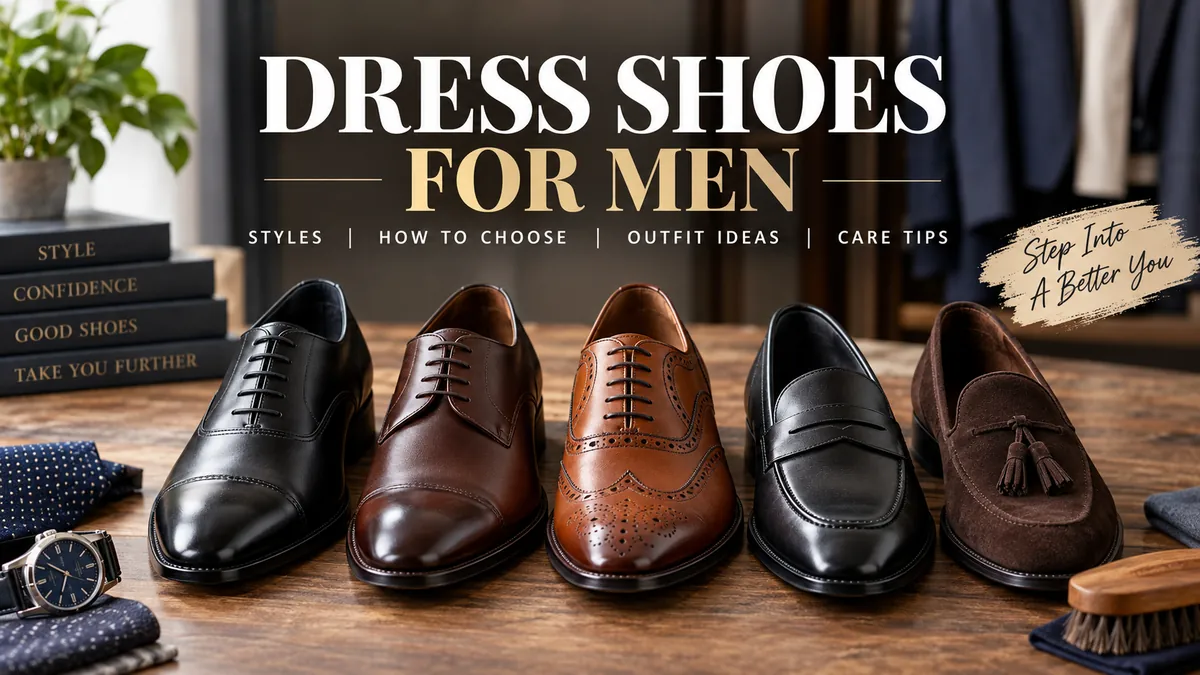
A good suit can look unfinished when the shoes underneath it are too casual, overly worn, or simply wrong for the occasion. The challenge is that formal footwear comes with its own vocabulary: Oxford, Derby, brogue, wingtip, loafer, monk strap, wholecut, welt and more.
Understanding dress shoes for men becomes much easier once you stop treating every name as a separate shoe. The most useful distinctions come from the closure system, shape, material, decoration, construction and level of formality.
Dress shoes for men are refined footwear designed primarily for formal, business and smart-casual clothing. The main styles are Oxfords, Derbies, loafers and monk straps, with dress boots and wholecuts providing additional options. Oxfords are generally the most formal, while Derbies and loafers offer greater flexibility for everyday dressing.
Once you can recognize those basic families, choosing shoes for a suit, wedding, interview, office or dinner becomes far more straightforward.
Types of Dress Shoes for Men
Most men’s formal footwear can be identified by looking first at how the shoe closes. Oxfords and Derbies use laces, monk straps use buckles, loafers slip on, while dress boots extend above the ankle.
One common source of confusion is the word brogue. Broguing describes decorative perforations rather than a specific closure system, so an Oxford or Derby can also be a brogue.
| Style | Defining Feature | General Formality | Common Uses |
|---|---|---|---|
| Oxford | Closed lacing | Very formal | Suits, business, formal weddings |
| Derby | Open lacing | Formal to smart-casual | Office, suits, tailored separates |
| Wholecut | Upper cut from a single main piece | Very formal | Formal tailoring, evening events |
| Monk strap | Buckle closure | Formal to semi-formal | Business, weddings, dinners |
| Loafer | Laceless slip-on | Semi-formal to smart-casual | Office, travel, summer tailoring |
| Dress boot | Ankle-height construction | Varies | Cold weather, business, smart-casual |
The material and details still matter. A sleek black leather Derby can appear considerably dressier than a chunky brown suede Derby with heavy broguing.
Oxford Shoes
An Oxford is defined by its closed lacing system. The eyelet facings are attached beneath the vamp, creating a neat, streamlined appearance when the shoe is tied.
That construction is why the Oxford traditionally sits toward the formal end of men’s footwear.
A plain or cap-toe black Oxford is particularly useful with dark business suits and conservative formal clothing. Dark brown versions provide more flexibility when the dress code is less strict.
Common variations include:
- Plain-toe Oxford
- Cap-toe Oxford
- Wholecut Oxford
- Wingtip Oxford
- Brogued Oxford
Decoration changes the character of the shoe. A clean cap toe generally looks more conservative than an elaborate wingtip covered in perforations.
Derby Shoes
At first glance, a Derby can look almost identical to an Oxford. Look at the laces and the difference becomes obvious.
A Derby uses open lacing, meaning the eyelet sections are attached on top of the vamp. The sides can spread apart more freely when the laces are loosened.
That construction gives the Derby two useful characteristics: a slightly more relaxed appearance and greater adjustability across the top of the foot.
For someone with a high instep or broader foot, that additional opening can make a Derby easier to fit than a tightly structured Oxford.
A simple dark leather Derby can work with business tailoring, while brown leather or suede versions transition naturally into chinos, flannel trousers and other smart-casual clothing.
Oxford vs Derby: What’s the Difference?
This is one of the easiest menswear distinctions to remember:
Oxford = closed lacing. Derby = open lacing.
The difference is structural, not simply decorative. Broguing, toe caps and different leather finishes can appear on either family.
If maximum formality is the goal, the Oxford normally has the advantage. If versatility, adjustability or accommodating a higher instep matters more, a Derby can be the better choice.
Loafers
Loafers remove laces completely. You simply slide your foot into the shoe.
Several classic versions exist:
Penny loafers feature a leather strap across the vamp, traditionally with a small cutout.
Tassel loafers use decorative tassels and usually have a slightly dressier personality.
Horsebit or bit loafers incorporate a metal detail across the vamp.
The exact level of formality depends heavily on design. A slim, dark leather loafer with a thin sole can look sophisticated with tailoring. A chunky suede loafer with a thick sole feels considerably more casual.
Loafers work particularly well with business-casual clothing, summer tailoring and relaxed suits. Contemporary business-casual footwear also commonly includes leather and suede loafers alongside Derbies and other less rigid styles.
Because there are no laces to tighten, fit becomes especially important. Excessive heel movement can quickly make an otherwise attractive loafer uncomfortable.
Monk Strap Shoes
A monk strap replaces traditional laces with one or more buckled straps.
There are two main versions.
A single monk uses one buckle and usually presents a cleaner silhouette. A double monk has two straps and produces a more noticeable visual statement.
Monk straps occupy an interesting middle ground. They are distinctive enough to stand apart from conventional lace-ups while remaining appropriate for many tailored outfits.
They can work with suits, dress trousers and smart-casual combinations, although a conservative black Oxford remains the safer option when the dress code is particularly strict.
Wholecut Shoes
A wholecut is distinguished by its exceptionally clean upper, traditionally formed from a single principal piece of leather rather than multiple panels stitched together.
The result is a minimalist silhouette with fewer visible seams.
Because there is little decoration to hide imperfections, wholecuts place considerable emphasis on leather quality, pattern cutting and finishing. Sleek black or dark brown versions can sit comfortably at the formal end of a wardrobe.
Brogues and Wingtips
Here’s an especially useful distinction:
A brogue is not necessarily a separate shoe family.
Broguing refers to decorative perforations punched into the leather. Those details can appear on Oxfords, Derbies and other shoe constructions.
Common levels include quarter brogues, semi-brogues and full brogues.
A wingtip usually has a decorative toe cap extending backward along the sides in a wing-like shape. Full brogues commonly use this design.
As decoration becomes more prominent, the shoe usually moves toward the less formal end of traditional menswear.
Quick Takeaway: Identify the shoe by its construction first and decoration second. Closed lacing suggests Oxford; open lacing suggests Derby. Broguing describes the perforated decoration that can be added to either.
How Formal Are Different Dress Shoes for Men?
Formality is not determined by the style name alone. Several elements work together:
Closure: Closed lacing generally looks more formal than open lacing or slip-on construction.
Color: Black traditionally sits above brown and burgundy for conservative formal dress.
Material: Smooth leather generally looks dressier than textured leather or suede.
Decoration: Plain designs tend to be more formal than heavily brogued ones.
Sole: Thin, refined soles generally look dressier than thick or aggressively lugged soles.
Toe shape: Balanced, elegant shapes work more naturally with formal tailoring than extremely chunky profiles.
A simplified spectrum looks like this:
| Shoe | Approximate Formality |
|---|---|
| Black wholecut/Oxford | Very high |
| Black cap-toe Oxford | Very high |
| Dark brown Oxford | High |
| Plain leather Derby | High to medium |
| Single monk strap | Medium-high |
| Double monk strap | Medium |
| Sleek leather loafer | Medium |
| Suede loafer | Smart-casual |
| Heavily brogued/chunky Derby | Smart-casual |
These are guidelines rather than mathematical rules. The complete shoe has to be considered.
How to Choose Dress Shoes for Different Occasions
The easiest approach is to match the shoe’s formality to the clothing and setting.
Dress Shoes for a Suit
For a traditional business suit, start with an Oxford or refined Derby.
A black cap-toe Oxford is among the safest choices with charcoal, navy and black tailoring. Dark brown provides a slightly softer appearance with navy and many shades of gray.
A clean Derby can also work very well with a suit, especially when the environment isn’t highly conservative.
Loafers become more appropriate as the tailoring itself becomes softer and less formal.
Dress Shoes for a Wedding
Wedding footwear depends on the dress code rather than the word “wedding.”
A formal evening wedding may call for highly polished black footwear. A daytime ceremony with lighter tailoring gives you much more freedom to wear brown Oxfords, Derbies, monk straps or refined loafers.
The groom should also think practically. Wedding shoes may stay on for many hours, so breaking in a new pair beforehand is far wiser than discovering a pressure point during the reception.
Dress Shoes for an Interview
Conservative usually wins.
A clean black or dark brown Oxford is difficult to get wrong in traditional professional settings. A restrained Derby is also appropriate in many workplaces.
The condition of the shoe matters as much as the style. Clean leather, intact heels and tidy laces communicate more than an expensive shoe that has been neglected.
Dress Shoes for Business Casual
Business casual offers considerably more flexibility.
Derbies and loafers are particularly useful because they bridge the space between formal tailoring and casual footwear. Recent business-casual guidance continues to emphasize leather and suede shoes, with brown being especially adaptable across office wardrobes.
Try combinations such as dark brown Derbies with gray trousers, penny loafers with chinos, or suede loafers with lightweight summer trousers.
Black vs Brown Dress Shoes
Color can change the formality of exactly the same shoe.
Black Dress Shoes
Black is traditionally the most formal and conservative option.
It pairs naturally with:
- Black
- Charcoal
- Dark gray
- Navy
For formal business clothing, funerals and dressier evening events, black remains a reliable choice.
Brown Dress Shoes
Brown covers a much wider visual range.
Dark brown can still appear polished and professional, while medium and lighter browns move progressively toward relaxed dressing.
Brown works particularly well with navy, blue, gray, beige, tan and many earth tones.
If your wardrobe is mainly business casual rather than strictly formal, a dark brown Derby can be remarkably versatile.
Burgundy and Oxblood
Burgundy or oxblood provides an alternative when black feels too severe and ordinary brown feels predictable.
These deeper red-brown shades work particularly well with navy, charcoal and medium-gray trousers. They attract more attention, though, so they may not be the first choice for the most conservative dress codes.
What Makes a Quality Men’s Dress Shoe?
Style tells you what a shoe looks like. Construction tells you much more about how it may perform over time.
Leather Quality
Calfskin is widely used for quality formal footwear because it can combine softness, durability and a fine surface.
You may also encounter labels such as full-grain and top-grain leather.
Full-grain leather retains the natural outer surface rather than having it heavily corrected. Quality examples can develop a distinctive patina as they age. Current dress-shoe buying guides commonly identify full-grain leather as a desirable material for longevity.
That said, terminology alone doesn’t guarantee quality. Examine the leather itself. Look for consistent finishing, sensible thickness, clean creasing and careful stitching.
Goodyear Welt Construction
A Goodyear welt is a traditional construction method in which a welt helps connect the upper, insole structure and outsole.
Its major practical advantage is repairability. Properly made welted shoes can often be resoled rather than discarded after the outsole wears down.
That can make a well-built shoe economical over a long period despite a higher initial cost.
Blake Stitch Construction
Blake construction stitches the outsole more directly to the upper/insole structure.
This can create a lighter, more flexible shoe with a sleek profile. The trade-off is that resoling requirements differ from those of a Goodyear-welted shoe and may require appropriate equipment and expertise.
Neither method automatically makes a shoe good. Material quality, last design, workmanship and finishing still matter.
Cemented Construction
Cemented shoes generally rely on adhesive to attach the sole.
This method allows manufacturers to make lightweight and relatively affordable footwear, but inexpensive cemented shoes can be less practical to rebuild repeatedly than traditionally welted footwear.
For occasional use, that may be perfectly acceptable. For a shoe intended to remain in rotation for years, repairability deserves more attention.
How Should Dress Shoes for Men Fit?
A beautiful shoe that hurts your feet is a bad shoe for you.
Proper fit should feel secure without creating painful pressure.
Pay particular attention to four areas:
| Area | What You Want |
|---|---|
| Toes | Enough room to sit naturally |
| Heel | Secure with minimal excessive slipping |
| Instep | Firm contact without painful pressure |
| Width | Supported without squeezing the sides |
Do not assume painful shoes simply need to be “broken in.”
Leather can soften and conform somewhat with wear, but a shoe that is fundamentally too short or too narrow will not magically become the correct size.
Do Dress Shoes Run Smaller?
There is no universal answer.
Sizing can vary between manufacturers, and even two shoes from the same brand can fit differently when built on different lasts.
The last is the three-dimensional form around which the shoe is shaped. It influences toe room, heel width, instep volume and the overall silhouette.
That is why knowing your usual numerical size is only the beginning.
What About Wide Feet?
A Derby is worth considering because its open-lacing construction allows more adjustment across the instep and is frequently recommended for wider or higher-volume feet.
But construction does not replace correct width sizing.
If a manufacturer offers dedicated wide widths, choose the width that actually matches your foot instead of sizing up excessively in length.
Quick Takeaway: Dress shoes should feel secure from the beginning. Minor stiffness can improve; incorrect length, severe squeezing and painful pressure usually will not.
Toe Shapes and Details That Change the Look
The front of the shoe has a surprisingly large effect on its personality.
Plain Toe
A plain toe has minimal decoration. Its simplicity allows the leather and overall shape to dominate.
Cap Toe
A cap toe adds a horizontal seam across the front.
The black cap-toe Oxford has become a classic choice for conservative business and formal clothing because it adds subtle structure without excessive ornamentation.
Wingtip
A wingtip extends decorative lines backward from the toe in a wing-like pattern.
It is usually more noticeable and therefore generally less conservative than a simple cap toe.
Square, Round or Pointed?
Extremes tend to date faster.
A moderately rounded or gently almond-shaped toe usually provides the greatest longevity because it works with changing trouser silhouettes without drawing unnecessary attention.
Very elongated pointed toes can look exaggerated, while extremely broad square toes can make formal footwear appear heavy.
Leather Soles vs Rubber Soles
Neither material is universally superior.
Leather soles provide a traditional appearance and can create a sleek profile. They are particularly appropriate for refined formal footwear.
Rubber soles generally provide better grip and weather resistance, making them useful for frequent walking or wet conditions.
Modern dress shoes can also combine the two approaches through discreet rubber sections or thin rubber outsoles.
Choose according to where the shoe will actually be worn rather than assuming the most traditional option is automatically the most practical.
How to Build a Useful Dress Shoe Rotation
You don’t need a closet full of formal footwear.
For many men, three carefully selected pairs cover most situations.
First Pair: Black Cap-Toe Oxford
This handles the most conservative requirements: interviews, formal business clothing, ceremonies and dressier events.
Its advantage is not excitement. It is reliability.
Second Pair: Dark Brown Derby
This is the flexible workhorse.
Wear it with navy and gray suits, tailored trousers and many business-casual combinations. The open-lacing design also makes it adaptable for different foot shapes.
Third Pair: Loafer
A dark brown or burgundy penny loafer expands the wardrobe into relaxed tailoring, dinners, travel and warm-weather business casual.
After those foundations are covered, monk straps, suede, brogues, wholecuts and dress boots become useful additions based on personal style.
How to Care for Leather Dress Shoes
Even excellent leather deteriorates quickly when repeatedly worn wet, left dirty or stored badly.
A straightforward maintenance routine makes a substantial difference.
1. Brush Away Surface Dirt
Use a soft horsehair brush to remove dust before applying products.
Dirt left on leather can become abrasive, particularly around creases.
2. Condition When the Leather Needs It
Leather gradually loses oils.
A suitable leather conditioner can help maintain flexibility, but more product is not necessarily better. Over-conditioning can leave leather overly soft or greasy.
3. Apply Shoe Cream
Cream polish can restore color while providing a subtle shine.
Choose a shade close to the shoe or use neutral cream when appropriate.
4. Use Wax Selectively
Wax polish creates a stronger shine and adds some surface protection.
Use thin layers, particularly around the toe and heel. Heavy wax buildup over flex points can crack.
5. Use Shoe Trees
Wooden shoe trees help shoes maintain their shape between wears and can assist with moisture management.
Insert them after wearing, when the shoes are still warm.
6. Rotate Your Shoes
Avoid wearing the same leather pair every day when possible.
Giving footwear time to dry between wears helps manage perspiration and allows the leather to recover.
7. Deal With Wet Shoes Carefully
If shoes become soaked, let them dry gradually at room temperature.
Avoid placing quality leather directly against a heater or other intense heat source, which can dry and damage it.
Common Mistakes With Men’s Dress Shoes
One of the biggest mistakes is assuming expensive automatically means appropriate. A beautifully made loafer can still be wrong for an extremely conservative formal event.
Another is confusing broguing with construction. Remember that an Oxford can be brogued and a Derby can be brogued; the perforations do not determine the underlying family.
Poor fit is another expensive mistake. Don’t buy an uncomfortable pair because you expect dramatic stretching.
Color matching can also become unnecessarily complicated. Shoes do not have to perfectly match every leather accessory. Keeping them within a coherent family is usually enough.
Finally, don’t neglect maintenance. Scuffed, dusty footwear can undermine otherwise excellent tailoring.
Are Expensive Dress Shoes Worth It?
Sometimes—but price by itself proves very little.
A higher price makes more sense when it pays for better leather, careful lasting, reliable stitching, comfortable components and a construction that allows future repair.
Think in terms of cost per wear.
Suppose one pair costs twice as much but remains comfortable, repairable and regularly worn for many years. It may ultimately represent better value than repeatedly replacing cheaper shoes that deteriorate quickly.
On the other hand, someone who wears formal footwear twice a year may reasonably prioritize comfort and appearance over expensive traditional construction.
Quality should fit your actual use.
Can Dress Shoes Be Comfortable?
Yes. Formal appearance and comfort are not opposites.
Comfort depends heavily on choosing the right last, width, instep volume and size. Cushioning helps, but it cannot compensate for a fundamentally incorrect fit.
People who stand or walk extensively should also consider outsole grip, flexibility, heel stability and underfoot support rather than judging a shoe solely by how sleek it looks.
A well-fitted Derby may be more comfortable for one foot shape, while another person may find a properly sized Oxford perfectly comfortable all day.
Can You Wear Dress Shoes With Jeans?
Some dress shoes work with jeans; others create too much contrast.
A highly polished black wholecut Oxford with faded casual denim usually feels mismatched because the shoe is considerably more formal than the trousers.
Better options include:
- Brown Derbies
- Brogued Derbies
- Penny loafers
- Suede loafers
- Dress boots
Dark, clean denim works better than distressed jeans.
The principle is simple: keep the level of formality reasonably consistent from top to bottom.
How Many Pairs of Dress Shoes Does a Man Need?
There is no required number.
Someone who wears suits every day will benefit from a larger rotation. Someone working in a casual environment may need only one or two pairs for occasional formal events.
A practical minimum is often a conservative formal pair plus a versatile brown pair.
From there, add shoes to solve actual wardrobe needs rather than collecting near-identical styles.
Final Thoughts on Dress Shoes for Men
Understanding dress shoes for men comes down to a handful of distinctions rather than dozens of complicated rules.
Start with construction. Oxfords use closed lacing and generally occupy the formal end of the spectrum; Derbies use open lacing and provide greater versatility; loafers offer slip-on convenience and a more relaxed character; monk straps replace laces with buckles. Broguing is decoration, while color, leather, sole and toe shape further influence formality.
Then focus on what matters after appearance: correct fit, appropriate materials, sensible construction and proper care.
For a simple wardrobe, begin with a black cap-toe Oxford for formal occasions and a dark brown Derby for versatility. Add loafers, monk straps, brogues or dress boots only when your lifestyle gives you a reason to wear them.
The best dress shoe isn’t necessarily the most expensive or most formal one. It’s the pair that fits properly, suits the occasion and earns its place in your regular rotation.