
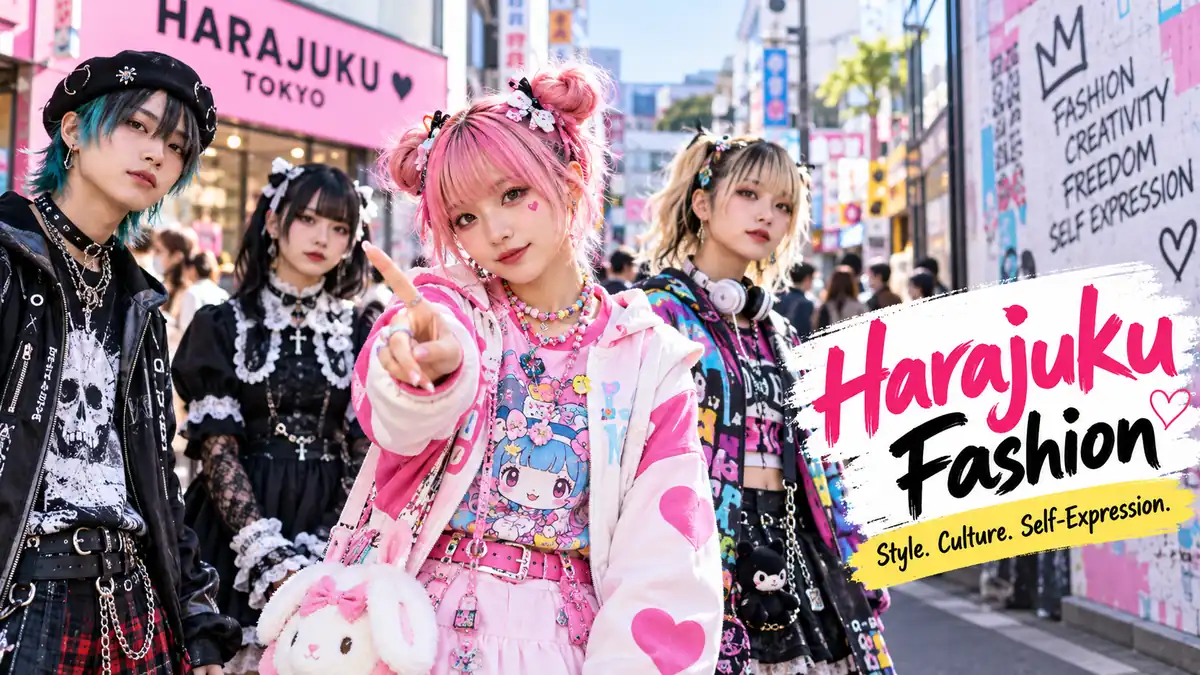
Harajuku has never been about following one fashion rule. That is precisely why it became one of the most recognizable street-style districts in the world.
Walk through the streets around Harajuku Station in Tokyo and you can encounter pastel accessories, dramatic Gothic silhouettes, vintage sportswear, handmade jewelry, platform shoes, punk details, designer pieces, and outfits that seem impossible to place inside any conventional fashion category.
harajuku fashion is the collective name for the diverse street styles and youth subcultures associated with Tokyo’s Harajuku district. Rather than describing one specific look, it represents creative self-expression through styles such as Lolita, Decora, Fairy Kei, Gothic fashion, punk, Visual Kei-inspired clothing, vintage mixing, and Japanese streetwear.
The important part is that Harajuku is a place first and a fashion label second. Different movements developed there at different times, sometimes overlapping and sometimes rejecting one another completely.
That distinction explains why two people can look nothing alike and still both represent Harajuku style.
What Is harajuku fashion?
harajuku fashion refers to the experimental streetwear and alternative fashion cultures that developed around Harajuku, a neighborhood in Shibuya, Tokyo.
It is less a uniform aesthetic than a creative ecosystem.
Some Harajuku looks are intensely colorful. Others are almost entirely black. One outfit might reference Victorian clothing, while another combines cartoon accessories, vintage denim, sneakers, handmade jewelry, and a designer bag.
What connects them is an emphasis on personal styling.
Common characteristics include:
- Layering different garments and textures
- Mixing secondhand, designer, handmade, and inexpensive pieces
- Using accessories as major visual elements
- Combining influences from different decades
- Experimenting with hair, makeup, and footwear
- Rejecting conventional ideas about what “matches”
- Using clothing to communicate membership in a subculture or personal identity
Tokyo’s official tourism guide describes Harajuku styles as ranging from cute and casual to highly extreme, including Lolita, Goth, Decora, and cosplay-influenced looks.
That variety matters because the phrase “Harajuku style” is often misunderstood outside Japan.
There is no single Harajuku uniform.
The History of harajuku fashion
Harajuku’s fashion identity developed gradually over several decades.
Understanding that history makes the unusual combinations seen today much easier to understand.
1960s: Harajuku becomes a youth destination
Harajuku’s transformation was influenced partly by its proximity to Washington Heights, a former U.S. military housing complex.
The area was also near venues connected with the 1964 Tokyo Olympics, exposing young Japanese visitors to international visitors, products, music, and culture.
By the mid-1960s, boutiques, cafés, and accessory shops were appearing around the neighborhood. Mademoiselle Nonnon, one of the area’s early major boutiques, opened in 1966.
Harajuku increasingly became somewhere young people went not simply to shop, but to be seen.
1970s: fashion culture takes shape
Youth-oriented fashion magazines helped give Harajuku national visibility.
Magazines such as AnAn and non-no encouraged fashion-conscious young people to explore the neighborhood, while boutiques multiplied.
One of the most important developments came in 1978 with the opening of Laforet Harajuku.
Located near the intersection of Meiji-dori and Omotesando, Laforet became closely associated with experimental youth fashion and remains one of Harajuku’s major fashion landmarks. Tokyo’s official tourism organization describes it as a trendsetting center containing more than 120 shops.
1980s: street performance and youth tribes
During the 1980s, Harajuku became closely associated with youth groups gathering around pedestrianized areas.
One famous movement was the Takenoko-zoku, groups of young dancers who performed in highly visible outfits around the area’s pedestrian zones.
Their clothes were loose, theatrical, colorful, and designed for movement.
The era helped establish a pattern that would define Harajuku culture for decades: young people using public space as both a social gathering point and an informal fashion stage.
1990s: subcultures multiply
Harajuku became internationally significant during the 1990s.
Different scenes developed simultaneously.
Lolita expanded. Punk and Gothic styles grew. Decora began emerging. Streetwear entrepreneurs transformed the backstreets of the neighborhood.
The area known as Ura-Harajuku, or “back Harajuku,” became particularly important for Japanese streetwear.
Designers and entrepreneurs such as NIGO, founder of A Bathing Ape (BAPE), helped establish a distinct Japanese streetwear identity in the neighborhood.
Harajuku was no longer producing only “cute Japanese fashion.”
It was producing multiple fashion languages at once.
FRUiTS changes how the world sees Harajuku
One publication became especially important.
In 1997, photographer Shoichi Aoki launched FRUiTS, a street-fashion magazine dedicated to documenting young people and their outfits.
Aoki photographed individuals rather than conventional professional fashion shoots. Readers saw real combinations of clothing, accessories, brands, hairstyles, and handmade pieces worn on Tokyo streets.
FRUiTS became one of the primary visual records of late-1990s and early-2000s Harajuku culture and helped introduce the scene to international audiences.
Its photographs demonstrated something important:
The creativity came from the wearer.
People were not simply reproducing outfits displayed by fashion houses. They were constructing identities from whatever pieces they could find.
Major Types of harajuku fashion
There is no definitive list because Harajuku culture constantly changes.
Still, several movements have become particularly closely associated with the neighborhood.
| Style | Key Characteristics | Typical Visual Elements |
|---|---|---|
| Lolita | Romantic, structured, historically inspired | Petticoats, lace, bows, dresses |
| Decora | Maximalist and colorful | Hair clips, badges, toys, bright jewelry |
| Fairy Kei | Pastel and nostalgic | Lavender, pink, toys, 1980s imagery |
| Gothic | Dark and dramatic | Black clothing, crosses, platforms |
| Visual Kei-inspired | Theatrical and music-influenced | Dramatic hair, makeup, layered clothing |
| Punk | Rebellious and DIY | Plaid, leather, safety pins, boots |
| Ura-Harajuku streetwear | Casual, graphic and brand-driven | Sneakers, hoodies, graphic tees |
| Vintage mixing | Eclectic and individual | Secondhand clothing from multiple eras |
These categories should be treated as reference points rather than rigid rules.
Many outfits combine several of them.
Lolita Fashion
Lolita is one of the Japanese fashion movements most strongly associated internationally with Harajuku.
Its visual language draws heavily from European historical clothing, particularly Victorian and Rococo-inspired silhouettes.
Typical elements include:
- Knee-length dresses or skirts
- Petticoats creating a bell or A-line silhouette
- Lace
- Blouses
- Headbows or bonnets
- Knee socks or tights
- Mary Jane-style shoes
- Structured handbags
Despite the name, Japanese Lolita fashion is not intended to be sexual. The style centers much more on elegance, detail, modest silhouettes, and carefully coordinated clothing.
Several major branches developed.
Sweet Lolita
Sweet Lolita uses lighter colors and playful imagery.
Common motifs include:
- Cakes
- Strawberries
- Animals
- Hearts
- Candy
- Toys
- Fairy-tale imagery
Pink is strongly associated with the style, although lavender, mint, blue, cream, and other pastel shades are also common.
Gothic Lolita
Gothic Lolita retains the structured silhouette of Lolita while incorporating darker visual language.
Expect:
- Black
- Burgundy
- Dark blue
- Cross motifs
- Religious or architectural imagery
- Dark lace
- Dramatic accessories
Classic Lolita
Classic Lolita usually appears more restrained.
Floral prints, antique colors, longer skirts, muted tones, and historically inspired accessories are common.
The difference between these styles shows why “Harajuku fashion” cannot be reduced to colorful clothing.
Some of its most recognizable movements can be elegant, dark, or highly disciplined.
Decora: Harajuku Maximalism
If minimalism says remove one accessory before leaving the house, Decora suggests adding several more.
The term comes from “decoration.”
The clothing itself may be relatively straightforward. The visual impact usually comes from accessories layered across the head, body, wrists, bags, and shoes.
Decora commonly includes:
- Colorful plastic hair clips
- Beaded bracelets
- Character merchandise
- Badges
- Toy accessories
- Bright socks
- Layered necklaces
- Stickers or decorative face details
- Colorful bags
The style became especially visible during the late 1990s and 2000s and was extensively documented by FRUiTS.
A common beginner mistake is thinking Decora simply means putting on random colorful objects.
Strong Decora coordinates usually still contain visual repetition.
A person might repeat pink throughout their hair clips, socks, bracelets, bag, and makeup. Another might build the entire outfit around rainbow colors or one character franchise.
The look appears chaotic from a distance, but successful styling often contains considerable structure.
Fairy Kei and Pastel Harajuku Style
Fairy Kei developed around dreamy pastel colors and nostalgic imagery.
The style frequently references Western children’s culture and pop imagery from the 1980s and early 1990s.
Common colors include:
- Lavender
- Baby pink
- Mint
- Pale blue
- Soft yellow
Typical imagery might include toys, stars, ponies, hearts, clouds, cartoon characters, and retro children’s graphics.
Silhouettes tend to be softer than Decora.
You might see:
- Oversized pastel sweaters
- Tulle skirts
- Leg warmers
- Sneakers
- Plastic jewelry
- Character bags
- Vintage children’s accessories
Fairy Kei demonstrates another important feature of Harajuku culture: nostalgia can be treated as raw design material.
Gothic Harajuku Fashion
Harajuku Gothic fashion sits almost at the opposite end of the visual spectrum from Fairy Kei.
Black often dominates.
Key elements can include:
- Layered black clothing
- Platform boots
- Leather
- Chains
- Piercings
- Silver jewelry
- Religious imagery
- Dramatic eye makeup
- Structured coats
- Punk-inspired accessories
Gothic looks sometimes overlap with Gothic Lolita, punk, Visual Kei, and other alternative Japanese scenes.
They are related but not identical.
Someone wearing black platform boots and layered distressed clothing should not automatically be labeled a Gothic Lolita, because Lolita fashion has much more specific silhouette conventions.
Knowing those distinctions prevents Harajuku culture from becoming one vague category of “Japanese alternative fashion.”
Visual Kei and Fashion
Visual Kei originated primarily as a Japanese music movement rather than as a Harajuku fashion category.
Bands used dramatic clothing, makeup, hairstyles, theatrical performance, and often androgynous presentation as major parts of their visual identities.
Fans adopted and adapted parts of those looks.
Typical fashion influences include:
- Elaborate hairstyles
- Heavy eye makeup
- Black clothing
- Ruffles
- Corset-like garments
- Leather
- Platforms
- Metallic accessories
- Historical or Gothic references
Some Visual Kei-inspired looks appeared around Harajuku, but it is more accurate to describe Visual Kei as a music-centered cultural movement whose visual language interacted with Japanese street fashion.
That difference is often lost in simplified explanations of Harajuku style.
Punk and DIY Fashion
Punk found fertile ground in Harajuku because the neighborhood already rewarded customization.
Japanese punk styling can incorporate familiar international punk elements:
- Plaid
- Safety pins
- Studs
- Leather
- Distressed denim
- Band shirts
- Boots
- Chains
But Harajuku styling often combines those pieces with Japanese brands, vintage clothing, handmade modifications, theatrical makeup, or unrelated fashion influences.
The result might contain British punk references without attempting to reproduce 1970s London exactly.
That process—absorbing an outside influence and rebuilding it locally—is central to Japanese street fashion.
Ura-Harajuku and Japanese Streetwear
Another side of Harajuku looks very different from Decora or Lolita.
During the 1990s, the backstreets of Harajuku became an important center for Japanese streetwear.
This area became known as Ura-Harajuku.
Brands associated with this broader movement helped establish Japan as a major force in global streetwear.
BAPE, founded by NIGO, became particularly influential.
Other designers, boutiques, sneaker culture, music scenes, and limited-edition product releases helped build an environment where graphic T-shirts, hoodies, sneakers, workwear, skate influences, military references, and American vintage clothing could be radically reinterpreted.
Japan’s tourism authority continues to identify Ura-Harajuku and Cat Street as two of Harajuku’s major shopping areas alongside Takeshita-dori.
This matters because international coverage sometimes treats Harajuku exclusively as kawaii fashion.
Streetwear is equally important to its history.
What Does Kawaii Mean in Harajuku Fashion?
Kawaii generally translates to “cute,” but its cultural role is broader than simply describing something attractive.
In clothing, kawaii aesthetics can involve:
- Childlike motifs
- Pastel colors
- Cartoon characters
- Bows
- Plush toys
- Rounded shapes
- Decorative accessories
- Playful proportions
Harajuku played a major role in making kawaii fashion internationally visible.
But not every Harajuku outfit is kawaii.
That is one of the most common misconceptions about the area.
Gothic fashion, punk, Ura-Harajuku streetwear, Visual Kei-inspired clothing, and many contemporary experimental looks may contain little conventional cuteness at all.
“Kawaii” is therefore one important branch of Harajuku culture, not a synonym for the entire scene.
Harajuku Fashion vs. Cosplay
They sometimes overlap visually, but they are not the same thing.
Cosplay generally involves dressing as a particular fictional character or deliberately reproducing a recognizable character design.
Harajuku fashion usually involves creating an individual outfit rather than impersonating a specific character.
For example:
Someone wearing pastel platform shoes, a vintage cardigan, plush accessories, and rainbow hair could be wearing Harajuku street fashion.
Someone intentionally recreating a particular anime character’s costume would normally be cosplaying.
Harajuku visitors may encounter both, which is probably why the two are frequently confused.
Why Is Takeshita Street Famous for Fashion?
Takeshita Street, or Takeshita-dori, begins near Harajuku Station and has become the neighborhood’s best-known pedestrian shopping street.
Its concentration of clothing shops, accessory stores, inexpensive fashion, food stands, character products, and youth-oriented businesses makes it a natural first stop for visitors.
Japan’s National Tourism Organization calls Takeshita Street Harajuku’s main artery and highlights its concentration of colorful shops, accessories, clothing, and youth trends.
Historically, it played a genuine role in youth fashion.
Today, however, visitors should avoid assuming that everything important in Harajuku exists on Takeshita Street.
The wider neighborhood tells a richer story.
The Fashion Geography of Harajuku
Different parts of Harajuku tend to present different sides of the area’s fashion culture.
Takeshita Street
Best known for:
- Teen-oriented fashion
- Accessories
- Kawaii products
- Trend-driven clothing
- Character goods
- Lolita-related shops
- Affordable fashion
The street can become extremely crowded, particularly on weekends.
Laforet Harajuku
Laforet remains one of the neighborhood’s most important fashion buildings.
It houses both established and smaller labels and has long provided retail space for experimental Japanese fashion.
For anyone trying to understand how subculture clothing becomes a retail ecosystem, Laforet is particularly useful.
Cat Street
Cat Street runs through the broader Harajuku–Shibuya area and leans more toward:
- Streetwear
- Sneakers
- Vintage clothing
- Contemporary casual fashion
- Independent boutiques
The mood generally feels different from Takeshita Street.
Ura-Harajuku
The Harajuku backstreets have deep connections with independent designers and Japanese streetwear.
Smaller stores and quieter streets historically provided space for labels that later became internationally influential.
Omotesando
Omotesando presents Harajuku’s polished side.
International luxury houses, architecture, designer stores, and upscale fashion dominate much of the avenue.
The contrast is striking.
Within a relatively small area, inexpensive accessories, experimental subculture boutiques, Japanese streetwear, vintage stores, and global luxury flagships can coexist.
That proximity encourages stylistic mixing.
How harajuku fashion Outfits Are Actually Built
The easiest way to understand Harajuku styling is to stop thinking of it as a costume.
Most strong outfits have an internal logic.
1. Start with a visual idea
The idea might be:
- Pastel nostalgia
- Gothic romance
- Punk layering
- Vintage sportswear
- One character
- One color
- Oversized proportions
- Victorian-inspired clothing
- 1990s streetwear
Having a direction prevents an outfit from becoming meaningless visual noise.
2. Choose a base silhouette
Silhouette matters more than most beginners realize.
A Lolita coordinate might depend on a bell-shaped skirt.
A streetwear outfit may use oversized trousers and a fitted top.
A Gothic look may rely on long vertical layers.
A Decora outfit can use fairly simple base clothing because the accessories provide the complexity.
3. Repeat elements
Repetition creates cohesion.
Repeat:
- Colors
- Shapes
- Motifs
- Materials
- Characters
- Metal finishes
If a red accessory appears only once, it can feel accidental.
If red appears in the socks, hair clips, print, and bag, it becomes intentional.
4. Layer deliberately
Harajuku styling often looks spontaneous, but layering works best when different garments remain visually readable.
Try combinations such as:
- T-shirt
- Overshirt or cardigan
- Jacket
- Neck accessories
- Bag or charms
- Distinctive footwear
Not every style requires this much layering, but the principle is useful.
5. Treat accessories as clothing
In mainstream fashion, accessories often finish an outfit.
In Harajuku fashion, they may define it.
Hair clips, bracelets, glasses, bags, belts, leg warmers, chains, badges, necklaces, hats, plush toys, and customized objects can become central design elements.
Do You Need Japanese Brands to Wear Harajuku Fashion?
No.
Historically, one of the scene’s most important characteristics has been mixing sources.
A single outfit might contain:
- Vintage clothing
- A Japanese designer piece
- Cheap accessories
- Handmade jewelry
- Customized garments
- Thrifted items
- Character merchandise
- Imported clothing
The styling matters more than whether every label came from Tokyo.
Trying to copy a photographed outfit item-for-item can actually miss the spirit of Harajuku.
Personal interpretation is closer to the tradition.
How to Try Harajuku Fashion Without Looking Like a Costume
The simplest approach is to begin with one subculture or visual principle.
Do not start by wearing every recognizable Harajuku cliché simultaneously.
Instead, choose one direction.
For example:
Beginner Decora
Use a colorful top, simple skirt or trousers, several bracelets, bright socks, and clustered hair clips.
Increase the accessory density gradually.
Beginner Gothic
Build around black clothing, strong footwear, layered silver jewelry, and one dramatic texture such as lace or leather.
Beginner Fairy Kei
Choose a pastel sweater, light skirt or loose trousers, retro accessories, and one nostalgic character item.
Beginner streetwear
Combine relaxed trousers, sneakers, a graphic top, vintage outerwear, and one unusual accessory.
The goal is not to appear “Japanese.”
The goal is to understand the styling vocabulary and adapt it creatively.
Common Harajuku Fashion Mistakes
Several misunderstandings appear repeatedly outside Japan.
Treating Harajuku as one style
This is the biggest one.
Harajuku contains competing subcultures and aesthetics. Decora and Ura-Harajuku streetwear have very little visually in common.
Calling every colorful outfit Decora
Color alone does not make an outfit Decora.
Accessory layering is central to the style.
Calling every dark dress Gothic Lolita
Gothic Lolita has specific silhouettes and construction conventions inherited from Lolita fashion.
A black alternative outfit is not automatically Lolita.
Confusing anime clothing with street fashion
Anime can influence Japanese fashion, but Harajuku culture cannot be reduced to anime fandom.
Music, historical clothing, punk, Western vintage, club culture, youth magazines, streetwear, designers, character culture, and many other sources have shaped it.
Copying stereotypes instead of studying real outfits
Actual Harajuku street style is much more varied than the exaggerated “Harajuku girl” stereotype often presented by overseas media.
Historic FRUiTS photography is particularly useful because it documents what real people actually wore.
The Role of FRUiTS and Shoichi Aoki
It is difficult to explain international awareness of Harajuku without returning to Shoichi Aoki.
His photographs preserved thousands of individual style decisions that otherwise might have disappeared.
FRUiTS launched in 1997 specifically in response to the creative youth fashion Aoki observed in Harajuku.
Instead of smoothing everyone into one trend, the photography highlighted individual combinations.
That documentation became especially important because street fashion is temporary by nature.
Stores close.
Friend groups change.
Subcultures shrink.
Trends move online.
But photographs allow researchers and fashion fans to examine exactly what people were wearing during a particular period.
For anyone interested in authentic late-1990s or early-2000s Harajuku style, FRUiTS remains one of the most valuable visual archives.
Is harajuku fashion Still Popular?
Yes, although the scene has changed significantly from its internationally famous late-1990s and early-2000s image.
Official Tokyo tourism material acknowledges that Harajuku’s most extreme street-fashion heyday may have passed while emphasizing that dedicated fashion communities remain active.
The transformation makes sense.
Fashion culture no longer depends entirely on physical gathering places.
Instagram, TikTok, online shops, resale platforms, global fandom communities, and other digital spaces allow niche styles to spread without everyone meeting on the same street.
At the same time, current Harajuku styling frequently mixes categories that once seemed more distinct.
A person might combine:
- Y2K pieces
- Vintage clothing
- Gyaru references
- Streetwear
- Goth accessories
- Designer footwear
- Handmade jewelry
Recent street-fashion coverage still shows Decora, Lolita, colorful experimental clothing, dark alternative looks, and heavily customized outfits appearing around the neighborhood.
The culture has evolved rather than disappeared.
Harajuku Fashion in the 2000s vs. Today
The distinction is useful because many international images of Harajuku still come from the early 2000s.
| Early-2000s Harajuku | Contemporary Harajuku |
|---|---|
| Stronger visible subculture identities | More cross-style mixing |
| Street magazines were major tastemakers | Social media plays a major role |
| Street gatherings shaped visibility | Online communities shape visibility |
| Decora and Lolita gained global attention | Y2K, vintage and hybrid styling are common |
| Street photography documented trends | Individuals publish their own looks instantly |
| Local scenes spread internationally later | Trends circulate globally almost immediately |
Neither era is more “authentic.”
They simply developed under different cultural and technological conditions.
Where Does Gyaru Fit?
Gyaru is frequently placed inside broad English-language discussions of Harajuku, although its history is not confined to Harajuku.
The fashion developed around youth culture, nightlife, magazines, beauty trends, and districts including Shibuya.
Classic Gyaru styling could involve:
- Dyed hair
- Dramatic eye makeup
- Tanned skin in some substyles
- Platform footwear
- Fashion-forward clothing
- Nail art
- Branded accessories
Numerous Gyaru branches developed over time.
Contemporary revivals often borrow visual elements from 1990s and 2000s Gyaru without recreating the entire lifestyle or subculture.
This is another reason to be careful with labels.
Tokyo youth cultures interacted continuously; they were never perfectly sealed off from one another.
Why Vintage Clothing Matters
Secondhand fashion is one of the quieter foundations of Harajuku creativity.
Vintage stores allow wearers to access silhouettes, prints, labels, and materials that are no longer available through ordinary retail.
This encourages combinations such as:
- 1980s sweater + modern platform shoes
- Vintage military jacket + designer bag
- Old sports jersey + handmade jewelry
- Antique-inspired blouse + contemporary skirt
- Retro children’s accessory + modern streetwear
Vintage clothing also makes exact repetition difficult.
If everyone owns different secondhand pieces, everyone has to style differently.
That helps preserve individuality.
Harajuku Fashion and Gender
Harajuku fashion has long provided space for experimenting with gender presentation.
Some subcultures use highly feminine historical silhouettes.
Others embrace androgyny.
Streetwear often favors oversized, gender-neutral garments.
Visual Kei has a long history of theatrical presentation that can blur conventional masculine and feminine visual codes.
The broader Harajuku environment therefore encourages clothing to function as creative expression rather than simply as a marker of conventional gender expectations.
That does not mean every participant approaches fashion in the same way.
It means the scene has historically tolerated a wider range of visual experimentation than many mainstream environments.
How Global Fashion Borrowed from Harajuku
Harajuku’s influence spread internationally through multiple routes.
Street-fashion magazines were one.
Music was another.
Japanese brands expanded overseas.
Online communities circulated street photographs.
Celebrities and designers referenced Japanese youth style.
Japan’s national tourism organization notes that Harajuku has attracted international attention from fashion figures including Lady Gaga.
Elements that became increasingly familiar worldwide include:
- Platform footwear
- Layered accessories
- Cute character styling
- Oversized streetwear
- Japanese graphic design
- Gender-fluid silhouettes
- Kawaii imagery
- Gothic-Lolita references
- Bag charms
- Customized sneakers
- Vintage-and-designer mixing
What once looked radically unusual to international audiences has gradually entered mainstream fashion vocabulary.
Is Harajuku Fashion Expensive?
It can be, but it does not have to be.
Some subcultures rely heavily on specialist garments that can be expensive.
A complete Lolita coordinate from established labels, for example, can involve a dress, blouse, petticoat, headwear, socks, shoes, jewelry, and bag.
Designer streetwear can also become costly.
But historically, Harajuku creativity has never depended exclusively on expensive clothing.
Thrifted pieces, handmade accessories, inexpensive jewelry, customized garments, and unconventional combinations are equally important parts of the scene.
A strong outfit made from secondhand clothing can express the culture better than an expensive outfit copied directly from a mannequin.
Harajuku’s Most Important Fashion Locations
Anyone studying the culture should remember these names:
Harajuku Station — the main transport gateway into the district.
Takeshita-dori — famous pedestrian street associated with youth trends, accessories, fashion, and food.
Laforet Harajuku — long-standing fashion building associated with youth and alternative labels.
Omotesando — major avenue known for designer stores and luxury fashion.
Cat Street — streetwear, vintage, sneakers, and contemporary fashion.
Ura-Harajuku — backstreets historically associated with independent labels and Japanese streetwear.
Yoyogi Park area — historically connected with youth gatherings and street performance.
Together, these spaces show that Harajuku is not merely one shopping street.
It is a network of overlapping fashion environments.
What Makes Harajuku Fashion Different from Ordinary Trends?
Most mainstream trends work through imitation.
A silhouette becomes popular. Brands reproduce it. Consumers adopt it. Eventually another trend replaces it.
Harajuku’s strongest tradition works differently.
It encourages interpretation.
The question becomes less:
“What should I wear this season?”
and more:
“What can I make these clothes say?”
That shift changes everything.
A belt can become decoration rather than merely functional.
A toy can become jewelry.
A children’s bag can become part of an adult outfit.
A formal blouse can be paired with sneakers.
A designer jacket can sit beside a thrift-store skirt.
Clothing becomes material for construction rather than a finished instruction.
How to Understand Harajuku Fashion Today
The most useful approach is to stop searching for one definitive Harajuku look.
Instead, learn the different fashion families.
Pay attention to:
- Silhouette
- Color palette
- Accessories
- Subculture history
- Music influences
- Vintage references
- Brands
- DIY techniques
- Hair and makeup
- Footwear
Then study how individuals combine them.
That is where the creativity becomes visible.
A strong Harajuku outfit often tells you something about its wearer before you know anything else about them.
Their favorite decade.
Their favorite character.
Their music taste.
Their preferred color.
Their interest in historical clothing.
Their attraction to maximalism or darkness.
Their willingness to ignore conventional fashion rules.
The Lasting Meaning of harajuku fashion
harajuku fashion became globally famous because the clothes were visually unforgettable, but its real significance goes deeper than bright hair, platform shoes, Lolita dresses, Decora accessories, or rare streetwear.
It demonstrated how powerful street-level creativity can become.
Young people around Harajuku turned sidewalks, shopping streets, pedestrian zones, boutiques, and back alleys into an informal fashion laboratory. Photographers such as Shoichi Aoki documented that creativity, brands such as BAPE carried part of it into global streetwear, and locations including Takeshita Street, Laforet Harajuku, Cat Street, Ura-Harajuku, and Omotesando continue to represent different sides of Tokyo fashion culture.
Styles change. Subcultures rise and shrink. Social media replaces some of the functions once performed by street magazines.
The central idea survives.
harajuku fashion is ultimately about building a visual identity rather than simply wearing whatever fashion dictates.
That is why the most useful next step is not to copy one famous Harajuku outfit. Study Decora, Lolita, Fairy Kei, Gothic fashion, Visual Kei, punk, vintage styling, and Ura-Harajuku streetwear separately—then notice how real people bend those categories into something personal.