
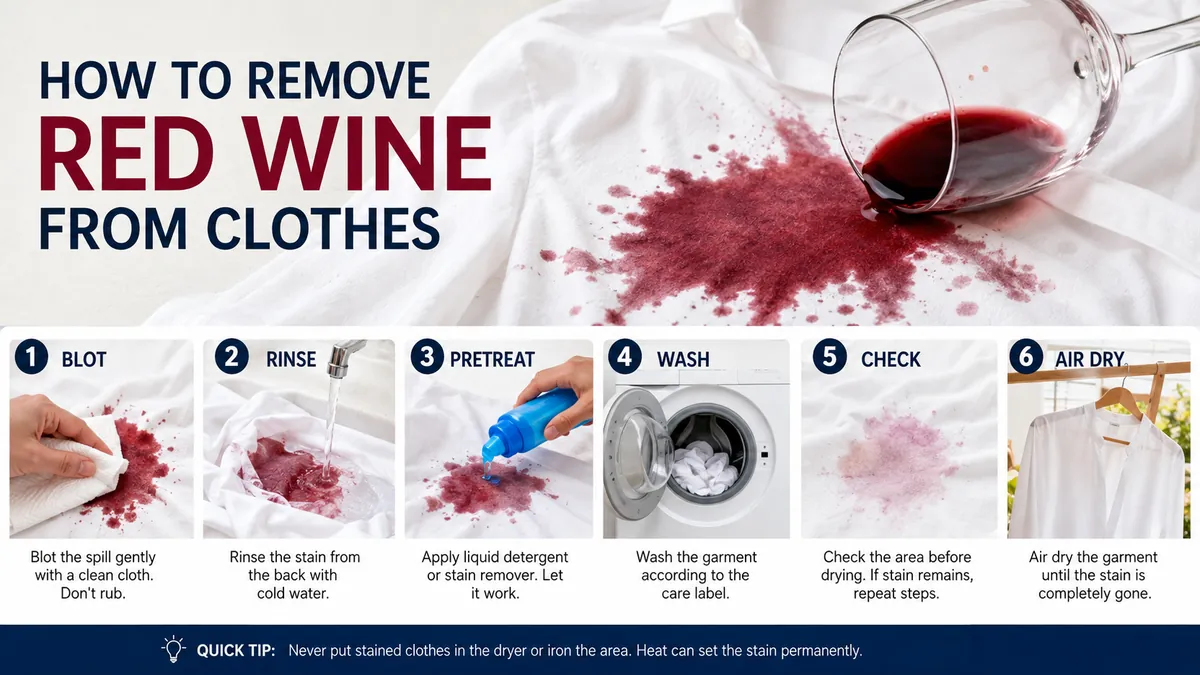
A splash of red wine on a favorite shirt can look permanent within seconds. The deep red-purple color spreads through fabric quickly, and rubbing it in a panic usually makes matters worse.
The good news is that most wine stains are treatable. Knowing how to remove red wine from clothes comes down to three things: acting quickly, using the right treatment for the fabric, and keeping the garment away from the dryer until the stain has disappeared.
Quick answer: Blot fresh red wine with a clean white cloth, rinse the stain from the back with cold water, pretreat it with liquid laundry detergent or a fabric-safe stain remover, and wash according to the care label. Never rub the spill or machine-dry the garment while any stain remains.
how to remove red wine from clothes step by step
For ordinary machine-washable clothing, you don’t need a complicated collection of cleaning products. Cold water, detergent, clean towels, and patience will handle many fresh spills.
1. Blot the wine immediately
Place a clean white cloth or paper towel over the spill and press gently.
Lift the cloth and move to a clean section before pressing again. Continue until you are no longer picking up much liquid.
Don’t scrub.
Rubbing pushes liquid farther into the fibers and can spread the affected area. Working from the outside of the stain toward its center also helps prevent it from getting larger.
2. Check the garment’s care label
Before reaching for vinegar, hydrogen peroxide, bleach, or a stain remover, check the fabric-care instructions.
Cotton and many polyester garments tolerate ordinary home stain treatments reasonably well. Silk, wool, cashmere, leather, structured clothing, and dry-clean-only pieces need more caution.
For an expensive or sentimental garment, professional cleaning may be safer than experimenting with aggressive household treatments.
3. Flush the stain with cold water
Turn the garment so you can rinse the stain from its reverse side. Run cool or cold water through the fabric.
Flushing from behind helps push wine back out rather than carrying it farther through the material.
Cold water is a sensible starting point because it is generally safe for washable clothing and gives you time to treat the remaining pigment without unnecessarily exposing the stain to heat. Several current laundry-care guides recommend a cold-water rinse as an early treatment step.
4. Pretreat the remaining mark
Apply liquid laundry detergent, an enzyme detergent, or a stain remover suitable for the garment.
Gently work liquid detergent into washable fabric with your fingers or, where appropriate, a soft-bristled brush. Avoid aggressive scrubbing.
Let the pretreatment work according to its instructions before washing.
5. Wash according to the care label
Wash the garment using an appropriate detergent and the temperature permitted by its care instructions.
Some manufacturer guidance recommends the warmest temperature safe for the fabric after pretreatment, while other stain-removal methods favor cooler washing while the stain remains. The garment label and the directions on the cleaning product should therefore take priority over a universal temperature rule.
6. Inspect before drying
This step is easy to forget and can determine whether a faint mark becomes much harder to remove.
Take the clothing out of the washing machine and inspect the stained area in good light.
If you can still see pink, purple, brown, or gray discoloration, do not put it in the tumble dryer and do not iron the area. Treat it again and rewash it.
Persil specifically recommends repeating treatment before drying when red wine remains.
Quick Takeaway: Blot → rinse → pretreat → wash → inspect → air-dry. Resist the urge to scrub or immediately throw the garment into a hot wash and dryer.
Why red wine stains clothes so easily
Understanding the stain makes the cleaning advice easier to remember.
Red wine contains intensely colored compounds responsible for its red, purple, and blue hues. Among the most relevant are anthocyanin pigments. Wine also contains tannins and acids.
Once wine reaches an absorbent textile, the liquid moves through the spaces between fibers. As moisture evaporates, colored material remains behind.
Natural fibers such as cotton and linen can absorb spills particularly quickly.
This is why speed helps.
You are not trying to magically “erase” red wine. The immediate objective is to remove as much liquid and pigment as possible before the residue becomes harder to release.
How to remove a fresh red wine stain from clothes
A stain that happened 30 seconds ago gives you more options than one discovered the next morning.
Start with blotting.
If you’re at a restaurant or party and can’t remove the garment immediately, use a clean napkin or paper towel to absorb what you can. If practical, sponge or rinse the affected area with cool water until you can properly pretreat and wash it.
Once home:
- Blot away remaining moisture.
- Rinse with cold water.
- Apply a suitable liquid detergent or stain remover.
- Allow the pretreatment time to work.
- Wash according to the garment label.
- Inspect before drying.
For a stubborn fresh stain on a suitable light-colored garment, a hydrogen peroxide-based treatment can be considered after spot-testing. Tide, for example, describes a treatment using three parts hydrogen peroxide with one part liquid detergent, followed by blotting and laundering.
Hydrogen peroxide can alter fabric dyes, however, so it isn’t a universal solution.
How to remove dried red wine from clothes
What if you didn’t notice the spill until the following morning?
Don’t assume the garment is ruined.
A dried red wine stain usually requires more soaking and repeated treatment because the easy-to-blot liquid is already gone.
Start by re-wetting the stain
Rinse or soak the stained area in cool water. The objective is to loosen dried residue and prepare the fabric for pretreatment.
Apply a good laundry stain remover or liquid detergent and let it work before washing.
For persistent washable garments, you may need to repeat this cycle:
soak → pretreat → wash → inspect
Good Housekeeping recommends soaking a remaining clothing stain in cold water before applying stain remover and washing, while Persil recommends an additional cold-water soak when wine survives the initial wash.
Try oxygen bleach when appropriate
An oxygen-based, color-safe bleach may help with stubborn discoloration if the product is approved for the garment.
Maytag recommends oxygen bleach as an option for several washable fabric categories, including cotton and common synthetics, subject to fabric-care instructions.
Always follow the bleach manufacturer’s dilution, soaking, and safety directions rather than improvising a concentration.
For white or colorfast fabric, consider hydrogen peroxide
Household 3% hydrogen peroxide is commonly suggested for stubborn wine stains on suitable light-colored or colorfast fabrics.
But “colorfast” matters.
Hydrogen peroxide has bleaching properties and can lighten dyes. Test it on an inconspicuous seam first. If the fabric’s color changes, stop.
Tide recommends testing peroxide-and-detergent treatment in an inconspicuous area when tackling old stains.
How to get red wine out of white clothes
White cotton often gives you more stain-removal options because there’s no colored dye you are trying to preserve.
That doesn’t mean every white garment can withstand aggressive bleaching.
Check the fiber and care label first.
White vinegar and detergent
White vinegar appears in several established wine-stain treatments.
For suitable washable white clothing, apply white vinegar to the stained area, follow with liquid laundry detergent, and then wash according to the garment-care instructions. Tide recommends this general sequence for white clothing.
White vinegar and chlorine bleach should never be mixed together.
Hydrogen peroxide and detergent
Hydrogen peroxide can be useful on white or very light, peroxide-safe material.
Tide recommends three parts hydrogen peroxide to one part liquid detergent for fresh and dried wine stains, while other published methods use different proportions. That variation is a good reason to follow the directions of the specific laundry product you are using rather than assuming stronger is better.
Chlorine bleach
For a truly bleach-safe white cotton item, chlorine bleach can sometimes remove remaining wine pigment.
Check both the clothing label and bleach directions first.
Never assume that “white” automatically means chlorine-bleach safe. Spandex, wool, silk and many blended or finished fabrics can be damaged by chlorine bleach.
How to remove red wine from colored clothes
With colored garments, removing the wine is only half the job. You also need to preserve the garment’s original dye.
Start conservatively:
- Blot the excess wine.
- Rinse with cold water.
- Pretreat with a color-safe detergent or stain remover.
- Wash according to the care label.
- Air-dry until you know the stain is gone.
If you want to use oxygen bleach, hydrogen peroxide, vinegar, or another treatment, perform a colorfastness test first.
Put a tiny amount of the diluted product on a hidden inside seam. Wait as directed, rinse or blot it away, and inspect for fading or discoloration.
For dark clothing, this small test can save you from replacing one wine stain with a permanent bleached patch.
Does salt remove red wine stains?
Salt is one of the oldest red-wine-spill remedies, but its role is often misunderstood.
On a fresh, wet spill, dry table salt can help absorb some liquid while you’re organizing a proper cleaning treatment. It is an emergency first step, not a replacement for laundering.
Persil recommends spreading salt over a damp stain after flushing it with cold water, then brushing the salt away before pretreating and washing.
If you use salt:
- Blot excess wine first.
- Cover the damp stain with table salt.
- Give it a few minutes to absorb moisture.
- Brush or shake it away.
- Rinse and pretreat the fabric.
- Wash normally.
Salt becomes less useful once the stain has completely dried.
Does baking soda remove red wine from clothes?
Baking soda, or sodium bicarbonate, is another useful household option, particularly as an absorbent treatment.
For washable material, blot the spill and make a paste from baking soda and water. Cover the stained area and allow the paste to dry before removing it, rinsing the fabric, and laundering it.
Tide includes a baking-soda-and-water paste among its wine-stain methods.
Don’t mistake absorption for complete stain removal, though.
A baking soda treatment may reduce the visible wine, but detergent and laundering are often still needed to remove the remaining residue from the fibers.
Does club soda get red wine out?
Club soda is a popular emergency remedy because it’s often readily available exactly where wine is being served.
The practical benefit is straightforward: it provides liquid for flushing and diluting a fresh spill while you’re acting quickly.
Tide lists club soda or cold water as an initial treatment before blotting and pretreating the stain.
So if you’re choosing between letting the stain sit untouched for several hours and flushing it with club soda, use the club soda.
But don’t worry if you don’t have any.
Plain cool water followed by proper pretreatment is still a solid approach.
Can dish soap remove a red wine stain?
Dishwashing liquid can help loosen stains because it contains surfactants designed to lift soils and allow them to disperse in water.
That doesn’t mean you should pour any dish product into your washing machine.
Instead, dish soap is generally used as part of a controlled spot treatment and then thoroughly rinsed away.
For clothing, a laundry detergent or dedicated laundry stain remover is often the simpler choice because it is specifically formulated for textiles and washing machines.
Dish soap becomes especially common in peroxide-based home treatments. If using one of these approaches, choose a clear liquid rather than a strongly colored product and test the treatment first.
What about the famous hydrogen peroxide and dish soap method?
This combination appears repeatedly in red wine stain advice because peroxide acts as an oxidizing agent while the detergent or dishwashing liquid helps lift residue.
It can work well on suitable white and light-colored fabrics.
It can also cause unwanted fading.
Before trying it:
- Read the care label.
- Keep it away from delicate fabrics unless specifically permitted.
- Test for colorfastness.
- Use standard household 3% hydrogen peroxide rather than a stronger concentration.
- Rinse thoroughly afterward.
- Don’t combine it casually with other cleaning chemicals.
If the garment is dark, valuable, silk, wool, or otherwise delicate, a less aggressive treatment is preferable.
Should you use hot or cold water on red wine stains?
You’ll see apparently conflicting advice about water temperature.
For the initial response, cool or cold water is widely recommended for rinsing and soaking. Good Housekeeping, Persil, Tide, and Maytag all incorporate cool or cold water into wine-stain treatment guidance.
The eventual wash temperature is a separate question.
Some manufacturers recommend washing in the warmest water safe for the fabric after proper pretreatment. The safest rule is therefore:
Use cold water for the initial flush, then follow the garment’s care label and your stain-removal product’s instructions for laundering.
Don’t automatically boil, soak, or wash an unknown fabric in very hot water.
how to remove red wine from clothes made from different fabrics
The same treatment shouldn’t automatically be used on a cotton T-shirt and a silk blouse.
Cotton
Cotton is absorbent, so act quickly.
Flush with cold water, pretreat with an enzyme detergent, and wash according to the label. Oxygen bleach can be considered for stubborn stains when the garment permits it. Chlorine bleach is an option only for compatible white cotton.
Polyester
Polyester and common synthetic blends can generally be rinsed, pretreated with detergent, and machine-washed according to their labels.
Maytag recommends enzyme detergent and, where appropriate, oxygen bleach for polyester, spandex, and nylon garments.
Linen
Linen can absorb wine quickly and should be treated promptly.
Use a mild treatment first and avoid assuming that strong bleach or high heat is safe merely because the fabric looks sturdy.
Wool and cashmere
These protein-based fibers require gentler handling.
Avoid vigorous scrubbing, strong alkaline treatments, and unapproved bleach. A mild detergent in cool water may be suitable for washable wool, but dry-clean-only or valuable pieces are better taken to a professional.
Silk
Silk can react poorly to aggressive stain-removal chemicals and excessive rubbing.
Blot the spill carefully and check the label. For valuable or dry-clean-only silk, professional treatment is usually the safer route.
Rayon, acrylic and delicate blends
Follow the care label closely. Maytag groups wool, silk, linen, rayon and acrylic under a gentler approach using mild detergent in cool water, followed by washing at a fabric-safe temperature.
What not to do when removing red wine stains
Some of the most stubborn wine marks are made worse during the first few minutes after the spill.
Don’t rub the stain
Scrubbing spreads wine sideways and works it deeper into the textile.
Blot instead.
Don’t automatically reach for the strongest bleach
A treatment that removes red pigment can also remove the dye from your shirt.
Start with the least aggressive method appropriate for the fabric.
Don’t skip the spot test
Hydrogen peroxide, bleach, and even some stain removers can affect dyes or finishes.
Test questionable treatments somewhere inconspicuous.
Don’t mix household cleaners
More chemicals don’t equal more cleaning power.
In particular, never mix chlorine bleach with vinegar or ammonia. These combinations can release dangerous gases.
Use one treatment at a time, rinse appropriately, and follow the manufacturer’s safety instructions.
Don’t tumble-dry a visible stain
This is one of the most consequential mistakes.
If the mark remains after washing, treat it again rather than sending the garment through the dryer. Persil advises against tumble-drying or ironing wine-stained clothing before the stain has been completely removed.
Fresh vs. dried red wine stains: what changes?
| Situation | Best starting approach | Extra treatment often needed? | Main risk |
|---|---|---|---|
| Fresh stain | Blot and cold-water rinse | Sometimes | Rubbing and spreading |
| Partially dried stain | Cold soak and pretreatment | Often | Drying before removal |
| Old/set stain | Soak, pretreat, wash and repeat | Usually | Aggressive bleaching |
| White cotton | Detergent plus fabric-safe whitening treatment | Sometimes | Using too much bleach |
| Colored fabric | Color-safe stain remover/detergent | Sometimes | Dye fading |
| Delicate fabric | Gentle treatment or professional cleaning | Often | Fiber damage |
Fresh stains are usually easier because you can physically remove a meaningful amount of wine before it dries.
With an older stain, patience becomes more important than force.
Two or three gentle treatment cycles can be safer than one extremely aggressive attempt.
What if the red wine stain remains after washing?
First, don’t panic—and don’t dry the garment.
Re-wet the affected area with cool water and inspect it closely. If the stain has faded substantially, another pretreatment and wash may finish the job.
For washable fabric, consider an oxygen-based stain remover if the label permits it. For suitable white or colorfast material, carefully tested hydrogen peroxide may help with persistent pigment.
If repeated treatment doesn’t produce meaningful improvement, stop escalating the chemistry.
Professional cleaning makes sense when the garment is:
- Dry-clean only
- Silk, cashmere, wool, or leather
- Structured or tailored
- Expensive
- Sentimental
- Unstable when spot-tested
- Still badly stained after repeated appropriate treatment
Laundry experts cited by Martha Stewart particularly recommend professional help for dry-clean-only, expensive, sentimental, or structured garments and stains that have resisted initial treatment.
The simplest method to remember
When a glass tips over, you probably won’t have time to compare six homemade stain-removal recipes.
Remember this sequence:
BLOT — RINSE — PRETREAT — WASH — CHECK — AIR-DRY
Blot instead of rubbing. Rinse with cold water, preferably from behind the stain. Pretreat with a fabric-safe laundry product. Wash according to the care label. Check carefully before exposing the garment to dryer or iron heat.
That’s the safest practical foundation for how to remove red wine from clothes, whether you’re dealing with a fresh splash on a cotton shirt or yesterday’s forgotten stain. If the first wash doesn’t completely remove it, repeat a gentle treatment before trying stronger chemicals—and let the garment air-dry until you’re certain the stain is gone.