
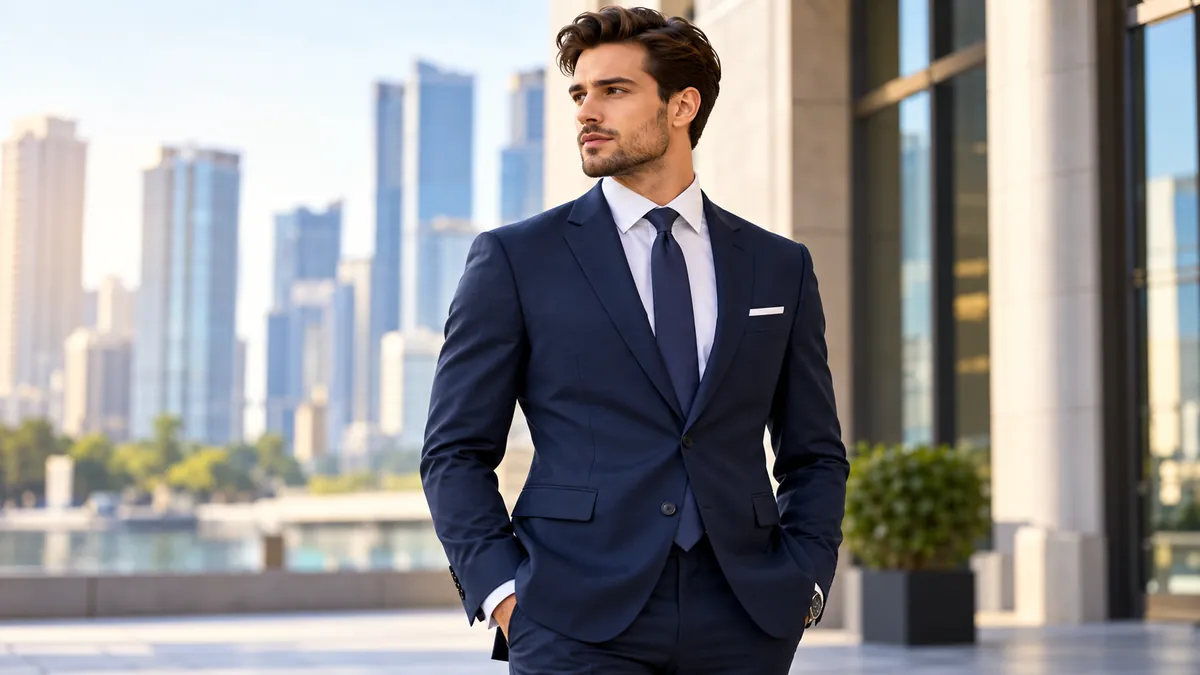
A man in suit can look polished, professional, relaxed, traditional, or fashion-forward. The difference rarely comes down to price alone. Fit, proportion, fabric, color, shirt choice, shoes, and small styling decisions determine whether a suit looks intentional or simply feels like formal clothing worn out of obligation.
A well-dressed man in suit wears a jacket that follows his natural shoulders, closes cleanly without pulling, and works proportionally with trousers that sit comfortably and fall neatly toward the shoes. Proper tailoring matters more than the label: even an expensive suit can look awkward when the shoulders, sleeves, jacket length, or trouser break are wrong.
What Makes a Man in Suit Look Well Dressed?
The strongest suit looks are balanced rather than complicated.
You do not need an unusual fabric, bold pocket square, expensive watch, or designer label. Start with four fundamentals:
- Correct fit
- Balanced proportions
- Appropriate colors
- Clean coordination
Fit deserves the most attention. Current tailoring guidance consistently emphasizes the shoulders, collar, chest, jacket length, sleeves, trouser waist, seat, and break as the major checkpoints.
A navy wool suit with a white shirt and simple leather shoes can look exceptional when everything fits correctly. The same outfit can look untidy when the jacket hangs beyond the shoulders or trousers bunch heavily around the ankles.
Fit Should Be Close, Not Tight
One of the most common mistakes is confusing a slim silhouette with a tight suit.
A jacket should follow the shape of the torso while leaving enough room for comfortable movement. When buttoned, the front should remain relatively smooth. Strong X-shaped creases radiating from the button generally indicate excessive tension. The lapels should also lie naturally against the chest rather than bowing outward.
The goal is a clean line.
You should be able to sit, walk, reach, and move normally without feeling trapped by the garment.
How Should a Man in Suit Jacket Look?
The jacket creates most of the visual structure of a suit, so begin there when assessing fit.
Shoulders
Shoulders are among the hardest parts of a jacket to alter successfully.
The jacket’s shoulder seam should finish close to the natural end of your shoulder. If the padded structure hangs noticeably beyond your body, the jacket is probably too large. If the shoulder fabric pulls, wrinkles, or creates pronounced divots, it may be too small or simply incompatible with your shoulder shape.
This is why choosing the correct base jacket is more important than relying on alterations later.
Collar
Look at the back of your neck.
The jacket collar should sit cleanly against the shirt collar. A visible space between the two is commonly called a collar gap. Posture, shoulder slope, jacket balance, and incorrect sizing can all contribute to the problem.
Minor collar issues may sometimes be corrected by a tailor, but significant problems can indicate that the jacket’s underlying shape does not suit your body.
Chest and Waist
Button the jacket while standing naturally.
The chest should look smooth, and the lapels should stay reasonably flat. You do not want large amounts of loose fabric, but you also should not see severe pulling around the fastening point.
A little shaping through the waist gives the jacket definition.
That does not mean every man needs an aggressively tapered silhouette. Someone with a broader midsection may look considerably better in a comfortable modern or classic cut than in an overly tight slim-fit jacket.
Jacket Length
Jacket length influences the apparent proportions of the entire body.
Traditional guidance generally calls for a suit jacket to cover the seat. Modern jackets can vary somewhat in length, but going excessively short can make the torso look abbreviated and expose too much of the trousers from behind.
The right length also depends on your height, torso, legs, and the intended silhouette.
Think about proportion rather than blindly following a single measurement.
Sleeve Length
Suit sleeves should not completely cover the shirt cuffs.
A commonly recommended starting point is to have roughly a quarter to half an inch of shirt cuff visible below the jacket sleeve.
This creates visual separation between the jacket and hand while making the shirt part of the complete outfit.
Sleeves are also one of the more practical areas to adjust after purchasing an off-the-rack suit, although working buttonholes near the cuff can sometimes limit alteration options.
How Should Suit Trousers Fit?
A sharp jacket cannot rescue badly fitting trousers.
Suit trousers should work with the jacket to create one continuous silhouette. They should sit securely at their intended waist position, provide adequate room through the seat and thighs, and fall cleanly toward the shoe.
Waist and Rise
Suit trousers traditionally sit higher than casual jeans.
The exact position varies according to the rise and design, but they should remain secure without requiring an aggressively tightened belt.
A higher rise can visually lengthen the legs and produce a more traditional tailored silhouette. Lower-rise trousers create a different proportion and may work with contemporary casual tailoring, although going too low can make the jacket and trousers appear disconnected.
Seat and Thighs
Inspect the trousers from the front, side, and back.
The seat should not sag excessively, but it should not pull tightly either. Horizontal tension lines can indicate insufficient room, while large folds of excess cloth suggest that the trousers may need adjustment.
The thighs need enough space for normal movement.
Sit in a chair during the fitting. A suit that only looks good while standing rigidly is not properly fitted for real life.
Trouser Break
The “break” describes the fold created where the trouser hem meets the shoe.
Common options include:
| Trouser Finish | Appearance | Works Well For |
|---|---|---|
| No break | Hem barely touches the shoe | Contemporary, streamlined looks |
| Slight break | Small fold at the front | Versatile modern tailoring |
| Half break | Noticeable but controlled fold | Classic business style |
| Full break | Deeper fold over the shoe | Traditional, fuller trousers |
Modern styling often favors little or no break, while a modest break remains suitable for traditional suits. The trouser width should also influence your decision; wider trousers generally accommodate more break naturally than very narrow ones.
Slim Fit vs Modern Fit vs Classic Fit
There is no universally superior suit cut.
The best choice depends on body shape, personal preference, comfort, and the overall aesthetic you want.
Slim Fit
A slim-fit suit generally has:
- A closer chest and waist
- Narrower sleeves
- Narrower trousers
- Stronger tapering
It works particularly well when the garment follows the body without visibly straining.
Do not size down simply to achieve a slimmer appearance. Proper slim tailoring comes from the pattern and cut rather than squeezing into a smaller jacket.
Modern Fit
Modern fit sits between slim and traditional cuts.
It usually provides some waist suppression and relatively clean trousers without fitting as closely as a slim suit.
For many men, this is an adaptable option because it combines contemporary proportions with practical comfort.
Classic or Regular Fit
Classic suits provide more room through the chest, waist, seat, and thighs.
That extra room does not automatically make the suit outdated. A properly tailored regular-fit suit can produce an elegant silhouette, particularly when the proportions suit the wearer’s build.
Contemporary tailoring has also become more open to relaxed silhouettes rather than treating extreme slimness as the only fashionable option.
Best Suit Colors for Men
Color determines both versatility and formality.
Navy Suit
Navy is one of the most adaptable suit colors.
It works for business settings, weddings, interviews, dinners, presentations, and many semi-formal events. It also coordinates easily with white, pale blue, and subtly patterned shirts.
For someone buying a first serious suit, navy is usually a practical place to start.
Charcoal Suit
Charcoal has a more restrained, formal character.
It works especially well for professional environments and pairs naturally with white, light blue, pale pink, and other understated shirts.
Because charcoal is neutral, ties can introduce controlled color without making the outfit look busy.
Medium and Light Grey
Grey suits cover a broad range of situations.
Medium grey offers substantial versatility, while lighter greys tend to feel more relaxed and are especially useful during warmer months or daytime events.
Black Suit
Black is formal but less universally versatile than many people assume.
It works particularly well for evening occasions, funerals, certain formal settings, and minimalist styling. For everyday business wear, navy or charcoal often provides more combinations.
A black business suit should also not be confused with a tuxedo. Black tie has its own conventions and typically involves dinner-jacket details such as satin or grosgrain facings.
Brown, Beige, and Earth Tones
Brown and earth-toned tailoring creates a softer, less corporate appearance.
These colors work particularly well with textured fabrics, loafers, suede footwear, knitwear, and autumn-inspired wardrobes.
Beige and tan suits are natural choices for warm weather and daytime celebrations.
Understanding Suit Lapels
Lapels have a surprisingly large effect on a man’s appearance.
The three major types are notch, peak, and shawl lapels.
Notch Lapel
A notch lapel has an indentation where the lapel meets the jacket collar.
It is the most familiar option on single-breasted business suits and works across professional, wedding, and general formal settings.
If you want one versatile suit, a moderate-width notch lapel is difficult to get wrong.
Peak Lapel
Peak lapels point upward toward the shoulders.
They traditionally appear on double-breasted tailoring but are also used on single-breasted suits.
They create a stronger, more formal visual impression and can emphasize the shoulders and chest.
Shawl Lapel
A shawl collar forms a continuous curved line without the notch or pointed peak found on conventional suit lapels.
It is most strongly associated with tuxedos and dinner jackets rather than everyday business suits.
Single-Breasted vs Double-Breasted Suits
A single-breasted jacket has one column of functional front buttons and remains the easiest style for most wardrobes.
The familiar two-button single-breasted jacket is suitable for an enormous range of situations.
A double-breasted jacket uses overlapping front panels and multiple visible buttons. It creates more visual structure and usually looks more assertive.
Neither style is inherently better.
Choose according to the occasion, your proportions, and the image you want to create.
Suit Button Rules
For a standard two-button jacket, fasten the upper button while standing and leave the lower button undone.
Unbutton the jacket when sitting.
Double-breasted jackets follow somewhat different conventions and are commonly kept fastened while standing.
These details seem minor, but they affect how the jacket hangs and maintains its intended shape.
Choosing the Right Shirt
A dress shirt provides the visual bridge between your face, suit, and tie.
White Shirt
A crisp white shirt is the most versatile choice.
It works with almost every conventional suit color and can move easily from professional to formal environments.
Light Blue Shirt
Light blue adds subtle color while remaining conservative.
It looks particularly natural with navy, charcoal, medium grey, and brown tailoring.
Patterned Shirts
Stripes and checks can add personality, but scale matters.
If the suit already has a noticeable pattern, keep the shirt relatively restrained. When mixing patterns, vary their scale so they do not compete visually.
For example, a fine striped shirt can work beneath a suit with a much larger check.
How to Choose a Tie
A tie should support the outfit rather than become its only focal point.
Classic colors such as burgundy, navy, forest green, grey, and dark red combine easily with standard business suits.
Proportion matters here too.
A very narrow tie can look disconnected from broad lapels, while an extremely wide tie may overwhelm a narrow jacket. Tailoring guidance commonly recommends considering the relationship among lapel width, tie width, and shirt collar proportions.
For patterns, start simply.
If your shirt is patterned, a solid or subtly textured tie is usually easier to coordinate. If the shirt is plain, you have more freedom to use stripes, dots, paisley, or other controlled designs.
Shoes That Work With a Suit
Shoes complete the lower half of the silhouette.
Oxford shoes are among the most formal choices. Derbies offer a little more flexibility, while loafers can make tailoring feel more relaxed.
A basic color guide is useful:
| Suit Color | Reliable Shoe Choices |
|---|---|
| Navy | Brown, dark brown, burgundy, black |
| Charcoal | Black, dark brown, burgundy |
| Medium grey | Black, brown, burgundy |
| Black | Black |
| Brown | Dark brown, burgundy |
| Beige | Brown, tan, dark brown |
These are guidelines rather than immutable laws.
The occasion still matters. Black leather Oxfords may be ideal for a conservative formal event, while brown loafers can make a lightweight navy suit feel much more relaxed.
Belt, Socks, Watch, and Pocket Square
Accessories should look connected without appearing overly coordinated.
Belt
When wearing a conventional leather belt, coordinate it reasonably closely with your shoes.
Black shoes normally call for a black belt. Brown shoes generally look better with a brown belt in a similar family of tones.
Some tailored trousers use side adjusters instead of belt loops, eliminating the need for a belt entirely.
Socks
For a conservative outfit, socks can relate to the trousers rather than the shoes. This creates a smoother visual transition down the leg.
Bolder socks can work in casual settings, but they should feel intentional rather than random.
Watch
A thin dress watch with a leather strap or restrained metal bracelet usually complements tailoring better than a very bulky sports watch.
Still, modern dress codes allow much more flexibility than traditional rules did.
Pocket Square
A pocket square introduces texture and contrast.
Avoid trying to match it exactly to the tie. Instead, choose complementary colors or use a simple white pocket square for a timeless finish.
Man in Suit for Different Occasions
A suit should respond to its environment.
The outfit for a conservative job interview should not necessarily be identical to what you wear at a summer wedding.
Business and Office
For traditional professional settings, choose:
- Navy, charcoal, or medium grey
- White or pale blue shirt
- Conservative tie
- Leather Oxfords or Derbies
- Minimal accessories
The objective is credibility and polish without unnecessary distraction.
Job Interview
A navy or charcoal suit remains a safe foundation for many formal interviews.
Keep the shirt clean and simple. Choose restrained footwear and accessories, and make sure the garments are pressed.
More importantly, research the organization’s dress culture. A suit can be expected in one industry and unusually formal in another.
Wedding
Wedding attire depends heavily on the invitation, venue, season, time of day, and dress code.
Navy, blue, grey, beige, brown, and subtle patterned suits can all work depending on the context.
Daytime summer weddings allow lighter fabrics and colors, while evening celebrations often support darker tailoring.
If the invitation specifies black tie, however, a regular business suit is not the standard interpretation. That dress code traditionally calls for a tuxedo or dinner suit.
Funeral
Dark, understated clothing is generally the safest approach.
A black, charcoal, or very dark navy suit with a plain white shirt, dark tie, and conservative shoes keeps attention away from the clothing and on the purpose of the gathering.
Dinner or Social Event
Social occasions allow more personality.
Try textured tailoring, an open-collar shirt, knit polo, roll neck where appropriate, loafers, or less conventional colors.
The suit remains structured, but the styling can become considerably more relaxed.
Choosing Suit Fabric
Fabric affects comfort, drape, durability, and seasonality.
Wool
Wool remains a foundational suiting material because it combines structure, breathability, resilience, and a refined appearance.
Different weights and weaves make wool suitable across multiple seasons.
Linen
Linen is highly breathable and ideal for warm conditions.
It wrinkles readily, but those wrinkles are part of its relaxed character. Linen suits work especially well at summer weddings, resort events, and less conservative daytime occasions.
Cotton
Cotton tailoring tends to look less formal than traditional worsted wool.
It can be an excellent option for smart-casual workplaces and warm-weather dressing.
Blends
Wool blends and other mixed fabrics can offer durability, stretch, easier maintenance, or lower prices.
Evaluate the actual cloth rather than assuming that either natural fibers or blends are automatically superior in every situation.
Ready-to-Wear, Made-to-Measure, and Bespoke
These terms describe different approaches to buying a suit.
Ready-to-Wear
Ready-to-wear suits are manufactured in standardized sizes.
They are immediately available and can often look excellent after straightforward alterations.
For many men, buying the correct ready-to-wear size and spending money on tailoring offers better results than simply purchasing a more expensive suit.
Made-to-Measure
Made-to-measure usually begins with an existing pattern that is adjusted using the customer’s measurements and selected options.
It offers more personalization than standard ready-to-wear clothing.
Bespoke
Traditional bespoke tailoring involves creating an individual pattern for the client and typically includes multiple stages of fitting and handwork.
Bespoke provides extensive control over proportion, construction, cloth, details, and fit, but it requires considerably more time and money.
Which Suit Alterations Are Worth Making?
Tailoring can dramatically improve a suit, but it cannot economically solve every structural problem.
Common alterations include:
- Shortening or lengthening sleeves
- Taking in or letting out the jacket waist
- Adjusting trouser waist
- Tapering trouser legs
- Correcting trouser length
- Adjusting the seat where construction allows
Major shoulder reconstruction is much more complicated. This is one reason suit-fit guides emphasize getting the shoulders right before purchasing.
The practical rule is simple: buy for the hardest-to-alter areas first, then let a skilled tailor refine the easier ones.
Common Mistakes Men Make When Wearing Suits
Even a quality suit can look wrong because of small styling errors.
Wearing the Wrong Jacket Size
Oversized shoulders and excessive fabric make the suit appear borrowed.
A jacket that is too small creates pulling and restricts movement.
Start with the shoulders and chest rather than focusing only on the size printed on the label.
Trousers That Are Too Long
Large piles of fabric around the ankles interrupt the clean vertical line of the trousers.
Choose a break appropriate for the trouser cut and have the hem adjusted if necessary.
Sleeves Covering the Shirt Completely
When jacket sleeves extend too far over the hands, the entire jacket can appear oversized.
A small amount of visible shirt cuff usually creates a cleaner finish.
Over-Accessorizing
Tie bars, lapel pins, pocket squares, bracelets, watches, rings, patterned socks, and statement ties can all work individually.
Wearing every accessory simultaneously can turn an elegant outfit into visual clutter.
Select a few details and allow the tailoring to remain the focus.
Ignoring Comfort
A suit is clothing, not a costume.
You should be able to walk, sit, shake hands, eat, and spend several hours wearing it without constantly adjusting yourself.
Fit should combine clean visual lines with functional movement.
How to Build a Versatile Suit Wardrobe
You do not need ten suits to dress well.
A thoughtful wardrobe can begin with only a few adaptable pieces.
A practical progression might be:
- Navy wool suit
- Charcoal or medium-grey suit
- Seasonal or textured suit
- Formal evening option if your lifestyle requires one
Add several white and light-blue shirts, a small collection of versatile ties, and good black and brown leather shoes.
From there, expand according to your actual life.
Someone working in a conservative corporate environment may benefit from additional navy and grey tailoring. Someone who mainly wears suits to weddings may get more value from seasonal colors, linen blends, and less formal fabrics.
How to Care for a Suit
Good maintenance extends the life of tailoring.
After wearing a suit, hang the jacket on a supportive hanger that helps preserve the shoulders. Hang trousers neatly and allow the garments to air before returning them to a crowded wardrobe.
Brush away surface dust when necessary.
Avoid unnecessary dry cleaning. Chemical cleaning is useful for stains and deeper cleaning, but a suit generally does not need to be dry-cleaned after every wear.
Steam can help release minor wrinkles, while pressing is useful when sharper creases and structure need restoration.
Rotate suits when possible rather than wearing the same one every day.
A Quick Fit Check Before Leaving Home
Before wearing a suit to an important event, stand naturally in front of a full-length mirror and check the complete silhouette.
Ask yourself:
- Do the shoulders follow my natural shoulder line?
- Does the collar sit cleanly against my shirt?
- Do the lapels lie flat?
- Can the jacket button without obvious pulling?
- Does the jacket adequately cover the seat?
- Is some shirt cuff visible?
- Do the trousers fit comfortably at the waist?
- Is the seat smooth rather than sagging or pulling?
- Do the trousers fall cleanly toward the shoes?
- Is the trouser break controlled rather than heavily bunching?
These checkpoints reflect the areas repeatedly emphasized in modern suit-fitting guidance.
Then take several steps, sit down, and stand again.
A suit needs to work while you move, not just while posing in front of a mirror.
Final Thoughts on the Man in Suit Look
The strongest man in suit look is built around fit and proportion rather than price or conspicuous branding.
Start with shoulders that follow your frame, a jacket that closes cleanly, appropriate sleeve and jacket lengths, and trousers that sit comfortably and fall neatly. Then choose colors, fabrics, shirts, ties, shoes, and accessories according to the occasion.
Trends will continue changing. Lapels become wider or narrower, trousers move between slim and relaxed silhouettes, and preferred jacket proportions shift over time. Good tailoring principles remain far more stable.
When the suit fits your body, suits the occasion, and lets you move comfortably, you do not need excessive accessories or complicated styling to make it work. The clothing simply looks like it belongs on you.