
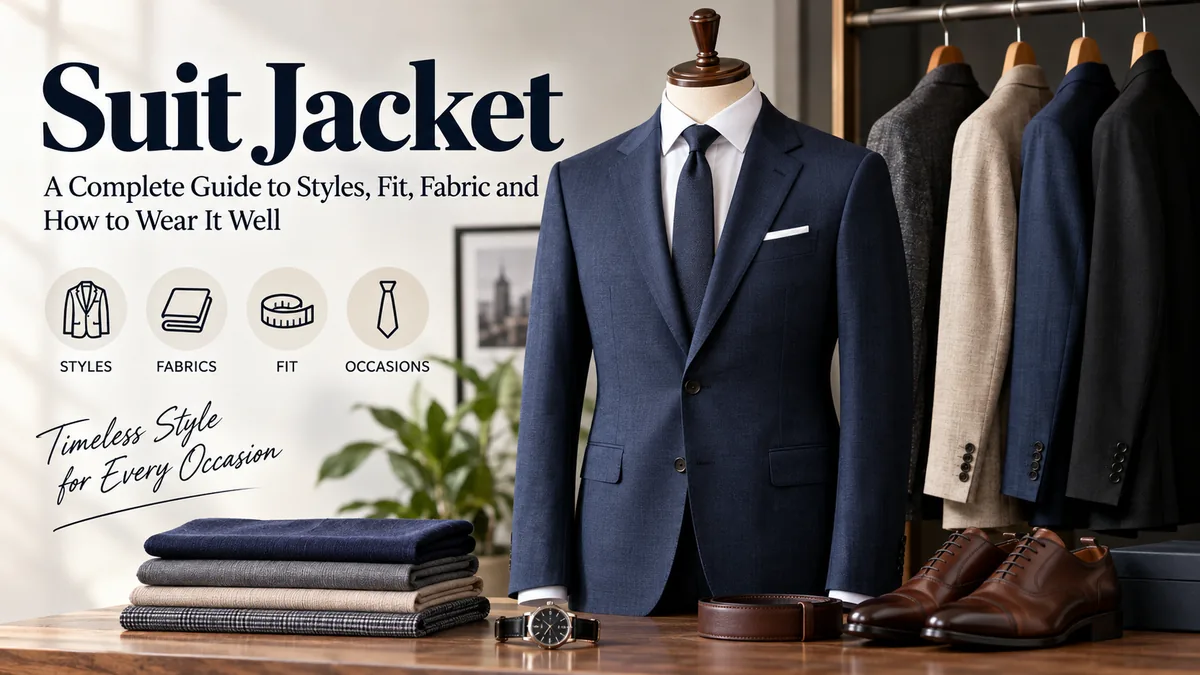
A suit jacket can look deceptively simple: lapels, sleeves, buttons, pockets. Yet small differences in shoulder fit, jacket length, lapel shape, fabric, construction, and tailoring can completely change how it looks on the body.
The first distinction is also the easiest to miss. A suit jacket is not simply another name for a blazer.
A suit jacket is the tailored upper half of a suit, made to be worn with matching trousers cut from the same cloth. It is generally more formal and structured than a sport coat and is commonly made from suiting fabrics such as worsted wool. Fit through the shoulders, chest, waist, sleeves, and jacket length determines whether it looks polished.
Understanding those basics makes everything else—from choosing lapels to judging alterations—much easier.
What Is a Suit Jacket?
A suit consists of matching garments made from the same cloth. In a standard two-piece suit, that means a jacket and trousers. A three-piece suit adds a matching waistcoat.
That relationship is what technically defines the suit jacket. It belongs to matching trousers rather than being designed primarily as a standalone coat.
This distinction matters because tailored jackets that appear almost identical can serve very different purposes.
A typical suit jacket includes:
- Structured or softly constructed shoulders
- A shaped chest
- Notch, peak, or shawl lapels
- One or more front buttons
- Welt, flap, jetted, or occasionally patch pockets
- A breast pocket
- Sleeve buttons
- One, two, or no rear vents
- Interior canvas or fusible structure
- Full or partial lining
Modern tailoring has blurred some traditional rules. Unstructured suits, linen suits, patch-pocket tailoring, and relaxed silhouettes mean you cannot always identify a garment from one detail alone. The matching-trouser test remains the most dependable starting point.
Suit Jacket vs Blazer vs Sport Coat
These three terms are frequently used interchangeably in stores, but traditionally they describe different garments.
| Feature | Suit Jacket | Blazer | Sport Coat |
|---|---|---|---|
| Matching trousers | Yes | No | No |
| Typical formality | Highest | Medium | More relaxed |
| Traditional fabric | Smooth suiting wool | Solid wool, hopsack or similar | Tweed, flannel, linen, textured wool |
| Patterns | Usually restrained | Traditionally solid | Wide variety |
| Buttons | Usually tonal | Contrasting or metal buttons are traditional | Horn, corozo or similar |
| Construction | Often structured | Structured or relaxed | Often softer |
| Best pairing | Matching suit trousers | Contrasting trousers or chinos | Chinos, wool trousers or jeans |
A blazer traditionally occupies the middle ground. Navy is the classic color, and contrasting or metal buttons are historically associated with the style.
A sport coat has roots in outdoor sporting clothing and consequently tends to embrace texture, patterns, softer construction, and more casual combinations. Tweed, herringbone, checks, flannel, and other visibly textured materials are common.
The boundaries are less rigid today. Retailers may call almost any standalone tailored jacket a blazer, so design intent, fabric, construction, and matching trousers tell you more than the product label.
How Should a Suit Jacket Fit?
Fit matters more than expensive fabric or decorative details. An inexpensive jacket that fits properly will usually look cleaner than an expensive one with poor proportions.
The areas to examine are the shoulders, collar, chest, waist, length, sleeves, and armholes.
Start With the Shoulders
Shoulders should be the first fit checkpoint because substantial shoulder alterations are difficult and often uneconomical.
The jacket’s shoulder seam should end close to where your natural shoulder ends. The sleeve should then fall smoothly without obvious dents, bulges, or excessive overhang.
A shoulder that is too narrow can pull across the upper back and restrict movement. One that is too wide can create a drooping or collapsed appearance.
Some tailoring traditions deliberately use more or less shoulder structure. A heavily padded British-inspired shoulder therefore looks different from a soft Neapolitan shoulder. Neither is automatically incorrect; the underlying jacket still needs to work with your body.
Check the Collar
The jacket collar should sit cleanly against your shirt collar.
A noticeable space between them is often called a collar gap. It can result from posture, shoulder balance, or simply an unsuitable jacket pattern.
Small collar problems may be alterable. Severe pulling or persistent gaps can indicate a more fundamental fit issue.
Look at the Chest
Button the jacket in its normal position and examine the front.
You need enough room to move comfortably without having excess fabric hanging around the chest. Strong horizontal pulling around the button usually suggests that the jacket is too tight.
A small amount of shape is desirable. Strain is not.
Find the Right Waist Suppression
“Waist suppression” describes how the jacket narrows around the waist.
Traditional tailored clothing uses this shaping to create a cleaner silhouette between the chest and hips. Slim-fit jackets often exaggerate it, while contemporary relaxed tailoring may use much less.
Your jacket should follow your shape rather than squeeze it.
If closing the button creates a pronounced X-shaped wrinkle across the front, the jacket is generally too tight around the waist or hips.
Get the Jacket Length Right
Jacket length has changed with fashion, but classic proportions remain a useful reference.
A traditional suit jacket generally covers the seat and creates visual balance between the upper and lower body. Very short jackets can make the torso look abbreviated, while excessive length can overwhelm a shorter frame.
A commonly used starting point is around the middle of the hand when the arms hang naturally, although body proportions matter more than applying one universal measurement.
Check Sleeve Length
The sleeve should end around the wrist area and normally allow a modest amount of shirt cuff to remain visible.
Around a quarter to half an inch of visible cuff is a common traditional preference, but there is no need to treat it as a mathematical law.
More important is consistency. One sleeve should not appear noticeably longer than the other, and the jacket sleeve should not cover most of the hand.
Quick Takeaway: Prioritize shoulders, collar, chest, and overall jacket length before worrying about small sleeve or waist adjustments. Sleeve length and moderate waist shaping are relatively routine alterations; rebuilding an unsuitable shoulder is not.
Suit Jacket Styles and Button Configurations
The two broad categories are single-breasted and double-breasted jackets.
Single-Breasted Suit Jacket
A single-breasted jacket has one column of front buttons and a relatively narrow overlap.
The two-button version is particularly common in modern menswear. It produces a clean V-shaped opening and works across business, wedding, and general formal settings. Three-button jackets also exist, as do three-roll-two configurations in which the lapel rolls over the upper button.
With a standard two-button jacket, the traditional rule is simple:
Button the top button when standing and leave the bottom button undone.
Unbutton the jacket when sitting so it does not bunch unnecessarily around the waist.
Double-Breasted Suit Jacket
A double-breasted jacket has overlapping front panels and two visible columns of buttons.
Configurations are sometimes described with numbers such as 6×2 or 4×1. The first number refers to the visible front buttons, while the second indicates how many are intended to fasten.
Double-breasted tailoring creates more visual presence through the chest and can produce a strong, elegant silhouette.
Modern versions are not necessarily bulky. Softer shoulders, lighter canvassing, higher armholes, and cleaner proportions can make a double-breasted jacket surprisingly streamlined.
Understanding Suit Jacket Lapels
Lapels frame the shirt, tie, and face, making them one of the most visually important parts of a jacket.
Three principal types dominate tailored clothing.
Notch Lapel
A notch lapel has a visible indentation where the lapel meets the collar.
It is the most familiar choice for conventional single-breasted business suits and works across a broad range of occasions.
For someone learning about tailoring, the notch lapel is the easiest reference point: understated, versatile, and widely used.
Peak Lapel
Peak lapels have points that extend upward toward the shoulders.
They traditionally appear on double-breasted jackets and more formal single-breasted suits, although modern designers use them much more broadly.
Because the upward points draw the eye toward the shoulders, peak lapels can create a stronger-looking upper body.
Shawl Lapel
A shawl collar uses a continuous curved line without the notch or pointed peak found on conventional lapels.
It is most strongly associated with dinner jackets and tuxedos rather than everyday business suits.
How Wide Should Lapels Be?
Lapel width moves with fashion. Extremely narrow lapels became prominent during certain slim-suit eras, while contemporary tailoring has generally allowed more generous proportions.
Rather than chasing extremes, balance the lapel against:
- Shoulder width
- Chest size
- Tie width
- Jacket length
- Overall silhouette
A moderately proportioned lapel usually ages better than an exaggerated fashion-driven one.
Suit Jacket Fabrics: Wool, Linen, Cotton, and Blends
Fabric affects far more than appearance. It changes breathability, drape, durability, wrinkle resistance, texture, and seasonal comfort.
Worsted Wool
Worsted wool is one of the foundational materials of classic suiting. Its relatively smooth surface creates a clean, formal appearance, which is why it appears frequently in business and dress suits.
Wool also regulates temperature better than many people expect. The right weave and fabric weight can make it useful through much of the year.
Flannel
Flannel has a softer, more textured surface.
Grey flannel is particularly associated with traditional menswear, but flannel suits are available in navy, charcoal, brown, and other colors.
It provides warmth and visual depth, making it especially suitable for cooler conditions.
Linen
Linen is valued for breathability and its relaxed appearance.
It wrinkles readily. That is not necessarily a defect—the natural creasing is part of linen’s character.
A linen suit jacket generally feels less formal than smooth worsted wool, making it well suited to warm-weather weddings, summer events, and relaxed tailoring.
Cotton
Cotton suiting sits between highly formal wool and very relaxed summer fabrics.
It can feel comfortable and familiar but typically does not drape or recover from wrinkles exactly like quality wool.
Wool Blends
Wool may be blended with silk, linen, cashmere, cotton, or synthetic fibers to alter texture, weight, durability, sheen, or cost.
Do not judge quality from the fiber name alone. Weave, yarn, finishing, construction, and intended use all matter.
What Is Inside a Suit Jacket?
Some of the most important differences between jackets cannot be seen from the outside.
Between the outer cloth and lining is an internal structure responsible for much of the jacket’s shape.
Full Canvas
A traditionally canvassed jacket contains an internal layer—historically involving materials such as horsehair—that helps support the chest and lapels.
In full-canvas construction, this structure extends farther through the jacket body.
With wear, a well-made canvas can settle with the body and contribute to a natural three-dimensional shape.
Half Canvas
Half-canvas construction concentrates the canvas through the upper portion of the jacket while using a different construction lower down.
It can provide much of the chest shape associated with traditional tailoring while reducing manufacturing complexity and cost.
Fused Construction
A fused jacket uses an adhesive interlining rather than relying entirely on a floating canvas.
Modern fusing technology is considerably better than the poor-quality examples that gave fused jackets a bad reputation. A well-made fused jacket can be perfectly practical.
Its main advantages are typically affordability, consistency, and efficient manufacturing.
Structured vs Unstructured
Construction also determines how formal a jacket feels.
A structured suit jacket may use:
- Shoulder padding
- Chest canvas
- Full lining
- Defined waist suppression
- Clean, firm edges
An unstructured jacket removes or reduces some of these elements.
The result feels lighter and more relaxed. Contemporary tailoring increasingly incorporates softer construction, which is one reason the visual boundaries between suits, blazers, and sport coats have become less obvious.
Suit Jacket Pockets, Vents, and Other Details
Small design decisions can reveal a jacket’s intended level of formality.
Flap Pockets
Flap pockets are extremely common on business suits.
They offer a useful middle ground: formal enough for professional tailoring without being as minimal as jetted pockets.
Some flap pockets can be tucked inward to create a cleaner appearance.
Jetted Pockets
Jetted pockets have narrow fabric openings without visible flaps.
Their clean appearance makes them particularly appropriate for formal tailoring and dinner jackets.
Patch Pockets
Patch pockets are sewn onto the exterior of the jacket.
They traditionally make a tailored coat feel more casual and are particularly common on sport coats and relaxed suits.
Yet they do not automatically turn a suit jacket into a sport coat. Modern designers regularly mix traditionally formal and casual details.
Breast Pocket
Most suit jackets have a breast pocket on the wearer’s left side.
It can hold a pocket square, which should complement rather than perfectly duplicate a tie.
Single Vent
A single vent is one opening at the center rear.
It is common in American-style tailoring and allows additional movement, though it may open noticeably when the wearer places their hands in trouser pockets.
Double Vents
Two side vents are strongly associated with British tailoring.
They provide comfortable movement and tend to keep more of the rear of the jacket covered when sitting or reaching into pockets.
Ventless Jacket
A ventless back creates a very clean line.
It is historically associated with some formal and Continental styles but provides less freedom of movement.
How to Wear a Suit Jacket Correctly
The simplest answer is also the technically correct one: wear a suit jacket with its matching suit trousers.
The trousers should be made from the same cloth—not merely a similar color.
Two navy fabrics that appear close indoors can have noticeably different textures and shades in daylight. Combining them can create the appearance of an accidentally mismatched suit.
With a Dress Shirt and Tie
This is the conventional business and formal combination.
A white or light blue dress shirt provides an easy foundation. The tie can introduce pattern or texture without fighting the suit.
Black or dark brown leather shoes are conventional choices depending on suit color and formality.
Without a Tie
A suit does not always require a tie.
For less formal settings, an open-collar dress shirt can soften the outfit while preserving the coordinated appearance of the matching jacket and trousers.
The shirt collar still needs enough structure to sit neatly under the lapels.
With Knitwear
Fine-gauge knitwear can work beneath a suit jacket when there is sufficient chest and armhole room.
A thin merino crewneck or turtleneck can create a polished cold-weather combination, particularly with softer or textured tailoring.
Heavy sweaters are more difficult because conventional suit jackets are usually cut to fit over a shirt rather than bulky layers.
Can You Wear a Suit Jacket With Jeans?
Sometimes—but it is one of the easiest menswear combinations to get wrong.
A highly formal jacket made from smooth, slightly lustrous worsted wool usually looks disconnected from denim. The upper half says “business suit” while the lower half says casual clothing. Several tailoring guides therefore recommend keeping formal worsted suit jackets with their matching trousers.
A suit jacket has a better chance of working separately when it has characteristics closer to a sport coat, such as:
- Textured fabric
- Soft shoulders
- Minimal padding
- Patch pockets
- Matte buttons
- Relaxed construction
- A less formal pattern
- Flannel, linen or textured wool
Even then, dark, clean denim generally works better than distressed jeans.
The safer option is a blazer or sport coat specifically designed to be worn with contrasting trousers.
Can You Wear a Suit Jacket as a Blazer?
Technically, a jacket remains a suit jacket even when separated from its trousers.
Stylistically, however, some can function as standalone jackets.
Texture is the key clue.
A navy hopsack, flannel, linen, or softly constructed suit jacket may blend naturally with contrasting trousers. A shiny charcoal worsted business jacket with strong shoulders and formal pockets usually will not.
There is another practical reason to keep a suit together: uneven wear.
If you repeatedly wear the jacket without its trousers, the jacket can fade and wear at a different rate. Eventually, the two pieces may no longer look perfectly matched.
When Should You Wear a Suit Jacket?
Because it belongs to a complete suit, the appropriate occasion depends partly on the suit itself.
A dark navy or charcoal suit can work for many professional and ceremonial settings. Lighter colors, linen, cotton, and softer construction move toward relaxed or seasonal dressing.
Common settings include:
- Business meetings
- Professional presentations
- Job interviews
- Weddings
- Formal dinners
- Religious ceremonies
- Funerals, with appropriately restrained colors
- Graduations
- Conferences
- Cocktail events where suits are appropriate
Dress codes still matter. A regular business suit is not automatically a substitute for black tie, which traditionally calls for a dinner jacket or tuxedo.
Common Suit Jacket Fit Problems
Knowing what bad fit looks like makes shopping and tailoring much easier.
The X-Wrinkle
Fasten the jacket and look around the button.
Deep diagonal lines forming an X usually indicate excessive tightness.
A little tension can occur depending on posture and cut, but obvious pulling means the front is fighting against the body.
Shoulder Divots
Indentations near the sleeve head can result from shoulder and armhole incompatibility.
This is why simply choosing a larger or smaller chest size does not solve every fit problem. Two people with the same chest circumference can have very different shoulder shapes.
Collar Gap
A visible space between shirt and jacket collars breaks the clean line around the neck.
Minor examples can sometimes be corrected by a tailor; major ones may indicate that the jacket’s balance is fundamentally wrong for the wearer.
Excess Fabric at the Waist
A boxy waist can often be improved by taking in the side or rear seams.
Do not overdo it. A jacket needs enough room for sitting, reaching, and normal movement.
Sleeves That Are Too Long
Sleeve shortening is one of the most common alterations.
The job becomes more complicated when the jacket has functional buttonholes—often called working or surgeon’s cuffs—because shortening significantly from the cuff can disrupt button spacing.
Which Suit Jacket Alterations Are Worth Doing?
A tailor can improve many aspects of a jacket, but tailoring is not magic.
Usually reasonable alterations include:
- Shortening or lengthening sleeves within available allowance
- Taking in the waist
- Minor chest adjustments
- Adjusting the collar
- Cleaning up some excess fabric
- Changing buttons
- Shortening trousers to coordinate overall proportions
Potentially difficult or expensive alterations include:
- Changing shoulder width
- Rebuilding armholes
- Major chest reconstruction
- Substantially changing jacket length
- Repositioning pockets
- Major lapel alterations
This leads to one of the most useful rules in tailored clothing: buy for the shoulders and overall structure first, then tailor the easier areas.
How to Choose the Right Suit Jacket
Instead of starting with trends, evaluate a jacket in a consistent order.
- Check the shoulders. They should follow your natural frame without obvious overhang or restriction.
- Examine the collar. It should sit against your shirt without a major gap.
- Button the jacket. Look for pulling across the chest and waist.
- Check the length. Make sure the jacket balances your torso and generally provides appropriate seat coverage.
- Inspect the sleeves. They should end around the wrist while allowing some shirt cuff to show.
- Move naturally. Sit down, walk, and reach forward. Tailored clothing should be shaped, not immobilizing.
- Evaluate the fabric. Match weight and breathability to the climate and intended use.
- Look at construction. Decide whether you prefer structured, softly tailored, canvassed, half-canvassed, or fused construction.
- Consider versatility. Navy and charcoal are traditionally adaptable suit colors, while unusual patterns and colors are more situational.
- Budget for alterations. Ready-to-wear tailoring often needs minor adjustments.
Quick Takeaway: A jacket that looks good standing perfectly still but becomes uncomfortable during normal movement does not fit properly.
Suit Jacket Care and Storage
Good tailoring can last for years when it is treated properly.
Hang the jacket on a shaped hanger with enough shoulder width to support the garment. Thin wire hangers can distort the shoulder area over time.
After wearing it, allow the jacket to air before returning it to a crowded wardrobe.
A clothes brush can remove surface dust and debris, particularly from wool. Small wrinkles often relax naturally after the jacket hangs.
Avoid unnecessary dry cleaning. Chemical cleaning is useful when genuinely needed, but excessive cleaning can gradually stress fibers and affect a garment’s appearance.
For wrinkles, steaming can help, but avoid aggressively pressing lapels flat. A well-made lapel is intended to have dimensional roll rather than looking like a sharply ironed piece of paper.
When traveling, use a garment bag when practical or learn a jacket fold that minimizes pressure on the shoulders and lapels.
What Makes a Good Suit Jacket?
Price alone is a poor measurement of quality.
A strong jacket combines appropriate fabric, competent construction, good proportions, clean finishing, and—most importantly—a pattern that works with the wearer’s body.
Look closely at:
- Fabric quality and suitability
- Clean lapel roll
- Consistent stitching
- Smooth sleeve attachment
- Balanced shoulders
- Proper pattern matching on checks or stripes
- Functional, well-positioned pockets
- Comfortable lining
- Stable buttons and buttonholes
- Appropriate canvas or interlining
- Enough seam allowance for sensible alterations
Handwork can add refinement and flexibility, but machine construction is not inherently bad. Modern manufacturing can produce extremely precise garments.
Likewise, full canvas is not automatically necessary for every wearer. A well-fitted half-canvas or quality fused jacket can be more useful than an expensive handmade garment with poor proportions.
Fit remains the deciding factor.
Understanding the Suit Jacket Without Getting Lost in Rules
Menswear has accumulated centuries of terminology, conventions, and tailoring traditions. Learning them is useful because they explain why apparently similar jackets can look completely different once worn.
But you do not need to memorize every rule.
Remember the fundamentals: a suit jacket is designed as part of a matching suit; the shoulders and collar establish the foundation of fit; chest and waist should be shaped without strain; lapels, vents, pockets, and buttons influence formality; and fabrics such as worsted wool, flannel, linen, and cotton change how the jacket drapes and where it works best.
Most importantly, judge the garment as a whole. A perfectly chosen lapel cannot rescue bad shoulders, and premium cloth cannot compensate for a jacket that pulls across the chest.
Start with fit, then consider fabric and construction, and finally look at styling details. That order turns the suit jacket from a confusing collection of tailoring terms into a garment you can understand—and wear properly.