
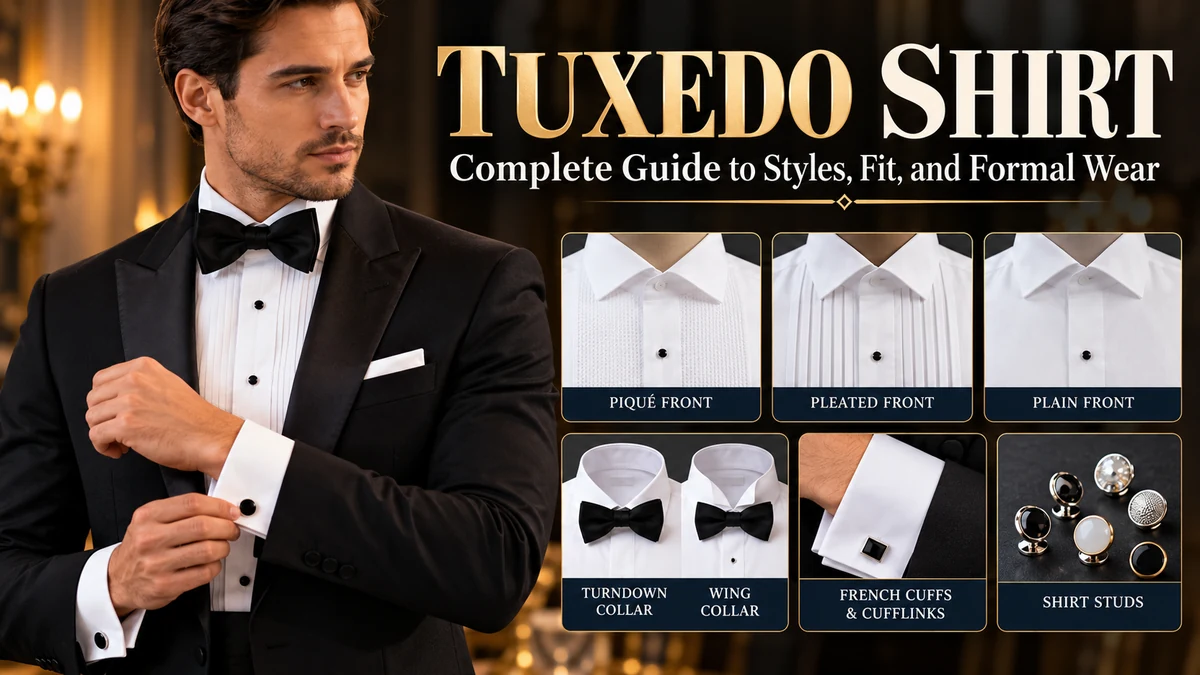
A tuxedo can be beautifully tailored, but the wrong shirt can make the entire outfit feel unfinished. Unlike an everyday white dress shirt, a tuxedo shirt is designed specifically for formal evening wear, with details that complement a dinner jacket, bow tie, studs, and cufflinks.
A tuxedo shirt is a formal shirt traditionally worn with a tuxedo or dinner jacket. It is usually white and may feature a pleated, piqué, or plain front, along with a turndown or wing collar and French cuffs. Many versions also accept removable shirt studs instead of ordinary buttons.
Understanding these details makes choosing one much easier. The goal is not simply to find a white shirt—it is to choose a shirt whose collar, front, cuffs, fabric, and fit work together with the rest of your black-tie clothing.
What Is a Tuxedo Shirt?
A tuxedo shirt, sometimes called a formal evening shirt, is designed to be worn beneath a tuxedo jacket. Its basic construction resembles a dress shirt, but several features distinguish traditional formal shirts.
The most recognizable differences are the shirt front, cuffs, and fastening system. A formal shirt may have a textured or pleated bib, French cuffs, and special buttonholes that accommodate removable studs.
Traditional versions are normally white because the strong contrast between a white shirt and a black or midnight-blue dinner jacket is a defining element of classic evening dress.
Some modern tuxedo shirts simplify the formula. They may use a plain front, concealed buttons, or a standard turndown collar while retaining the clean appearance expected with black tie.
Tuxedo Shirt vs. Regular Dress Shirt
A normal white dress shirt can look similar from a distance, but the two garments serve different purposes.
| Feature | Tuxedo Shirt | Regular Dress Shirt |
|---|---|---|
| Primary use | Black tie and formal evening wear | Business, suits, smart casual |
| Typical color | White | Many colors and patterns |
| Shirt front | Piqué, pleated, plain, or covered | Usually plain |
| Cuffs | Commonly French cuffs | Barrel or French cuffs |
| Fastening | Studs, concealed buttons, or buttons | Standard sewn buttons |
| Neckwear | Usually bow tie | Necktie or bow tie |
| Overall effect | Formal and ceremonial | Versatile everyday tailoring |
Formalwear guides commonly distinguish three principal front treatments: piqué bib, pleated bib, and plain tuxedo front.
That does not mean every tuxedo shirt must contain every traditional feature. Modern black tie allows somewhat more flexibility, particularly for weddings and contemporary evening events.
Tuxedo Shirt Front Styles
The front of the shirt is one of the first decisions to make because it remains visible between the lapels of the tuxedo jacket.
Piqué or Marcella Bib Front
A piqué bib is a textured panel covering the visible upper front of the shirt. In British formalwear terminology, the bird’s-eye textured cotton used for this style is often called Marcella.
The result is crisp and structured rather than decorative.
A piqué bib works especially well when you want a traditional formal appearance. The texture creates subtle contrast against the smoother body of the shirt while remaining understated beneath a black dinner jacket.
Piqué fronts are generally considered more formal than pleated fronts. Proper Cloth, for example, describes its piqué bib as its most formal tuxedo-shirt front.
Pleated Tuxedo Shirt
A pleated front uses narrow vertical folds running down either side of the shirt placket.
This is probably the style many people picture when they hear “tuxedo shirt.” The pleats introduce texture without requiring a separate piqué panel.
Pleated shirts are especially common at:
- Black-tie weddings
- Galas
- Formal dinners
- Balls and dances
- Evening celebrations
Narrow pleats generally create a cleaner contemporary appearance, while wider or more pronounced pleats can produce a stronger vintage effect.
The pleated bib remains a traditional black-tie option but is generally regarded as slightly less formal than a crisp piqué front.
Plain-Front Tuxedo Shirt
A plain-front tuxedo shirt removes most decorative detailing.
Instead of pleats or a textured bib, it uses a smooth front, often combined with a French placket or concealed fastening.
This is an increasingly useful choice for someone who prefers minimalist evening wear. It works particularly well with clean, modern tuxedos because there are fewer competing visual details.
Proper Cloth describes the plain front as the simplest and most versatile of its formal shirt-front options.
Fly or Covered Front
Another modern approach hides the shirt buttons beneath a strip of fabric.
The covered placket creates an uninterrupted vertical line down the shirt. It also eliminates the need for decorative studs.
This can be particularly effective with a minimalist tuxedo and bow tie.
Quick takeaway: Choose piqué for a highly traditional formal appearance, pleats for classic black tie with more texture, and a plain or covered front for a cleaner contemporary look.
Which Collar Should a Tuxedo Shirt Have?
The two collars most strongly associated with tuxedo shirts are the turndown collar and wing collar.
Turndown Collar
A turndown collar resembles the collar found on a conventional dress shirt.
Spread and semi-spread versions are especially useful because they frame a bow tie naturally while leaving enough room for the knot.
This has become an extremely common choice for contemporary black tie. Proper Cloth specifically recommends a spread—but not excessively cutaway—collar for its tuxedo shirts.
A turndown collar is a dependable option when wearing:
- A classic black tuxedo
- A midnight-blue tuxedo
- A shawl-collar dinner jacket
- A peak-lapel tuxedo
- A modern black-tie wedding outfit
Wing Collar
The wing collar has a short standing collar with two small folded points at the front.
It has deep roots in traditional formal evening dress and remains strongly associated with highly formal clothing.
However, simply choosing a wing collar does not automatically make an outfit better. The proportions of the collar, bow tie, shirt front, and jacket need to work together.
For most modern black-tie occasions, a well-proportioned turndown collar provides a straightforward and versatile solution. A wing collar makes more sense when deliberately pursuing a traditional formalwear aesthetic.
Pleated or Plain Tuxedo Shirt: Which Is Better?
Neither style is universally better.
The appropriate choice depends on how traditional you want the outfit to appear.
A pleated shirt creates visible texture and immediately signals formal evening wear. A plain shirt feels cleaner and more restrained.
Think of the choice this way:
| If you want… | Consider… |
|---|---|
| Traditional black tie | Pleated front |
| Highly formal texture | Piqué/Marcella bib |
| Clean modern styling | Plain front |
| No visible studs | Covered/fly front |
| Vintage character | Pleated or period-specific styling |
If this is your first tuxedo shirt, prioritize versatility and fit over unusual detailing. A white shirt with a well-shaped turndown collar, formal cuffs, and restrained front treatment can work with many dinner jackets.
French Cuffs and Cufflinks
The cuff is another area where a tuxedo shirt differs from many ordinary shirts.
French Cuffs
French cuffs—also called double cuffs—extend beyond the wrist and fold back onto themselves.
Instead of being closed with a sewn button, they are secured with cufflinks.
This makes them particularly appropriate for evening dress because they continue the polished, deliberate appearance of the shirt front.
What Cufflinks Work With a Tuxedo?
Keep them relatively restrained.
Classic choices include:
- Black onyx
- Mother-of-pearl
- Silver-toned metal
- Gold
- Black enamel
- Simple geometric designs
Black onyx, mother-of-pearl and precious metals have long been associated with formal shirt jewelry.
The cufflinks do not need to become the centerpiece of the outfit. Their purpose is to finish the shirt cleanly and add a controlled amount of detail.
What Are Tuxedo Shirt Studs?
Studs are small removable fasteners used instead of conventional shirt buttons on certain formal shirts.
They pass through specially constructed buttonholes along the front placket, creating decorative fastening points down the visible portion of the shirt.
Modern ready-to-wear tuxedo shirts commonly accommodate around four studs, although the exact number varies according to shirt construction and the wearer’s proportions. Historical conventions also varied.
Do You Have to Wear Studs?
Not necessarily.
If the tuxedo shirt has a covered placket or concealed fastening system, studs may not be required.
If the shirt was specifically designed for studs, however, using them gives the garment the appearance its construction was intended to create.
The safest approach is to inspect the shirt rather than assuming. Some formal shirts include removable buttons, while others provide dedicated stud holes or a concealed fly.
Should Studs Match Cufflinks?
A coordinated set produces the most traditional appearance.
That does not necessarily mean every component must be completely identical. Keeping the materials, metal tones, and overall level of formality consistent is usually enough to create visual harmony.
Best Fabric for a Tuxedo Shirt
Cotton is the foundation of most quality formal shirts, but the weave affects appearance, opacity, texture, and comfort.
Broadcloth
Broadcloth has a smooth, tightly woven surface.
It produces a crisp, minimal appearance that suits modern formalwear. Because some lightweight broadcloth can be relatively sheer, opacity should be checked before wearing it under strong event lighting.
Twill
Twill has a subtle diagonal weave.
It tends to drape smoothly and can offer greater opacity than lightweight broadcloth. Proper Cloth notes that white twill and broadcloth are both suitable formal-shirt fabrics, with twill generally offering more opacity and sheen.
Piqué
Piqué provides the raised texture associated with traditional formal bibs.
Rather than necessarily making the entire shirt from heavy textured material, many tuxedo shirts use piqué specifically on the visible front panel.
Poplin
Poplin is lightweight and smooth, making it useful when comfort and breathability matter.
Whatever weave you choose, avoid judging fabric only by thickness. A tuxedo shirt spends hours beneath a jacket, often at weddings, dinners, and crowded indoor events. Breathability and moisture management matter almost as much as visual crispness.
What Color Should a Tuxedo Shirt Be?
For conventional black tie, white is the standard choice.
White provides maximum contrast with black or midnight-blue evening jackets and complements the traditional white pocket square and black bow tie.
Colored shirts exist in fashion-oriented formalwear, but they change the character of the outfit and should not be confused with conventional black tie.
When an invitation specifically says black tie, a crisp white shirt is the most straightforward interpretation.
How Should a Tuxedo Shirt Fit?
Formal detailing cannot compensate for poor fit.
The shirt should sit close enough to the body that excess material does not balloon around the waist, but it should not pull across the chest or restrict movement.
Collar Fit
Fasten the collar and check that it sits securely around the neck without choking or creating obvious gaps.
Remember that you may wear the shirt for several hours. A collar that already feels uncomfortable before the event is unlikely to improve as the evening continues.
Shoulder Fit
The shoulder seams should align closely with the ends of your natural shoulders.
If they fall significantly beyond the shoulder, the shirt can appear oversized beneath the structured tuxedo jacket.
Chest and Waist
Look for a smooth front.
Horizontal pulling around the buttons indicates that the shirt is too tight. Large folds of material around the waist usually mean it is too loose.
Sleeve Length
The sleeve should be long enough to allow a small amount of shirt cuff to remain visible beyond the jacket sleeve when your arms are relaxed.
Proper Cloth’s ready-to-wear sizing illustrates why both collar and sleeve measurements matter when selecting a formal shirt rather than relying only on a generic small, medium, or large size.
Shirt Length
A tuxedo shirt should remain securely tucked into the trousers.
Formal shirts are therefore often cut longer than casual shirts. Some higher-end constructions even incorporate a tab designed to help secure the shirt front to the trousers and reduce billowing.
Quick takeaway: Judge tuxedo-shirt fit while wearing the trousers and jacket you intend to use. A shirt that looks fine by itself can behave differently once it is tucked into high-rise formal trousers and covered by a fitted dinner jacket.
How to Wear a Tuxedo Shirt Correctly
The shirt is only one part of a coordinated black-tie outfit.
A traditional combination generally consists of a white formal shirt, black or midnight-blue dinner jacket and matching trousers, black bow tie, appropriate evening shoes, and either a cummerbund or suitable formal waistcoat when the style calls for one.
The visible shirt front should remain neat between the jacket lapels.
Wear a Bow Tie
The bow tie is the conventional neckwear for black tie.
A self-tied black bow tie is the traditional option. Its slightly imperfect shape also tends to look more natural than an extremely rigid pre-tied bow.
Keep the Waist Covered
Traditional black tie aims to prevent an exposed band of white shirt from appearing between the jacket button and trouser waistband.
This is one reason formal trousers traditionally sit higher on the waist and why cummerbunds or formal waistcoats exist.
Coordinate Shirt and Jacket Details
A heavily textured shirt combined with numerous flashy accessories can make the outfit visually busy.
If the shirt has a pronounced pleated front, consider keeping the studs and cufflinks restrained. If the shirt is plain, subtle formal jewelry can supply a small amount of visual interest.
Proper Cloth similarly identifies a bibbed shirt as the more traditional formal approach and a plain or covered placket as a more modern alternative.
Can You Wear a Regular White Shirt With a Tuxedo?
You can physically wear one, but it may not create the same formal effect.
A high-quality white dress shirt with a clean turndown collar and French cuffs can work with some contemporary tuxedos, particularly when the event’s dress expectations are flexible.
For traditional black tie, however, a purpose-built tuxedo shirt offers advantages: its front, cuffs, collar, and fastening system are designed specifically around evening wear.
A business shirt with a chest pocket, casual buttons, button-down collar, or strongly patterned fabric will generally look less cohesive with a tuxedo.
Can You Wear a Tuxedo Shirt Without a Tuxedo?
Yes, but context matters.
Fashion has repeatedly borrowed formal evening shirts for less traditional outfits. A pleated or bib-front shirt can be deliberately styled with tailoring or even more casual clothing when the goal is fashion rather than dress-code correctness.
In fact, tuxedo shirts have also appeared as a broader fashion trend rather than exclusively as black-tie clothing.
That is different from attending a formal black-tie event, where the shirt is normally understood as one component of the complete evening ensemble.
Tuxedo Shirt for a Wedding
Weddings are one of the most common occasions for wearing tuxedos, but the invitation should guide the level of formality.
For a traditional evening wedding, a white formal shirt with a turndown collar, French cuffs, and either a pleated or piqué front creates a classic appearance.
For a contemporary wedding, a plain or concealed-front shirt can produce a cleaner result.
The groom should also consider how the shirt photographs. Strong pleats, unusual studs, oversized wing collars, and contrasting details become more noticeable in close-up photographs than they may appear in a mirror.
Fit is especially important. Weddings involve sitting, standing, dancing, photographs, and hours of wear, so the shirt needs enough mobility to remain comfortable without creating excess fabric under the jacket.
Common Tuxedo Shirt Mistakes
Small errors become noticeable because formalwear is intentionally simple.
Wearing an Obviously Casual Shirt
Button-down collars, chest pockets, bold patterns, and casual fabrics usually conflict with the streamlined character of a tuxedo.
Choosing the Wrong Size
An oversized shirt creates bunching beneath the jacket. An excessively tight shirt pulls at the placket and can make the collar uncomfortable.
Making Every Detail a Statement
Pleats, elaborate cufflinks, decorative studs, an unusual bow tie, and a bold pocket square can compete with one another.
Formalwear generally looks strongest when one consistent visual language runs through the entire outfit.
Ignoring the Shirt Front
If you plan to use studs, make sure the shirt is actually designed to accept them before the day of the event.
Studs replace standard front fasteners on compatible formal shirts; they are not simply decorative pieces pinned over ordinary buttons.
Wearing a Poorly Proportioned Collar
The collar frames both your face and bow tie. An oversized wing collar or extremely wide spread collar can disrupt otherwise balanced proportions.
How to Choose a Tuxedo Shirt
Instead of choosing based on one decorative detail, work through the outfit systematically.
- Check the dress code. Traditional black tie calls for more conventional choices than creative or optional black tie.
- Choose white for classic black tie. It remains the standard and most versatile formal-shirt color.
- Select the front. Pick piqué for a highly formal traditional look, pleats for classic texture, or plain/covered for minimal styling.
- Choose the collar. A turndown spread collar is highly versatile; a wing collar creates a more traditional formal effect.
- Check the cuffs. French cuffs and cufflinks remain a classic evening-wear combination.
- Decide between studs and concealed buttons. Let the shirt’s construction determine which fastening system works.
- Evaluate fabric. Look for opacity, breathability, crispness, and comfort.
- Test the complete fit. Try the shirt with your tuxedo trousers, bow tie, jacket, cufflinks, and waist covering rather than evaluating it in isolation.
Caring for a Tuxedo Shirt
A quality tuxedo shirt may only be worn a few times each year, which makes proper storage especially important.
Remove cufflinks and studs before laundering or sending the shirt for professional cleaning. Leaving removable hardware attached can damage both the jewelry and fabric.
Treat collar and cuff stains promptly because body oils can become harder to remove after prolonged storage.
Follow the garment’s care label rather than automatically using the hottest washing or ironing settings. Cotton weave, interfacing, pleating, and bib construction can affect appropriate care.
When ironing a pleated front, work carefully around each fold instead of flattening the structure. Piqué bibs should also retain their characteristic texture rather than being aggressively pressed flat.
Store the shirt completely clean and dry. Long-term storage with perspiration, fragrance, or food residue can cause discoloration.
Choosing the Right Tuxedo Shirt Comes Down to Balance
The best tuxedo shirt is not necessarily the one with the most formal details. It is the one whose details suit the dress code and work naturally with the rest of the outfit.
For classic black tie, start with white fabric, an appropriate formal front, a well-proportioned collar, and French cuffs. Add restrained studs and cufflinks when the shirt is designed for them. Piqué creates a crisp traditional effect, pleats provide recognizable black-tie texture, while plain and concealed fronts offer a cleaner modern alternative.
Above all, prioritize fit. When the collar sits correctly, the cuffs meet the jacket sleeves cleanly, the front remains smooth, and the shirt stays tucked throughout the evening, even understated formalwear looks intentional.