
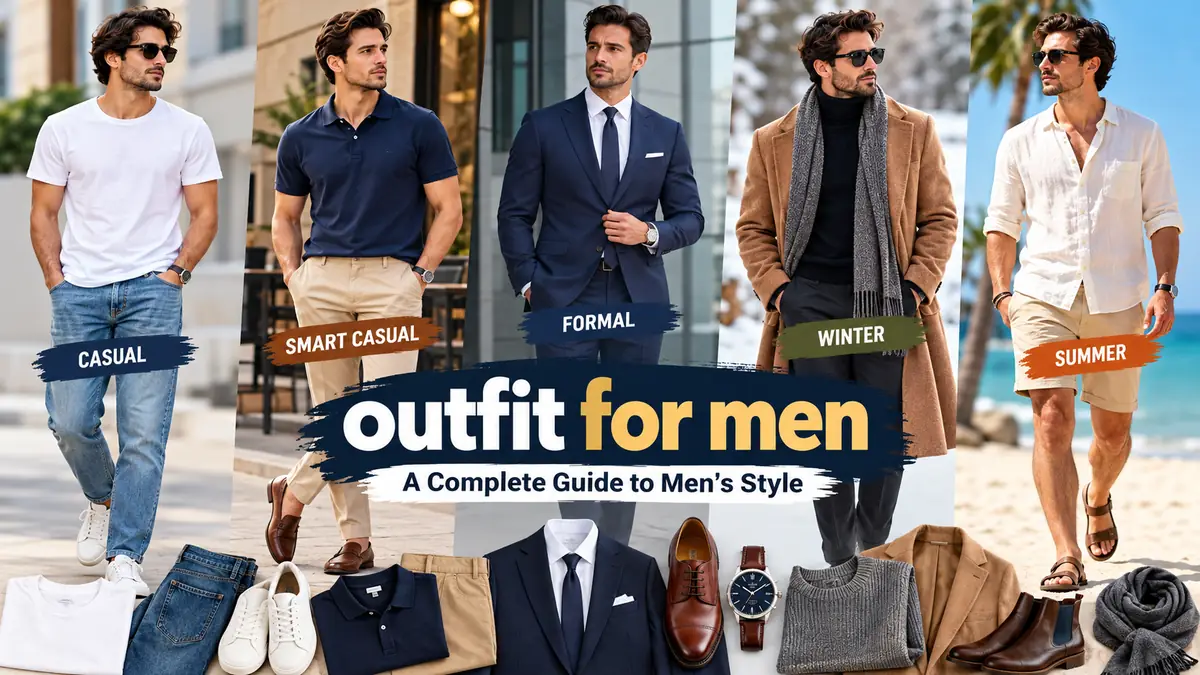
A great outfit doesn’t require expensive designer clothes or a wardrobe full of the latest trends. Often, the difference between looking ordinary and looking well-dressed comes down to fit, color coordination, and choosing the right clothes for the occasion.
Finding the right outfit for men starts with understanding a few simple principles: wear clothes that fit properly, combine complementary colors, choose appropriate footwear, and dress for the setting. From everyday jeans and T-shirts to business casual outfits and formal suits, a versatile wardrobe makes dressing easier.
Men’s fashion offers more variety than ever, but the fundamentals remain consistent. A white Oxford shirt, dark denim jeans, tailored chinos, neutral sneakers, and a well-fitting jacket can form the foundation of dozens of combinations.
This guide explains how to build stylish men’s outfits for different occasions, seasons, and personal preferences without making your wardrobe unnecessarily complicated.
How to Choose the Right outfit for men
Before putting together an outfit, consider three things: where you’re going, what the weather is like, and how you want to present yourself.
Understand the dress code
Different settings call for different levels of formality.
| Dress code | Typical clothing | Suitable occasions |
|---|---|---|
| Casual | T-shirt, jeans, sneakers | Everyday activities, weekends |
| Smart casual | Polo, chinos, loafers | Dinner dates, social gatherings |
| Business casual | Oxford shirt, tailored trousers | Offices, professional meetings |
| Business formal | Suit, dress shirt, leather shoes | Corporate events, formal workplaces |
| Black tie | Tuxedo, formal shirt, bow tie | Formal evening events |
Dress codes can vary by country, industry, and venue. For example, dark jeans might be acceptable in a creative workplace but inappropriate in a traditional corporate office.
Prioritize fit over brand names
A properly fitted inexpensive shirt usually looks better than an expensive shirt with awkward proportions.
Pay attention to shoulder seams, sleeve length, trouser breaks, and how clothing sits around your chest and waist.
Clothes should allow comfortable movement without excessive fabric bunching or pulling.
Build around neutral colors
Navy, black, white, gray, beige, olive, and brown are useful foundation colors because they work in many combinations.
A simple starting formula is one main neutral, one supporting neutral, and an optional accent color.
Casual Outfit Ideas for Men
Casual clothing should feel comfortable without looking careless. The best everyday combinations are simple, functional, and easy to repeat.

1. T-shirt, jeans, and white sneakers
A plain white crew-neck T-shirt with straight-fit blue jeans and clean white sneakers is a reliable everyday combination. Add a lightweight overshirt when the temperature drops.

2. Polo shirt and chinos
A navy polo shirt with beige chinos creates a polished appearance without feeling formal. Minimalist sneakers or suede loafers work well with this combination.

3. Hoodie and tapered joggers
Choose a structured hoodie, tapered joggers, and understated sneakers for an athletic-inspired outfit. Avoid excessively baggy or worn-out pieces when aiming for a neat appearance.
How can men make casual outfits look better?
The simplest improvements involve maintaining your clothing, choosing consistent proportions, and paying attention to shoes.
A clean pair of sneakers, a T-shirt with the right shoulder fit, and trousers that don’t pool excessively around the ankles can improve an entire look.
Casual doesn’t have to mean oversized, although relaxed silhouettes can work when the overall proportions are intentional.
Smart Casual outfit for men
Smart casual sits between relaxed everyday clothing and traditional formalwear. It’s particularly useful for restaurants, casual offices, family celebrations, and dates.
Oxford shirt with tailored chinos
A light-blue Oxford cloth button-down shirt pairs naturally with navy or stone chinos.
You can wear the shirt tucked in for a more polished appearance or untucked if its length and hem are designed for that style.
Complete the outfit with leather loafers, suede desert boots, or simple sneakers, depending on the occasion.
Knit polo with tailored trousers
A fine-knit polo offers a slightly more refined appearance than a traditional cotton piqué polo.
Try a cream knit polo with charcoal trousers and dark-brown loafers. The combination uses texture to create interest without relying on bold prints.
Blazer with dark denim


12
A navy blazer, plain shirt, dark indigo jeans, and leather shoes can work for smart casual events.
Choose dark denim without heavy distressing and a blazer with a comfortable, natural shoulder.
Not every blazer works with jeans. Highly structured suit jackets may look mismatched when worn with casual denim.
Formal and Business Outfit Ideas for Men
Formal dressing relies on clean lines, appropriate tailoring, restrained accessories, and footwear that matches the level of formality.
Classic navy suit
A navy two-piece suit is one of the most adaptable options in men’s tailoring.
Combine it with a white dress shirt, dark-brown Oxford shoes, and a coordinating leather belt for a traditional business appearance.
A dark tie adds formality, while an open collar may be appropriate for less formal occasions.
Charcoal suit for professional settings
Charcoal gray is another useful suit color, particularly for business meetings and formal daytime events.
Black leather Oxford shoes are a traditional choice. Dark-brown shoes can also work in many business environments, depending on the dress code.
Black-tie evening outfit
For an event explicitly marked black tie, the traditional choice is a tuxedo rather than an ordinary business suit.
A classic black-tie ensemble includes a dinner jacket with satin or grosgrain facings, matching formal trousers, a white formal shirt, a black bow tie, and polished black shoes.


8
Common formalwear mistakes
One frequent mistake is wearing a suit that’s too tight through the shoulders or thighs. Another is choosing trousers that are much too long.
Other details matter too: a dress shirt should sit neatly beneath the jacket, socks should be appropriate when seated, and shoes should be clean and maintained.
Tailoring small fit issues often makes a bigger visual difference than adding expensive accessories.
Seasonal Outfit Ideas for Men
Weather affects more than comfort. It determines which fabrics, layers, colors, and footwear work best together.
Summer outfits for men


9
During hot weather, lightweight fabrics and breathable silhouettes help keep clothing comfortable.
Linen, cotton poplin, lightweight cotton jersey, and certain breathable fabric blends are useful options.
Three practical summer combinations include:
- Relaxed summer: White linen shirt, beige shorts, and leather sandals.
- Smart summer: Light-blue polo, stone chinos, and suede loafers.
- Weekend summer: Cotton T-shirt, tailored shorts, and canvas sneakers.
Linen wrinkles naturally, which is part of its relaxed character. For a neater appearance, choose a linen-cotton blend.
In particularly humid weather, looser silhouettes may feel more comfortable than tight-fitting clothes.
Winter outfits for men


12
Cold-weather dressing is about combining insulation with practical layering.
A useful winter outfit starts with a comfortable base layer, adds a sweater or fleece, and finishes with an appropriate coat.
Try a charcoal turtleneck with a camel overcoat, dark trousers, and Chelsea boots for a refined winter appearance.
For a casual option, combine a navy puffer jacket with a heavyweight sweatshirt, straight-leg jeans, and weather-resistant boots.
Wool, merino wool, fleece, and insulated outerwear can provide warmth, while wind-resistant shells help reduce heat loss in exposed conditions.
Spring and autumn outfits
Transitional seasons are ideal for lightweight layering.
An Oxford shirt, overshirt, chinos, and sneakers create a versatile spring combination. For autumn, swap the overshirt for a Harrington jacket or a knitted cardigan.
Denim jackets, bomber jackets, chore coats, and lightweight trench coats are also useful depending on the weather and setting.
The goal is to add or remove layers without disrupting the overall outfit.
outfit for men for Different Occasions
A stylish outfit should suit the activity, not just look good in a photograph.
College and university outfits
Students generally benefit from comfortable clothing that can handle long days of walking, studying, and commuting.
Straight-leg jeans, a simple T-shirt, an overshirt, and sneakers create an easy everyday combination.
Cargo trousers, relaxed denim, hoodies, and varsity jackets are alternatives for those who prefer streetwear.
Keep footwear practical and consider carrying a lightweight layer for changing temperatures.
Date night outfits
For a casual dinner, try a dark knit polo, tailored trousers, and loafers.
For a relaxed coffee date, dark jeans, a clean crew-neck T-shirt, and a casual jacket work well.
The location should guide the outfit. A fine-dining restaurant may call for a collared shirt and leather shoes, while an outdoor daytime date allows more relaxed clothing.
Avoid wearing something completely unfamiliar if it makes you uncomfortable or requires constant adjustment.
Wedding guest outfits
Wedding attire depends on the invitation, venue, season, and cultural traditions.
A navy or charcoal suit works for many formal and semi-formal celebrations, while lighter suits may suit daytime summer weddings.
For traditional South Asian celebrations, a well-fitted kurta pajama or shalwar kameez can be appropriate, sometimes paired with a waistcoat or traditional footwear.
Always check whether the hosts have specified a dress code or cultural expectations.
Travel outfits
Travel clothing should balance mobility, comfort, temperature control, and appearance.
Stretch chinos, a breathable T-shirt, lightweight knitwear, and comfortable sneakers make a practical airport outfit.
A wrinkle-resistant overshirt or jacket can help you transition from traveling to sightseeing or casual dining.
Choose footwear you can comfortably walk in for extended periods rather than prioritizing appearance alone.
Office outfits
Business casual clothing varies significantly between workplaces.
For a traditional office, start with an Oxford shirt, chinos or tailored trousers, and leather shoes.
In a relaxed workplace, dark jeans, a knitted polo, and minimalist sneakers may be acceptable.
When starting a new job, observe how colleagues dress before experimenting with more casual combinations.
GQ
+1
How to Match Colors in Men’s Clothing
Color coordination is one of the easiest ways to make basic clothing look intentional.
You don’t need complicated color theory. Start with a limited palette and use contrast thoughtfully.
Reliable men’s outfit color combinations
| Main color | Matching color | Example outfit |
|---|---|---|
| Navy | Beige | Navy polo with beige chinos |
| Black | Gray | Black T-shirt with charcoal trousers |
| White | Olive | White shirt with olive chinos |
| Brown | Cream | Brown knitwear with cream trousers |
| Light blue | Navy | Light-blue shirt with navy trousers |
| Burgundy | Charcoal | Burgundy sweater with charcoal trousers |
| Forest green | Stone | Green overshirt with stone chinos |
Is an all-black outfit a good choice?
Yes. An all-black outfit can look streamlined and modern when the garments have complementary proportions.
Try a black heavyweight T-shirt with black straight-leg jeans and black leather boots.
To avoid a flat appearance, introduce texture through denim, knitwear, suede, or leather.
Can men wear bright colors?
Absolutely. Neutral colors are useful foundations, but they aren’t the only stylish choices.
Current menswear discussions include expressive shades such as cherry red, ocean blue, green, and butter yellow, alongside deeper neutrals such as chocolate brown and olive.
GQ
+1
For a balanced look, pair one colorful item with quieter pieces. A burgundy sweater with charcoal trousers is easier to coordinate than several competing bright colors.
Personal preference matters more than following every seasonal color trend.
Essential Wardrobe Pieces Every Man Should Own
A versatile wardrobe makes daily outfit planning faster because individual garments can work in several combinations.
This approach is often called a capsule wardrobe: a smaller selection of complementary pieces that covers most everyday situations.
GQ
+1
Core clothing essentials
| Clothing item | Versatile option | Main use |
|---|---|---|
| Plain T-shirt | White, black, or gray | Casual outfits and layering |
| Oxford shirt | White or light blue | Smart casual and business casual |
| Polo shirt | Navy or cream | Refined everyday outfits |
| Jeans | Dark indigo or black | Casual and smart casual |
| Chinos | Beige, olive, or navy | Everyday and semi-formal settings |
| Tailored trousers | Charcoal | Office and evening outfits |
| Sweater | Gray or navy | Layering in cooler weather |
| Casual jacket | Denim or Harrington | Transitional seasons |
| Blazer | Navy | Smart casual occasions |
| Suit | Navy or charcoal | Formal events |
| Sneakers | Minimal white or neutral | Everyday footwear |
| Leather shoes | Brown or black | Business and formal occasions |
Not everyone needs every item. Someone working remotely in a warm climate may wear T-shirts and lightweight trousers far more frequently than suits and wool sweaters.
Build around your actual routine rather than an arbitrary wardrobe checklist.
How many outfits can a small wardrobe create?
A wardrobe with five interchangeable tops, four pairs of trousers, and three footwear options offers many theoretical combinations.
However, not every combination will be suitable for every occasion. Formality, fabric weight, and color compatibility still matter.
A useful method is to plan five complete outfits before adding a new garment to your wardrobe.
How to Choose Shoes for Every Outfit
Shoes strongly influence whether an outfit looks casual, sporty, refined, or formal.

Minimal sneakers
Jeans, chinos, casual trousers

Suede loafers
Smart casual and summer tailoring

Chelsea boots
Autumn, winter, evening outfits

Oxford shoes
Business suits and formal events
Other useful footwear includes Derby shoes, brogues, desert boots, canvas sneakers, and athletic trainers.
The distinction between Oxford and Derby shoes is primarily their lacing construction. Oxfords feature closed lacing, while Derbies use open lacing, which generally creates a less formal appearance.
For everyday outfits, consider the shape of the shoe as well as its color. Chunky sneakers tend to create a different silhouette from slim leather sneakers.
Should shoes and belts match?
For traditional formalwear, matching leather shoes and belts in similar shades is a reliable convention.
With casual outfits, exact matching is less necessary. A brown belt and tan suede shoes can coordinate without being identical.
The overall appearance should feel harmonious rather than mechanically matched.
Men’s Fashion Trends in 2026
Men’s fashion in 2026 includes both relaxed silhouettes and more tailored, minimalist approaches.
Contemporary styling is not limited to one dominant fit. Roomy blazers, expressive color, refined basics, and understated monochromatic outfits all appear in recent fashion coverage.
GQ
+1
Relaxed and wide-leg trousers
Wide-leg jeans and relaxed trousers offer more room through the thigh and leg than slim-fit styles.
They often pair well with boxy T-shirts, cropped jackets, knitwear, and structured outerwear.
For balance, pay attention to trouser length. Excess fabric gathering around the shoes can look intentional in some streetwear outfits but untidy in others.
Minimalist menswear
Minimalist style focuses on restrained colors, clean shapes, subtle details, and useful clothing.
A cream knit polo, dark trousers, and simple loafers can create a refined outfit without prominent logos.
Minimalism is not necessarily expensive. Fit and fabric maintenance make a significant difference.
Modern tailoring
Traditional suits remain relevant, but contemporary tailoring allows greater variation in jacket structure, trouser width, and layering.
An unstructured blazer with a fine-knit shirt and relaxed tailored trousers can look polished without resembling conventional office attire.
Workwear-inspired clothing
Chore jackets, utility trousers, overshirts, denim, and sturdy boots draw inspiration from practical work clothing.
These pieces often use durable fabrics and functional pockets.
For a balanced outfit, combine one workwear-inspired item with simpler clothing rather than layering several bulky garments.
Should men follow every fashion trend?
No. Trends are most useful as sources of inspiration.
A new silhouette or color may complement your wardrobe, but it shouldn’t replace clothing that already fits your lifestyle.
A consistent personal style usually develops through experimenting with proportions, fabrics, and combinations over time.
How to Dress Well for Your Body Proportions
Men’s clothing looks different depending on height, shoulder width, torso length, and overall proportions.
Rather than treating body shapes as strict categories, focus on how individual garments sit on your frame.
For shorter men
Well-proportioned clothing can create a balanced silhouette.
Consider jackets that end near the hip, trousers with controlled length, and outfits with limited abrupt color breaks.
High-rise trousers may visually lengthen the legs, depending on torso proportions.
Avoid assuming that oversized clothing is automatically unsuitable. The key is choosing intentional volume and correct lengths.
For taller men
Taller men can experiment with longer outerwear, relaxed trousers, and layered combinations.
Check sleeve and trouser lengths carefully, particularly with ready-to-wear clothing.
A jacket that fits the shoulders but has sleeves that are too short may require a different size or a tall-specific cut.
For broader builds
Look for shirts that accommodate the chest and shoulders without pulling at buttons.
Straight-leg or gently tapered trousers can create comfortable proportions.
Avoid excessively tight fabrics that restrict movement, and consider structured garments that maintain their shape.
For slimmer builds
Layering can introduce visual depth through overshirts, sweaters, and jackets.
Straight or relaxed trousers may offer a different silhouette from skinny jeans.
Textured fabrics such as corduroy, denim, and substantial cotton jersey can also add visual interest.
There is no universal requirement to dress in a way that makes the body look taller, slimmer, or broader. Comfort and individual style remain valid priorities.
Common Men’s Outfit Mistakes and How to Avoid Them
Even good-quality clothing can look awkward when the pieces don’t work together.
Wearing the wrong size
Clothes that pull across the chest, restrict movement, or hang awkwardly may need adjustment.
Try multiple cuts instead of assuming that one brand’s medium or large will fit consistently.
Mixing incompatible levels of formality
Running shoes with a formal business suit may feel mismatched in a conservative setting.
However, sneakers with relaxed tailoring can work in creative or casual environments.
The context determines whether a combination feels appropriate.
Ignoring fabric care
Faded colors, stains, damaged collars, and heavily creased clothing can undermine an otherwise coordinated outfit.
Follow garment care labels, avoid excessive heat when washing delicate fabrics, and store jackets appropriately.
Using too many statement pieces
A patterned shirt, brightly colored trousers, oversized jewelry, and bold sneakers may compete for attention.
A simpler approach is to choose one prominent element and keep the rest relatively understated.
Forgetting comfort
An outfit that constantly needs adjusting can make even a well-dressed person uncomfortable.
Before leaving, sit down, walk, bend your arms, and check whether the clothing moves naturally.
How to Build Your Personal Style
Personal style develops when you understand which clothing combinations suit your activities and preferences.
Start by identifying the outfits you already enjoy wearing. Look for recurring patterns in colors, fits, and footwear.
Then experiment gradually.
For example, someone who normally wears jeans and graphic T-shirts might try plain heavyweight tees, an Oxford overshirt, or tailored chinos.
Someone accustomed to formal business clothing might experiment with knitted polos, unstructured blazers, and suede loafers for weekends.
A practical exercise is to photograph several outfits and compare them. This can reveal which proportions and colors work well together.
You can also draw inspiration from established menswear traditions such as Ivy style, classic tailoring, workwear, sportswear, and contemporary streetwear.
The goal isn’t to imitate a single aesthetic perfectly. It’s to develop a wardrobe that feels coherent and useful.
Final Thoughts on Choosing an outfit for men
Choosing the right outfit for men becomes much easier when you focus on fit, occasion, fabric, color, and comfort rather than constantly changing trends.
Start with versatile essentials such as plain T-shirts, Oxford shirts, jeans, chinos, knitwear, and appropriate footwear. Learn a few reliable combinations for casual days, work, social occasions, and formal events.
Experiment with seasonal layering, different silhouettes, and colors that reflect your preferences.
A well-dressed wardrobe doesn’t have to be large or expensive. It simply needs to contain clothes that work together, fit comfortably, and suit the way you actually live.