
A pair of dress shoes can look elegant but still feel wrong for the occasion. The difference often comes down to a small construction detail: how the laces are attached.
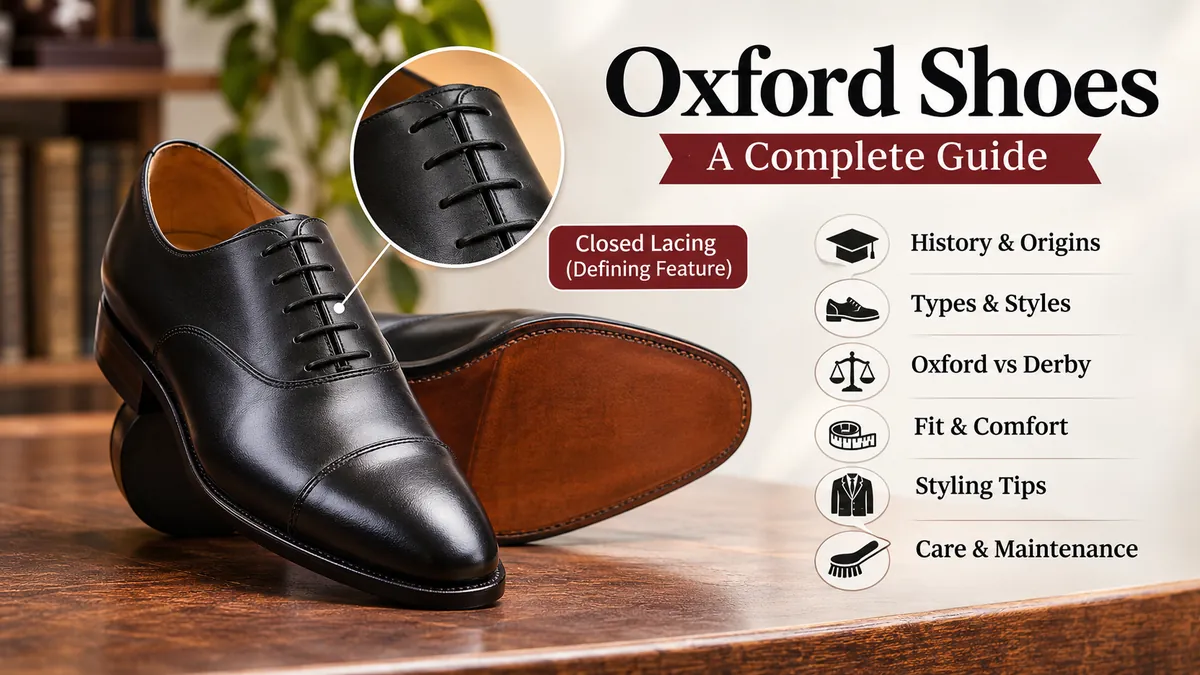
oxford shoes are classic lace-up footwear distinguished by their closed lacing system, where the eyelet tabs are sewn beneath the vamp. This creates a clean, streamlined appearance associated with formal dressing. Available in leather, suede, and several decorative styles, Oxfords work with business suits, wedding attire, and selected smart-casual outfits.
Understanding their construction, variations, and fit makes it much easier to distinguish genuine Oxfords from similar-looking shoes.
What Are oxford shoes?
Oxford shoes are a traditional style of lace-up footwear recognized by their closed lacing construction. The defining feature is the relationship between the vamp, which covers the front of the foot, and the quarters, which form the sides and rear of the upper.
On an Oxford, the lower portions of the eyelet tabs are secured beneath the vamp. As a result, the facing panels come together in a relatively narrow opening when the laces are tightened.
This creates the neat silhouette that makes Oxfords a longstanding choice for formal and professional clothing.
Key features of Oxford footwear
Several characteristics help identify an Oxford:
- Closed lacing: The eyelet tabs are attached beneath the vamp rather than sitting freely above it.
- Streamlined upper: The shoe generally has a smooth profile with limited bulk around the instep.
- Defined heel: Traditional dress Oxfords have a low, separate heel.
- Structured construction: Many use leather linings, reinforced heel counters, and shaped insoles.
- Versatile designs: Styles range from undecorated wholecuts to heavily perforated brogues.
Not every Oxford is equally formal. Material, color, toe design, sole thickness, and decorative detailing all influence its appearance.
Why is closed lacing important?
Closed lacing does more than create a recognizable look. It also affects how the shoe accommodates the top of the foot.
Because the eyelet panels have limited room to spread apart, Oxfords may feel restrictive on people with high insteps. Derby shoes, which have open lacing, generally offer more adjustment in this area.
This is why two shoes of the same labeled size can feel noticeably different.
The History and Origins of Oxford Shoes
The history of Oxford footwear is closely associated with British university fashion and nineteenth-century changes in men’s clothing.
Before low-cut lace-up shoes became widespread, boots were common everyday footwear for European men. Over time, shorter shoes became more acceptable for urban and professional use.
The connection to Oxford University
One frequently repeated explanation links the style to students at the University of Oxford in England.
According to this account, students favored lower, more comfortable footwear as an alternative to tall boots. The term Oxonian is often mentioned in discussions of the style’s early development.
However, the precise origin of the modern Oxford shoe is not conclusively established. Historical accounts differ, and the name’s association with the university should not be treated as proof that the present-day design was invented there.
The Scottish and Irish connection
Another historical tradition associates early closed-lacing footwear with Scotland and Ireland, where similar shoes are sometimes called Balmorals.
The term Balmoral is particularly common in American footwear terminology, although its meaning varies by maker and region.
Some manufacturers use it broadly for closed-lacing dress shoes, while others reserve it for particular upper constructions.
How Oxfords became formal footwear
During the nineteenth and twentieth centuries, low-cut leather shoes gradually became standard components of tailored men’s clothing.
As business suits became more common, smooth black and brown Oxfords developed a strong association with professional dress.
Today, the style is also found in women’s footwear, contemporary fashion collections, and less formal designs.
Its longevity comes from a simple combination: recognizable construction and a silhouette that works across changing fashion trends.
Types of oxford shoes and Their Differences
Although all traditional Oxfords share closed lacing, their appearance varies considerably.
The main distinctions involve toe construction, decorative perforations, seams, and materials.
1. Plain-Toe Oxfords
Plain-toe Oxfords have a smooth front without a separate toe-cap seam. Their understated design makes them suitable for formal business attire and tailored suits.
Allen Edmonds Men’s Siena Clean Cap Toes Oxford – Sithimy.com
2. Cap-Toe Oxfords
A cap-toe Oxford has a visible seam crossing the front of the shoe. Black versions are especially common in conservative offices, formal meetings, and weddings.
Loake Chester 2 Tan (Leather sole) Leather Shoes – Wagstaff Shoes
3. Wingtip Oxfords
Wingtip Oxfords feature a toe cap extending backward in a wing-like shape. They often include brogue perforations, creating a more decorative and usually less formal appearance.
Buy Plain Wholecut Oxford – Dark Brown colour shoe for men online – 3DM Lifestyle
4. Wholecut Oxfords
Wholecuts are made with an upper cut primarily from one piece of leather, apart from necessary seams and components. Their smooth surface creates a refined look, although the quality of leather and finishing is especially noticeable.
993 Saddle Bal Oxford (Black Shell Cordovan) – The Alden Shop
5. Saddle Oxfords
Saddle shoes have a contrasting band of material across the midfoot. They are commonly associated with vintage American casual style, school uniforms, and retro fashion.
What about brogue Oxfords?
Brogue is a decorative category rather than a separate lacing construction.
Brogue detailing consists of small perforations and, in some designs, serrated edges along leather panels.
Common variations include:
- Quarter brogues, with minimal perforation.
- Semi-brogues, featuring a decorated toe cap.
- Full brogues, commonly identified by wingtip detailing.
An Oxford can be a brogue, but not every brogue is an Oxford. Derby shoes and boots can also feature broguing.
Which Oxford style is most formal?
A traditional black patent-leather Oxford is a conventional choice for many black-tie dress codes, while a polished black plain-toe or cap-toe Oxford is well suited to formal business clothing.
As a general principle, smooth leather, dark colors, slim soles, and limited decoration create a more formal appearance.
Heavy broguing, contrasting panels, suede, and chunky soles usually move the shoe toward smart-casual dressing.
Oxford vs Derby Shoes: Understanding the Difference
Oxford and Derby shoes are often confused because both are low-cut lace-up styles that can look similar from a distance.
Their most important difference is how the eyelet panels connect to the upper.
Men’s Leather Oxford Shoe – Fratelli Rossetti
Oxford — closed lacing
Derbies à lacets en cuir marron homme | La Halle
Derby — open lacing
| Feature | Oxford | Derby |
|---|---|---|
| Lacing | Closed | Open |
| Eyelet panels | Secured beneath vamp | Attached above vamp |
| Appearance | Generally sleeker | Generally more relaxed |
| Instep adjustment | More limited | Usually more flexible |
| Formality | Traditionally more formal | Often business or smart casual |
| Typical use | Formal suits, office wear | Office wear, chinos, casual tailoring |
Are Oxford shoes more formal than Derbies?
Generally, yes. Traditional Oxfords are associated with formal tailoring because of their clean lacing arrangement.
However, construction alone does not determine formality.
A black polished Derby with a slim leather sole may look more formal than a thick-soled suede Oxford with elaborate broguing.
Color, material, silhouette, and decoration should always be considered together.
Which is better for wide feet?
Derbies often accommodate wide feet and high insteps more comfortably because their open lacing provides additional adjustment.
That does not mean Oxfords are unsuitable for wide feet. Many manufacturers offer wider fittings or lasts with more instep volume.
The critical factor is the shape of the shoe’s last, not simply the style name.
Materials, Construction, and Quality
Two pairs of Oxford shoes can look almost identical while differing substantially in comfort, durability, and repairability.
These differences usually come from the upper material, sole, lining, and method used to attach the sole.
Full-grain and calf leather
Calfskin is a common material for refined dress shoes because it can offer a smooth finish and supple feel.
Full-grain leather retains its natural grain surface and may develop an attractive patina with proper care.
Neither term guarantees quality by itself. Tanning, finishing, hide selection, and manufacturing standards also matter.
Correctly maintained leather can remain serviceable for years, but it still needs protection from prolonged moisture and excessive heat.
Suede Oxford shoes
Suede has a soft, textured surface produced from the flesh side of a hide or split leather.
It creates a less formal appearance than polished smooth leather and works well with textured trousers, chinos, and seasonal tailoring.
Suede requires different care. A suede brush and suitable protective spray are generally preferable to ordinary leather cream.
Leather soles versus rubber soles
| Sole material | Advantages | Limitations |
|---|---|---|
| Leather | Traditional appearance, relatively slim profile | Can be slippery on wet surfaces and wear faster under harsh conditions |
| Rubber | Better practical grip in many conditions, moisture resistance | May create a heavier appearance |
| Combination | Balances classic styling and traction | Quality depends on construction and materials |
A rubber sole does not automatically make a shoe low quality. Well-designed rubber soles are used in many premium dress shoes.
Goodyear welted construction
In a traditional Goodyear-welted shoe, a welt is stitched to the upper and an insole-related attachment structure. The outsole is then stitched to the welt.
This method can make resoling more straightforward when the shoe is otherwise in good condition.
It may also create a slightly more substantial sole edge.
Blake-stitched construction
Blake stitching attaches the outsole to the upper and insole through stitching that passes through the interior of the shoe.
It often allows a slimmer, more flexible profile.
However, resoling requires appropriate machinery and expertise.
Cemented construction
Cemented shoes use adhesive to attach the outsole rather than relying primarily on a stitched attachment.
They can be lightweight and affordable, but repairability varies considerably.
A high-quality adhesive construction can perform well, so the method should be evaluated alongside the materials and intended use.
How Should oxford shoes Fit?
Fit is particularly important for Oxfords because their closed lacing offers less room for adjustment over the instep.
A shoe that looks excellent but presses painfully against the top of the foot is unlikely to become comfortable simply through repeated wear.
Check the toe area
Your toes should have enough space to rest naturally without pressing against the front or sides.
The amount of visible empty space ahead of the toes varies according to the shape of the last.
A long, pointed toe design may have more unused space than a rounded design without being oversized.
Check the widest part of the foot
The ball of your foot should align with the widest part of the shoe.
If the shoe pinches at this point, increasing the length may not solve the problem. A wider fitting or different last is often more appropriate.
Examine the lacing gap
A small, even gap between the facing panels is normal on many Oxford designs.
If the panels are pulled very far apart and create pressure across the instep, the shoe may lack sufficient volume.
If the panels overlap or close completely while the foot still feels loose, the shoe may be too roomy in that area.
Neither observation is an absolute sizing rule, but both can help diagnose fit.
Assess heel movement
A little initial heel movement can occur in stiff new leather shoes, but excessive slipping is undesirable.
Your heel should feel supported while walking without substantial lifting or rubbing.
Try shoes at the right time
Feet can change slightly in volume throughout the day, particularly after prolonged standing or walking.
Trying dress shoes later in the day, with the socks you intend to wear, can provide a more realistic assessment.
Do not assume that painful shoes will eventually stretch enough to fit. Leather may soften and adapt modestly, but a fundamentally incorrect size or shape is unlikely to become suitable.
How to Style Oxford Shoes for Different Occasions
The Oxford’s reputation for formality does not mean it belongs exclusively with business suits.
The most successful combinations depend on matching the shoe’s level of refinement with the rest of the outfit.
Oxford shoes with a business suit
Black cap-toe Oxfords are a dependable option with charcoal, navy, and black business suits.
Dark brown Oxfords also work well with many navy and gray suits, particularly in workplaces where brown footwear is accepted.
The trousers should fall cleanly over the shoes without excessive fabric bunching at the ankle.
A matching or harmonizing belt helps create a cohesive appearance.
Oxford shoes for weddings
For a formal daytime wedding, polished black or dark brown leather Oxfords can complement tailored suits.
Black-tie events generally call for more specific footwear, such as black patent-leather dress Oxfords or highly polished formal alternatives.
Wedding dress codes vary, so the invitation and venue should guide the final choice.
Oxford shoes with chinos
Brown suede Oxfords, brogue Oxfords, and less formal leather variations can work with chinos.
Navy, beige, olive, and gray trousers are common combinations.
A highly polished black plain-toe Oxford may appear too formal with relaxed cotton chinos, particularly when paired with a casual shirt.
The overall outfit should feel balanced rather than assembled from unrelated dress codes.
Can you wear Oxford shoes with jeans?
Yes, but some versions work better than others.
Dark, clean jeans can pair with brown brogue Oxfords or textured suede styles.
Distressed denim, oversized casual silhouettes, and very formal black dress Oxfords tend to create a more difficult contrast.
Straight or tapered jeans with an appropriate hem generally work better than trousers that bunch heavily over the shoe.
Women’s Oxford shoes
Women’s Oxfords include traditional flat lace-ups, platform designs, heeled versions, and contemporary styles with chunky soles.
They can be worn with tailored trousers, skirts, dresses, and jeans.
A slim leather Oxford can create a polished professional outfit, while a heavier platform version may provide a more fashion-forward contrast.
The same defining principle still applies: closed lacing distinguishes an Oxford from other lace-up shoe constructions.
How to Clean and Maintain Oxford Shoes
Good shoe care helps preserve appearance and can extend the useful life of leather footwear.
The appropriate routine depends on the material and how frequently the shoes are worn.
Cleaning smooth leather Oxfords
- Remove surface dust using a soft brush or clean cloth.
- Wipe away light dirt with a slightly damp cloth when appropriate.
- Allow the leather to dry naturally, away from direct heat.
- Apply a small amount of suitable leather conditioner when needed.
- Use matching shoe cream to refresh color and finish.
- Apply wax polish selectively when a higher shine is desired.
- Buff gently with a clean brush or cloth.
Avoid applying excessive conditioner or polish. Heavy product buildup can dull the finish and attract dirt.
Always test unfamiliar products on an inconspicuous area.
Caring for suede Oxfords
Suede requires a different approach.
Use a dedicated suede brush to lift dirt and restore the nap. A suede eraser can help with certain dry marks.
Avoid ordinary leather wax and cream, which can alter the texture and appearance.
If suede becomes wet, allow it to dry naturally before brushing. Stuffing the shoes lightly with clean, absorbent paper can help them retain their shape during drying.
Why shoe trees matter
Cedar shoe trees are commonly used to help maintain shape, reduce creasing, and absorb some residual moisture.
They are particularly useful for leather dress shoes that are worn regularly.
Choose a tree that supports the shoe without stretching it aggressively.
Should Oxford shoes be worn every day?
Leather shoes generally benefit from time to dry between wears, especially when exposed to perspiration or damp conditions.
Rotating between pairs can reduce prolonged moisture exposure and give the materials time to recover.
The required rest period depends on climate, use, and how damp the shoes become.
Common Mistakes When Choosing Oxford Shoes
Even experienced dress-shoe wearers can overlook practical details.
Choosing appearance over fit
A narrow, elegant silhouette may look appealing, but pressure on the toes or instep is a sign that the last may not suit your foot.
Fit should come before styling.
Confusing broguing with lacing construction
Decorative perforations do not determine whether a shoe is an Oxford.
Look at the eyelet panels. If they are secured beneath the vamp, the shoe uses Oxford-style closed lacing.
Assuming expensive shoes always last longer
Price alone does not establish durability.
Leather quality, stitching, outsole material, construction, maintenance, and frequency of wear all influence lifespan.
A costly shoe that fits poorly may also wear unevenly.
Ignoring the outsole
A thin leather sole can look elegant but may be impractical for frequent walking in wet conditions.
Consider the surfaces and climate in which the shoes will be worn.
Using the wrong care products
Leather polish, suede protector, and synthetic-material cleaners are not interchangeable.
Using the wrong product can stain, stiffen, or damage the finish.
Expecting a dramatic break-in
Well-fitting leather shoes may soften with wear, but significant pain, numbness, or persistent rubbing should not be accepted as normal.
Changing the size, width, or last is often more effective than waiting.
How to Identify Genuine Oxford Shoes
When examining a shoe online or in person, focus on its construction rather than its product name.
Some retailers use the word Oxford loosely to describe almost any smart lace-up shoe. The traditional definition is more specific.
A simple identification method
- Look directly at the lacing area.
- Identify the two panels containing the lace eyelets.
- Examine where those panels meet the front section of the upper.
- Check whether the panels are secured underneath the vamp.
- If the lacing is closed, the shoe follows traditional Oxford construction.
The presence of a toe cap, wingtip, or decorative perforations does not change this fundamental classification.
This distinction is consistent with the construction terminology used by established British shoemakers, including Crockett & Jones. Crockett & Jones UK+1
Other dress-shoe styles worth recognizing
Oxfords belong to a broader family of classic footwear:
- Derbies: Lace-up shoes with open lacing.
- Bluchers: An open-lacing variation, with terminology that sometimes overlaps with Derby shoes.
- Monk straps: Dress shoes secured with one or more buckled straps.
- Loafers: Slip-on shoes without laces.
- Balmorals: A term associated with closed-lacing shoes, although definitions differ between British and American usage.
- Spectator shoes: Two-tone footwear that may use Oxford or other constructions.
Understanding these categories makes it easier to recognize shoe designs accurately.
Are Oxford Shoes Comfortable for Walking?
Oxford shoes can be comfortable for daily walking when their shape, materials, cushioning, and sole construction suit the wearer’s feet.
However, a formal appearance does not guarantee comfort.
A stiff leather sole, narrow toe box, or poorly matched instep can make an otherwise well-made Oxford uncomfortable.
What makes an Oxford comfortable?
The most relevant factors include:
- A last that matches the foot’s shape.
- Sufficient room around the toes and ball of the foot.
- Secure but nonrestrictive instep support.
- Appropriate cushioning for the intended activity.
- A sole with suitable flexibility and traction.
- Breathable lining materials.
- A stable heel that does not slip excessively.
People who spend long hours standing may prefer Oxfords with cushioned footbeds and practical rubber outsoles.
Those attending occasional formal events may prioritize a slimmer silhouette and traditional leather construction.
Can Oxford shoes be worn without socks?
Some contemporary Oxfords are styled without visible socks, but wearing them directly against bare skin can increase friction and moisture buildup.
Low-cut socks designed to remain hidden inside the shoe provide a practical alternative.
For formal business attire, conventional dress socks are usually the more appropriate choice.
Final Thoughts on oxford shoes
Oxford shoes remain one of the most recognizable forms of classic dress footwear because of their closed lacing, balanced proportions, and adaptable design.
Plain-toe and cap-toe versions are particularly suitable for formal clothing, while brogue, suede, and contemporary variations offer more flexibility for everyday outfits.
The most useful distinction to remember is that an Oxford is defined by its lacing construction, not by its toe shape, color, or decorative details.
When evaluating a pair, examine the lacing, check the fit across the instep, consider the outsole, and choose a design that suits how the shoes will actually be worn.
A well-fitting Oxford with appropriate materials and regular maintenance can be a reliable part of a wardrobe for many years.