
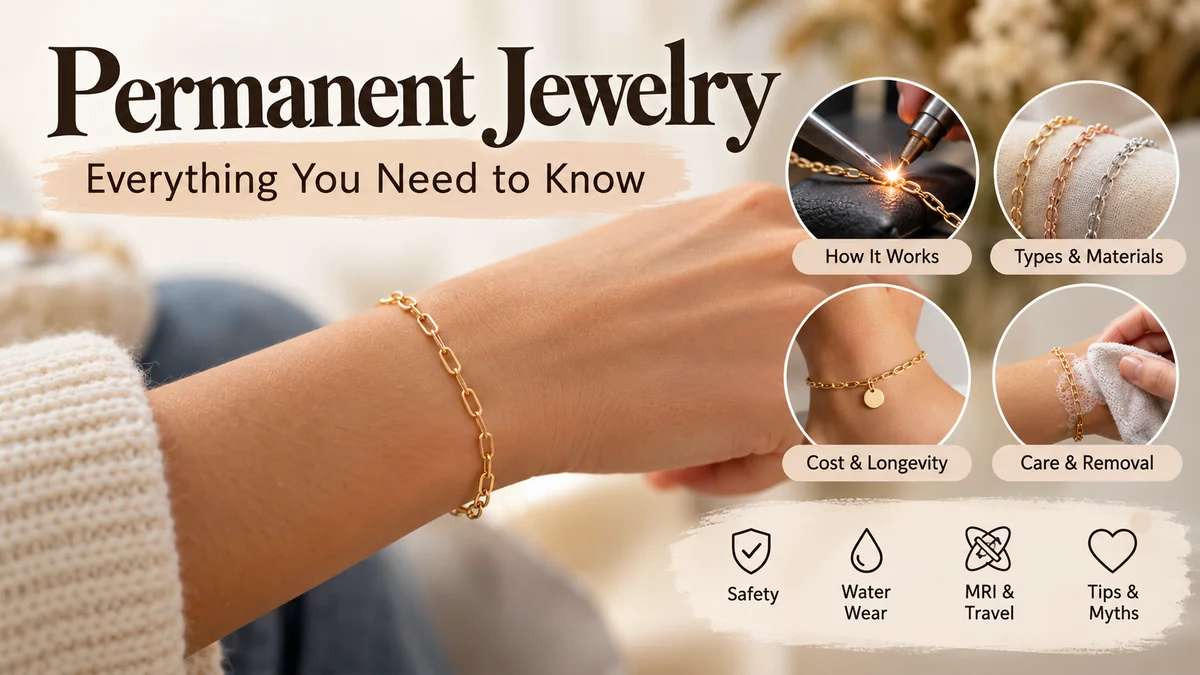
Imagine wearing a delicate gold bracelet that never needs fastening, never has a dangling clasp, and becomes part of your everyday style. That’s the idea behind permanent jewelry, a growing trend that combines minimalist accessories with personal meaning.
Despite its name, permanent jewelry isn’t something you’re stuck wearing forever. It’s simply designed to remain in place until you decide to remove it.
Permanent jewelry is a custom-fitted bracelet, anklet, necklace, or other chain accessory that a trained professional closes using a tiny weld instead of a traditional clasp. The process is typically quick and painless, and the finished piece can stay on through everyday activities. It can also be cut off and often reattached later.
From friendship bracelets and matching couples’ jewelry to everyday gold chains, these accessories have become popular because they offer convenience, sentimental value, and a seamless appearance.
Understanding the materials, welding process, costs, safety considerations, and maintenance requirements will help you decide whether this style suits your lifestyle.
What Is permanent jewelry and How Does It Work?
Permanent jewelry, sometimes called welded jewelry, infinity jewelry, forever bracelets, or claspless jewelry, refers to accessories that are joined around the body without a removable fastening mechanism.
Traditional jewelry usually features a lobster clasp, spring ring, or another closure. Permanent pieces replace that closure with a small welded connection.
A professional jewelry artist measures a chain to fit your wrist, ankle, or neck and joins its ends using a specialized micro-welding device.
The finished connection is usually small enough to blend into the rest of the chain.
Why Is It Called Permanent?
The word “permanent” describes how the jewelry is worn rather than an irreversible attachment to your body.
The chain remains closed during normal activities because it has no clasp to open. However, it can be removed by cutting an appropriate link with jewelry cutters or another suitable tool.
Unlike tattoos or body piercings, the process doesn’t require needles, puncturing the skin, or permanently modifying your body.
Why Has Permanent Jewelry Become Popular?
Several characteristics explain its appeal.
- Everyday convenience: There is no need to repeatedly fasten and unfasten a bracelet.
- Minimalist appearance: Delicate chains create a continuous, understated look.
- Personal significance: Matching pieces can represent friendship, relationships, or milestones.
- Customization: Different metals, chain styles, charms, and lengths allow personal expression.
- Layering: Thin welded bracelets can complement watches and conventional jewelry.
For many people, the appeal is emotional as much as aesthetic. A simple chain can become a reminder of a friendship, anniversary, graduation, or other meaningful occasion.
How Is Permanent Jewelry Applied?


10
Getting a welded bracelet is generally straightforward. Most appointments involve selecting a chain, adjusting its fit, and closing it with a specialized welding tool.
Step 1: Choose the Chain and Material
The process begins with selecting a metal and chain design.
Common choices include 14K solid gold, gold-filled chain, and sterling silver. Some studios also offer 10K gold, rose gold, or other materials.
Chain styles may include cable, paperclip, curb, and other fine-link designs.
Step 2: Measure for a Comfortable Fit
The artist measures the area where the jewelry will sit.
A properly fitted bracelet should move comfortably without slipping excessively or pressing tightly against the skin.
The artist should account for normal movement and minor fluctuations in wrist or ankle size.
Step 3: Position the Chain
After determining the length, the artist wraps the chain around the selected area and connects the ends with a small jump ring.
A protective barrier, often leather or another heat-resistant material, is placed between the connection and your skin.
Step 4: Weld the Connection
A precision pulse-arc welder creates a brief electrical pulse that fuses the metal connection.
The welding electrode touches the metal, not your skin.
When performed correctly with suitable equipment and protective measures, the procedure should not cause pain.
Step 5: Inspect the Finished Jewelry
The artist checks the connection and ensures the chain moves comfortably.
The result is a continuous accessory with no conventional clasp.
The actual weld takes only a moment, although the complete appointment may take several minutes or longer depending on customization and the studio.
Types of Permanent Jewelry
Although bracelets are the most recognizable option, welded accessories come in several forms.

Permanent Bracelets
The most common style. A delicate chain is welded around the wrist, making it suitable for everyday wear, matching friendship pieces, and layering.

Permanent Anklets
These wrap around the ankle and provide a subtle accessory for sandals, summer outfits, and casual styling. They may experience more friction from shoes and socks.

Permanent Necklaces
Claspless necklaces create a continuous chain around the neck. Proper fitting and easy access to a safe removal method are particularly important.

Permanent Rings
Some studios offer welded chain rings. Because fingers can swell and rings may catch on objects, fit and safety deserve extra attention.
Can You Add Charms to Permanent Jewelry?
Yes. Many studios offer small charms, birthstones, initials, symbolic pendants, and decorative connectors.
Popular additions include hearts, stars, gemstones, and meaningful symbols.
Charms can make a simple bracelet more personal, although they may increase the cost and introduce additional points that can snag or wear.
Best Metals for Permanent Jewelry
Material selection has a major influence on appearance, durability, comfort, and price.
Since welded jewelry is intended for continuous wear, choosing a suitable metal matters more than it might for an accessory worn only occasionally.
14K Solid Gold
Fourteen-karat gold is a popular premium option because it balances durability, appearance, and resistance to tarnishing.
It contains approximately 58.3% gold, with the remaining portion consisting of other metals that influence its color and hardness.
Solid gold does not have a plated surface that can wear away, although it can still scratch, bend, or break.
People with metal sensitivities should verify the specific alloy composition rather than assuming all gold alloys are nickel-free.
Gold-Filled Jewelry
Gold-filled jewelry features a substantial layer of gold mechanically bonded to a base-metal core.
It generally provides better surface durability than ordinary thin gold plating.
However, it is not solid gold, and repeated abrasion or exposure to harsh chemicals can eventually affect its appearance.
Gold-filled chains are often chosen as a middle-ground option between price and durability.
Sterling Silver
Sterling silver usually contains 92.5% silver, with the remaining 7.5% made up of other metals.
It offers a bright, cool-toned appearance and is often more affordable than solid gold.
Its main maintenance consideration is tarnishing, which can develop through exposure to moisture, sulfur compounds, and other environmental substances.
Regular gentle cleaning helps maintain its shine.
Gold-Plated and Gold Vermeil
Gold-plated jewelry has a comparatively thin layer of gold over another metal.
Gold vermeil typically uses sterling silver as its base, covered with a gold layer meeting applicable thickness and purity requirements.
Both finishes can wear with friction and repeated exposure to chemicals.
For a piece intended to remain on continuously, the longevity of its surface finish deserves particular consideration.
Permanent Jewelry Material Comparison
| Material | Durability | Maintenance | Relative cost |
|---|---|---|---|
| 14K solid gold | High, depending on chain | Low to moderate | High |
| 10K solid gold | Generally durable | Low to moderate | Medium to high |
| Gold-filled | Good with proper care | Moderate | Medium |
| Sterling silver | Good, but tarnishes | Moderate | Low to medium |
| Gold-plated | Surface may wear faster | Higher | Low |
| Gold vermeil | Depends on coating and wear | Moderate to high | Medium |
No material makes a delicate chain unbreakable. Link thickness, chain construction, fit, and everyday activities can be just as important as metal composition.
How Much Does Permanent Jewelry Cost?
The price of permanent jewelry varies according to the metal, chain length, design, geographic location, and studio.
As a general reference, simple welded bracelets in the United States often cost approximately $50–$200, although solid-gold designs and elaborate pieces may exceed that range.
Jewelers Mutual Group
+1
Typical Permanent Jewelry Prices
| Jewelry type | Approximate US price |
|---|---|
| Sterling silver bracelet | $50–$90 |
| Gold-filled bracelet | $65–$120 |
| 14K solid gold bracelet | $100–$250+ |
| Sterling silver anklet | $60–$100 |
| Gold-filled anklet | $75–$130 |
| Gold necklace | $130–$350+ |
These figures are illustrative market ranges, not standardized prices or guaranteed quotes.
Jewelers Mutual Group
+1
What Affects the Price?
The most significant factors are the following:
- Metal purity: Solid gold generally costs more than silver or gold-filled chain.
- Chain length: Anklets and necklaces typically require more material than bracelets.
- Chain thickness: Heavier chains use more metal.
- Charms and gemstones: Decorative additions increase material and labor costs.
- Welding and service fees: Some studios include the welding service in the listed price, while others charge separately.
- Local pricing: Labor costs and jewelry markets vary by region.
Is Permanent Jewelry Worth the Cost?
Its value depends on your expectations.
A well-made piece can provide years of enjoyment, especially when the material and design suit your daily routine.
However, someone who frequently changes accessories or needs to remove jewelry for work may find a conventional clasp more practical.
The absence of a clasp is a convenience feature, not a guarantee of superior durability.
How Long Does Permanent Jewelry Last?
Permanent jewelry can last for years, but there is no universal lifespan.
Some studio care guides estimate roughly one to three years for certain everyday-wear chains, while others report substantially longer use. Differences in metal quality, chain construction, and wear habits make a single lifespan estimate unreliable.
ATL Luxury Jewelry
+2
Factors That Determine Longevity
Metal quality: Solid gold generally offers better long-term resistance to surface deterioration than thinly plated metals.
Chain thickness: Very delicate links can be more vulnerable to stretching or breaking.
Daily activities: Contact with gym equipment, tools, clothing, and bags can put stress on a chain.
Chemical exposure: Chlorine, cleaning agents, fragrances, and some cosmetics may damage or discolor certain materials.
Weld quality: A poorly completed connection may fail sooner than a properly fused joint.
Fit: Jewelry that is too loose can catch more easily, while a tight fit can become uncomfortable or unsafe.
Can Permanent Jewelry Break?
Yes. Permanent does not mean indestructible.
A chain can break if it catches on a door handle, clothing, equipment, or another object.
A fine chain may also stretch or weaken over time.
If a piece breaks, preserve the chain and any charms. A jewelry professional may be able to reconnect it, provided the remaining material is in suitable condition.
Is Permanent Jewelry Safe?
Permanent jewelry is generally considered safe when applied by a trained professional using appropriate equipment, protective barriers, and properly fitted materials.
However, continuous wear creates a few considerations that should not be overlooked.
Does Getting Permanent Jewelry Hurt?
The procedure should be painless.
The welding pulse is directed at a small metal connection, while a protective barrier separates the work area from your skin.
You may notice a brief flash during welding, but the equipment should not burn or contact your skin.
If the artist cannot explain their protective process or the jewelry feels uncomfortably tight, the procedure should not continue until those concerns are addressed.
Can Permanent Jewelry Cause an Allergic Reaction?
Yes. Some people develop allergic contact dermatitis after exposure to particular metals, especially nickel.
Symptoms can include itching, redness, irritation, or a persistent rash.
The American Academy of Dermatology advises people with nickel allergies to choose jewelry carefully and avoid materials containing the allergen.
American Academy of Dermatology
Before getting welded jewelry, ask about the exact metal composition, including the chain and connecting ring.
Labels such as “hypoallergenic” do not guarantee that a particular item will be suitable for every person.
If irritation develops, arrange safe removal and seek medical advice when symptoms persist or worsen.
What About Swelling or Changes in Wrist Size?
A bracelet that fits comfortably today may become tight if swelling develops.
This can occur with injuries, medical conditions, pregnancy-related changes, or other circumstances.
Because permanent jewelry has no adjustable clasp, it should be removed promptly if it causes pressure, pain, numbness, or circulation concerns.
A welded chain should never be treated as something that must remain in place regardless of discomfort.
Is Permanent Jewelry Safe for Children?
Extra caution is appropriate for children.
Growing wrists, active play, and the risk of jewelry catching on objects can make continuous-wear accessories less suitable.
Children may also have difficulty recognizing or communicating problems caused by a tight chain.
Age restrictions and consent policies vary among studios.
Can You Wear Permanent Jewelry in Water?
Most permanent jewelry is designed to tolerate ordinary daily activities, including handwashing and showering.
However, water resistance depends on the material and construction.
Showering
Solid gold and sterling silver generally tolerate brief contact with clean water, although soap residue can dull their appearance.
Rinsing and gently drying the jewelry helps prevent buildup.
Swimming Pools
Chlorinated water can be harsh on jewelry, especially certain gold alloys, silver, and coated materials.
Repeated exposure may contribute to discoloration or deterioration.
If you swim frequently, ask the jeweler about the limitations of your specific chain.
Saltwater
Saltwater and sand can leave deposits and contribute to wear.
After ocean exposure, rinse the chain with clean water and dry it carefully.
Exercise and Sweating
Normal exercise does not automatically damage welded jewelry.
The larger concern is mechanical stress.
Weightlifting, contact sports, climbing, and activities involving machinery can increase the chance of snagging or pulling.
Where jewelry creates an injury risk, removal is safer than relying on the chain to break.
How to Clean and Care for Permanent Jewelry
Continuous-wear jewelry collects the same substances that accumulate on other accessories: skin oils, sweat, lotion, soap residue, and dirt.
Simple cleaning can help maintain its appearance.
Basic Cleaning Steps
- Check the chain for visible damage or loose connections.
- Mix a small amount of mild, fragrance-free soap with lukewarm water.
- Gently clean the chain using a soft cloth or very soft brush, if suitable for the material.
- Rinse thoroughly to remove soap residue.
- Pat the jewelry dry with a soft, lint-free cloth.
Avoid pulling the chain while cleaning.
Jewelry containing pearls, delicate gemstones, adhesives, or special coatings may require different methods.
What Should You Avoid?
Avoid prolonged exposure to strong household cleaners, bleach, abrasive products, and concentrated chemicals.
Try not to apply perfume, hairspray, or lotion directly onto the chain.
For sterling silver, a suitable polishing cloth can help reduce tarnish, but aggressive polishing may damage decorative finishes.
Do not use ultrasonic cleaners or chemical dips without confirming that they are appropriate for every component.
How Often Should You Clean It?
There is no fixed cleaning schedule for every piece.
A light cleaning whenever residue becomes noticeable is reasonable. More frequent care may be useful for people who exercise regularly or frequently apply lotions and sunscreen.
Inspecting the chain occasionally for stretching, thinning, or damage is equally important.
Can You Remove Permanent Jewelry?
Yes. Removing permanent jewelry is possible, and doing so does not require cutting or damaging your skin.
The chain itself must be opened, usually by cutting an accessible connecting ring or link.
How to Remove a Permanent Bracelet Safely
For a simple, delicate bracelet that can be accessed comfortably:
- Locate the small jump ring or the connection recommended by the jeweler.
- Position the jewelry away from the skin.
- Use an appropriate small jewelry cutter to cut the connection.
- Carefully lift the chain away.
- Store the chain and any charms for possible reattachment.
Never force a tool between tight jewelry and your skin.
If the chain is difficult to reach, unusually thick, or already pressing into the skin, have a professional remove it.
Seek urgent medical help if jewelry is restricting circulation or causing significant swelling, and do not delay necessary care to preserve the chain.
Can Permanent Jewelry Be Reattached?
Often, yes.
A jewelry professional may reconnect the original chain using another jump ring or weld.
Some studios offer complimentary repairs within a specified period, while others charge a service fee.
Reattachment may not be possible if the chain is severely damaged, too short, or unsuitable for welding.
Permanent Jewelry and MRI, Surgery, and Airport Security
Medical procedures and security screening are among the most practical considerations before choosing a continuously worn accessory.
Can You Wear Permanent Jewelry During an MRI?
Do not assume permanent jewelry is MRI-safe.
MRI scanners use powerful magnetic fields, and metallic accessories may create safety concerns or interfere with diagnostic images.
RadiologyInfo.org, a patient information resource from the American College of Radiology and Radiological Society of North America, advises removing metallic jewelry before MRI examinations.
Radiologyinfo.org
+1
Tell the MRI facility about your welded jewelry before your appointment. Follow its screening and removal instructions.
If removal is required, arrange it before the scan.
What About Surgery?
Hospitals may require jewelry removal before surgery or certain medical procedures.
The rules depend on the procedure, equipment, and healthcare facility.
Inform your healthcare team about any welded accessories well in advance.
Can You Go Through Airport Security?
Small welded chains may not trigger metal detectors, but that is not guaranteed.
Screening procedures vary according to the airport, country, and security equipment.
If an officer requires removal or additional screening, follow the applicable instructions.
Permanent jewelry should never be assumed exempt from security rules.
Permanent Jewelry vs. Traditional Jewelry
Both styles have practical advantages.
| Feature | Permanent jewelry | Traditional jewelry |
|---|---|---|
| Closure | Welded connection | Removable clasp or closure |
| Everyday convenience | No fastening required | May require daily fastening |
| Removal | Usually requires cutting a link | Usually easy |
| Adjustability | Limited after welding | Depends on design |
| Repairs | May need professional rewelding | Often conventional repair |
| Style | Seamless and minimalist | Wide variety |
| Medical removal | Requires advance planning | Generally straightforward |
| Durability | Depends on metal and construction | Depends on metal and construction |
Advantages of Permanent Jewelry
A continuous chain can be convenient for people who dislike fiddly clasps.
Its minimalist appearance works well with many outfits, and its custom fit can make it comfortable for regular wear.
It also offers sentimental appeal, especially when shared with friends, partners, or family members.
Disadvantages to Consider
The main limitation is reduced flexibility.
You cannot simply unfasten a welded bracelet when you want to change your accessories, attend a medical appointment, or participate in an activity where jewelry is prohibited.
It may also require professional assistance for repairs or reattachment.
For someone who frequently removes jewelry, a traditional clasp may be the more practical choice.
What to Know Before Getting Permanent Jewelry
A few decisions can make the experience more comfortable and help prevent disappointment.
Choose an Appropriate Chain
Select a chain that suits your daily routine.
A very fine chain may look elegant but can be vulnerable to snagging.
A heavier chain may offer greater resistance to some forms of wear, although it is not automatically safer or more comfortable.
Check the Metal Composition
Ask whether the chain is solid gold, gold-filled, sterling silver, or plated.
If you have known metal allergies, confirm the alloy ingredients and connecting-ring material.
Make Sure the Fit Is Comfortable
The chain should not restrict movement or leave persistent pressure marks.
Consider how your wrist or ankle changes throughout the day.
Understand the Repair Policy
Ask whether the studio can reconnect a broken chain and whether repair fees apply.
Some warranties cover weld failures but exclude damage from snagging or loss.
Consider Your Occupation and Hobbies
People working around rotating machinery, electrical equipment, or environments with strict jewelry restrictions should assess the risks carefully.
Healthcare workers, food handlers, athletes, and others may also face workplace rules that make removable accessories more suitable.
Plan for Future Removal
Even if you intend to wear the piece for years, understand where it can be cut and how it can be reattached.
A permanent bracelet should always have a practical removal plan.
Why Do People Get Matching Permanent Jewelry?
Matching welded bracelets have become a symbolic alternative to traditional friendship bracelets and matching necklaces.
The idea is simple: two or more people choose coordinating chains to represent a shared connection.
Friendship Bracelets
Friends may choose identical chains or complementary metals to commemorate a lasting friendship.
The jewelry becomes a small everyday reminder of the relationship.
Couples’ Jewelry
Partners sometimes select matching welded bracelets as anniversary gifts or symbols of commitment.
Unlike engagement rings or wedding bands, these accessories have no universally recognized ceremonial meaning. Their significance is personal.
Family Connections
Parents, siblings, and other relatives may choose matching chains to celebrate birthdays, reunions, or family milestones.
Personal Milestones
A welded bracelet can also commemorate graduation, recovery, career achievements, travel, or a meaningful life transition.
The emotional significance comes from the occasion and the wearer, not from the welding process itself.
Common Myths About Permanent Jewelry
Myth: Permanent Jewelry Can Never Be Removed
False. Most pieces can be removed by cutting an appropriate link.
The term refers to the lack of a removable clasp, not an irreversible attachment.
Myth: The Welding Process Burns Your Skin
A correctly performed weld uses protective equipment and does not require the welding electrode to touch your skin.
Improper technique can still cause injury, which is why professional application matters.
Myth: Permanent Jewelry Lasts Forever
No chain is guaranteed to last indefinitely.
Wear, metal quality, accidental pulling, and chemical exposure all affect durability.
Myth: Every Gold Chain Is Hypoallergenic
Gold alloys may contain other metals, and some can cause allergic reactions.
The purity and complete alloy composition matter.
Myth: Permanent Jewelry Never Needs Cleaning
Continuous wear can lead to residue buildup.
Gentle cleaning and periodic inspection help maintain its condition.
Myth: You Can Wear It During Every Activity
Some workplaces, sports, medical procedures, and other activities require jewelry removal.
Safety rules should always take priority over convenience.
Is Permanent Jewelry Right for You?
Permanent jewelry may be appealing if you prefer simple accessories, enjoy wearing the same piece every day, and appreciate jewelry with sentimental significance.
It is particularly convenient for people who find conventional bracelet clasps difficult to manage.
However, the style may be less suitable if you regularly need to remove accessories, have fluctuating swelling, work around equipment that can catch jewelry, or experience metal-related skin reactions.
The best choice depends on your lifestyle rather than the popularity of the trend.
Before deciding, consider three practical questions: Will the chain be comfortable during daily activities? Is the material suitable for your skin and budget? Can you remove it promptly if necessary?
Those answers matter more than the promise of permanence.
Final Thoughts on permanent jewelry
Permanent jewelry offers a distinctive combination of simplicity, customization, and personal meaning. Its seamless design makes it convenient for everyday wear, while matching chains and personalized charms can represent important relationships or memories.
Still, permanent doesn’t mean indestructible or impossible to remove. Metal quality, chain construction, proper fitting, and regular care determine how well a piece holds up over time.
Understanding the welding process, expected costs, safety considerations, and removal options allows you to appreciate the style without unrealistic expectations.
A thoughtfully chosen welded bracelet or necklace can become a meaningful everyday accessory, provided it remains comfortable, practical, and safe for the way you live.
