
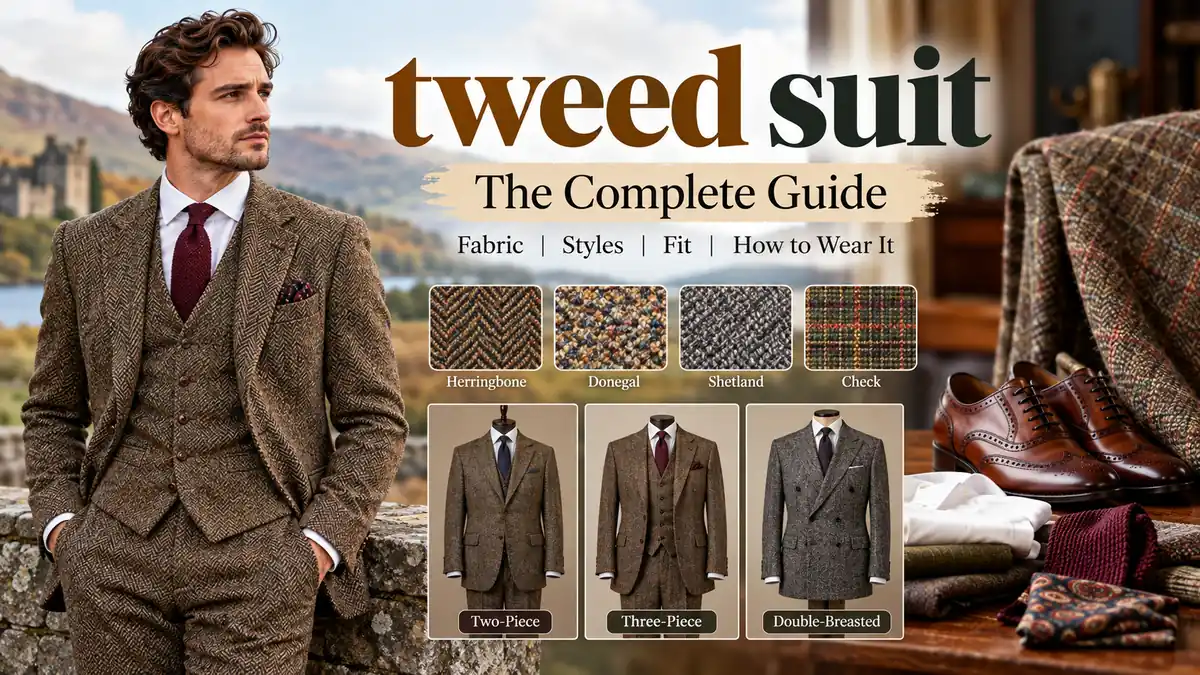
A tweed suit has a character that ordinary business suits rarely achieve. Its textured fabric, rich colors, and distinctive patterns give it a classic appearance that works particularly well for autumn, winter, weddings, and smart-casual occasions.
But not every tweed suit looks or feels the same. The weight of the cloth, weaving technique, jacket construction, and overall fit can dramatically change its appearance and comfort.
A tweed suit is a tailored outfit made from tweed, a durable woven fabric traditionally produced from wool. Known for its textured surface, warmth, and patterns such as herringbone, houndstooth, and checks, it typically includes a matching jacket and trousers. A waistcoat may complete a traditional three-piece version.
Understanding the fabric and its styling possibilities makes it easier to appreciate why tweed has remained part of menswear for generations.
What Is a Tweed Suit?
A tweed suit is a two-piece or three-piece tailored ensemble constructed from tweed fabric. Unlike smoother worsted-wool suits, tweed has a more pronounced texture, often featuring multiple colored yarns woven together.
Traditionally, tweed is made from wool, although some contemporary fabrics contain blends of wool and other fibers.
The material developed a reputation for durability, warmth, and resistance to everyday wear. These characteristics made it suitable for outdoor clothing before it became an established part of classic tailoring.
Main characteristics of a tweed suit
- Textured appearance: The woven surface has visible depth rather than a smooth finish.
- Warmth: Wool fibers provide natural insulation, making many tweed suits comfortable in cooler weather.
- Distinctive patterns: Herringbone, houndstooth, windowpane, and traditional checks are common.
- Earthy colors: Brown, olive, charcoal, gray, and muted green are especially associated with tweed.
- Structured tailoring: Many traditional examples feature substantial shoulders, lapels, and jacket construction.
- Versatility: Depending on the fabric and cut, tweed can suit formal daytime events, countryside settings, and relaxed social occasions.
The defining feature is the cloth itself. Two suits with identical cuts can look entirely different when one uses smooth worsted wool and the other uses heavily textured tweed.
The History and Origins of Tweed Suits
Tweed is closely associated with Scotland and the wider British countryside. Its development reflects the practical clothing needs of communities living in cold, wet, and windy environments.
Scottish origins
Traditional tweed developed through wool weaving in Scotland, including the Highlands, Borders, and island communities.
Early tweed fabrics were valued for their substantial construction and natural wool properties. Their patterns and colors also reflected regional weaving traditions.
The name tweed is commonly linked to a nineteenth-century misunderstanding of the Scottish textile term tweel, meaning twill. According to the widely repeated account, the word was confused with the River Tweed, and the name became established in the textile trade.
This explanation is historical tradition rather than an entirely settled account of the word’s origin.
Tweed and British country clothing
During the nineteenth century, tweed became associated with outdoor activities among Britain’s landed classes.
It was worn for shooting, fishing, walking, riding, and other countryside pursuits. Substantial jackets and matching garments offered warmth and practical durability.
Estate tweeds and district patterns also became recognizable elements of country dress.
As tailoring evolved, tweed moved beyond outdoor clothing into everyday wardrobes, university settings, and urban fashion.
Tweed in modern menswear
Today, tweed appears in traditional tailoring, contemporary slim-cut suits, relaxed jackets, and modern heritage-inspired clothing.
The fabric is particularly associated with British country style, vintage menswear, academic dressing, and autumn wedding attire.
Its popularity is not limited to historical fashion. Modern designs frequently combine traditional woven patterns with lighter construction and more contemporary silhouettes.
Types of Tweed Fabric Used in Suits
Not all tweed fabrics share the same origin, weight, or texture. Some terms refer to protected geographical production traditions, while others describe broader regional styles or weaving characteristics.

Harris Tweed
Harris Tweed is handwoven by islanders in their homes in the Outer Hebrides, using pure virgin wool dyed and spun in the islands and finished there. Its authenticity is protected by legislation and identified by the Orb certification mark.

Donegal Tweed
Associated with County Donegal in Ireland, this fabric is recognizable for colorful flecks or neps scattered through the weave. The flecked effect creates visual depth without requiring a bold pattern.

Shetland Tweed
Associated with wool from Scotland’s Shetland Islands, Shetland-style tweeds often have a softer, loftier hand than some densely woven country tweeds. Exact characteristics vary by mill and finishing method.

Cheviot Tweed
Cheviot wool is traditionally associated with the Cheviot sheep breed and the Scottish Borders. Tweeds made from this wool can feel relatively crisp and resilient, making them suitable for structured tailoring.
Lightweight vs. heavyweight tweed
Fabric weight has a significant effect on comfort, drape, and seasonal suitability.
| Fabric weight (approximate) | Characteristics | Typical use |
|---|---|---|
| 250–320 g/m² | Relatively light and flexible | Mild autumn days, indoor occasions |
| 320–400 g/m² | Medium weight with noticeable structure | General cool-weather tailoring |
| 400–500 g/m² | Substantial and insulating | Cold-weather suits |
| Above 500 g/m² | Heavy, often rugged cloth | Traditional country clothing |
These are approximate descriptive categories, not universal industry classifications. Fabric weight alone does not determine warmth: weave density, finishing, lining, and the wearer’s activity also matter.
A lightweight tweed can be easier to wear indoors, while heavier cloth generally provides greater insulation and a more traditional silhouette.
Popular Tweed Suit Styles and Designs
A tweed suit can look traditional, contemporary, formal, or relaxed depending on its construction.
Understanding the main styles helps explain how the same fabric can work across different dress codes.
Two-piece tweed suit


8
A two-piece suit consists of a matching jacket and trousers.
It is one of the most versatile forms of tweed tailoring because the jacket and trousers can also be worn separately.
A single-breasted jacket with notch lapels, two buttons, and a moderate shoulder structure creates a balanced appearance.
Two-piece suits are especially appropriate for daytime gatherings, smart-casual offices, and semi-formal autumn events.
Three-piece tweed suit

A three-piece suit adds a matching waistcoat beneath the jacket.
The waistcoat creates a more layered, traditional silhouette and offers extra warmth. It also allows the outfit to retain a tailored appearance when the jacket is removed.
Three-piece tweed suits are commonly associated with heritage-inspired dressing, countryside weddings, and vintage fashion.
A well-fitting waistcoat should sit close to the torso without pulling across the buttons. Its front should extend far enough to cover the trouser waistband.
Double-breasted tweed suit
A double-breasted jacket has overlapping front panels and two vertical rows of buttons.
This construction creates a more structured appearance, particularly when paired with peak lapels and a defined waist.
Double-breasted tweed suits can look striking in charcoal, dark brown, and muted olive.
Because tweed already has visual texture, understated patterns often work particularly well with this jacket style.
Slim-fit and modern tweed suits
Modern tweed tailoring frequently features narrower lapels, a closer waist, and tapered trousers.
The objective is a cleaner silhouette rather than the fuller proportions associated with traditional country suits.
However, an excessively tight fit can be uncomfortable, especially with heavier fabric.
A modern tweed suit should still allow natural movement through the shoulders, chest, seat, and thighs.
Traditional country tweed suits
Traditional country tailoring may include practical details such as:
- Hacking pockets, which are angled rather than horizontal.
- Ticket pockets positioned above a main jacket pocket.
- Throat latches for additional protection around the neck.
- Action backs or pleats to improve mobility.
- Reinforced construction and substantial wool cloth.
The Norfolk jacket is a particularly recognizable country-style garment, historically featuring belts, pleats, and practical pocket arrangements.
These details reflect tweed’s origins as functional outdoor clothing.
The Curiously Compelling Story Of Tweed
+1
Tweed Suit Patterns and Colors Explained
One reason tweed remains visually distinctive is the variety of patterns achievable through weaving.
Some designs are subtle enough to appear nearly solid from a distance, while others make the fabric the central feature of an outfit.
Herringbone tweed

Herringbone is recognizable by its repeated V-shaped pattern, resembling the skeleton of a fish.
It is produced through changes in the direction of a twill weave, creating a broken zigzag effect.
Gray and brown herringbone suits are classic choices because the pattern adds interest without dominating the entire outfit.
Houndstooth tweed

Houndstooth features repeated broken checks with pointed or irregular edges.
Small-scale houndstooth patterns can appear restrained, while larger versions create a bolder visual effect.
The pattern works particularly well when combined with plain shirts and understated accessories.
Windowpane and checked tweed
Windowpane designs use thin vertical and horizontal lines to create large rectangular checks.
Traditional checked tweeds may contain multiple intersecting colors and smaller repeating patterns.
Prince of Wales checks, also known as glen checks, are another familiar design in classic tailoring, although they are not exclusive to tweed.
A large check generally creates a more noticeable appearance than a small herringbone or subdued Donegal weave.
Best tweed suit colors
| Color | Visual character | Suitable combinations |
|---|---|---|
| Brown | Warm, traditional, earthy | Cream, white, burgundy |
| Gray | Understated and adaptable | White, navy, charcoal |
| Olive green | Countryside-inspired | Beige, cream, dark brown |
| Navy | Refined and contemporary | Light blue, gray, burgundy |
| Charcoal | Restrained and sophisticated | White, pale blue, black |
| Tan | Lighter and more relaxed | Ivory, chocolate brown, forest green |
Brown and olive are strongly associated with heritage tweed, while gray and navy often integrate more easily into contemporary wardrobes.
The color should also complement the pattern. A heavily checked green suit may feel much more expressive than a plain charcoal version.
How to Wear a Tweed Suit for Different Occasions
The most effective way to style a tweed suit is to balance its texture with simpler garments.
Because the fabric already has depth and visual interest, accessories rarely need to compete for attention.
How to style a tweed suit for a wedding
A tweed suit can be an excellent option for an autumn or winter wedding, particularly one held in a countryside venue, historic building, or relaxed traditional setting.
For a classic wedding outfit, combine a brown or gray tweed suit with a white or pale blue shirt, a complementary tie, and polished leather shoes.
A three-piece suit can create a more ceremonial appearance, especially for a groom or member of the wedding party.
Modern wedding styling may also incorporate sage, light brown, and softer neutral tones.
However, the invitation’s dress code should take priority. Tweed is generally unsuitable for black-tie events, where a dinner jacket or tuxedo is expected.
Moss
Can you wear a tweed suit to work?
Yes, provided the workplace allows business-casual or smart-casual clothing.
A charcoal or navy tweed suit with a light shirt and dark leather shoes can look professional in creative offices, educational settings, and less formal business environments.
For conservative corporate settings, smooth worsted wool is often the more conventional choice.
Avoid overly bold checks when a restrained professional appearance is required.
Wearing tweed for casual occasions
A full tweed suit can be dressed down by replacing a formal shirt and tie with fine knitwear.
A lightweight merino wool sweater or plain roll-neck can create a comfortable autumn outfit.
The jacket can also be worn separately with chinos, flannel trousers, or dark denim, depending on its cut and pattern.
For example, a brown herringbone jacket works naturally with cream trousers and a navy knitted sweater.
The main consideration is texture. A heavy, rugged jacket often looks more balanced with substantial trousers than with extremely thin summer fabrics.
Is a tweed suit appropriate for formal events?
Tweed occupies an interesting position in classic menswear.
It is tailored and can look sophisticated, but its historical association with country clothing makes it generally less formal than smooth worsted wool.
It can be appropriate for daytime celebrations, smart receptions, and certain weddings.
It is usually not the right choice for black tie, white tie, or events that specifically require traditional formal eveningwear.
A dark, subtly patterned tweed suit tends to look more formal than a heavily checked, rustic design.
What Shoes, Shirts, and Accessories Go With a Tweed Suit?
Coordinating accessories is easier when the suit’s dominant color and pattern are considered first.
Shirts that complement tweed
White shirts provide a clean contrast against most tweed fabrics.
Light blue shirts work particularly well with gray, brown, and navy suits.
Cream and pale pink can also complement warmer brown or green tones.
For patterned tweed, a plain shirt is usually the safest option. A subtle striped shirt can work, but it requires careful coordination with the suit’s pattern scale.
Best shoes for tweed suits
| Shoe style | Appearance | Best use |
|---|---|---|
| Oxford shoes | Clean and dressy | Weddings, formal daytime occasions |
| Derby shoes | Classic and versatile | Everyday tailored outfits |
| Brogues | Decorative and traditional | Country-inspired styling |
| Chelsea boots | Streamlined and contemporary | Autumn and winter outfits |
| Loafers | Relaxed and refined | Lightweight tweed, smart-casual events |
Brown leather is a natural companion to earthy tweed colors.
Dark brown or oxblood shoes can work with gray and navy suits, while black shoes may suit darker, more formal combinations.
Suede footwear can also complement tweed’s textured surface, although it may require additional care in wet conditions.
Ties and pocket squares
Wool, knitted silk, grenadine, and matte silk ties often harmonize with tweed’s surface.
Burgundy, forest green, navy, and muted gold are useful colors.
Pocket squares should complement the outfit rather than reproduce every color and pattern exactly.
For a heavily patterned suit, a plain white linen pocket square can provide a particularly clean finish.
Accessories to avoid overcomplicating the look
Traditional tweed styling sometimes includes flat caps, pocket watches, patterned waistcoats, and substantial leather accessories.
These can work individually, but wearing all of them together may create an overly theatrical appearance.
A restrained combination generally feels more natural: one statement garment, a few complementary colors, and accessories that serve a practical purpose.
How Should a Tweed Suit Fit?
Fit is essential because textured wool can add visual bulk.
A well-fitting tweed suit should follow the body’s shape without feeling restrictive.
Jacket shoulders and chest
The shoulder seam should align naturally with the end of the shoulder, unless the jacket intentionally uses a softer or extended shoulder construction.
The jacket should close without strong horizontal pulling around the button.
Excess fabric around the chest or upper back may indicate an unsuitable size or cut.
Jacket length and sleeves
Traditional jackets often provide more seat coverage than some modern cropped designs.
The appropriate length depends on the wearer’s proportions and the suit’s overall style.
Sleeves should generally allow a small amount of shirt cuff to show, although personal preferences vary.
Trouser fit
Tweed trousers should have enough room through the seat and thighs for comfortable sitting and walking.
The waistband should sit securely without excessive tension.
A slight break at the shoe is a classic choice, while shorter, cleaner hems can work with contemporary tailoring.
Waistcoat fit
A waistcoat should lie close to the body without pulling across the buttons.
Its lower front should cover the waistband of the trousers so that the shirt does not show between them.
Traditional single-breasted waistcoats are commonly worn with the bottom button left undone.
Common fitting mistakes
- Choosing a jacket that is too tight through the shoulders.
- Wearing trousers that pull across the thighs.
- Selecting an overly short jacket for a traditional three-piece suit.
- Ignoring the additional thickness of heavyweight cloth.
- Assuming all tweed fabrics drape identically.
- Relying on alterations to correct fundamentally unsuitable shoulder construction.
A tailor can often adjust trouser length, sleeve length, and some waist shaping. Major shoulder alterations are much more complicated and may not be practical.
Tweed Suit vs. Wool Suit: What’s the Difference?
A common misconception is that tweed and wool are entirely separate materials.
In reality, traditional tweed is a type of wool fabric.
The more useful comparison is between tweed and smooth worsted-wool suiting.
| Feature | Tweed suit | Smooth worsted-wool suit |
|---|---|---|
| Fabric surface | Textured, sometimes coarse | Smooth and refined |
| Typical appearance | Heritage-inspired, substantial | Businesslike, polished |
| Common patterns | Herringbone, checks, flecks | Solids, pinstripes, checks |
| Warmth | Often warm, depending on weight | Varies widely by fabric weight |
| Formality | Usually less formal | Often more formal |
| Traditional use | Countrywear, smart-casual tailoring | Business and formal daytime wear |
| Seasonal suitability | Often autumn and winter | Available for all seasons |
Neither fabric is automatically superior.
A fine worsted-wool suit may be better suited to a formal business meeting, while tweed offers more texture and a distinctive appearance for relaxed tailored occasions.
Is tweed warmer than regular wool?
Not necessarily.
Tweed is commonly made from wool, and its warmth depends on factors such as fabric weight, weave, air retention, and garment construction.
A heavyweight tweed suit will generally feel warmer than a lightweight worsted suit. However, a substantial worsted-wool suit can also provide considerable insulation.
The fabric’s actual specifications are more useful than its name alone.
Is tweed waterproof?
No. Ordinary tweed is not waterproof.
Wool can resist light moisture, and some dense tweed fabrics provide reasonable protection against brief exposure to drizzle.
However, sustained rain can penetrate the material.
Water-resistant properties should not be confused with a waterproof membrane or technical rainwear construction.
Can You Wear a Tweed Suit in Summer?
Tweed is traditionally associated with cooler temperatures, but its seasonal suitability depends on the specific cloth.
A lightweight, loosely woven tweed with minimal lining may be comfortable during mild spring days or cool summer evenings.
Heavy country tweed is generally unsuitable for hot, humid conditions.
Choosing tweed for different seasons
Autumn: Medium-weight tweed is particularly practical, offering warmth without requiring a heavy overcoat in many climates.
Winter: Heavier tweed can provide insulation and work well with scarves, overcoats, and layered knitwear.
Spring: Lightweight tweed in gray, tan, or muted green can suit cooler days.
Summer: Lightweight alternatives such as linen, cotton, fresco wool, or tropical worsted wool are often more comfortable in high temperatures.
For warm-weather occasions, breathability, lining construction, and fabric weight deserve particular attention.
How to Care for and Maintain a Tweed Suit
Proper maintenance can help preserve a tweed suit’s appearance for many years.
Wool fibers are naturally resilient, but incorrect washing, excessive heat, and poor storage can damage the fabric or garment structure.
1. Brush the fabric gently
Use a soft clothes brush to remove surface dust and loose particles.
Brush in the direction of the fabric’s nap where appropriate, without excessive pressure.
This helps maintain the surface between professional cleanings.
2. Allow the suit to air
After wearing the suit, hang it in a well-ventilated area away from direct heat.
Allow moisture and odors to dissipate before placing it in a crowded wardrobe.
A shaped hanger helps maintain the jacket’s shoulders.
3. Avoid unnecessary washing
Many tailored tweed suits contain canvas, padding, interlinings, and other structural components that can be damaged by ordinary machine washing.
Follow the garment’s care label.
Professional dry cleaning may be appropriate when necessary, but frequent cleaning can create unnecessary wear.
4. Handle stains carefully
For fresh liquid spills, gently blot the affected area with a clean cloth.
Avoid aggressive rubbing, which can spread stains or disturb the wool fibers.
For significant stains, consult a cleaner experienced with wool tailoring.
5. Store the suit correctly
Use a broad-shouldered hanger for the jacket and a suitable trouser hanger to minimize creasing.
Store the suit in a breathable garment cover rather than airtight plastic.
Keep the wardrobe clean and monitor for clothes moths, which can damage wool fibers.
6. Remove wrinkles safely
Light wrinkles may relax after the suit hangs in a ventilated space.
When pressing is necessary, use suitable wool settings, a pressing cloth, and careful steam application.
Avoid pressing directly and heavily onto textured fabric, as this can flatten the surface or create unwanted shine.
For complex creases, professional pressing is preferable.
Advantages and Disadvantages of Tweed Suits
Tweed offers several practical and aesthetic benefits, but it also has limitations.
Advantages
Distinctive texture: Tweed provides depth and character that smooth suiting fabrics may lack.
Durability: Well-constructed wool tweed can withstand regular wear, although durability varies by weave and quality.
Warmth: Medium and heavyweight tweeds are useful in cooler climates.
Classic appearance: Traditional colors and patterns remain recognizable across changing fashion trends.
Versatile separates: A tweed jacket or waistcoat can often be combined with other wardrobe pieces.
Natural fiber properties: Wool offers useful insulation, moisture management, and resilience.
Disadvantages
Potential heaviness: Traditional tweed may feel bulky compared with lightweight suiting.
Limited hot-weather comfort: Many tweeds are too insulating for summer temperatures.
Variable texture: Coarser wool may feel scratchy against sensitive skin, especially in unlined garments.
Care requirements: Structured tweed tailoring generally needs careful cleaning and storage.
Dress-code limitations: Tweed is not suitable for every formal or corporate setting.
Pattern coordination: Bold checks can be harder to combine with patterned shirts and accessories.
The most suitable tweed depends on climate, personal comfort, and how the garment will be worn.
How to Identify a Quality Tweed Suit
A quality tweed suit is not defined solely by its price, thickness, or country of origin.
Fabric, construction, fit, and finishing all contribute to the garment’s performance.
Examine the fabric
Look for an even weave, consistent pattern alignment, and a surface appropriate to the intended style.
Some irregularity is part of the character of certain tweeds, particularly flecked or handwoven varieties.
The fabric should feel resilient rather than fragile or excessively loose.
Check the composition label
Traditional tweed is wool-based, but modern suits may use blended fabrics.
A wool-rich composition is often desirable for natural drape and insulation, although blends can serve practical purposes.
Do not assume that a fabric described as tweed is automatically pure wool.
Inspect the tailoring
Look at the jacket’s lapels, collar, shoulder construction, and seams.
The collar should sit cleanly against the neck, and the jacket should hang evenly.
Check that pockets, buttons, lining, and trouser seams are securely finished.
Pattern matching around pockets and major seams can indicate careful construction, although exact matching is not always possible with complex patterns.
Understand canvas construction
Tailored jackets may use fused, half-canvas, or full-canvas construction.
Canvas can help shape the chest and lapels, while fused construction uses adhesive interlinings.
A well-executed fused jacket can still perform satisfactorily. Full canvas is not automatically necessary for every wearer.
The quality of the overall construction matters more than one isolated specification.
Verify Harris Tweed authenticity
Genuine Harris Tweed is protected under the Harris Tweed Act 1993.
The cloth must meet defined production requirements in Scotland’s Outer Hebrides, and the Harris Tweed Authority oversees the certification system.
The Orb mark is an important indicator of authentic Harris Tweed cloth.
Harris Tweed Authority
+1
A suit made from authentic Harris Tweed should not be confused with one merely described as Harris-style or Scottish-style tweed.
Consider the garment’s intended purpose
A substantial country suit and a lightweight urban suit should not be judged against identical expectations.
A traditional country suit may prioritize warmth, durability, and freedom of movement.
A modern tailored suit may prioritize lighter construction and a cleaner silhouette.
Quality means that the fabric and construction perform well for their intended use.
Common Tweed Suit Styling Mistakes
Even a beautifully made tweed suit can look unbalanced when its proportions and accessories are poorly coordinated.
Mixing too many patterns
Combining a large checked suit, striped shirt, patterned tie, and bold pocket square can overwhelm the outfit.
When the suit has a prominent pattern, simpler supporting pieces usually create a more cohesive appearance.
Wearing an overly tight jacket
Heavy tweed needs sufficient space to drape naturally.
Excessively narrow shoulders or a tight chest can create pulling and uncomfortable movement.
A tailored fit should not mean a restrictive fit.
Ignoring the season
Wearing heavyweight tweed in hot weather can be uncomfortable.
Fabric weight and garment construction should reflect the expected temperature and environment.
Choosing inappropriate footwear
Very lightweight athletic shoes can look disconnected from substantial traditional tweed.
Footwear with enough visual weight, such as leather Derbies, brogues, or boots, often creates a more harmonious combination.
However, contemporary casual styling can successfully incorporate minimalist sneakers with lighter, less structured tweed suits.
Treating tweed as a costume
Heritage accessories can complement tweed, but too many historical references may feel exaggerated.
A modern shirt, restrained footwear, and well-balanced tailoring often allow the fabric’s character to stand out naturally.
Is a Tweed Suit Still in Style in 2026?
Yes. Tweed remains a recognized part of classic tailoring, especially in autumn and winter wardrobes.
Its continued relevance comes from the combination of traditional fabric, distinctive texture, and adaptable silhouettes.
Contemporary styling tends to emphasize balanced proportions, comfortable construction, and restrained combinations rather than excessive historical detailing.
Current menswear guides also show tweed being worn in both traditional country settings and contemporary wedding outfits.
Moss
+1
A brown herringbone three-piece suit may communicate traditional British style, while a softly tailored gray tweed suit can feel more contemporary.
The fabric itself does not determine whether the outfit looks old-fashioned. Fit, styling, and context have a much greater influence.
Final Thoughts on Choosing and Wearing a Tweed Suit
A tweed suit combines traditional craftsmanship, textured wool, and distinctive tailoring in a way few other garments can replicate.
Its appeal lies in versatility. A subtle gray two-piece suit can work in a smart-casual office, while a brown three-piece design can suit a countryside wedding or formal daytime celebration.
Understanding the differences between Harris, Donegal, Shetland, and other tweeds helps clarify the fabric’s origins and characteristics. Equally important are fabric weight, fit, pattern, and the occasion.
For a balanced look, begin with a well-fitting suit in a versatile color, coordinate it with simple shirts and footwear, and choose a fabric weight appropriate to the climate.
With proper care and thoughtful styling, a tweed suit can remain a useful and distinctive part of a wardrobe for many years.
