
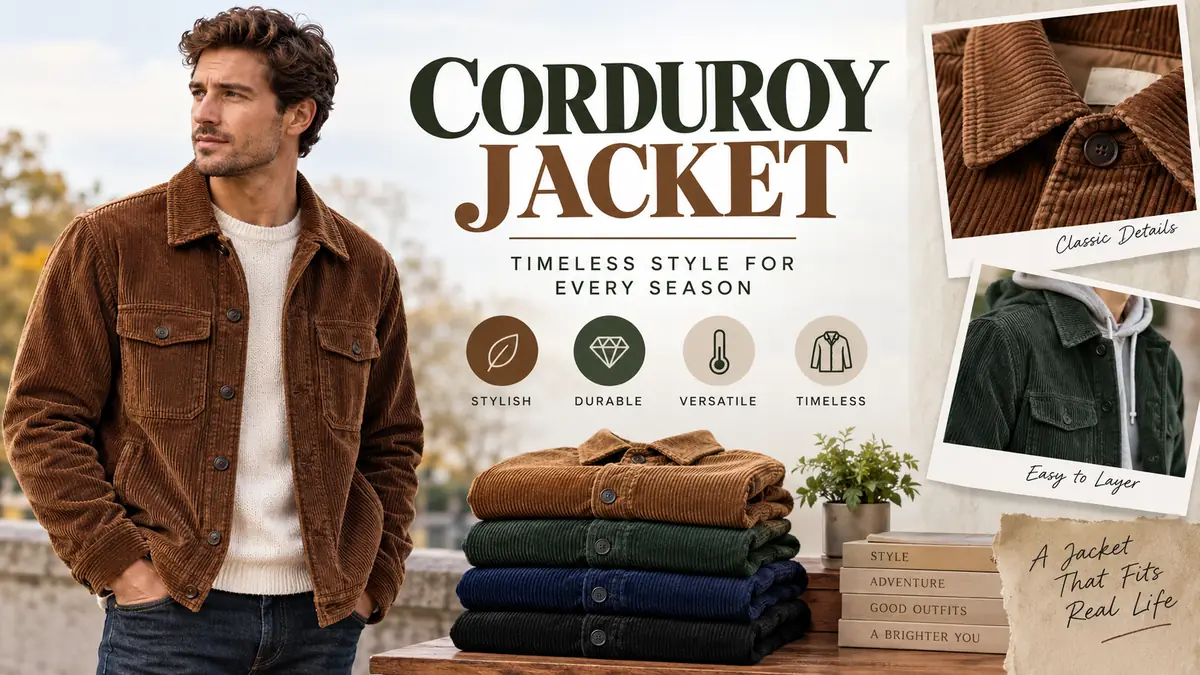
A corduroy jacket stands out without needing loud patterns or complicated details. Its raised ribs give an ordinary jacket shape more depth, while the soft pile creates a warmer, more relaxed appearance than many flat cotton fabrics.
That combination explains why corduroy has moved comfortably between workwear, tailoring, collegiate clothing, and everyday casual wardrobes. It can appear rugged in a wide-wale chore coat or surprisingly refined when made into a fine-wale blazer.
A corduroy jacket is an outer layer made from corduroy, a woven pile fabric recognized by parallel raised ribs called wales. Usually made primarily from cotton, it combines softness, texture, moderate warmth, and durability. Jacket styles range from truckers and chore coats to overshirts, bombers, blazers, and lined winter designs.
Understanding the jacket becomes much easier once you understand its fabric. Wale count, fiber composition, weight, lining, cut, and nap all affect how a corduroy jacket looks, feels, and performs.
What Is a corduroy jacket?
A corduroy jacket is essentially a familiar jacket silhouette constructed from corduroy rather than denim, canvas, wool, leather, or another conventional outerwear material.
Corduroy’s defining characteristic is its series of lengthwise raised ribs. These ribs are known as wales, and the number of wales within an inch is described as the wale count. Lower counts mean broader ribs; higher counts mean finer ones.
Most contemporary corduroy is cotton or predominantly cotton, although manufacturers may add polyester for durability or elastane/spandex for stretch. Fiber composition therefore varies from one jacket to another.
The surface also has a soft pile. This creates the slightly velvety hand feel associated with corduroy and allows the material to interact with light differently from smooth cotton twill.
That texture is a major part of its appeal. A plain brown jacket made from flat fabric can look simple; the same color in corduroy develops visible shadows and highlights across its ribs.
How is corduroy made?
Corduroy belongs to the broader historical family of pile fabrics associated with fustian. Modern corduroy is constructed with additional yarns that are cut to produce its raised pile and characteristic cords.
The basic process involves:
- Weaving the base cloth with additional yarns.
- Cutting the relevant surface yarns to create pile.
- Brushing and finishing the cut fibers.
- Producing clearly defined parallel wales.
- Cutting garment panels while respecting the direction of the fabric’s nap.
The finished material feels soft but can still be relatively substantial and hard-wearing.
This is why corduroy has historically worked for trousers and working clothes as well as jackets.
Why Wale Count Changes a corduroy jacket So Much
If there is one technical term worth learning before comparing corduroy jackets, it is wale count.
Wale count describes the number of ribs within a given width, usually one inch. A common misconception is that a higher number means thicker ribs. It is actually the opposite: the higher the wale count, the narrower and more closely packed the ribs are.
| Corduroy type | Approximate wale count | Appearance | Common jacket character |
|---|---|---|---|
| Wide wale | Around 3–6 | Large, obvious ribs | Rugged and substantial |
| Medium/standard wale | Around 10–12 | Balanced texture | Versatile and casual |
| Fine wale | Around 14–16 | Smaller ribs | Cleaner and neater |
| Pinwale/needlecord | 16+ | Very fine texture | Lightweight and refined |
These categories are useful descriptions rather than universal manufacturing standards. Wale count also does not tell you everything about quality. Two fabrics with identical rib counts can have different weights, fiber compositions, stretch, softness, and durability.
Wide-wale corduroy
Wide-wale fabric has thick, strongly defined cords.
On a jacket, it produces a pronounced vintage or workwear character. The texture is noticeable even from several feet away, particularly in earthy colors such as tobacco, rust, chocolate, tan, olive, and dark brown.
Wide wale works particularly well for chore jackets, trucker jackets, and substantial casual outerwear.
Because the ribs are visually prominent, the fabric itself becomes one of the main design features.
Standard and medium wale
Standard wale sits between chunky wide-wale fabric and subtle needlecord.
It is arguably the easiest version to incorporate into everyday clothing because the texture is obvious without overwhelming the jacket’s silhouette.
Medium wale can work across trucker jackets, overshirts, casual coats, bombers, and other familiar designs.
Pinwale and needlecord
Pinwale, sometimes called pincord or needlecord, uses many narrow ribs.
From a distance, the fabric can appear much smoother than wide-wale corduroy. Up close, its distinctive texture remains visible.
Fine corduroy is particularly useful when a cleaner appearance is wanted. It can suit lighter jackets, shirts, overshirts, dresses, and tailored pieces better than extremely chunky corduroy.
Quick takeaway: Choose wide wale when texture is supposed to make a statement. Choose medium wale for versatility and fine wale when you want a subtler, more polished appearance.
The Main Types of Corduroy Jackets
“corduroy jacket” describes the fabric more than a single construction. Almost any familiar casual jacket shape can be recreated in corduroy.
The silhouette matters because it determines how formal or casual the finished garment feels.
Corduroy trucker jacket
The trucker jacket is closely associated with denim, but the design translates naturally to corduroy.
Typical features include a relatively short body, pointed collar, front buttons, chest pockets, and structured seams.
Corduroy softens some of denim’s visual toughness while preserving the practical shape. A brown or tan trucker can therefore feel warmer and more autumnal than its blue-denim equivalent.
It works particularly well with plain T-shirts, Oxford shirts, flannel, knitwear, chinos, and denim.
Corduroy chore jacket
A chore coat or chore jacket usually has a straightforward button front and generously sized patch pockets.
The combination makes sense historically and aesthetically. Corduroy has long associations with practical working clothing, and the chore jacket itself developed around utility.
A relaxed corduroy chore jacket can function as light outerwear or as a substantial mid-layer beneath a larger coat.
Corduroy overshirt and shirt jacket
The line between a jacket and an overshirt is intentionally blurred in a shirt jacket, sometimes called a shacket.
It typically has the collar and button front of a shirt but uses heavier material and a roomier cut.
Corduroy is particularly suitable because it adds more substance than ordinary shirting without necessarily becoming as heavy as traditional winter outerwear.
Wear it open over a T-shirt in mild weather or buttoned over a light knit when temperatures fall.
Corduroy blazer and sport coat
A corduroy blazer or sport coat demonstrates the more tailored side of the fabric.
Fine or medium wale generally creates a cleaner effect, although wide wale can work when a deliberately rustic or heritage appearance is intended.
Corduroy tailoring is usually less formal than a smooth worsted-wool suit jacket. That makes it useful for smart-casual outfits involving Oxford shirts, roll-necks, knitwear, chinos, flannel trousers, or dark denim.
Corduroy bomber jacket
A bomber uses a shorter silhouette, often accompanied by ribbed cuffs and hem.
When constructed in corduroy, the shape feels less sporty than some nylon bombers and more textured than plain cotton alternatives.
The result fits naturally into casual wardrobes.
Sherpa-lined corduroy jacket
A sherpa-lined or fleece-lined design adds insulation to the shell.
This distinction matters because corduroy itself should not automatically be treated as a heavy winter fabric. Its warmth depends on fabric weight, weave, lining, construction, wind resistance, and what you wear beneath it.
A substantial lined jacket can work in considerably colder conditions than a thin unlined corduroy overshirt.
Is a corduroy jacket Warm?
Corduroy is commonly associated with autumn and winter because its pile, texture, and often substantial cotton construction feel at home in cooler conditions. Contemporary style guides consistently position it alongside fabrics such as flannel, wool, denim, canvas, and heavier knitwear for cooler-weather dressing.
But the simple answer to “Is corduroy warm?” needs qualification.
Corduroy can provide moderate warmth, but wale count alone does not determine insulation.
A lightweight fine-wale unlined jacket may be appropriate for a cool evening without being suitable for freezing weather. A heavyweight corduroy jacket with insulated lining is a very different garment.
Look at:
- fabric weight and density;
- shell composition;
- lining material;
- wind protection;
- jacket length;
- collar and cuff construction;
- available room for layering.
Best seasons for corduroy
For many climates, autumn is the natural season for corduroy.
Its tactile surface complements seasonal fabrics and colors particularly well. Olive, burgundy, camel, tobacco, navy, cream, and brown all gain additional depth from the pile.
Spring can also suit lightweight versions.
Winter suitability depends heavily on construction. If temperatures become genuinely cold, an unlined cotton jacket may work better as a mid-layer than as the only outer layer.
In hot summer weather, heavyweight corduroy can feel unnecessarily warm. Fine-wale lightweight pieces are more adaptable, but corduroy remains most strongly associated with transitional and cool-weather clothing.
How Should a Corduroy Jacket Fit?
Fit should be judged according to the jacket style rather than according to the fabric alone.
A tailored blazer and relaxed chore jacket are not supposed to fit the same way.
For a conventional casual jacket, check four areas first: shoulders, chest, sleeves, and hem.
The shoulder seams should generally sit close to your natural shoulder unless the design intentionally uses dropped shoulders.
The chest should leave enough room to button or zip the garment comfortably. If the fabric pulls sharply around the closure, the jacket is probably too tight.
Sleeves should permit normal arm movement without excessive bunching.
Most importantly, consider what will go underneath.
Leave room for layering
Trying a jacket over only a thin T-shirt can produce the wrong size decision if you actually plan to wear it over sweaters.
A useful test is to try the jacket with the thickest layer you realistically expect to use.
Raise your arms. Reach forward. Sit down. Button the front.
If those movements create strong tension across the upper back, chest, or armholes, more room may be necessary.
On the other hand, excessive fabric through the shoulders and torso can make a structured trucker or blazer look sloppy.
Relaxed versus tailored fit
A relaxed fit works naturally with:
- chore coats;
- overshirts;
- workwear jackets;
- casual truckers;
- layered winter styles.
A closer fit is often more appropriate for:
- blazers;
- sport coats;
- fine-wale jackets;
- dressier casual outfits.
The right answer therefore isn’t universally “slim” or “oversized.” The silhouette should match the jacket’s purpose.
How to Style a corduroy jacket
Corduroy’s visible texture can make styling appear more complicated than it really is.
A practical approach is to treat the jacket like another familiar cotton outer layer and allow its ribs to supply the visual interest.
Contemporary corduroy guides commonly pair the fabric with denim, Oxford cloth, flannel, wool, canvas, T-shirts, sweaters, and substantial knitwear.
With jeans
A corduroy jacket and jeans create an easy combination because the fabrics provide contrasting textures.
For example:
Brown corduroy jacket + white T-shirt + dark blue jeans + boots
The jacket supplies texture, while the rest of the outfit remains simple.
Black or charcoal denim can make rust, camel, tan, or olive corduroy stand out more strongly.
With chinos
Chinos create a cleaner appearance than heavily faded denim.
Try navy corduroy with stone chinos, dark brown with cream or khaki trousers, or olive corduroy with beige chinos.
The main consideration is contrast. If the jacket and trousers are very similar in both color and texture, the outfit can unintentionally resemble a mismatched suit.
With knitwear
Corduroy and knitwear naturally complement each other because both introduce visible texture.
A crew-neck sweater underneath a chore jacket creates a straightforward cool-weather combination. A roll-neck under a fine-wale blazer moves the same material toward smart casual territory.
Keep the thickness of the knit proportional to the jacket. Heavy knitwear requires enough room through the sleeves and chest.
With a hoodie
A relaxed trucker, overshirt, or workwear jacket can sit over a hoodie when the jacket has enough room.
This creates a much more casual outfit.
Trying to force a thick hooded sweatshirt under a close-fitting jacket usually produces bunching at the shoulders and sleeves, so fit becomes especially important here.
With an Oxford or button-down shirt
An Oxford shirt is one of the simplest ways to make corduroy look slightly neater.
This combination works particularly well with a blazer, chore coat, or fine-wale jacket.
White, pale blue, cream, and subtle stripes generally provide enough visual contrast without competing against the corduroy’s surface.
Can you wear corduroy with corduroy?
Yes, but intentional coordination matters.
A full corduroy outfit can work when the pieces share a deliberate color family or when the wale sizes and shades provide enough contrast.
For an easier approach, wear one corduroy item and use smoother materials elsewhere.
Quick takeaway: Corduroy already supplies substantial visual texture. Simple surrounding pieces usually make the jacket easier to wear.
Choosing Corduroy Jacket Colors
Color changes the personality of corduroy because the raised pile creates small variations in light and shadow.
Brown
A brown corduroy jacket is one of the fabric’s most traditional expressions.
Chocolate, tobacco, chestnut, and caramel shades emphasize its heritage and workwear associations.
Brown combines naturally with denim, cream, olive, navy, white, grey, and many earth tones.
Tan and camel
Tan or camel corduroy feels lighter than dark brown while preserving the fabric’s autumnal character.
These shades pair easily with indigo jeans, black trousers, navy chinos, white shirts, and darker knitwear.
Olive and green
Olive gives corduroy a strong workwear or outdoors-inspired appearance.
Its muted character works especially well with beige, cream, brown, charcoal, navy, and denim.
Navy
Navy makes the texture less visually dominant and can therefore be useful when you want corduroy’s depth without an overtly vintage look.
Fine-wale navy jackets can appear particularly clean.
Black
A black corduroy jacket provides a more contemporary alternative to classic brown.
The ribs are often less conspicuous from a distance, though changes in lighting still reveal the fabric’s pile.
Black works especially well in trucker, bomber, and overshirt silhouettes.
Burgundy and rust
Burgundy, wine, burnt orange, and rust emphasize corduroy’s retro character.
Because these shades already have personality, keeping the remaining outfit relatively restrained usually produces the strongest result.
Corduroy vs Denim, Velvet, and Other Jacket Fabrics
Corduroy is sometimes described alongside velvet because both fabrics have pile, but their appearance and typical uses differ.
It is also frequently compared with denim because both have strong casual and workwear associations.
| Fabric | Surface | Typical feel | Visual character | Common strength |
|---|---|---|---|---|
| Corduroy | Raised parallel wales | Soft, textured | Warm, tactile, casual | Texture and versatility |
| Denim | Diagonal twill structure | Firm to soft | Rugged, familiar | Durability |
| Velvet | Dense pile | Very soft | Smooth, rich, dressier | Luxurious appearance |
| Canvas | Plain, sturdy surface | Firm | Utilitarian | Hard-wearing construction |
| Moleskin | Smooth, brushed surface | Soft and dense | Understated | Comfort and warmth |
| Wool | Varies by weave | Soft to coarse | Tailored or outdoorsy | Insulation |
Corduroy and velvet are historically related through the wider family of pile/fustian textiles, but corduroy’s clearly defined wales give it a much more recognizable ribbed structure.
Corduroy vs denim jacket
A denim jacket usually has a flatter, tougher-looking surface.
Corduroy feels softer and visually warmer because of its pile. Both can develop character with wear, making either suitable for casual wardrobes.
Choosing between them is therefore often about texture and styling rather than one fabric being universally superior.
Denim is exceptionally easy to integrate year-round. Corduroy brings more seasonal texture and is especially effective when autumn and winter wardrobes become dominated by heavier materials.
What Makes a Good Corduroy Jacket?
Quality cannot be judged from wale count alone.
A more useful assessment considers the fabric, construction, lining, hardware, fit, and finishing together.
Check the fiber composition
Traditional and contemporary corduroy is frequently cotton-based.
A small amount of elastane can introduce useful stretch, while polyester blends may alter durability, wrinkle behavior, feel, and cost.
There is no universally correct composition. The important point is understanding what you are getting rather than assuming every corduroy garment is 100% cotton.
Examine the pile
Look at the jacket under good light.
The wales should generally appear consistent, with no unexplained bald areas or severely flattened patches on a new garment.
Run your hand gently along the material in both directions. Because corduroy has a nap, the appearance may become lighter or darker depending on which direction the pile is brushed.
That is normal.
Look beyond wale count
A common mistake is equating a particular wale size with quality.
Wale count primarily describes the scale of the ribs. It does not independently specify fabric weight, fiber quality, softness, stretch, density, or durability.
Instead, consider whether the wale suits the intended garment.
Chunky ribs make sense on rugged outerwear. Fine needlecord may make more sense on a lightweight tailored jacket.
Inspect construction
Pay attention to:
- straight seams;
- secure buttons or zippers;
- reinforced pocket openings;
- clean lining installation;
- properly finished cuffs;
- consistent collar shape;
- sufficient seam allowance;
- alignment of visible fabric direction.
Corduroy’s nap makes cutting direction especially significant. If panels are oriented inconsistently, they can reflect light differently and appear to be slightly different colors.
Consider the lining
An unlined jacket is usually lighter and easier to use during transitional weather.
A cotton or lightweight lining can improve comfort and structure.
Quilted, fleece, or sherpa linings provide considerably more insulation.
Again, “corduroy” alone tells you less about warmth than the complete garment construction does.
How to Wash and Care for a corduroy jacket
Corduroy is durable, but careless washing can flatten its pile, attract lint, fade the dye, or distort the ribs.
Always begin with the garment’s care label. Fiber blends, linings, dyes, trims, and construction methods vary, so generic advice should never override manufacturer instructions.
If machine washing is permitted, turning corduroy inside out before washing can help protect the pile. Closing buttons and zippers can also reduce unnecessary abrasion and distortion.
Basic washing method
For a washable jacket:
- Empty all pockets.
- Fasten zippers and buttons as appropriate.
- Turn the jacket inside out.
- Follow the care label’s recommended temperature and cycle.
- Keep it away from heavily lint-producing items where possible.
- Reshape the jacket after washing.
- Air-dry when the label permits.
- Restore the pile gently once dry if necessary.
Avoid automatically putting every corduroy jacket through the same washing routine.
Structured blazers, lined jackets, or garments containing special interfacing may require professional cleaning.
Why lint can be a problem
The textured pile can catch fibers released by towels, fleece, and other lint-heavy fabrics.
Washing corduroy separately from those items can reduce the amount of lint embedded in its ribs. Current corduroy care guidance also recommends avoiding lint-heavy washing loads and using air drying where appropriate.
Can corduroy go in the dryer?
Only when the care label permits it.
High heat can be unnecessarily harsh on cotton garments and may contribute to shrinkage or changes in the surface.
Air drying is a conservative approach for many washable corduroy garments because it reduces heat exposure, although the manufacturer’s directions remain the deciding factor.
Can you iron corduroy?
Be careful.
Pressing a hot iron directly and aggressively onto the raised side can crush the pile and leave flattened marks.
If the care label allows ironing, turn the garment inside out and use the recommended temperature. Gentle steaming may sometimes help with wrinkles without pressing the ribs flat.
For a structured or expensive jacket, professional care is safer when you are uncertain.
Common Corduroy Jacket Problems
Even durable fabric develops signs of wear.
Understanding what is normal helps distinguish character from damage.
Flattened pile
Repeated pressure can compress corduroy’s raised surface.
Areas around elbows, cuffs, pockets, shoulders, and seats on trousers tend to experience the most friction.
Gentle brushing may help restore mildly compressed fibers, but permanently worn pile cannot always be returned to its original condition.
Fading
Cotton corduroy can fade with washing and use.
That is not necessarily undesirable. Some pigment-dyed corduroy is specifically designed to develop irregular, vintage-looking color variation as it ages.
If maintaining the original shade matters, follow the care label closely and avoid unnecessary washing.
Crushing the nap
Heavy pressure or inappropriate ironing can flatten the surface.
This is one reason corduroy deserves different treatment from a plain cotton shirt.
Shrinkage
Cotton can shrink when exposed to inappropriate washing or drying conditions.
Never assume that a cotton corduroy jacket is automatically safe for hot washing or high-heat drying.
Wear at high-friction areas
Corduroy is known for durability, but it is not indestructible.
Constant rubbing eventually wears down the pile. This can become visible at cuffs, elbows, pocket edges, and other frequently handled areas.
Where Did Corduroy Come From?
Corduroy’s history is more complicated than some popular stories suggest.
The material belongs to a broader family of fabrics associated with fustian, and corduroy developed into a recognizable textile in Europe over centuries. It became particularly associated with British manufacturing and practical clothing, including production connected with Manchester and surrounding textile districts.
By the Industrial Revolution, its combination of durability, substance, warmth, and comfort made it useful for working clothes. It later moved beyond workwear into country clothing, collegiate style, tailoring, counterculture, and mainstream casual fashion.
The fabric became particularly visible internationally during the 20th century, including the fashion of the 1970s.
That history helps explain its unusual identity today.
Corduroy can evoke work jackets and practical clothing in one context, university professors and Ivy style in another, and 1970s fashion in another.
Does “corduroy” mean “cord of the king”?
The often-repeated story says the name comes from the French corde du roi, interpreted as “cord of the king.”
It makes a memorable story, but the etymology is not considered established. Reference material describes the origin of the word as uncertain and identifies the French explanation as a popular false etymology.
This is a useful example of why corduroy’s documented textile history should be separated from fashion folklore.
Is Corduroy Still in Style?
Corduroy repeatedly cycles between being labeled “retro” and being treated as a standard wardrobe fabric.
Current 2026 fashion coverage continues to feature corduroy across jackets, overshirts, trousers, and other cool-weather clothing, with recent style guides describing renewed interest in its texture and vintage character.
But longevity matters more than trend status.
A plain corduroy trucker, chore coat, blazer, or overshirt uses established jacket silhouettes that existed before any particular seasonal trend.
The safest approach is therefore to choose a shape that already fits your wardrobe rather than chasing an exaggerated seasonal cut.
Is a Corduroy Jacket Practical for Everyday Wear?
For many people, yes.
Its main strengths are texture, softness, versatility, durability, and compatibility with cool-weather layering.
It can occupy a useful middle ground between very casual denim and more formal wool tailoring.
There are limitations.
Corduroy can attract lint. Its pile can become flattened by abrasion. Heavy versions may be too warm for summer. Cotton shells are not automatically waterproof or highly wind resistant, and structured versions may require more careful cleaning.
That produces a fairly straightforward trade-off:
| Advantages | Limitations |
|---|---|
| Distinctive texture | Can collect lint |
| Soft hand feel | Pile can flatten |
| Durable when well made | Heavy versions can feel warm |
| Works with many jacket shapes | Not inherently waterproof |
| Easy to layer | Requires thoughtful washing |
| Wide range of wale sizes | Friction can wear the pile |
| Ages with character | Some styles feel strongly seasonal |
How to Choose the Right corduroy jacket
Instead of starting with color alone, work through the practical details in order.
First, decide on the silhouette. A trucker provides compact casual styling, a chore coat offers utility and room, an overshirt emphasizes layering, and a blazer moves toward smart casual.
Second, choose wale size. Wide wale creates a rugged statement; medium wale provides balanced texture; fine wale looks more restrained.
Third, check composition and weight. Decide whether you want pure cotton, stretch, or a blend and whether the garment needs to function as light or substantial outerwear.
Fourth, evaluate the lining. Unlined construction favors transitional weather. Insulated or sherpa-lined versions make more sense when warmth is a priority.
Fifth, test the fit with real layers. Don’t judge a winter jacket over an unusually thin shirt.
Finally, inspect the pile and construction. Consistent wales, clean seams, sturdy hardware, secure pockets, and properly oriented fabric panels matter more than fashionable terminology.
Final Thoughts on the corduroy jacket
A corduroy jacket works because a simple textile detail—the raised wale—changes the entire character of familiar outerwear.
Wide-wale corduroy can turn a chore coat or trucker into rugged, texture-heavy workwear. Fine needlecord can make a blazer or overshirt feel softer and more refined. Cotton provides the traditional foundation, while modern blends can add stretch or change durability and feel.
The most useful things to remember are simple: lower wale numbers mean wider ribs, higher numbers mean finer ribs; corduroy is not automatically a winter-weight fabric; fit should reflect the jacket silhouette; and the pile needs more thoughtful care than flat cotton cloth.
Choose the style according to how you actually dress, pay attention to fabric weight and construction rather than wale count alone, and follow the care label. With those basics right, a corduroy jacket can remain useful long after a particular seasonal trend has passed.