
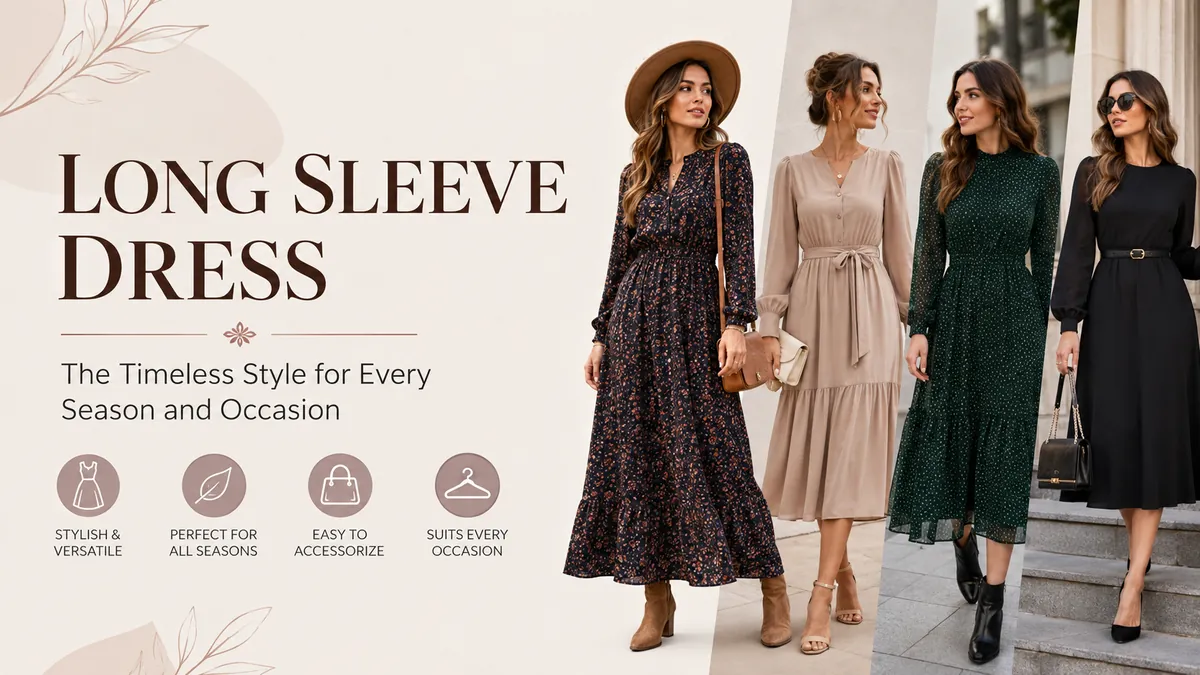
A dress can look perfect on the hanger and still feel completely wrong once you put it on. With a long sleeve dress, the difference usually comes down to three things: sleeve proportion, fabric, and silhouette.
A long sleeve dress is a dress with sleeves that extend most or all the way to the wrist. Available in mini, midi, and maxi lengths, it can work across casual, professional, formal, and seasonal wardrobes. Choosing the right one depends primarily on fabric weight, sleeve construction, overall fit, and occasion.
That versatility explains why long sleeves are not restricted to winter anymore. Lightweight cotton and linen-blend dresses can work in warm weather, while knits, velvet, and heavier jersey make the same basic silhouette practical during colder months. Recent fashion guides likewise treat long-sleeved dresses as year-round pieces rather than strictly cold-weather clothing.
The key is understanding what each length, sleeve shape, fabric, and cut actually does.
What Is a long sleeve dress?
A long sleeve dress combines the one-piece construction of a dress with sleeves that generally reach toward the wrist. Within that simple definition, however, there is enormous variety.
The skirt may be mini, midi, or maxi length. The bodice can be fitted, wrapped, tailored, smocked, or loose. Sleeves may sit close to the arm or take the form of bishop, balloon, bell, puff, sheer, lace, or flared designs.
That means “long sleeve” describes only one part of the garment rather than one particular fashion aesthetic.
You can find:
- Cotton shirt dresses for everyday wear
- Ribbed knit dresses for cooler weather
- Wrap dresses with waist definition
- Formal satin and crepe dresses
- Lace or sheer-sleeve occasion dresses
- Flowing bohemian maxi dresses
- Fitted bodycon styles
- Structured sheath dresses
- Sweater dresses
- Sequin and velvet evening dresses
The long sleeve therefore functions as both a practical feature and a design element.
It can provide coverage and warmth, but it can also change the visual balance of an outfit. A fitted sleeve produces a streamlined effect, while a bishop or balloon sleeve creates volume and becomes part of the statement.
Types of long sleeve dress by Length
Dress length is one of the easiest ways to narrow down the right style. Mini, midi, and maxi dresses can all have long sleeves, yet they produce noticeably different proportions.
| Dress length | General character | Common uses | Styling consideration |
|---|---|---|---|
| Mini | Youthful, sharp, playful | Parties, casual outings, evenings | Long sleeves balance the shorter hem |
| Midi | Polished, versatile | Work, dinners, weddings, everyday wear | Easy to pair with flats, boots, or heels |
| Maxi | Flowing, dramatic, covered | Formal events, holidays, modest dressing | Fabric weight matters because there is more material |
Long Sleeve Mini Dress
A long sleeve mini dress creates deliberate contrast: more arm coverage paired with a shorter hemline.
That visual balance is one reason the silhouette works well for parties, dinners, concerts, and transitional-season outfits.
Fitted mini dresses tend to feel more evening-oriented, while loose cotton, shirt, or smocked minis can look relaxed during the day.
When temperatures drop, tights and boots can extend their usefulness into autumn and winter.
Long Sleeve Midi Dress
For versatility, the midi is difficult to beat.
A hem that falls somewhere between the knee and ankle gives enough coverage for many professional and semi-formal situations without the visual weight of a floor-length dress.
A structured crepe midi can feel office-ready. A floral chiffon version suits daytime celebrations. A satin or velvet midi can shift easily into evening wear.
Current styling guides frequently identify midi silhouettes as among the most adaptable options for work, weddings, cocktail occasions, and transitional dressing.
Long Sleeve Maxi Dress
A long sleeve maxi dress creates the greatest amount of coverage and often the most movement.
Flowing chiffon, viscose, or lightweight cotton can keep the silhouette relaxed, while velvet, satin, lace, and embellished fabrics make it suitable for formal settings.
Because both the arms and legs are largely covered, proportion matters. A defined waist, open neckline, side slit, lightweight material, or subtle shaping can prevent a maxi from appearing visually heavy.
Popular Long Sleeve Styles and What They Change
Sleeves deserve as much attention as the skirt.
Two otherwise identical dresses can look completely different when one has narrow fitted sleeves and the other uses exaggerated bishop sleeves.
Fitted Sleeves
Fitted sleeves follow the arm closely from shoulder to wrist.
They produce a clean, streamlined silhouette and work particularly well with bodycon, sheath, knit, and minimalist dresses.
Movement is the main fit test. You should be able to bend your elbow and reach forward without the shoulder seam pulling or the sleeve twisting excessively.
Stretch jersey and knit fabrics make close-fitting sleeves easier to wear.
Bishop Sleeves
A bishop sleeve has fullness through the arm before gathering at the cuff.
The added volume gives a dress a soft, romantic character and is common in chiffon, crepe, bohemian, and occasion styles.
Because the sleeves already provide visual volume, they often look strongest with a more controlled waist or bodice.
Balloon Sleeves
Balloon sleeves create noticeable fullness before narrowing at the cuff.
They can transform an otherwise simple dress into a statement piece.
Keep proportion in mind. If the sleeves are extremely voluminous, a clean skirt or defined waist usually keeps the overall silhouette balanced.
Bell and Flared Sleeves
Bell sleeves widen toward the lower arm or wrist.
They have associations with bohemian and retro dressing but also appear on modern evening gowns.
The practical drawback is obvious: wide cuffs can brush against plates, drinks, desks, and coat sleeves. For an event involving dinner or significant hand movement, test the sleeve length before wearing the dress.
Puff Sleeves
Puff sleeves concentrate volume closer to the shoulder.
That can make the shoulder line appear broader, which may be useful when you want to create more visual balance between the upper and lower body.
Very exaggerated versions make a strong statement; smaller puff sleeves are easier to incorporate into everyday clothing.
Sheer, Lace, and Illusion Sleeves
Sheer sleeves offer the visual coverage of a sleeve without the density of opaque fabric.
Lace, mesh, chiffon, and tulle are frequently used for this effect in wedding-guest dresses, evening gowns, cocktail dresses, and other occasionwear. Formal-dress guides commonly distinguish illusion and lace sleeves as their own design categories because they create coverage while retaining visual lightness.
Check the seams carefully with delicate fabrics. Scratchy embroidery or stiff internal stitching around the arm can become uncomfortable surprisingly quickly.
How to Choose the Right Fabric
Fabric determines far more than appearance.
It affects warmth, breathability, drape, stretch, transparency, movement, wrinkle resistance, and how formal a dress feels.
| Fabric | Best suited to | Main advantage | Possible drawback |
| Cotton | Casual and warm-weather wear | Breathable and comfortable | Can wrinkle |
| Linen blend | Summer and holidays | Airy and lightweight | Often creases |
| Viscose | Spring and summer | Soft drape | Quality varies |
| Jersey | Everyday wear | Stretch and comfort | Thin jersey may cling |
| Crepe | Work and occasions | Structured drape | Some versions lack stretch |
| Ponte | Office and fitted dresses | Holds its shape | Can feel warm |
| Chiffon | Events and flowing styles | Light movement | Often requires lining |
| Satin | Evening wear | Smooth, polished surface | Can show creasing or pulls |
| Velvet | Winter events | Rich texture and warmth | Usually too heavy for hot weather |
| Knit/wool blend | Autumn and winter | Warm and comfortable | May pill depending on quality |
Cotton and Linen Blends
A common misconception is that long sleeves automatically make a dress too warm for summer.
Sleeve length is only one part of thermal comfort.
A loose cotton or linen-blend garment can feel much cooler than a sleeveless dress made from dense synthetic material because weave, breathability, fit, humidity, and airflow all matter.
For hot weather, look for lightweight fabric and room between the sleeve and skin.
Viscose and Tencel/Lyocell
Viscose-family fabrics are often chosen for their soft hand and fluid drape.
Lyocell, commonly associated with the TENCEL brand, can also create lightweight dresses with good movement.
Care instructions vary considerably, so check the garment label rather than assuming all cellulose-based fabrics can be washed in the same way.
Jersey and Ribbed Knits
Jersey is useful when comfort and movement matter.
Stretch versions work especially well for fitted and wrap silhouettes. Ribbed knits can add texture while remaining flexible.
Thin knit fabrics, however, may reveal underwear lines or stretch unevenly around the hips, elbows, or seat. Looking at the garment in natural light is more revealing than relying on a dressing-room mirror.
Crepe and Ponte
Crepe is a common choice when you want more structure without the stiffness of heavily tailored fabric.
Ponte knit is denser and generally stretches while holding its shape, making it useful for work dresses and streamlined cold-season pieces.
Chiffon and Georgette
Chiffon and georgette create movement without making long sleeves appear visually heavy.
They are particularly effective for bishop sleeves, gathered cuffs, printed maxis, and event dresses.
Because they can be translucent, the bodice and skirt are frequently lined while the sleeves remain sheer.
Satin
Satin describes a weave rather than one specific fiber.
It can be made from silk or manufactured fibers such as polyester. Its smooth reflective surface makes it a natural choice for evening dressing.
Because satin catches light, fit becomes noticeable. Pulling across the hips, bust, shoulders, or upper arms can be more visible than it would be in a matte fabric.
Velvet
Velvet adds texture and depth, especially in darker colors and jewel tones.
Its warmth and visual richness make it particularly suited to winter dinners, holiday parties, formal evenings, and cold-weather weddings.
Can You Wear a long sleeve dress in Summer?
Yes. A long sleeve dress can work comfortably in summer when its material and construction suit the temperature.
Glamour’s 2026 summer styling guidance, for example, recommends lightweight materials and seasonally appropriate hemlines and footwear rather than automatically avoiding sleeves.
For warm weather, prioritize:
- Lightweight cotton, linen blends, viscose, or similarly breathable fabrics.
- A relaxed rather than skin-tight sleeve.
- Lighter colors when prolonged sun exposure is expected.
- Unlined or lightly lined construction where appropriate.
- Open shoes such as sandals or slingbacks.
- A silhouette that allows air circulation.
A loose white cotton shirt dress and a lined black velvet gown both have long sleeves, but they clearly do not perform the same way in heat.
What About Spring and Autumn?
Long sleeves are especially convenient during transitional weather.
A midi dress can work alone during warmer daytime temperatures, then take a blazer, trench coat, cardigan, or lightweight jacket as conditions change.
Ankle boots, loafers, ballet flats, and sneakers can all work depending on the dress.
Best Options for Winter
Winter is where heavier long-sleeved dresses become most useful.
Look toward:
- Merino or wool blends
- Sweater knits
- Ribbed jersey
- Ponte
- Velvet
- Heavier crepe
- Lined fabrics
Knee-high boots and tights provide substantially more warmth than simply choosing a longer skirt.
For very cold conditions, thermal base layers can sometimes sit discreetly beneath a looser dress.
How to Style a long sleeve dress for Different Occasions
The easiest styling method is to consider the dress, shoes, bag, outer layer, and accessories as one visual system.
You rarely need every element to make a statement.
Casual Everyday Outfits
For a relaxed outfit, choose uncomplicated fabrics and practical shoes.
An easy formula is:
Cotton or jersey midi dress + sneakers or flats + crossbody bag
A denim jacket can add texture in mild weather, while a cardigan makes the outfit softer.
If the dress has print, gathers, or statement sleeves, keep the accessories simple.
Office and Workwear
Work clothing varies by industry, but structured midi and knee-length silhouettes translate particularly well into professional environments.
Crepe, ponte, heavier jersey, and tailored shirting usually maintain their shape better through a full working day.
One straightforward combination is:
Long sleeve midi dress + loafers or low block heels + structured tote
A belt can create additional waist definition on a shirt dress.
Before relying on a dress for work, sit down in it. A hemline that appears completely appropriate while standing can move considerably when seated.
Wedding Guest Outfits
Long sleeves can be particularly useful for autumn, winter, and evening weddings, but fabric and dress code matter more than sleeve length alone.
For cocktail or semi-formal celebrations, a chiffon, crepe, lace, satin, or velvet midi often works well.
Formal and black-tie events generally call for more elevated fabrics and longer or more sophisticated silhouettes.
Avoid assuming that “more coverage” automatically means “more formal.” A cotton sweater dress has greater coverage than many cocktail dresses but remains inherently casual.
For weddings specifically, follow the couple’s stated dress code and avoid colors or styling that could conflict with local wedding customs.
Date Night and Evening Wear
A long sleeve dress can create a polished evening look without needing elaborate styling.
Wrap dresses, bodycon cuts, velvet, satin, lace, and dresses with subtle cut-outs or interesting necklines can all provide contrast against the greater arm coverage.
Try:
Waist-defined midi + pointed heel or ankle boot + small bag + one focal piece of jewelry
The single focal-accessory approach keeps the outfit intentional rather than crowded.
Holiday Parties
Holiday dressing gives richer fabrics room to work.
Velvet, sequins, satin, metallic details, lace, and jewel tones such as burgundy, emerald, plum, and deep blue suit the mood without requiring an elaborate silhouette.
When the material itself is highly reflective or embellished, simplify the jewelry.
How Should a Long Sleeve Dress Fit?
Fit is more important than the label on the size tag.
The sleeve introduces additional fitting points that sleeveless dresses do not have, particularly at the shoulder, bicep, elbow, cuff, and wrist.
Check the Shoulder First
The shoulder seam on a conventionally fitted dress should generally align close to where your shoulder ends.
A seam that sits too far inward can restrict movement. One that falls considerably beyond the shoulder may indicate an oversized fit unless dropped shoulders are part of the design.
Test Arm Movement
Raise your arms.
Reach forward.
Bend your elbows.
Cross your arms.
If the entire dress rides upward whenever your arms move, the shoulders, armholes, bodice, or sleeves may be too restrictive.
This is particularly important with woven fabrics that contain little or no stretch.
Check the Bicep
A fitted sleeve should follow the arm without creating uncomfortable horizontal pulling.
If you can barely bend your elbow or feel the fabric cutting into the upper arm, increasing the dress size may not completely solve the problem. A different cut or fabric may fit better.
Look at Sleeve Length
A conventional full-length sleeve usually ends around the wrist, although design details can intentionally make it longer or shorter.
Petite shoppers may find standard sleeves extend over the hands, while taller people or those with longer arms may encounter sleeves that finish too high.
Three-quarter sleeves can be a practical alternative when standard sleeve proportions are difficult.
Check the Cuff
Buttons and fitted cuffs should close without digging into the wrist.
With bell or flared sleeves, check whether your hands can function comfortably during eating, working, or carrying a bag.
Choosing a Dress for Your Proportions
Style advice traditionally sorts people into categories such as pear, apple, rectangle, and hourglass.
Those labels can provide a starting point, but they are not rules about what anyone “should” wear.
A more useful approach is deciding what visual effect you want.
If You Want More Waist Definition
Consider:
- Wrap construction
- Belted shirt dresses
- Fit-and-flare silhouettes
- Seamed waists
- Smocking
- Structured bodices
A natural waist creates traditional definition, while an empire waist shifts emphasis upward.
If You Want a Longer Visual Line
A relatively uninterrupted silhouette can create a more vertical impression.
Try fitted sleeves, monochromatic colors, moderate-volume skirts, V-necklines, or vertical seams and details.
Petite fit guides also commonly recommend controlling excess sleeve and skirt volume so the garment does not overwhelm a smaller frame.
If You Want More Movement Through the Skirt
A-line, fit-and-flare, pleated, tiered, and flowing maxi dresses provide more room than bodycon or narrow sheath silhouettes.
The correct choice is fundamentally about comfort and preference, not correcting a body shape.
If You Want to Balance Statement Sleeves
A balloon, bishop, bell, or puff sleeve already adds visual interest.
Pairing it with a simpler skirt often creates an easy balance.
Alternatively, combining dramatic sleeves with a full skirt produces an intentionally maximal silhouette. Neither approach is wrong; they simply create different effects.
How to Choose the Right Neckline
Long sleeves cover a significant portion of the body, so the neckline can dramatically change the overall impression.
V-Neck
A V-neck creates a strong vertical line and visually opens the upper body.
It works particularly well with wrap dresses.
Crew Neck
A crew neck feels clean and simple.
On a fitted knit dress, it creates a minimalist silhouette. On a loose maxi with long sleeves, however, a high neckline can create considerable coverage, so fabric weight becomes more noticeable.
Square Neck
Square necklines add geometric structure and expose more of the collarbone while retaining substantial overall coverage.
They work particularly well with fitted and puff-sleeve styles.
Turtleneck
A turtleneck dress provides maximum upper-body coverage and naturally reads as cold-weather clothing.
Ribbed knit versions pair particularly well with boots and long coats.
Off-the-Shoulder Neckline
Off-the-shoulder designs create a striking contrast: covered arms with exposed shoulders.
This moves long sleeves away from purely practical coverage and turns them into a design feature.
What Shoes Go With a Long Sleeve Dress?
There is no single correct shoe. Hem length, fabric, dress code, weather, and personal style matter more than the sleeves themselves.
Sneakers
Best for casual cotton, ribbed, jersey, or shirt dresses.
A clean sneaker can make even a midi silhouette feel relaxed.
Ballet Flats and Mary Janes
These pair naturally with mini and midi lengths and can move between casual and polished outfits.
Loafers
Loafers work especially well with shirt dresses, sweater dresses, and structured midis.
Ankle Boots
One of the easiest autumn pairings.
They work with mini, midi, and some maxi dresses, although the relationship between the boot opening and hem matters.
Knee-High Boots
Knee-high boots are particularly useful with sweater dresses and shorter hemlines.
They provide extra warmth while reducing the amount of exposed leg.
Heels
Pointed pumps, block heels, slingbacks, and strappy sandals can all make a long-sleeved dress feel more formal.
Choose the shoe based on the event rather than trying to match a rigid fashion formula.
How to Layer Without Making the Outfit Bulky
Long sleeves remove one obvious layering option: putting a shirt or fitted top underneath.
That makes outer layers more important.
Blazer
A tailored blazer sharpens a jersey, crepe, or simple midi dress.
Make sure the dress sleeves fit comfortably inside the blazer arms. Voluminous bishop and balloon sleeves can bunch underneath narrow tailoring.
Cardigan
Cardigans create a softer casual look and pair naturally with knitted, floral, and everyday dresses.
A cropped cardigan emphasizes the waist; a longer version creates a more relaxed line.
Trench Coat
A trench works particularly well during transitional weather because it complements both casual and tailored dresses.
Ideally, coat and dress lengths should look intentional rather than stopping only a few centimeters apart in an awkward position.
Long Wool Coat
For winter, a streamlined long coat can sit over sweater, jersey, and formal dresses without adding unnecessary visual breaks.
If the dress has substantial sleeves, confirm that the coat armholes and sleeves provide enough room.
Black, White, Printed, or Colorful?
Color changes how versatile a dress feels, but there is no universal “best” shade.
Black Long Sleeve Dress
Black is easy to restyle because footwear, jewelry, bags, and outerwear can substantially change its character.
The same black midi might work with:
- Loafers and a tote for work
- Boots and a coat for winter
- Heels and jewelry for dinner
- Sneakers and a crossbody bag for daytime
Fabric is what distinguishes a casual black dress from an evening one.
White and Cream
Light neutral dresses tend to feel especially fresh during spring and summer.
Cotton, broderie anglaise, eyelet, and linen-blend styles emphasize that effect.
Check transparency in natural light and consider the undergarments or slip required.
Prints
Print can do much of the styling work for you.
Florals create a softer look, stripes can make shirt dresses feel crisp, and geometric prints often work particularly well on simple silhouettes.
If the print is visually busy, accessories can stay restrained.
Jewel and Earth Tones
Burgundy, forest green, navy, rust, brown, plum, and deep blue naturally complement autumn and winter textures such as velvet, wool blends, satin, and heavier crepe.
These associations are stylistic rather than rules; any color can work year-round when fabric and styling support it.
Common Mistakes When Choosing a Long Sleeve Dress
Some problems only become obvious after several hours of wear.
Choosing for Appearance but Ignoring Mobility
A sleeve can look perfectly fitted while your arms hang naturally and become unbearable when you reach forward.
Always perform a movement test.
Assuming Long Sleeves Mean Warmth
A sheer chiffon sleeve provides almost no insulation.
Conversely, dense ribbed knit can become uncomfortable even in mild temperatures.
Judge warmth by the complete fabric construction.
Ignoring the Lining
Lining affects opacity, movement, breathability, and comfort.
With formal dresses, inspect whether the lining ends smoothly and whether it causes the outer material to cling.
Getting the Dress Length Right but Ignoring Sleeve Length
People often check hem length carefully but accept badly fitting sleeves.
Excess fabric around the wrist can make tailoring look sloppy, while sleeves that are too short may appear accidental unless that is the intended design.
Combining Too Many Statement Elements
A dramatic neckline, giant balloon sleeves, heavily embellished fabric, statement necklace, ornate shoes, and large bag can compete for attention.
When the dress already provides the focal point, accessories do not need to do the same job.
Buying by Size Number Alone
Sizing is inconsistent across brands and even between garments from the same brand.
Use garment measurements whenever possible, particularly bust, waist, hips, shoulder width, sleeve length, and overall length.
How to Care for Long Sleeve Dresses
The care label should always take priority because two visually similar dresses can contain completely different fibers.
A few habits nevertheless improve longevity.
Wash Only as Necessary
Frequent washing creates friction, fading, fiber damage, and stretching.
If the dress is clean and odor-free after brief wear, airing it may be enough.
Protect Delicate Sleeves
Lace, mesh, embroidery, sequins, and loose-knit sleeves snag easily.
Keep them away from rough jewelry, exposed zippers, Velcro, and sharp bag hardware.
A mesh laundry bag can help protect machine-washable delicate garments.
Reshape Knits
Heavy knit dresses may stretch when hung for long periods.
Fold them when the care instructions and storage space permit.
After washing, reshape the garment carefully rather than stretching wet sleeves.
Deal With Wrinkles According to Fabric
Cotton and linen commonly tolerate ironing at appropriate temperatures, while synthetic satin, velvet, and delicate fibers require much more care.
A steamer may be suitable for many garments, but always follow the manufacturer’s instructions first.
How to Build Outfits Around One Long Sleeve Dress
A versatile dress does not require dozens of accessories.
Take one simple black, navy, brown, or neutral midi and change the context around it.
Casual: sneakers + crossbody bag + light jacket
Work: loafers + structured tote + blazer
Autumn: ankle boots + trench coat
Winter: knee-high boots + tights + wool coat
Dinner: pointed heels + small shoulder bag + earrings
That is a better test of versatility than asking whether a dress follows a particular trend.
A garment that works with shoes and outerwear you already own is much more likely to become useful rather than sit untouched in the wardrobe.
A Practical Checklist Before Wearing or Choosing One
Before deciding that a long-sleeved dress works, check more than your first impression in the mirror.
Ask:
- Can I lift and bend my arms comfortably?
- Does the shoulder sit where the design intends?
- Is there enough room through the upper arm?
- Do the cuffs fit comfortably?
- Does the fabric suit the expected temperature?
- Is the garment transparent in daylight?
- Does it require a slip or special underwear?
- Can I sit comfortably at the current hem length?
- Does the fabric wrinkle excessively?
- Will the sleeves fit underneath the outerwear I plan to use?
- Can I wear it with shoes already in my wardrobe?
- Are the washing and care requirements realistic for me?
Those practical details tend to matter more over time than whether a dress looked impressive for thirty seconds in a fitting room.
Final Thoughts on Choosing a long sleeve dress
The most useful long sleeve dress is not simply the one with the most fashionable sleeve or flattering photograph. It is the one whose length, fabric, cut, sleeve construction, and level of formality match the way you actually intend to wear it.
Start with the occasion and temperature. Then choose an appropriate fabric and length. Check the shoulders, upper arms, cuffs, and freedom of movement before worrying about accessories.
For year-round versatility, a midi in cotton, viscose, crepe, ponte, or comfortable jersey is an easy foundation. For warm weather, favor breathable lightweight construction. For cold weather, move toward knitwear, velvet, wool blends, heavier jersey, and layering. For formal occasions, satin, lace, chiffon, crepe, and refined sleeve details can provide elegance without sacrificing coverage.
Once the fit is right, styling becomes the easy part.