
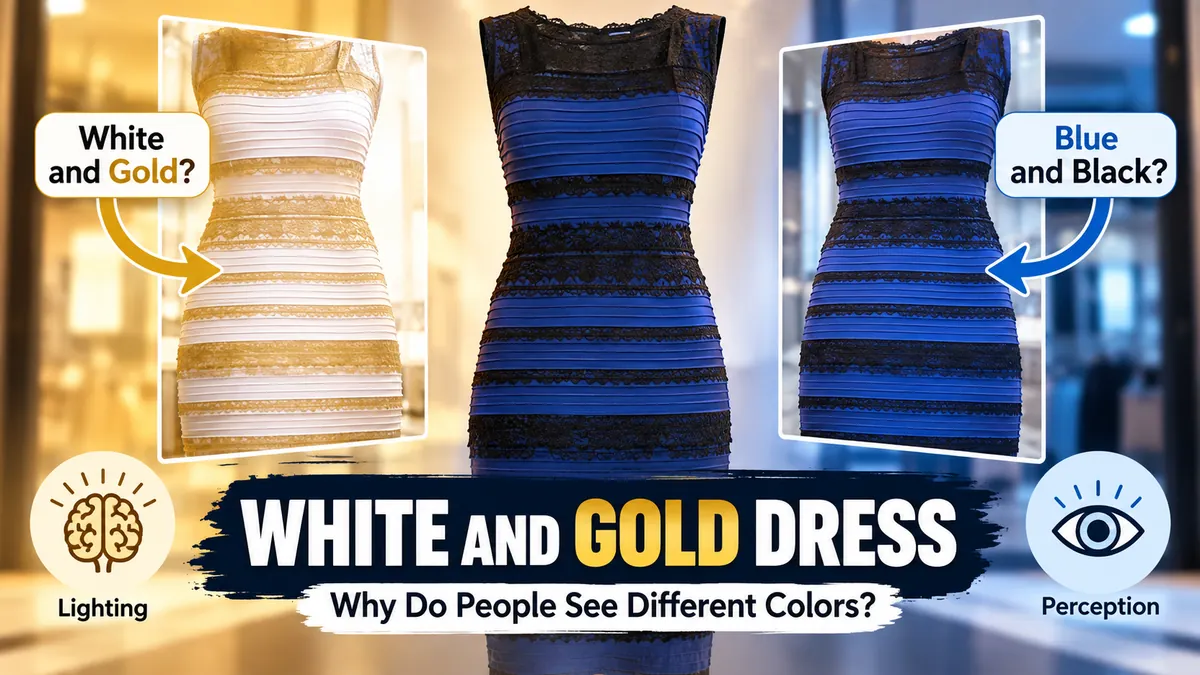
The white and gold dress is one of the internet’s most famous visual-perception puzzles. In February 2015, a photograph of a striped dress went viral because some viewers were convinced it was white and gold, while others saw blue and black. The physical dress was actually blue and black. PubMed Central (PMC)
The disagreement happens largely because the photograph provides ambiguous information about illumination. Your visual system tries to compensate for the light it thinks is falling on the dress. If your brain interprets the scene as being under cool, bluish light, you may perceive white and gold; a different assumption about illumination can produce blue and black. PubMed
What Is the White and Gold Dress?
The phrase white and gold dress usually refers to the viral photograph commonly called “The Dress” or “#TheDress.”
The image became an online phenomenon in February 2015 after viewers discovered that they could look at exactly the same photograph yet report dramatically different colors. Some saw pale white fabric with gold lace, while others saw blue fabric with dark or black lace.
The disagreement quickly moved beyond an ordinary social-media debate. Vision researchers became interested because the photograph offered an unusually striking demonstration of how the brain interprets color.
The key distinction is simple:
| Question | Answer |
|---|---|
| What color was the actual dress? | Blue and black |
| Why does it look white and gold to some people? | Ambiguous lighting and color interpretation |
| Is the image itself changing? | No |
| Are people necessarily pretending to see different colors? | No—the perceptual differences can be genuine |
| What visual process is involved? | Color constancy and illumination estimation |
Roman Originals, the company associated with the garment, identified the original dress as blue and black. British Vogue
That leaves the much more interesting question: why can something physically blue and black appear so convincingly white and gold?
Why Does the White and Gold Dress Look Different to Different People?
Color is not determined simply by reading the wavelength information reaching your eyes and assigning a fixed label.
Your visual system also tries to determine what is causing that light.
Imagine placing a white sheet outside in blue-tinted shade. The light reaching your eyes from the sheet may be relatively blue, but you usually continue to perceive the sheet as white. Your brain effectively compensates for the illumination.
That ability is related to color constancy.
The dress photograph creates a difficult situation because the illumination is unclear. Researchers have described the image as compatible with different interpretations of the lighting conditions. Color2
If the brain assumes one type of illumination, the pixels are interpreted one way. Assume another type, and the perceived colors can shift dramatically.
Your Brain Is Trying to Correct the Lighting
Consider a familiar object under several lighting conditions.
A white shirt might appear:
- slightly blue outdoors in shadow,
- yellowish under a warm indoor bulb,
- neutral in daylight,
- gray in a dark room.
You normally don’t conclude that the shirt itself keeps changing color.
Instead, the visual system attempts to separate an object’s surface color from the color and intensity of the light illuminating it.
With #TheDress, the photograph doesn’t provide enough reliable contextual information for everyone to make the same correction.
That ambiguity is central to the illusion.
Why Do Some People See White and Gold?
People who experience the white and gold dress interpretation are generally thought to be discounting a cool or bluish illuminant.
In other words, the visual system may interpret the dress as being photographed in bluish shadow or under another cool light source. It therefore treats some of the blue information in the photograph as coming from the illumination rather than the fabric itself.
Once that blue cast is discounted, the lighter portions can appear much closer to white.
The dark portions can consequently look gold or brownish.
Research on The Dress supports an important role for assumptions about the illuminant and interpretation of the surrounding scene. PubMed
Think of It Like Automatic White Balance
A useful comparison is a camera’s white-balance system.
A digital camera tries to determine what should count as neutral white under different lighting conditions. If the white balance is wrong, the entire photograph can acquire a blue, orange, yellow, or another color cast.
Your brain performs a much more sophisticated version of this problem continuously.
Most of the time, it works so well that you don’t notice it.
The dress is memorable precisely because the system encounters unusually ambiguous evidence.
Why Do Other People See Blue and Black?
Other viewers look at the identical photograph and immediately see blue and black.
Their visual systems make a different interpretation of the illumination, leaving much more of the blue information assigned to the dress itself.
The lighter areas therefore remain visibly blue, while the darker lace appears black or nearly black.
The difference illustrates why saying that one group simply has “better eyesight” misses the point. The viral effect primarily concerns interpretation of an ambiguous visual scene rather than an ordinary eye test.
Researchers studying the phenomenon have linked people’s reported colors with how they infer the scene’s illumination. Sage Journals
The Image Was Particularly Well Suited to the Illusion
The photograph contains several characteristics that encourage uncertainty.
Its exposure and color balance make the illumination difficult to identify confidently, while the surrounding context does not give the brain the usual collection of dependable references.
Rochester Institute of Technology color scientist Mark Fairchild described the photograph as significantly overexposed and explained that display characteristics can also alter color appearance. Rochester Institute of Technology
Normally, a richer scene might contain recognizable skin tones, neutral objects, shadows, or other environmental information that helps your brain infer the light source.
The original dress image gives the visual system much less certainty.
What Color Is the Dress Actually?
Despite the famous debate, the physical garment associated with the viral photograph was blue and black.
That fact does not mean someone who perceives white and gold is lying or simply failing to recognize obvious colors.
It helps to separate two questions:
What colors did the manufactured garment have?
Blue and black.
What colors can someone genuinely perceive in the viral photograph?
Among the reported perceptions are white and gold and blue and black, with some people describing intermediate colors.
Scientific studies explicitly distinguish between the actual colors of the garment and the colors observers perceive from the ambiguous photograph. PubMed Central (PMC)
That distinction is what makes The Dress scientifically interesting.
What Is Color Constancy?
Color constancy is the visual system’s tendency to perceive an object’s color as relatively stable even when illumination changes.
Suppose you own a red coffee mug.
You recognize it as red:
- beside a sunny window,
- under an LED bulb,
- beneath warm restaurant lighting,
- on an overcast morning.
Yet the precise light entering your eyes from the mug isn’t identical in all those situations.
Your visual system uses surrounding information to estimate the illuminant and infer the object’s likely surface properties.
Why Color Constancy Usually Helps
Without some form of color constancy, identifying objects by color would be considerably more difficult.
Sunlight itself varies during the day. Artificial lamps have different spectral characteristics. Shadows alter the light falling on surfaces.
The visual system therefore cannot simply treat the incoming light as a direct measurement of an object’s permanent color.
It needs context.
The viral dress provides context—but not enough unambiguous context.
Brainard and Hurlbert’s scientific discussion of #TheDress describes how the same retinal image could be interpreted as blue-and-black material under one illumination or white-and-gold material under another. Color2
That is the heart of the puzzle.
Is the White and Gold Dress an Optical Illusion?
It is commonly described as an optical illusion, although “perceptual ambiguity” is particularly useful for understanding what is happening.
The pixels displayed on the screen don’t need to change for your experience of their colors to change.
Instead, your brain interprets those pixels within an assumed lighting environment.
Scientific work has examined both lower-level visual factors and higher-level processing. One study using fMRI reported differences in activity associated with people who perceived the dress as white/gold versus blue/black, including regions involved in higher-level visual processing and cognition. ScienceDirect
The important lesson isn’t that the brain is malfunctioning.
Quite the opposite: the phenomenon exposes processes that normally help vision function effectively in a world where illumination constantly changes.
Can the Same Person See Both Versions?
Yes.
Some people can experience the dress differently after viewing another version of the photograph, changing the surrounding context, or reconsidering the illumination.
You may initially see:
white + gold
and later suddenly perceive:
blue + black.
For some observers, the new perception becomes difficult to reverse.
Context can have a powerful influence because color perception doesn’t occur independently of the surrounding visual scene.
A MathWorks explanation of the phenomenon noted reports that adding familiar visual information to the scene could alter how some viewers interpreted the dress’s colors. MathWorks Blogs
This is another reminder that your brain isn’t evaluating each pixel independently.
It is interpreting an entire scene.
Does Screen Brightness Change What You See?
It can influence the appearance, although it isn’t the complete explanation for the disagreement.
Screens differ in:
- brightness,
- contrast,
- color temperature,
- white point,
- viewing angle,
- display technology,
- image-processing settings.
Changing those variables alters the light reaching your eyes.
RIT’s Mark Fairchild specifically noted that differences in how smartphones, computers, and tablets reproduce an image can change its color appearance. Rochester Institute of Technology
However, display differences alone cannot explain the entire phenomenon because people can disagree while viewing the same image on the same display.
The ambiguity in the photograph and the brain’s interpretation of illumination remain fundamental.
Is Seeing White and Gold a Sign of Color Blindness?
No. Seeing the viral image as white and gold should not by itself be interpreted as evidence that someone has color-vision deficiency.
Color-vision deficiencies involve particular difficulties distinguishing colors, often because of differences in cone photoreceptor function.
The Dress phenomenon is different.
People with otherwise normal color vision can perceive the photograph differently because the image creates uncertainty about illumination and surface color.
Your retina contains photoreceptors that respond to incoming light, but the information they produce must still be interpreted by the visual system.
Researchers have investigated whether early optical, retinal, and neural factors contribute to differences in Dress perception, while the broader scientific literature emphasizes illumination estimation and color constancy. PubMed Central (PMC)
So a person’s answer to “What color is this dress?” is not a diagnostic test for color blindness.
Do Your Eyes or Your Brain Determine the Color?
Both are involved, but perception cannot be explained by the eyes alone.
Light first enters the eye and reaches the retina. Cone photoreceptors respond to different portions of the visible spectrum and provide information used by the visual system to construct color.
That neural information then undergoes substantial processing.
The brain considers factors such as:
- contrast,
- surrounding colors,
- brightness,
- illumination,
- shadows,
- scene context,
- previous visual assumptions.
Consequently, the color you consciously experience is not simply a label attached directly to a wavelength.
The visual system is solving a problem: What object and lighting conditions most likely produced the light reaching my eyes?
Usually there is a strong answer.
The Dress is unusual because there are multiple plausible answers.
Does Age Affect How You See the White and Gold Dress?
Researchers have investigated individual differences in perception, but simple claims such as “young people see one version and older people see another” should be treated cautiously.
Several factors can potentially affect color perception.
The eye’s lens changes with age, for example, and individual observers differ in retinal and optical characteristics. Brainard and Hurlbert noted that differences in pre-retinal filtering, cone sensitivities, and other aspects of vision could potentially contribute to differences between observers. Color2
But the most useful explanation for The Dress remains the ambiguity of the photograph and how viewers estimate its illumination.
No single demographic characteristic determines what everyone will see.
Does Being a Morning Person or Night Owl Matter?
This became another fascinating line of research.
One hypothesis proposed that people’s exposure to different kinds of illumination could affect their assumptions about the photograph. Natural daylight and artificial lighting environments have different characteristics, potentially influencing how someone interprets an ambiguous illuminant.
Research has explored relationships among environmental lighting, inferred light sources, and Dress perception. One study reported that the observer’s environmental lighting conditions provided a relevant cue and discussed possible connections with circadian changes in ambient light. PubMed
However, this shouldn’t be turned into a rigid rule.
Being an early riser does not guarantee that you will see white and gold, just as staying up late does not guarantee blue and black.
It is better understood as evidence that perceptual assumptions can be shaped by experience and context.
Why Doesn’t Everyone See the Same Colors?
Because vision is an interpretation of sensory information, not a perfect recording of the physical world.
Two observers can receive very similar visual information while their brains resolve ambiguity differently.
The Dress makes this unusually obvious.
Most everyday scenes contain enough information for different observers’ visual systems to arrive at approximately the same interpretation. You rarely argue with someone about whether a banana sitting on a kitchen counter is yellow.
But remove reliable illumination cues and introduce unusual exposure, and the problem becomes harder.
The viral photograph sits in that uncertain territory.
As a result, one visual system may effectively reason:
This scene appears to have a cool cast, so I should discount the blue illumination.
Another may preserve more of that blue as belonging to the fabric.
The final conscious perceptions can therefore be dramatically different.
Why Was the Dress Such a Big Internet Phenomenon?
Many optical illusions are obviously designed to trick you.
The Dress wasn’t.
It looked like an ordinary photograph of an ordinary garment. That made discovering that another person could sincerely see completely different colors startling.
It also had an ideal social format.
You could show someone the image and ask one simple question:
What colors do you see?
No special equipment or scientific knowledge was required.
The result was immediate, personal, and sometimes surprisingly difficult to change.
Celebrities and major publications joined the debate, while researchers used the phenomenon to discuss color science, visual perception, illumination, and the brain. British Vogue documented how figures including Taylor Swift, Julianne Moore and others publicly reported different perceptions. British Vogue
What started as an internet argument consequently became a memorable demonstration of perception science.
What the White and Gold Dress Teaches Us About Human Vision
The biggest lesson from the white and gold dress is not really about the dress.
It’s about seeing.
We tend to experience vision as direct access to reality: light enters our eyes, we look at an object, and we simply see its color.
The actual process is more complicated.
The visual system continually makes calculations and assumptions about illumination, context, contrast, and surface properties. Normally those processes operate unnoticed.
The Dress exposed them.
Perception Depends on Context
A color can appear different depending on the colors surrounding it and the illumination your brain believes is present.
Lighting Is Fundamental to Color
An object’s physical properties matter, but the light illuminating that object also determines what reaches your eyes.
The Brain Corrects Visual Information
Color constancy helps objects maintain relatively stable perceived colors despite changing lighting.
Ambiguity Can Produce Different Valid Experiences
When visual evidence supports multiple interpretations, observers can experience strikingly different perceptions of the same image.
A Photograph Isn’t the Physical Object
The real dress and the viral image should not be treated as identical sources of color information. A photograph introduces exposure, white balance, display reproduction, and contextual limitations.
White and Gold Dress: The Final Explanation
The famous white and gold dress was physically a blue-and-black garment, but the viral photograph created unusually ambiguous lighting information. That ambiguity caused different visual systems to compensate for the apparent illumination differently. PubMed Central (PMC)
If your brain discounts a cool, bluish illuminant, the dress can appear white and gold. If it interprets the illumination differently and attributes more blue to the fabric, blue and black becomes the dominant perception.
Neither experience requires the photograph itself to change.
The phenomenon demonstrates something much broader: color perception is constructed from incoming light plus context and the brain’s interpretation of the scene. The dress became famous because it turned that normally invisible process into something millions of people could see—and disagree about—with their own eyes.
