
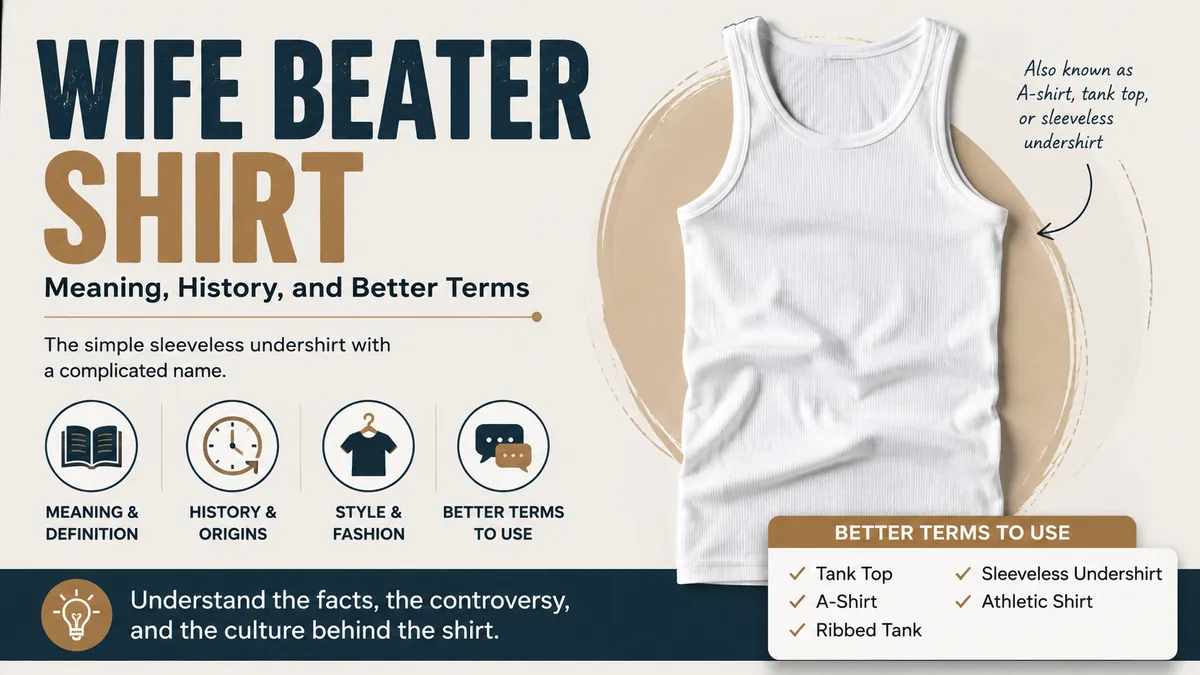
The wife beater shirt is one of the simplest pieces of clothing imaginable: a close-fitting, sleeveless undershirt, usually made from lightweight or ribbed cotton. Yet the slang name attached to it carries a far more complicated history.
For decades, the garment has appeared everywhere from underwear drawers and gyms to Hollywood films, music videos, streetwear, and high-fashion collections. The shirt itself is ordinary. The controversy comes from a nickname that directly evokes domestic violence.
A wife beater shirt generally means a close-fitting sleeveless undershirt, traditionally white and often made from ribbed cotton. More neutral names include tank top, A-shirt, athletic shirt, ribbed tank, and sleeveless undershirt. The slang term became established in American English during the late 20th century and is now widely considered offensive.
Understanding the distinction between the garment and its nickname helps explain why this basic piece of clothing remains popular even as the language surrounding it changes.
What Is a Wife Beater Shirt?
A wife beater shirt is the slang name commonly associated with a fitted sleeveless undershirt. Dictionary.com defines the clothing sense as a white, sleeveless, close-fitting men’s undershirt that may also be worn as an outer garment, while labeling the term offensive slang.
The classic version usually has:
- No sleeves
- Wide shoulder straps
- A relatively low neckline
- Large arm openings
- A close fit around the torso
- Lightweight cotton construction
- Ribbed or stretchy fabric
- A straight or slightly extended hem
White is the traditional color, although black, gray, navy, beige, and other versions are now common.
The garment can function as underwear beneath a dress shirt, as casual summer clothing, as workout wear, or as part of a layered outfit.
Is a Wife Beater Shirt the Same as a Tank Top?
Not exactly.
A tank top is a broad clothing category covering many kinds of sleeveless tops. They can be loose or fitted, plain or printed, athletic or fashionable.
The garment traditionally described by the slang term is a more specific type of tank: usually a thin, fitted, ribbed sleeveless undershirt.
| Feature | Traditional Wife Beater Shirt | General Tank Top |
|---|---|---|
| Fit | Usually close-fitting | Fitted or loose |
| Fabric | Often ribbed cotton | Cotton, polyester, blends and more |
| Traditional color | White | Any color |
| Original purpose | Undershirt | Casual, athletic or fashion wear |
| Shoulder straps | Usually relatively wide | Varies considerably |
| Modern use | Layering or standalone | Broad range of uses |
| Neutral terminology | A-shirt or sleeveless undershirt | Tank top |
Calling the garment a white ribbed tank top is often the clearest description when discussing fashion.
Why Is It Called a Wife Beater Shirt?
This is where the story becomes complicated.
The literal expression “wife-beater,” meaning a man who beats his wife, is much older than its clothing meaning. Etymonline traces the person-related sense to the 19th century, while placing the slang use for a sleeveless undershirt around 1990. Dictionary.com similarly dates the clothing sense to roughly 1990–95.
That distinction matters because it challenges the idea that the shirt had always carried this name.
It did not.
Sleeveless undershirts existed long before Americans commonly called them wife beaters.
The Famous 1947 Story
One frequently repeated explanation involves a 1947 domestic-violence case in Detroit. According to the story, newspapers showed a man identified as James Hartford Jr. wearing a stained sleeveless undershirt after he was arrested for killing his wife. The image was supposedly captioned in a way that connected “wife-beater” with the undershirt.
This explanation has been repeated in modern accounts, including Dictionary.com’s history of the expression.
However, it should not be presented as unquestionable historical fact.
The strongest linguistic evidence places widespread use of wife beater as the name of the garment decades later. The 1947 story may have contributed to the stereotype or may represent a later explanation attached to an already developing cultural association.
In other words, there is a difference between a memorable origin story and securely documented etymology.
Hollywood Strengthened the Stereotype
Popular culture probably played an important role in connecting the white undershirt with a particular type of aggressive masculinity.
One of the most famous examples is Marlon Brando as Stanley Kowalski in A Streetcar Named Desire. Brando’s character frequently appears in a fitted undershirt and is also violent and abusive.
The visual became culturally powerful: muscular man, white undershirt, working-class surroundings, anger, sweat, and aggression.
Later films and television repeatedly used similar imagery. By the late 20th century, audiences could recognize the stereotype even when nobody explicitly explained it.
The Washington Post noted in 1999 that the garment had become fashionable among young people while its provocative nickname drew attention precisely because of the stereotype attached to it.
When Did the Term Become Popular?
Available linguistic evidence suggests that calling the shirt a “wife beater” became especially recognizable in American English during the 1990s.
Etymonline dates the sleeveless-undershirt meaning to around 1990, while Dictionary.com gives a first-recorded range of 1990–95.
By the end of that decade, the expression was sufficiently widespread for mainstream newspapers to discuss both the shirt and controversy over its name.
That is important because people sometimes assume the nickname originated alongside the garment itself.
The garment is much older.
The slang name is comparatively recent.
Music, Movies, and 1990s Fashion
During the 1980s and 1990s, fitted tanks became increasingly visible outside the home.
They appeared in:
- Hip-hop culture
- Rock and alternative fashion
- Gym clothing
- Streetwear
- Movies and television
- Designer fashion
- Youth subcultures
Dictionary.com’s historical overview also points to the garment’s affordability, comfort, workout practicality, and increased fashion visibility during this period.
A piece originally associated with underwear was becoming acceptable as outerwear.
That transition helped turn a cheap basic into a recognizable fashion item.
What Is the Proper Name for a Wife Beater Shirt?
There isn’t one universally required name, but several neutral alternatives are more descriptive.
A-Shirt
A-shirt is commonly used for the traditional fitted, sleeveless undershirt.
The term helps distinguish this garment from a T-shirt or other types of undershirts. It is particularly useful when discussing the classic ribbed underwear version rather than fashion tank tops generally.
Tank Top
Tank top is probably the easiest everyday replacement.
It is widely understood and doesn’t carry the violent meaning of the slang expression.
The limitation is precision: “tank top” describes a much larger category. A loose workout tank and a fitted ribbed undershirt can both qualify as tank tops.
Sleeveless Undershirt
If the garment is actually being worn underneath another shirt, sleeveless undershirt is arguably the most straightforward description.
No cultural explanation is required.
Ribbed Tank Top
For fashion writing, shopping searches, and outfit descriptions, ribbed tank top or white ribbed tank often communicates exactly what someone means.
It describes the garment instead of the stereotype.
Why Is the Term Wife Beater Considered Offensive?
The problem isn’t the shirt.
It’s the phrase.
In its literal meaning, a wife beater is a person who physically abuses his wife. Using the same expression casually for clothing can make a serious form of violence sound trivial or humorous.
Dictionary.com explicitly labels the clothing meaning offensive slang.
Some people use the expression without intending any reference to abuse. They may simply have learned it as the ordinary name of the shirt.
Intent, however, doesn’t erase the phrase’s literal meaning.
That explains why neutral terms such as tank top, A-shirt, and sleeveless undershirt are increasingly preferable in professional, retail, editorial, and everyday contexts.
Is It Wrong to Say Wife Beater Shirt?
Language isn’t governed by one universal rulebook, so context matters.
People still recognize and use the term, particularly in the United States. Someone searching “wife beater shirt” may simply be trying to identify a garment they have seen.
But recognition and recommendation are different things.
If you’re describing the clothing yourself, white ribbed tank, A-shirt, or sleeveless undershirt communicates the same basic idea without invoking domestic violence.
That is especially useful in workplaces, product descriptions, journalism, schools, and conversations where the slang could distract from what you actually mean.
The Shirt Existed Long Before the Slang Name
Sleeveless undershirts did not suddenly appear in the 1990s.
Undergarments evolved considerably during the late 19th and early 20th centuries as clothing became lighter, mass production expanded, and people’s expectations around comfort changed.
By the early-to-mid 20th century, sleeveless undershirts were already established menswear.
Historical material documenting World War II-era clothing even shows ribbed A-style shirts in use before America’s entry into the war, demonstrating that the garment clearly predates its later slang nickname.
This makes an important point:
The history of the shirt and the history of the phrase are not the same thing.
The clothing developed as practical underwear.
The controversial nickname emerged later through cultural stereotypes and slang.
From Underwear to Fashion Staple
The ribbed white tank has undergone one of fashion’s most familiar transformations: something once intended to remain hidden became something deliberately displayed.
The same thing happened to T-shirts.
Early T-shirts were primarily undergarments. Eventually they became perfectly normal outerwear.
Sleeveless undershirts followed a similar path.
The Classic Masculine Image
Film helped make the white tank visually powerful.
Marlon Brando’s appearance in A Streetcar Named Desire is perhaps the most famous example, but later actors, musicians, athletes, and fictional characters continued the look.
The shirt exposed the shoulders and arms while fitting tightly around the torso, making it particularly effective for characters intended to appear physically strong, rebellious, working-class, or confrontational.
That imagery became bigger than the garment itself.
Streetwear and Music Culture
By the late 20th century, the tank had moved well beyond its underwear origins.
Musicians and performers wore fitted white tanks as standalone pieces. Hip-hop, punk, rock, and street fashion incorporated them in different ways.
The inexpensive garment had an advantage that designer clothing often lacked: authenticity.
It looked simple because it was simple.
High Fashion Adopts the Basic Tank
Designer fashion eventually embraced the silhouette too.
Dictionary.com’s historical account points to Dolce & Gabbana’s use of muscular models wearing versions of the shirt in its early-1990s runway imagery.
That reflects a recurring pattern in fashion.
A practical working-class or everyday garment enters a subculture, gains cultural meaning, and eventually gets reinterpreted by designers.
The basic tank followed that path remarkably well.
How the Wife Beater Shirt Is Worn Today
Strip away the controversial nickname and you’re left with an extremely versatile piece of clothing.
Modern ribbed tanks can work as underwear, casual clothing, athletic wear, or a base layer.
As an Undershirt
This is the traditional role.
A lightweight tank beneath a button-down can provide another layer between the skin and outer clothing.
Because there are no sleeves, however, it doesn’t cover the underarms like a crew-neck or V-neck T-shirt does.
That makes the choice largely personal.
With Jeans
A fitted white tank with blue or black jeans creates one of the simplest casual outfits possible.
Because the top is minimal, proportions become important. Relaxed or straight-leg trousers can balance a fitted upper half.
Under an Open Shirt
A ribbed tank also works beneath:
- Oxford shirts
- Flannel shirts
- Denim shirts
- Linen shirts
- Overshirts
- Lightweight jackets
Leaving the outer layer open creates visual depth without requiring complicated styling.
With Tailored Clothing
One of the more modern interpretations pairs a clean tank with tailored trousers, loafers, jackets, or an unstructured blazer.
The contrast is the point.
The tank is casual and minimal; tailoring is structured and polished.
For Exercise
Sleeveless tops naturally allow unrestricted arm movement and ventilation, which explains their longstanding relationship with gyms and athletic clothing.
A dedicated performance tank may be more comfortable for intense exercise because technical fabrics generally manage moisture better than traditional heavy cotton.
How Should a Ribbed Tank Fit?
Fit depends on whether you’re wearing it as underwear or outerwear.
For an undershirt, the garment should usually sit close enough to the body that it doesn’t bunch beneath another shirt.
For casual outerwear, there is more freedom.
A good fitted tank generally:
- Follows the torso without painfully squeezing it
- Allows comfortable shoulder movement
- Lies relatively flat around the neckline
- Has armholes that don’t excessively gape
- Reaches far enough below the waist for the intended outfit
If you’re layering it beneath trousers or another shirt, extra length can help keep it tucked in.
If you’re wearing it by itself, proportion matters more than traditional underwear rules.
Cotton vs. Cotton Blends
Traditional versions are strongly associated with cotton, particularly ribbed cotton.
Pure cotton tends to feel soft and breathable, while adding elastane or another stretch fiber can improve recovery and create a closer fit.
Neither construction is automatically better.
The right choice depends on whether you prioritize natural feel, stretch, durability, moisture management, or shape retention.
Is a Wife Beater Shirt a T-Shirt?
Technically, not in the usual sense.
A traditional T-shirt gets its name from the T-like silhouette created by its body and short sleeves.
A classic A-shirt or tank has no sleeves.
Both garments may be made from cotton and both can serve as undershirts, but their construction and coverage differ.
Think of them as related categories rather than interchangeable names.
Is a Wife Beater Shirt Only for Men?
No.
Although the slang expression historically refers to a men’s undershirt, the basic fitted tank silhouette is now effectively unisex.
Women’s fashion has long included camisoles, tanks, ribbed tops, racerbacks, cropped tanks, and other sleeveless variations.
Modern fashion has blurred many of the old boundaries between “underwear” and “outerwear” as well as men’s and women’s basics.
What matters more today is cut, fit, fabric, and styling.
Is a Wife Beater Shirt Always White?
No.
White became the stereotypical version because traditional men’s undershirts were commonly sold in white and because that visual was repeatedly reinforced through movies and popular culture.
Modern versions come in almost any color.
Common choices include:
- White
- Black
- Gray
- Navy
- Cream
- Brown
- Olive
- Burgundy
If someone specifically says “wife beater shirt,” however, the image they are most likely describing is still a fitted white ribbed tank top.
What Does “Wife Pleaser” Mean?
Fashion language continues to evolve.
In the early 2020s, some social-media users began jokingly calling the classic white ribbed tank a “wife pleaser” instead. GQ reported on the expression in 2023, describing it as a playful attempt to replace the violent older nickname with something positive.
The term attracted attention partly because the shirt itself was experiencing another fashion revival.
“Wife pleaser” isn’t a formal clothing classification, though, and it may or may not have lasting linguistic staying power.
If clarity is the priority, tank top or ribbed tank remains simpler.
Common Myths About the Wife Beater Shirt
A controversial name tends to produce memorable origin stories. Unfortunately, memorable doesn’t always mean historically proven.
Myth: The Shirt Was Invented in 1947
No.
Sleeveless undershirts existed well before 1947. Historical examples of ribbed A-style shirts can be found from the pre-World War II period.
The famous 1947 story concerns a possible explanation for the nickname, not the invention of the garment.
Myth: It Has Always Been Called a Wife Beater
Again, no.
Major etymological and dictionary sources place the clothing use of the expression around the early 1990s rather than the early history of the garment.
Myth: “Waif Beater” Was a Medieval Garment
You may encounter an internet story claiming medieval knights wore something called a “waif beater,” which eventually became “wife beater.”
This explanation has circulated online, but it should not be treated as established etymology. The stronger documentary trail connects the literal expression to abusive husbands and places the clothing slang much later.
When an origin story sounds almost too neat, checking when the word actually appears in documented usage is usually worthwhile.
Myth: Every Tank Top Is the Same Shirt
Tank top is an umbrella term.
Racerbacks, athletic tanks, loose-cut gym shirts, fashion tanks, camisoles, stringers, and fitted ribbed undershirts can all differ considerably.
The slang term traditionally points to a much narrower style: the fitted sleeveless undershirt.
Why the Garment Has Lasted
The terminology surrounding it may change, but the shirt itself isn’t disappearing.
Its longevity comes from basic design rather than cultural controversy.
It is:
- Simple
- Lightweight
- Easy to layer
- Comfortable in warm weather
- Relatively inexpensive
- Available in many fabrics
- Compatible with casual and tailored clothing
- Functional as either underwear or outerwear
Few garments require less explanation from a design perspective.
That simplicity also makes the tank easy for each generation to reinterpret.
One era sees underwear.
Another sees rebellion.
Another sees streetwear.
Another puts it beneath a blazer.
The garment stays almost identical while the cultural meaning changes around it.
What Should You Call It Today?
If you’re simply describing the garment, the easiest choices are:
Tank top — best general everyday term.
A-shirt — useful for the traditional fitted undershirt style.
Sleeveless undershirt — precise when discussing underwear.
White ribbed tank — particularly clear for fashion and styling.
Athletic shirt — sometimes used for similar sleeveless undershirts.
There is no need to pretend the phrase wife beater shirt doesn’t exist. People still encounter it in conversations, movies, search queries, and older fashion writing. Understanding its meaning is useful.
Using it yourself is another question.
Because the phrase literally describes domestic abuse and major dictionaries identify its clothing meaning as offensive slang, neutral alternatives usually communicate the same information more clearly and without the unnecessary baggage.
The Bottom Line
The wife beater shirt is not a unique category of mysterious clothing. It is essentially the familiar fitted sleeveless undershirt—often a white ribbed cotton tank or A-shirt—that has existed far longer than its controversial nickname.
Its history crosses practical underwear, Hollywood masculinity, working-class stereotypes, streetwear, music culture, gyms, and designer fashion. What changed most dramatically wasn’t the garment. It was what people called it and what the shirt came to symbolize.
The strongest linguistic evidence places the clothing sense of “wife beater” in the late 20th century, even though several older cultural stories are frequently offered to explain the association.
Today, the shirt remains a wardrobe basic while the terminology continues to evolve. If you want a straightforward name without the association with domestic violence, tank top, white ribbed tank, A-shirt, or sleeveless undershirt all do the job.
The style is timeless. The outdated nickname doesn’t have to be.