
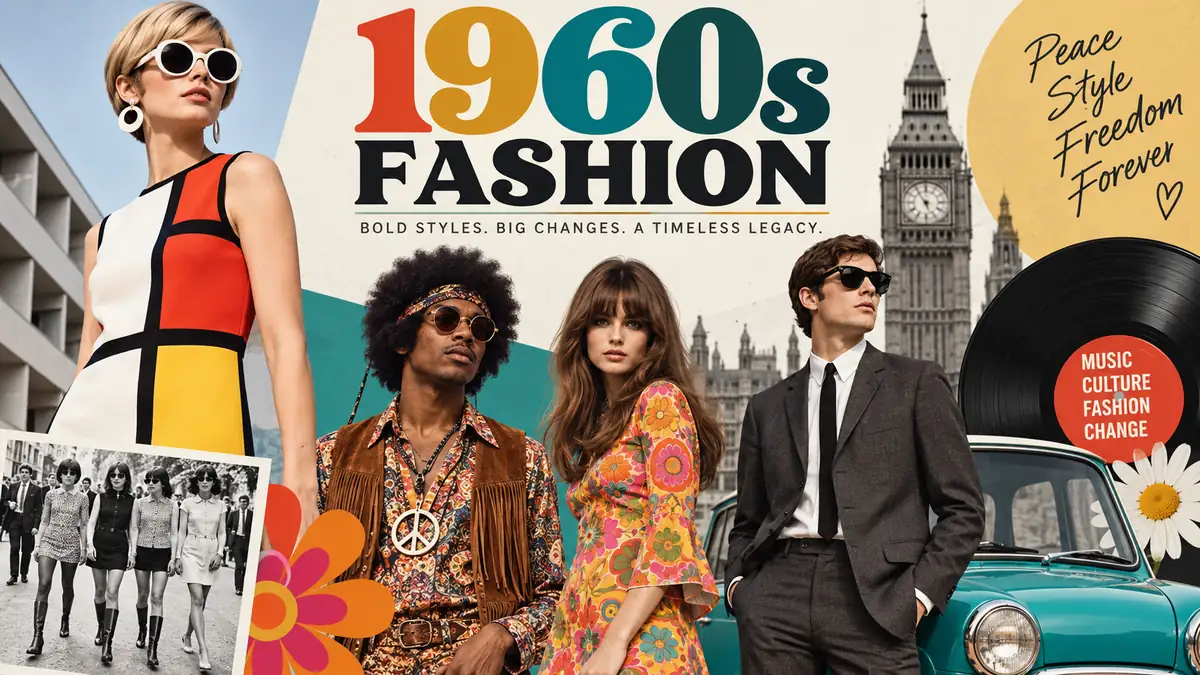
Few decades changed the way people dressed as dramatically as the 1960s. Fashion moved from the polished elegance inherited from the 1950s to miniskirts, geometric prints, futuristic plastics, colorful menswear, and eventually the relaxed bohemian clothing of the counterculture.
1960s fashion was defined by rapid change: early-decade elegance gave way to youthful Mod clothing and miniskirts, followed by futuristic Space Age designs and late-1960s hippie style. Mary Quant, André Courrèges, Pierre Cardin, Paco Rabanne, Twiggy, and Jacqueline Kennedy helped shape a decade in which youth culture increasingly drove fashion.
Rather than having one recognizable look, the decade contained several fashion revolutions. Understanding how they developed explains why the 1960s remain such an important reference point for designers and everyday style.
What Defined 1960s Fashion?
The simplest way to understand 1960s fashion is to divide the decade into three broad periods.
| Period | Dominant Style | Typical Clothing | Major Influences |
|---|---|---|---|
| Early 1960s | Polished elegance | A-line dresses, suits, pillbox hats, gloves | Jacqueline Kennedy, couture |
| Mid-1960s | Mod and Space Age | Miniskirts, shift dresses, tights, go-go boots | Swinging London, youth culture, space exploration |
| Late 1960s | Hippie and bohemian | Maxi dresses, prints, embroidery, flared trousers | Counterculture, music, anti-war movement |
The transition was remarkable because fashion authority itself changed.
At the beginning of the decade, established couture houses and sophisticated public figures still strongly influenced what women wore. By the middle of the 1960s, young people increasingly wanted clothing created specifically for them rather than smaller versions of their parents’ wardrobes.
London became particularly important. King’s Road and Carnaby Street developed into centers of boutiques selling colorful, relatively accessible clothes and separates. Their popularity helped establish the international image of Swinging London.
Why Did Fashion Change So Much in the 1960s?
Several cultural forces arrived at roughly the same time.
A growing youth market had more cultural influence. Pop and rock music connected fashion with performers and fans. Social conventions concerning gender and appropriate dress were being challenged. Mass manufacturing made fashionable clothing available more quickly, while synthetic materials gave designers possibilities that traditional wool, silk, and cotton could not.
Television, magazines, photography, film, and celebrity culture also allowed a new style to spread rapidly.
Fashion no longer needed to travel exclusively from an elite Parisian couture house downward. Something worn by young people in a London street or nightclub could become an international phenomenon.
Quick takeaway: The most important change wasn’t simply shorter skirts or brighter colors. The 1960s helped shift fashion toward youth, experimentation, informality, and individual identity.
Early 1960s Fashion: Elegance Before the Youthquake
Early 1960s clothing retained much of the structure and refinement associated with the previous decade.
Women’s outfits frequently featured clean tailoring, coordinated accessories, knee-length skirts, fitted or boxy jackets, and carefully arranged hairstyles. Gloves and hats were still normal components of formal wardrobes.
One of the era’s most visible style figures was Jacqueline Kennedy.
As First Lady of the United States from 1961 to 1963, Kennedy became associated with understated sophistication: simple silhouettes, cropped jackets, sleeveless dresses, pastel colors, pillbox hats, and elegant eveningwear. American designer Oleg Cassini was closely associated with her White House wardrobe.
But that polished style tells only the beginning of the story.
As the decade progressed, fashion became younger, shorter, brighter, and increasingly informal. The Fashion History Timeline at the Fashion Institute of Technology describes 1960s womenswear through three major developments: continuing ladylike elegance, youthful and Space Age fashion, and the Eastern-influenced hippie style that emerged later.
Common Early-1960s Women’s Clothes
Typical pieces included:
- A-line and sheath dresses
- Matching skirt suits
- Cropped or boxy jackets
- Capri pants
- Kitten heels
- Low pumps
- Pillbox hats
- Gloves
- Pearls
- Structured handbags
The waist was becoming less dominant than it had been during the 1950s. Straighter silhouettes increasingly prepared the way for one of the decade’s most important garments: the shift dress.
1960s Fashion and the Rise of Mod Style
By the middle of the decade, London had become one of the world’s most exciting fashion centers.
The Mod, or Modernist, movement emphasized youth, modernity, sharp silhouettes, bright colors, and a deliberate rejection of older conventions. Clothing could be simple in construction while visually striking through proportion, pattern, and color.
Women’s Mod outfits commonly incorporated short shift dresses, miniskirts, colored tights, flat footwear, bold geometric patterns, and clean silhouettes.
The aesthetic felt new because it was supposed to.
Instead of emphasizing mature sophistication, designers celebrated youthfulness.
Mary Quant and the Miniskirt
No discussion of 1960s fashion can avoid Mary Quant.
Working from London’s Chelsea fashion scene, Quant became closely associated with short skirts, simple dresses, jersey garments, colored tights, skinny-rib sweaters, and playful clothing designed around an active youthful lifestyle.
She is frequently described as the inventor of the miniskirt, although the historical story is more complicated.
The Victoria and Albert Museum notes that there is no conclusive evidence establishing a single inventor. French designer André Courrèges was also producing increasingly short skirts, while street fashion itself was pushing hemlines upward. Extremely short skirts became particularly established around 1966.
That distinction matters.
The miniskirt wasn’t simply a garment one designer suddenly invented. It emerged from broader changes in youth culture, social expectations, street style, and fashion design.
Quant nevertheless played an enormous role in popularizing it internationally.
What Did a Typical Mod Outfit Look Like?
A recognizable women’s Mod outfit might combine:
- A short A-line or shift minidress
- Opaque colored tights
- Flat shoes or boots
- A geometric or Op Art pattern
- Minimal jewelry
- Graphic eye makeup
- A short geometric haircut
Black and white combinations were especially effective, but orange, yellow, pink, green, red, and blue appeared throughout the period.
Rather than elaborate decoration, many Mod garments relied on strong shapes and contrasting colors.
The Miniskirt Changed More Than Hemlines
The miniskirt became the single garment most strongly associated with 1960s women’s fashion.
Yet surviving evidence shows that skirts did not suddenly become extremely short at the beginning of the decade. Hemlines rose progressively, and by around 1966 the true mini had become a major fashion statement.
Shorter skirts also affected other garments.
Traditional stockings could become visible beneath very short hemlines, making tights far more practical.
Mary Quant recognized this relationship and helped commercialize opaque tights in colors designed to coordinate with dresses and skirts. Patterned and Op Art tights subsequently became fashion statements themselves.
This produced one of the decade’s signature combinations:
Minidress + colored tights + flat boots.
The outfit wasn’t merely visually different from 1950s fashion. It allowed considerably freer movement than restrictive skirts, stockings, and high heels.
Twiggy and the New Fashion Model
The rise of Twiggy reinforced the youthful aesthetic.
Her slender silhouette, short hair, large eyes, and distinctive makeup became internationally recognizable. She modeled the abbreviated dresses and skirts associated with London’s fashion revolution, helping transform the new British look into a global trend.
Models themselves were increasingly becoming celebrities rather than anonymous figures displaying clothing.
Fashion, music, photography, and popular culture were beginning to overlap.
1960s Space Age Fashion: Dressing for the Future
While London’s Mods were transforming street fashion, another group of designers looked upward.
The Space Race made rockets, satellites, astronauts, and futuristic technology part of everyday popular imagination. Designers responded with clothes that seemed intended for a world that hadn’t arrived yet.
Three names are particularly associated with Space Age fashion:
André Courrèges, Pierre Cardin, and Paco Rabanne.
Their approaches differed, but all challenged assumptions about what clothes should look like and what materials could be used to make them.
André Courrèges
Courrèges favored clean geometric construction, white and silver, short skirts, trouser suits, flat boots, goggles, and helmet-like headwear.
His clothes could resemble uniforms for an imagined technological future.
Rather than simply decorating traditional garments with futuristic motifs, he incorporated futurism into silhouette and construction.
Pierre Cardin
Pierre Cardin also experimented heavily with geometric silhouettes and futuristic forms.
His designs incorporated sculptural shapes, cutouts, bold colors, and synthetic-looking surfaces. In 1966, Cardin presented pinafore-style dresses worn over close-fitting tops and turtlenecks.
Paco Rabanne
Paco Rabanne pushed experimentation even further.
Instead of limiting himself to conventional textiles, Rabanne became famous for garments constructed from unconventional materials and linked components, particularly metallic-looking discs.
This approach blurred the line between dress, sculpture, and industrial design.
What Were Space Age Clothes Made From?
Technological enthusiasm encouraged designers to experiment with materials including:
- PVC
- Perspex
- Polyester
- Acrylic
- Nylon
- Rayon
- Spandex
- Vinyl
- Metal
- Paper-like materials
The V&A notes that designers enthusiastically explored modern plastics and synthetic fibers during the decade.
The paper dress became one of the strangest expressions of this fascination.
Disposable dresses appeared in the United States in 1966 after beginning as a promotional idea. Usually made from cellulose combined with synthetic fibers rather than ordinary writing paper, boldly printed disposable garments became a short-lived novelty on both sides of the Atlantic. Their popularity largely faded by 1968.
They captured something important about the period: novelty itself could be fashionable.
1960s Women’s Fashion Beyond the Miniskirt
It is easy to reduce women’s 1960s fashion to miniskirts and go-go boots, but women wore a much wider range of clothing.
Shift Dresses
The shift dress became a defining silhouette.
Unlike the strongly cinched waists of many 1950s dresses, shifts fell relatively straight from the shoulders. Their uncomplicated construction created an ideal canvas for geometric prints, color blocking, and experimental fabrics.
They also worked perfectly with rising hemlines.
A-Line Dresses
A-line silhouettes widened gradually toward the hem and became another recognizable shape.
They could appear sophisticated or playful depending on fabric, length, and styling.
Trousers and Trouser Suits
Women increasingly wore trousers in casual settings, while designers pushed pants into more fashionable contexts.
Marion Foale and Sally Tuffin were among British designers associated with unconventional daywear and trouser suits for women.
This reflected a larger movement toward practical clothing and relaxed gender rules.
Hot Pants
Extremely short shorts appeared toward the end of the decade and into the early 1970s. Mary Quant is among the designers closely associated with their development and popularization; the V&A credits her with creating hot pants in 1966.
Jersey Clothing
Jersey deserves more attention than it usually receives.
Stretchy knitted fabrics allowed designers to produce comfortable clothes that moved with the body and could be manufactured in numerous shapes and colors.
Quant became particularly associated with jersey dresses. The V&A considers the expansion of knitted jersey one of the decade’s most consequential clothing developments because its flexibility supported the new silhouettes of both the 1960s and 1970s.
Colors and Prints That Defined the Decade
The stereotypical 1960s palette is bright—and with good reason.
Fashion embraced vivid orange, hot pink, yellow, lime green, turquoise, purple, and red. But black-and-white combinations and futuristic white and silver were equally significant.
Patterns became increasingly graphic.
Geometric and Op Art Prints
Op Art, short for Optical Art, influenced clothing through repeating lines, checks, circles, and high-contrast geometric arrangements that appeared to vibrate or move.
Black and white worked particularly well for these effects.
Florals and Psychedelic Prints
Later in the decade, psychedelic and floral motifs became more prominent.
Paisley, swirling colors, oversized flowers, and complex prints reflected the changing visual culture surrounding rock music and the counterculture.
Emilio Pucci and Print
Italian designer Emilio Pucci was known for energetic abstract prints and saturated color. His distinctive visual language fit naturally into a decade increasingly comfortable with bold pattern.
Color was no longer simply an accent.
It could become the entire identity of an outfit.
1960s Fashion Accessories
Accessories changed alongside clothing.
As dresses became simpler in shape, accessories could either reinforce their graphic quality or introduce dramatic contrast.
Go-Go Boots
White boots became an enduring symbol of the decade.
Styles ranged from ankle height to taller versions, generally featuring simple shapes and relatively low heels.
Courrèges incorporated flat boots into his futuristic fashion vocabulary, while similar footwear became closely associated with Mod style.
Tights
Colored and patterned tights solved the practical problem created by very short skirts while opening another surface for design.
Red, yellow, purple, white, patterned, and Op Art tights could transform an otherwise simple dress.
Sunglasses
Large and unusual frames reflected the decade’s experimentation with plastics and geometry.
Round lenses later became particularly associated with hippie and rock styles.
Jewelry
Early-decade jewelry could remain restrained and elegant, while later styles became larger and more experimental.
Plastic bangles, geometric earrings, oversized necklaces, beads, and ethnic-inspired jewelry all found audiences.
Hats
The pillbox hat was strongly associated with Jacqueline Kennedy and early-1960s sophistication.
As youth fashion became more informal, hats and gloves became less essential parts of everyday dress.
1960s Men’s Fashion: From Conservative Suits to Peacock Style
Men’s clothing underwent an equally significant transformation.
At the beginning of the decade, a conventional male wardrobe still centered on suits, shirts, ties, knitwear, and conservative colors.
Young British Mods challenged that formula.
They favored sharply cut clothes influenced partly by Continental European style, including narrow trousers and slim Italian-inspired suits. London’s Carnaby Street became central to the emerging scene.
Designer and retailer John Stephen, who opened a Carnaby Street boutique in 1957, became an important figure in this transition.
The Beatles’ Influence
Popular music accelerated fashion change.
When The Beatles became international stars, their slim suits, boots, distinctive hairstyles, and collarless jackets provided young men with alternatives to their fathers’ wardrobes.
The V&A identifies collarless jackets and slim trousers—often worn with heeled boots—as important elements of changing menswear during this period.
Rock stars increasingly became fashion authorities.
What Was the Peacock Revolution?
By the middle and late 1960s, some fashionable men embraced much more flamboyant clothing.
This became known as the Peacock Revolution.
Velvet, embroidery, wide ties, florals, paisley, bright colors, ruffled shirts, and unusual tailoring challenged the idea that respectable menswear needed to be subdued.
Designer Michael Fish, who opened Mr Fish in London in 1966, became an influential figure in this movement. Other important boutiques included Hung On You, Blades, and Granny Takes a Trip.
Men could now dress conspicuously on purpose.
Military Influence
Military-inspired jackets also entered fashionable wardrobes.
In an ironic twist during an era increasingly defined by opposition to war, ceremonial military clothing was appropriated by musicians and countercultural figures.
Mick Jagger famously appeared in a Victorian guardsman’s jacket during a televised performance in 1966, helping popularize the look.
Decorative military jackets subsequently became closely connected with psychedelic rock style.
Late 1960s Hippie Fashion and the Birth of Boho
By the late 1960s, the polished futurism of Mod and Space Age clothing existed alongside something almost opposite.
Hippie fashion emphasized looseness, craft, naturalness, cultural borrowing, and apparent rejection of conventional consumer fashion.
Political and cultural upheaval provided the background.
The Civil Rights Movement, protests against the Vietnam War, the 1967 Summer of Love in San Francisco’s Haight-Ashbury district, and the Woodstock festival in 1969 all became associated with a counterculture that challenged mainstream values.
What Did Hippies Wear in the 1960s?
Typical late-1960s countercultural clothing included:
- Bell-bottom or flared trousers
- Maxi skirts and dresses
- Loose blouses
- Peasant tops
- Embroidered clothing
- Fringed jackets and vests
- Denim
- Tie-dye
- Paisley
- Floral prints
- Sandals
- Headbands
- Beads
- Vintage and secondhand garments
Folkloric influences and garments inspired by different global traditions became especially visible.
Vogue describes late-decade bohemian fashion as including loose silhouettes, floral maxi dresses, and folkloric styles, with the broader boho aesthetic subsequently entering mainstream fashion during the 1970s.
Mod vs. Hippie Fashion
The difference between these styles reveals just how quickly the decade changed.
| Mod Fashion | Hippie Fashion |
|---|---|
| Structured and geometric | Loose and flowing |
| Miniskirts | Maxi skirts |
| Synthetic materials | Natural-looking and handcrafted materials |
| Clean shapes | Layered silhouettes |
| Graphic patterns | Floral, paisley and tie-dye |
| Futuristic influence | Folk and historical influence |
| Urban London image | Countercultural image |
Both rejected older conventions, but they did so in different ways.
Mod fashion celebrated modernity, consumption, and the new. Hippie style increasingly questioned mainstream consumer culture and sought individuality through unconventional, handmade, vintage, or culturally inspired dress.
Quick takeaway: 1960s fashion did not progress neatly from conservative to wild. Different styles overlapped. A sophisticated Jackie Kennedy-inspired suit, a Courrèges Space Age dress, a Carnaby Street Mod outfit, and a hippie maxi dress could all belong to the same decade.
Hairstyles and Makeup in 1960s Fashion
Clothing was only part of the transformation.
Hair and makeup changed dramatically as well.
Women’s Hairstyles
Early-1960s hairstyles often emphasized controlled volume.
The bouffant and beehive became recognizable looks, requiring teasing and hairspray to create height.
Later, geometric cuts became fashionable.
Hairdresser Vidal Sassoon developed precision cuts that complemented the clean lines of Mod clothing. Short styles could be sharply structured rather than simply practical, turning the haircut itself into part of the outfit.
Twiggy’s short hair reinforced the new youthful ideal.
Toward the end of the decade, longer and more natural-looking hair became increasingly associated with hippie culture.
1960s Makeup
Eyes often became the focal point.
Popular elements included:
- Heavy eyeliner
- Defined upper lashes
- Mascara
- False eyelashes
- Pale or neutral lips
- Graphic eye makeup
Twiggy’s famous eye look emphasized upper and lower lashes, producing a deliberately doll-like effect.
Early makeup could remain polished and restrained, while later styles allowed much more experimentation.
The Designers Who Shaped 1960s Fashion
The decade produced an extraordinary mix of established couture designers and younger innovators.
Mary Quant
Quant represented youthful British fashion and became internationally associated with miniskirts, jersey dresses, colored tights, PVC clothing, skinny-rib sweaters, and playful styling.
Her influence extended beyond individual garments. She helped demonstrate that young women deserved a fashion market designed around their own lives.
André Courrèges
Courrèges combined couture construction with futuristic minimalism.
Short skirts, angular shapes, white boots, silver details, trouser suits, goggles, and helmet-like accessories established a vocabulary that remains recognizable as Space Age fashion.
Pierre Cardin
Cardin approached clothing as an opportunity for geometric experimentation.
His futuristic collections embraced unusual shapes, bold surfaces, and synthetic materials, contributing heavily to the visual identity of the decade.
Paco Rabanne
Rabanne challenged the very definition of fabric by constructing garments from unconventional materials.
His metallic creations remain among the clearest examples of the 1960s belief that future clothing might bear little resemblance to traditional dressmaking.
Yves Saint Laurent
Yves Saint Laurent contributed to the changing relationship between womenswear and tailoring.
His work during the decade participated in a broader shift toward trousers, modern art references, and clothing that challenged traditional assumptions about how fashionable women should dress.
Barbara Hulanicki and Biba
Barbara Hulanicki founded Biba, which became closely associated with accessible, youthful London fashion.
Biba’s rise demonstrated the growing importance of boutiques and ready-to-wear clothing in a fashion world that was becoming less dependent on couture.
Hubert de Givenchy
Hubert de Givenchy represented another side of the decade: refined elegance.
His association with Audrey Hepburn helped popularize streamlined, sophisticated clothing that offered an alternative to the louder Mod and psychedelic trends.
The coexistence of Givenchy and Quant is a useful reminder that no single aesthetic completely defined the 1960s.
Fashion Icons of the 1960s
Designers create clothes, but public figures often determine how people imagine an era.
Jacqueline Kennedy
Kennedy represented early-decade elegance through clean silhouettes, tailored suits, restrained accessories, and carefully coordinated outfits.
Audrey Hepburn
Audrey Hepburn embodied a minimalist version of sophistication. Her Givenchy wardrobe, slim trousers, cropped pants, simple dresses, ballet flats, and graphic silhouettes remain influential.
Twiggy
Twiggy represented the youth revolution.
Her short haircut, dramatic lashes, slender silhouette, minidresses, and tights became inseparable from the visual memory of Swinging London.
The Beatles
The Beatles helped normalize rapidly changing men’s style, from slim suits and boots early in their career to colorful psychedelic and military-inspired clothing later.
Their transformation almost functions as a miniature history of men’s fashion across the decade.
Mick Jagger
Jagger pushed menswear toward flamboyance, experimentation, and a less rigid understanding of masculinity.
Rock musicians increasingly showed that men’s fashion could be theatrical, decorative, and provocative.
How 1960s Fashion Reflected Social Change
The decade’s clothing makes more sense when viewed as social history.
Fashion was changing because society was changing.
Youth Became a Cultural Force
Teenagers and young adults increasingly had their own music, stores, magazines, celebrities, and clothing.
Designers such as Mary Quant understood that young consumers didn’t necessarily want to dress like older generations. Boutique culture allowed fashion to respond much faster to their preferences.
Women’s Clothing Became Less Restrictive
Miniskirts alone did not liberate women, and it would be simplistic to treat fashion as a direct measure of women’s social progress.
But practical changes were meaningful.
Tights replaced cumbersome stocking arrangements. Jersey allowed movement. Flat footwear worked with shorter dresses. Trousers became increasingly acceptable. Simple garments required less formal coordination.
Clothing was adapting to more active lifestyles.
Men’s Fashion Challenged Masculine Dress Codes
The Peacock Revolution undermined another longstanding convention: that serious men’s clothing should be dark and understated.
Bright floral shirts, velvet jackets, long hair, heeled boots, jewelry, and ruffles complicated older expectations about masculinity.
Fashion became another arena in which gender conventions could be tested.
Technology Became Fashionable
Synthetic materials embodied optimism about science and industry.
PVC, acrylic, polyester, nylon, Perspex, and other manufactured materials weren’t always treated as cheap substitutes. Designers could deliberately choose them because they looked modern.
Space Age fashion made technology itself aesthetically desirable.
Counterculture Rejected the Same Modernity
Then came the contradiction.
The late-1960s counterculture often turned away from precisely the synthetic, disposable, consumption-oriented future that Space Age fashion celebrated.
Handcraft, vintage clothing, denim, embroidery, folk influences, and natural-looking fabrics offered an alternative.
That tension between technological optimism and anti-consumer counterculture is one reason 1960s fashion is far more complex than its stereotypes suggest.
How to Recognize Authentic 1960s Style
When identifying vintage clothing or recreating a historically informed look, avoid assuming that every bright minidress is automatically “1960s.”
First determine which part of the decade the outfit represents.
An early-1960s look might involve a knee-length dress, cropped jacket, structured handbag, and low heels.
A mid-decade Mod look could feature a short shift dress, colored tights, graphic pattern, and flat boots.
Space Age styling would lean toward white, silver, geometric construction, PVC-like surfaces, or futuristic accessories.
Late-decade hippie styling might use flares, embroidery, paisley, fringe, beads, and flowing layers.
Silhouette matters more than simply adding stereotypical accessories.
Common Mistakes When Recreating the Look
One mistake is combining every famous 1960s trend into a single outfit.
A pillbox hat, psychedelic bell-bottoms, white go-go boots, and Space Age minidress represent different aesthetics and moments.
Another is assuming the entire decade was psychedelic.
The dramatic psychedelic imagery most people associate with “the sixties” belongs primarily to the later part of the period.
The same applies to the miniskirt. Although hemlines were already moving upward earlier, extremely short minis became particularly prominent around the middle of the decade rather than defining 1960 from day one.
Historical accuracy improves immediately when you choose a specific phase—early, mid, or late 1960s—and build around its silhouette.
Why 1960s Fashion Still Matters
Many features that seem ordinary in contemporary wardrobes were radical, unusual, or newly fashionable during the 1960s.
Bright tights, miniskirts, short shift dresses, women’s trouser suits, synthetic fabrics, flamboyant menswear, boutique shopping, celebrity models, and youth-oriented ready-to-wear all helped reshape the industry.
The decade also accelerated the connection between fashion and popular culture.
Musicians could influence clothes. Models could become international celebrities. Street style could challenge established designers. Young shoppers could determine what became fashionable.
Perhaps most importantly, there was no single ending to the decade’s fashion story.
The Mod movement fed later revivals. Space Age design continues to inspire futuristic collections. The Peacock Revolution helped broaden the possibilities of menswear. Late-1960s counterculture contributed to the bohemian styles that flourished in the 1970s and repeatedly return to fashion.
The Lasting Legacy of 1960s Fashion
1960s fashion transformed clothing from polished early-decade elegance through the Mod revolution, miniskirts, Swinging London and futuristic Space Age experimentation before ending with psychedelic and hippie influences.
Mary Quant helped make youthful clothing a global phenomenon. André Courrèges, Pierre Cardin, and Paco Rabanne imagined wardrobes for a technological future. Twiggy embodied a new model ideal. Jacqueline Kennedy and Audrey Hepburn demonstrated that understated elegance remained powerful, while The Beatles and Mick Jagger helped redefine men’s style.
The real legacy of the decade, however, goes beyond individual garments.
Fashion became younger, faster, more informal, more experimental, and increasingly connected to music, social movements, technology, and personal identity. From the miniskirt and colored tights to flamboyant menswear and bohemian dresses, the 1960s established ideas about self-expression that continue to shape the way people dress today.