
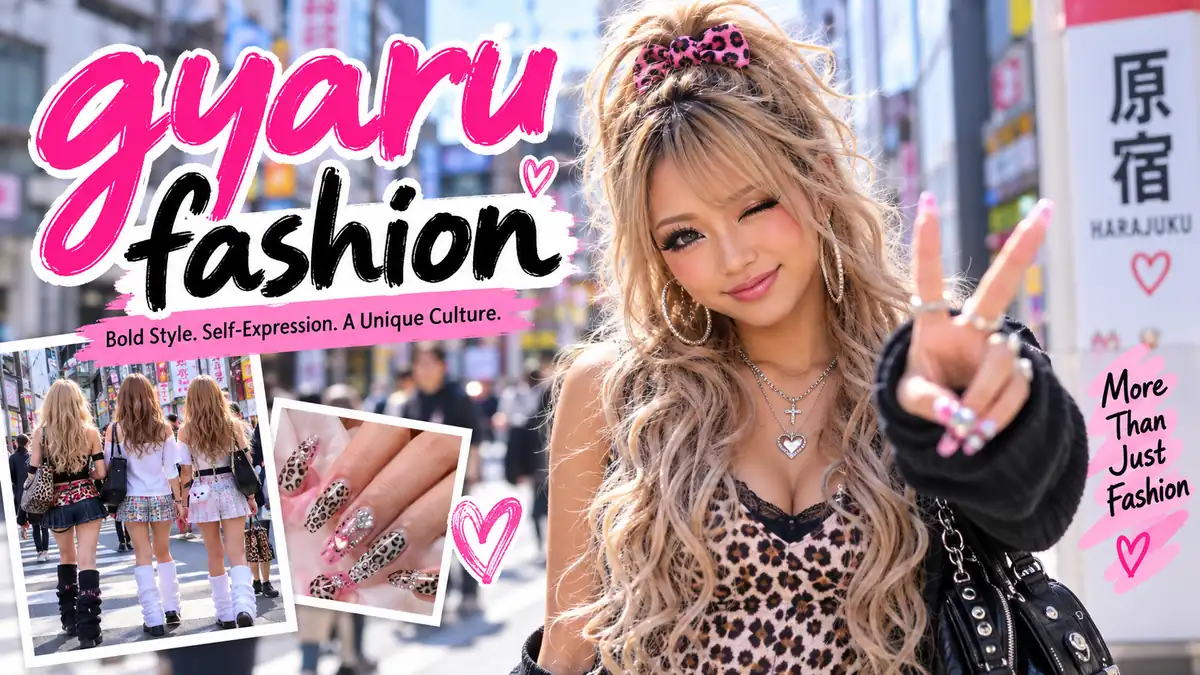
Gyaru is easy to recognize but surprisingly difficult to reduce to one outfit. Behind the dramatic lashes, styled hair, platform shoes, short skirts, elaborate nails, and sometimes deep tans is a Japanese youth culture that spent decades changing its own rules.
gyaru fashion is a Japanese fashion and lifestyle subculture associated especially with Shibuya and the 1990s–2000s. Derived from the English word “gal,” gyaru developed around bold self-expression, conspicuous makeup, styled or dyed hair, fashionable clothing, and resistance to conventional expectations of feminine appearance. It later divided into numerous distinct substyles.
Understanding that last point matters. Ganguro, kogal, hime gyaru, agejo, onee gyaru, and manba can look dramatically different from one another. Gyaru therefore makes more sense as an evolving fashion culture than as a checklist of clothes.
What Is gyaru fashion?
The Japanese term gyaru (ギャル) comes from the English slang word “gal.” Over time, however, it acquired a much more specific cultural meaning in Japan.
Gyaru became associated with fashionable young women whose appearance departed from conservative beauty expectations. Dyed or lightened hair, conspicuous makeup, fashionable clothing, decorated nails, platform footwear, tanning in some eras, and a highly styled overall presentation became recurring elements.
The movement was particularly visible in Shibuya, one of Tokyo’s major shopping and youth-culture districts. Shibuya 109—the famous fashion complex near Shibuya Station—became closely connected with the scene and the brands followed by young shoppers.
Yet there is no universal gyaru uniform.
A hime gyaru in curls, lace, bows, and princess-like clothing can look almost unrelated to a neon-clad manba. A mature onee gyaru outfit can be considerably subtler than either. What connects them is the deliberate construction of a visibly fashionable, confident persona.
What does gyaru mean?
At its simplest, gyaru means “gal.” But within Japanese popular culture, the word can describe much more than gender or age. It has been associated with a recognizable fashion culture, personality stereotypes, language, social behavior, nightlife, magazines, and particular approaches to beauty.
This distinction also explains why calling every fashionable Japanese woman a gyaru would be inaccurate.
Gyaru is a specific cultural tradition with its own history.
The History of gyaru fashion
The familiar gyaru aesthetic did not suddenly appear fully formed in the 1990s. Its development reflects changing Japanese consumer culture, youth identities, magazines, music, nightlife, and attitudes toward conventional femininity.
Before the 1990s: Where “gal” came from
The word “gal” circulated in Japanese advertising and popular culture before the mature gyaru subculture emerged. By the 1980s, fashionable young women and increasingly conspicuous consumer lifestyles were already changing ideas about female youth culture.
Japan’s bubble economy also created an environment in which fashion, nightlife, designer goods, and highly visible consumption became powerful cultural signals.
These influences formed part of the background from which later gyaru styles developed.
The 1990s and the rise of kogal
The 1990s brought the aesthetic much closer to what people now recognize as gyaru.
Kogal, also written kogyaru, became one of the era’s defining youth styles. Its imagery centered heavily on teenage school fashion: shortened pleated skirts, loose socks, loafers, cardigans, fashionable bags, accessories, and brown or lightened hair.
Instead of treating the school uniform as something purely institutional, kogal styling transformed it into personal fashion.
Shibuya became an important center for the culture. Music and celebrity style mattered too, with singer Namie Amuro frequently associated with 1990s trends involving brown hair, tanned skin, miniskirts, and boots.
Ganguro pushes the aesthetic further
By the late 1990s, some gyaru adopted a deliberately more extreme appearance.
Ganguro became known for deeply tanned skin, lightened or bleached hair, contrasting pale makeup around the eyes and lips, platform footwear, and colorful clothes.
It was visually striking precisely because it contradicted conventional beauty ideals involving pale skin and dark, understated hair.
Ganguro is consequently important to gyaru history, but the two terms are not synonyms.
Ganguro is a branch or historical expression of the wider gyaru culture.
Yamanba and manba
The aesthetic became even more exaggerated through yamanba and later manba styling.
These looks could feature extremely dark tans, conspicuous white eye and lip makeup, bright colors, stickers or decorative facial details, vivid clothing, heavily accessorized outfits, and dramatic hair.
They also became associated with the energetic Para Para dance and social scene of the period.
This was gyaru maximalism at one of its most recognizable points.
The 2000s: gyaru diversifies
During the 2000s, gyaru no longer moved in a single visual direction.
Some styles became sweeter. Others became more glamorous, mature, sexy, casual, or rock influenced. Hime gyaru embraced princess aesthetics. Agejo drew heavily on glamorous nightlife imagery. Onee gyaru provided a more grown-up interpretation.
This diversification is one reason historical gyaru photographs can appear to depict entirely separate fashion movements.
They were branches of the same broad cultural family.
Major gyaru fashion Substyles Explained
There are far more gyaru labels than a beginner needs to memorize. Some describe specific historical scenes, while others were popularized through magazines and brands rather than functioning as perfectly fixed categories.
These are the most useful styles to recognize:
| Gyaru style | Typical visual identity | Common fashion elements |
|---|---|---|
| Kogal/Kogyaru | School-inspired, youthful | Pleated skirts, loose socks, loafers, cardigans |
| Ganguro | Tanned, bold, high contrast | Deep tan, light hair, platforms, pale eye/lip accents |
| Manba/Yamanba | Extreme maximalism | White makeup details, neon colors, heavy accessories |
| Hime Gyaru | Princess-like and ornate | Lace, bows, florals, curls, pearls |
| Agejo | Glamorous nightlife | Fitted dresses, heels, elaborate hair and makeup |
| Onee Gyaru | Mature and polished | Refined silhouettes, heels, sophisticated styling |
| Rokku Gyaru | Rock influenced | Leather, studs, boots, darker colors |
| Amekaji | American casual | Denim, hoodies, graphic pieces, sneakers |
| Tsuyome | Strong and edgy | Darker makeup, fitted clothes, statement accessories |
| Gyaruo | Men’s gyaru | Dyed hair, tanning, styled silhouettes, accessories |
The categories overlap, and individuals historically could change their style rather than remain permanently attached to one label.
Kogal or Kogyaru
Kogal is one of the most culturally recognizable forms of gyaru.
The foundation is the Japanese school uniform, deliberately personalized through shorter skirts, loose socks, loafers, oversized sweaters or cardigans, accessories, makeup, and dyed hair.
Loose socks became particularly emblematic of the 1990s schoolgirl look.
Kogal is therefore useful for understanding the early relationship between gyaru and youth rebellion: ordinary clothing was altered and restyled until it communicated a completely different identity.
Ganguro
Ganguro is probably the style most frequently mistaken for gyaru as a whole.
Classic visual markers include:
- Deeply tanned skin
- Bleached or light brown hair
- Pale or white eye makeup
- Light lipstick
- Platform shoes
- Miniskirts
- Bright colors
- Strong accessories
Its intentionally high contrast produced an aesthetic dramatically removed from conventional Japanese beauty standards of the period.
Manba and Yamanba
Manba and yamanba pushed the visual language further.
White makeup could extend prominently around the eyes and across the nose, while bright clothing, hibiscus motifs, colorful hair, face decorations, and numerous accessories produced an intentionally exaggerated effect.
Historical terminology can become complicated because styles changed over time and labels were not always applied consistently.
For beginners, the useful distinction is simple: manba and yamanba represent some of the most maximalist developments within the broader ganguro-era gyaru world.
Hime Gyaru
Hime means princess, which explains the concept immediately.
Hime gyaru favors a lavish, doll-like form of femininity rather than the beachy rebellion associated with ganguro.
Typical elements include large curled hairstyles, bows, roses, lace, pearls, elaborate dresses, pink and cream palettes, decorative nails, heels, and princess-inspired accessories.
Brands such as Jesus Diamante and La Pafait became associated with this aesthetic.
The styling can draw on Rococo-like visual references, but it remains gyaru rather than simply becoming Lolita fashion.
Agejo
Agejo developed around a more sensual, nightlife-oriented kind of glamour.
Fitted mini dresses, lace, heels, sparkling jewelry, voluminous curled hair, dramatic lashes, and polished makeup are characteristic references.
The magazine Koakuma Ageha became particularly influential in establishing this glamorous visual vocabulary.
Rather than looking youthful or deliberately chaotic, agejo styling aims to appear highly finished.
Onee Gyaru
“Onee” relates to the idea of an older-sister aesthetic.
Onee gyaru emerged as a more mature option for women who wanted to retain gyaru beauty and fashion influences while moving beyond teenage styling.
Think cleaner silhouettes, elegant dresses, fitted jackets, heels, sophisticated accessories, carefully styled hair, and polished makeup.
It demonstrates an important fact about the movement: gyaru was never limited to one age-specific wardrobe.
Rokku and Tsuyome Gyaru
Rokku gyaru introduces rock and punk elements—leather, boots, studs, darker palettes, graphic clothing, and harder-edged accessories.
Tsuyome, roughly conveying a stronger aesthetic, similarly emphasizes an assertive, sexy, tougher-looking interpretation.
Both demonstrate how easily gyaru absorbed outside fashion influences while retaining recognizable beauty styling.
Amekaji
Amekaji comes from American casual.
Its wardrobe can include denim, shorts, hoodies, baseball-inspired pieces, graphic tops, sneakers, caps, stars and stripes, and other references to casual American fashion.
The clothes can be considerably more relaxed than hime or agejo, but hair, makeup, accessories, and overall coordination keep the outfit connected to gyaru.
Gyaruo
Gyaru culture was not exclusively female.
Gyaruo developed as a male counterpart, with looks involving dyed or highlighted hair, tanning in some eras, carefully styled hairstyles, fashionable clothing, and a conspicuous approach to personal presentation.
The magazine men’s egg, related to the influential gyaru publication egg, helped develop and circulate gyaruo aesthetics.
What Makes an Outfit Look Gyaru?
This is where modern interpretations often become confused.
A crop top, mini skirt, and platform boots may resemble Y2K fashion, but those pieces alone do not automatically create a convincing gyaru look.
Traditional gyaru styling is highly coordinated.
1. The silhouette is intentional
Depending on the substyle, common silhouettes include mini skirts with tall boots, fitted dresses with heels, shorts with platform footwear, school-uniform combinations, or ornate princess dresses.
The exact pieces matter less than their relationship.
Hair, shoes, clothing, makeup, nails, and accessories should feel as though they belong to the same visual idea.
2. Accessories aren’t an afterthought
Gyaru frequently treats accessories as part of the outfit rather than optional finishing touches.
That can mean:
- Statement earrings
- Layered necklaces
- Belts
- Sunglasses
- Handbags
- Hair bows
- Decorative clips
- Rings and bracelets
- Scarves
- Long decorated nails
Hime gyaru may emphasize bows and pearls, while rokku styling might favor metal hardware and studs.
3. Shoes carry visual weight
Platform shoes became one of the enduring images associated with historical gyaru.
But footwear varies considerably by substyle. Kogal commonly uses loafers, agejo favors glamorous heels, rokku can incorporate boots, and casual interpretations may use sneakers.
The important factor is proportion: footwear should support the intended silhouette.
gyaru fashion Makeup: Why the Face Matters So Much
Clothing gets considerable attention, but gyaru makeup is one of the strongest identifiers of the style.
Across different eras, the exact makeup changed. Still, enlarged and strongly defined eyes became particularly characteristic.
Common techniques include false eyelashes, eyeliner, eyeshadow, shaped brows, defined lower lashes, circle lenses in some modern looks, contouring, highlighting, and carefully selected lip colors.
Classic gyaru eye makeup
The eyes often provide the focal point.
Upper false lashes create volume while lower lashes or carefully placed liner can make the eye appear larger. Eyeliner may extend beyond the natural eye shape, while shadow and highlight help create additional dimension.
The result should look deliberate.
Simply applying unusually heavy eyeliner does not necessarily create gyaru makeup because lash placement, eye shape, brows, skin finish, and hair all influence the final impression.
Do you need tanned skin to wear gyaru?
No.
This is one of the biggest misconceptions about gyaru fashion.
Tanning is fundamental to ganguro, manba, and several historically tanned styles, but it is not mandatory across the entire gyaru spectrum. Hime, agejo, onee, and numerous other interpretations can use different skin tones and finishes. Contemporary gyaru communities likewise include people with naturally diverse complexions.
Treating tanning as a universal requirement confuses one famous branch with the entire culture.
False lashes and circle lenses
False lashes became an especially recognizable feature during the 2000s. Upper and lower lash designs could dramatically change the perceived size and angle of the eyes.
Circle lenses have also appeared in modern and later-era gyaru beauty, but they are not a historical requirement for every look.
A useful rule for beginners is to learn the eye shape first rather than assuming that the largest lenses and heaviest lashes automatically produce the best result.
Gyaru Hair: Volume, Color and Deliberate Styling
Hair is the second major visual anchor after makeup.
Historical gyaru frequently featured brown, blonde, highlighted, or bleached hair in deliberate contrast to natural dark hair. Depending on the period and substyle, hairstyles ranged from relatively straightforward straight hair to enormous curled arrangements.
Common approaches include:
- Voluminous curls
- Teased crowns
- Bleached or highlighted hair
- Brown and blonde tones
- Long extensions
- Side-swept bangs
- Decorative clips
- Bows and floral accessories
- Elaborate updos
Hime gyaru is famous for especially large curls and ornate hair. Agejo similarly uses glamorous volume, whereas onee styling can be smoother and more restrained.
Hair does not have to be bleached to participate in modern gyaru. Wigs, extensions, temporary styling, and natural hair can all be adapted without unnecessary chemical damage.
Gyaru Nails and Beauty Details
One feature frequently lost when gyaru gets simplified into generic Y2K fashion is its attention to detail.
During the height of elaborate gyaru beauty, nails could become miniature works of maximalist design.
Long acrylic or gel nails might feature rhinestones, pearls, bows, flowers, glitter, metallic decorations, three-dimensional charms, or intricate painted patterns.
The goal was coordination.
A princess-inspired manicure complements hime styling differently from a black, metallic manicure paired with rokku clothing.
This head-to-toe approach helps explain why authentic-looking gyaru can be difficult to reproduce through clothing alone.
The Magazines That Built Gyaru Culture
Before social media feeds dictated daily trends, Japanese fashion magazines had enormous influence.
Several publications became central to different parts of the gyaru ecosystem.
egg became one of the movement’s defining publications, documenting fashion, models, beauty, and gyaru lifestyle. Popteen became influential among younger readers, while Koakuma Ageha was strongly associated with highly glamorous agejo aesthetics. men’s egg provided an important platform for gyaruo.
These publications did more than photograph clothes.
They showed readers hairstyles, makeup, models, brands, social trends, and ways of presenting themselves. Before TikTok tutorials and Instagram outfit accounts, magazines served as a shared visual vocabulary.
Models themselves could become trendsetters.
Figures such as Tsubasa Masuwaka, alongside earlier celebrity influence from Namie Amuro, became closely connected with different periods of Japanese gal culture.
Iconic Gyaru Brands
Brands helped define individual eras and substyles just as strongly as magazines.
ALBA ROSA became associated with earlier gyaru imagery, while brands including Liz Lisa, d.i.a., Jesus Diamante, and La Pafait represented different directions within the broader scene.
Brand names are useful for studying archival outfits because they reveal how different aesthetics were constructed.
But wearing an original brand is not a requirement for understanding or recreating gyaru today.
This is particularly important because many vintage pieces have become scarce, collectible, or expensive. The underlying styling principles—silhouette, coordination, beauty, hair, and accessories—matter more than a label sewn inside a garment.
Gyaru vs. Ganguro: What’s the Difference?
This distinction deserves a direct answer.
Gyaru is the broad fashion subculture. Ganguro is one style within it.
| Feature | Gyaru | Ganguro |
|---|---|---|
| Meaning | Broad fashion/cultural umbrella | Specific gyaru style |
| Skin tone | Varies by style | Characteristically deeply tanned |
| Hair | Many colors and styles | Often bleached or lightened |
| Makeup | Varies greatly | Strong pale/white contrast |
| Clothing | Depends on substyle | Frequently colorful and bold |
| Historical period | Multiple decades | Especially associated with late 1990s/early 2000s |
Someone can therefore dress gyaru without dressing ganguro.
The same principle applies to hime, agejo, rokku, and other substyles.
Gyaru vs. Y2K Fashion
The renewed interest in 2000s aesthetics has created considerable overlap between gyaru and today’s Y2K fashion revival.
Mini skirts, low-rise bottoms, tiny tops, platform shoes, rhinestones, oversized sunglasses, flashy bags, and conspicuous accessories can appear in both.
The difference is historical and stylistic context.
Y2K is a broad contemporary label for fashion inspired by the late 1990s and early 2000s. Gyaru is a specific Japanese subculture with its own communities, magazines, terminology, beauty practices, brands, and substyles.
An outfit can be both.
But labeling any Y2K outfit “gyaru” simply because it includes a mini skirt and platforms strips away much of the culture that produced the original aesthetic.
Gyaru vs. Lolita Fashion
Gyaru and Lolita fashion are also separate Japanese fashion traditions.
Confusion usually comes from hime gyaru because both can incorporate lace, bows, curls, ornate dresses, and princess imagery.
The silhouettes and styling traditions are nevertheless different.
Lolita fashion is strongly associated with structured dresses and skirts, petticoat-supported silhouettes, blouses, specific headwear, and aesthetics influenced by historical European clothing.
Hime gyaru retains gyaru beauty conventions and a glamorous, often body-conscious approach even when it borrows princess-like imagery.
A bow does not make an outfit Lolita, just as curled hair does not automatically make it hime gyaru.
How to Dress in gyaru fashion as a Beginner
Trying to combine every famous gyaru feature into one first outfit usually creates a costume-like result.
A better method is to choose one historical or aesthetic direction and build coherently.
Step 1: Pick one substyle
Start with the look you genuinely like.
Choose kogal if school-inspired styling appeals to you, hime for ornate femininity, rokku for darker fashion, agejo for glamorous nightlife styling, or Amekaji for something casual.
This immediately gives the outfit boundaries.
Step 2: Study complete outfits
Do not study only individual garments.
Look at archival magazine scans and full outfits from the period you want to reference. Pay attention to proportions, makeup, hairstyle, shoes, nails, bags, and jewelry.
Ask what makes the entire presentation work together.
Step 3: Build a small clothing base
For a general 2000s-inspired gyaru wardrobe, useful pieces might include fitted tops, mini skirts, denim, shorts, a statement belt, boots or platforms, a structured handbag, and noticeable jewelry.
Adapt that base to the chosen substyle rather than buying everything associated with gyaru.
Step 4: Learn the makeup gradually
Practice the eye shape separately before wearing a complete look.
Experiment with liner placement and lashes, take photographs, and see how the makeup reads from normal conversational distance rather than only in a close-up mirror.
Historical makeup can be dramatic without being randomly heavy.
Step 5: Style the hair
Even a simple outfit changes dramatically when paired with intentionally styled hair.
Try curls, volume, extensions, clips, or a carefully shaped straight style depending on your chosen era.
Step 6: Finish the whole look
Add shoes, bag, jewelry, nails, and other details only after establishing the basic silhouette.
The aim is coordination, not maximum decoration.
Common Mistakes When Recreating Gyaru
The most common mistake is treating gyaru as a pile of individual trends.
Copying only the clothes
A mini skirt, crop top, and platform shoes can produce an excellent outfit, but it may read simply as Y2K.
Hair and makeup historically carried substantial visual weight within gyaru.
Assuming darker skin is required
It isn’t.
Trying to artificially imitate a particular ethnicity or skin tone is unnecessary. If you’re studying ganguro, understand tanning as part of that historical substyle rather than treating it as a requirement for participating in gyaru generally.
Mixing unrelated substyles accidentally
Experimentation is part of fashion, and gyaru itself changed constantly.
The problem comes when beginners combine kogal socks, hime accessories, manba makeup, and rock clothing without understanding why those elements developed.
Learn recognizable style languages first. Mixing them intentionally becomes much easier afterward.
Buying expensive vintage pieces before learning the look
A rare d.i.a. garment or vintage ALBA ROSA piece does not automatically make an outfit coherent.
Study photographs and magazine styling before spending heavily on collectible items.
Secondhand and ordinary clothing can often reproduce the right silhouette more effectively than one expensive branded piece surrounded by unrelated garments.
Treating gyaru as a costume
Gyaru was lived fashion.
People shopped, socialized, danced, followed magazines, changed hairstyles, formed friendships, adopted slang, and developed new substyles around it. The clothes existed inside that wider youth culture.
Recognizing that history leads to better styling—and a more respectful understanding of the movement.
What Is “Gyaru Mind”?
Modern discussions increasingly use expressions such as gyaru mind or gal spirit to describe the attitude associated with the culture.
There is no single official definition.
Broadly, the idea emphasizes confidence, sociability, independence, friendship, self-expression, and having the nerve to present yourself conspicuously despite pressure to conform.
That doesn’t mean clothing has stopped mattering. Gyaru remains a fashion culture.
Rather, “gyaru mind” helps explain why many participants view the movement as something more personal than wearing a particular skirt or applying false lashes.
Is gyaru fashion Still Popular?
Yes, although its cultural position has changed substantially.
Gyaru no longer dominates Japanese youth fashion in the way its most visible forms did during the late 1990s and 2000s. Contemporary interest instead exists through surviving communities, revivals, nostalgic fashion, vintage collecting, renewed egg culture, and international enthusiasts.
Social platforms such as TikTok, Instagram, and YouTube have also made historical Japanese fashion accessible to people who never encountered the original magazines. Recent guides consistently describe a renewed international interest linked partly to the wider Y2K revival.
This revival comes with an interesting reversal.
During gyaru’s peak, Japanese magazines transmitted trends outward to readers. Today, archival photographs and scans can circulate globally in minutes, and enthusiasts from many countries reinterpret the styles.
The result is not an exact reconstruction of 1999 or 2007.
It is another stage in gyaru’s evolution.
Why Gyaru Still Matters in Japanese Fashion History
The lasting importance of gyaru is not that everyone should dress like a 1990s kogal or reproduce an elaborate 2000s hairstyle.
Its significance comes from what the culture demonstrated.
Young people could create fashion identities outside conventional ideals and turn shopping streets, magazines, clubs, hairstyles, makeup, and everyday clothing into their own visual language.
Gyaru also repeatedly reinvented itself.
Kogal’s customized school styling did not look like ganguro. Ganguro did not look like hime. Hime did not look like rokku or mature onee styling. Yet these changes did not erase the broader culture.
That adaptability helped gyaru survive beyond its original peak.
Quick Takeaway
Gyaru should be understood as an umbrella culture rather than one aesthetic. Dramatic eye makeup, styled hair, conspicuous accessories, and carefully coordinated outfits recur frequently, but individual styles have different rules.
Kogal, ganguro, manba, hime gyaru, agejo, onee gyaru, Amekaji, rokku, tsuyome, and gyaruo all tell different parts of the same story.
Understanding gyaru fashion Beyond the Aesthetic
It is tempting to summarize gyaru with a few recognizable objects: loose socks, platform shoes, false eyelashes, blonde hair, miniskirts, decorated nails.
Those objects are useful clues, but they are not the complete picture.
gyaru fashion grew into a diverse Japanese fashion culture because its participants continually changed what being a “gal” could look like. From Shibuya’s kogal scene and the visual extremity of ganguro and manba to the princess styling of hime gyaru and polished maturity of onee gyaru, reinvention has always been part of its identity.
For someone discovering gyaru today, the best next step is not buying the loudest outfit possible. Study one substyle and its original magazines, makeup, hairstyles, brands, and complete outfits. Once you understand that visual language, the difference between simply wearing Y2K-inspired clothes and deliberately creating a gyaru look becomes much clearer.