
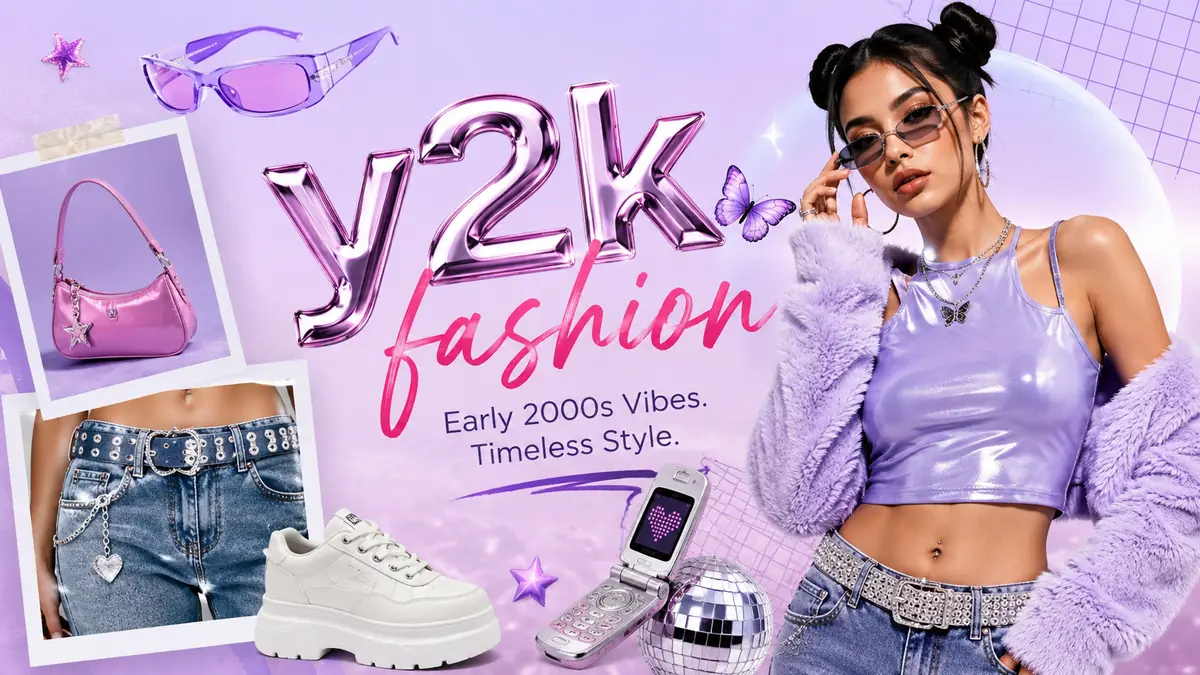
Fashion has a habit of bringing back the styles people once swore would never return. Low-rise jeans, tiny shoulder bags, metallic fabrics, baby tees, platform shoes, and butterfly clips have all found their way back into wardrobes.
Together, these nostalgic elements form what is now widely called y2k fashion—a style rooted around the turn of the millennium and shaped by pop culture, rapidly developing technology, celebrity influence, and a playful vision of the future.
Y2K fashion is the clothing aesthetic associated mainly with the late 1990s and early 2000s, combining futuristic details, bold colors, fitted silhouettes, denim, metallic finishes, playful accessories, and technology-inspired styling. Modern interpretations mix genuine early-2000s references with contemporary pieces rather than reproducing the period exactly.
What Is Y2K Fashion?
The term “Y2K” originally meant “year 2000.” Before the millennium arrived, it became closely associated with the Y2K computer problem—the fear that computer systems using two-digit year formats might incorrectly interpret the year 2000.
Fashion developed against this unusual cultural background.
Technology was becoming a much bigger part of everyday life, the internet was expanding, mobile devices were evolving, and popular culture was increasingly fascinated by what the digital future might look like. Fashion responded with its own version of futurism.
Shiny materials, unusual sunglasses, bright colors, fitted clothing, exposed midriffs, platform footwear, and futuristic accessories became part of the visual language.
Vogue describes the original Y2K period as carrying both uncertainty and optimism while producing a futuristic-retro style characterized by bold colors, shiny textures, curve-hugging silhouettes, low-rise jeans, crop tops, logomania, It-bags, and distinctive footwear.
That combination explains why Y2K is difficult to reduce to one outfit.
It could be sporty.
It could be glamorous.
It could look futuristic.
And sometimes it deliberately looked excessive.
Y2K Fashion vs. 2000s Fashion
The two terms are often used interchangeably online, but there is a useful distinction.
Strictly speaking, Y2K fashion refers most closely to the styles surrounding the millennium, particularly the late 1990s and beginning of the 2000s. Broader “2000s fashion” can include trends from much later in the decade.
This matters because the fashion of 1999 did not look exactly like the fashion of 2007.
Early Y2K imagery often leaned toward cyber-inspired futurism, metallic finishes, streamlined silhouettes, unusual eyewear, and an optimistic vision of technology.
Later 2000s style expanded into other recognizable aesthetics involving velour tracksuits, graphic tees, heavy rhinestones, trucker hats, colorful streetwear, and increasingly visible luxury branding.
The internet has gradually placed many of these different styles under one Y2K label.
Y2K Fashion vs. McBling: They Are Not Exactly the Same
One of the biggest misconceptions surrounding Y2K style is that every flashy early-2000s outfit belongs to the same aesthetic.
It doesn’t.
McBling is an overlapping but distinct aesthetic that became particularly visible during the 2000s.
Vogue distinguishes classic Y2K from McBling by placing Y2K somewhat earlier on the fashion timeline. McBling developed into a louder style centered on rhinestones, bright colors, glamorous streetwear, matching tracksuits, graphic shirts, and conspicuous branding.
Think of the distinction this way:
| Y2K Fashion | McBling |
|---|---|
| Futuristic and cyber-inspired | Celebrity and luxury-inspired |
| Metallic silver and bright colors | Pink, colorful and rhinestone-heavy |
| Sleek futuristic accessories | Oversized glamorous accessories |
| Low-rise silhouettes | Low-rise silhouettes |
| Tech-inspired styling | Logo-heavy styling |
| Late-’90s/turn-of-millennium influence | Stronger mid-2000s influence |
The boundaries were never perfectly clean, of course. Real people mixed trends then just as people do now.
But understanding the distinction makes it easier to create a more intentional Y2K outfit instead of simply combining random 2000s references.
Where Did the Y2K Aesthetic Come From?
Y2K fashion makes much more sense when viewed alongside the culture surrounding the millennium.
Computers were moving into homes. The internet was transforming communication. Mobile phones were becoming more accessible. Digital entertainment was expanding.
At the same time, people imagined the future through movies, music videos, advertising, magazines, and runway fashion.
That produced an interesting contradiction.
Technology looked exciting, but sometimes frightening.
The future seemed close, but nobody knew exactly what it would look like.
Fashion turned that uncertainty into something visual.
Metallic materials could suggest machines or spacecraft. Narrow sunglasses looked futuristic. Shiny accessories echoed new consumer electronics. Bright synthetic colors made clothing appear deliberately artificial rather than traditional.
Vogue’s history of 1990s fashion similarly identifies an embrace of technological change and playful cyber fashion as one of the aesthetics developing around Y2K.
Pop Culture Made the Look Mainstream
Runways were only part of the story.
Musicians, actors, television personalities, and celebrity culture helped turn individual garments into recognizable symbols of the era.
Britney Spears, Jennifer Lopez, Destiny’s Child, Paris Hilton and other celebrities became closely associated with different parts of early-2000s style. Contemporary retrospectives still point to combinations such as crop tops with cargo pants, oversized sunglasses, denim looks, miniskirts, and tiny bags when explaining the era.
Music television also mattered.
Before social-media feeds became a primary source of fashion inspiration, music videos, magazines, television programs, red carpets, and celebrity photographs played a much larger role in determining which looks spread.
That relationship between fashion and entertainment is central to understanding authentic Y2K style.
The Most Recognizable Y2K Fashion Trends
There was no official Y2K uniform. Still, certain pieces appear repeatedly when looking at the period and its modern revival.
1. Low-Rise Jeans
Few pieces represent the era more immediately than low-rise jeans.
Instead of sitting around the natural waist, these jeans rest much lower on the hips. Cuts varied considerably, including bootcut, flared, straight, and baggy styles.
Low-rise trousers were frequently paired with short tops, making the proportions of the outfit instantly recognizable.
They remain one of the most divisive elements of the Y2K revival.
Fortunately, recreating the aesthetic doesn’t require wearing an extremely low waist. A mid-rise jean with the right top and accessories can produce a similar visual effect while being more comfortable for many people.
2. Baby Tees and Fitted Tops
The baby tee is another essential part of the look.
These small, fitted T-shirts often finish around the waist or above it and may include playful graphics, logos, slogans, or simple designs.
Shrunken tanks and fitted tops were equally common.
Harper’s Bazaar has highlighted baby tees, pleated miniskirts, flares, bandage dresses, and lettuce-hem details among pieces associated with the Y2K revival.
For a simple modern outfit, pair a fitted baby tee with relaxed denim. The contrast between a small top and looser trousers creates the right proportions without turning the outfit into a costume.
3. Cargo Pants
Cargo trousers fit naturally into the more casual and futuristic sides of Y2K fashion.
They may be baggy, low-slung, sporty, or made from lightweight technical fabrics.
A cropped tank, cargo pants, narrow sunglasses, and sneakers create an easy Y2K-inspired combination without requiring many accessories.
4. Mini Skirts
Denim minis, pleated skirts, fitted mini skirts, and extremely short silhouettes all became recognizable parts of early-2000s fashion.
The modern approach can be considerably more flexible.
A mini skirt can be balanced with an oversized jacket, fitted cardigan, tall boots, sneakers, or simple tank depending on how strongly you want the outfit to reference the period.
5. Flared and Bootcut Pants
Not every pair of Y2K trousers was ultra-baggy.
Flared jeans and bootcut pants were major silhouettes too.
They create a completely different shape from today’s straight-leg basics and work particularly well with fitted tops and platform footwear.
6. Denim Everywhere
Denim was not limited to ordinary jeans.
The era embraced:
- Denim mini skirts
- Denim jackets
- Denim dresses
- Denim handbags
- Embellished jeans
- Low-rise denim
- Head-to-toe denim combinations
Britney Spears and Justin Timberlake’s coordinated denim appearance in 2001 remains one of the most widely remembered examples of the decade’s willingness to take denim to extremes.
You don’t need to recreate that level of commitment.
A denim mini with a baby tee or relaxed jeans with a fitted top gives a much easier nod to the period.
Y2K Tops That Define the Look
The top half of a Y2K outfit is often where the aesthetic becomes obvious.
Common choices include:
- Baby tees
- Crop tops
- Halter tops
- Tube tops
- Camisoles
- Fitted tank tops
- Corset-inspired tops
- Graphic tees
- One-shoulder tops
- Layered tanks
Layering was particularly playful.
A fitted tee might appear underneath another top, while camisoles could be layered or paired with contrasting textures.
The important point is proportion.
Y2K outfits frequently combined a small, fitted top with either low-rise or relaxed bottoms.
Y2K Dresses and Skirts
Dresses during the era ranged from casual to unapologetically glamorous.
Popular silhouettes and details included slip-inspired dresses, minidresses, body-conscious shapes, handkerchief hems, satin fabrics, embellishment, and asymmetric designs.
For skirts, the mini dominated much of the popular imagery.
Pleated versions could create a preppy feel, while denim and fitted minis leaned more casual.
There was also room for longer silhouettes. Modern retrospectives of the era include maxi skirts and dresses among pieces that can still translate into contemporary wardrobes.
The Accessories That Make an Outfit Look Y2K
Accessories are often more effective than clothing when you want a subtle reference to the era.
Baguette and Shoulder Bags
Small bags tucked close beneath the arm became one of the most recognizable accessories of the period.
The Fendi Baguette is particularly associated with late-’90s and early-2000s fashion, while other designer It-bags also became powerful status symbols.
Today, you don’t need a designer original.
The shape does most of the work.
Look for a compact shoulder bag with a short strap, especially in a bright, glossy, metallic, or playful finish.
Tinted and Narrow Sunglasses
Tiny sunglasses have become one of the easiest shortcuts to a Y2K-inspired outfit.
Wraparound and sporty shapes can push the look toward futuristic cyber-Y2K, while tinted lenses and decorative frames create a more playful version.
Butterfly Clips
Butterfly clips are practically visual shorthand for nostalgic late-’90s and early-2000s styling.
They work because they add the aesthetic without requiring you to redesign your entire wardrobe.
Statement Belts
Belts weren’t always there merely to hold trousers up.
Chain belts, embellished belts, and decorative styles could become central parts of an outfit.
Harper’s Bazaar has identified waist and chain belts among recognizable trends returning from the 2000s.
Chunky and Playful Jewelry
Depending on the particular Y2K substyle, accessories might include:
- Hoop earrings
- Chokers
- Colorful jewelry
- Chunky rings
- Rhinestones
- Charm jewelry
- Layered necklaces
This is also an area where Y2K and McBling can easily overlap.
Y2K Shoes: From Platforms to Kitten Heels
Footwear during the era was surprisingly varied.
Vogue’s overview includes ballet flats, pumps, strappy sandals, kitten-heeled mules, chunky sneakers, pointy boots, and platform soles among shoes connected with Y2K fashion.
That gives you plenty of room when building an outfit.
For casual styling, chunky sneakers or platforms work well.
For a more polished look, kitten heels or a small mule can immediately shift the outfit toward early-2000s glamour.
The footwear doesn’t have to match every other element perfectly. In fact, some of the most convincing outfits from the period worked because they mixed seemingly unrelated influences.
Y2K Colors, Fabrics, and Prints
Silhouette alone doesn’t create the aesthetic.
Texture and color matter too.
Signature Colors
Popular Y2K-inspired palettes often include:
- Metallic silver
- Bubblegum pink
- Baby blue
- White
- Black
- Lime green
- Lavender
- Bright red
- Pastels
- Iridescent shades
Cyber-inspired outfits tend to favor silver, black, white, and artificial-looking bright colors.
McBling-influenced styling leans more readily toward pink, sparkle, rhinestones, and conspicuous glamour.
Fabrics and Finishes
Look for materials that create texture or shine:
- Satin
- Velour
- Mesh
- Denim
- Faux leather
- Metallic fabrics
- Rhinestone embellishment
- Sheer materials
- Glossy synthetics
The contrast between ordinary denim and something shiny is particularly effective.
How to Dress Y2K Without Looking Like You’re Wearing a Costume
This is where many modern Y2K outfits go wrong.
Putting every recognizable trend into a single outfit can make the result look more like themed party clothing than personal style.
A better strategy is to choose one or two strong Y2K references and build the rest of the outfit from simple contemporary basics.
Start With One Hero Piece
Choose something unmistakably Y2K:
- Low-rise or relaxed jeans
- A baby tee
- A mini skirt
- Cargo pants
- A baguette bag
- A metallic top
- Platform shoes
Then build around it.
For example:
Baby tee + relaxed jeans + sneakers + shoulder bag
The top and bag communicate the aesthetic while the remaining pieces keep it wearable.
Mix Tight and Loose Proportions
A common formula from the period is:
Fitted top + relaxed bottom
Try a crop top with cargo trousers or a baby tee with loose jeans.
You can reverse the formula too by combining a larger jacket with a fitted skirt or dress.
Use Accessories for a Subtle Version
If low-rise jeans or tiny tops aren’t your style, ignore them.
Try:
Straight jeans + white tank + small shoulder bag + narrow sunglasses
The outfit references Y2K without requiring a literal reconstruction.
Don’t Copy an Old Photograph Piece for Piece
Fashion revival works best as reinterpretation.
Modern Y2K style isn’t necessarily supposed to reproduce an exact outfit from 2001. Vogue similarly notes that revivalism can involve remixing elements of the past to fit current needs rather than making a perfect replica.
Use the era as inspiration rather than a strict dress code.
Easy Y2K Outfit Ideas
If you’re trying the aesthetic for the first time, these formulas provide useful starting points.
| Style | Outfit Formula |
|---|---|
| Casual Y2K | Baby tee + baggy jeans + sneakers + shoulder bag |
| Sporty Y2K | Crop top + cargo pants + wraparound sunglasses |
| Feminine Y2K | Mini skirt + fitted cardigan + small bag + kitten heels |
| Cyber Y2K | Metallic top + black trousers + futuristic sunglasses |
| Denim Y2K | Denim skirt + fitted tank + platform shoes |
| Glam Y2K | Satin mini dress + small shoulder bag + strappy heels |
| Subtle Y2K | Straight jeans + tank top + narrow sunglasses + baguette bag |
These are frameworks, not rules.
Change the rise of the trousers, skirt length, heel height, or amount of skin shown according to your comfort level.
Personal style matters more than historical accuracy.
What Brands Were Popular in the Y2K Era?
Brands helped define both genuine Y2K fashion and the broader 2000s aesthetic.
Depending on the specific period and subculture, frequently referenced names include Juicy Couture, Baby Phat, Von Dutch, Blumarine, Dior, Gucci, Fendi, Louis Vuitton, and Balenciaga.
Some are more closely associated with McBling or later early-2000s celebrity fashion than strict turn-of-the-millennium cyber-Y2K.
That distinction is useful when researching vintage pieces.
A rhinestone-heavy Baby Phat item, for example, communicates a different part of 2000s fashion history from a metallic futuristic top inspired by the millennium itself. Vogue specifically associates Baby Phat, Von Dutch, Juicy Couture, Rocawear, Ed Hardy and Blumarine with McBling’s development.
Why Did Y2K Fashion Come Back?
Fashion works in cycles, but the Y2K revival is about more than simply waiting long enough for old clothes to feel new again.
Nostalgia
For people who experienced the period, Y2K fashion can recall music television, magazines, early internet culture, celebrity red carpets, and childhood or teenage memories.
For younger people, the same era can feel unfamiliar enough to be exciting.
That’s an important distinction.
One generation sees nostalgia.
Another sees discovery.
Gen Z Reinterpreted the Era
Social platforms accelerated the rediscovery of archived celebrity photographs, runway collections, music videos, and vintage clothing.
That allowed younger audiences to pick individual elements from the era and combine them differently.
Rather than faithfully reproducing 2000, contemporary wearers might combine a baby tee with newer sneakers, modern baggy jeans, and vintage sunglasses.
The result is inspired by Y2K rather than trapped inside it.
Designers Revisited the 2000s
The revival also moved beyond social-media aesthetics.
Fashion houses and designers returned to early-2000s references, helping bring items such as miniskirts, ballet flats, logo tops, and recognizable archival designs back into contemporary fashion conversations. Harper’s Bazaar noted continued early-2000s references on major runways as recently as 2025.
Vintage Shopping Changed the Way Trends Return
Vintage and secondhand shopping make revival trends fundamentally different from how they worked decades ago.
People can now search directly for authentic pieces from a particular era instead of relying entirely on brands to reproduce them.
That has also blurred the boundary between vintage collecting and trend participation.
Is Y2K Fashion Still Popular in 2026?
Yes, although the revival continues to evolve.
Some commentators have predicted fashion moving toward other nostalgic periods, including renewed interest in the 1980s and later 2000s or 2010s aesthetics. Yet individual Y2K pieces have proved more durable than a short-lived microtrend.
Recent fashion coverage in 2026 continues to revisit early-2000s celebrity outfits, highlighting items including halter tops, capri pants, cargo trousers, oversized sunglasses, maxi skirts, corset dresses, and velour tracksuits as references that remain wearable today.
That suggests Y2K is moving from a single dominant “aesthetic” into the wider fashion vocabulary.
A baguette bag no longer needs an entirely Y2K outfit around it.
Neither does a baby tee.
That’s usually what happens when a revival matures: its most wearable elements remain after the initial hype cools.
Common Mistakes When Trying Y2K Style
A convincing Y2K-inspired wardrobe doesn’t require buying dozens of new pieces.
In fact, restraint usually produces better results.
Treating Every 2000s Trend as Y2K
A trend appearing sometime between 2000 and 2009 doesn’t automatically make it strict Y2K.
Learning the difference between turn-of-the-millennium futurism, McBling, later 2000s boho, and other aesthetics will make your styling more coherent.
Wearing Every Trend at Once
Low-rise jeans, a rhinestone baby tee, butterfly clips, tinted sunglasses, a chain belt, a baguette bag, platform shoes, and chunky jewelry can technically reference the period.
Together, however, they may overwhelm each other.
Choose a focal point.
Ignoring Comfort
You don’t need to suffer for historical accuracy.
Don’t like low-rise jeans? Wear mid-rise.
Don’t like mini skirts? Use a maxi.
Don’t want platforms? Wear sneakers.
The best revival fashion translates the visual idea into clothing that works for the person wearing it.
Buying Everything New
A trend based heavily on nostalgia is a perfect opportunity to explore existing clothing, vintage stores, and secondhand pieces.
Start with your own wardrobe.
A fitted tank, relaxed jeans, old shoulder bag, and sunglasses may already give you most of what you need.
Building a Y2K Wardrobe From Scratch
Instead of collecting every trend, build a small foundation.
Start with:
- One fitted top — a baby tee, tank, or crop top.
- One characteristic bottom — relaxed jeans, cargos, flares, or a mini skirt.
- One small shoulder bag — preferably with a compact silhouette.
- One statement accessory — sunglasses, clips, a belt, or jewelry.
- One era-inspired shoe — sneakers, platforms, mules, or kitten heels.
Once you can create several outfits from those five categories, add more distinctive pieces.
This method keeps the wardrobe wearable and prevents the aesthetic from becoming a pile of disconnected trend items.
The Lasting Appeal of Y2K Fashion
The most interesting thing about y2k fashion isn’t that low-rise jeans or tiny bags returned.
It’s that a period once obsessed with imagining the future has itself become nostalgic.
The original aesthetic reflected a world discovering new digital technology, celebrity culture, bold consumerism, and a new millennium. Its revival looks backward at that optimism while filtering it through today’s ideas about comfort, individuality, vintage clothing, and personal expression.
That’s why there isn’t one correct way to wear Y2K.
You can embrace futuristic metallics and cyber-inspired sunglasses. You can choose baby tees and relaxed denim. You can borrow the glamorous excess of McBling, or simply carry a tiny shoulder bag with an otherwise modern outfit.
The strongest approach is also the simplest: understand the era first, choose the parts that genuinely suit you, and reinterpret them instead of copying them.
That keeps Y2K fashion connected to its history without making your wardrobe feel stuck in the year 2000.