
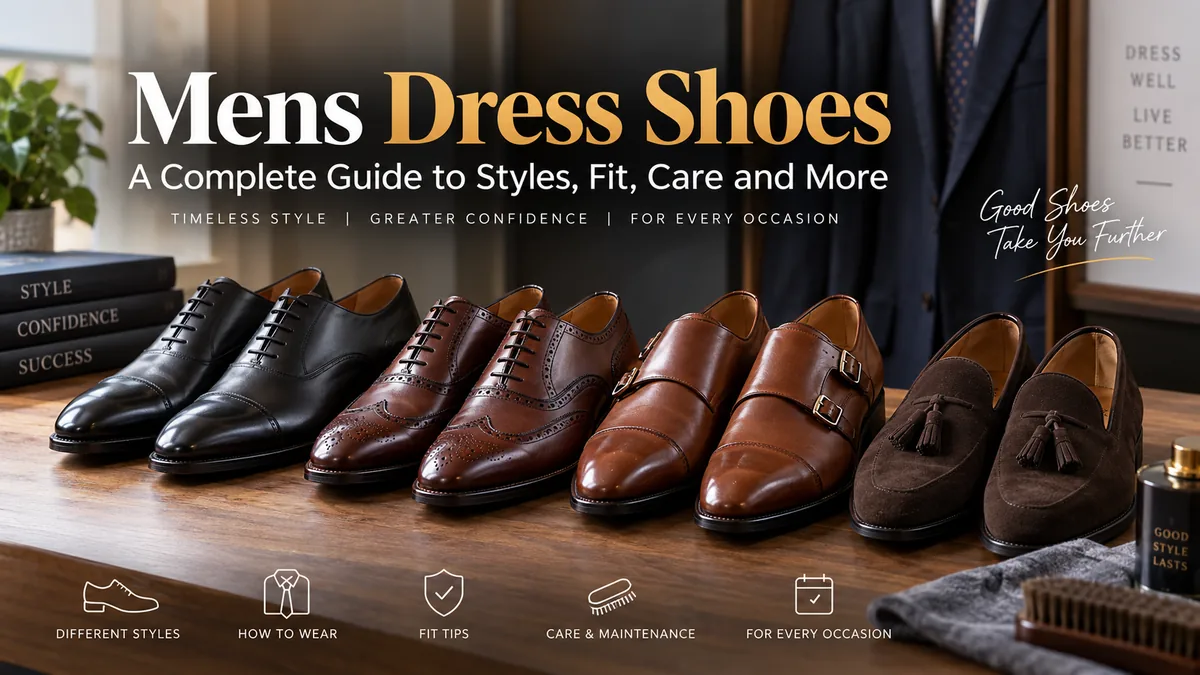
A good pair of mens dress shoes can make a simple suit look polished, while the wrong pair can make an otherwise sharp outfit feel mismatched. The challenge is that terms such as Oxford, Derby, brogue, monk strap, and loafer describe different aspects of footwear—and they are often used interchangeably when they should not be.
The easiest way to understand dress shoes is to look at five things: style, lacing system, material, construction, and formality. Once you know those basics, choosing shoes for a suit, wedding, office, interview, or smart-casual outfit becomes much easier.
Quick answer: Mens dress shoes are refined footwear designed for formal, business, and smart-casual clothing. The main styles are Oxfords, Derbies, monk straps, and loafers. Oxfords are generally the most formal, while Derbies and loafers offer more flexibility. Leather quality, construction, fit, color, toe design, and broguing also determine how formal and durable a shoe will be.
Understanding the Main Types of mens dress shoes
The names used for dress shoes can initially sound complicated, but most traditional men’s footwear falls into a handful of recognizable categories.
| Shoe style | Defining feature | Typical formality | Common use |
|---|---|---|---|
| Oxford | Closed lacing | Very formal | Suits, formal business, ceremonies |
| Derby | Open lacing | Formal to smart-casual | Office, suits, tailored trousers |
| Monk strap | Buckle closure | Formal to smart | Business, weddings, social events |
| Penny loafer | Slip-on with vamp strap | Smart-casual | Office, chinos, relaxed tailoring |
| Tassel loafer | Decorative tassels | Smart-casual | Business casual, social occasions |
| Wholecut | Upper made from a highly minimal piece of leather | Very formal | Formal tailoring, evening wear |
| Brogue | Decorative perforations | Varies | Business to smart-casual |
One useful distinction is often overlooked: Oxford and Derby describe construction, while brogue describes decoration. An Oxford can therefore be a brogue, and so can a Derby.
Oxford Shoes: The Traditional Formal Choice
Oxford shoes are recognizable by their closed-lacing system. The eyelet facings are attached beneath the vamp, creating a clean, streamlined appearance when the shoe is laced.
That seemingly small construction detail has a major effect on appearance.
Because there are fewer visible layers around the laces, Oxfords generally look sleeker than Derbies. This is why they remain closely associated with formal tailoring.
Plain-Toe Oxford
A plain-toe Oxford has minimal decoration across the front.
Its simplicity makes it one of the dressiest configurations available, particularly in smooth black leather.
Cap-Toe Oxford
The cap toe has an additional horizontal seam across the toe box.
A black cap-toe Oxford is a classic choice for conservative business clothing, formal events, interviews, and dark suits.
Wholecut Oxford
A wholecut has an exceptionally clean upper with very few visible seams.
The minimalist appearance can look particularly refined when made from smooth calfskin and paired with formal tailoring.
Brogue Oxford
Adding decorative perforations changes the personality of an Oxford.
The underlying shoe still uses closed lacing, but broguing introduces texture and visual detail, generally moving it toward the less-formal end of Oxford styling.
Quick Takeaway: If maximum formality is the priority, favor smooth leather, darker colors, restrained decoration, and a streamlined silhouette.
Derby Shoes: A More Flexible Alternative
At first glance, an Oxford and Derby can look nearly identical.
Look at the laces and the difference becomes obvious.
A Derby uses open lacing. Its eyelet facings are stitched on top of the vamp rather than beneath it. When the laces are loosened, those sections can open more freely.
Oxford vs Derby
The practical difference can be summarized simply:
| Feature | Oxford | Derby |
|---|---|---|
| Lacing | Closed | Open |
| Appearance | Sleeker | Slightly more relaxed |
| Traditional formality | Higher | Slightly lower |
| Adjustment | More restricted | More adjustable |
| High instep compatibility | Can be difficult | Often easier |
| Typical use | Formal tailoring | Business through smart-casual |
The extra adjustment available from open lacing can make a Derby particularly useful for men with a high instep or wider foot.
A dark brown Derby is also remarkably versatile. Depending on its leather, sole, and decoration, it can work with a suit, tailored trousers, chinos, and some dark denim.
That makes the Derby a strong everyday option for someone whose wardrobe moves regularly between business and smart-casual clothing.
Monk Strap Shoes: Buckles Instead of Laces
A monk strap replaces conventional laces with a leather strap and metal buckle.
There are two primary versions:
- Single monk strap: one strap and buckle
- Double monk strap: two straps and buckles
Single monks tend to look cleaner and more restrained. Double monks create more visual detail and have become a recognizable contemporary menswear style.
In terms of formality, monk straps generally occupy the territory between conservative lace-up shoes and relaxed loafers, although material, color, toe shape, and decoration can shift that position.
Dark brown and burgundy monk straps work particularly well with navy, charcoal, medium-grey, and brown tailoring.
The buckle itself matters, too. Because hardware naturally attracts attention, overly large or highly polished buckles can make a shoe look more conspicuous.
For understated outfits, restrained hardware usually integrates more naturally.
Loafers and When They Count as Dress Shoes
Loafers have no traditional lacing system. You simply slip your foot into them.
That convenience does not automatically make them casual.
A sleek black or dark-brown leather loafer with a thin profile can look quite refined. A chunky suede loafer with a heavy rubber sole sits much further toward casual footwear.
Penny Loafers
Penny loafers feature a distinctive leather strap across the vamp, traditionally with a small cutout.
They are among the most versatile loafers because they work with chinos, tailored trousers, blazers, and relaxed suits.
Tassel Loafers
Tassel loafers feature decorative tassels on the vamp.
They typically have more visual personality than plain penny loafers and are frequently worn with business-casual or tailored outfits.
Horsebit Loafers
Horsebit loafers use metal hardware across the vamp.
The hardware creates a dressier, more distinctive appearance than many casual slip-ons, although the exact formality still depends on the shoe’s material and shape.
Can You Wear Loafers With a Suit?
Yes, but context matters.
Leather penny and tassel loafers can work well with relaxed tailoring and many modern business outfits. For highly conservative or ceremonial dress codes, an Oxford is generally the safer traditional option.
Brogues and Wingtips Explained
One of the most persistent footwear misconceptions is that a brogue is a completely separate type of shoe.
It isn’t.
Broguing refers to decorative perforations in leather. Those perforations can appear on Oxfords, Derbies, boots, and other footwear.
Common levels include:
Quarter Brogue
Decorative perforation is concentrated around the cap-toe seam without extensive decoration elsewhere.
Semi-Brogue
A semi-brogue adds more perforation and often includes decorative detailing on the toe.
Full Brogue or Wingtip
A full brogue typically has a distinctive wing-shaped toe cap extending toward the sides of the shoe.
Longwing Brogue
The wing pattern continues along the sides toward the heel.
As a general styling principle, more decoration tends to make a traditional dress shoe appear less formal.
That isn’t a statement about quality. A beautifully constructed full-brogue Derby may be far better made than a plain Oxford. It simply belongs at a different point on the formality spectrum.
How Formal Are Different mens dress shoes?
Formality is not determined by one feature alone.
Think of it as several signals working together.
1. Lacing
Closed lacing generally appears more formal than open lacing.
2. Color
Black traditionally occupies the most formal position, followed broadly by dark brown and burgundy or oxblood. Lighter browns and tan tend to look more relaxed.
3. Decoration
Plain surfaces look more formal than heavily brogued or textured ones.
4. Material
Smooth polished leather normally appears dressier than suede or heavily grained leather.
5. Sole
A slim leather sole usually looks more elegant than a thick lugged rubber sole.
6. Toe Shape
Moderately rounded or almond-shaped toes generally remain timeless. Extremely square or aggressively pointed toes can look trend-driven.
Put these factors together and you get a useful spectrum:
More formal:
Black smooth-leather Oxford → dark cap-toe Oxford → restrained Derby → monk strap → decorative Derby/brogue → leather loafer → suede loafer.
This hierarchy is approximate rather than absolute. Dress codes, local customs, and the rest of the outfit still matter.
What Materials Are Used in Quality Dress Shoes?
The upper material affects appearance, comfort, aging, maintenance, and price.
Full-Grain Leather
Full-grain leather retains the natural outer surface of the hide rather than having it heavily corrected.
High-quality examples can develop an attractive patina over time.
Calfskin
Calfskin is prized in traditional dress footwear because it can be smooth, relatively supple, and capable of taking a fine polish.
You’ll commonly see it used on refined Oxfords and other formal shoes.
Corrected-Grain Leather
Corrected leather has had surface imperfections mechanically altered or covered with a finish.
It can provide a very uniform appearance and lower price, although heavily coated versions may not age like high-quality natural leather.
Patent Leather
Patent leather has a highly glossy surface.
Its strongest traditional association is evening formalwear rather than everyday office footwear.
Suede
Suede provides softness and texture.
That texture also lowers perceived formality, making suede Derbies, loafers, and similar shoes especially useful with smart-casual clothing.
Leather, suede, calf, and corrected-grain materials all appear in contemporary dress-shoe manufacturing, but the material alone does not determine quality. Construction and finishing matter just as much.
Goodyear Welt vs Blake Stitch vs Cemented Construction
Turn a shoe over and you may learn more about its long-term usefulness than you can from looking at the polished upper.
How the upper and sole are joined affects flexibility, weight, water resistance, repairability, and cost.
Goodyear Welt
A Goodyear welt uses a separate welt as part of the connection between the upper and sole.
Its major advantage is repairability. Properly constructed Goodyear-welted shoes can generally be resoled more readily than many simpler constructions.
Potential advantages include:
- Good structure
- Easier resoling
- Durability
- Better resistance to water entering around the sole edge than some constructions
Potential disadvantages include greater weight, stiffness when new, and usually a higher manufacturing cost.
Blake Stitch
Blake construction stitches the outsole more directly through the shoe.
This allows a slimmer, lighter, and often more flexible profile.
That makes Blake construction attractive for sleek Italian-style footwear and lightweight formal shoes.
Compared with Goodyear construction, resoling can require more specialized machinery and expertise.
Cemented Construction
Cemented shoes rely primarily on adhesive to attach the sole.
This approach can produce light, flexible, inexpensive footwear. Its tradeoff is that many cemented dress shoes are less practical to resole once the outsole is substantially worn.
None of these methods automatically makes a shoe comfortable. A well-designed shoe must also fit your actual foot.
Leather Soles vs Rubber Soles
Traditionalists often associate dress shoes with leather soles, but modern rubber soles can be extremely practical.
| Leather sole | Rubber sole |
|---|---|
| Sleek appearance | Better grip |
| Traditional formal aesthetic | Better wet-weather practicality |
| Can feel firm initially | Often more forgiving |
| Can be slippery when new | Usually more traction |
| Works well for formal settings | Excellent for daily commuting |
Dainite-style rubber soles are particularly popular on refined shoes because they provide extra grip and water resistance without necessarily requiring a bulky profile.
Your environment should influence the decision.
Someone walking mainly across carpeted offices has different requirements from someone commuting on wet pavement every morning.
How Should mens dress shoes Fit?
Construction gets plenty of attention, but fit matters more than almost everything else.
An expensive shoe in the wrong size is still the wrong shoe.
Your toes need enough room to sit naturally. The widest part of your foot should correspond reasonably closely with the widest portion of the shoe.
The heel should feel secure without excessive pressure.
A new leather shoe may soften and conform somewhat with wear, but don’t rely on “breaking in” to correct severe tightness.
Watch the Instep
The instep is particularly important with Oxfords.
Because closed lacing provides less adjustment, men with high insteps may find some Oxford lasts uncomfortable even when the nominal length is correct.
A Derby’s open lacing is often more forgiving.
Width Matters
Two people who both wear the same numerical shoe size can have very different feet.
One may need a narrow last while another requires additional width.
Whenever width options are available, use them instead of automatically sizing up. Increasing length simply to obtain more width can leave unnecessary space around the heel and toe.
Try Shoes at a Realistic Time
Feet can change slightly in volume through the day.
Try dress shoes with the type of socks you actually intend to wear, and walk around rather than judging them while sitting.
Pay attention to:
- Toe pressure
- Heel movement
- Instep pressure
- Arch comfort
- Width across the forefoot
- Flex point
A good fit should feel secure rather than restrictive.
Understanding the Last and Toe Shape
The last is the three-dimensional form around which a shoe is shaped during manufacturing.
It influences the shoe’s:
- Toe shape
- Width
- Instep volume
- Heel shape
- Overall silhouette
This explains why the same marked size can fit differently across brands—or even across two models from the same brand.
Toe shape also changes the visual character of dress shoes.
Round Toe
Traditional, balanced, and forgiving.
Almond Toe
Slightly elongated without becoming aggressively pointed.
It works especially well with modern tailored clothing.
Square Toe
A subtle squared profile can work, but exaggerated square-toe shoes tend to create a much heavier visual impression.
Pointed Toe
Moderate tapering can look elegant. Excessively long, sharp toes can distort the proportions of both the foot and trouser leg.
For a long-term wardrobe, moderate shapes usually age better than extreme ones.
Choosing Dress Shoes by Occasion
The question isn’t simply “What is the best shoe?”
It is what is appropriate for this outfit and setting?
Business Formal
A black or dark cap-toe Oxford remains one of the safest traditional choices.
Dark brown can also work in many modern business environments depending on the suit and dress code.
Job Interview
For conservative industries, simple usually beats distinctive.
A clean black or dark-brown Oxford or restrained Derby avoids making footwear the focal point of the outfit.
Wedding
Your role and the wedding’s dress code matter.
A guest at a relaxed daytime wedding has much more flexibility than a groom at a formal evening ceremony.
Oxfords work naturally with formal suits, while Derbies, loafers, and monk straps can complement less rigid tailoring.
Business Casual
This is where Derbies and loafers become especially useful.
Brown leather and suede can soften the outfit while maintaining a polished appearance. Current business-casual guidance commonly includes Derbies, loafers, and certain boots alongside more relaxed footwear.
Black Tie
Black tie sits at the highly formal end of menswear.
Traditional choices include highly polished black formal shoes, with minimal decoration generally preferable to casual detailing.
What Color Dress Shoes Should You Wear?
Color affects versatility almost as much as shoe style.
Black
Black is traditionally the most formal and conservative choice.
It pairs naturally with black, charcoal, and many dark-grey suits.
Dark Brown
Dark brown is exceptionally adaptable.
It works well with:
- Navy
- Grey
- Brown
- Olive
- Beige
- Many smart-casual combinations
For someone who rarely attends highly formal events, dark brown can sometimes provide greater everyday versatility than black.
Burgundy and Oxblood
These shades sit between conservative and expressive.
They can complement navy and grey particularly well while offering more character than conventional brown.
Tan and Cognac
Lighter browns naturally draw attention.
They tend to work better with lighter tailoring, chinos, and less formal outfits than with highly conservative dark suits.
Matching Dress Shoes With Suits and Trousers
You don’t need a complicated color chart to dress well.
A few reliable combinations cover most situations.
| Clothing | Shoe colors that commonly work |
|---|---|
| Black suit | Black |
| Charcoal suit | Black, dark brown, burgundy |
| Navy suit | Black, dark brown, burgundy |
| Medium-grey suit | Black, brown, burgundy |
| Brown suit | Dark brown, medium brown |
| Beige/tan suit | Brown, tan, burgundy |
| Navy chinos | Brown, burgundy, loafers |
| Grey trousers | Black, brown, burgundy |
These aren’t absolute rules. Fabric texture, occasion, season, belt, and overall formality can change the best combination.
A useful principle is to keep the shoe’s formality reasonably close to the outfit’s.
A sleek black Oxford can look excessively severe with casual chinos, while chunky suede loafers may look too relaxed beneath a highly formal dark suit.
Should Your Belt Match Your Dress Shoes?
It does not have to be an identical shade.
It should usually belong to the same general color family when you’re wearing traditional business or formal clothing.
Black shoes with a black belt remain straightforward.
With brown leather, a belt that is reasonably close in tone generally creates a more coherent outfit than trying to find an exact factory color match.
Other leather accessories do not all need to match perfectly. Coordination tends to look more natural than obsessive uniformity.
Comfort Features Worth Understanding
Classic appearance and comfort are not mutually exclusive.
Several less-visible elements influence how a dress shoe feels.
Insole
The insole sits beneath the foot and provides structural support.
Footbed
Modern shoes may add cushioning over the structural insole.
Lining
Leather lining can create a smooth interior and help manage moisture.
Shank
A shank supports the area between the heel and forefoot. Steel and wood shanks are among the options used in dress-shoe construction.
Heel
Heel shape and height influence balance and walking comfort.
A well-designed shoe distributes pressure effectively rather than relying on thick foam alone.
How to Tell if Dress Shoes Are Well Made
Price isn’t a perfect indicator of craftsmanship.
Instead, inspect the actual shoe.
Look at the stitching. It should be reasonably straight and consistent.
Check where the upper meets the sole. Large glue marks, uneven edges, or obvious separation deserve attention.
Examine the leather. Natural variation is normal, but poor finishing, cracking, or a thick plastic-like coating can indicate compromises in material or finishing.
Look inside as well.
A neat lining, securely attached components, and a stable heel counter tell you more than branding printed on the insole.
Finally, read the construction specification.
Knowing whether a shoe is Goodyear welted, Blake stitched, or cemented gives you useful information about how it was assembled and how practical future repairs may be.
How to Break In New Leather Dress Shoes
New leather shoes can feel firmer than they will after several wears, particularly when the sole and upper are structured.
Don’t begin with an entire day of walking.
- Wear them indoors for short periods.
- Increase wear time gradually.
- Use the socks you’ll normally wear with them.
- Allow the leather to rest between early wears.
- Stop if you develop significant pain or persistent pressure.
Some softening is normal.
Severe squeezing isn’t.
A shoe that is fundamentally too narrow, short, or low across the instep won’t magically transform into the correct size.
How to Care for mens dress shoes
Good care can dramatically improve how footwear looks as it ages.
Use Shoe Trees
Wooden shoe trees help maintain shape while shoes are resting and can assist with moisture management.
Insert them after wear once the shoes are off your feet.
Brush Away Dust
Fine dirt accumulates in creases and around the welt.
A soft horsehair brush is useful for routine cleaning.
Condition Leather
Leather can dry over time.
An appropriate leather conditioner helps maintain suppleness, although excessive product can be counterproductive.
Polish When Necessary
Cream polish can restore color and provide a subtle shine.
Wax polish is commonly used when a higher shine is desired, particularly around the toe and heel.
Let Shoes Rest
Wearing the same leather shoes every single day gives moisture less time to dissipate.
Rotating between pairs gives each pair time to dry and recover its shape.
Deal With Water Carefully
If leather shoes become wet, allow them to dry gradually at room temperature.
Avoid placing quality leather footwear directly against strong heaters or other intense heat sources.
Common Dress Shoe Mistakes
A few errors appear repeatedly because they sound logical at first.
Assuming Expensive Means Better
Price can reflect craftsmanship and materials, but it can also reflect marketing, retail overhead, or branding.
Evaluate the shoe itself.
Buying Too Small Because Leather Will Stretch
Leather may soften and adapt, but it shouldn’t be expected to correct fundamentally poor sizing.
Confusing Brogue With Shoe Type
Remember: broguing is decoration.
An Oxford, Derby, or boot can all feature broguing.
Ignoring Sole Material
A beautiful leather sole may not be ideal for someone who walks long distances through frequent rain.
Practical requirements matter.
Choosing Extreme Toe Shapes
Highly exaggerated square or pointed toes can date quickly.
Balanced shapes are usually easier to wear over many years.
Wearing One Pair Every Day
Even durable leather benefits from rest.
Rotation can help preserve shape and allows moisture accumulated during wear to dissipate.
What Pair Should You Start With?
There is no universal answer because your wardrobe determines the right starting point.
If you regularly wear conservative dark suits, a black cap-toe Oxford is difficult to beat.
If your life involves office wear, weddings, chinos, tailored trousers, and occasional suits, a dark-brown Derby may give you greater flexibility.
If you already own those basics, consider expanding into:
- Burgundy or dark-brown loafers
- Brown brogues
- Monk straps
- Suede Derbies or loafers
- More specialized formal footwear
The objective isn’t to collect every style. It’s to cover the situations that actually occur in your life.
Final Thoughts on mens dress shoes
Understanding mens dress shoes becomes much easier once you stop treating every design as a completely separate category.
Start with the structure. Oxfords use closed lacing; Derbies use open lacing; monk straps use buckles; loafers slip on. Broguing describes decoration rather than the underlying shoe type. Then consider leather, color, toe shape, sole, construction, fit, and the formality of the occasion.
For most wardrobes, a few carefully chosen pairs are more useful than a large collection of similar shoes. Prioritize proper fit first, choose a style that matches how you actually dress, and look after the leather. A well-fitted, well-maintained dress shoe will usually look better than a more expensive pair chosen for its name alone.