
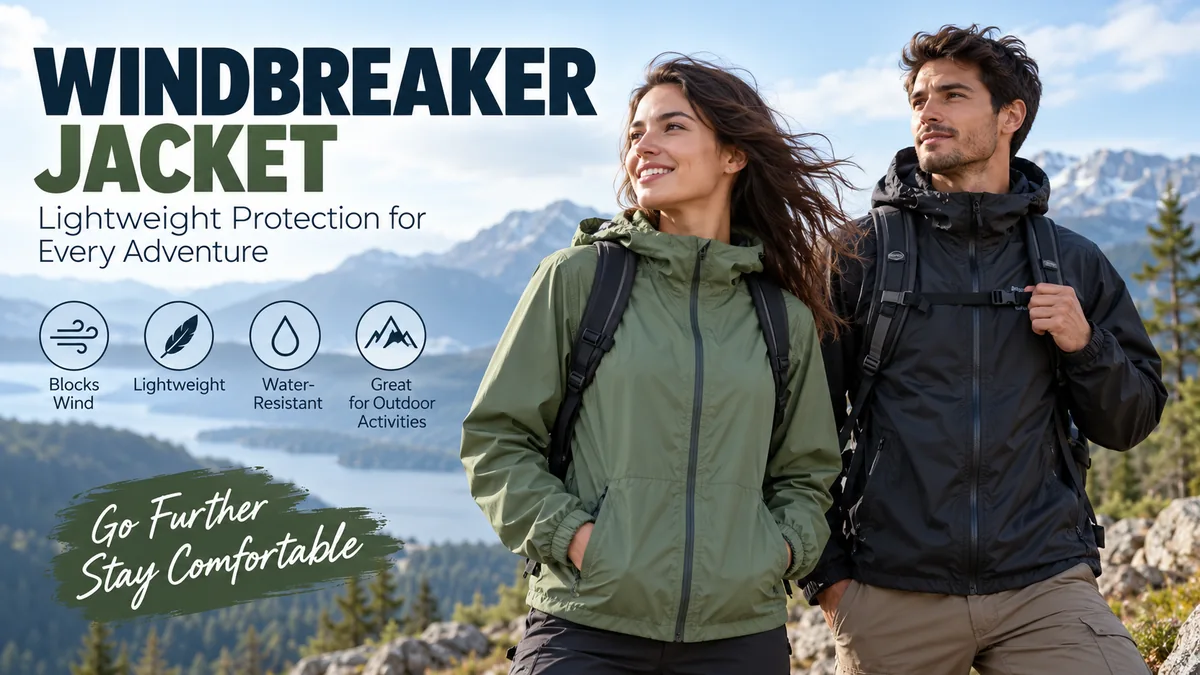
A cold breeze can make mild weather feel surprisingly uncomfortable, especially when the clothing underneath allows moving air to pass straight through. A windbreaker jacket solves that problem without the weight and insulation of a winter coat.
A windbreaker jacket is a thin, lightweight outer layer designed primarily to reduce wind penetration and wind chill. Most are made from tightly woven nylon or polyester and may include a water-repellent finish for drizzle. Unlike a waterproof rain jacket, a typical windbreaker prioritizes wind resistance, breathability, mobility, and packability.
That simple purpose makes the windbreaker one of the more versatile pieces of transitional-weather clothing. It can be worn over a T-shirt on a breezy summer evening, combined with a fleece when temperatures drop, or packed into a backpack as an emergency outer layer.
What Is a Windbreaker Jacket?
A windbreaker, sometimes called a windcheater, is a lightweight jacket constructed to create a barrier between your body and moving air. Traditional versions are thin, synthetic, and minimally insulated.
The defining characteristic isn’t a particular cut or fashion style. It’s the jacket’s ability to limit airflow.
Common features include:
- Nylon or polyester shell fabric
- Full-length zipper or pullover construction
- Elastic or adjustable cuffs
- Adjustable hem
- Hood or stowable hood
- Zippered hand pockets
- High collar
- Lightweight lining or no lining
- Water-repellent surface treatment
- Packable construction
Some jackets fold into one of their own pockets, creating a compact package that can fit easily inside a backpack.
The terminology can vary geographically. “Windbreaker” is especially common in North America, while “windcheater” is also used in other English-speaking markets. Regardless of the name, the fundamental function remains protection from wind with minimal bulk.
How Does a Windbreaker Jacket Actually Work?
Windbreakers don’t need thick insulation to make you feel warmer. Instead, they reduce the movement of cold air across your clothing and body.
Your body continually produces heat. Clothing helps retain some of that heat by holding relatively warm air close to your skin. Strong wind disrupts this layer and increases heat loss.
A tightly woven windbreaker creates a physical barrier that slows that process.
This explains a familiar outdoor experience: a fleece or sweatshirt may feel warm while standing still, yet suddenly feel inadequate when a strong breeze starts. Adding a very thin wind-resistant shell over it can make a noticeable difference even though the shell contains little or no insulation.
Wind Resistance vs. Windproofing
These terms shouldn’t automatically be treated as identical.
A wind-resistant garment significantly reduces airflow but may still allow some air through. A highly windproof shell permits substantially less air movement.
Technical manufacturers sometimes express air permeability in CFM, or cubic feet per minute. Lower airflow generally means stronger wind protection, although fabric construction and testing methods matter when comparing numbers.
For example, one current technical windbreaker from Finisterre lists a 1 CFM windproof rating, illustrating how performance-oriented jackets may provide actual airflow specifications rather than simply using a generic “windproof” label.
Maximum wind blocking isn’t automatically better for every activity. Allowing a controlled amount of airflow can improve comfort during running, cycling, hiking, and other high-output activities.
What Materials Are Windbreakers Made From?
Most modern windbreakers rely on synthetic fibers because they can produce thin, durable fabrics with excellent strength for their weight.
Nylon
Nylon is one of the classic windbreaker materials. A tightly woven nylon shell can provide strong wind resistance while remaining extremely lightweight.
Its advantages include:
- Good strength-to-weight ratio
- Excellent packability
- Abrasion resistance
- Smooth hand feel in many constructions
- Ability to accept water-repellent treatments
Ultralight outdoor jackets frequently use thin nylon because manufacturers can reduce garment weight without eliminating basic weather protection.
Polyester
Polyester is another common choice.
It offers:
- Good durability
- Quick drying
- Shape retention
- Easy care
- Good compatibility with prints and colors
- Relatively low weight
Neither “nylon” nor “polyester” alone tells you exactly how a jacket will perform. Fabric weight, yarn thickness, weave density, coatings, construction, seams, and ventilation can dramatically change performance.
Ripstop Fabric
Outdoor-oriented windbreakers may use ripstop nylon or polyester.
Look closely at ripstop material and you’ll often see a subtle grid. Stronger reinforcement threads are incorporated into the fabric structure to help limit the spread of small tears.
This construction can be useful for hiking and backpacking, where branches, rocks, equipment, and repeated packing create more opportunities for abrasion or damage.
DWR Treatments
Many windbreakers receive a durable water repellent (DWR) treatment.
DWR helps water form droplets and roll away from the face fabric rather than immediately soaking into it. This can make a windbreaker useful during drizzle or a brief shower.
It does not, by itself, transform the jacket into a waterproof rain shell. Waterproof performance requires looking at the entire garment system, including membranes or coatings, seams, zippers, and construction.
Quick takeaway: Material names provide useful clues, but construction matters as much as fiber type. Two nylon windbreakers can behave very differently in wind, rain, heat, and strenuous activity.
Is a Windbreaker Jacket Waterproof?
Usually, no.
This is one of the most common misunderstandings surrounding windbreakers.
A standard windbreaker may be water resistant or water repellent, meaning it can cope with small amounts of moisture. That is different from being genuinely waterproof.
Think of the protection roughly like this:
| Weather | Typical Windbreaker Performance |
|---|---|
| Dry, breezy conditions | Excellent |
| Cool wind | Excellent |
| Light drizzle | Often adequate |
| Brief light shower | Depends on construction |
| Sustained rain | Usually inadequate |
| Heavy downpour | Use a waterproof rain jacket |
Some windbreakers have DWR finishes or additional coatings that improve their resistance to precipitation. However, prolonged rainfall can eventually penetrate the fabric or enter through seams and openings.
A waterproof rain shell is designed specifically to prevent that.
Columbia similarly distinguishes the two categories: windbreakers focus on blocking wind, whereas rain jackets commonly use nylon or polyester combined with waterproof membranes or coatings, with seam sealing becoming particularly important in heavier rain.
Windbreaker Jacket vs. Rain Jacket
Windbreakers and rain jackets can look nearly identical from a distance. Their priorities are different.
| Feature | Windbreaker | Rain Jacket |
|---|---|---|
| Primary purpose | Wind protection | Rain protection |
| Wind protection | High | Usually high |
| Water protection | Light to moderate | High |
| Typical construction | Thin woven shell | Waterproof shell/membrane system |
| Seam sealing | Often absent | Common on waterproof models |
| Breathability | Often very good | Depends on membrane/construction |
| Weight | Very low | Usually higher |
| Packability | Excellent | Good to excellent |
| Best conditions | Dry and breezy | Wet weather |
| Typical use | Running, cycling, travel, hiking | Hiking, commuting, prolonged rain |
A waterproof shell naturally creates a substantial barrier to moving air, so a good rain jacket normally provides wind protection too.
Why not simply carry a rain jacket all the time?
Comfort.
When rain isn’t expected, the lighter construction and greater air permeability of a windbreaker can feel more comfortable during physical activity. Windbreakers can also be smaller and easier to carry.
Conversely, choosing a windbreaker because it’s lighter doesn’t make sense when several hours of rain are expected.
The weather should determine the tool.
Windbreaker vs. Softshell Jacket
A softshell sits somewhere else on the outerwear spectrum.
Softshell jackets typically emphasize stretch, comfort, breathability, moderate weather resistance, and sometimes light insulation. They are generally thicker and heavier than minimalist windbreakers.
A simple comparison is:
Windbreaker: maximum simplicity and low weight.
Softshell: mobility, comfort, durability, and some warmth.
Rain shell: waterproof weather protection.
Insulated jacket: heat retention.
A softshell can be a good option for cool-weather climbing, hiking, or everyday outdoor activity when additional warmth and stretch matter more than minimum packed size.
A windbreaker makes more sense when you primarily need to stop moving air and want the smallest practical outer layer.
Is a Windbreaker Warm?
A windbreaker can make you feel significantly warmer, but most windbreakers aren’t inherently warm garments.
The distinction matters.
A puffer jacket, fleece, or insulated coat retains body heat using insulating material. A basic windbreaker has little insulation. Instead, it reduces heat loss caused by moving air.
This makes it particularly effective when combined with another layer.
For example:
T-shirt + windbreaker: good for mild, breezy weather.
Base layer + windbreaker: useful for active exercise in cooler conditions.
Fleece + windbreaker: considerably warmer because the fleece provides insulation while the shell blocks wind.
Insulated layer + windbreaker: potentially useful in dry cold conditions when the insulating garment itself is highly air permeable.
This approach is part of the broader layering system used in outdoor clothing.
The Three-Layer Principle
A conventional outdoor layering strategy consists of:
- Base layer — manages moisture next to the skin.
- Midlayer — provides insulation, often using fleece or another insulating material.
- Outer shell — protects against environmental conditions such as wind or precipitation.
A windbreaker can serve as the outer shell when wind rather than heavy rain is the main concern.
That flexibility is one reason a very thin shell can be surprisingly useful across different temperatures.
Why Breathability Matters
Stopping wind is only half of good windbreaker design.
The jacket also has to deal with heat and moisture generated by your body.
Imagine running uphill in a completely impermeable plastic jacket. It may stop every gust of wind, but sweat and heat accumulate rapidly inside.
A practical active windbreaker attempts to balance wind resistance and breathability.
Designers can manage this through:
- Fabric air permeability
- Thin woven materials
- Mechanical ventilation
- Mesh-lined pockets
- Back vents
- Underarm ventilation
- Lightweight construction
- Moisture-vapor transmission
This balance becomes especially important during trail running, cycling, fast hiking, and other aerobic activities.
A highly breathable jacket may deliberately permit a small amount of air movement rather than attempting to create an absolute barrier.
When Should You Wear a Windbreaker Jacket?
A windbreaker performs best when the conditions are breezy, relatively mild, and mostly dry.
Hiking
Weather can change quickly on exposed trails.
A packable wind shell gives hikers an easy layer to put on when reaching an open ridge, summit, or windy section of trail. Because it occupies little backpack space, carrying one may be more convenient than carrying a heavier outer jacket when rain isn’t expected.
For prolonged or heavy precipitation, however, a waterproof shell is the safer choice.
Running
Windbreakers are particularly useful for running because wind becomes more noticeable when your own forward movement increases airflow across your body.
A running windbreaker should prioritize:
- Low weight
- Breathability
- Freedom of movement
- Secure pockets
- Minimal bulk
- Ventilation
- Reflective details when running in low light
A heavily insulated jacket can quickly become uncomfortable during vigorous exercise.
Cycling
Cyclists experience the same effect even more strongly because speed creates substantial airflow.
A thin wind-resistant layer can protect the chest and arms without requiring bulky insulation. Cycling-specific jackets may have a longer rear hem to improve coverage in a riding position.
Travel
Packability gives the windbreaker a major advantage for travel.
A compact jacket can remain in a daypack until conditions change. It is useful for cool airports, breezy coastlines, evening walks, exposed viewpoints, and destinations with variable temperatures.
Everyday Commuting
Windbreakers also work well outside technical outdoor activities.
For walking to work, commuting, running errands, or spending time outdoors in spring and autumn, they provide enough protection to bridge the gap between a sweatshirt and a heavier coat.
Spring and Fall
The classic windbreaker season is transitional weather.
During spring and autumn, temperatures can shift considerably between morning, afternoon, and evening. A lightweight jacket can be removed and packed away as temperatures rise.
Columbia likewise describes windbreakers as particularly useful during spring, summer, and fall “in-between” conditions, while colder winter weather generally requires additional insulation.
What Features Matter in a Good Windbreaker?
The most useful features depend on what you’re doing rather than how complicated the jacket looks.
Adjustable Hood
A hood protects the head and neck from wind.
For active use, adjustment matters. An oversized hood can flap around or obstruct peripheral vision. Some designs use elastic edges, drawcords, or rear adjustment systems.
Other jackets have a stowable hood that folds into the collar when unnecessary.
Cuffs
Wind can enter through sleeve openings, so cuffs influence overall protection.
Common systems include:
- Elastic cuffs
- Hook-and-loop adjustment
- Partially elastic cuffs
- Simple stretch bindings
Elastic is light and uncomplicated, while adjustable cuffs provide greater control.
Hem Adjustment
A loose hem allows wind to travel upward underneath the jacket.
A drawcord or elastic hem helps close this opening, particularly in exposed conditions.
Collar
A high collar protects the neck even when the hood isn’t being used.
This small feature can make a substantial comfort difference in strong winds.
Pockets
Everyday windbreakers commonly have two hand pockets, while technical designs may reposition pockets so they’re accessible while wearing a backpack hip belt.
Zippered pockets help prevent phones, keys, and other items from falling out during movement.
Packability
Some windbreakers compress into a separate stuff sack. Others fold into an integrated pocket.
This feature is especially valuable for:
- Backpacking
- Running
- Cycling
- Air travel
- Day hikes
- Emergency layers
The smallest jacket isn’t necessarily the most durable, though. Ultralight fabrics generally require more careful treatment than heavier materials.
Reflective Details
Reflective logos or panels can improve visibility during early-morning or evening running and cycling.
They shouldn’t replace proper lights or dedicated high-visibility equipment, but they can provide another layer of visibility.
UPF Protection
Some windbreakers are designed to provide UPF (Ultraviolet Protection Factor) protection from sunlight.
That can be particularly useful for fishing, hiking, travel, and other activities involving extended sun exposure. Columbia, for example, highlights sun-protection technology as an available feature in some windbreaker designs.
Full-Zip, Pullover, and Anorak Windbreakers
Not every windbreaker uses the same opening system.
Full-Zip Windbreaker
A full front zipper is the most versatile configuration.
It is easy to put on and remove, and opening the zipper provides immediate ventilation when you become warm.
Pullover Windbreaker
Pullover models reduce hardware and can have a clean, lightweight construction.
The disadvantage is less convenient temperature regulation.
Anorak
An anorak-style windbreaker generally uses a partial front zipper or other pullover construction and may include a large front pocket.
These designs are popular in outdoor clothing and streetwear because they combine functional weather protection with a distinctive silhouette.
The best configuration depends primarily on ventilation preferences and intended activity rather than one design being universally superior.
How Should a Windbreaker Fit?
A windbreaker should normally allow comfortable movement without leaving excessive loose fabric that catches the wind.
For casual use, a relaxed fit is perfectly reasonable.
For running or cycling, a closer athletic fit can reduce flapping.
For hiking and general outdoor use, leave enough room underneath for the layers you realistically expect to wear.
Check the fit in four areas:
Shoulders: Move your arms forward and overhead. The jacket shouldn’t strongly restrict movement.
Chest: There should be enough space for normal breathing and your intended base or midlayer.
Sleeves: They should continue covering the wrists when your arms are extended.
Hem: The jacket should provide coverage without riding significantly upward during movement.
A useful fitting test is to try the jacket with the clothing you intend to wear underneath rather than only a thin T-shirt.
How to Layer a Windbreaker Correctly
Layering is where a windbreaker becomes far more versatile than its thin construction suggests.
Mild Weather
Wear:
T-shirt → windbreaker
This works when temperatures are comfortable but the wind makes exposed skin feel cold.
Cool Active Weather
Try:
Moisture-managing base layer → windbreaker
During running or hiking, your body produces enough heat that heavy insulation may be unnecessary.
Colder Dry Weather
Use:
Base layer → fleece → windbreaker
Here, each garment performs a specific job. The base layer manages moisture, fleece traps warm air, and the windbreaker reduces convective heat loss.
Wet Weather
If sustained rain becomes likely, replace the windbreaker with a waterproof shell, or carry a dedicated rain jacket separately.
Columbia specifically notes that longer adventures with variable conditions can justify carrying both because windbreakers are highly compact and the two garments solve different weather problems.
Quick takeaway: Don’t expect a thin windbreaker to provide every type of weather protection. Its strength is acting as one efficient component of a flexible clothing system.
Windbreaker Jacket for Summer, Winter, and Changing Seasons
Can You Wear a Windbreaker in Summer?
Yes, particularly during:
- Cool mornings
- Windy evenings
- Coastal conditions
- Mountain trips
- Cycling
- Running
- Fishing
- Travel
A thin, breathable shell can provide wind and sometimes sun protection without the insulation of a conventional jacket.
In hot and humid conditions, however, even a lightweight shell can trap unwanted heat. Ventilation becomes more important than maximum wind protection.
Can You Wear One in Winter?
Yes—but usually not by itself.
A typical uninsulated windbreaker doesn’t contain enough insulation for genuinely cold winter weather.
It becomes more useful when placed over an insulating layer. A fleece, wool midlayer, or insulated jacket supplies warmth while the wind shell reduces heat loss.
In severe winter weather involving snow, strong precipitation, or very low temperatures, purpose-built insulated and weatherproof outerwear is generally more appropriate.
Windbreaker vs. Hoodie
A hoodie and windbreaker solve different problems.
A cotton or fleece hoodie can provide considerably more insulation, but many hoodies allow wind to penetrate easily.
A windbreaker may contain almost no insulation but can block moving air far more effectively.
This is why wearing them together can work so well:
Hoodie = warmth
Windbreaker = wind barrier
The combination is particularly useful for casual cool-weather use when conditions are dry.
Windbreaker vs. Puffer Jacket
A puffer jacket relies on down or synthetic insulation to trap air and retain body heat.
A windbreaker focuses on stopping airflow.
Puffers are therefore better suited to cold conditions, while windbreakers excel when the temperature itself isn’t extremely low but wind is creating discomfort.
They also differ dramatically in packed volume. An ultralight wind shell can weigh only a fraction of many insulated jackets. As one real-world example, Finisterre lists its current recycled Forecast windbreaker at 161 grams in size medium, though weights vary widely among products.
How to Tell If You Actually Need a Windbreaker
Instead of asking whether a windbreaker is “better” than another jacket, consider the conditions you need to solve.
A windbreaker makes sense when:
- Wind is your main weather concern.
- Heavy rain isn’t expected.
- You want minimal weight.
- You need something highly packable.
- You generate substantial heat during activity.
- A normal sweatshirt lets too much air through.
- You want a lightweight layer for variable temperatures.
Choose a rain jacket instead when prolonged precipitation is likely.
Choose a softshell when you value stretch, durability, and some warmth more than minimum weight.
Choose an insulated jacket when cold temperature—not simply wind—is the primary problem.
That distinction prevents one of the most common outerwear mistakes: expecting a single jacket to perform equally well in every environment.
Common Windbreaker Mistakes
Assuming Water Resistant Means Waterproof
Water beading on the surface doesn’t prove that a garment can withstand sustained rain.
DWR treatments can help with brief precipitation, but waterproof performance depends on much more than the surface finish.
Choosing an Overly Heavy Model for Exercise
A lined casual windbreaker may be comfortable for commuting but too warm for running.
Match insulation and fabric weight to your expected activity level.
Ignoring Breathability
Maximum wind resistance can sound ideal until you’re climbing uphill and overheating.
For high-output activities, the balance between airflow and protection often matters more than achieving the strongest possible wind barrier.
Wearing Cotton Underneath in Demanding Conditions
For ordinary everyday use, cotton may be perfectly comfortable.
For longer outdoor activities where sweating, cold, and changing weather matter, moisture-managing synthetic or wool base layers generally create a more functional layering system.
Buying Too Tight
A shell that fits perfectly over a T-shirt may become restrictive when worn over fleece.
Think about your complete clothing system when evaluating fit.
Neglecting the Hood, Cuffs, and Hem
Excellent shell fabric can’t provide complete wind protection if air continually enters through large openings.
Closures and adjustment points are functional parts of the weather barrier, not merely design details.
How to Care for a Windbreaker Jacket
Correct care helps preserve the shell fabric and any water-repellent treatment.
Always begin with the garment’s own care label because fabrics, membranes, coatings, prints, and seam construction vary.
As a general approach:
- Empty the pockets and close major zippers.
- Follow the manufacturer’s washing temperature instructions.
- Use an appropriate mild detergent.
- Avoid treatments specifically prohibited on the label.
- Rinse thoroughly.
- Dry according to the garment instructions.
- Inspect the shell periodically for damage or declining water repellency.
If a previously water-repellent jacket begins absorbing moisture instead of allowing droplets to bead on the surface, its DWR performance may have declined.
Some garments permit reactivation or application of a compatible water-repellent treatment, but the manufacturer’s instructions should determine the appropriate method.
How Long Does a Windbreaker Last?
There is no universal lifespan.
Durability depends on:
- Fabric thickness
- Nylon or polyester construction
- Ripstop reinforcement
- Frequency of use
- Abrasion
- Washing habits
- Zipper quality
- UV exposure
- Coatings and finishes
- Storage
- Intended activity
A heavier everyday windbreaker may tolerate repeated abrasion better than an extremely thin ultralight model.
That doesn’t make ultralight fabrics poor quality. It reflects a deliberate engineering tradeoff: reducing material and weight generally means the user needs to treat the garment with greater care.
Small tears in some shells can be repaired with appropriate technical fabric patches rather than immediately replacing the entire jacket.
What Makes a Windbreaker Different From an Ordinary Jacket?
The word “jacket” covers an enormous range of garments.
Denim jackets, leather jackets, fleece jackets, insulated jackets, suit jackets, rain shells, and windbreakers can all be outer layers, yet their construction serves different purposes.
The defining priorities of a windbreaker are:
Wind resistance + low weight + mobility + packability.
Warmth is secondary. Waterproofing is secondary unless the garment has specifically been engineered for stronger rain protection.
This functional definition also explains why windbreakers can look so different. A minimalist trail-running shell, a color-block streetwear anorak, and a hooded travel jacket may all qualify despite having different aesthetics.
The Windbreaker as Sportswear and Everyday Fashion
Windbreakers have moved well beyond purely technical outdoor clothing.
Synthetic lightweight jackets became increasingly visible in recreational sports and casual fashion during the second half of the twentieth century. By the 1970s and 1980s, brightly colored shells and tracksuit-inspired designs had become closely associated with jogging, athletic clothing, and street style.
Modern versions range from understated monochrome jackets to retro color-block designs and oversized streetwear silhouettes.
That evolution hasn’t changed the garment’s underlying advantage: the same construction that works for a runner or hiker also creates a practical everyday jacket.
What to Look for When Evaluating a Windbreaker Jacket
Ignore unnecessary feature overload and start with the environment.
Ask yourself:
- How much wind protection do I need? Exposed mountains and fast cycling place different demands on a jacket than everyday commuting.
- How much rain do I expect? For occasional drizzle, a water-repellent windbreaker may be sufficient. For persistent rainfall, choose waterproof construction.
- How active will I be? Running and steep hiking require greater attention to breathability and ventilation.
- Will I carry it frequently? If the jacket spends most of its life inside a backpack, packed size and weight become major considerations.
- What will I wear underneath? Allow enough room for the appropriate base and midlayers.
- Do I need a hood? A hood improves protection but isn’t essential for every activity.
- How durable does it need to be? Ultralight shells prioritize weight; tougher fabrics can make more sense around rocks, branches, equipment, or daily work.
- Are there useful technical specifications? Air-permeability figures, garment weight, fabric composition, water-resistance information, and UPF ratings can be more informative than vague marketing labels.
The best choice isn’t necessarily the jacket with the longest feature list. It is the one whose construction matches the conditions in which you’ll actually use it.
Final Thoughts on the Windbreaker Jacket
A windbreaker jacket is best understood as a specialized lightweight barrier against moving air. Its tightly woven nylon or polyester shell reduces wind chill while keeping weight and bulk low, and many designs add DWR treatment, adjustable hems, hoods, secure pockets, UPF protection, or packable construction.
Its limitations are equally important. A windbreaker isn’t automatically waterproof, isn’t a substitute for substantial winter insulation, and isn’t always the right shell for sustained rain.
For dry, breezy conditions, running, cycling, hiking, commuting, travel, and transitional spring or fall weather, however, few outer layers provide the same combination of protection, breathability, mobility, and packability. Choose according to weather and activity, layer it appropriately, and a windbreaker can cover far more situations than its thin construction might suggest.