
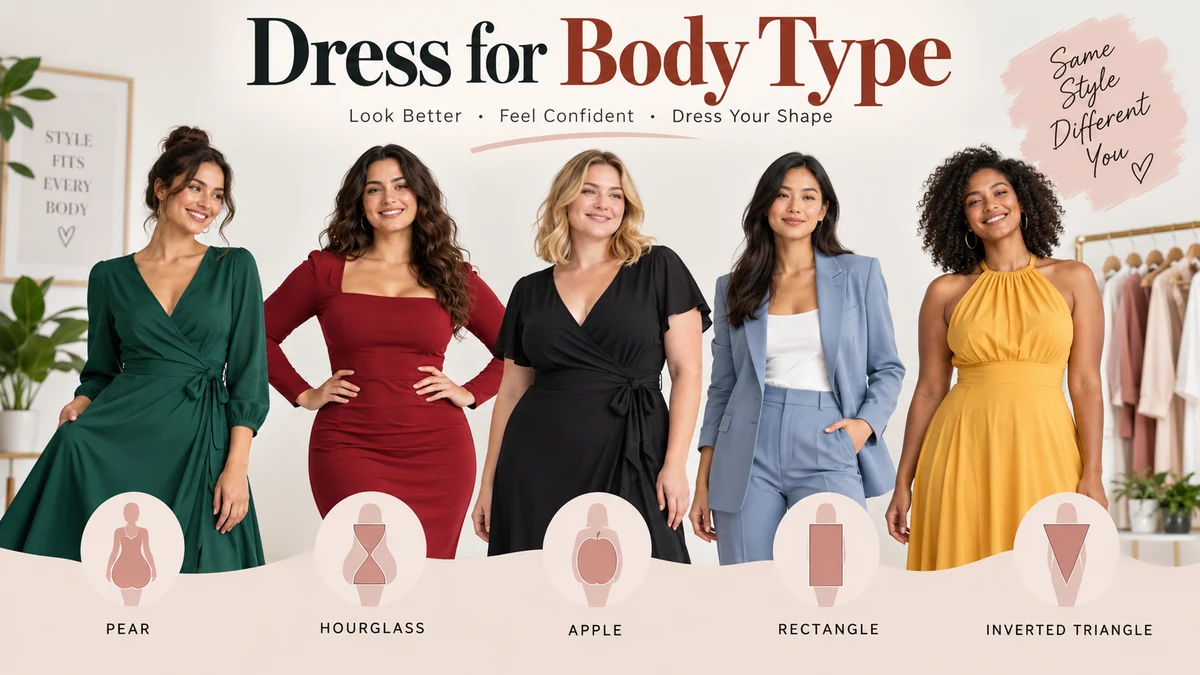
A dress can look perfect on a hanger and completely different once you put it on. Often, the difference is not size or weight. It is how the garment’s waistline, neckline, structure, volume, and length interact with your proportions.
Learning how to dress for body type means understanding the relationship between your shoulders, bust, waist, and hips, then choosing clothing that creates the visual effect you want. The five commonly used shapes are hourglass, pear, apple, rectangle, and inverted triangle. These are styling guides rather than rules, and many people fall somewhere between two shapes.
The useful part of body-shape styling is not putting yourself into a category. It is learning why an A-line dress, wrap dress, empire waist, wide-leg trouser, or structured jacket changes the way an outfit looks.
How to Identify Your Body Shape
Before deciding what to wear, forget your clothing size for a moment. Body shape describes proportion, not whether someone is petite, tall, plus-size, slim, or curvy. Two people who wear very different sizes can have essentially the same body shape.
You can identify your general proportions using four areas:
- Shoulders: Measure around the broadest part of your shoulders if possible.
- Bust: Measure around the fullest part without pulling the tape tight.
- Natural waist: Measure around the narrow area of your torso, usually above the belly button.
- Hips: Measure around the fullest part of your hips and seat.
Stand naturally while measuring. Do not suck in your stomach or pull the tape tight enough to compress the body.
Then compare the measurements rather than focusing on the numbers themselves.
| Body shape | Typical proportions | Main styling principle |
|---|---|---|
| Hourglass | Bust/shoulders and hips balanced; defined waist | Follow the natural waist |
| Pear/Triangle | Hips wider than shoulders or bust | Add visual interest above the waist |
| Apple/Round | Fuller through the midsection | Create clean, lengthening lines |
| Rectangle | Shoulders, waist and hips relatively similar | Create or emphasize definition |
| Inverted triangle | Shoulders/bust wider than hips | Add visual weight below the waist |
These categories are approximations. You might have pear-shaped proportions with relatively broad shoulders, for example, or sit somewhere between a rectangle and hourglass.
That is normal.
Body Shape Is Not the Same as Body Size
One of the most useful distinctions in this subject is the difference between shape and size.
Shape describes ratios.
Size describes dimensions.
Height is another separate variable.
That means an hourglass body can be petite, tall, straight-size, or plus-size. The same is true for every other shape.
This distinction matters because advice such as “pear shapes should wear A-line skirts” only addresses horizontal proportion. It says nothing about whether that skirt’s rise, hem length, or overall scale works for your height and torso.
How to dress for body type If You Have an Hourglass Shape
An hourglass figure generally has similar visual width through the bust or shoulders and hips, with a noticeably narrower waist.
Because the upper and lower body already appear relatively balanced, you do not necessarily need to add volume to either side. Instead, clothing can follow those proportions and make the natural waist visible.
Dress Styles for an Hourglass Body
Wrap dresses are particularly useful because the diagonal wrap follows the torso while the tie defines the waist.
Other options include:
- Belted dresses
- Fit-and-flare dresses
- Fitted sheath dresses
- Body-skimming dresses
- Tailored jumpsuits
- High-waisted skirts and trousers
- Pencil skirts
- Dresses with shaped waist seams
A V-neck, sweetheart, scoop, or open neckline can also work well, although neckline choice should account for bust size and personal preference rather than body-shape labels alone.
What About Oversized Clothes?
An hourglass figure can absolutely wear oversized pieces. The question is whether you want to preserve visible waist definition.
A loose blazer over a fitted top and straight trousers, for instance, gives you an oversized element without making the entire outfit equally voluminous.
If you want a deliberately relaxed or boxy silhouette, however, there is no reason to avoid it. Body-type advice should explain visual effects, not dictate what you are allowed to wear.
Quick takeaway: If your shoulders and hips look balanced and your waist is clearly defined, start with clothing that follows that existing proportion rather than dramatically changing it.
How to dress for body type If You Have a Pear Shape
A pear or triangle shape usually has hips that are wider than the shoulders or bust, often alongside a defined waist.
Traditional proportion-based styling creates balance by introducing more visual emphasis around the shoulders and upper torso while allowing fabric to skim or flow over the hips.
Best Dresses for a Pear-Shaped Body
The A-line dress is a straightforward option. It can define the upper torso before gradually widening below the waist.
Fit-and-flare silhouettes work on a similar principle.
Consider:
- A-line dresses
- Fit-and-flare dresses
- Wrap dresses
- Dresses with interesting sleeves
- Structured shoulders
- Off-the-shoulder necklines
- Boat or wider necklines
- Statement collars
- Defined natural waists
If you enjoy South Asian clothing, anarkalis and flared lehengas use much the same proportion principle: definition around the upper body or waist combined with movement through the lower half.
Tops and Jackets
Visual details around the upper body can make the shoulders appear broader relative to the hips.
Think textured tops, brighter colors, prints, structured jackets, interesting necklines, or sleeves with some shape.
A cropped jacket that ends near the waist can also emphasize the narrower part of the torso. A jacket ending directly across the widest part of the hips produces a different visual line, so experiment with length.
Trousers and Skirts
Straight-leg, bootcut, and wide-leg trousers can create a clean line from hip to hem.
A-line and flowing skirts offer a similar effect.
That does not mean pear shapes cannot wear skinny jeans or pencil skirts. Those styles simply emphasize the hips more strongly. If that is the silhouette you want, they may be exactly the right choice.
Quick takeaway: For visual balance, keep the waist visible and experiment with detail, structure, or openness around the upper body.
How to dress for body type If You Have an Apple Shape
An apple or round body shape generally carries more visual fullness around the middle, while the waist may be less defined. The legs or hips may appear relatively narrower.
A useful approach is creating uninterrupted vertical or diagonal lines rather than forcing a tightly cinched waist. Fluid dresses, open layers, V-necklines, and straight-leg trousers are commonly recommended for this reason.
Dresses for an Apple Body Shape
Empire-waist dresses can work particularly well because their primary seam sits beneath the bust rather than directly around the natural waist.
Other possibilities include:
- Wrap dresses
- Empire-waist dresses
- A-line dresses
- Fluid midi dresses
- Straight dresses with controlled structure
- Dresses with V-necklines
- Asymmetrical styles
- Open-front layers
The fabric matters almost as much as the silhouette.
Very thin, clingy jersey may reveal every contour, while extremely stiff material can stand away from the body and add unwanted bulk. Fabrics with controlled drape tend to follow the body without gripping it.
Creating Vertical Lines
An open cardigan, longline jacket, coat, or blazer creates two vertical edges through the front of an outfit.
Similarly, a V-neck directs the eye vertically rather than creating a strong horizontal boundary across the upper torso.
Monochromatic outfits can produce another continuous line, but you do not need to wear dark colors exclusively. Fit and garment construction usually matter more than relying on black to make the body appear smaller.
Should Apple Shapes Wear Belts?
Yes, if you like the result.
The key is placement.
A narrow belt at the natural waist creates one effect; a belt positioned slightly higher creates another. An empire seam beneath the bust can provide definition without tightly emphasizing the midsection.
Try several positions rather than assuming every belt belongs at the same point.
Quick takeaway: Prioritize clean lines, comfortable structure, intentional waist placement, and fabric that skims rather than grips.
Best Clothes for a Rectangle Body Shape
A rectangle shape generally has shoulders, bust, waist, and hips that are relatively close in width, with less obvious waist definition.
You have two equally valid styling directions.
You can celebrate that naturally straight silhouette with clean, minimalist clothing, or create more contrast between the waist and upper/lower body.
If the second effect is your goal, belts, cropped jackets, fuller skirts, and shaped garments can introduce definition.
Dresses That Create Waist Definition
Useful silhouettes include:
- Belted dresses
- Fit-and-flare dresses
- Wrap dresses
- Peplum styles
- Dresses with ruching
- Dresses with waist cutouts
- Tiered dresses
- Structured A-line dresses
A fit-and-flare dress works by creating two visual changes: narrowing at the waist and expanding below it.
Peplum construction can create a related effect by introducing volume around the hip area.
Use Volume Strategically
Volume does not have to appear everywhere.
You could combine a fitted top with wide-leg trousers, a structured blouse with an A-line skirt, or a cropped jacket with high-waisted pants.
Details such as ruffles, gathering, pockets, pleats, and textured fabric can also change the perceived shape of an outfit.
If you prefer a sleek aesthetic, however, rectangles are particularly well suited to straight trousers, column dresses, long coats, and architectural tailoring.
The objective does not have to be creating an hourglass figure.
Quick takeaway: Rectangle proportions offer considerable flexibility. Add waist definition and strategic volume when you want curves, or use clean lines to emphasize the body’s natural straightness.
How to Dress an Inverted Triangle Body Shape
An inverted triangle shape generally has shoulders or a bust that appear wider than the hips.
For conventional visual balance, the strategy is essentially the reverse of pear-shape styling: simplify the upper body and introduce movement or volume below the waist.
Dresses for an Inverted Triangle
A-line and fit-and-flare dresses are reliable starting points because the skirt widens below the waist.
You can also experiment with:
- V-neck dresses
- A-line skirts
- Pleated skirts
- Full skirts
- Wide-leg trousers
- Bootcut trousers
- Palazzo pants
- Dresses with lower-body detailing
A V-neck can visually break up the width of the upper torso. Softer fabrics around the shoulders can have a similar effect.
Where to Put Visual Interest
If balancing your shoulders is the goal, place more noticeable details lower down.
That might mean a patterned skirt, lighter trousers, pleats, pockets, embellishment, or a wider trouser leg.
Large shoulder pads, prominent puff sleeves, or highly structured shoulders will usually emphasize shoulder width instead. That is not inherently bad. It is simply a different visual result.
Quick takeaway: For greater proportional balance, keep the shoulder area relatively streamlined and introduce shape, movement, or detail around the hips and legs.
dress for body type: The Clothing Details That Matter Most
Body-shape labels are useful shortcuts, but real styling happens through individual garment details.
Two A-line dresses can look completely different on the same person because their neckline, waist placement, fabric, sleeve, and hemline differ.
Understanding these variables is more useful than memorizing a long list of fashion “rules.”
Necklines
Necklines influence the perceived width and length of the upper torso.
V-necks create a strong vertical or diagonal direction and can visually lengthen the upper body.
Scoop necks provide openness without the sharper geometry of a V.
Boat necks create a broader horizontal line across the shoulders.
Sweetheart necklines introduce curves around the bust and can make the waist-to-bust contrast more visible.
Off-the-shoulder styles emphasize shoulder width and the collarbone.
Rather than asking, “Which neckline belongs to my shape?” ask what visual effect you want around your upper body.
Waistlines
Waist placement can dramatically change proportions.
A natural waist seam highlights the body’s actual waist.
A high or empire waist moves the visual division upward and allows fabric to flow from beneath the bust.
A dropped waist lengthens the torso visually before the garment expands.
High-rise trousers can also change the apparent torso-to-leg ratio by making the legs begin visually at a higher point.
Fabric and Drape
Fabric determines whether a silhouette actually behaves as intended.
A stiff cotton A-line skirt maintains its volume. A bias-cut satin skirt falls much closer to the body.
Consider three broad fabric behaviors:
| Fabric behavior | Visual effect | Examples |
|---|---|---|
| Structured | Holds shape and creates defined lines | Denim, suiting, heavier cotton |
| Fluid | Moves and skims the body | Crepe, viscose, some silks |
| Stretch/cling | Follows body contours closely | Jersey, rib knits, stretch blends |
Neither is universally more flattering.
Choose according to whether you want to follow, soften, or reshape your natural outline.
Prints and Color
Color can direct attention, but the old rule that everyone should use dark colors to “hide” areas is unnecessarily limiting.
Contrast is more useful to understand.
A bright patterned blouse with plain trousers naturally attracts the eye upward. A neutral top paired with a vivid skirt does the opposite.
Horizontal lines can emphasize width, while long uninterrupted vertical elements can emphasize length.
Use those effects intentionally instead of treating particular colors or prints as forbidden.
Height, Torso Length, and Proportion Matter Too
One of the biggest limitations of conventional body-type advice is that it often stops after comparing shoulders, waist, and hips.
But two women with pear proportions may need completely different clothes if one is 5 feet tall with a long torso and the other is 6 feet tall with long legs.
Height and vertical proportion matter. Current styling guides increasingly distinguish body shape from petite/tall considerations and recommend adjusting hems, jacket lengths, and overall outfit proportions accordingly.
If You Are Petite
“Petite” refers primarily to height-based garment proportions, not weight or body shape.
Commonly useful adjustments include:
- Correct shoulder placement
- Shorter jacket lengths
- Proper sleeve lengths
- Higher rises when you want longer-looking legs
- Hemlines positioned deliberately
- Smaller-scale details when oversized elements overwhelm your frame
The biggest improvement is often tailoring rather than choosing a different body-shape category.
If You Are Tall
Tall bodies may require additional torso, sleeve, rise, and inseam length.
A garment that seems “unflattering” may simply have a waist seam positioned several centimeters above your actual waist.
Longer coats, maxi silhouettes, wide-leg trousers, and larger-scale prints can work particularly naturally on taller frames, although none is mandatory.
Long Torso vs. Short Torso
If you have a long torso and relatively shorter legs, raising the visual waistline can change the balance. High-rise trousers, tucked tops, and cropped jackets are common ways to do this.
If your torso is relatively short, mid-rise bottoms, longer tops, and lower visual breaks may create more space through the upper body.
This is why body-shape labels should be the beginning of fit analysis, not the end.
How Fit Changes the Way Any Body Shape Looks
You can select the theoretically “perfect” silhouette for your body shape and still dislike the result if the garment fits poorly.
Proper fit depends on several areas:
- Shoulder seams
- Bust accommodation
- Armhole depth
- Waist placement
- Hip ease
- Trouser rise
- Inseam
- Sleeve length
- Hem placement
Mass-produced clothing is generally developed around standardized sizing and fit models, while real bodies vary substantially in shoulder width, bust, waist, hips, torso length, and leg proportions.
That mismatch explains why the same labeled size can behave differently across garments and bodies.
Tailoring Can Matter More Than the Label
Suppose a blazer fits perfectly through your shoulders but has too much room at the waist.
Choosing a smaller size might fix the waist but make the shoulders restrictive.
The better solution may be buying for the harder-to-alter area—often the shoulders—and having the waist adjusted.
Likewise, shortening trousers to the correct break or adjusting a dress strap by an inch can change the entire silhouette.
Before deciding that a particular style “doesn’t suit your body,” check whether the garment actually fits where it should.
Choosing a Dress for Body Type Without Following Rigid Rules
The phrase dress for body type can sound as though each body has an approved list of garments.
That is not a particularly useful way to approach personal style.
Modern body-shape guidance increasingly treats these categories as tools for understanding proportion rather than instructions for hiding supposed flaws.
A better process is:
- Identify your proportions. Compare shoulders, bust, waist, and hips.
- Decide what you want to emphasize. There is no requirement to create an hourglass silhouette.
- Choose the garment’s visual direction. Look at neckline, waist position, volume, and length.
- Check the fabric. Decide whether you want structure, drape, or body-hugging stretch.
- Consider your vertical proportions. Account for height, torso length, and leg length.
- Evaluate actual fit. Check shoulders, bust, waist, hips, rise, and hem.
- Move in the clothing. Sit, walk, reach, and bend before deciding whether the fit works.
- Adjust rather than automatically reject. A minor alteration can transform an otherwise suitable garment.
Most importantly, separate “this changes my proportions” from “I am not allowed to wear this.”
Those statements are completely different.
A pear-shaped person can wear a bodycon dress. It will emphasize the hips rather than visually balance them.
An inverted-triangle figure can wear dramatic shoulder pads. They will emphasize the shoulders rather than soften them.
A rectangle can wear a column dress. It will celebrate the straight silhouette rather than manufacture waist definition.
Once you understand that distinction, body-shape advice becomes far more useful.
A Simple Body-Type Dressing Cheat Sheet
When you are standing in front of your wardrobe and do not want to analyze every seam, use proportion as your shortcut.
| If you want to… | Try… |
|---|---|
| Emphasize your waist | Belts, wrap styles, shaped seams, high-rise bottoms |
| Add width to shoulders | Boat necks, shoulder detail, structured jackets |
| Reduce shoulder emphasis | V-necks, softer shoulders, simpler upper-body details |
| Add volume around hips | A-line skirts, pleats, wide-leg trousers, full skirts |
| Create a longer visual line | V-necks, open jackets, continuous colors, long layers |
| Add curves visually | Peplums, belts, fit-and-flare cuts, strategic volume |
| Follow natural curves | Wrap dresses, fitted knits, shaped tailoring |
| Create a straighter silhouette | Column dresses, long jackets, straight trousers |
Use this as an effects guide rather than a list of restrictions.
Common Body-Type Styling Mistakes
The first mistake is assuming your body needs to be “fixed.” Clothing is supposed to fit your body—not force every body toward one ideal silhouette.
The second is identifying shape from weight alone. Weight can change, but body-shape classification concerns relative proportions.
The third is ignoring fabric. A structured A-line dress and a soft jersey dress may share a product-page silhouette label while behaving completely differently when worn.
The fourth is overlooking undergarments. The right bra size and support can change how the bust sits inside a garment, which affects waist placement, neckline fit, and the overall silhouette.
The fifth is treating every recommendation as an “avoid” rule. Older styling systems often tell apple shapes to hide their stomachs, pear shapes to hide their hips, or rectangles to manufacture curves. You do not have to pursue any of those goals.
And finally, do not confuse poor garment construction with a problem in your proportions. If a dress pulls at the bust, gaps at the waist, or twists around the hips, the issue may simply be that its pattern does not correspond well to your measurements.
What Is the Most Flattering Dress for Every Body Type?
There is no single dress that universally flatters every body because body shape is only one part of fit.
That said, several designs are unusually adaptable.
Wrap dresses allow adjustable waist definition and create diagonal lines through the torso.
A-line dresses offer upper-body structure with increasing room below the waist.
Fit-and-flare dresses provide waist definition and lower-body movement.
A well-cut midi dress can also work across many proportions when the waist and hem are correctly positioned.
Even these versatile silhouettes need adjustment for bust size, shoulder width, torso length, height, fabric, and personal preference.
The most flattering garment is therefore not necessarily the one assigned to your “type.” It is the one whose construction aligns with both your measurements and the silhouette you want to create.
Final Thoughts on How to dress for body type
Learning to dress for body type is most useful when you treat it as a lesson in proportion rather than a set of fashion restrictions.
Start by comparing your shoulders, bust, waist, and hips to determine whether your proportions are closest to hourglass, pear, apple, rectangle, inverted triangle, or somewhere between categories. Then look beyond the label.
Pay attention to necklines, waist placement, volume, fabric drape, jacket length, trouser rise, and hemline. Factor in height and torso-to-leg proportions, and remember that tailoring can solve problems that no body-shape chart can.
Once you understand what clothing does visually, you can make the rules work for you—or deliberately break them. That is ultimately the point: choosing clothes with intention rather than assuming your body is the problem when a garment does not fit.