
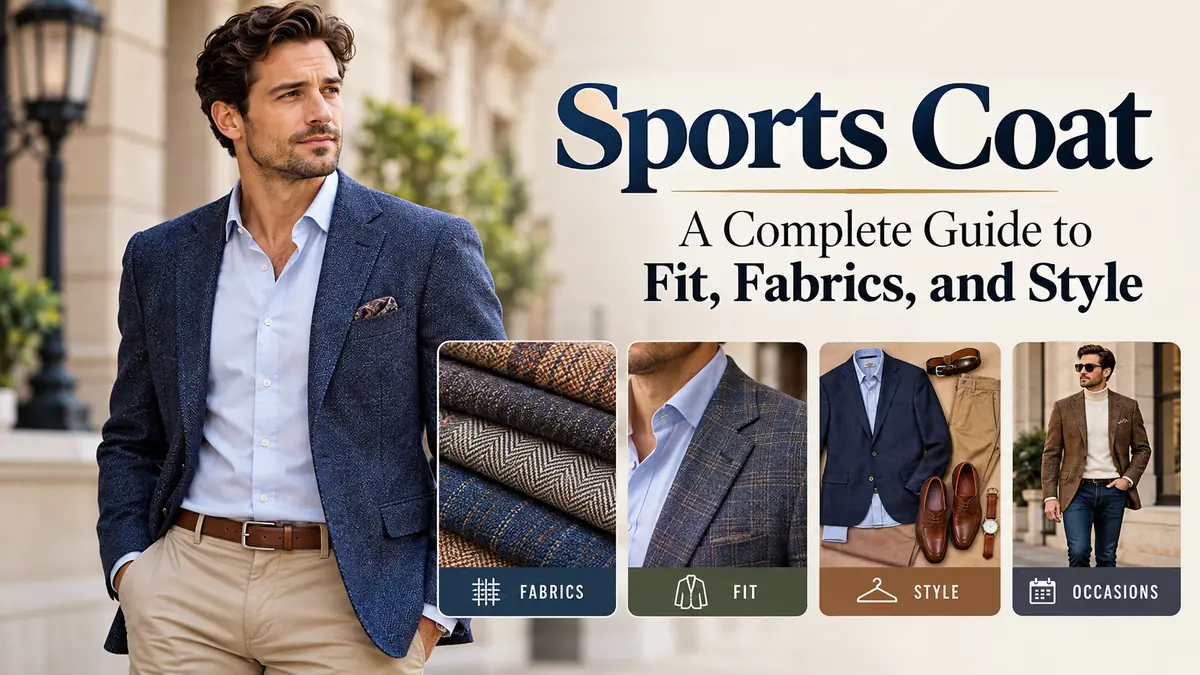
A sports coat is one of the easiest ways to make an outfit look sharper without wearing a full suit. It adds structure to casual clothes, works across a wide range of occasions, and can be paired with everything from wool trousers and chinos to dark jeans.
Unlike a suit jacket, a sports coat is specifically designed to be worn with non-matching trousers. It is generally more casual and often uses textured fabrics, visible weaves, checks, herringbone, or other patterns that help the jacket work independently rather than looking like half of a missing suit.
A good sports coat sits between everyday casual clothing and traditional tailoring. The key is choosing the right fabric, fit, trousers, shirt, and shoes so all the pieces look intentional.
What Is a Sports Coat?
A sports coat, also called a sport coat or sports jacket, is a tailored standalone jacket worn without matching trousers. Traditional versions were associated with outdoor sporting activities, while modern sports coats have become staples of smart-casual and business-casual wardrobes.
Sports coats usually have more visual texture than suit jackets. Common materials include:
- Tweed
- Hopsack
- Flannel
- Corduroy
- Linen
- Cotton
- Wool
- Wool blends
Checks, windowpane, herringbone, Donegal flecks, and other patterns are also common.
This variety is part of the appeal. A smooth charcoal suit jacket may look strange over casual jeans because it obviously belongs to a suit. A brown herringbone sports coat, by contrast, was designed to stand on its own.
Why Is It Called a Sports Coat?
The word “sports” can be confusing because modern sports coats have little to do with gym clothing or athletic jackets.
The name comes from the garment’s connection with traditional outdoor pursuits.
The history is closely associated with nineteenth-century British country clothing and jackets worn for activities such as hunting and shooting. One important predecessor was the Norfolk jacket, a loose-fitting jacket designed to provide freedom of movement. Historical examples incorporated features such as box pleats, belts, and large patch pockets.
The Norfolk jacket appeared during the nineteenth century and became associated with country leisure and sporting activities. Its precise origin remains disputed, with different accounts connecting it to the Duke of Norfolk, the Prince of Wales, or simply the English county of Norfolk.
Modern sports coats are considerably different, but their casual character, textured materials, and independence from matching trousers reflect that heritage.
Sports Coat vs Blazer vs Suit Jacket
These three garments share similar tailoring, so the terminology is often confusing. Modern retailers also use “blazer” and “sports coat” somewhat inconsistently.
The easiest distinction is to look at how the jacket was intended to be worn.
| Feature | Sports Coat | Blazer | Suit Jacket |
|---|---|---|---|
| Matching trousers | No | No | Yes |
| Formality | Casual to smart casual | Smart casual to dressy | Most formal |
| Typical appearance | Textured or patterned | Often solid | Usually smooth and refined |
| Common fabrics | Tweed, hopsack, flannel, linen | Wool, hopsack, blends | Fine worsted wool and suit fabrics |
| Common trousers | Jeans, chinos, wool trousers | Chinos, dress trousers | Matching suit trousers |
| Traditional details | Texture, patterns, patch pockets | Solid color, distinctive buttons | Refined construction and matching cloth |
The distinctions are useful guidelines rather than absolute rules because contemporary tailoring frequently mixes traditional features.
Sports Coat vs Suit Jacket
The most reliable difference is simple:
A suit jacket belongs to matching trousers. A sports coat does not.
Suit jackets generally use smoother, finer fabrics because the jacket and trousers are supposed to form one continuous outfit.
Sports coats have greater freedom.
They may use visible texture, contrasting threads, large checks, patch pockets, softer shoulders, and less structured construction. That makes them easier to combine with trousers made from a different material.
A suit jacket can occasionally work as a separate jacket, but not every suit jacket does. A very smooth business suit jacket worn with jeans can easily look like the wearer misplaced the matching trousers.
Sports Coat vs Blazer
The difference between a blazer and sports coat is less rigid.
Traditionally, a blazer is a standalone jacket that is usually solid-colored. Navy is the classic example, sometimes accompanied by contrasting or metal buttons.
A sports coat traditionally allows more texture, pattern, and color variation.
Modern fashion has blurred this distinction considerably, so a solid navy textured jacket may be marketed as either a blazer or sports coat.
For practical purposes, focus more on the fabric, construction, and formality of the actual jacket than the label attached to it.
How Should a Sports Coat Fit?
Fit matters more than almost any other feature.
An inexpensive jacket that fits well generally looks better than a costly jacket with poor proportions.
Shoulders
Start with the shoulders because they are difficult and expensive to alter.
The shoulder seam should generally end around the natural edge of your shoulder. The jacket should follow your body cleanly without obvious dents, pulling, or excessive overhang.
If the shoulders are significantly too wide or narrow, try another size or cut rather than relying on alterations.
Chest
Button the jacket and look at the front.
It should close comfortably without severe pulling around the button. Strong horizontal creases or an obvious X-shaped pull can indicate that the jacket is too tight.
At the same time, there should not be large amounts of loose fabric around the chest.
You need enough room to move comfortably and, depending on the season, wear a light sweater underneath.
Jacket Length
Traditional tailoring generally favors enough length to provide balanced coverage through the seat.
Modern casual jackets are sometimes cut shorter, but extremely short jackets can disrupt the proportions of an outfit and quickly look dated.
Your height, torso length, and jacket design all influence the ideal length.
Sleeve Length
The sleeve should normally allow a small amount of shirt cuff to remain visible.
There is no need to obsess over an exact fraction of an inch. What matters is visual balance and making sure the jacket sleeves do not completely swallow your hands or stop noticeably too high above your wrists.
Sleeve length is also one of the easier tailoring adjustments in many jackets, although working buttonholes can complicate alterations from the cuff.
Collar
The jacket collar should sit cleanly against your shirt collar.
A large gap between the shirt and jacket collar usually indicates a fit problem. Excess fabric bunching underneath the collar may also require tailoring.
Buttoning Point
Most contemporary single-breasted sports coats have two buttons.
When standing, button the top button and leave the bottom button undone. When sitting down, unbutton the jacket for comfort.
The buttoning point should look natural around the waist rather than dramatically high or low.
Sports Coat Fabrics Explained
Fabric dramatically changes how formal, seasonal, and versatile a sports coat feels.
A navy hopsack jacket and heavy brown tweed jacket may share the same basic construction, yet they serve very different wardrobes.
Wool
Wool remains one of the most useful materials for tailored jackets.
It breathes reasonably well, drapes effectively, resists wrinkles better than many natural alternatives, and can be woven into everything from lightweight open fabrics to substantial winter cloth.
The weave and weight matter as much as the fiber itself.
Hopsack
Hopsack uses a visible basket-like weave that gives the fabric texture.
That texture is valuable because it visually separates the garment from a smooth suit jacket. Navy hopsack is particularly versatile and can work with gray wool trousers, chinos, and other contrasting pants.
Depending on its weight and construction, hopsack can work across multiple seasons.
Tweed
Tweed represents the traditional country side of sports coats.
It is textured, durable, and generally better suited to cool weather. Brown, gray, olive, and earth tones are particularly common.
Different varieties can have very different appearances. Donegal tweed, for example, is known for distinctive colored flecks, while herringbone creates a recognizable V-shaped weaving pattern.
A substantial tweed sports coat looks natural with:
- Flannel trousers
- Corduroys
- Chinos
- Denim
- Oxford shirts
- Roll-neck or crewneck sweaters
- Leather boots
Flannel
Flannel has a soft surface and works especially well during cooler months.
A flannel sports coat can appear sophisticated without having the polished finish of a formal worsted suit.
Because flannel already carries visible softness and texture, it pairs naturally with other autumn and winter materials.
Linen
Linen is an excellent warm-weather option.
Its breathable character and naturally relaxed appearance make it appropriate for summer tailoring. Linen wrinkles easily, but those wrinkles are generally considered part of the fabric’s casual character rather than a flaw.
Try a linen sports coat with lightweight cotton trousers, chinos, or linen-blend pants.
Cotton
Cotton sports coats usually feel more casual than traditional wool tailoring.
They work particularly well for relaxed business-casual or smart-casual outfits. Cotton can also be a practical choice for transitional weather.
Corduroy
Corduroy has distinctive vertical ridges known as wales.
Its strong texture makes it unmistakably casual and particularly effective in autumn and winter wardrobes.
Brown, tan, olive, burgundy, and navy corduroy jackets can work beautifully with denim, chinos, or wool trousers.
Common Sports Coat Patterns
Patterns are one of the features that traditionally distinguish sports coats from conservative suit jackets.
Herringbone
Herringbone creates a broken zigzag or V-shaped pattern.
It is especially common in wool and tweed jackets and works well when you want visual interest without an aggressive pattern.
Windowpane
Windowpane consists of widely spaced horizontal and vertical lines that create large squares.
Because the pattern is noticeable, keep the shirt and trousers relatively simple.
Plaid and Checks
Checked sports coats range from subtle tonal designs to bold combinations of multiple colors.
A useful rule is to let the jacket remain the dominant pattern.
If your coat already contains several colors and large checks, solid trousers and a simple shirt make the outfit easier to balance.
Donegal
Donegal-style cloth is recognizable for its irregular flecks of contrasting color.
The effect creates texture from a distance and interesting detail up close, making it particularly suitable for casual cold-weather tailoring.
How to Wear a Sports Coat
The central principle is contrast.
Because a sports coat is an odd jacket, the trousers should look intentionally different rather than almost matching.
Sports Coat With Dress Trousers
This is one of the smartest combinations.
A navy textured sports coat with medium-gray wool trousers creates a classic outfit appropriate for many business-casual settings, dinners, and social occasions.
Try:
Navy sports coat + light blue shirt + gray trousers + brown leather shoes
The jacket and trousers are clearly different, but their formality levels are compatible.
Sports Coat With Chinos
Chinos make the outfit slightly more casual.
Useful combinations include:
- Navy jacket with stone chinos
- Brown jacket with navy chinos
- Gray jacket with khaki chinos
- Olive jacket with beige chinos
Avoid combinations where the jacket and trousers are so similar in color that they appear to be a mismatched suit.
Sports Coat With Jeans
Yes, you can wear a sports coat with jeans.
The trick is choosing a jacket casual enough to match denim.
Textured wool, tweed, hopsack, cotton, and unstructured jackets usually work better than smooth, heavily padded tailoring.
Dark, clean jeans are the easiest option.
A straightforward outfit is:
Textured navy sports coat + white Oxford shirt + dark indigo jeans + brown loafers or boots
Avoid heavily distressed jeans when you want the outfit to remain smart casual.
Sports Coat With a T-Shirt
A sports coat can work with a T-shirt when the jacket itself is relaxed.
Choose a clean, simple T-shirt with a good neckline and avoid pairing an ultra-casual shirt with a highly structured formal jacket.
An unstructured cotton or lightweight wool jacket is usually more convincing here.
Minimal leather sneakers or loafers can complete the outfit.
Sports Coat With a Polo
A polo shirt provides an excellent middle ground between a T-shirt and button-down shirt.
A fine-knit polo looks particularly refined because its texture complements tailoring without becoming overly formal.
This combination works well for warm-weather dinners, business-casual environments, and social occasions.
Sports Coat With a Sweater
During colder months, layer a crewneck, V-neck, cardigan, or roll-neck sweater beneath your jacket.
Fine merino wool is particularly useful because it provides warmth without creating excessive bulk.
Make sure the sports coat has enough room for layering. A jacket fitted perfectly over a thin shirt may become restrictive once a thick sweater is added.
What Shirt Should You Wear With a Sports Coat?
The occasion should determine the shirt.
For a polished appearance, wear a dress shirt.
For classic smart casual, an Oxford cloth button-down is difficult to beat.
For relaxed outfits, consider:
- Polo shirts
- Knit polos
- Chambray shirts
- Denim shirts
- Fine-gauge sweaters
- Plain T-shirts
Pattern coordination matters when your jacket is patterned.
If the sports coat already has a bold check, a solid shirt is usually safest. If both pieces contain patterns, change the scale—for example, a broad jacket check with a much smaller shirt pattern.
What Pants Go With a Sports Coat?
The best trousers create obvious but harmonious contrast.
Gray Wool Trousers
Gray trousers are among the most useful companions for navy, brown, olive, and patterned sports coats.
They create a refined appearance without turning the outfit into a suit.
Chinos
Chinos work particularly well with relaxed jackets.
Khaki, stone, cream, navy, and olive provide enough options to create contrast with most jacket colors.
Jeans
Choose dark or medium-wash denim for maximum versatility.
The more formal your jacket becomes, the cleaner your jeans should generally be.
Corduroy Trousers
Corduroy is useful in cold-weather outfits, especially with tweed and textured wool jackets.
Be careful when combining multiple heavily textured materials. They should complement each other rather than compete.
What Shoes Go With a Sports Coat?
Your footwear controls much of the outfit’s overall formality.
Loafers
Loafers are among the easiest options because they sit comfortably between formal and casual.
Penny loafers and tassel loafers work especially well.
Derby Shoes
Derbies are usually slightly more relaxed than highly formal Oxford shoes, making them natural companions for tailored separates.
Brogues
Decorative perforations give brogues a casual character that complements textured sports coats.
They work especially well with tweed, flannel, and country-inspired outfits.
Boots
Chukka and Chelsea boots can work well during cooler weather.
Brown suede chukkas with chinos and a textured sports coat create an especially balanced smart-casual combination.
Sneakers
Minimal sneakers can work with contemporary unstructured sports coats.
Keep the rest of the outfit relaxed. Pairing athletic running shoes with traditional structured tailoring usually creates too much stylistic contrast.
When Should You Wear a Sports Coat?
A sports coat is appropriate whenever you want to look more polished than ordinary casual clothing but a full suit would feel excessive.
Common situations include:
- Business-casual workplaces
- Dinner dates
- Restaurants
- Family celebrations
- Casual weddings when the dress code permits
- Holiday gatherings
- Social events
- Conferences
- Presentations in relaxed workplaces
- Smart-casual parties
- Weekend dinners
Dress codes still matter.
A sports coat should not automatically replace a suit at events specifically requesting formal business attire, cocktail attire, black tie, or another clearly defined formal dress code.
Can You Wear a Sports Coat to a Wedding?
Sometimes.
For a relaxed daytime or smart-casual wedding, a sports coat with tailored trousers can be entirely appropriate.
For a formal wedding, however, wear a suit if the dress code calls for one.
Never interpret “black tie” as an opportunity to wear a sports coat. Black tie traditionally requires a dinner jacket or tuxedo rather than an odd jacket.
When uncertain, it is generally safer to dress slightly more formally for a wedding.
Can You Wear a Sports Coat to Work?
In many workplaces, yes.
Sports coats are particularly useful in business-casual environments because they create structure without requiring a complete suit.
A conservative combination might be:
Navy sports coat + white or pale-blue shirt + gray trousers + brown leather shoes
For a more casual office:
Textured sports coat + Oxford shirt + chinos + loafers
Company culture remains the deciding factor. Traditional finance, legal, government, or executive settings may still require a suit for certain meetings.
How to Choose Your First Sports Coat
If you are buying your first sports coat, prioritize versatility over novelty.
1. Start With Navy
A textured navy sports coat is one of the easiest options to combine with an existing wardrobe.
It works with gray trousers, khaki chinos, cream pants, and denim.
Navy is also subdued enough for business casual while remaining relaxed enough for social occasions.
2. Choose Visible Texture
Texture helps make it clear that the jacket is a standalone garment.
Hopsack is particularly useful because its basket-like weave provides visual interest without requiring a bold pattern.
3. Keep the Pattern Subtle
Your first jacket does not need a dramatic windowpane.
Solid textured navy, subtle herringbone, or a muted check provides more combinations and is less likely to dominate every outfit.
4. Prioritize Fit
Do not choose a jacket simply because the label says your usual size.
Try different cuts.
A 40 Regular from one manufacturer can fit differently from a 40 Regular from another.
Pay particular attention to:
- Shoulders
- Chest
- Jacket length
- Collar
- Sleeve length
Small waist and sleeve adjustments are common tailoring jobs. Major shoulder corrections generally are not worth relying on.
5. Think About Your Climate
Someone living in a hot climate will get little use from heavy tweed.
Likewise, an extremely lightweight linen jacket will have limited usefulness during a cold winter.
Choose the fabric according to when you actually expect to wear the garment.
Structured vs Unstructured Sports Coats
Construction significantly changes a jacket’s appearance.
Structured Jackets
A structured jacket may use stronger shoulder padding, chest construction, and internal support.
The result is a sharper silhouette.
These jackets tend to work well when you want the sports coat to lean toward the dressier end of smart casual.
Unstructured Jackets
Unstructured jackets reduce internal padding and construction.
They feel softer and more relaxed and can resemble a cardigan in comfort while retaining the general shape and lapels of tailored clothing.
This style works especially well with chinos, denim, polos, and T-shirts.
Neither construction is universally better.
Choose according to your wardrobe and the occasions where you will wear the jacket.
Patch Pockets vs Flap Pockets
Pocket style also affects formality.
Patch Pockets
Patch pockets are sewn directly onto the outside of the jacket.
Their visible construction creates a relaxed appearance and is particularly appropriate for casual sports coats.
Flap Pockets
Flap pockets have a cleaner, slightly dressier appearance.
They are common on both suits and odd jackets.
Welted Chest Pocket
Most sports coats still feature a welted breast pocket where a pocket square can be worn.
A simple white or textured pocket square can add polish, but it is optional rather than necessary.
Single-Breasted vs Double-Breasted
Single-breasted sports coats are the most common and easiest to wear.
A two-button configuration is particularly versatile.
Double-breasted jackets create a stronger visual statement and generally feel dressier. Modern versions can still work as sports coats, particularly when made from textured cloth or relaxed construction.
For a first sports coat, a single-breasted two-button jacket is usually the most adaptable choice.
Best Sports Coat Colors
Navy
Navy offers perhaps the broadest versatility.
Pair it with:
- Gray
- Cream
- Khaki
- Brown
- Olive
- Denim
Brown
Brown works beautifully with blue shirts, denim, cream trousers, gray flannel, and other earth tones.
It is especially natural in textured autumn fabrics.
Gray
A gray sports coat can be useful, but trouser contrast requires more thought.
Avoid pairing a medium-gray jacket with nearly identical gray pants unless they are genuinely part of the same suit.
Olive
Olive provides an understated alternative to brown.
It pairs naturally with beige, cream, gray, navy, and denim.
Tan and Beige
Light neutrals are particularly effective during spring and summer.
A beige linen or lightweight wool sports coat can work with navy trousers, white or cream pants, and many shades of blue.
Seasonal Sports Coat Guide
Spring
Look for:
- Lightweight wool
- Hopsack
- Cotton
- Linen blends
Medium and lighter colors become easier to wear as temperatures rise.
Summer
Prioritize breathability.
Linen, open-weave wool, lightweight hopsack, and cotton-linen blends can reduce heat compared with dense winter fabrics.
Unlined or partially lined construction may also improve airflow.
Autumn
Autumn is ideal for sports coats because layered clothing and textured fabrics naturally suit the season.
Consider:
- Tweed
- Flannel
- Corduroy
- Herringbone
- Donegal-style wool
Brown, rust, olive, burgundy, and muted checks become especially useful.
Winter
Choose heavier wool, tweed, flannel, or substantial blends.
Layer with fine knitwear when necessary.
Remember that a sports coat is not always a substitute for outerwear. In genuinely cold conditions, you may still need an overcoat on top.
Common Sports Coat Mistakes
Wearing an Obvious Suit Jacket as a Sports Coat
This is perhaps the most common mistake.
A shiny, smooth, highly structured suit jacket rarely looks natural with casual trousers.
Use texture as your guide. Fabrics such as hopsack, tweed, flannel, corduroy, and linen usually separate more convincingly.
Matching the Trousers Too Closely
A sports coat outfit should use intentional contrast.
A navy jacket and slightly different navy trousers can look like an incorrectly matched suit.
Choose clearly different colors or textures instead.
Buying the Jacket Too Tight
A tailored jacket should follow your body without restricting it.
You should be able to move your arms naturally and button the jacket without severe pulling.
Remember to account for seasonal layering if you intend to wear sweaters underneath.
Ignoring Fabric Seasonality
Heavy tweed in hot summer weather is uncomfortable.
Light linen during a freezing winter looks equally disconnected from the environment.
The best sports coat is one suited to your actual climate.
Combining Too Many Patterns
A checked jacket, striped shirt, patterned tie, and patterned trousers can quickly become chaotic.
If one piece is visually dominant, allow the others to support it.
Overloading Accessories
A sports coat does not require a tie, lapel pin, pocket square, patterned socks, bracelet, watch, and statement shoes all at once.
A restrained outfit usually makes good tailoring more noticeable.
Do You Need a Tie With a Sports Coat?
No.
One reason sports coats are so versatile is that they work with or without neckwear.
For a dressier appearance, add a tie.
Knitted silk, wool, grenadine, or other textured ties often complement sports coats particularly well because they maintain the slightly relaxed character of the jacket.
For ordinary smart casual, an open-collar shirt is perfectly appropriate.
Can You Wear a Sports Coat Without a Dress Shirt?
Yes.
Contemporary sports coats can work with:
- Polo shirts
- Knit polos
- T-shirts
- Turtlenecks
- Crewneck sweaters
- Fine-gauge knitwear
The jacket’s construction should match the casualness of the layer underneath.
A soft unstructured sports coat over a knit polo looks coherent. A highly padded, formal-looking jacket over a graphic T-shirt is much harder to balance.
How Many Sports Coats Do You Need?
There is no universal number.
A small, practical collection might begin with one versatile navy jacket.
Once that role is covered, add jackets that solve different seasonal or stylistic needs rather than purchasing several nearly identical pieces.
For example:
- Navy hopsack for general year-round use
- Brown or gray tweed for autumn and winter
- Lightweight linen or open-weave wool for summer
Those three jackets can create dozens of outfits when combined with different trousers and shirts.
Someone who rarely wears tailoring may need only one.
How to Care for a Sports Coat
Good care extends the life of tailored clothing.
Hang It Properly
Use a broad jacket hanger that supports the shoulders.
Thin wire hangers can distort the jacket’s shape over time.
Brush Wool Jackets
A clothing brush can remove surface dust and debris from wool fabrics.
This reduces the need for frequent dry cleaning.
Let It Rest
Avoid wearing the same wool jacket every day when possible.
Giving wool time to rest allows wrinkles and moisture to dissipate naturally.
Steam Minor Wrinkles
Light steaming can help relax wrinkles.
Avoid pressing textured fabrics aggressively because excessive heat and pressure can flatten their surface.
Dry Clean Sparingly
Dry cleaning is useful when necessary, but frequent chemical cleaning can be hard on natural fibers and jacket construction.
For small surface marks, spot treatment by an appropriate professional may be sufficient.
Always follow the manufacturer’s care instructions.
Is a Sports Coat Worth Owning?
For anyone who regularly encounters smart-casual or business-casual situations, a sports coat can be one of the most useful pieces of tailoring available.
It provides much of the visual benefit of a suit jacket without requiring matching trousers.
That flexibility is precisely why the garment has survived its transition from nineteenth-century country sportswear to modern everyday tailoring. Its predecessors were practical garments associated with outdoor pursuits; today’s versions are adaptable jackets worn in offices, restaurants, weddings, dinners, and casual social settings.
The best first choice is usually simple: find a well-fitting jacket in a versatile color, choose enough texture that it clearly looks like a standalone piece, and make sure its fabric suits your climate.
A navy hopsack sports coat with gray trousers can look polished. The same jacket with chinos becomes relaxed business casual. Pair it with dark denim and loafers, and it becomes a weekend outfit.
That range is the real strength of the sports coat. Rather than replacing a suit or casual jacket, it fills the large space between them—giving you an easy way to look put together without looking overdressed.
