
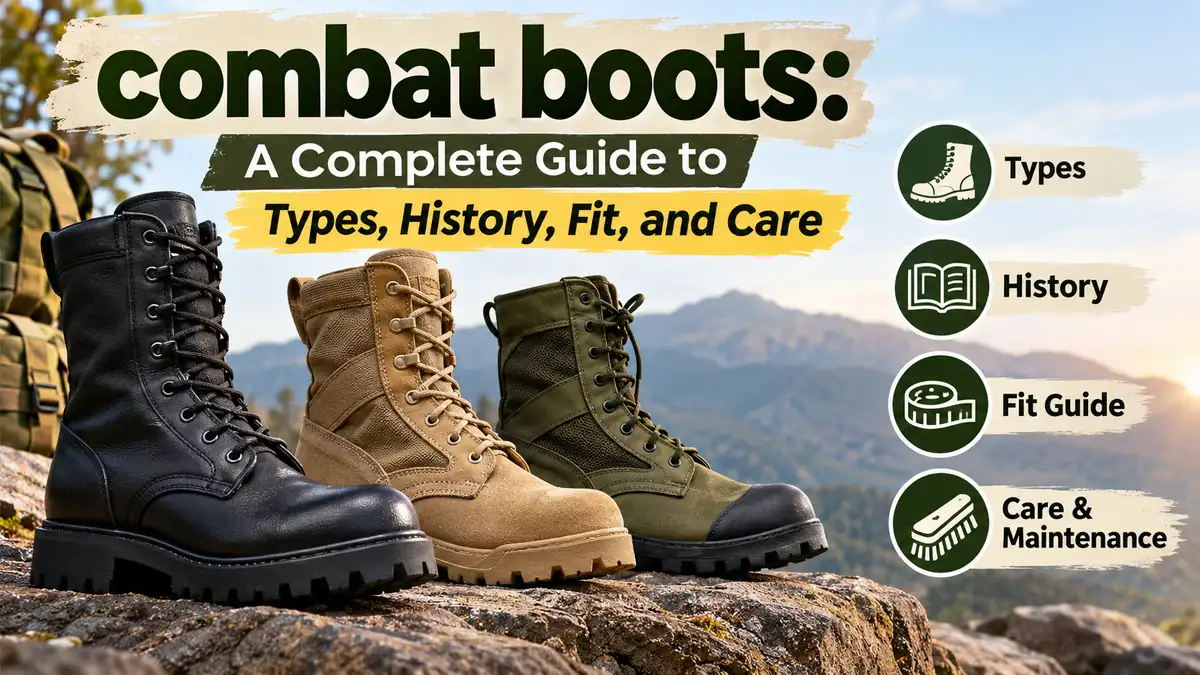
Combat boots have evolved from specialized military footwear into a recognizable part of everyday fashion. Their rugged construction, ankle support, and distinctive appearance make them useful in demanding environments while giving them a lasting place in streetwear and alternative style.
Yet not every boot with a military-inspired appearance is designed for actual military use. Understanding the differences in materials, construction, comfort, and intended purpose helps explain what makes these boots unique.
Combat boots are durable, usually ankle-high or taller boots originally developed for military personnel. They typically feature protective uppers, secure lacing, supportive soles, and construction intended for demanding conditions. Modern versions range from military-issued footwear and tactical boots to fashion designs that borrow the appearance without offering the same performance.
What Are combat boots?
Combat boots are a category of footwear traditionally designed to protect and support the feet of soldiers during training, marching, field operations, and other military activities.
Unlike ordinary casual shoes, traditional military boots prioritize durability, traction, foot protection, and stability across uneven ground.
Their most recognizable characteristics include:
- High-cut construction: Covers the ankle and part of the lower leg.
- Lace-up closure: Allows adjustment around the foot and ankle.
- Durable uppers: Often made from leather, nylon, suede, or synthetic materials.
- Protective outsoles: Provide traction on various surfaces.
- Reinforced construction: Helps withstand repeated wear and abrasion.
- Functional design: Balances protection, support, weight, and mobility.
The term also describes fashion footwear inspired by military designs. These versions may emphasize appearance over field performance.
Combat Boots vs. Tactical Boots
Although the terms are often used interchangeably, there are practical distinctions.
Combat boots are traditionally associated with military field use. Tactical boots are a broader category frequently marketed toward law enforcement, security professionals, emergency responders, and other users who need supportive footwear.
| Feature | Combat Boots | Tactical Boots |
|---|---|---|
| Traditional purpose | Military field operations | Tactical and occupational activities |
| Typical construction | Leather, textile, or mixed materials | Often lightweight mixed materials |
| Ankle coverage | Usually medium to high | Low, medium, or high |
| Weight | Varies by design | Frequently designed for mobility |
| Common colors | Black, brown, coyote, camouflage-compatible tones | Black, tan, coyote, and other colors |
| Primary emphasis | Field durability and protection | Mobility, comfort, and task-specific performance |
These categories overlap considerably. A modern military boot may also be described as tactical footwear.
The History and Evolution of Combat Boots
Military footwear has changed substantially as armies have adapted to new environments, technologies, and operational requirements.
Early Military Footwear
Before modern combat boots became standardized, soldiers often wore leather shoes, ankle boots, or taller boots depending on their military organization and period.
During the nineteenth century, leather military footwear became increasingly standardized in many armies.
Durability and repairability were important because soldiers frequently traveled long distances on foot.
World War I and Trench Warfare
World War I exposed soldiers to mud, standing water, cold temperatures, and prolonged periods in trenches.
Footwear needed to provide protection while allowing soldiers to move through difficult terrain.
Prolonged exposure to wet and cold conditions could contribute to trench foot, a serious non-freezing cold injury.
Military organizations responded through improved footwear practices, foot hygiene, sock management, and changes to equipment.
World War II Military Boots
During World War II, military footwear continued evolving.
The United States military used different boot configurations, including service shoes worn with leggings and later combat-service boots with integrated ankle cuffs.
Paratroopers also became associated with tall lace-up jump boots designed for airborne military use.
These designs influenced the appearance of later military and civilian footwear.
Vietnam War and Jungle Boots
Tropical environments created different challenges from those encountered in European combat zones.
Jungle boots were developed for hot, wet environments where conventional leather footwear could retain moisture and dry slowly.
Many jungle boot designs combined leather with breathable textile panels and drainage features.
The goal was not necessarily to keep all water out, but to help footwear release water and dry more effectively.
Modern Military Footwear
Contemporary military footwear incorporates advances in synthetic textiles, cushioning, outsole compounds, and manufacturing methods.
Modern designs may include:
- Breathable nylon panels
- Full-grain or rough-out leather
- Shock-absorbing midsoles
- Slip-resistant rubber compounds
- Moisture-management linings
- Specialized traction patterns
- Lightweight composite components
Military specifications differ between countries, branches, and operational environments.
For example, the United States Army’s footwear requirements are not identical to those of every other military organization.
Different Types of Combat Boots
Not all military-style boots serve the same purpose. Design differences often reflect climate, terrain, activity, and the level of protection required.
1. Standard Military Combat Boots
Freestyle Recce Combat Boots – Varusteleka
Traditional military combat boots are built for general field use.
They commonly have leather or mixed-material uppers, sturdy soles, and secure lacing systems.
Their construction aims to balance protection with the ability to walk and work for extended periods.
2. Jungle Boots
Jungle boots are designed for humid, wet, and tropical environments.
They often feature breathable textile panels and drainage openings to help moisture escape.
Because many jungle boots are not waterproof, their performance depends partly on ventilation, sock selection, and drying practices.
3. Desert Combat Boots
Desert boots are intended for dry, sandy, and often hot conditions.
Common characteristics include lighter-colored uppers, suede or rough-out leather, breathable textile sections, and outsoles suited to dry terrain.
Their construction can help reduce heat buildup compared with some heavy, fully lined boots.
However, breathability varies significantly between models.
4. Waterproof Combat Boots
Waterproof designs incorporate protective membranes, treated materials, or other barriers intended to reduce water penetration.
Some use technologies such as GORE-TEX membranes.
Waterproof boots can be useful in rain, wet grass, and muddy environments.
However, waterproof membranes may reduce ventilation, and water entering over the boot collar can remain trapped inside.
5. Lightweight Tactical Boots
Lightweight boots often use synthetic fabrics, reduced-weight midsoles, and flexible construction.
They may be preferred for activities requiring frequent movement, especially on relatively predictable surfaces.
A lighter boot is not automatically more supportive or more durable.
Performance depends on the complete design.
6. Jump Boots
Jump boots have a strong historical association with airborne military units.
Traditional examples feature tall shafts, extensive lacing, and polished leather uppers.
Today, some are worn for ceremonial purposes, while others are sold as military-inspired fashion footwear.
7. Fashion Combat Boots
Fashion combat boots borrow recognizable military design elements, including tall uppers, prominent laces, eyelets, and thick soles.
They may include platform soles, decorative buckles, side zippers, or exaggerated silhouettes.
These features can create a distinctive appearance without necessarily providing the durability or protection expected from military field footwear.
Materials Used in Combat Boots
Material selection strongly influences comfort, durability, weather resistance, and maintenance requirements.
Full-Grain Leather
Full-grain leather retains the outer grain layer of the hide.
It is commonly valued for abrasion resistance, structural durability, and its ability to develop a worn appearance over time.
However, leather may require conditioning and can take longer to dry than some synthetic materials.
Rough-Out Leather and Suede
Rough-out leather exposes the flesh side of the hide, producing a textured exterior.
It is commonly used in military-style footwear because the surface can conceal some scuffs and abrasions.
Suede and rough-out leather are not identical in every manufacturing context, although they share a textured appearance.
Cleaning methods should follow the manufacturer’s guidance.
Nylon and Synthetic Textiles
Nylon and other synthetic fabrics can reduce weight and improve flexibility.
They are frequently combined with leather in modern tactical and military footwear.
Their abrasion resistance, breathability, and drying speed depend on the specific fabric and construction.
Rubber Outsoles
Rubber is widely used for boot outsoles because it can provide traction and resist wear.
Important design factors include:
- Lug depth and pattern
- Rubber compound
- Flexibility
- Contact area
- Resistance to abrasion
- Performance on wet or oily surfaces
A deep lug pattern can help on loose ground but does not guarantee superior traction on smooth wet floors.
Common Material Comparisons
| Material | Main advantage | Main limitation |
|---|---|---|
| Full-grain leather | Durable and supportive | Can be heavier and slower to dry |
| Rough-out leather | Abrasion-tolerant exterior | Requires suitable cleaning methods |
| Nylon | Lightweight and flexible | Performance varies by fabric |
| Waterproof membrane | Helps prevent external water penetration | May reduce breathability |
| Rubber outsole | Traction and wear resistance | Grip depends on compound and tread |
| EVA midsole | Lightweight cushioning | May compress with prolonged use |
| Polyurethane midsole | Supportive cushioning options | Some formulations deteriorate with age |
How Should Combat Boots Fit?
Proper fit is one of the most important factors affecting comfort.
A well-designed boot can still cause discomfort, blisters, or pressure injuries if its shape does not match the wearer’s feet.
Toe Room
The toes should have enough space to move without being compressed.
When standing, there should generally be some clearance beyond the longest toe, but the correct amount depends on the boot’s shape and intended use.
The toes should not repeatedly strike the front of the boot while walking downhill.
Heel Fit
A small amount of initial heel movement can occur in some new leather boots.
However, excessive heel lifting increases friction and can contribute to blisters.
The heel should feel reasonably secure without painful pressure.
Width and Instep
Footwear should accommodate the natural width of the forefoot.
Tightness across the ball of the foot, numbness, or tingling can indicate an unsuitable fit.
The instep should feel supported without excessive pressure from the laces.
Ankle Support
A high boot shaft does not automatically guarantee strong ankle support.
Support depends on shaft stiffness, lacing, heel stability, sole construction, and overall fit.
The boot should allow necessary movement without feeling unstable.
How to Check the Fit
- Wear the socks you intend to use regularly.
- Try the boots later in the day, when feet may be slightly larger.
- Lace them securely without excessive tightness.
- Walk on level ground and, where possible, an incline.
- Check for heel slipping, toe impact, and pressure points.
- Bend and squat to assess flexibility and ankle comfort.
- Recheck the fit after several minutes of movement.
Do not assume a painful boot will eventually become comfortable through breaking in.
Leather may soften, but a boot that is fundamentally too short or narrow is unlikely to become suitable.
How to Break In Combat Boots Safely
New boots can feel stiffer than ordinary sneakers, particularly when they contain substantial leather panels or firm midsoles.
Breaking them in gradually allows the upper materials to flex and helps the wearer identify pressure points before attempting extended walks.
A Practical Break-In Routine
- Start indoors: Wear the boots for 20–30 minutes while walking around the house.
- Increase wearing time: Progress to short outdoor walks if there is no pain or significant rubbing.
- Use suitable socks: Moisture-wicking socks can help manage perspiration and friction.
- Adjust the lacing: Experiment with tension across the instep and ankle.
- Check your feet: Look for redness, hotspots, or early signs of blistering.
- Increase distance gradually: Avoid starting with long hikes or demanding activities.
There is no universal break-in period. Some modern lightweight boots feel comfortable almost immediately, while stiffer leather constructions may take considerably longer.
Avoid soaking boots in water, heating them aggressively, or using methods that could damage adhesives and leather.
Are Combat Boots Comfortable for Everyday Wear?
Combat boots can be comfortable for everyday activities when their shape, weight, flexibility, and cushioning match the wearer’s needs.
However, their appearance alone provides little information about comfort.
Cushioning and Shock Absorption
Many modern boots contain EVA foam, polyurethane, or other cushioning materials in their midsoles.
These components help manage impact during walking.
A thick sole does not necessarily provide better cushioning. Material properties and construction matter more than appearance.
Arch Support
Footwear should provide a stable platform that accommodates the wearer’s foot shape.
Some boots include removable footbeds, allowing users to replace them with compatible insoles.
People who require specialized orthotic support should check that the boot has sufficient internal volume and an appropriate fit.
Breathability
Footwear that traps heat and moisture can become uncomfortable during extended wear.
Leather, textile panels, linings, waterproof membranes, and socks all influence moisture management.
For warm climates, breathable construction may be more useful than heavy insulation.
Weight and Flexibility
Heavy boots can increase the effort required during prolonged walking.
Extremely flexible boots, meanwhile, may not provide the stability needed for certain terrain or activities.
The ideal balance depends on the intended use.
Can You Wear Combat Boots All Day?
Yes, many people wear them throughout the day without problems.
Comfort depends on correct sizing, suitable socks, activity level, and individual foot characteristics.
Persistent pain, numbness, or blisters should not be treated as a normal part of wearing boots.
Combat Boots vs. Other Types of Boots
Combat boots share several characteristics with hiking, work, and fashion boots, but these categories have different design priorities.
| Boot type | Primary purpose | Typical characteristics |
|---|---|---|
| Combat boots | Military field use | Durable upper, ankle coverage, field-oriented sole |
| Hiking boots | Outdoor walking | Terrain-specific traction, cushioning, foot protection |
| Work boots | Occupational tasks | May include certified protective toes and slip-resistant soles |
| Tactical boots | Operational mobility | Often lightweight, supportive, task-specific |
| Chelsea boots | Everyday or dress wear | Elastic side panels, slip-on construction |
| Motorcycle boots | Riding protection | May include impact, abrasion, and torsional protection |
Are Combat Boots Good for Hiking?
Some combat boots perform well on hiking trails, particularly when they provide suitable traction, comfort, and protection.
However, a military boot is not automatically superior to purpose-built hiking footwear.
Hiking boots may offer features such as trail-specific outsole patterns, more flexible midsoles, and construction optimized for long-distance walking.
For extended hikes, the actual fit and terrain suitability are more important than the footwear category.
Are Combat Boots Suitable for Snow?
Certain insulated and waterproof military boots are designed for cold environments.
Standard hot-weather or desert combat boots generally lack the insulation needed for prolonged exposure to freezing temperatures.
On ice, ordinary rubber soles may provide inadequate grip.
Appropriate winter footwear and compatible traction devices may be necessary.
Are Combat Boots Safety Boots?
Not necessarily.
Although some military boots include reinforced toes or protective features, standard combat boots should not automatically be considered safety footwear.
Workplace protective footwear may need to meet standards such as ASTM F2413 in the United States or EN ISO 20345 in relevant European markets.
A military-style appearance does not establish compliance with these standards.
Military Combat Boot Standards and Regulations
Military organizations establish footwear requirements to maintain uniformity and ensure appropriate performance.
The United States Army provides a useful example of how detailed these requirements can be.
Understanding AR 670-1
AR 670-1 and associated Army guidance address uniform appearance and authorized footwear.
Requirements can include boot color, height, materials, sole design, and other construction details.
The U.S. Army’s combat uniform guidance identifies tan or coyote-colored leather boots, while more detailed requirements appear in the applicable uniform regulations and pamphlets. The United States Army+1
A boot marketed as military-inspired is not necessarily authorized for uniform wear.
Official Combat Boot Specifications
The U.S. Army’s temperate-weather combat boot demonstrates the technical requirements of military footwear.
Its documented construction includes:
- Coyote-colored rough-side-out leather
- Nylon duck upper material
- Waterproof breathable membrane
- Shock-absorbing sole construction
- Abrasion-resistant and slip-resistant rubber outsole
- Combination eyelet and speed-lacing system
The design also incorporates specific environmental protection features. Army Combat Boot (Temperate Weather)
The U.S. Defense Logistics Agency maintains the MIL-DTL-32237 specification for hot-weather Army combat boots. Its active specification covers footwear for wet and dry hot-weather environments, with a validation dated April 22, 2026. QuickSearch
Why Climate-Specific Requirements Matter
Footwear appropriate for one environment may be unsuitable for another.
For example, U.S. Army jungle operations guidance issued in 2026 recommends aggressive tread and drainage holes for relevant training conditions. Army API
This illustrates why waterproofing is not always the best solution. In consistently wet tropical conditions, drainage and drying ability may be especially valuable.
Personnel subject to military uniform rules should consult their current service regulations and unit guidance rather than relying solely on commercial product descriptions.
How to Style Combat Boots
Beyond their original military function, combat boots have become a recognizable feature of punk, grunge, gothic, streetwear, and contemporary casual fashion.
Their visual appeal comes from the contrast between a structured, rugged boot and different clothing silhouettes.
Combat Boots With Jeans
How to DIY Your Way to This Season’s Coolest Denim Trend | GQ
Straight-leg and slim jeans work particularly well with traditional lace-up designs.
Cuffed jeans can reveal the boot shaft, while wider trousers create a more relaxed silhouette.
Black leather boots paired with dark denim produce a simple, understated appearance.
Combat Boots With Cargo Pants
Cargo trousers complement the utilitarian design of military-inspired boots.
Olive, khaki, black, and brown are common combinations.
Trousers can fall naturally over the boot shaft or be tucked into the boots, depending on the desired appearance.
Combat Boots With Dresses and Skirts
Chunky black boots can contrast with flowing dresses or skirts.
This pairing became especially recognizable through alternative fashion movements and remains common in contemporary styling.
The contrast works because the footwear adds visual weight to otherwise softer clothing.
Combat Boots in Punk and Grunge Fashion
Combat-style footwear has long been associated with alternative music and youth subcultures.
Brands such as Dr. Martens became strongly connected with punk and alternative fashion, although not every boot made by the company is intended for military use.
The boots’ association with rebellion and self-expression helped them transition from functional footwear into cultural symbols.
How to Clean Combat Boots
Regular cleaning helps prevent dirt, moisture, and accumulated debris from damaging boot materials.
The correct method depends on whether the footwear contains smooth leather, rough-out leather, suede, textile panels, or waterproof membranes.
Cleaning Smooth Leather Boots
- Remove loose dirt using a soft brush.
- Wipe the exterior with a slightly damp cloth.
- Apply a suitable leather cleaner when necessary.
- Allow the boots to dry naturally.
- Use an appropriate conditioner if recommended by the manufacturer.
- Clean the outsole and remove stones trapped in the tread.
Avoid saturating leather or placing boots next to direct heat sources.
Excessive heat can dry out leather and damage adhesives.
Cleaning Suede and Rough-Out Leather
Suede and rough-out leather generally require gentler treatment.
Use a suitable suede brush to remove dry dirt.
For stubborn marks, a cleaning product formulated for the specific material may be appropriate.
Traditional leather polish can alter the texture and appearance of rough-out leather, so it should not be applied unless specifically recommended.
Cleaning Nylon and Fabric Panels
Use a soft brush and mild cleaning solution where permitted by the manufacturer’s instructions.
Avoid harsh detergents, bleach, and aggressive scrubbing.
Rinse or wipe away cleaning residue and allow the material to air-dry.
Drying Wet Combat Boots
Wet footwear should be dried carefully to prevent damage and unpleasant odors.
Remove the insoles and loosen the laces to improve airflow.
Stuffing boots loosely with absorbent paper can help remove moisture, provided the paper is replaced when damp.
A fan or well-ventilated room is usually preferable to direct heat.
Do not place boots directly against heaters or use high-temperature drying methods unless the manufacturer explicitly permits them.
How to Maintain Combat Boots for Longer Life
Cleaning is only one part of proper maintenance.
Regular inspection helps identify problems before they become serious.
Inspect the Outsoles
Check the tread for excessive wear, separation, or uneven abrasion.
Worn tread may reduce traction, especially on loose or wet surfaces.
Check the Stitching
Examine the seams around the upper, heel, and toe.
Loose or broken stitching can allow moisture and debris to enter and may eventually affect the boot’s structural integrity.
Replace Damaged Laces
Frayed laces can break unexpectedly and prevent secure fastening.
Replacement laces should have an appropriate length and diameter for the boot’s eyelets.
Maintain the Insoles
Removable insoles should be aired regularly.
Replace them when cushioning deteriorates or the material becomes damaged.
Store Boots Properly
Keep boots in a dry, ventilated location away from prolonged direct sunlight and excessive heat.
Avoid leaving wet boots sealed inside plastic bags.
If footwear will remain unused for extended periods, inspect it periodically for material deterioration.
Common Combat Boot Problems and Solutions
Even durable boots can develop problems through repeated use or unsuitable maintenance.
| Problem | Possible cause | Practical response |
|---|---|---|
| Heel blisters | Excessive movement or friction | Recheck sizing, socks, and lacing |
| Toe pain | Insufficient toe room | Assess length and toe-box shape |
| Foot overheating | Limited ventilation | Use suitable socks and climate-appropriate footwear |
| Unpleasant odor | Trapped moisture | Dry boots and insoles thoroughly |
| Sole separation | Adhesive deterioration or damage | Seek professional repair or replacement |
| Cracked leather | Dryness, age, or improper care | Use appropriate care products and assess damage |
| Poor traction | Worn tread or unsuitable sole | Use footwear suited to the surface |
| Ankle discomfort | Poor fit or restrictive construction | Adjust lacing and reassess boot suitability |
Why Do Combat Boots Cause Blisters?
Blisters commonly result from repeated friction and pressure.
Poor sizing, excessive heel movement, damp socks, and sudden increases in walking distance can all contribute.
Proper fit and gradual adaptation are generally more effective than simply tolerating repeated rubbing.
Why Do Combat Boots Squeak?
Squeaking can occur because of moisture, friction between components, or movement in the outsole or insole.
Removing and drying the insoles may help if moisture is responsible.
Persistent squeaking accompanied by visible sole separation should be inspected because it may indicate structural damage.
Can Combat Boots Be Resoled?
Some boots can be resoled, particularly those with repair-friendly construction.
Others use directly attached or molded soles that may be difficult or uneconomical to replace.
Repairability depends on the specific design, materials, and availability of qualified repair services.
How Long Do Combat Boots Last?
There is no universal lifespan for combat boots.
Their durability depends on construction quality, frequency of use, walking surfaces, environmental exposure, and maintenance.
A boot worn occasionally for casual activities may last considerably longer than one used daily for demanding fieldwork.
Factors that influence lifespan include:
- Upper material quality
- Outsole abrasion resistance
- Stitching and bonding methods
- Exposure to water, mud, and heat
- Frequency of cleaning and drying
- Walking distance and carried loads
- Storage conditions
Rather than relying on a fixed number of months or years, inspect boots for signs that their protective or supportive functions have deteriorated.
A worn outsole, damaged upper, unstable heel, or failing sole attachment can indicate that repair or replacement is necessary.
Environmental Considerations and Boot Durability
Footwear production uses leather, rubber, synthetic materials, adhesives, energy, and other resources.
Environmental impacts vary depending on sourcing, manufacturing processes, product lifespan, and disposal methods.
Long-lasting footwear can reduce the frequency of replacement, but durability alone does not establish that a particular product is environmentally preferable.
Repairable construction may help extend useful life.
Proper cleaning and storage can also reduce premature deterioration.
Some manufacturers use recycled textiles or alternative materials, although environmental claims should be evaluated against specific evidence rather than broad marketing language.
How to Identify Quality Combat Boots
A boot’s appearance does not reliably indicate its durability or performance.
A more useful evaluation considers how the materials and construction work together.
Examine the Upper
Look for consistent stitching, securely attached panels, and materials appropriate for the intended environment.
Thick leather may provide abrasion resistance but can also increase weight.
Assess the Sole
Consider the tread pattern, flexibility, cushioning, and connection between the outsole and upper.
The most aggressive-looking tread is not necessarily the most suitable for everyday walking.
Check the Lacing System
Eyelets, speed hooks, and other fastening components should feel secure.
A good lacing system allows adjustment without creating uncomfortable pressure points.
Consider the Interior
Check for rough seams, poorly positioned padding, and areas likely to rub against the foot.
Removable insoles can make drying and maintenance easier.
Match the Boot to Its Intended Purpose
A fashion boot may be perfectly suitable for casual use while lacking the technical features needed for demanding military or outdoor activities.
Likewise, a heavy-duty field boot may be unnecessarily stiff or warm for ordinary urban wear.
The most useful measure of quality is whether the boot performs its intended function comfortably, safely, and consistently.
Final Thoughts on combat boots
Combat boots have a long history shaped by military needs, changing environments, and improvements in footwear technology. Today, the term covers everything from specialized field boots to casual fashion designs inspired by traditional military footwear.
Their defining characteristics include durable construction, secure lacing, ankle coverage, and a rugged appearance. Yet differences in materials, sole design, waterproofing, breathability, and fit can significantly affect how they perform.
Understanding these distinctions makes it easier to recognize suitable footwear for everyday wear, outdoor activities, or demanding occupational environments. Above all, proper fit, appropriate construction, and regular maintenance matter more than appearance alone.