
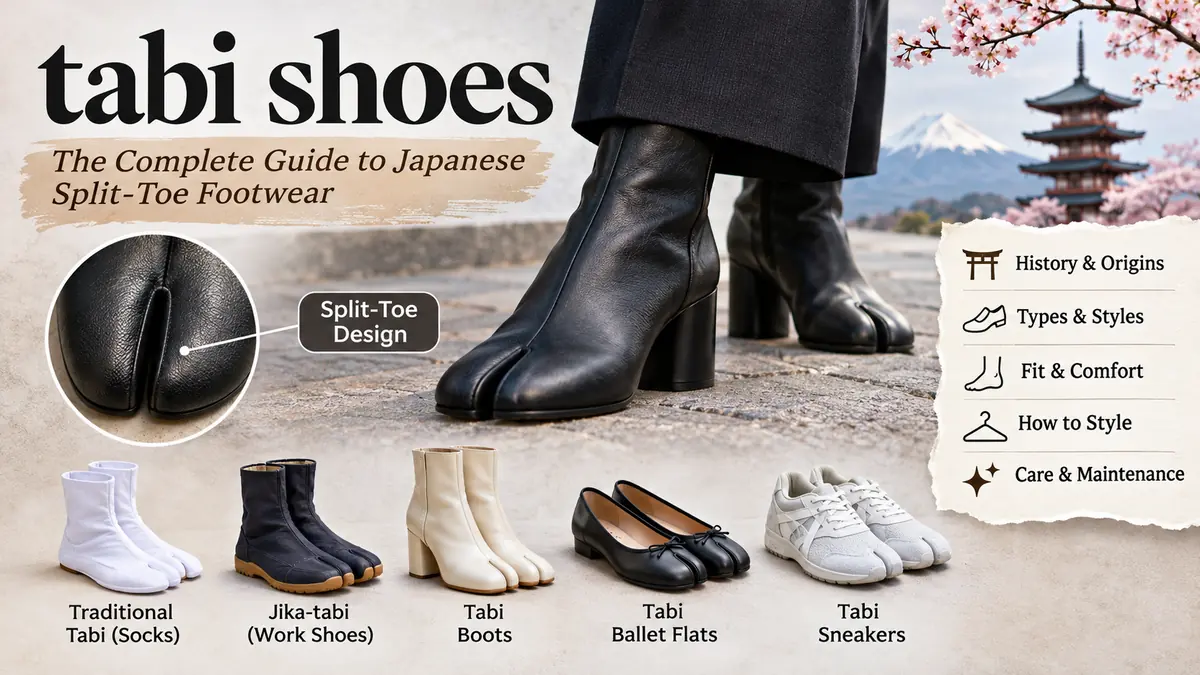
Few footwear designs are as instantly recognizable as tabi shoes. Their distinctive split-toe shape challenges the familiar rounded silhouette of conventional shoes, connecting centuries of Japanese clothing traditions with contemporary fashion.
Originally associated with traditional Japanese socks and work footwear, the tabi design has evolved into an international fashion statement. Today, it appears in everything from traditional festival footwear to designer boots, ballet flats, sneakers, and minimalist shoes.
tabi shoes are footwear characterized by a separate compartment for the big toe and another for the remaining four toes. The design originated in Japanese tabi socks and later influenced outdoor footwear called jika-tabi. Modern versions combine this traditional construction with contemporary materials, silhouettes, and fashion aesthetics.
Understanding their history, construction, benefits, and limitations makes it easier to appreciate why this unusual footwear has remained relevant across generations.
What Are tabi shoes?
Tabi shoes are a category of split-toe footwear inspired by traditional Japanese tabi socks. Unlike conventional shoes, which enclose all five toes in one toe box, tabi footwear separates the big toe from the other four.
This creates a recognizable cleft at the front of the shoe.
The split-toe construction is more than a decorative feature. Historically, it allowed traditional Japanese footwear to be worn with sandals that have a thong between the first and second toes.
Modern designers have adapted the same principle into fashion footwear, athletic-inspired shoes, and everyday styles.
The defining features of tabi footwear
Although individual designs vary, several characteristics distinguish tabi footwear:
- Split-toe construction: A separate space for the big toe.
- Japanese design heritage: A connection to traditional tabi socks and jika-tabi.
- Distinctive silhouette: A toe shape that differs from conventional footwear.
- Varied materials: Cotton, canvas, rubber, leather, suede, and synthetic fabrics.
- Multiple styles: Boots, flats, sneakers, sandals, and work shoes.
The appearance can range from understated and practical to sculptural and experimental.
Are tabi shoes the same as traditional tabi socks?
No. Traditional tabi are socks, usually made with a separate big-toe compartment. They are commonly worn with kimono and traditional sandals such as zori or geta.
Shoes inspired by tabi construction have an outer sole and are designed to function as footwear rather than socks alone.
Jika-tabi, meanwhile, are a particular type of outdoor footwear with flexible rubber soles.
These distinctions matter because the word tabi is sometimes used broadly for several related products that have different purposes.
The History of tabi shoes in Japan
The story of tabi footwear begins long before contemporary fashion designers adopted its distinctive shape.
Tabi developed alongside traditional Japanese clothing and footwear practices. Over time, their design changed as materials, manufacturing methods, and everyday activities evolved.
Traditional tabi socks and Japanese clothing
Tabi socks became an established part of Japanese dress, particularly during the Edo period (1603–1868).
They were traditionally worn with sandals and were made in different fabrics and colors depending on their intended use.
White tabi became especially associated with formal clothing, ceremonies, traditional performing arts, and certain martial arts.
They are still worn with kimono in settings such as weddings, tea ceremonies, and cultural performances.
Traditional tabi commonly feature a fastening system along the back or side using small metal hooks known as kohaze.
These fasteners allow the fabric to fit closely around the ankle.
The development of jika-tabi
From indoor socks to outdoor work footwear
A major development occurred in the early twentieth century with the introduction of rubber-soled jika-tabi.
The term jika-tabi is commonly understood as tabi footwear intended for direct contact with the ground, rather than being worn only inside sandals.
In 1922, Tokujiro Ishibashi, associated with the Japanese footwear company later known as MoonStar, developed a rubber-soled jika-tabi design.
These shoes became useful for workers who needed flexible footwear suitable for active movement.
Construction workers, agricultural workers, gardeners, and festival participants are among the groups associated with jika-tabi.
Their rubber soles provided protection and traction while retaining the characteristic separated big toe.
How tabi footwear entered international fashion
The transition from traditional Japanese footwear to luxury fashion became especially visible through Belgian designer Martin Margiela.
His fashion house introduced its now-famous Tabi boot in its debut collection in 1988.
The design transformed the Japanese split-toe concept into a high-fashion silhouette, often featuring a heel and ankle-length leather upper.
The Maison Margiela Tabi became one of the label’s most recognizable designs.
Its influence helped establish split-toe footwear as a recurring feature of avant-garde fashion rather than simply a historical or occupational design.
Different Types of tabi shoes
The term covers several footwear categories, and the differences extend beyond appearance.
| Type | Main characteristics | Typical use |
|---|---|---|
| Traditional tabi | Soft fabric, split toe, often ankle fastening | Traditional Japanese clothing |
| Jika-tabi | Flexible rubber sole, split-toe upper | Work, gardening, festivals |
| Tabi boots | Structured upper, split toe, flat or heeled sole | Contemporary fashion |
| Tabi ballet flats | Low-profile design, flexible or structured sole | Casual and dress outfits |
| Tabi sneakers | Athletic-inspired construction with divided toe | Everyday fashion |
| Minimalist split-toe shoes | Flexible construction, often low heel-to-toe drop | Walking and movement-focused use |
Traditional Japanese tabi
Traditional tabi are generally worn as socks with Japanese clothing rather than as standalone outdoor shoes.
White cotton versions are particularly recognizable, although modern variations include patterned fabrics and different colors.
The design allows the wearer to use traditional sandals comfortably while maintaining a formal appearance.
Jika-tabi work shoes
Jika-tabi are practical footwear designed for movement and ground contact.
Their flexible soles and relatively close fit can help wearers feel the terrain beneath their feet, although the level of protection depends on the model.
Some modern versions incorporate reinforced toes, thicker soles, or additional protective features for particular working environments.
Not every jika-tabi model qualifies as safety footwear, so occupational protection should never be assumed from appearance alone.
Designer tabi boots
Designer tabi boots emphasize the shape as an aesthetic statement.
They may include leather uppers, cylindrical heels, concealed fastenings, and carefully structured toe compartments.
Maison Margiela’s Tabi boots are especially associated with this category, although other designers have explored related split-toe silhouettes.
Tabi ballet flats
Ballet-flat versions adapt the divided toe to a lower, more understated profile.
They often pair the split-toe shape with soft leather, thin soles, and a simple upper.
Because they resemble conventional flats from a distance, they can be an accessible introduction to the style for people interested in experimental footwear.
Tabi sneakers and minimalist footwear
Sneaker-inspired designs combine split-toe construction with contemporary cushioning, rubber outsoles, and casual uppers.
Some minimalist footwear brands also explore divided-toe concepts, though their goals may differ from those of fashion designers.
For example, Nike introduced the Air Rift in 1996, featuring a split-toe design inspired by running footwear.
The Air Rift demonstrates how the divided-toe concept can appear in sportswear without directly reproducing traditional jika-tabi construction.
Why Are tabi shoes Split at the Toe?
The split-toe construction is the defining characteristic of tabi footwear, but its original purpose was practical.
Traditional Japanese sandals often have a strap that passes between the big toe and second toe. Separating the big toe in a sock allows that strap to sit directly against the foot without bunching the fabric.
As the design evolved into shoes, the divided toe remained central to its identity.
How the split-toe design affects movement
Separating the big toe can allow it to move somewhat independently from the other toes, depending on the shoe’s construction.
This may change how the wearer experiences ground contact, particularly in flexible footwear.
However, the benefits depend on several factors:
- The amount of space inside the toe compartments.
- The flexibility and thickness of the outsole.
- The shape of the wearer’s foot.
- The cushioning and arch support provided.
- The activity for which the footwear is designed.
A split toe alone does not guarantee better balance, improved posture, or stronger feet.
Are tabi shoes good for your feet?
Tabi shoes are not automatically healthier than conventional footwear.
Some wearers appreciate the separate big-toe compartment and flexible construction. Others find the division uncomfortable, especially if the seam presses against the skin.
A properly fitted pair should allow natural toe positioning without squeezing, rubbing, or forcing the toes apart.
People with bunions, sensitive skin, toe deformities, or other foot conditions may need to be especially careful about fit.
Claims that split-toe shoes can correct foot alignment, prevent injuries, or improve circulation are not established simply by the footwear’s design.
Are tabi shoes Comfortable for Everyday Wear?
Comfort depends more on the individual shoe and the wearer’s foot than on the split-toe appearance.
A soft leather ballet flat may feel very different from a structured heeled boot or a thin-soled jika-tabi.
What makes tabi footwear comfortable?
The most useful comfort features include a correctly positioned toe division, adequate width, flexible materials, and suitable cushioning.
A good fit should feel secure around the heel and midfoot without putting excessive pressure on the big toe.
The inner seam between the toes deserves particular attention because it contacts an area that conventional shoes usually leave unobstructed.
Common comfort problems
Some wearers experience:
- Friction between the big toe and second toe.
- Pressure from a narrow toe compartment.
- Heel slipping in loosely fitted flats.
- Foot fatigue in thin-soled styles.
- Discomfort when wearing ordinary socks.
- Reduced cushioning in minimalist designs.
These problems are not inevitable, but they explain why trying on split-toe footwear can be more important than relying on a familiar shoe size.
Do tabi shoes take time to get used to?
They can.
People who have worn only conventional footwear may initially notice the fabric or leather between their toes.
A gradual adjustment period is sensible. Begin with short periods indoors and increase wear time if the shoes remain comfortable.
Persistent pain, numbness, blistering, or tingling should not be treated as a normal break-in process.
How to Choose the Right Size in tabi shoes
Sizing is one of the most important considerations because the divided toe must align with the wearer’s anatomy.
Two people with the same overall foot length may have different toe proportions, making the same split-toe shoe fit differently.
Measure your foot correctly
For a more reliable fit:
- Place a sheet of paper on a level floor.
- Stand naturally with your weight distributed across the foot.
- Mark the back of your heel and the end of your longest toe.
- Measure the distance between those marks.
- Repeat for the other foot.
- Compare the larger measurement with the manufacturer’s size chart.
Foot length is only the starting point. Width, instep height, and the position of the big-toe division also matter.
Should tabi shoes fit tightly?
No. They should fit securely, but the big toe should not be compressed.
The divided compartment must follow the natural space between the first and second toes without pulling against the skin.
Leather may soften with use, but it is unwise to depend on significant stretching to correct an uncomfortable toe split.
Sizing considerations by style
| Style | Main fitting concern |
|---|---|
| Tabi ballet flats | Heel security and toe alignment |
| Tabi ankle boots | Toe fit, instep space, ankle comfort |
| Jika-tabi | Close fit without toe compression |
| Split-toe sneakers | Width, cushioning, and movement |
| Heeled tabi shoes | Forefoot pressure and stability |
European, UK, US, and Japanese sizing systems do not always translate consistently across brands.
Japanese footwear sizes are often expressed in centimeters, but the manufacturer’s chart should still take priority over a generic conversion table.
How to Style tabi shoes With Different Outfits
Modern tabi footwear works best when treated as a distinctive design element rather than an ordinary shoe with an unusual toe.
The split creates a visual focal point, so the surrounding clothing can either emphasize or balance it.
Tabi boots with tailored trousers
MAISON MARGIELA Tabi split-toe leather ankle boots | NET-A-PORTER
Maison Margiela TABI ANKLE BOOTS H60 – Shinzone
Maison Margiela – Tabi Split-Toe Leather Boots – Black Maison Margiela
11
Tailored trousers provide a structured contrast to the unconventional shape of tabi boots.
Straight-leg or slightly cropped trousers can reveal the toe division while maintaining a clean silhouette.
Black leather boots with charcoal, navy, or cream trousers create a relatively understated combination.
Tabi ballet flats with casual outfits
Tabi leather ballet flats in black – Maison Margiela | Mytheresa
CALICO Black Leather Split-Toe Tabi Ballet Flat | Women’s Designer Flats – Steve Madden Canada
13
Ballet flats offer a softer interpretation of the design.
They can be paired with relaxed denim, wide-leg trousers, midi skirts, or simple dresses.
Because the profile is low, the split-toe detail tends to attract attention without dominating the entire outfit.
Tabi sneakers with streetwear
Sneaker-style tabi footwear suits relaxed clothing such as loose trousers, denim, oversized shirts, and utility-inspired outfits.
The combination works particularly well when the shoe’s materials and colors complement the clothing.
A neutral split-toe sneaker can also introduce an unusual detail into an otherwise simple everyday outfit.
Styling tabi shoes for different seasons
In warmer weather, lightweight flats and breathable sneaker styles are practical options.
During autumn and winter, leather ankle boots can work with heavier trousers, knitwear, and long coats.
Seasonal suitability depends on the outsole, upper material, water resistance, and insulation rather than the split-toe design itself.
tabi shoes vs. Regular Shoes: Key Differences
The main distinction is toe construction, but other differences may affect comfort and usability.
| Feature | Tabi shoes | Conventional shoes |
|---|---|---|
| Toe design | Big toe separated | Toes share one compartment |
| Appearance | Distinctive split silhouette | Usually rounded, pointed, or square |
| Sock compatibility | Often requires split-toe socks | Works with standard socks |
| Toe movement | Depends on compartment shape | Depends on toe-box width |
| Cushioning | Varies by model | Varies by model |
| Everyday versatility | Depends on style and fit | Broad range of styles |
| Cultural background | Strong Japanese footwear connection | Many different traditions |
Tabi vs. barefoot shoes
Barefoot shoes generally emphasize a wide toe box, flexible sole, low or zero heel-to-toe drop, and minimal cushioning.
Tabi shoes are defined primarily by their split-toe construction.
Some minimalist tabi footwear shares characteristics with barefoot shoes, but many designer tabi boots have structured uppers, raised heels, and relatively rigid soles.
Consequently, a fashionable tabi boot should not automatically be classified as barefoot footwear.
Tabi vs. five-toe shoes
Five-toe shoes provide individual compartments for all five toes.
Tabi shoes divide the foot into two compartments: one for the big toe and one for the remaining four toes.
Five-toe footwear is commonly associated with movement-focused or minimalist designs, while tabi footwear includes traditional, occupational, athletic-inspired, and luxury fashion categories.
Neither design is universally superior. Fit and intended activity are more important than the number of toe compartments.
Do You Need Special Socks for tabi shoes?
For enclosed split-toe shoes, ordinary socks are often unsuitable because their continuous toe section cannot sit comfortably inside the divided front.
Split-toe socks solve this problem by separating the big toe from the remaining toes.
Types of socks that work
Common options include traditional tabi socks, modern ankle-length split-toe socks, and low-cut versions designed for flats or sneakers.
Materials vary from cotton blends to moisture-wicking synthetic fabrics.
The appropriate choice depends on the shoe’s shape, interior space, and how much of the sock should remain visible.
Can you wear tabi shoes without socks?
Some styles can be worn without socks, particularly soft leather flats or sandals.
However, wearing them barefoot may increase direct friction and moisture buildup.
The decision should depend on the lining, climate, individual comfort, and manufacturer’s care guidance.
For closed shoes, a thin split-toe sock can help reduce friction and keep the interior cleaner.
How to Clean and Maintain tabi shoes
Care requirements depend on the materials used.
A leather fashion boot needs different treatment from a cotton tabi sock or rubber-soled work shoe.
Cleaning leather tabi footwear
Remove loose dirt with a soft, dry cloth.
Use a suitable leather cleaner when necessary, following the manufacturer’s instructions. Avoid soaking leather or applying harsh household detergents.
Pay particular attention to the crease between the toe compartments, where dust can accumulate.
Allow the shoes to dry naturally, away from direct heat.
Cleaning canvas and fabric styles
For canvas or fabric footwear, brush away dry debris before spot-cleaning with a mild cleaning solution compatible with the material.
Some fabric footwear may be washable, but machine washing should only be used when specifically permitted by the manufacturer.
Aggressive washing can weaken adhesives, distort the toe division, or damage decorative components.
Maintaining the split-toe shape
The divided toe should not be forced into a conventional pointed shoe tree.
Instead, use appropriate soft stuffing or a shoe-support product that does not place pressure on the inner toe seam.
For leather styles, conditioning the material according to the manufacturer’s recommendations may help prevent excessive drying.
Store footwear in a dry, ventilated environment.
Why Have tabi shoes Become So Popular?
The popularity of tabi footwear reflects a combination of design history, fashion culture, and changing attitudes toward unconventional silhouettes.
Maison Margiela played a central role in introducing the shape to international luxury fashion.
Its first Tabi boots were presented in 1988, and the design became a lasting signature of the house. The Museum of Modern Art documents the original boots as an example of Margiela’s reinterpretation of traditional Japanese footwear. Maison Margiela+1
The influence of avant-garde fashion
Avant-garde design often challenges expectations about how clothing should look or function.
The tabi silhouette does exactly that.
Its divided toe can appear strange when compared with familiar shoe shapes, yet its history demonstrates that unconventional appearance does not necessarily mean the design lacks a practical origin.
Margiela’s reinterpretation is particularly significant because it took a recognizable traditional construction and placed it within a different cultural and aesthetic setting.
Social media and fashion visibility
Fashion photography and social media have made visually distinctive footwear easier to recognize.
The split-toe silhouette is immediately identifiable in close-up photographs, outfit videos, and street-style images.
Its association with fashion enthusiasts, designers, and celebrities has also helped move it beyond a small audience of avant-garde collectors.
Fashion publications have documented this shift from niche design to broader cultural recognition. Vogue+1
Why the design divides opinion
Not everyone finds tabi footwear attractive.
Some people appreciate the unusual silhouette, while others dislike its resemblance to a hoof or cleft toe.
That disagreement has become part of the design’s cultural identity.
Its lasting significance comes from the combination of historical roots, recognizable construction, and the ability to provoke different reactions without changing its essential form.
Common Mistakes When Wearing tabi shoes
Understanding the design helps prevent problems that can make split-toe footwear less comfortable or practical.
One common mistake is choosing a size based only on the wearer’s usual sneaker size. The toe division and overall shape may require different measurements.
Another is wearing thick conventional socks inside enclosed tabi footwear. This can create uncomfortable bunching or pressure.
Some people also assume that all tabi shoes provide the flexibility of traditional jika-tabi. In reality, a heeled designer boot and a flexible work shoe can have very different mechanical properties.
Using thin-soled footwear for activities that require substantial cushioning or protective soles is another potential problem.
Finally, the unusual toe construction requires careful cleaning and storage. Neglecting the inner split can allow dirt and moisture to accumulate.
The Cultural Significance of tabi shoes
Tabi footwear represents more than a contemporary fashion trend.
Its origins are closely connected to Japanese clothing, traditional sandals, working practices, and cultural activities.
Traditional tabi continue to be worn with kimono and in formal settings, while jika-tabi remain associated with certain occupations and festivals.
Contemporary designer versions introduce the silhouette to new audiences, but they should not be confused with the original cultural forms.
Japanese craftsmanship and footwear traditions
Traditional tabi production involves carefully shaping fabric around the foot and constructing a separate compartment for the big toe.
The quality of the stitching, fastening system, and fabric affects the finished fit.
Japanese footwear traditions also include geta, zori, and waraji, each with different materials, construction methods, and historical uses.
Understanding these related forms helps explain why split-toe socks developed as a practical part of Japanese dress.
Fashion reinterpretation and cultural appreciation
Modern split-toe footwear illustrates how historical designs can influence international fashion.
The key distinction is recognizing the Japanese origins of tabi rather than treating the silhouette as an invention of contemporary luxury brands.
Maison Margiela’s contribution was its influential fashion reinterpretation, not the creation of split-toe footwear itself.
This distinction preserves the historical context while acknowledging the design’s modern evolution.
Are tabi shoes Practical for Daily Life?
They can be, provided the specific pair suits the activity and fits correctly.
A comfortable flat or sneaker-style design may be suitable for ordinary walking, commuting, or casual outings.
A structured heeled boot may be better suited to shorter periods of wear, depending on its construction and the wearer’s comfort.
Traditional jika-tabi can be practical for certain work and cultural activities, but protective requirements vary.
Before wearing any pair regularly, consider the surface conditions, expected walking distance, weather, sole traction, and overall support.
For people trying split-toe footwear for the first time, a flexible, well-fitted style may offer an easier introduction than a rigid or heavily structured design.
Final Thoughts on tabi shoes
tabi shoes connect traditional Japanese footwear with modern fashion, demonstrating how a functional design can acquire new cultural meanings over time.
From fabric tabi socks and rubber-soled jika-tabi to Maison Margiela boots and contemporary split-toe sneakers, the defining feature remains the separation of the big toe.
Their unusual appearance is only part of the story. History, construction, fit, comfort, and intended use all contribute to understanding the design.
The most useful starting point is to distinguish traditional tabi, practical jika-tabi, and modern fashion interpretations. That context makes it easier to appreciate the footwear’s heritage while judging each style on its own merits.