
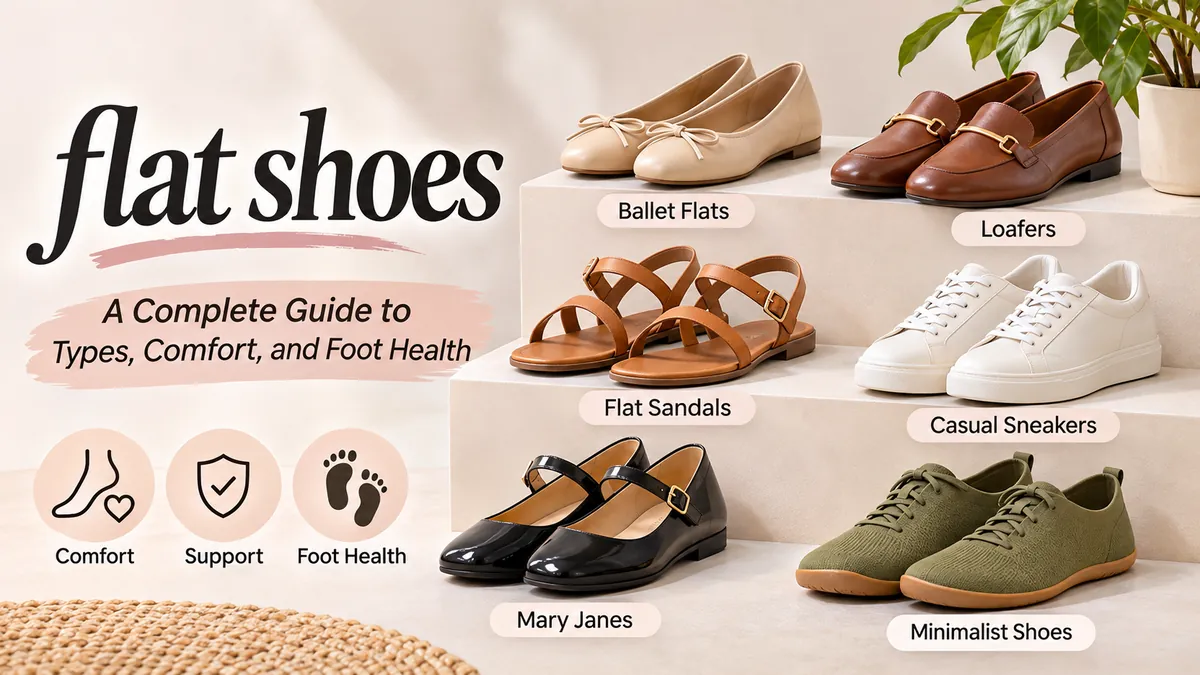
Flat shoes are a wardrobe staple, but not every flat shoe feels the same. Some provide cushioning and stability for long days on your feet, while others prioritize flexibility, lightweight construction, or a streamlined appearance.
Flat shoes are footwear with little or no height difference between the heel and forefoot. Common examples include ballet flats, loafers, flat sandals, slip-ons, and minimalist shoes. Their comfort depends on more than heel height: cushioning, arch support, toe-box width, flexibility, materials, and overall fit all influence how they feel during everyday activities.
Understanding these differences can help you recognize which designs suit different occasions, foot shapes, and activity levels.
What Are Flat Shoes?
Flat shoes generally have a low-profile sole and minimal heel elevation. Unlike high heels, which raise the rear of the foot significantly above the toes, flat footwear keeps the foot closer to a level position.
However, the term flat describes a broad category rather than one specific construction.
A ballet flat may have a thin, flexible sole, while a supportive walking shoe can have a relatively level platform with considerably more cushioning. Both may be described as flat, even though their performance differs.
Flat shoes vs. zero-drop shoes
A common misconception is that all flat footwear is zero-drop.
Heel-to-toe drop refers to the difference in stack height between the heel and forefoot.
- Zero-drop shoes: The heel and forefoot sit at approximately the same height.
- Low-drop shoes: The heel is slightly higher than the forefoot.
- Traditional flat footwear: May have a small raised heel despite its overall flat appearance.
- Minimalist shoes: Typically emphasize low weight, flexibility, limited cushioning, and a relatively natural foot position.
A zero-drop design is not automatically minimalist. A shoe can have equal heel and forefoot heights while still offering substantial cushioning.
Types of Flat Shoes and Their Features
Flat footwear comes in numerous styles, each designed around different combinations of appearance, comfort, and function.
Ballet flats
13 Best Ballet Flats for All-Day Comfort and Style – Modern Luxury
Naturalizer Maxwell Ballet Flat | Womens Flats
Dafne timeless ballet flat – Fabio Rusconi
10
Ballet flats are recognizable by their low-cut uppers, lightweight construction, and rounded, almond-shaped, or pointed toes.
Many traditional designs feature a thin outsole and minimal internal structure. Modern versions may include padded insoles, elasticized edges, or additional arch support.
Ballet flats are often worn with trousers, skirts, dresses, and casual office clothing.
Their main limitation is that very thin soles may provide insufficient protection on hard or uneven surfaces. Narrow toe boxes can also create pressure around the toes.
Loafers
Penny Loafer Brown | Handcrafted Full-Grain Calfskin | 3DM Lifestyle
Georgia Loafers – Full Grain Leather – Women’s
Handcrafted Leather Shoes for Men | Made in Delhi | Dapper Shoes Co.
8
Loafers are slip-on shoes with a structured upper and typically a low heel.
Popular variations include penny loafers, tassel loafers, horsebit loafers, and soft leather driving loafers.
Compared with many ballet flats, loafers often have firmer outsoles and more substantial uppers. Some models provide additional underfoot support, although construction varies considerably.
A secure heel fit matters because loose loafers may cause the foot to slide forward or require the toes to grip during walking.
Flat sandals
Thompson Camel Women’s Flat Sandal | FRANKIE4
Earth Origins Adjustable Sport Sandals – Skylar – QVC.com
Rome Camel Women’s Flat Sandal | FRANKIE4
10
Flat sandals include strappy sandals, slides, gladiator sandals, and sport sandals.
Their open construction promotes airflow, making them popular in warm weather.
Adjustable straps and a contoured footbed can improve stability. Slides with loose straps may be less secure, particularly during extended walking.
Sandals with thin, rigid soles may also expose the feet to greater pressure from uneven ground.
Sneakers and casual slip-ons
Casual sneakers, canvas shoes, and slip-on trainers can offer a flat-looking silhouette with more cushioning than traditional dress flats.
Features vary by design, but may include:
- Foam midsoles for impact absorption
- Removable insoles
- Flexible rubber outsoles
- Breathable textile uppers
- Padded collars and heel counters
Not all sneakers are technically flat or zero-drop. Many have a noticeable heel-to-toe drop despite their low-profile appearance.
Mary Jane flats
Mary Jane shoes feature one or more straps crossing the upper part of the foot.
The strap can improve retention compared with an open-throat ballet flat, particularly for people whose heels tend to slip out of shoes.
Styles range from traditional rounded-toe leather designs to contemporary square-toe and platform versions.
Minimalist and barefoot-style shoes
Minimalist footwear is designed to reduce the structural interference between the foot and the ground.
Typical characteristics include a wide toe box, flexible outsole, low heel-to-toe drop, and limited cushioning.
These features may allow more natural toe spreading and greater sensory feedback from the ground.
However, transitioning suddenly from highly cushioned footwear to minimalist shoes can increase stress on the calves, Achilles tendons, and forefoot. Gradual adaptation is generally more sensible than immediately using them for long walks or runs.
Comparing Popular Flat Shoe Styles
| Shoe type | Typical characteristics | Common uses |
|---|---|---|
| Ballet flats | Lightweight, flexible, low-cut | Everyday and dress-casual wear |
| Loafers | Structured upper, slip-on design | Office and smart-casual outfits |
| Flat sandals | Open upper, straps or slides | Warm-weather activities |
| Mary Janes | Instep strap, secure upper | Casual and semi-formal wear |
| Casual sneakers | Cushioned sole, flexible upper | Walking and everyday activities |
| Minimalist shoes | Wide toe box, low drop, flexible sole | Natural-movement-focused activities |
| Espadrilles | Canvas or fabric upper, traditionally rope-style sole | Casual summer wear |
The category alone does not determine comfort. Two shoes of the same style can feel completely different because of their construction and fit.
Benefits of Wearing Flat Shoes
Flat footwear offers several practical advantages, although the benefits depend on the shoe’s construction and the person wearing it.
Lower heel elevation
High heels shift more body weight toward the forefoot. Lower-heeled shoes generally reduce this forward positioning and may help avoid some of the pressure associated with elevated heels.
This does not mean that completely flat shoes are always healthier. Footwear still needs appropriate support and cushioning.
Versatility for everyday clothing
Flat shoes work with a wide range of outfits and dress codes.
Ballet flats and loafers can complement tailored trousers or dresses, while canvas slip-ons and sneakers suit more casual clothing.
Neutral colors such as black, tan, beige, navy, and brown are especially adaptable, although brighter colors and metallic finishes can create a more distinctive appearance.
Ease of movement
Many flat designs are lightweight and easy to put on or remove.
A secure, well-fitting flat shoe may also offer a stable platform for ordinary activities without the balance demands associated with narrow high heels.
However, an unsecured slip-on can be less stable than a properly fitted shoe with straps or laces.
Different levels of flexibility
Flexible footwear can accommodate natural movement through the forefoot, while more structured shoes may offer better protection and stability.
Neither extreme is ideal for everyone. The right amount of flexibility depends on the intended activity and individual foot mechanics.
Are Flat Shoes Good for Your Feet?
The answer depends on the design, fit, activity, and any existing foot problems.
Flat shoes are not inherently harmful, but very thin, unsupportive styles can cause discomfort when worn for prolonged periods, especially on hard surfaces.
The American Podiatric Medical Association emphasizes choosing footwear according to foot type, activity, and individual needs rather than assuming one style works for everyone. apma.org
Flat shoes and plantar fasciitis
Plantar fasciitis, also called plantar fasciopathy, involves pain around the heel and arch associated with irritation or overload of the plantar fascia.
People with this condition may find that thin-soled ballet flats, flip-flops, and other unsupportive footwear aggravate their symptoms.
The National Health Service recommends cushioned heels, good arch support, and appropriate insoles for people experiencing plantar fasciitis. NHS+1
Supportive walking shoes may therefore be more suitable during painful periods than completely flat, minimally cushioned footwear.
Flat shoes for people with flat feet
Flat shoes and flat feet are different concepts.
Flat feet, also known as pes planus, describe a foot structure in which the medial longitudinal arch is low or appears absent when standing.
Many people with flat feet experience no symptoms and do not need special treatment.
For those experiencing discomfort, wider shoes, suitable insoles, or additional support may help. The NHS advises that treatment is generally unnecessary when flat feet cause no problems. NHS
Can flat shoes cause bunions?
Bunions, medically known as hallux valgus, involve a change in the alignment of the big toe joint.
Footwear is not the only factor involved; inherited foot structure and other biomechanical influences can contribute.
However, narrow or pointed toe boxes may increase pressure around the big toe and aggravate discomfort.
A flat shoe with a wide, anatomically shaped toe box may be more comfortable than a narrow pointed flat, even if both have the same heel height.
Are flat shoes suitable for all-day walking?
Some are, but many traditional dress flats are not designed for prolonged walking.
Features that can improve walking comfort include a cushioned midsole, stable heel counter, secure fastening, appropriate sole flexibility, and adequate toe room.
For people with foot pain, Guy’s and St Thomas’ NHS Foundation Trust generally recommends supportive athletic footwear for everyday walking. Guy’s and St Thomas’ NHS Trust
The practical lesson is simple: a shoe’s appearance does not reveal how well it will perform over several hours.
How to Choose Comfortable Flat Shoes
Finding comfortable flat shoes starts with understanding fit rather than focusing only on style.
Flat shoe fit checklist
Interactive
Fit checks completed
0 of 6Enough room in front of the longest toeNo squeezing across the toe boxHeel stays secure while walkingComfortable cushioning and supportSole suits the intended activityNo rubbing, pinching, or pressure points
1. Check the toe box
The toe box should accommodate the natural width and shape of the forefoot.
Your toes should not overlap, curl, or press tightly against the sides of the shoe.
A useful general guideline is approximately 1 cm of space between the longest toe and the front of the shoe. This recommendation appears in NHS footwear guidance. Guy’s and St Thomas’ NHS Trust
A pointed-toe shoe can still fit comfortably if its overall length and internal shape provide adequate room. However, some pointed designs narrow too sharply.
2. Examine arch support
Arch support refers to the structure beneath the midfoot.
Some shoes feature molded footbeds, while others use removable insoles that can be replaced with orthotic inserts.
People who need additional support may benefit from a shoe with sufficient depth to accommodate an insole without crowding the foot.
Not everyone needs a pronounced arch contour. Excessive or poorly positioned support can also feel uncomfortable.
3. Evaluate cushioning
Cushioning helps absorb some of the impact associated with walking on hard surfaces.
Common midsole materials include ethylene-vinyl acetate (EVA), polyurethane (PU), and other engineered foams.
The amount and firmness of cushioning influence how the shoe feels underfoot.
A very soft footbed is not automatically better. Some people prefer a firmer platform that provides a more stable sensation.
4. Look at the outsole
The outsole is the bottom layer that contacts the ground.
Rubber outsoles often provide traction and durability, although grip depends on tread design, material composition, and surface conditions.
Leather outsoles are common in dress footwear but can be slippery on certain wet or polished surfaces.
For regular walking, examine whether the sole provides sufficient grip and protection.
5. Check heel retention
The heel should remain reasonably secure during walking.
If the back of the shoe repeatedly slips, the foot may compensate by gripping with the toes.
A strap, lace closure, or properly fitted heel counter can improve retention.
6. Consider the upper material
Leather, suede, canvas, knit fabric, mesh, and synthetic materials are all common in flat footwear.
Leather can soften and conform somewhat with wear, while breathable mesh and textile uppers may improve ventilation.
Synthetic materials vary widely in flexibility and breathability.
The ideal upper should accommodate the foot without excessive pressure or rubbing.
Flat Shoes for Different Foot Shapes and Needs
There is no universally comfortable shoe because feet vary in length, width, arch structure, and movement patterns.
| Foot characteristic | Features worth considering |
|---|---|
| Wide feet | Wide toe box, available width options |
| Narrow heels | Adjustable straps, secure heel counter |
| High arches | Comfortable cushioning, suitable midfoot support |
| Low arches | Stable construction, supportive insoles if needed |
| Bunions | Spacious forefoot, soft upper material |
| Sensitive heels | Padded heel area, shock-absorbing sole |
| Swelling during the day | Adjustable fastening, adequate shoe volume |
These are general considerations rather than prescriptions. Persistent pain or a diagnosed foot condition may require individualized footwear advice.
Flat shoes for wide feet
Wide feet need more than a larger shoe size.
Increasing length to gain width may leave excessive space at the heel and cause instability.
Look for shoes available in wide fittings, with a rounded or foot-shaped forefoot and an upper that does not compress the metatarsal area.
Flat shoes for high arches
High arches, sometimes called pes cavus, may concentrate pressure around the heel and forefoot.
Comfortable cushioning and an appropriately shaped footbed can help distribute pressure.
The American Podiatric Medical Association advises that foot structure should influence footwear selection, especially for athletic activities. apma.org
Flat shoes for standing all day
Prolonged standing can expose the feet to sustained pressure, particularly on concrete or tile flooring.
A supportive, cushioned shoe with a secure fit is generally more appropriate than a thin dress flat.
People working in healthcare, hospitality, education, retail, or other standing-intensive occupations may benefit from alternating footwear when practical.
Flat Shoes vs. Heels: Key Differences
Women’s Feliz Ballet Flat In Black Leather – Thursday
Flat footwearLow heel elevation, with cushioning and support varying by design.
GROES | The London Coat | Evening Look
High-heeled footwearRaised heel, greater forward weight shift, and different balance demands.
High heels and flat shoes influence foot position differently.
| Feature | Flat shoes | High heels |
|---|---|---|
| Heel elevation | Minimal or low | Moderate to substantial |
| Forefoot loading | Generally less forward shift | Greater forward shift |
| Balance | Often more stable | Can require greater balance control |
| Toe pressure | Depends on toe-box shape | Often increased in narrow designs |
| Cushioning | Varies considerably | Varies considerably |
| Everyday walking | Depends on construction | Often less practical for long distances |
Completely flat footwear is not necessarily the ideal alternative to high heels.
For some people, a modest heel elevation combined with appropriate cushioning and support may be more comfortable than a zero-drop, thin-soled design.
A gradual transition can also be helpful for someone accustomed to wearing elevated heels.
How to Style Flat Shoes for Different Occasions
Flat shoes can complement both relaxed and polished clothing.
Casual everyday outfits
Ballet flats, canvas slip-ons, and casual sneakers work well with straight-leg jeans, cropped trousers, relaxed denim, and simple dresses.
A low-profile silhouette can create a clean appearance without adding significant visual bulk.
Office and business-casual clothing
Leather loafers, Mary Jane flats, and structured ballet flats are common choices for business-casual environments.
Black and brown leather designs can complement tailored trousers, while neutral ballet flats can work with midi skirts and dresses.
The level of formality depends on the workplace dress code.
Formal events
Pointed-toe flats, embellished ballet flats, and dressy slingbacks offer alternatives to high heels.
Materials such as satin, polished leather, suede, and metallic finishes can create a more formal appearance.
For events involving extended standing or walking, the sole and heel fit still deserve attention.
Summer outfits
Espadrilles, woven flats, and strappy sandals pair naturally with linen trousers, cotton dresses, shorts, and lightweight skirts.
For long outdoor walks, secure sandals with supportive footbeds are usually more practical than loose slides.
Common Mistakes When Wearing Flat Shoes
Several avoidable mistakes can turn otherwise attractive footwear into an uncomfortable experience.
Choosing shoes that are too small
A snug fit should not mean compression.
Shoes that squeeze the toes or rub the heel may cause blisters, corns, calluses, or nail discomfort.
Assuming all flats provide enough support
The word flat says little about cushioning, stability, or internal structure.
A thin ballet pump and a cushioned walking shoe may look similarly low to the ground but behave differently during prolonged use.
Wearing worn-out shoes
Outsoles can lose traction, midsoles can compress, and uppers can stretch over time.
Uneven wear, reduced cushioning, and persistent discomfort are signs that footwear may no longer be performing as intended.
Ignoring activity requirements
A delicate leather flat may be appropriate for a short indoor event but unsuitable for hiking, running, or extensive walking on uneven ground.
Choose footwear that matches the movement and environment.
Switching abruptly to minimalist shoes
A sudden change to zero-drop or minimally cushioned footwear can alter loading patterns in the foot and lower leg.
Introduce unfamiliar designs gradually, particularly if you are accustomed to substantial heel elevation or cushioning.
How to Care for Flat Shoes
Proper maintenance can help preserve the appearance, fit, and function of flat footwear.
Cleaning leather flats
Remove loose dirt with a soft cloth or brush.
Use a cleaner suitable for the leather finish, and apply conditioner when appropriate to help prevent drying.
Avoid soaking leather shoes or exposing them to direct heat during drying.
Caring for suede shoes
Use a suede brush to remove surface dirt and restore the nap.
For stains, choose a product specifically intended for suede rather than using ordinary leather polish.
Cleaning canvas and fabric flats
Spot-clean with mild detergent and water when permitted by the manufacturer’s care instructions.
Some textile shoes are machine washable, but others contain adhesives, stiffeners, or decorative components that may be damaged.
Storing flat footwear
Keep shoes in a cool, dry, ventilated location.
Allow damp footwear to dry before storage, and use shoe trees or suitable inserts when needed to maintain shape.
Rotating frequently worn pairs can also give the materials time to dry between uses.
When Should You Replace Flat Shoes?
There is no universal replacement schedule for all flat footwear.
Durability depends on material quality, walking frequency, body weight, surface conditions, and maintenance.
Inspect your shoes for these signs:
- Outsole tread has become smooth or uneven.
- The heel counter has collapsed.
- The sole is separating from the upper.
- Cushioning feels noticeably compressed.
- The shoe has become loose or unstable.
- New discomfort appears during ordinary walking.
Shoes may remain visually attractive even after their supportive components have deteriorated.
For footwear used regularly, function matters as much as appearance.
Final Thoughts on Flat Shoes
Flat shoes combine practical styling with a wide range of construction options, from delicate ballet flats to supportive loafers, secure sandals, and minimalist footwear.
Their comfort and suitability depend on the complete design rather than heel height alone. Toe-box shape, cushioning, arch support, secure fastening, outsole grip, and appropriate sizing all contribute to how a shoe performs.
For everyday use, prioritize footwear that fits comfortably and matches the activity. If you experience recurring heel pain, arch discomfort, numbness, or other persistent symptoms, consult a qualified podiatrist or healthcare professional for individualized advice.
The most useful approach to choosing flat shoes is to judge how they fit, feel, and function—not simply how flat they look.