
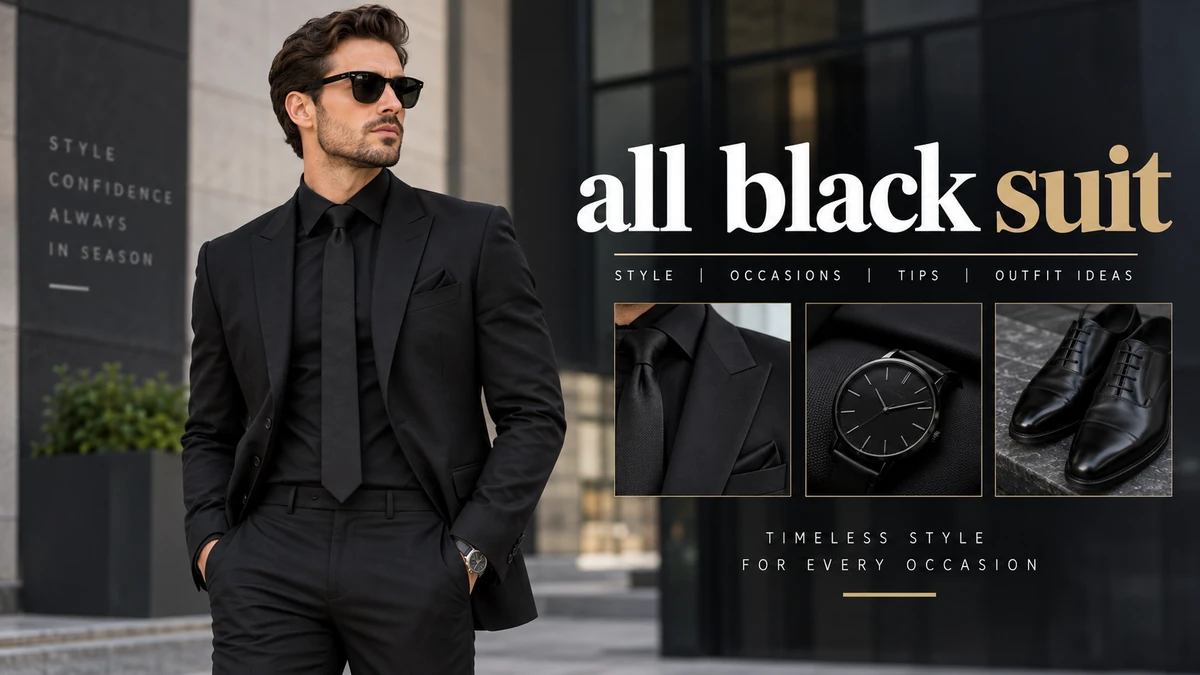
An all black suit looks simple because every major piece shares the same color. That simplicity is exactly what makes it unforgiving. Poor fit, faded fabrics, mismatched shades, or overly shiny accessories become much easier to notice when there is no contrasting color to distract the eye.
The strongest version combines a well-fitted black suit with a black shirt or fine-gauge knit, restrained accessories, and black footwear. The secret is not making every piece visually identical. Instead, use subtle differences in texture, fabric, and finish to give the monochromatic outfit depth while preserving its clean silhouette.
An all-black outfit can work particularly well for evening events, dinners, dates, parties, creative workplaces, and some weddings. It can also move in a more casual direction when the dress shirt is replaced by a T-shirt, polo, or roll-neck.
But there are situations where traditional styling is safer. A conservative business environment may call for a white or light-colored shirt, while a funeral generally calls for understated clothing rather than a fashion-forward black-on-black combination.
What Is an all black suit?
An all black suit generally means a monochromatic outfit built around a black suit jacket and matching trousers, with most or all of the remaining visible pieces also in black.
A typical combination includes:
- Black suit jacket
- Matching black trousers
- Black dress shirt
- Black leather shoes
- Black belt, when required
- Optional black tie
- Minimal dark or metallic accessories
This is different from simply wearing a black suit.
A conventional black suit might be paired with a crisp white shirt, black tie, and black Oxford shoes. That remains one of the classic formal combinations. An all-black outfit removes most of that color contrast, producing a darker and more contemporary appearance.
Current menswear guidance increasingly treats the black suit as something that can extend beyond weddings, interviews, and funerals. Depending on the cut and styling, it can be worn with shirts, knitwear, polos, T-shirts, loafers, boots, and even restrained sneakers.
Black suit vs. tuxedo
A black suit should not automatically be treated as a tuxedo.
| Feature | Black Suit | Tuxedo |
|---|---|---|
| Typical lapel | Same or similar fabric as jacket | Often satin or grosgrain faced |
| Trouser detailing | Usually plain | May have a satin side stripe |
| Typical shirt | Standard dress shirt | Formal tuxedo shirt |
| Typical footwear | Oxfords, Derbies, loafers | Highly polished formal shoes |
| Best use | Formal to smart occasions | Black-tie events |
| Styling flexibility | High | More dress-code specific |
A black suit can sometimes be styled formally, but a dress code explicitly stating black tie traditionally calls for a dinner jacket or tuxedo rather than an ordinary business-style black suit.
Why an all black suit Works So Well
Black-on-black tailoring creates one continuous visual line. Because the eye is not repeatedly interrupted by contrasting colors, attention shifts toward silhouette, proportion, fabric, and small details.
That is why the outfit can appear especially clean and streamlined.
The same characteristic creates its biggest weakness: there is nowhere for bad tailoring to hide.
A slightly oversized shoulder, excessively long trousers, wrinkled shirt, dusty shoe, or washed-out jacket becomes part of the visual focus.
Monochrome does not have to mean flat
The easiest mistake is assuming every piece needs exactly the same surface.
Imagine these two combinations:
Outfit one: shiny black polyester-looking jacket, shiny shirt, glossy tie, polished belt, and patent-effect shoes.
Outfit two: matte wool suit, smooth cotton shirt, lightly textured silk tie, and polished calf-leather shoes.
Both are black from head to toe. The second outfit has considerably more visual depth.
Menswear stylists repeatedly recommend using texture to distinguish the individual elements of an all-black outfit rather than depending on color contrast.
Quick takeaway: In monochrome tailoring, texture does much of the work normally performed by color.
Getting the Fit of an all black suit Right
Fit should be the first consideration, not the shirt, tie, watch, or shoes.
A reasonably priced suit altered correctly will generally create a cleaner appearance than an expensive suit that does not fit your proportions.
Modern black tailoring does not have to mean extremely skinny. Current styles range from clean slim-straight silhouettes to considerably more relaxed tailoring, but the garment should still look deliberate rather than simply oversized. GQ’s recent guidance similarly emphasizes a clean shoulder line and trousers with a clearly defined silhouette.
How the jacket should fit
Start with the shoulders.
The jacket’s shoulder seam should sit close to the end of your natural shoulder. Deep dents, collapsed fabric, or a shoulder extending significantly beyond your body usually indicate a poor fit.
Then check the collar.
It should sit neatly around the back of your shirt collar rather than standing away from your neck.
When the jacket is buttoned, the front should look clean. Strong pulling around the button creates an obvious X-shaped crease and usually means the jacket is too tight.
Traditional tailoring also allows a small amount of shirt cuff to remain visible below the jacket sleeve. The Black Tux suggests roughly ¼ to ½ inch as a useful reference point.
How the trousers should fit
Your trousers should complement the jacket rather than competing with it.
Look for:
- A comfortable waist without excessive bunching
- A clean line through the seat and thigh
- Enough room to sit comfortably
- Controlled taper through the lower leg
- Little unnecessary fabric pooling over the shoe
A slight break or no break can create a particularly clean contemporary silhouette.
Avoid assuming that tighter automatically means better. Trousers stretched across the thighs or seat can make a carefully planned outfit look uncomfortable.
The Best Shirt for an all black suit
The black shirt is the defining choice for a true black-on-black suit combination.
But “black” is not one perfectly standardized shade.
A cotton shirt, wool jacket, and silk tie interact with light differently. A faded black shirt can therefore appear charcoal or even brownish beside a deep-black jacket.
Check the complete outfit under natural or neutral lighting before wearing it to an important event.
Black dress shirt
A black dress shirt creates the sharpest monochromatic interpretation.
Choose a clean collar that maintains its shape beneath the jacket. The shirt should fit closely enough to avoid excess fabric around the waist without pulling across the chest.
A matte or subtly textured cotton fabric usually integrates more naturally with wool tailoring than a highly reflective shirt.
Black T-shirt
A plain black T-shirt moves the suit toward smart casual territory.
This works particularly well for:
- Dinner
- Date night
- Parties
- Creative events
- Fashion-focused gatherings
- Informal evening weddings where the dress code permits it
Keep the T-shirt simple. Large logos and graphics interrupt the uninterrupted silhouette that makes the outfit effective.
A heavier, structured T-shirt often sits beneath tailoring more cleanly than a very thin undershirt-style tee.
Black roll-neck or turtleneck
A fine-gauge black roll-neck is an excellent cold-weather alternative to a shirt.
Merino wool and cashmere introduce a softer texture that contrasts naturally with structured suiting. FashionBeans specifically highlights merino and cashmere as ways to add depth while reducing formality.
Avoid thick, bulky knitwear unless the suit jacket has enough room to accommodate it.
Black polo or knitted polo
A fine knitted polo sits between a dress shirt and T-shirt in formality.
It provides a collar and some structure without creating the conventional office appearance of a button-front shirt. Contemporary black-suit styling also increasingly incorporates knitted polos and similar knitwear.
Should You Wear a Black Tie With an all black suit?
You can, but you do not have to.
An open black shirt without a tie often creates the cleanest modern interpretation. Adding a tie makes the combination more structured and formal.
If you choose one, texture becomes especially useful.
A silk, grenadine-style, knitted, or subtly textured black tie can remain monochromatic while still separating visually from the shirt.
The width should also make sense with the suit.
A very narrow tie combined with broad lapels can look disconnected, while an oversized tie may overwhelm a slim jacket. Proportion between the tie, lapel, collar, and overall cut helps the outfit feel coherent. GQ has similarly highlighted proportional balance when styling black suits.
Do you need a pocket square?
No.
The outfit can actually look cleaner without one.
For a formal interpretation, a neatly folded white pocket square introduces a classic point of contrast, although technically the outfit is no longer completely black.
For a monochromatic approach, use a black pocket square with a different texture from the jacket rather than a shiny matching set of tie and square.
Best Shoes to Wear With an all black suit
Black shoes are the easiest and most cohesive choice.
The specific shoe depends on how formal you want the outfit to feel.
| Shoe | Formality | Best Use |
|---|---|---|
| Black Oxford | High | Formal dinners, ceremonies, formal weddings |
| Black Derby | Medium-high | Work, events, versatile formal wear |
| Black loafer | Medium | Parties, dates, evening events |
| Black Chelsea boot | Medium | Fall/winter, fashion-forward events |
| Minimal black sneaker | Casual | Creative or relaxed styling |
Black Oxfords
For traditional tailoring, black leather Oxfords remain one of the safest choices.
A simple cap-toe or plain-toe design keeps attention on the overall outfit rather than the footwear.
Black loafers
Loafers make black tailoring feel lighter and less corporate.
Leather loafers work for polished outfits, while velvet or suede introduces noticeable texture for evening styling.
Black boots
Chelsea boots can work extremely well with narrow or straight trousers during cooler months.
The trouser hem should fall cleanly over or just meet the boot rather than bunching heavily around the ankle.
Can you wear sneakers with a black suit?
Yes, provided the occasion is casual enough.
Contemporary styling guides increasingly combine black suits with unobtrusive sneakers, although lace-ups, loafers, and boots remain more traditional options.
Choose simple sneakers rather than bulky running shoes. The cleaner the shoe, the easier it is to maintain the streamlined character of the suit.
The Right Fabrics and Textures
Once color is removed as the main source of contrast, fabric becomes much more important.
Wool
Wool is the most versatile starting point for a black suit.
A quality worsted wool can create a smooth surface without looking excessively shiny. Depending on fabric weight and construction, it can also work across multiple seasons.
Wool blends
Wool blended with a small amount of another fiber can offer durability, stretch, or different handling characteristics.
Judge the fabric by appearance and feel rather than fiber composition alone.
Cotton
Black cotton tailoring usually feels more casual than traditional worsted wool.
It can work well for daytime smart-casual outfits and less formal environments.
Linen and linen blends
Linen is breathable and naturally textured, making it useful for warm weather.
However, it wrinkles easily and tends to create a more relaxed appearance. A linen blend can provide some of the texture and breathability while maintaining greater structure.
Velvet
Velvet is strongly associated with eveningwear.
A black velvet jacket can create a rich, dramatic look, particularly around dinners, parties, or festive events. It is far less suitable as an everyday business suit.
Satin and grosgrain
Satin and grosgrain are frequently used as contrasting lapel facings on dinner jackets.
Because these fabrics reflect light differently from wool, they create subtle contrast without introducing another color.
How to Create Contrast Without Adding Color
A common question is: How do you stop an all-black outfit from looking boring?
Use differences in surface, shape, and finish.
You could combine:
- A matte wool jacket
- A smooth cotton shirt
- A textured tie
- Polished leather shoes
- A brushed metal watch
Everything remains black or neutral, yet each layer interacts with light differently.
Use texture strategically
Herringbone, birdseye, ribbed knitwear, suede, velvet, smooth leather, and subtle weaves can all provide depth.
The key word is subtle.
You do not need five competing textures. Usually two or three are enough.
Use silhouette
Contrast can also come from shape.
A structured jacket over a soft knit, wider trousers with sleek loafers, or a relaxed suit with a fitted T-shirt can create visual interest without introducing another color.
Use small metallic details
Silver, steel, gunmetal, or restrained gold details can break up the darkness without dominating it.
A watch, cufflinks, or small ring is usually enough.
all black suit Outfit Ideas
There is no single correct way to wear monochromatic tailoring. Changing just the layer beneath the jacket and the footwear can substantially alter the character of the outfit.
1. Classic black-on-black
Wear:
- Black wool suit
- Black dress shirt
- Black tie
- Black leather Oxfords
- Minimal metal watch
This is the most formal version of the monochromatic look.
It works best in evening settings where a conventional business suit would feel too ordinary but a tuxedo is not required.
2. Modern no-tie combination
Wear:
- Black suit
- Black dress shirt
- Open collar
- Black loafers
- Simple watch
Removing the tie immediately relaxes the outfit while keeping the sharp shirt-and-jacket structure.
3. Minimalist T-shirt combination
Wear:
- Relaxed black suit
- Plain black crew-neck T-shirt
- Black loafers or minimalist sneakers
This is one of the easiest ways to make tailoring feel contemporary rather than corporate.
4. Winter roll-neck combination
Wear:
- Black wool suit
- Fine black merino roll-neck
- Black Chelsea boots
- Minimal accessories
The knitted layer introduces enough texture that a tie becomes unnecessary.
5. Evening textured look
Wear:
- Black suit or velvet jacket
- Black shirt
- Black loafers
- Subtle metal accessory
This works particularly well under artificial evening lighting, where velvet, silk, polished leather, and wool each reflect light differently.
Can You Wear an all black suit to a Wedding?
Often, yes—but the dress code and context matter.
A black suit is commonly suitable for evening weddings and formal celebrations. An all-black shirt-and-suit combination is more fashion-forward than the conventional black suit with a white shirt, however.
Check the invitation first.
If the wedding specifies black tie, wear the appropriate black-tie attire rather than assuming any black suit meets the requirement.
If it specifies cocktail attire, formal attire, or a flexible evening dress code, black tailoring may be appropriate.
There is another consideration: the wedding party.
If the groom and groomsmen are deliberately wearing all black, copying their exact look as a guest may make you appear to be part of the wedding party. When uncertain, a white shirt provides an easy distinction while keeping the black suit.
Is an all black suit Appropriate for Work?
It depends heavily on the workplace.
Creative industries, nightlife, fashion, hospitality, media, entertainment, and some modern offices may accommodate monochromatic tailoring easily.
Traditional corporate environments tend to favor more conventional combinations.
A black suit with a white shirt and understated tie is generally more conservative than a black suit, black shirt, and black tie.
There is also a practical issue. Head-to-toe black can lose definition when every garment has the same flat surface. A recent corporate-styling discussion described this as an “all-black blob” and recommended varying textures to restore visual interest.
For an important interview in a conservative industry, navy or charcoal tailoring—or a black suit with a light shirt—may fit traditional business expectations more naturally.
Should You Wear an all black suit to a Funeral?
A black suit itself is entirely conventional funeral attire in many Western contexts, but an aggressively styled black-on-black fashion look can be less appropriate.
The purpose of funeral clothing is generally respect and restraint rather than attracting attention.
A straightforward combination such as:
black suit + white shirt + dark tie + black dress shoes
is often the more traditional choice.
The Black Tux similarly recommends a white or light-blue shirt rather than a dramatic all-black shirt combination for funerals.
Cultural and religious expectations vary, so local customs and the family’s wishes should take priority.
Can You Wear an all black suit During Summer?
Yes, although fabric weight matters more than color alone.
Black absorbs more visible light than lighter colors, which can make an all-black outfit uncomfortable during hot outdoor events.
For warm weather, look for:
- Lightweight wool
- Tropical wool
- Linen blends
- Breathable cotton
- Half-lined or lightly constructed jackets
- Breathable shirts
The setting matters too. An all-black suit at an air-conditioned evening dinner is very different from wearing one at an outdoor afternoon ceremony in direct summer sun.
For very hot daytime events, lighter-colored tailoring is often more comfortable.
Accessories That Work With Black-on-Black Tailoring
The outfit already makes a strong visual statement, so accessories should normally support rather than dominate it.
Belt
If your trousers require a belt, match it closely to your shoes.
Black leather shoes call for a black leather belt with relatively understated hardware.
If the trousers have side adjusters, you may not need a belt at all. This creates an especially clean waistline.
Watch
A watch with a black leather strap, steel bracelet, or dark dial integrates easily.
Avoid choosing an oversized statement watch simply because the outfit feels plain. The suit’s simplicity is part of its appeal.
Jewelry
A ring, bracelet, or subtle chain can work, especially with open-collar or T-shirt styling.
Keep the number of visible accessories controlled.
Socks
Black socks are the easiest solution.
Choose a length that prevents bare skin from showing when you sit down if the outfit is formal.
Common all black suit Mistakes
A monochromatic outfit does not give you many places to hide styling errors.
1. Mixing faded and deep blacks
This is one of the most common problems.
A jacket that has retained its original color beside trousers that have faded after repeated cleaning may no longer look like a matching suit.
Current GQ guidance specifically recommends paying attention to the depth of black because fading can become particularly visible around high-wear areas such as elbows and knees.
Inspect the jacket and trousers together in daylight.
2. Making everything shiny
A glossy suit, shiny shirt, reflective tie, polished belt, and highly reflective shoes can quickly make the outfit feel costume-like.
Use matte surfaces as the foundation and let one or two elements provide sheen.
3. Wearing a badly fitted jacket
The darker palette cannot rescue poor shoulder fit.
If the shoulders collapse, sleeves are too long, or the jacket strains when buttoned, visit a tailor before changing accessories.
4. Going too skinny
The ultra-tight suit is not the only route to a sharp silhouette.
A clean straight or relaxed cut can look just as deliberate when the shoulders, waist, trouser length, and proportions are controlled.
5. Ignoring texture
Black jacket + black shirt + black tie can disappear into one visual mass when all three have nearly identical finishes.
Change one texture rather than adding a random bright color.
6. Wearing the wrong shoes for the occasion
Minimal sneakers can work for a creative dinner.
They are not interchangeable with polished Oxfords at a traditional formal ceremony.
Formality still matters even when the color remains the same.
7. Confusing a black suit with black tie
A dress code named “black tie” describes a category of formal eveningwear, not simply clothing that happens to be black.
When a genuine black-tie dress code applies, follow its conventions.
8. Over-accessorizing
A large watch, lapel pin, necklace, rings, pocket square, tie bar, cufflinks, and statement belt worn simultaneously can undermine the minimalist effect.
Choose a few details and give them room to work.
How to Keep a Black Suit Looking Black
Color consistency is unusually important with monochrome tailoring.
Repeated cleaning, sunlight, abrasion, and general wear can gradually change the appearance of black fabric.
A few habits help preserve it:
- Brush the suit after wearing it.
- Allow it to air before returning it to the wardrobe.
- Use a properly shaped hanger.
- Avoid unnecessary dry cleaning.
- Treat stains promptly rather than repeatedly cleaning the entire suit.
- Keep it away from prolonged direct sunlight during storage.
- Rotate suits if you wear tailoring frequently.
- Follow the garment’s care label.
Most importantly, treat matching jacket and trousers as a pair.
If you wear the trousers three times as often as the jacket, they may fade and wear at a different rate. Eventually the “suit” can begin to resemble mismatched separates.
How to Build the Look Step by Step
If you have never worn head-to-toe black tailoring, do not begin with accessories.
Start with the fundamentals.
1. Choose the suit.
Look for clean shoulders, appropriate jacket length, comfortable trousers, and a fabric that suits the season.
2. Get the tailoring right.
Adjust sleeve and trouser length and correct manageable waist or trouser issues before the event.
3. Select the layer underneath.
Use a dress shirt for a sharper appearance, knitwear for texture, or a T-shirt for a casual interpretation.
4. Compare the shades of black.
Look at the complete outfit in good lighting. Replace obviously faded pieces.
5. Add appropriate footwear.
Oxfords are formal; loafers and boots can relax the outfit; minimal sneakers are best reserved for casual contexts.
6. Decide whether you actually need a tie.
Do not add one automatically. An open collar or fine knit may look more balanced.
7. Add one or two restrained accessories.
A watch and ring may be enough.
8. Check the entire silhouette.
Look at the outfit from a distance rather than examining individual pieces separately.
This last step matters. A good all-black outfit should read as one deliberate silhouette first and a collection of individual garments second.
all black suit vs. Black Suit With a White Shirt
Neither combination replaces the other. They communicate different levels of contrast and formality.
| Styling Point | All Black | Black Suit + White Shirt |
|---|---|---|
| Overall effect | Monochromatic, modern | Classic, high contrast |
| Formality | Depends strongly on styling | Traditionally formal |
| Evening wear | Excellent | Excellent |
| Conservative office | Less conventional | More conventional |
| Funeral | Can appear fashion-focused | Traditional choice |
| Date/dinner | Strong choice | More formal |
| Texture importance | Very high | Moderate |
| Styling difficulty | Higher than it appears | Relatively straightforward |
If you need maximum versatility, the useful lesson is that you do not need two different suits.
The same well-fitted black suit can create both combinations. Change the shirt, tie, shoes, and accessories, and the character of the outfit changes substantially.
That versatility is one reason contemporary menswear coverage continues to treat black tailoring as more than clothing reserved for funerals or highly formal occasions.
Final Thoughts on Wearing an all black suit
A successful all black suit is less about wearing as much black as possible and more about controlling the details.
Start with fit. Keep the shoulders clean and the trousers intentional. Then create separation with wool, cotton, silk, knitwear, suede, velvet, or leather rather than forcing color into the outfit. Choose shoes according to the occasion, keep accessories restrained, and make sure the individual shades of black have not faded noticeably apart.
For formal events, a black shirt and polished dress shoes create a sharper interpretation. For dinners and dates, removing the tie immediately relaxes the outfit. A black T-shirt, knitted polo, or fine roll-neck can push the same suit further into contemporary smart-casual territory.
Most importantly, dress for the setting. Black-on-black tailoring works because it is visually simple, but simple clothing demands precision. When the fit, proportions, textures, and level of formality agree with one another, an all-black outfit needs very little else.