
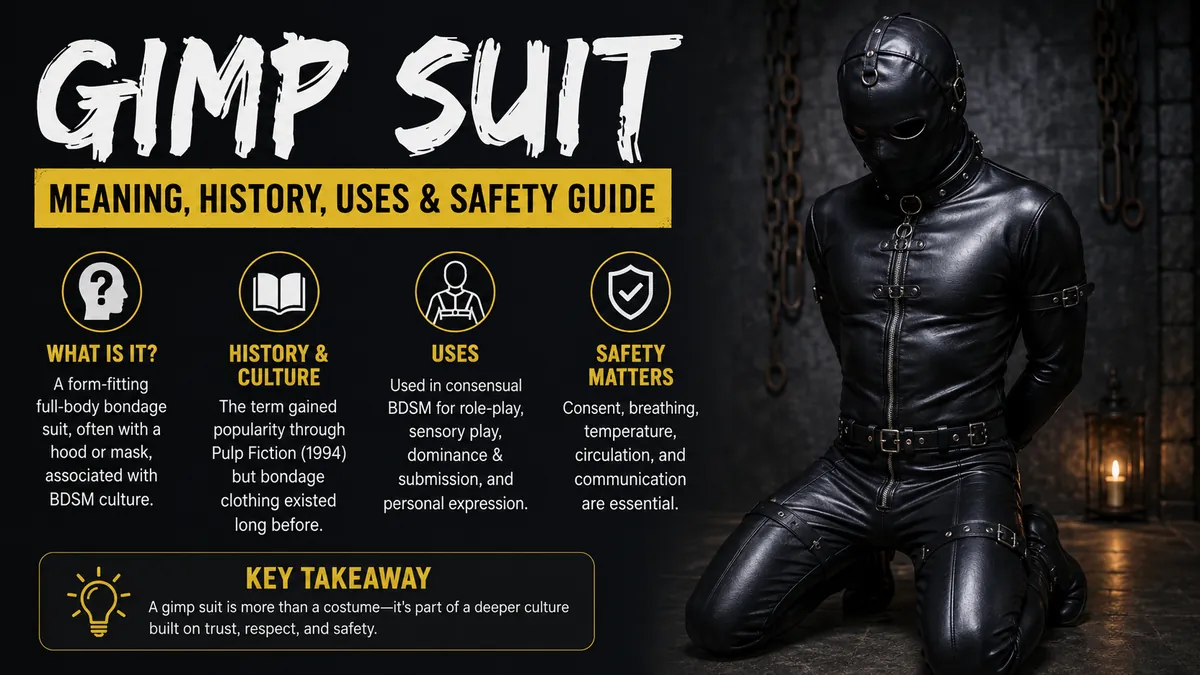
The term gimp suit can be confusing if you encounter it in a movie, online discussion, costume reference, or BDSM glossary. It does not describe one standardized piece of clothing. Instead, it is an informal name generally applied to a close-fitting, full-body bondage suit associated with fetish and BDSM culture.
A gimp suit is a form-fitting bondage garment that typically covers most or all of the body and may be combined with a hood or mask. Common materials include leather, latex, rubber, PVC, and stretch fabrics. Within BDSM contexts, it is generally associated with consensual role-play, restraint, sensory limitation, and dominant/submissive dynamics.
Understanding the term requires more than knowing what the garment looks like. Its meaning has been shaped by BDSM terminology, popular culture, different garment designs, and the complicated history of the word “gimp” itself.
What Is a gimp suit?
A gimp suit is another informal name for a bondage suit: a garment designed to fit closely around the body and, in many designs, cover the wearer from head to toe. Some versions incorporate the head covering into the garment, while others are paired with a separate bondage hood or mask.
The basic design varies considerably. A suit might cover the torso, arms, legs, hands, and feet, while another may leave certain areas uncovered. Some designs include zippers, straps, buckles, rings, or attachment points.
Materials also vary. Traditional-looking versions are frequently associated with black leather or rubber, but contemporary examples may use:
- Latex
- Natural or synthetic rubber
- Leather
- PVC or vinyl-like materials
- Spandex and other stretch fabrics
A BDSM glossary describes the term broadly as a tight, form-fitting suit—often made from rubber, PVC, heavy leather, or similar materials—that encloses the body and can include rings, straps, or other attachment features.
This means there is no universal design that every garment must follow before it can be called a gimp suit.
Is a gimp suit the same as a bondage suit?
In everyday usage, the terms frequently overlap. Dictionaries and reference sources commonly treat gimp suit as an informal synonym for bondage suit.
There can still be a difference in connotation.
“Bondage suit” is the more descriptive term because it identifies the general garment category. “Gimp suit” carries stronger associations with a particular submissive role, full-body enclosure, masks, black leather or rubber, and depictions of BDSM in popular culture.
So, while someone may use the two expressions interchangeably, not every garment described as a bondage suit will necessarily match the stereotypical image people associate with a gimp suit.
What Is the Purpose of a gimp suit?
There isn’t one universal purpose.
Within consensual adult BDSM, full-body bondage clothing can be connected with role-play, sensory experiences, restraint, anonymity, psychological transformation, or dominant/submissive dynamics. The meaning depends on what the participants have agreed to beforehand.
The suit can also create a dramatic visual transformation. Covering ordinary clothing, skin, and sometimes facial features changes how the wearer appears and may help distinguish a role from everyday identity.
Some garments include attachment points for compatible restraints, while others are essentially close-fitting fetish clothing without substantial restraint features.
This distinction matters: appearance does not automatically tell you what a particular suit is designed to do.
Dominance and submission
The gimp suit is strongly associated with dominance and submission, often abbreviated as D/s.
In this context, one participant may consensually adopt a submissive role while another adopts a dominant role. Specialized BDSM references consequently use “gimp” not only for the garment but sometimes for a submissive role involving full-body fetish clothing.
That doesn’t mean every submissive wears such clothing or that wearing a suit automatically defines someone’s BDSM role.
The clothing is simply one possible element within a much broader range of consensual practices.
Sensory limitation
A hood or enclosed garment can change what a wearer can see, hear, feel, or perceive around them. This is one reason masks and hoods appear so frequently alongside full-body bondage clothing.
However, deliberately reducing someone’s ability to see, communicate, move, or breathe introduces additional risk.
That makes consent, communication, supervision, fit, temperature management, and quick removal particularly important.
What Does a gimp suit Look Like?
The stereotypical image is a shiny or matte black, head-to-toe garment with a matching hood.
Real designs are much more varied.
Some look similar to catsuits. Others use thick leather panels, straps, buckles, reinforcement, or separate hoods. Stretch-material versions can fit tightly against the body, whereas leather generally behaves differently because it lacks the elasticity of materials such as latex or spandex.
Typical characteristics may include:
| Feature | What It Means |
|---|---|
| Full-body coverage | Torso and limbs are largely or completely enclosed |
| Close fit | Garment follows the body’s shape |
| Hood or mask | May be integrated or worn separately |
| Zippers | Provide entry, removal, or adjustment |
| Straps and buckles | May alter fit or support a restraint-oriented design |
| Attachment points | Some garments have rings or reinforced areas |
| Specialized material | Leather, latex, rubber, PVC, or stretch fabric is common |
None of these characteristics is mandatory.
A simple stretch bodysuit and a heavily reinforced bondage garment can look superficially similar while serving very different purposes.
gimp suit vs. Gimp Mask, Catsuit, and Zentai
Several types of full-body clothing can resemble one another in photographs, which creates confusion around terminology.
Gimp mask or bondage hood
A gimp mask generally refers to a hood worn over the head rather than an entire body garment.
A full suit may have an attached hood, but if it doesn’t, it can be combined with a separate bondage hood. This association is strong enough that reference sources regularly discuss the two together.
Catsuit
A catsuit is a close-fitting one-piece garment covering the torso and usually the legs and arms.
The major distinction is purpose rather than simply appearance. Catsuits can be fashion garments, costumes, performance clothing, athletic-inspired apparel, or fetish wear. They don’t inherently imply bondage.
Zentai
Zentai generally refers to extremely close-fitting full-body clothing that can cover the head as well as the rest of the body.
Although its appearance can overlap with certain fetish garments, full-body coverage by itself does not make something a bondage suit.
Bondage suit
“Bondage suit” is the broader and more descriptive BDSM-related term.
A traditional bondage-oriented garment may incorporate reinforced straps, rings, belts, lacing, or other features specifically designed around restraint. A garment marketed simply for its full-body appearance might have none of these.
Quick takeaway: A gimp mask covers the head, a catsuit is primarily a type of one-piece clothing, zentai emphasizes full-body coverage, and a bondage suit is specifically associated with bondage. “Gimp suit” is an informal term commonly used for the last category.
What Materials Are gimp suit Designs Made From?
Material has a major influence on appearance, flexibility, heat retention, fit, durability, and comfort.
Leather
Leather produces the classic heavy appearance commonly associated with traditional bondage imagery.
Unlike highly elastic materials, leather does not stretch around the body in exactly the same way as latex or spandex. Leather garments therefore rely more heavily on their construction, panels, lacing, buckles, and tailoring for fit.
Latex and rubber
Latex and rubber are strongly associated with fetish fashion because of their smooth, close-fitting appearance.
They can also become hot during prolonged wear because full-body garments can interfere with normal heat dissipation. Some people may additionally experience reactions to natural rubber latex.
PVC
PVC-based clothing can create a glossy appearance resembling latex while having different physical properties.
A PVC garment shouldn’t automatically be assumed to have the same stretch, strength, or restraint capabilities as latex or reinforced bondage equipment.
Spandex and other stretch fabrics
Stretch fabrics are generally lighter and can create the full-body silhouette without the weight of heavy leather.
They are also commonly associated with catsuits and other body-covering costumes, illustrating why visual appearance alone isn’t enough to identify a garment’s intended purpose.
Reference descriptions of bondage suits include leather, PVC, rubber, spandex, and related materials among the commonly encountered options.
Where Did the Term gimp suit Come From?
The exact history is less straightforward than some online explanations suggest.
The word gimp has several unrelated or partially overlapping meanings. Historically, it has appeared as slang referring to a limp or physical disability and can be derogatory when applied to a disabled person. Modern dictionaries and language references therefore treat that usage as offensive or derogatory.
The term has a separate specialized meaning within BDSM and fetish culture, where it can refer to a submissive wearing full-body leather, rubber, or similar clothing.
Because the same word exists in these different contexts, claims about a single neat origin for “gimp suit” should be treated cautiously.
Did Pulp Fiction invent the term?
The 1994 film Pulp Fiction, directed by Quentin Tarantino, had an enormous influence on public recognition of the term.
The movie features a character referred to as “the Gimp” wearing full-body bondage clothing. Reference sources specifically connect the widespread popular use of “gimp suit” with the film.
That distinction is useful.
It is safer to say that Pulp Fiction popularized the term and its visual association for mainstream audiences rather than assuming the movie invented bondage suits themselves. Specialized bondage clothing and fetish culture existed before the film.
The movie simply gave millions of viewers an instantly recognizable cultural reference.
Why Is the gimp suit Associated With Pulp Fiction?
For many people outside BDSM communities, Pulp Fiction was their first exposure to the word in this context.
The film’s depiction was visually memorable: a person completely enclosed in dark bondage clothing and a hood. The scene helped establish the pop-culture stereotype of what a “gimp” looks like.
That influence continues decades later.
Movies, television programs, Halloween costumes, comedy sketches, internet memes, and games may reference the visual idea even when they aren’t accurately representing BDSM practices.
This creates an important distinction between pop-culture imagery and real-world consensual BDSM.
A fictional character is written to create drama. Real BDSM relationships depend on communication and agreement between adults rather than simply copying what appears in a movie.
Is the Word “Gimp” Offensive?
It can be.
Outside its specialized fetish meaning, gimp has historically been used as a derogatory expression for people with physical disabilities. Wiktionary, for example, documents disability-related and insulting senses separately from the BDSM meaning.
That history makes context important.
Within some BDSM communities, individuals may voluntarily use “gimp” to describe a particular consensual role or style of clothing. That self-selected usage does not erase the word’s potentially offensive meaning in other settings.
A practical approach is simple:
- Use bondage suit when you only need to identify the garment.
- Avoid using “gimp” to describe a disabled person.
- Don’t assume someone identifies with the BDSM term simply because of what they are wearing.
- Consider the audience and context before using the expression casually.
“Bondage suit” is usually clearer when discussing the clothing academically or descriptively.
Is a gimp suit Always Sexual?
No.
The garment is strongly connected with fetish culture and BDSM, but appearance alone does not establish what someone is doing or why they are wearing it.
Similar full-body clothing can appear in costume design, performance art, theatrical productions, fashion photography, cosplay, music performances, film, or other artistic settings.
The distinction depends largely on context and purpose.
This is also why terms such as catsuit, zentai, fetish suit, bondage suit, and gimp suit shouldn’t automatically be treated as perfect synonyms.
Two garments may look nearly identical while belonging to completely different contexts.
gimp suit Safety: What Matters Most?
Full-body clothing creates practical risks that ordinary clothing usually doesn’t.
The risk becomes greater when a garment limits movement, communication, vision, hearing, or the wearer’s ability to remove it independently. Any activity involving actual restraint requires greater care than simply wearing a costume.
1. Consent comes first
BDSM activities should involve informed, voluntary agreement among capable adults.
Participants need to understand what is planned, what isn’t acceptable, how either person can stop the activity, and how the garment or equipment can be removed.
Consent to wear a suit also isn’t automatic consent to anything else.
2. Maintain unrestricted breathing
Nothing should interfere with the wearer’s airway.
Hoods and masks deserve particular attention because poor positioning, unsuitable construction, swelling, panic, or movement can turn an apparently manageable situation into an emergency.
Breathing must never depend on a single easily obstructed opening.
3. Watch body temperature
Rubber, latex, PVC, and other enclosed materials can trap heat and perspiration.
The wearer may become overheated more quickly than expected, especially in warm rooms or during physical activity.
Breaks, hydration, reasonable room temperature, and attention to symptoms such as dizziness or confusion are basic precautions.
4. Avoid dangerous restriction
A close-fitting garment shouldn’t dangerously compromise circulation.
Numbness, unusual discoloration, severe pain, weakness, or loss of sensation are warning signs that something needs to be removed or adjusted.
5. Have a rapid removal plan
Complicated clothing can take longer to remove than expected.
Anyone using restrictive equipment should understand its closures beforehand and have a practical method of getting the wearer out quickly if something goes wrong.
6. Keep communication possible
A hood, mask, or role-play scenario can make normal speech difficult.
Participants should establish an unmistakable stop signal before starting. If speech could become impossible, a reliable non-verbal signal is necessary.
7. Don’t leave a restrained person unattended
Someone whose movement, senses, or ability to remove their clothing is substantially restricted may be unable to respond appropriately to an emergency.
Active supervision is therefore essential whenever actual restraint is involved.
Quick takeaway: The more a garment limits breathing, movement, vision, communication, temperature regulation, or independent removal, the more seriously its safety requirements should be treated.
Common Misconceptions About the gimp suit
Popular culture has produced several misleading assumptions about these garments.
“Every gimp suit is made from latex”
Not true.
Leather, rubber, PVC, spandex, and other fabrics are also documented materials.
“Every suit has a mask”
Not necessarily.
Some have an integrated hood, some are combined with a separate bondage hood, and others leave the head uncovered.
“A full-body suit is automatically a gimp suit”
No.
Catsuits, zentai, theatrical costumes, protective clothing, and other garments can provide extensive body coverage without being bondage equipment.
“The clothing automatically means someone is submissive”
No.
Clothing doesn’t establish consent, role, identity, or relationship dynamics. Those things depend on the individuals and context.
“Pulp Fiction created bondage suits”
It didn’t.
The movie strongly popularized the modern term and visual reference, but bondage clothing and BDSM culture predate the 1994 film.
How the Meaning Has Expanded in Popular Culture
Today, gimp suit can be encountered far beyond specialized BDSM discussions.
The phrase appears in movie references, costume discussions, gaming, online slang, fashion commentary, and descriptions of fictional characters. One example is Grand Theft Auto: San Andreas, where a bondage-style outfit appears as an in-game costume connected with a mission.
This broader cultural use has made the expression recognizable even to people who know little about BDSM.
It has also made the definition less precise.
One person might use “gimp suit” specifically for heavy bondage equipment with attachment points. Another may apply the expression to almost any black, tight-fitting full-body costume with a hood.
For accurate informational writing, bondage suit remains the more useful general category, while gimp suit describes an informal term with strong BDSM and pop-culture associations.
Final Thoughts on the gimp suit
A gimp suit is best understood as an informal term for a close-fitting, often full-body bondage suit associated with BDSM and fetish culture. It can be made from leather, latex, rubber, PVC, spandex, or related materials and may include a hood, mask, straps, buckles, zippers, or restraint attachment points.
Its modern cultural image is strongly connected with Pulp Fiction, although bondage clothing existed long before the movie. The word itself also deserves careful use because “gimp” has a separate history as derogatory disability-related slang.
Most importantly, fictional portrayals shouldn’t be confused with responsible real-world practice. When restrictive full-body clothing is used by consenting adults, clear communication, informed consent, safe breathing, temperature control, circulation awareness, supervision, and the ability to remove the garment quickly are far more important than recreating any particular pop-culture image.