
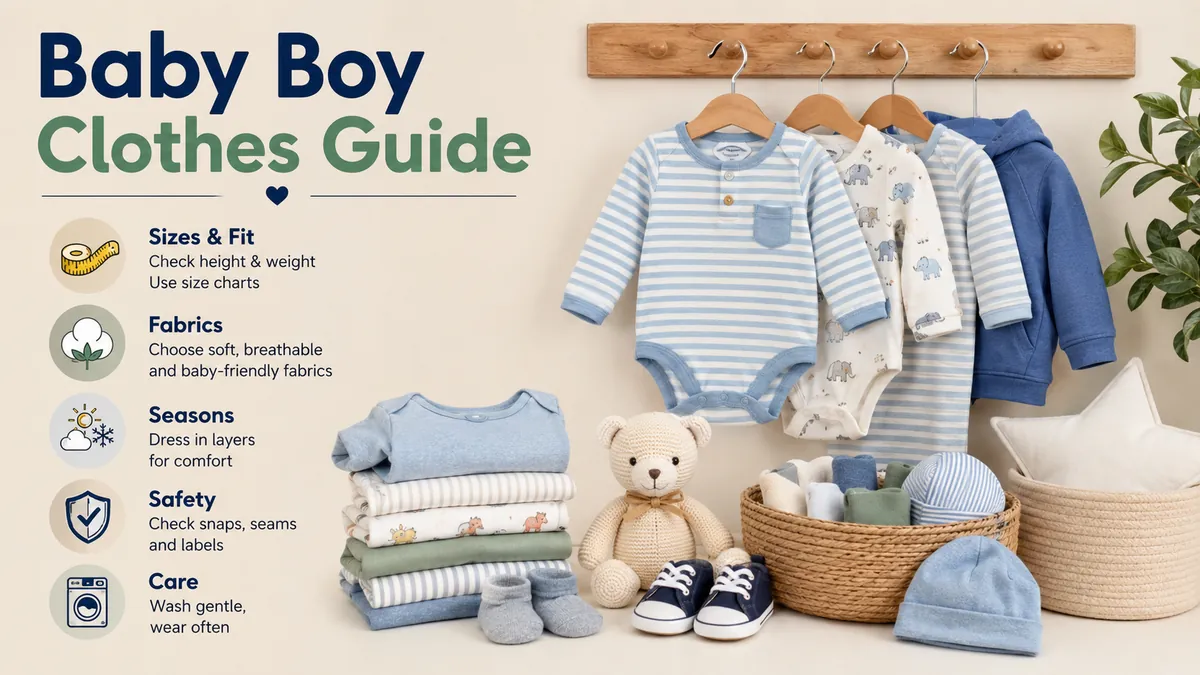
Buying baby boy clothes looks simple until you face newborn sizing, rapidly changing measurements, seasonal layers, sleepwear rules, different fabrics, and dozens of garments that may or may not get used. Babies grow quickly, so the most useful wardrobe is rarely the biggest one. It is the one built around comfort, easy diaper changes, appropriate sizing, safe sleepwear, and washable everyday basics.
Baby boy clothes should be soft, correctly sized, easy to put on and remove, suitable for the weather, and practical for frequent washing and diaper changes. A useful infant wardrobe usually centers on bodysuits, sleepers, rompers, pants, tops, socks, seasonal layers, and a small number of special-occasion outfits rather than large quantities of one size.
What baby boy clothes are actually essential?
For the first year, babies spend much more time sleeping, feeding, being changed, crawling, and playing than dressing for formal occasions. That makes practical baby clothing far more valuable than complicated outfits.
Current baby-clothing ranges from major retailers consistently organize infant wardrobes around categories such as bodysuits, one-pieces, rompers, pajamas, bottoms, tops, outerwear, shoes, accessories, and coordinated sets. Gap, for example, describes its baby range as covering newborn and infant sizes from 0 to 24 months, while Nordstrom similarly categorizes baby boy clothing through 24 months.
A balanced everyday wardrobe normally includes:
- Bodysuits for layering and everyday wear
- One-piece sleepers or pajamas
- Rompers for simple daytime outfits
- Soft pull-on pants or joggers
- Lightweight T-shirts or long-sleeve tops
- Socks or soft booties when needed
- A cardigan, sweatshirt, jacket, or other seasonal layer
- A few coordinated outfits for outings or photographs
- Weather-specific pieces such as sun hats, swimwear, coats, or snowsuits
The exact quantity depends far more on how often you do laundry than on the baby’s age.
If washing clothes every two or three days is realistic, you need fewer pieces. If laundry happens once a week, extra bodysuits and sleepers become much more useful.
Bodysuits
A bodysuit fastens underneath the diaper, usually with snaps. It stays tucked in better than a conventional T-shirt, which makes it especially practical during the early months.
Short-sleeve versions work alone in warm conditions or underneath another layer. Long-sleeve bodysuits provide additional coverage during cooler weather.
Envelope-style shoulders or wider neck openings can also make dressing easier.
Sleepers and one-piece pajamas
Sleepers cover most or all of the body in one garment. Many have snaps or zippers positioned to simplify diaper changes.
Gap specifically highlights zipper closures and inseam snaps as practical features in baby pajamas.
For nighttime changes, this seemingly minor detail matters. A two-way zipper that allows the lower half of the garment to open without completely undressing the baby can be especially convenient.
Rompers
Rompers combine a top and bottom into one garment. They are useful when you want the simplicity of a bodysuit with the appearance of a complete daytime outfit.
Short rompers suit warmer conditions, while long-sleeve and full-leg versions offer additional coverage in cooler weather.
Tops and bottoms
Once babies become more active, separate stretchy pants, leggings, joggers, shorts, T-shirts, sweatshirts, and sweaters become increasingly useful.
Elasticated waistbands usually work better for everyday wear than complicated belts, stiff waistbands, or decorative closures.
Choosing the right size for baby boy clothes
Age labels are helpful starting points, but they are not universal measurements.
One brand’s 3M clothing may fit differently from another brand’s 0–3M clothing. A baby’s height, weight, torso length, and body proportions matter more than the age printed on the tag.
That is why checking the manufacturer’s size chart is one of the most useful habits when choosing baby boy clothes.
Carter’s, for example, lists its bodysuit measurements approximately as follows:
| Label | Approximate height | Approximate weight |
|---|---|---|
| Newborn | 18–21.5 in | 6–9 lb |
| 3M | 21.5–24 in | 9–12.5 lb |
| 6M | 24–27 in | 12.5–17 lb |
| 9M | 27–28.5 in | 17–21 lb |
| 12M | 28.5–30 in | 21–25 lb |
| 18M | 30–32 in | 25–28 lb |
| 24M | 32–34 in | 28–30 lb |
These figures illustrate why age alone can be misleading. They are one manufacturer’s measurements, not a universal baby sizing system.
Should you buy newborn or 0–3 month clothes?
A sensible approach is to have some of both.
Newborn clothing can fit smaller babies better during the earliest weeks, but some babies begin wearing 0–3 month or 3M sizes quickly. Buying an entire wardrobe in newborn size before birth can therefore leave you with barely worn clothes.
For an expected newborn, concentrate on a modest number of newborn essentials and keep more garments in the next size available.
How do you know when baby clothes are too small?
Do not wait until the age printed on the tag changes.
Move up a size when you notice:
- Tightness around the neck, arms, thighs, or waist
- Deep elastic marks on the skin
- Difficulty fastening the crotch snaps
- A sleeper pulling noticeably at the toes
- Restricted movement
- A waistband pressing tightly into the abdomen
- Zippers becoming difficult to close comfortably
A little growing room is useful. Excessively oversized clothing, however, is not necessarily better, especially for sleepwear.
Best fabrics for everyday baby boy clothes
Fabric can make a greater difference to everyday comfort than color, print, or style.
For frequently worn garments, look for materials that feel soft against the skin, tolerate repeated washing, and suit the surrounding temperature.
Cotton
Cotton remains one of the most common materials in baby clothing, and current mainstream baby ranges frequently include standard and organic cotton bodysuits, pants, shirts, pajamas, and outfit sets. Gap and Nordstrom, for example, list numerous organic cotton baby garments.
Cotton works particularly well for:
Everyday bodysuits, lightweight pajamas, T-shirts, rompers, leggings, and layering pieces.
The material is generally soft and versatile, although different cotton knits can vary substantially in weight and stretch.
Organic cotton
“Organic” describes how the cotton was produced rather than automatically telling you whether a garment will be softer, safer, or more durable.
If organic production matters to you, look for credible certification information rather than relying only on marketing language.
From a practical standpoint, fit, construction, washability, seam quality, and fabric weight still matter.
Muslin and gauze
Cotton muslin and gauze are lightweight fabrics that can work particularly well in warm conditions.
They commonly appear in summer rompers, shirts, pants, and layering pieces because the open construction feels lighter than many dense knits.
Fleece
Fleece provides warmth but can be considerably warmer than lightweight cotton.
That makes it useful for cold-weather outer layers but less suitable as an automatic choice in every indoor environment. Pay attention to the baby’s temperature rather than assuming thicker clothing is always better.
Wool and merino wool
Fine merino wool is used in some premium baby garments because it can provide warmth without requiring extremely bulky clothing.
The downsides are price and care requirements. Some wool garments require gentler washing than ordinary cotton basics.
What about polyester blends?
Synthetic fibers are common in children’s clothing because they can improve stretch, shape retention, durability, or drying time.
There is no need to reject a garment simply because it contains polyester. Instead, consider where and how it will be worn. A soft cotton-elastane bodysuit, for example, may offer useful stretch, while a heavily insulated synthetic garment may be unnecessarily warm indoors.
baby boy clothes for different seasons
The best wardrobe changes with climate, indoor temperature, and daily activities.
Instead of building separate wardrobes around rigid seasonal labels, think in layers. Layers can be removed or added when conditions change.
Summer baby clothes
In hot weather, prioritize lightweight garments.
A typical warm-weather wardrobe might include short-sleeve bodysuits, short rompers, lightweight shorts, soft T-shirts, breathable pajamas, and a sun hat for appropriate outdoor use.
Avoid dressing a baby according to how an outfit photographs. If several coordinated layers look cute but make the baby hot, simplify the outfit.
Winter baby clothes
Cold-weather dressing works best with manageable layers rather than one extremely bulky outfit.
Depending on temperature, this might mean a bodysuit underneath a sleeper or outfit, followed by a sweater or jacket when going outside.
Coats, buntings, snowsuits, hats, and warmer footwear can become useful in genuinely cold climates. Retail baby collections commonly include sweaters, jackets, sherpa buntings, and snowsuits as seasonal outerwear.
Indoor layers should be adjusted once you enter a heated building.
Spring and fall
Transitional weather is where layering becomes especially useful.
Keep lightweight cardigans, zip jackets, long-sleeve bodysuits, pull-on pants, and a mixture of short- and long-sleeve garments available.
You can then change one layer rather than replacing the entire outfit.
How should a baby be dressed for sleep?
Sleep clothing deserves separate attention because nighttime safety matters more than styling.
In the United States, the Consumer Product Safety Commission regulates children’s sleepwear above certain infant sizes. Covered sleepwear generally must meet prescribed flammability requirements or qualify as tight-fitting sleepwear according to specified dimensions.
The CPSC advises that children’s sleepwear should be flame-resistant where required or properly snug-fitting rather than substituting loose-fitting ordinary clothing for pajamas.
That makes the product label worth reading.
If pajamas carry instructions saying they should fit snugly, do not intentionally size up simply to get several additional months of use.
For babies, sleep clothing should also match the room conditions. Thick layers are not automatically better. Lightweight, appropriately fitted sleep clothing can help avoid unnecessary overheating.
The practical rule is simple: separate daytime fashion decisions from sleepwear decisions. Something suitable for photographs, outings, or daytime lounging is not automatically suitable as pajamas.
Safety details parents can easily overlook
Most clothing decisions are about comfort and convenience, but a few design details deserve closer inspection.
Check decorations and fasteners
Before dressing a baby, inspect buttons, snaps, appliqués, decorative patches, bows, and other attachments.
If something is loose, repair or retire the garment rather than waiting for it to fall off.
This becomes especially relevant as babies increasingly grab objects and put things in their mouths.
Avoid unnecessarily complicated neckwear
For everyday infant clothing, simpler designs are usually easier to manage.
Long decorative ties, cords, and elaborate accessories add little practical value.
The CPSC specifically identifies hood and neck drawstrings on children’s upper outerwear in sizes 2T through 12 as a substantial strangulation hazard. Although that rule applies to older children’s specified outerwear sizes rather than infant clothing generally, it illustrates why cords around children’s neck areas deserve particular caution.
Think about the car seat separately
Bulky outerwear can affect how a car-seat harness fits.
Rather than assuming a thick winter coat belongs underneath the harness, follow the instructions supplied by the child’s specific car-seat manufacturer.
Inspect secondhand clothing
Pre-owned baby clothes can make excellent sense because infants often outgrow garments long before the fabric wears out.
Still, inspect every piece for broken zippers, loose snaps, stretched elastic, missing fasteners, damaged seams, cords, and detachable embellishments before use.
For sleepwear or specialized garments, make sure essential safety and care labels remain readable whenever possible.
How many baby clothes do you really need?
There is no universal magic number.
A newborn who spits up frequently or experiences diaper leaks may go through several outfits in one day. Another baby may wear the same daytime outfit for hours.
Laundry frequency matters just as much.
A practical starter wardrobe could contain roughly six to ten everyday bodysuits, five to eight sleepers, several rompers or outfits, four to six comfortable bottoms, a few tops, several pairs of socks, and weather-appropriate outer layers.
Treat those numbers as planning guidance rather than a required checklist.
The smartest approach is to begin moderately and add pieces when you discover what your routine actually uses.
Buy more basics than formal outfits
One common mistake is creating a wardrobe full of adorable coordinated clothing while running short of simple sleepers and bodysuits.
The reverse balance works better.
Most babies need washable basics repeatedly. They need dress shirts, suspenders, tiny jeans, holiday outfits, and photo clothing occasionally.
Special-occasion clothing certainly has a place; current baby ranges frequently feature button-down shirts, overalls, coordinated sets, sweaters, and dressier pants.
Just keep their quantity proportional to how often they will actually be worn.
Features that make baby clothes easier to use
A garment can look excellent on a hanger and become frustrating after the first diaper change.
Practical construction matters.
For young babies, look closely at neck openings, crotch snaps, zipper placement, waistband stretch, cuffs, seams, and access to the diaper.
Two-way zippers can simplify nighttime changes. Snaps along the inseam can make rompers easier to use. Stretchy necklines help when pulling bodysuits over a baby’s head.
Soft elasticated pants usually allow easier movement than stiff structured trousers.
For babies learning to crawl, avoid designs that put thick knots, oversized decorations, or uncomfortable fasteners directly beneath the knees, abdomen, or back.
For babies beginning to walk, mobility becomes even more important. Clothing should allow the hips and knees to bend freely rather than forcing the child to move around the outfit.
How to build a baby wardrobe without wasting clothes
Babies can move through sizes surprisingly quickly. Buying strategically reduces the pile of barely worn clothing.
Start by purchasing the most frequently used basics in the baby’s current size. Keep a smaller selection in the next size ready rather than buying months of clothing far in advance.
This is particularly useful with seasonal items. A winter coat purchased six months early may reach the right size in summer.
Mix-and-match colors save effort
A wardrobe built around compatible colors creates more outfit combinations from fewer pieces.
Neutral colors are useful but not mandatory. Blue, green, rust, yellow, red, cream, brown, gray, navy, stripes, animals, vehicles, and brighter prints can all coexist if several bottoms work with several tops.
The principle matters more than the palette.
Instead of purchasing six completely separate outfits, choose interchangeable pieces.
Multipacks are useful for high-rotation items
Bodysuits, socks, basic pants, and pajamas are good candidates for multipacks because they are worn repeatedly.
Formal clothing is less suitable for bulk buying because babies may only wear each piece once before outgrowing it.
Leave tags on future sizes
If you purchase ahead, keep tags attached until the garment is actually needed.
Babies do not always grow according to predicted seasonal timing, and unopened items are easier to exchange where retailer policies allow.
Washing and caring for baby boy clothes
Baby clothing gets washed often, so complicated care requirements can become inconvenient quickly.
Always start with the garment’s care label because fabrics and finishes differ.
Separate items when required, fasten zippers to prevent snagging, and check pockets or attached accessories before washing.
Treat stains sooner rather than allowing milk, food, or diaper stains to dry for days.
Before the garment goes back into the wardrobe, check that fasteners remain secure and seams have not started to separate.
There is also no practical prize for preserving every outfit perfectly. Everyday infant clothes are supposed to be worn, washed, stained, and eventually outgrown.
When should you move from baby sizes to toddler clothes?
The transition is not determined by the first birthday.
Many baby collections extend through 18 or 24 months. Gap’s current baby section covers sizes through 24 months, while Nordstrom separates its baby boy assortment into age ranges through 18–24 months.
Some brands then switch to toddler sizing such as 2T.
Baby 24M and toddler 2T are not necessarily identical, even when intended for similar ages. Toddler garments may be cut differently to accommodate a more mobile child’s proportions.
Again, the size chart beats the age label.
Choosing baby boy clothes that work in real life
The most useful baby boy clothes are not necessarily the most expensive, fashionable, or elaborate. They are the pieces that fit comfortably, wash well, match the weather, allow unrestricted movement, make diaper changes easier, and suit the activity for which they are being worn.
Build the wardrobe around bodysuits, sleepers, rompers, soft pants, simple tops, pajamas, and seasonal layers. Check height and weight rather than relying exclusively on age labels, follow garment-specific sleepwear instructions, inspect fasteners and decorations regularly, and avoid buying too heavily into one size.
Once those basics are covered, colors, prints, coordinated sets, and special outfits can make dressing a baby fun without turning the wardrobe into a collection of clothes he outgrows before wearing.