
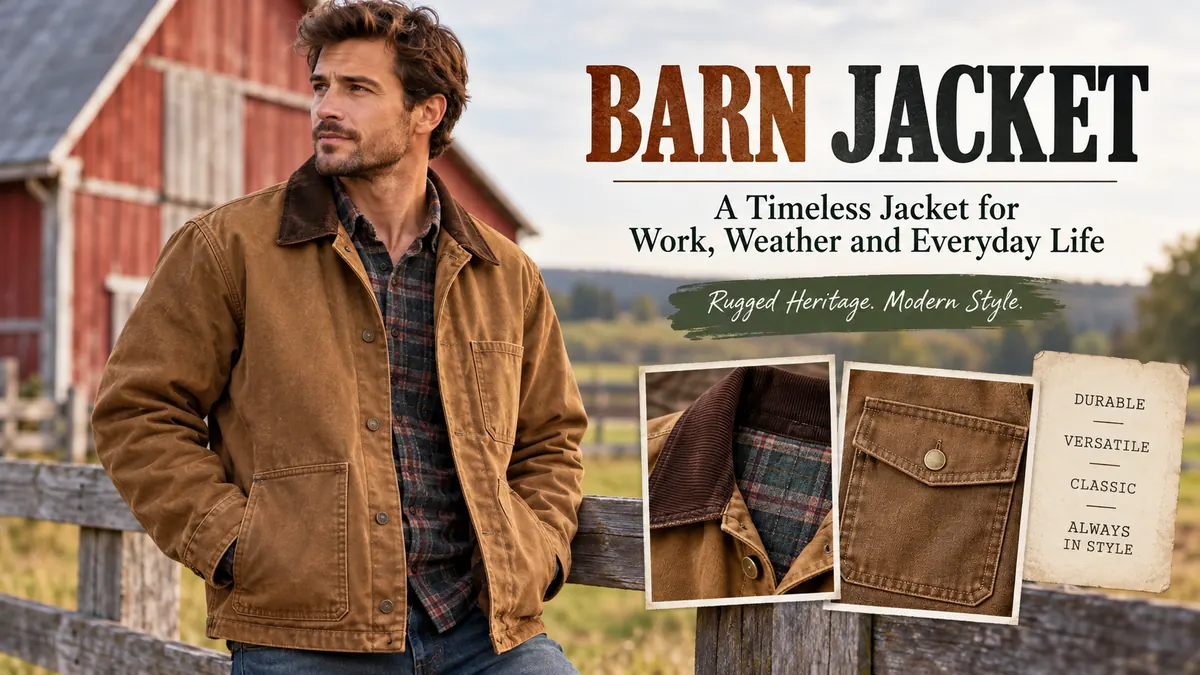
A barn jacket looks simple: sturdy fabric, roomy pockets, a relaxed shape, and often a contrasting corduroy collar. Yet this practical piece of outerwear has traveled a long way from farms, fields, and outdoor work to city streets and fashion runways.
Its appeal comes from that balance. A barn jacket can protect against wind and light weather, carry everyday essentials, layer comfortably over knitwear, and still look polished enough to wear away from the countryside. Recent interpretations from Prada, Loewe, Toteme, The Row, J.Crew, Barbour, and Carhartt have helped keep the silhouette visible in contemporary fashion.
A barn jacket is a loose, usually hip-length utility jacket originally associated with outdoor work. It typically has durable cotton or canvas construction, large patch pockets, a boxy fit, button or snap closures, and a contrasting corduroy or leather collar. Some versions use waxed fabric, lining, or insulation for additional weather protection.
What Is a Barn Jacket?
The easiest way to recognize a barn jacket is by its practical construction rather than any single design detail.
Traditional versions are relatively roomy and finish around the hips. Large pockets dominate the front because the garment was created with utility in mind rather than purely decorative styling. Durable cotton, canvas, drill, moleskin, and waxed cotton are closely associated with this family of workwear.
A contrasting collar is another major visual clue. Corduroy is particularly common, although leather and other materials are also used. Cambridge Dictionary describes the garment as a loose, hip-length jacket with large pockets, typically made from thick cotton and sometimes treated with wax for rain resistance.
Typical characteristics include:
- A straight or slightly boxy silhouette
- Hip-length coverage
- Large patch or utility pockets
- Cotton canvas, drill, denim, moleskin, or waxed cotton
- Corduroy or leather contrast collar
- Button, snap, or zipper closure
- Room for layering underneath
- Earthy colors such as brown, tan, olive, khaki, cream, and navy
- Optional flannel, tartan, quilted, or other warm lining
Not every modern version includes all these features. Designers increasingly experiment with cropped lengths, oversized proportions, suede, leather, technical fabrics, unusual colors, and more tailored silhouettes.
The recognizable DNA, however, remains rooted in functional outdoor clothing.
Where Did the Barn Jacket Come From?
The history of the barn jacket overlaps with several related garments, particularly chore coats, field jackets, hunting coats, and traditional work jackets. That overlap explains why accounts of its exact origin can differ.
From European workwear to American utility clothing
One important predecessor is the French chore jacket.
During the 19th century, French laborers, farmers, and railway workers wore practical jackets constructed from tough materials such as cotton drill and moleskin. Roomy pockets allowed workers to carry tools and personal items, while uncomplicated construction made the garments practical for physical work.
The classic French work jacket became associated with bleu de travail, or “working blues,” referring to the distinctive blue work clothing worn by laborers.
As similar utilitarian ideas developed in North America, heavier jackets became particularly useful for farming, ranching, hunting, and other outdoor activities.
American versions increasingly incorporated details we now associate with barn outerwear: tougher canvas, generous pockets, warmer construction, weather resistance, and contrasting collars.
Workwear brands helped define the American look
Carhartt, founded in 1889, became closely associated with rugged American workwear. Its durable canvas outerwear helped establish the visual language that continues to influence modern chore and barn jackets. British Vogue notes that Carhartt WIP later translated this workwear heritage into lifestyle fashion.
L.L.Bean also played an important role in American outdoor clothing. Hunting and field coats emphasized useful features such as large pockets and collars that could be turned upward for extra protection.
Across the Atlantic, Barbour developed its own influential tradition of waxed outerwear for demanding outdoor conditions. Barbour’s weather-resistant country clothing shares several visual and functional qualities with today’s barn jacket, although the histories and individual garment designs are not identical.
That distinction matters: barn jacket, chore coat, field jacket, and waxed country jacket are related terms, but they do not always describe exactly the same garment.
How the Barn Jacket Became a Fashion Staple
Few garments move successfully from genuine work clothing to mainstream fashion without losing their original identity. The barn jacket managed to do it largely because its functional features also happen to create an attractive casual silhouette.
One particularly important moment came in 1983.
J.Crew introduced its Barn Jacket in 1983, helping turn the style into a recognizable part of American preppy casualwear. J.Crew has repeatedly returned to the design, including collaborations with Barbour and heritage-inspired reinterpretations.
The formula worked because it sat comfortably between several wardrobes.
It was rugged without looking like specialized technical gear. It was preppy without the formality of a blazer. And it offered more character than a basic lightweight jacket.
The runway revival
The style eventually moved much further into high fashion.
Jonathan Anderson presented cropped, waxed-cotton interpretations at Loewe’s spring/summer 2023 show. Prada’s spring/summer 2024 collection then prominently featured worn-looking barn jackets in traditional shades including navy, khaki, brown, and hunter green.
Toteme, The Row, and other fashion labels subsequently explored the same broad workwear language. Celebrities and street-style dressing reinforced the trend, while heritage manufacturers continued producing more traditional versions.
By 2026, the jacket had outgrown the idea of being merely a short-lived revival. Vogue described it as a continuing transitional staple, appearing at fashion weeks and in collections while retaining the boxy silhouette, pockets, contrast collar, and durable construction associated with its practical origins.
What Makes a Barn Jacket Different From Similar Jackets?
This is where terminology can become confusing.
Retailers sometimes use “barn,” “chore,” “field,” and “utility” interchangeably because the garments share visual characteristics. Looking at construction is more useful than relying entirely on a product name.
| Jacket type | Typical length | Common material | Defining characteristics | Traditional purpose |
|---|---|---|---|---|
| Barn jacket | Hip length | Canvas, cotton, waxed cotton | Large pockets, contrast collar, relaxed shape | Farm and outdoor work |
| Chore coat | Hip to upper thigh | Cotton drill, denim, moleskin | Patch pockets, simple collar, workwear construction | Manual labor |
| Field jacket | Hip to thigh | Cotton or technical fabric | Multiple pockets, military influence | Military/outdoor use |
| Waxed jacket | Varies | Waxed cotton | Water-resistant finish | Country and outdoor wear |
| Hunting jacket | Hip to thigh | Canvas or waxed cotton | Game/storage pockets, rugged construction | Hunting |
| Bomber jacket | Waist/hip | Nylon, leather, cotton | Ribbed hem and cuffs | Aviation |
| Trucker jacket | Waist/hip | Denim | Short structured body, chest pockets | Work/casual wear |
A classic barn coat usually feels more substantial and outdoors-oriented than the traditional French chore jacket.
Its contrast corduroy collar is particularly recognizable.
A field jacket, meanwhile, generally carries stronger military influences and often features multiple flap pockets and additional adjustment points.
Barn Jacket Materials Explained
Material changes how the jacket performs, ages, hangs on the body, and feels throughout the year.
Cotton canvas
Canvas is one of the most natural materials for traditional workwear.
Its dense construction resists everyday abrasion and develops character with repeated wear. A new canvas jacket may initially feel somewhat rigid, but good cotton canvas tends to soften gradually.
This makes it particularly appropriate for someone who likes clothing that looks better rather than newer with age.
Waxed cotton
Waxed cotton adds greater resistance to wind and light rain.
The fabric is treated with wax to reduce the amount of moisture passing through it. The result has a distinctive texture that develops creases and patina as it is worn.
Barbour is especially closely associated with waxed country outerwear. A modern J.Crew and Barbour collaboration, for example, used four-ounce waxed cotton with Barbour’s signature tartan lining.
Waxing does not automatically make a garment equivalent to a fully waterproof technical shell. Performance depends on construction, treatment, seams, condition, and exposure.
Cotton drill and moleskin
These fabrics connect modern designs to European workwear traditions.
Cotton drill is strong and tightly woven. Moleskin is also a densely woven cotton fabric but has a soft, brushed surface that gives it a warmer and slightly more refined feel.
Neither should be confused with actual animal skin.
Denim
Denim versions move the jacket closer to casual workwear.
They can be especially useful when someone likes the utility shape but does not want the traditional country aesthetic of brown canvas or olive waxed cotton.
Suede and leather
Fashion-focused versions sometimes replace workwear cotton with suede or leather.
The result retains the silhouette but changes its personality considerably. A suede barn jacket can look softer and more luxurious, while leather creates a stronger statement.
For fall 2026, for example, Banana Republic and La Ligne included a nubuck barn jacket in their collaborative collection, illustrating how far the silhouette can move beyond traditional canvas.
Why Does a Barn Jacket Have a Corduroy Collar?
The contrast collar isn’t simply decoration.
Corduroy feels softer against the neck than stiff canvas and provides a little extra comfort when the collar is turned upward. Historically, practical collars could be raised to give the neck more protection from cold and wind.
Visually, the contrasting texture also breaks up a large area of heavy cotton.
That detail has become so closely associated with the style that a brown or olive canvas jacket with large pockets and a dark corduroy collar is immediately recognizable as barn-inspired outerwear.
Modern designers sometimes replace corduroy with leather, suede, or tonal fabric, but the contrasting collar remains one of the strongest identifiers.
How Should a Barn Jacket Fit?
A traditional barn jacket should not fit like a tailored blazer.
Its origins required freedom of movement and enough room for layers. Consequently, a little space through the chest and body is normal.
The shoulders should still sit reasonably well unless the garment is deliberately oversized. The sleeves should allow movement without swallowing the hands, and the body generally ends around the hips.
A practical rule is simple: judge the fit while wearing the thickest layer you realistically expect to put underneath it.
Trying one over a thin T-shirt can make a jacket appear perfectly sized, only for it to become restrictive once a sweatshirt or sweater is added.
Relaxed does not mean shapeless
There is a difference between intentional volume and simply wearing a jacket that is too large.
A good relaxed fit gives you:
- Comfortable shoulder and arm movement
- Space for a sweater or sweatshirt
- A clean line through the body
- Sleeves that reach approximately the wrist
- Enough room to fasten the jacket without pulling
If the shoulders collapse significantly, sleeves cover most of the hands, and the body extends far beyond the intended length, you may have crossed from relaxed into oversized.
That can still work stylistically—but it is a different look.
How to Style a Barn Jacket Without Looking Like You’re Doing Farm Work
The easiest approach is contrast.
Because the jacket already carries a strong workwear identity, pairing every other piece with the same rugged aesthetic can make an outfit feel costume-like. Mixing it with cleaner wardrobe staples produces a more contemporary result.
Barn jacket with jeans
This is the simplest combination.
Try an olive, tan, or brown jacket with straight-leg blue denim, a white T-shirt, and leather shoes or sneakers.
The jacket provides texture while the rest of the outfit stays uncomplicated.
For a more workwear-heavy outfit, darker denim and boots work naturally. For something cleaner, use straight dark jeans, a fine-gauge sweater, and loafers.
Barn jacket with trousers
One reason the current interpretation feels different from old farmwear is that people increasingly combine rugged outerwear with smarter clothing.
A canvas jacket over a button-down shirt, knitwear, and pleated trousers creates useful tension between practical and polished pieces.
The same principle explains why contemporary designers have successfully paired these jackets with tailoring.
Barn jacket with skirts and dresses
Women’s styling does not have to imitate menswear workwear.
Prada famously emphasized contrast by placing rugged barn-style jackets over sheer and fringed skirts, while other designers have paired similar outerwear with dresses and softer fabrics.
A midi skirt with a boxy jacket creates a similar balance in a much more wearable everyday form.
You can also combine one with:
- A slip dress and boots
- A denim skirt and knit
- A pleated midi skirt
- A simple mini dress and loafers
- A long dress with a cropped version
The visual weight of the outerwear keeps delicate pieces from feeling overly formal.
Barn jacket with knitwear
This may be the most natural cold-weather combination.
A crewneck sweater, rollneck, cardigan, or simple wool knit fits comfortably underneath the relaxed silhouette.
Keep the knit relatively simple if the jacket already has prominent pockets, hardware, lining, or a strongly contrasting collar.
Quick Takeaway: Let the barn jacket supply the rugged element. Combining it with clean denim, trousers, simple knitwear, skirts, or dresses usually looks more natural than building an entire head-to-toe “country” outfit.
Choosing the Right Color
Traditional colors remain popular because they reflect the jacket’s outdoor origins and are easy to combine with everyday wardrobes.
Olive and hunter green
Green may be the color most immediately associated with field and country clothing.
It works particularly well with cream, navy, brown, faded denim, burgundy, gray, and white.
Brown and tan
Brown canvas emphasizes the American workwear side of the garment.
Wear it with blue denim for a classic combination or use black trousers to make the overall outfit more contemporary.
Navy
Navy is one of the easiest choices if you want the silhouette without a strong farmwear impression.
It combines naturally with gray trousers, blue jeans, khaki chinos, cream knitwear, and white shirts.
Black
A black barn jacket strips away some of the garment’s countryside associations.
The pockets, collar, and silhouette remain recognizable, but monochromatic styling can make the piece feel more urban.
Cream and beige
Lighter versions emphasize the jacket’s shape rather than its ruggedness.
They work particularly well during spring and early fall, although stains and visible wear obviously become more noticeable.
Is a Barn Jacket Warm?
Sometimes—but not necessarily.
A barn jacket describes a general outerwear style rather than a standardized level of insulation. Two jackets that look nearly identical can perform very differently in cold weather.
An unlined cotton version may be ideal for mild fall or spring temperatures. A flannel- or quilt-lined version can handle considerably cooler conditions.
Consider four things:
- Shell material: Heavy canvas generally blocks wind better than lightweight cotton.
- Lining: Flannel, wool blends, fleece, and quilted insulation add warmth.
- Fit: Extra room allows sweaters and other insulating layers underneath.
- Length and closure: More coverage and a secure front reduce exposure.
This is why the garment is frequently described as transitional outerwear. Vogue continues to position it as a useful layering piece between seasons rather than treating every barn-style jacket as a winter coat.
For genuinely severe cold, an insulated parka or technical winter jacket will normally provide more dependable protection.
Is a Barn Jacket Waterproof?
Not automatically.
Untreated cotton canvas can absorb water. Waxed cotton provides considerably better resistance, but “water-resistant” and “waterproof” should not be treated as synonyms.
A traditional waxed jacket is useful in drizzle, damp conditions, and changeable weather. Prolonged heavy rain is a different test.
Wax treatments also wear down.
Areas exposed to frequent friction—elbows, cuffs, pockets, shoulders—may eventually lose some of their original weather resistance. Depending on the garment, rewaxing can restore much of the protective finish.
Always follow the manufacturer’s care instructions because ordinary detergent, machine washing, dry cleaning, or high heat can damage certain wax finishes.
Barn Jacket vs. Chore Coat: Are They the Same Thing?
The terms overlap, but there is a useful distinction.
The classic chore coat is strongly associated with European industrial workwear. It typically has a simple point collar, button front, roomy patch pockets, and cotton drill, moleskin, or denim construction.
The American barn jacket tends to be somewhat heavier and more outdoors-oriented.
It commonly adds features such as:
- A contrasting corduroy collar
- Heavier canvas
- Weather-resistant treatment
- Warmer lining
- Larger utility pockets
- A slightly more substantial structure
There are plenty of exceptions. Contemporary brands borrow details freely, so one company might call essentially the same garment a chore coat while another labels it a barn coat, field coat, or utility jacket.
Rather than worrying excessively about terminology, examine the fabric, pockets, lining, collar, length, and weather protection.
Those details tell you more about what the garment will actually do.
Barn Jacket vs. Barbour-Style Waxed Jacket
These are also easy to confuse.
Barbour was founded by John Barbour in South Shields, England, in 1894 and became known for weather-resistant outerwear and countrywear.
Traditional British waxed jackets are closely connected with shooting, equestrian activities, farming, fishing, and country life. Their waxed cotton, corduroy collars, large pockets, earthy colors, and relaxed shapes naturally overlap with barn-jacket aesthetics.
The difference is largely one of lineage and design.
“Barn jacket” describes a broader American workwear-influenced style, whereas Barbour refers to a specific British company with numerous individual jacket models.
Modern fashion deliberately blurs those boundaries—as demonstrated by J.Crew and Barbour creating a collaborative waxed-cotton Barn Jacket.
What to Look for in a Well-Made Barn Jacket
A fashionable silhouette matters, but this type of garment makes the most sense when it retains some of its original practicality.
Check the shell fabric
Look at both fiber content and fabric weight.
A substantial canvas should feel durable without becoming unnecessarily restrictive. If weather resistance matters, determine whether the material has been waxed or otherwise treated rather than assuming that heavy cotton will repel rain.
Examine the pockets
Useful pockets are part of the jacket’s identity.
Check whether your hands fit comfortably and whether important pockets can actually secure their contents. Some fashion interpretations preserve the appearance of traditional workwear while making the pockets surprisingly shallow.
Look at stress points
Seams around shoulders, pocket openings, cuffs, and closures experience regular strain.
Clean stitching and reinforcement at high-stress areas are more meaningful indicators of practical construction than decorative heritage details.
Consider the lining
An unlined model is more adaptable during mild weather.
A quilted or flannel lining provides warmth but reduces seasonal versatility. If you already plan to wear heavy knitwear underneath, a thick lining may not be necessary.
Test movement
Reach forward, raise your arms, sit down, and fasten the jacket.
Workwear-inspired clothing should allow movement. A jacket that looks excellent while standing still but pulls sharply across the shoulders defeats one of the main advantages of the silhouette.
How to Care for a Barn Jacket
Care depends heavily on material.
Never assume that every canvas-looking jacket can go straight into a washing machine.
Ordinary cotton and canvas
Check the care label first.
Washable cotton usually benefits from cooler temperatures and gentler cleaning because excessive heat can cause shrinkage and accelerate fading.
Some fading is not necessarily undesirable. Workwear fabrics often develop a softer, more individual appearance as they age.
Waxed cotton
Treat waxed cotton differently.
Routine maintenance generally focuses on brushing or wiping away surface dirt rather than conventional washing. When the finish becomes dry or uneven, compatible wax can be reapplied according to the manufacturer’s instructions.
Avoid improvising with harsh detergents or high heat.
Corduroy collars
Collars collect skin oils and dirt faster than much of the body.
Gentle spot cleaning can help, but again, the shell fabric matters. Aggressive cleaning around a corduroy collar on a waxed jacket may disturb the surrounding finish.
Suede
Suede needs its own care routine and is more vulnerable to staining and moisture than ordinary canvas.
A suede brush and appropriate specialist cleaner are generally safer than treating it like cotton workwear.
Can You Wear a Barn Jacket Year-Round?
For most climates, think of it primarily as transitional outerwear.
Spring and fall are its natural seasons because the relaxed construction works over light layers without the bulk of a full winter coat.
A lightweight cotton version can also work during cool summer evenings. A lined or heavier waxed version extends farther into winter when paired with knitwear.
The jacket’s usefulness therefore depends more on construction than its name.
| Season | Best construction | Useful layers |
|---|---|---|
| Spring | Lightweight cotton or unlined canvas | T-shirt, shirt, light knit |
| Summer evenings | Lightweight cotton | T-shirt or linen shirt |
| Fall | Canvas or waxed cotton | Sweater, sweatshirt, overshirt |
| Mild winter | Lined canvas/waxed cotton | Wool knit, fleece, thermal layer |
| Severe winter | Usually insufficient alone | Insulated outerwear is preferable |
That adaptability is a major reason the design has survived repeated fashion cycles.
Why the Barn Jacket Keeps Coming Back
Fashion trends often disappear when the visual novelty wears off.
The barn jacket has an advantage: it was useful before it was fashionable.
Large pockets remain useful. Durable cotton still ages well. A relaxed cut still accommodates layers. A collar that can be turned up still provides protection. Neutral colors still combine easily with denim and knitwear.
Fashion can change the proportions without destroying those fundamentals.
Loewe can crop it. Prada can make it deliberately worn-in. The Row and Toteme can refine it. Carhartt can emphasize workwear heritage. Barbour can approach it through waxed country clothing. J.Crew can lean into American prep.
The underlying idea remains recognizable.
That is also why the jacket works across men’s and women’s wardrobes. Its core design isn’t dependent on a narrow trend-driven silhouette.
Is the Barn Jacket Still in Style in 2026?
Yes, but it is increasingly useful to think of it as a recurring outerwear category rather than a single-season trend.
The fashion revival accelerated through Loewe’s spring/summer 2023 collection and Prada’s spring/summer 2024 runway, followed by interpretations from labels including Toteme and The Row.
The style remained visible going into fall 2026. Vogue’s August 2026 coverage described barn jackets as a continuing transitional staple and highlighted their presence across contemporary street style and fashion collections.
What changes from season to season is the styling.
One year may favor oversized canvas versions; another may emphasize cropped proportions, suede, technical fabrics, or cleaner minimal shapes. The recognizable utility pockets, contrast collar, and relaxed construction provide continuity.
Common Barn Jacket Styling Mistakes
The garment is forgiving, but a few choices can make it harder to wear.
Too many heritage pieces at once is the most common issue. A barn jacket, plaid shirt, heavy work jeans, rugged boots, cowboy hat, and multiple country accessories can quickly become thematic rather than natural.
Choose one or two rugged elements and let simpler clothing balance them.
Ignoring proportions creates another problem. An oversized jacket paired with extremely loose trousers can overwhelm the body unless that volume is intentional. Conversely, very slim trousers beneath a dramatically oversized coat can make the upper body appear disproportionately heavy.
Buying only for appearance is equally limiting.
If you need rain resistance, check the fabric treatment. If you need winter warmth, inspect the insulation. If you want a spring layer, avoid unnecessarily heavy lining.
A barn jacket’s heritage is based on function, so its practical details deserve as much attention as its appearance.
The Barn Jacket Is More Than a Passing Workwear Trend
The barn jacket occupies an unusual place in modern clothing. It can reference French chore coats, American farm and hunting gear, British waxed country jackets, preppy J.Crew catalogs, Carhartt workwear, and Prada runways without completely belonging to any one of them.
Its defining characteristics remain refreshingly straightforward: durable fabric, useful pockets, a relaxed hip-length silhouette, and often a contrasting corduroy or leather collar.
Choose lightweight cotton for easy transitional layering, canvas for traditional durability, waxed cotton when weather resistance matters, or a lined version when warmth is the priority. Then wear it with clothing you already own rather than trying to build an entire heritage costume around it.
That combination of utility, durability, adaptability, and understated style is why the barn jacket has lasted—and why it continues to make sense long after the latest fashion cycle moves on.