
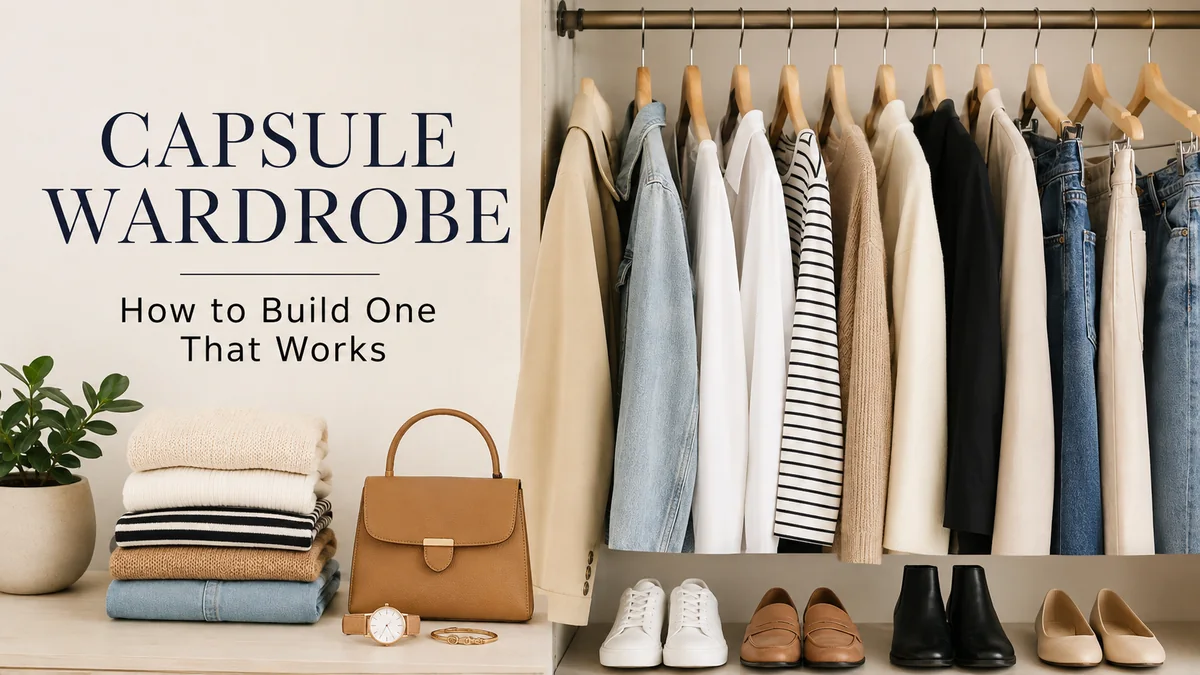
A packed closet can still leave you feeling like you have nothing to wear. The problem is often not the number of clothes you own, but how poorly those clothes work together.
A capsule wardrobe is a carefully chosen collection of versatile clothing that can be mixed and matched into many outfits. Rather than following a rigid item limit, it focuses on fit, coordination, personal style, lifestyle needs, and repeat wear. The result is a smaller, more functional wardrobe that makes everyday dressing easier.
The concept has been around for decades. London boutique owner Susie Faux helped revive the term in the 1970s, describing a wardrobe built around essential pieces that do not quickly go out of fashion. Designer Donna Karan later helped popularize capsule dressing in the 1980s.
Today, the idea has become more flexible. You do not need to become a strict minimalist or replace your entire closet. A useful capsule simply gives you a dependable foundation for getting dressed.
What Is a capsule wardrobe?
At its simplest, a capsule wardrobe is a limited collection of clothes selected because they work well together.
Imagine opening your closet and finding that most of your shirts coordinate with most of your trousers, jeans, skirts and jackets. Your shoes work with several outfits instead of one. Your outerwear layers comfortably over the clothes underneath.
That compatibility is the real point.
A traditional capsule usually emphasizes:
- Versatile tops
- Reliable bottoms
- Layering pieces
- Everyday dresses where appropriate
- Practical outerwear
- A small selection of shoes
- Coordinating colors
- Seasonal additions
Some modern guides suggest approximately 25 to 40 pieces per season, although there is no universal number you must follow. Lifestyle, climate, work requirements and personal preferences matter far more than hitting an arbitrary total.
Someone working in a formal office may need several tailored trousers, button-up shirts and blazers. A person working remotely might rely more heavily on jeans, knitwear and comfortable casual clothing.
Both can have successful capsules.
A capsule wardrobe is not a uniform
One common misconception is that capsule dressing means wearing black, beige and white every day.
It doesn’t.
Neutral colors make mixing pieces easier, which explains their popularity in capsule guides, but color, patterns and statement pieces can still belong in the system. The important question is whether they coordinate with enough of your other clothes to earn regular wear.
Your wardrobe should still look like you.
Why Build a capsule wardrobe?
The strongest reason to create a capsule is not simply to own fewer clothes.
It is to own clothes that produce more usable outfits.
A large wardrobe can be surprisingly restrictive when individual garments were purchased separately without considering what you already own. You may have 100 pieces but repeatedly wear the same ten because everything else requires a particular shoe, jacket or top.
A coordinated capsule reverses that situation.
Getting dressed becomes faster
Decision fatigue is real when you are staring at dozens of unrelated choices.
With a coordinated wardrobe, you already know that your trousers work with several shirts and your jacket works over most of them. Instead of building an outfit from scratch every morning, you are choosing among combinations that have already been designed to work.
You understand your personal style better
Building a capsule forces you to pay attention to what you actually wear rather than what you imagine yourself wearing.
Perhaps you admire structured blazers online but consistently reach for cardigans. Maybe you keep buying bright dresses but spend most weekdays in trousers and simple tops.
Those patterns are useful information.
Clothes can receive more wear
A versatile white shirt might work with denim on Saturday, tailored trousers on Monday and under a sweater later in the week.
That versatility makes it much easier to justify its place in your closet.
Shopping becomes more intentional
Once your wardrobe has a clear structure, gaps become easier to identify.
Instead of thinking, “I need new clothes,” you might realize:
I need one lightweight layer that works with my three most-worn trousers.
That is a much more useful shopping criterion.
Travel can become easier
The same principles work especially well when packing.
A travel capsule emphasizes lightweight pieces that coordinate across multiple outfits. Current travel capsule guidance similarly focuses on mix-and-match garments, practical layers and accessories that can change the appearance of simple outfits.
Quick Takeaway: The goal isn’t maximum minimalism. A successful capsule gives you maximum usefulness from the clothes you choose to keep.
How Many Clothes Should Be in a capsule wardrobe?
There is no official capsule wardrobe number.
You will frequently see recommendations around 25–40 pieces, but treating that range as a rule can make the process unnecessarily difficult.
A better approach is to determine what your life requires.
For example:
| Category | Example Starting Range |
|---|---|
| Tops | 7–10 |
| Bottoms | 4–6 |
| Sweaters/knitwear | 2–4 |
| Dresses | 1–3 |
| Jackets/blazers | 2–3 |
| Outerwear | 1–3 |
| Shoes | 3–5 |
These are starting points rather than rules.
Underwear, sleepwear, gym clothing, uniforms and highly specialized equipment are commonly treated separately because they serve purposes different from an everyday capsule.
Climate matters too.
Someone experiencing four distinct seasons may rotate several capsules throughout the year. In a consistently warm climate, lightweight shirts, breathable trousers, dresses and sandals could form a larger share of the permanent wardrobe.
How to Build a capsule wardrobe Step by Step
The biggest mistake people make is assuming that creating a capsule requires buying an entirely new minimalist wardrobe.
It usually doesn’t.
Start with what you already own. Current capsule guidance from stylists and fashion publications consistently emphasizes identifying dependable existing pieces before filling genuine gaps.
1. Audit your current closet
Take your everyday clothing out and review it by category.
Separate:
- Shirts and T-shirts
- Sweaters
- Trousers
- Jeans
- Skirts
- Dresses
- Jackets
- Coats
- Shoes
Do not begin by asking what you should remove.
Ask what you wear.
Your most frequently worn garments provide clues about preferred silhouettes, fabrics, colors and levels of formality.
2. Identify your real weekly activities
A capsule needs to serve your actual schedule.
Write down how you typically spend a week.
For example:
- Office: 4 days
- Home: 2 days
- Social activities: 2 evenings
- Exercise: 3 sessions
- Formal events: occasional
If 70 percent of your life is casual, approximately 70 percent of your everyday wardrobe should probably support casual dressing.
Building around an imaginary lifestyle is one of the fastest ways to create another closet full of unworn clothing.
3. Find your favorite existing pieces
Choose the garments you repeatedly reach for.
Perhaps that includes:
- Straight-leg jeans
- A white T-shirt
- Black trousers
- A striped shirt
- A navy blazer
- A comfortable knit
- A midi dress
- White sneakers
Do not worry about whether these appear on someone else’s “essential wardrobe” checklist.
If they fit well, suit your lifestyle and coordinate easily, they are already strong capsule candidates.
4. Choose a practical color palette
A restrained palette improves interchangeability, and neutral foundations such as white, black, grey, navy, cream and denim remain common recommendations in capsule styling.
A simple structure is:
Base neutrals:
Choose two or three, such as black, navy, cream, grey, brown or white.
Accent colors:
Choose one to three shades you genuinely enjoy wearing.
Optional prints:
Add patterns that contain colors already present in your palette.
You are not permanently committing yourself to these colors. You are creating enough visual consistency that your clothes cooperate.
5. Build around versatile basics
Now look for the pieces that connect everything else.
Common capsule wardrobe essentials include:
| Essential | Why It Works |
|---|---|
| Plain T-shirt | Works alone or underneath layers |
| Button-up shirt | Can move between casual and smarter outfits |
| Jeans | Reliable everyday foundation |
| Tailored trousers | Useful for work and polished casual looks |
| Crewneck sweater | Easy cold-weather layer |
| Cardigan | Flexible temperature control |
| Blazer | Adds structure to simple outfits |
| Simple dress | Creates a complete outfit with one piece |
| Everyday sneakers | Works across many casual combinations |
| Loafers/flats/boots | Adds a smarter footwear option |
| Trench or practical coat | Provides adaptable outerwear |
White T-shirts, crisp shirts, straight-leg jeans, classic knitwear, simple dresses and fluid trousers continue to appear prominently in current capsule recommendations.
But “essential” is contextual.
If you never wear dresses, don’t buy one because a checklist says you need it.
6. Test every item for versatility
Before keeping or adding something, ask:
Can I create at least three outfits with this using clothes I already have?
Ideally, versatile basics will create considerably more.
Take one button-up shirt.
You might wear it:
- With jeans and sneakers.
- With trousers and loafers.
- Open over a T-shirt.
- Under a crewneck sweater.
- Tucked into a skirt.
- Under a blazer.
- With shorts in warm weather.
That is capsule logic in action.
7. Check fit before buying more
Versatility means very little if you dislike wearing the garment.
Fit is therefore one of the most overlooked parts of capsule building.
British Vogue’s current capsule guidance specifically emphasizes well-fitting foundational pieces and even suggests alterations when necessary because these clothes are intended to carry a significant share of everyday outfits.
Pay attention to:
- Shoulder placement
- Sleeve length
- Trouser rise
- Hem length
- Waist comfort
- Layering room
- Fabric movement
A modestly priced garment that fits beautifully can become more useful than an expensive “investment piece” you constantly adjust.
8. Fill gaps slowly
After building your first capsule from existing clothes, wear it.
Do not immediately go shopping.
Within a few weeks, real gaps become obvious.
You might notice that you need another lightweight top because laundry cycles leave you short. Or perhaps your only smart shoes are uncomfortable, making several otherwise good outfits impractical.
Those are genuine wardrobe gaps.
Fill them individually rather than rebuilding the entire capsule at once.
capsule wardrobe Essentials for Different Seasons
A year-round capsule doesn’t mean wearing exactly the same pieces for twelve months.
Think of your wardrobe as having a permanent core surrounded by seasonal modules.
Spring
Useful spring pieces may include:
- Lightweight trench coat
- Cotton shirts
- T-shirts
- Jeans
- Lightweight trousers
- Cardigan
- Sneakers
- Loafers
Layering matters because temperatures can change significantly throughout the day.
Summer
Focus on breathable fabrics and uncomplicated silhouettes:
- Lightweight T-shirts
- Tanks
- Linen or cotton shirts
- Shorts
- Breathable trousers
- Skirts
- Simple dresses
- Sandals
- Lightweight sneakers
A summer travel capsule can be even smaller because warm-weather garments generally layer and pack easily.
Autumn
Autumn is ideal for combining your existing warm-weather basics with heavier layers.
Current autumn capsule recommendations commonly pair staples such as white T-shirts and denim with cashmere or other knitwear, blazers, tailored trousers, jackets and boots.
Winter
A winter capsule needs more attention to warmth:
- Base layers
- Long-sleeve tops
- Wool or warm knitwear
- Jeans
- Heavy trousers
- Boots
- Coat
- Scarf and practical accessories
The principle remains the same: make sure layers work together.
A beautiful sweater that cannot comfortably fit beneath your only winter coat is less versatile than it appears.
How to Make a capsule wardrobe Feel Personal
Capsule wardrobes sometimes look remarkably similar online: white shirt, beige trench, black trousers, blue jeans, white sneakers.
Those pieces are popular because they are adaptable, not because everyone must own them.
Your version could contain bold colors, vintage denim, floral dresses, oversized tailoring or streetwear.
Use a personal uniform
Notice combinations that consistently make you feel comfortable.
Perhaps yours is:
T-shirt + wide-leg trousers + sneakers
or:
Button-up + straight jeans + loafers
or:
Midi dress + cardigan + boots
Once you identify two or three dependable formulas, shopping becomes much easier.
Add interest through accessories
Accessories can dramatically change basic combinations without requiring dozens of additional garments.
Consider:
- Belts
- Scarves
- Jewelry
- Bags
- Sunglasses
- Hats
A simple black dress can feel casual with sneakers and a tote, then noticeably smarter with different shoes, jewelry and a structured bag.
Keep some statement pieces
Minimal does not have to mean boring.
A bright jacket, patterned skirt or unusual pair of shoes can work beautifully when the rest of your wardrobe provides a coordinated foundation.
In fact, foundational basics can make statement pieces easier to style because you already have simple garments to wear with them.
Quality vs. Quantity: What Should You Actually Look For?
“Buy quality” sounds useful until you try to define quality.
Price alone doesn’t tell you enough.
When evaluating a potential capsule piece, inspect:
Fabric
Consider how the material feels, breathes and behaves after washing.
Cotton, linen, wool, denim, silk and well-designed synthetic fabrics can all have legitimate roles depending on the garment and intended use.
Construction
Look at:
- Seams
- Stitching
- Buttons
- Zippers
- Lining
- Hem finishing
- Pattern alignment
Care requirements
A garment that requires expensive or inconvenient maintenance may not suit a high-use wardrobe.
Check the care label before deciding that something is an everyday essential.
Comfort
Wearability matters.
If shoes hurt after an hour or trousers feel uncomfortable when sitting, you probably won’t reach for them enough to justify their place in a compact collection.
Cost per wear
A useful way to think about value is:
Cost per wear = purchase price ÷ number of times worn
A $150 jacket worn 150 times costs roughly $1 per wear.
A $40 shirt worn twice costs $20 per wear.
This does not mean expensive clothes are automatically better. It simply highlights why repeat use matters more than the initial price alone.
Common capsule wardrobe Mistakes
Creating a capsule sounds straightforward, but a few mistakes can make it unnecessarily restrictive.
Buying a completely new wardrobe
This defeats one of the most practical benefits of the system.
Your current favorites should form the starting point. Buying everything at once means making assumptions about what you will wear rather than learning from actual use.
Copying someone else’s capsule exactly
A fashion editor’s wardrobe might be beautiful but completely wrong for your climate, workplace, body, budget or daily routine.
Use example wardrobes for ideas, not instructions.
Choosing only neutrals because you think you have to
If you love green, burgundy, blue or pink, use them.
Coordination matters more than beige.
Keeping uncomfortable “classics”
A trench coat is not essential if you hate trench coats.
Neither are ballet flats, blazers, dresses or white shirts.
A true essential is something that performs an essential role for you.
Ignoring laundry frequency
This is surprisingly practical.
If you do laundry once every ten days, a capsule containing only five everyday tops could become frustrating.
Your clothing quantity needs to match your routine.
Making the capsule too small
Reducing your wardrobe can become a numbers game.
It shouldn’t.
If having 42 pieces makes your life easier than having 30, keep 42.
The method works when your clothes coordinate and get worn—not when you reach an arbitrary minimalist target.
How to Know Whether Your capsule wardrobe Is Working
After four to six weeks, review your capsule.
Ask yourself:
- Which pieces did I wear most?
- Which pieces did I never wear?
- What outfits did I repeat?
- Which items were difficult to style?
- Was anything missing repeatedly?
- Did weather expose any gaps?
- Were my shoes practical?
- Did I have enough clothes between laundry days?
- Did the capsule work for both routine and occasional activities?
One particularly useful measure is outfits per piece.
A garment that participates in ten combinations contributes more to your wardrobe than something that works in only one.
This idea—that a capsule should be judged by how effectively garments combine rather than simply by owning the fewest possible pieces—is also emphasized in current capsule wardrobe guidance.
Can a capsule wardrobe Include Trends?
Absolutely.
Timeless clothing forms a useful foundation, but personal style does not need to freeze in place.
Treat trends as optional additions rather than the architecture of the wardrobe.
For example, you might have a stable foundation of:
- Straight jeans
- Black trousers
- White shirt
- Plain tees
- Crewneck knit
- Blazer
- Everyday sneakers
Then introduce a seasonal color, current shoe silhouette or trend-driven jacket.
When the trend eventually fades, the underlying wardrobe still functions.
This balance between long-term staples and more expressive fashion is reflected in current fashion coverage, where classic basics are increasingly presented alongside newer pieces that earn their place through repeated wear.
A Simple Starter capsule wardrobe Example
If you want a practical starting framework, try something like this:
Tops
- 2 plain T-shirts
- 2 casual shirts
- 1 button-up shirt
- 1 long-sleeve top
- 1 slightly dressier top
Bottoms
- 2 pairs of jeans
- 2 pairs of trousers
- 1 skirt or alternative bottom
Layers
- 1 cardigan
- 1 crewneck sweater
- 1 blazer or structured jacket
- 1 casual jacket
One-Piece Options
- 1 everyday dress
- 1 smarter dress, jumpsuit or equivalent outfit
Outerwear
- 1 lightweight coat
- 1 weather-appropriate heavier coat if needed
Shoes
- 1 pair of everyday sneakers
- 1 pair of loafers, flats or smarter shoes
- 1 pair of boots or seasonal shoes
That creates a starting capsule of roughly 20–25 core pieces before specialized clothing and accessories.
But customize it aggressively.
A person who wears dresses every day might need six dresses and only two pairs of trousers. Someone who never wears dresses should replace them entirely.
Quick Takeaway: Build categories around your life instead of changing your life to fit somebody else’s wardrobe categories.
The Best capsule wardrobe Is the One You Actually Wear
A capsule wardrobe is not really about reaching 20, 30 or 40 garments. It is about creating a closet in which clothes have relationships with one another.
Start with the pieces you already love. Study your real schedule. Choose a workable color palette, prioritize fit, identify versatile foundations and resist the temptation to buy an entirely new “capsule” in one shopping trip.
Then wear it and adjust.
Over time, you will discover which jeans genuinely fit your life, which shirts deserve repeat wear, which colors make combinations effortless and which supposed “essentials” you simply don’t need.
That is when capsule dressing becomes useful: not when your wardrobe is as small as possible, but when opening your closet makes getting dressed feel straightforward.