
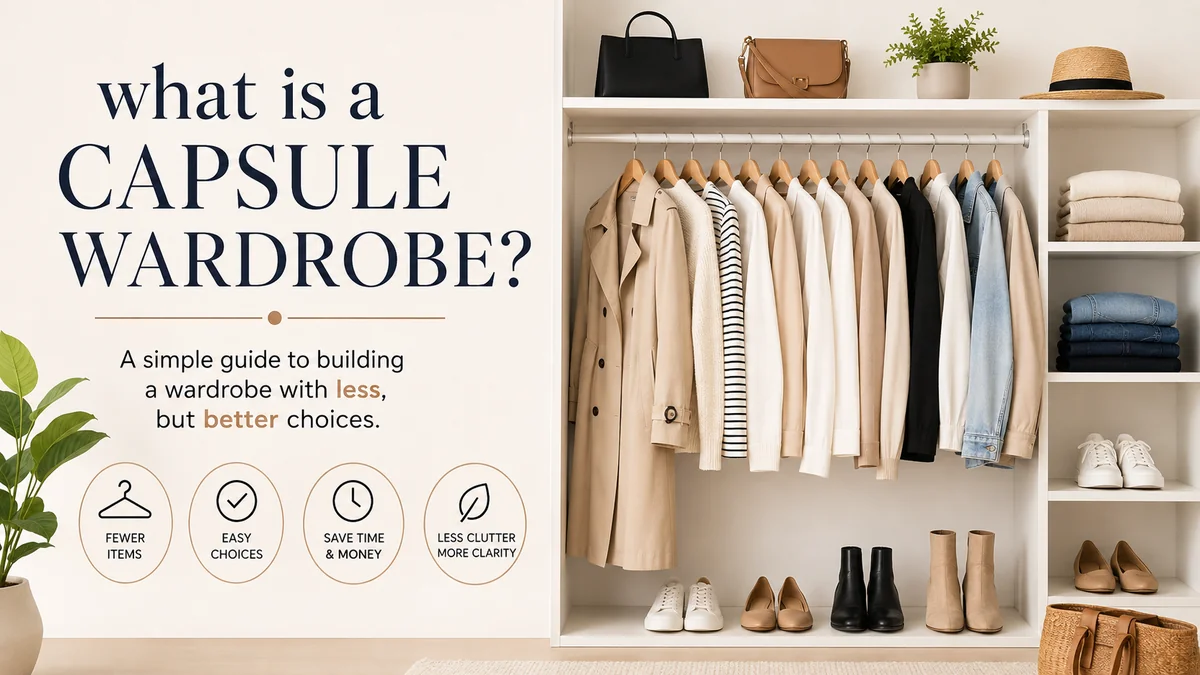
A closet can be packed with clothes and still leave you feeling like you have nothing to wear. The problem often isn’t the number of garments you own. It’s that too few of them work together.
A capsule wardrobe is a deliberately selected collection of versatile clothing that can be mixed and matched to create many outfits from relatively few pieces. Rather than following a strict item count, it focuses on coordination, fit, personal style, lifestyle, climate, and clothes you’ll genuinely wear repeatedly.
The idea sounds minimalist, but you don’t have to become a minimalist, wear only neutral colors, or throw away half your closet. A good capsule is simply a more intentional way of organizing and using your clothes.
what is a capsule wardrobe and how does it work?
At its simplest, a capsule wardrobe is a small working collection in which most pieces can be worn with several others.
Imagine owning five tops and four bottoms. If every top works with every bottom, those nine garments can already create 20 basic combinations before you add jackets, shoes, accessories, or layering.
That is the real strength of capsule dressing: compatibility matters more than quantity.
A conventional closet may contain many individual pieces you love but relatively few complete outfits. A capsule reverses that relationship. Each item is chosen partly for how well it supports the rest of the wardrobe.
Typical characteristics include:
- Versatile pieces that work in several outfits
- Clothes appropriate for your actual lifestyle
- A reasonably cohesive color palette
- Reliable basics alongside selected statement pieces
- Comfortable, well-fitting garments
- Seasonal layering options where necessary
- Fewer pieces bought solely for short-lived trends
- An emphasis on repeat wear rather than constant novelty
British Vogue also emphasizes fit as a key part of a useful capsule: foundational garments need to fit properly if they’re going to be worn repeatedly and support numerous outfits.
A capsule therefore isn’t simply a small closet. It is a coordinated closet.
Where did the capsule wardrobe idea come from?
The capsule wardrobe isn’t a social-media invention.
The term is generally credited to Susie Faux, owner of the London boutique Wardrobe, who developed the concept in the 1970s. Her approach centered on a core collection of timeless, well-made garments that could remain useful beyond individual fashion seasons.
Designer Donna Karan helped bring a related idea into mainstream fashion with her Seven Easy Pieces collection in 1985. Rather than suggesting everyone literally needed seven garments, the collection demonstrated how interchangeable foundations could produce different looks.
More recently, minimalist clothing challenges have given the concept another life.
One of the best known is Project 333, created by Courtney Carver. Its framework involves dressing with 33 selected items for three months. That figure includes categories such as clothing, shoes, jewelry, and accessories, which is why it shouldn’t be treated as a universal capsule-wardrobe rule.
The details have changed over the decades, but the underlying principle remains remarkably consistent:
Own clothes that work together instead of accumulating isolated pieces.
How many clothes should be in a capsule wardrobe?
There is no official number.
You’ll frequently encounter figures such as 10, 20, 30, 33, 37, or 40 pieces. The disagreement exists partly because different capsule systems count different things.
Some include shoes and bags. Others count only everyday clothing. Some exclude jewelry, workout clothing, underwear, sleepwear, and special-occasion outfits.
Current capsule guides commonly place a practical seasonal wardrobe somewhere around 20 to 40 pieces, while other approaches extend slightly beyond that range.
Your appropriate number depends on factors such as:
| Factor | How It Affects Your Capsule |
|---|---|
| Climate | Strong seasonal changes usually require more clothing |
| Work | A separate professional dress code may require additional pieces |
| Lifestyle | Social, casual, outdoor, and formal activities change your needs |
| Laundry | Less frequent washing can require more basics |
| Personal style | Layering or accessory-heavy styles may need different proportions |
| Season | Winter generally requires different layers than summer |
| Activities | Regular sport, travel, or formal events may need separate clothing |
Someone working remotely in a mild climate may function comfortably with a very compact wardrobe.
Someone who experiences freezing winters, hot summers, formal office days, and active weekends may reasonably need considerably more.
Neither person is doing capsule dressing incorrectly.
What counts as a capsule wardrobe item?
There isn’t one accepted counting method.
A seasonal capsule might include:
- T-shirts and casual tops
- Shirts and blouses
- Sweaters and knitwear
- Jeans
- Trousers
- Skirts
- Dresses
- Blazers
- Jackets
- Coats
- Everyday shoes
Depending on your system, bags, belts, scarves, and other accessories may also count.
Underwear, pajamas, workout clothing, uniforms, and highly specific special-occasion pieces are frequently kept outside the main count.
Quick takeaway: Don’t chase an arbitrary number. A 37-piece closet that doesn’t suit your life is less useful than a 42-piece wardrobe whose clothes are consistently worn.
What is a capsule wardrobe supposed to include?
There is no universal capsule wardrobe checklist because people’s lives aren’t universal.
A lawyer commuting to an office, a university student, a parent working from home, and someone living in a tropical climate shouldn’t own identical capsules.
Still, most functional wardrobes contain several broad categories.
Everyday tops
These form the upper half of many outfits and might include:
- Plain T-shirts
- Button-down shirts
- Blouses
- Tank tops
- Long-sleeve tops
- Knitwear
A white T-shirt is frequently presented as the quintessential wardrobe essential, but it isn’t compulsory. If you never wear white T-shirts, including one merely because a checklist recommends it defeats the purpose.
Versatile bottoms
Common options include:
- Jeans
- Tailored trousers
- Casual pants
- Skirts
- Shorts in warm climates
Fit and compatibility matter more than choosing a supposedly timeless cut.
Layers and outerwear
Depending on climate, useful layers can include:
- Cardigans
- Sweaters
- Blazers
- Denim jackets
- Leather jackets
- Trench coats
- Winter coats
Layers are especially valuable because they change the appearance and temperature range of outfits without requiring an entirely different wardrobe.
Dresses and one-piece outfits
Dresses and jumpsuits can be useful when they suit your lifestyle.
A simple dress, for example, might work casually with sneakers and a jacket, professionally with a blazer, and for an evening occasion with different shoes and accessories.
But someone who rarely wears dresses doesn’t need them just to complete a capsule formula.
Shoes
Footwear should cover the situations you actually encounter.
That might mean:
- Everyday sneakers
- Loafers or flats
- Boots
- Work-appropriate shoes
- Sandals
- A smarter pair for evenings or events
The goal remains the same: each pair should work with several outfits rather than only one garment.
Why do people build capsule wardrobes?
The appeal goes beyond having a tidy-looking closet.
Getting dressed can become easier
Too many poorly coordinated choices can make a morning routine surprisingly frustrating.
With a capsule, you’ve already done part of the decision-making. You know your trousers work with several tops and that your jackets complement both.
Instead of asking, “What can I possibly wear?” you’re choosing among combinations you already know work.
You can see what you actually own
Overcrowded wardrobes hide clothes.
Reducing the active selection makes individual pieces easier to see and can expose duplication. You may discover that you don’t need another black top because you already have three serving essentially the same purpose.
Shopping can become more intentional
Capsule dressing changes the question you ask before buying something.
Instead of:
“Do I like this?”
you can ask:
“How many things I already own can I wear this with?”
That’s a much more useful test.
Clothes may get worn more often
A garment that coordinates with five other pieces has more opportunities to leave the closet than something requiring one particular pair of shoes, one specific jacket, and the right occasion.
This repeat-wear principle is one reason capsule wardrobes are often discussed alongside slow fashion, sustainable fashion, and efforts to reduce dependence on fast fashion.
That doesn’t mean creating a capsule automatically makes a wardrobe sustainable. Replacing perfectly good clothing simply to achieve a minimalist aesthetic can create unnecessary consumption.
The more sensible approach is usually to start with what you already own.
Personal style can become clearer
Having fewer active pieces makes patterns easier to recognize.
You might notice that you consistently prefer relaxed trousers, structured jackets, natural fabrics, monochromatic outfits, or colorful knitwear.
Those patterns are more valuable than a generic list of “must-have basics.”
Capsule wardrobe vs. minimalist wardrobe: what’s the difference?
The terms overlap, but they aren’t identical.
| Capsule Wardrobe | Minimalist Wardrobe |
| Focuses on pieces working together | Focuses primarily on owning less |
| Can contain colorful or statement pieces | Often associated with reducing possessions |
| May rotate seasonally | May remain small year-round |
| Coordination is the main strategy | Reduction is a central principle |
| Doesn’t require a minimalist lifestyle | Often reflects broader minimalist values |
A capsule wardrobe is primarily a wardrobe system.
Minimalism is a broader philosophy about reducing possessions or complexity.
You can own a capsule wardrobe without considering yourself a minimalist. Likewise, someone can own relatively few clothes without those garments forming an effective capsule.
Wardrobe essentials are slightly different again. They are simply individual staples considered useful—such as jeans, a shirt, or a blazer. Owning a collection of “essentials” doesn’t guarantee those pieces actually coordinate.
what is a capsule wardrobe color palette?
Color is where capsule advice often becomes unnecessarily restrictive.
You do not need a closet made entirely of black, beige, navy, gray, and white.
Neutral colors are popular because they’re generally easy to combine, but a cohesive palette can include plenty of color.
One simple approach is to choose:
- Two or three base colors
- Several complementary colors
- One or two accent colors
- Prints containing colors already represented elsewhere
For example, someone’s wardrobe might use navy, cream, and denim as foundations, with burgundy, olive, and pale blue as secondary colors.
Another person might build around black, bright red, cobalt blue, and white.
Both can work.
The question isn’t whether a color is neutral. It’s whether the garment coordinates with enough of your existing wardrobe.
Do capsule wardrobes have to be boring?
No.
This is one of the biggest misconceptions surrounding the concept.
You can include:
- Bold prints
- Bright colors
- Unusual silhouettes
- Statement jackets
- Vintage pieces
- Trend-led accessories
The practical test is wearability.
If your bright patterned jacket works with four bottoms and several tops, it may be more capsule-friendly than a beige skirt you never know how to style.
Personal style shouldn’t disappear in pursuit of efficiency.
How to build a capsule wardrobe from clothes you already own
The easiest mistake is assuming that creating a capsule requires buying an entirely new wardrobe.
It doesn’t.
Several current guides specifically recommend starting with your existing closet and filling genuine gaps later rather than purchasing a ready-made capsule all at once.
Here’s a more practical process.
1. Look at what you actually wear
Before decluttering anything, observe your clothing habits.
For a week or two, notice which pieces repeatedly come out of the closet.
Ask yourself:
- Which jeans do I automatically reach for?
- Which shoes are comfortable enough for real life?
- What do I wear to work?
- What do I choose on weekends?
- Which fabrics feel best?
- What clothes constantly stay on the hanger?
Your real behavior provides better information than an online capsule template.
2. Separate favorites from aspirational clothing
Most closets contain clothes for two different people:
the person you actually are and the person you imagine dressing like.
Maybe you love the appearance of structured blazers but always reach for cardigans. Or perhaps you’ve bought several delicate dresses despite spending most days in casual clothes.
A successful capsule is designed around your actual routine.
Start with pieces you genuinely wear and feel comfortable in.
3. Identify your lifestyle categories
Think about a normal month.
You may need clothes for:
- Office work
- Remote work
- School or university
- Errands
- Parenting
- Social occasions
- Religious or community events
- Outdoor activities
- Travel
- Formal events
Then consider how much time you spend doing each.
If 70% of your life is casual, approximately 70% of your working wardrobe should probably support casual dressing.
4. Find your wardrobe anchors
Choose a few dependable pieces around which outfits naturally form.
These might be:
- Your best-fitting jeans
- Favorite trousers
- A frequently worn skirt
- A comfortable blazer
- A versatile jacket
- A dependable dress
Don’t choose them because a fashion article calls them essentials.
Choose them because you already wear them.
5. Build compatible combinations
Now test your tops against your bottoms.
Ideally, most everyday tops should work with multiple bottoms, and your main layers should fit over several combinations.
You don’t need perfect interchangeability.
The goal is enough overlap that one garment doesn’t require an entirely separate set of supporting pieces.
6. Add shoes and layers
Test the complete outfit, not just the clothing combination.
A shirt and trousers aren’t especially useful together if none of your shoes work with them.
Likewise, an outfit that works in your bedroom may fail outside if you don’t have appropriate outerwear.
7. Identify real gaps
Only after creating outfits should you consider buying anything.
Suppose you discover that your trousers work beautifully with your shirts, but none of your jackets suit both. That’s a legitimate wardrobe gap.
Write it down.
A specific need—such as “lightweight jacket that works with navy and cream trousers”—is far more useful than putting “new jacket” on a shopping list.
8. Add slowly
You don’t need to finish your capsule this weekend.
Wear it.
You’ll quickly discover which supposed essentials aren’t useful and which missing pieces would genuinely improve your options.
Quick takeaway: Build first, shop second. A capsule created from real wearing habits is usually more functional than one purchased from somebody else’s checklist.
How can you tell whether a clothing item belongs in your capsule?
Before adding something, run it through a simple test.
Does it fit properly now?
Not after losing weight. Not after getting it altered someday.
Now.
Poor fit is one of the fastest ways to turn an apparently useful basic into an unworn garment.
Is it comfortable enough for its purpose?
A beautiful pair of shoes that hurts after 15 minutes won’t become more useful because it matches everything.
Comfort affects repeat wear.
Can you create several outfits with it?
There’s no magic threshold, but an everyday item should generally work with multiple existing pieces.
If a new blouse only works with one particular skirt, ask whether you really need the combination.
Does it suit your lifestyle?
A garment can be beautiful, high-quality, timeless, and completely wrong for your life.
Function comes before theoretical versatility.
Would you choose it if nobody called it an “essential”?
This catches a surprising number of unnecessary purchases.
A trench coat, white shirt, black blazer, straight-leg jeans, and little black dress are frequently presented as timeless staples. They’re useful only if they suit your taste, body, climate, and routine.
Seasonal capsule wardrobes explained
A seasonal capsule uses a smaller active wardrobe appropriate for the current weather while storing or separating out-of-season clothing.
People often rotate capsules two to four times per year, depending on climate.
A four-season system might look like:
Spring
Light jackets, shirts, breathable knitwear, jeans, trousers, transitional shoes, and easy layers.
Summer
T-shirts, lightweight shirts, skirts, shorts, dresses, breathable trousers, sandals, and other warm-weather pieces.
Autumn
Sweaters, jeans, trousers, boots, medium-weight jackets, blazers, and layering pieces.
Winter
Warm knitwear, coats, boots, thermal layers, heavier trousers, scarves, and weather-appropriate accessories.
You don’t need four completely separate wardrobes.
Many pieces can transition between seasons. A white shirt, jeans, lightweight trousers, sneakers, or cardigan might work for much of the year.
Climate matters more than the calendar. Someone living somewhere warm year-round needs a very different system from someone experiencing temperatures ranging from intense summer heat to freezing winters.
Can you have more than one capsule wardrobe?
Yes.
Trying to force every aspect of your life into one tiny collection can make the system less useful.
You might maintain separate mini-capsules for:
- Work
- Everyday casual clothing
- Exercise
- Travel
- Formal events
- Maternity wear
- Different seasons
A person with a strict corporate dress code, for example, effectively has different clothing requirements at work and on weekends.
Separating those functions can make more sense than trying to make every garment perform both jobs.
What is a travel capsule wardrobe?
A travel capsule is simply a compact version designed around a particular trip.
Because the time period and activities are clearly defined, travel capsules can be much smaller than an everyday wardrobe. Some guides suggest around 10–12 pieces for certain trips, including footwear, although the destination and activities should determine the final number.
A strong travel capsule prioritizes:
- Layering
- Comfortable fabrics
- Repeatable bottoms
- Coordinating colors
- Appropriate footwear
- Weather conditions
- Day-to-evening versatility when required
Again, outfit combinations matter more than hitting an exact number.
Does a capsule wardrobe save money?
It can, but not automatically.
A capsule saves money only when it changes your purchasing habits.
If you stop buying duplicate items, reduce impulse purchases, wear clothes for longer, and replace garments only when necessary, your clothing spending may decrease over time.
But creating a capsule can become expensive if you decide that every existing garment must be replaced with premium “timeless essentials.”
You don’t need:
- A designer blazer
- Luxury cashmere
- An expensive leather handbag
- A perfectly coordinated collection purchased simultaneously
“Quality over quantity” doesn’t necessarily mean “expensive over affordable.”
Quality should mean appropriate construction, fabric, comfort, fit, durability, and usefulness for the amount you’re willing to spend.
Secondhand and pre-owned clothing can also fill wardrobe gaps without requiring everything to be bought new.
Are capsule wardrobes more sustainable?
Potentially.
The strongest sustainability benefit comes from using clothes longer and buying fewer unnecessary replacements, rather than simply owning a particular number of items.
Capsule dressing naturally encourages repeat wear because garments are selected for versatility.
However, it’s worth avoiding a common contradiction: throwing away wearable clothing so you can purchase a completely new “sustainable capsule wardrobe.”
That replaces overconsumption with another round of consumption.
A better sequence is:
- Wear what you own.
- Repair useful pieces when practical.
- Alter good garments that fit poorly.
- Sell, donate, or responsibly pass on pieces you no longer use.
- Buy only when you’ve identified a genuine need.
- Choose pieces you’re likely to wear repeatedly.
The most sustainable garment in your closet is often one you already own and continue wearing.
Common capsule wardrobe mistakes
The concept is simple, but several habits make it unnecessarily difficult.
Copying someone else’s wardrobe exactly
A creator’s “perfect 30-piece capsule” was designed around their body, job, climate, preferences, and daily routine.
Use examples for inspiration—not as instructions.
Buying everything at once
You cannot accurately predict how every new garment will perform before living in it.
Starting with existing clothes gives you real-world evidence about what works. Buying an entire wardrobe at once turns the process into guesswork.
Choosing aesthetics over function
A beautifully coordinated rail of beige clothes isn’t successful if you dislike wearing beige.
Your capsule needs to work when you’re rushing out the door on an ordinary Tuesday, not merely look good in a photograph.
Becoming obsessed with the item count
The popular 33-piece or 37-piece numbers aren’t universal standards.
Project 333 uses 33 as part of a specific three-month challenge, while 37 became associated with another personal capsule approach. Different methods also count different categories.
Treat numbers as optional boundaries, not measures of success.
Removing personality
Capsule wardrobes don’t require abandoning fashion trends.
If you love a current trend and expect to wear it repeatedly, it can earn a place. Timeless basics can provide a foundation while accessories, colors, prints, and selected trend pieces keep the wardrobe personal.
Ignoring laundry
A tiny capsule may look efficient on paper but become annoying if you’re constantly washing clothes.
Your wardrobe has to work between laundry cycles.
Practicality wins.
How often should you update a capsule wardrobe?
There is no need to rebuild it every month.
For many people, seasonal reviews are enough. Others with relatively stable climates may maintain one year-round core and adjust a few layers as temperatures change.
A useful wardrobe review asks:
- What did I wear repeatedly?
- What did I never wear?
- What became uncomfortable?
- What wore out?
- Which outfits were difficult to complete?
- Did my work or lifestyle change?
- Is there an actual gap?
Replace worn-out essentials when necessary and reconsider pieces that consistently go unused.
Avoid treating each season as permission to shop again.
Is a capsule wardrobe right for everyone?
Not necessarily—and that’s fine.
Capsule wardrobes are particularly useful for people who:
- Feel overwhelmed by large closets
- Regularly struggle to put outfits together
- Want easier morning decisions
- Want to understand their personal style
- Are trying to reduce impulse buying
- Have limited storage space
- Travel frequently
- Prefer repeatable, dependable outfits
They can be less appealing to people who view frequent experimentation and a large clothing selection as an important creative hobby.
Even then, the underlying principle can still help.
You don’t have to own 30 pieces. You could own 100 and simply make sure new purchases coordinate with clothes you already enjoy.
The method should serve you—not become another set of rules.
what is a capsule wardrobe really about?
After all the numbers, checklists, neutral color palettes, minimalist challenges, and seasonal formulas are stripped away, what is a capsule wardrobe really about?
It’s about making your clothes work harder together.
A useful capsule reflects your personal style, lifestyle, climate, dress code, comfort needs, and real daily habits. It doesn’t require a specific number of garments, a neutral aesthetic, expensive basics, or abandoning trends.
Start with the clothes you already wear. Identify the combinations that consistently work, remove pressure to keep pieces that don’t serve your life, and fill genuine gaps gradually.
The best capsule wardrobe isn’t necessarily the smallest one.
It’s the one where opening your closet makes getting dressed easier.