
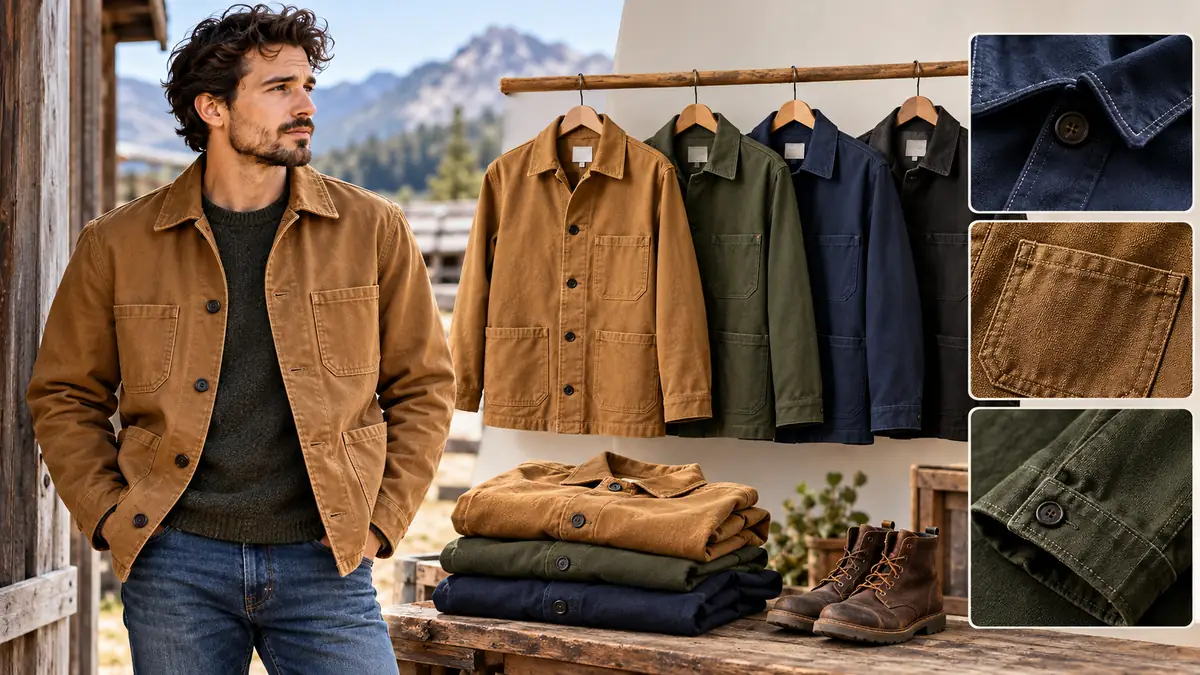
Some jackets are designed to make a statement. Others earn their place in your wardrobe by being comfortable, practical, and easy to wear. The chore coat manages to do both.
Originally created for manual labor, this simple workwear jacket has evolved into a versatile piece of everyday clothing. Its relaxed silhouette, durable fabric, and distinctive patch pockets make it recognizable without feeling overly formal or trendy.
A chore coat is a lightweight to medium-weight workwear jacket traditionally made from durable cotton fabric, featuring a straight cut, button-front closure, and large patch pockets. Originating in European work clothing, particularly French labor uniforms, it combines utility with understated style. Modern versions are worn as casual outerwear by men and women.
Understanding its history, construction, and fit makes it easier to appreciate why this practical garment has remained relevant for generations.
What Is a chore coat?
A chore coat is a functional outerwear garment originally designed to protect workers’ clothing while providing convenient storage for tools and everyday essentials.
Unlike structured blazers or insulated winter jackets, chore coats typically have a simple, unlined construction that allows comfortable movement.
Their defining characteristics include:
- Straight, relaxed silhouette: Provides room for layering and physical activity.
- Button-front closure: Traditionally uses sturdy buttons rather than zippers.
- Large patch pockets: Usually two lower pockets and one chest pocket, although designs vary.
- Durable fabric: Common materials include cotton canvas, twill, denim, and moleskin.
- Minimal decoration: Functional construction takes priority over ornamental details.
- Hip-length design: Most versions finish around the hip or upper thigh.
The result is a jacket that sits somewhere between a casual overshirt and a traditional work jacket.
Some modern designs are lightweight enough to wear indoors, while heavier canvas versions provide protection during outdoor activities.
Why Is It Called a chore coat?
The name comes from the garment’s association with practical tasks and physical labor.
Workers needed clothing that could withstand repeated use while offering freedom of movement. Large pockets made it easier to carry small tools, gloves, notebooks, and other essentials.
The term chore coat became common in American workwear terminology, although similar garments existed in Europe under different names.
Today, the name describes the jacket’s recognizable construction rather than requiring it to be worn for actual chores.
The History and Origins of the chore coat
The chore coat’s history is closely connected to the development of practical work clothing during the nineteenth and twentieth centuries.
Although several countries developed similar utility jackets, the French work jacket remains one of the most influential predecessors of the modern design.
French Workwear and the Bleu de Travail
In France, workers commonly wore garments known as bleu de travail, meaning “work blue.”
The phrase refers broadly to traditional blue work clothing rather than one specific jacket pattern.
French laborers, mechanics, agricultural workers, and factory employees wore practical cotton garments designed for demanding working conditions.
Blue-dyed cotton twill and moleskin became closely associated with these uniforms.
The familiar French work jacket, sometimes called a veste de travail, generally featured a simple button closure, generous pockets, and an uncomplicated silhouette.
Its design prioritized durability, affordability, and everyday usefulness.
The Rise of American Workwear
Similar jackets developed in the United States as industrial workwear became more standardized.
Railroad employees, farmers, mechanics, and factory workers relied on sturdy garments that could tolerate abrasion and frequent washing.
American workwear manufacturers, including Carhartt, developed durable jackets and coats for industrial and outdoor occupations.
Other heritage brands, such as Dickies and Lee, became associated with practical work clothing, although their individual jacket designs varied.
Heavy cotton duck canvas, denim, reinforced seams, and roomy cuts became recognizable features of American utility outerwear.
The American chore coat often developed a slightly heavier, more rugged appearance than the classic French version.
From Work Uniform to Everyday Fashion
During the twentieth century, utilitarian clothing gradually moved beyond its original occupational purpose.
Denim jeans, military field jackets, and work boots followed similar paths.
By the late twentieth and early twenty-first centuries, vintage clothing enthusiasts and contemporary designers were increasingly incorporating traditional work jackets into casual wardrobes.
Brands such as Le Mont Saint Michel, Vetra, Universal Works, and Engineered Garments helped maintain or reinterpret the aesthetic of functional workwear.
Today, chore coats appear in heritage clothing collections, minimalist wardrobes, contemporary streetwear, and gender-neutral fashion.
Their appeal comes partly from their simplicity: the design has changed relatively little because its original proportions remain useful.
Key Features That Define a Traditional Chore Coat
Not every button-front jacket qualifies as a traditional chore coat.
Several construction details distinguish this garment from similar casual outerwear.
1. Practical Patch Pockets
Patch pockets are among its most recognizable features.
Instead of being concealed inside the garment, these pockets are sewn directly onto the exterior fabric.
A traditional three-pocket configuration includes one chest pocket and two lower front pockets.
Some American workwear versions have four pockets, additional interior compartments, or specialized storage.
Large lower pockets are particularly useful for carrying gloves, a phone, keys, or small accessories.
However, loading them with heavy objects can distort the jacket’s shape.
2. Simple Button Closure
Most traditional designs use a row of buttons down the front.
Metal buttons, plastic buttons, and durable workwear-style fasteners are common.
Buttons are easy to replace and contribute to the jacket’s understated appearance.
Modern interpretations sometimes feature snap closures or concealed fastenings, but the button-front design remains the most recognizable.
3. Relaxed Shoulder and Body Construction
Traditional work jackets were designed for movement rather than sharply tailored proportions.
Their shoulders and sleeves generally provide enough room for reaching, lifting, and bending.
Many versions have minimal internal structure and no shoulder padding.
This gives the garment a natural drape that works particularly well with casual clothing.
4. Durable Stitching and Reinforcement
Workwear construction often includes reinforced seams, sturdy thread, and additional stitching around stress points.
Some jackets feature bar tacks at pocket corners or double-needle stitching along major seams.
These details can improve durability, although their presence does not automatically guarantee superior construction.
Fabric quality, seam strength, and finishing also matter.
5. Functional Collar Design
Most chore coats feature a straightforward pointed collar that can lie flat when the jacket is open or buttoned.
The collar is generally less structured than that of a tailored blazer.
Some contemporary versions use corduroy collars, contrasting fabrics, or wider collar shapes.
These changes introduce visual variety while retaining the traditional workwear silhouette.
Types of chore coat and Popular Fabric Options
Fabric selection has a major influence on how a chore coat feels, drapes, ages, and performs.
Two jackets with almost identical patterns can behave very differently when made from different materials.
| Fabric | Main characteristics | Typical use |
|---|---|---|
| Cotton canvas | Firm, durable, abrasion-resistant | Everyday utility and rugged casual wear |
| Cotton twill | Flexible, tightly woven, comfortable | Classic workwear and daily outfits |
| Denim | Durable, softens with use | Casual and vintage-inspired styling |
| Cotton moleskin | Dense, soft surface, substantial feel | Traditional French-inspired jackets |
| Corduroy | Ribbed texture, softer appearance | Autumn and cool-weather layering |
| Linen or linen blend | Breathable, lightweight, relaxed | Warm-weather casual wear |
| Wool blend | Warmer, often more structured | Cold-weather layering |
Cotton Canvas Chore Coats
Canvas is one of the most practical materials for a workwear-inspired jacket.
Its sturdy woven structure resists everyday abrasion and develops character with repeated wear.
Cotton duck, a closely woven form of canvas, is particularly associated with American workwear.
Heavy canvas can initially feel stiff, but many garments soften over time.
The main drawback is weight. A thick canvas jacket may feel uncomfortable during hot weather or prolonged indoor use.
Denim Chore Coats
A denim chore coat combines the familiar texture of jeans with the pocket arrangement and silhouette of a utility jacket.
Indigo denim is especially popular because it develops fading patterns through wear and washing.
Raw denim versions may feel stiff initially and can experience shrinkage or dye transfer, depending on the fabric and finishing process.
Washed denim offers a softer feel from the beginning.
Unlike a conventional denim trucker jacket, a denim chore coat generally has a straighter body and larger external pockets.
French Moleskin Work Jackets
Cotton moleskin is a dense woven fabric with a soft, brushed surface.
Despite its name, it is not made from animal skin.
Historically associated with European workwear, cotton moleskin offers a distinctive combination of softness, durability, and substantial texture.
Traditional French blue moleskin jackets are particularly recognizable.
Vintage examples may show fading, repairs, and wear patterns that reflect their working history.
Lightweight Linen and Cotton Versions
Not every utility jacket needs to be heavy.
Lightweight cotton, linen, and cotton-linen blends provide a more breathable alternative for warmer conditions.
These fabrics generally create a softer, less structured silhouette.
They work well over T-shirts and thin shirts, although they provide less abrasion resistance than heavy canvas.
Linen also wrinkles more readily, which contributes to its relaxed appearance.
Corduroy and Wool Variations
Corduroy introduces a softer texture that suits autumn clothing.
Wool and wool-blend versions provide greater warmth, particularly when paired with lining.
These garments may retain the familiar patch pockets and button closure while functioning more like seasonal outerwear.
They are modern interpretations rather than direct copies of traditional lightweight work jackets.
How Should a chore coat Fit?
A chore coat should feel relaxed without appearing excessively oversized.
The ideal fit depends on whether it will be worn over a T-shirt, button-down shirt, sweater, or several layers.
Traditional workwear silhouettes generally provide more room than tailored casual jackets.
Shoulder Fit
The shoulder seams should sit near the natural shoulder or slightly beyond it, depending on the intended design.
A small amount of drop is normal in relaxed workwear.
However, excessive shoulder width can make the sleeves bunch and create an awkward silhouette.
When trying on a jacket, raise both arms and reach forward to check mobility.
Chest and Body Fit
The jacket should button comfortably without pulling across the chest.
A practical fit allows room for at least a light layer underneath.
If the fabric stretches tightly between buttons, the body is probably too narrow.
If the jacket balloons significantly around the waist, it may be too large unless an oversized appearance is intentional.
Sleeve Length
Sleeves generally look balanced when they finish near the wrist bone.
They should provide sufficient coverage when the arms are extended.
A slight cuff or roll can work with casual outfits, especially on unlined cotton jackets.
Very long sleeves may interfere with everyday tasks and make the garment look poorly proportioned.
Jacket Length
Most classic versions end around the hip, although longer styles are available.
A shorter jacket can create a compact silhouette with high-rise trousers.
Longer versions offer additional coverage and can work well over sweaters.
The correct length depends on body proportions and the overall outfit.
Regular Fit vs. Oversized Fit
| Feature | Regular fit | Oversized fit |
|---|---|---|
| Shoulder | Near natural shoulder | Noticeably dropped |
| Body | Relaxed but controlled | Wide and loose |
| Layering | T-shirt or light sweater | Thicker knitwear or multiple layers |
| Appearance | Traditional and balanced | Contemporary and casual |
| Movement | Comfortable with correct sizing | More room, but excess fabric may interfere |
A common mistake is sizing up automatically.
Because many chore coats already have generous proportions, choosing a larger size can produce excessive fabric around the chest and sleeves.
Always compare the actual garment measurements with a jacket that fits well.
How to Wear a chore coat for Different Occasions
One reason this jacket has remained popular is its versatility.
Its simple shape works with clothing ranging from basic casual essentials to more polished everyday outfits.
The key is balancing the jacket’s relaxed structure with the rest of the outfit.
Casual Everyday Outfit
A classic combination includes:
- Navy or olive cotton chore coat
- Plain white or gray T-shirt
- Straight-leg jeans
- Canvas sneakers or casual leather shoes
This combination reflects the garment’s workwear heritage without looking like a uniform.
A neutral color palette helps the jacket blend naturally with other pieces.
For a softer appearance, choose a washed cotton version rather than heavy, rigid canvas.
Smart-Casual Styling
A chore coat can replace a casual blazer in some informal settings.
Try pairing a dark navy or charcoal jacket with an Oxford button-down shirt, chinos, and leather loafers.
The jacket adds texture and a relaxed silhouette while keeping the outfit neat.
However, it does not offer the same formality as a tailored blazer.
It is generally unsuitable as a substitute for formal business attire or events requiring a suit.
Workwear-Inspired Outfit
For a traditional utility aesthetic, combine the jacket with sturdy denim, a heavyweight cotton shirt, and work boots.
Earth tones such as brown, tan, olive, and faded blue suit this approach.
The challenge is avoiding too many heavy workwear pieces at once.
A structured canvas jacket paired with thick denim and bulky boots can feel visually overwhelming.
Using one lighter or softer garment creates better balance.
Minimalist Wardrobe Styling
A black, cream, or navy jacket fits naturally into a minimalist wardrobe.
Pair it with simple trousers, knitwear, and understated footwear.
Avoiding excessive patterns allows the garment’s pockets, stitching, and texture to provide visual interest.
A clean, unlined cotton design can be particularly effective because it functions as both a light outer layer and a substantial overshirt.
How Women Can Style a chore coat
The garment’s straightforward construction makes it suitable for a wide range of wardrobes.
Women can pair a relaxed version with straight-leg jeans, wide-leg trousers, skirts, or casual dresses.
A slightly cropped style may balance high-waisted trousers or longer skirts.
For a softer contrast, a structured canvas jacket can be worn over a fine-knit top or flowing dress.
The most useful consideration is proportion rather than gender-specific styling rules.
chore coat vs. Other Popular Jacket Styles
The chore coat shares features with several other outerwear designs, but its construction and original purpose set it apart.
| Jacket type | Defining features | Main difference |
|---|---|---|
| Chore coat | Patch pockets, straight fit, button front | Designed around utility and easy movement |
| Denim trucker jacket | Short body, chest pockets, often waist adjusters | Usually more fitted and cropped |
| Field jacket | Multiple pockets, military-inspired construction | Often includes a longer body and weather features |
| Overshirt | Shirt-like collar and construction | Usually lighter and less rugged |
| Blazer | Tailored lapels, structured shape | More formal and fitted |
| Barn jacket | Country-workwear design, often contrasting collar | Frequently offers greater weather coverage |
Chore Coat vs. Denim Jacket
A denim trucker jacket commonly has a shorter body, shaped panels, and chest pockets.
A chore coat typically features a straighter silhouette and larger lower patch pockets.
Both can be made from denim, so fabric alone does not determine the garment category.
The difference lies primarily in the cut and construction.
Chore Coat vs. Overshirt
Overshirts, sometimes called shirt jackets or shackets, are designed to be worn as a layer between a shirt and a jacket.
They may have a shirt-like hem, lighter fabric, and smaller pockets.
Chore coats are generally more clearly inspired by protective work clothing.
However, modern fashion designs increasingly blur the distinction.
A lightweight chore coat can function much like an overshirt.
Chore Coat vs. Barn Jacket
Barn jackets traditionally draw from rural and agricultural outerwear.
They often feature longer cuts, contrasting corduroy collars, weather-resistant finishes, or additional lining.
A classic chore coat tends to have simpler construction and a shorter silhouette.
Both belong to the broader family of utility outerwear, and contemporary versions can overlap significantly.
Best Colors for a Versatile Chore Coat
The color of a chore coat affects how easily it coordinates with the rest of a wardrobe.
Traditional workwear colors remain popular because they are practical and visually understated.
Navy Blue
Navy is closely associated with traditional French work jackets.
It works with beige chinos, gray trousers, faded denim, and neutral knitwear.
A deep navy jacket can look relatively polished, while a faded blue version creates a more vintage-inspired appearance.
Olive Green
Olive is particularly versatile for casual clothing.
It pairs naturally with cream, black, brown, and indigo.
The earthy tone complements canvas and cotton twill fabrics, making it a common choice for workwear-inspired outerwear.
Brown and Tan
Brown duck canvas is strongly associated with American utility clothing.
Tan and tobacco shades highlight the fabric’s texture and often develop visible wear patterns.
These colors work especially well with dark denim, white shirts, and neutral footwear.
Black and Charcoal
Black and charcoal create a cleaner, more contemporary appearance.
They are suitable for minimalist outfits and can make a casual jacket feel slightly more refined.
However, dark cotton fabrics may show lint, dust, and fading more noticeably than some lighter colors.
Ecru and Natural Cotton
Ecru, cream, and undyed cotton offer a softer alternative to traditional dark workwear.
These shades suit spring and summer outfits particularly well.
The disadvantage is that stains and marks are generally more visible, making regular care especially useful.
When Can You Wear a chore coat?
A chore coat is primarily a transitional outerwear garment, although fabric and lining determine its actual seasonal suitability.
Spring
Lightweight cotton twill and denim versions work well during mild spring weather.
They provide an additional layer over a T-shirt or shirt without the bulk of a winter coat.
Unlined construction also makes them easier to carry when temperatures rise.
Summer
In hot weather, traditional heavy canvas jackets can feel uncomfortable.
However, lightweight linen or thin cotton versions may be practical during cooler evenings or in air-conditioned environments.
Breathability depends on fabric weight, weave, lining, and fit.
Cotton alone does not guarantee that a garment will feel cool.
Autumn
Autumn is particularly suitable for chore coats because changing temperatures make layering useful.
A medium-weight canvas or moleskin jacket can be worn over a sweatshirt, flannel shirt, or lightweight sweater.
The relaxed cut allows flexibility as conditions change throughout the day.
Winter
An unlined chore coat is not generally a replacement for an insulated winter jacket.
Dense cotton can reduce some airflow, but it provides limited thermal insulation compared with purpose-built cold-weather outerwear.
For colder conditions, lined wool-blend or insulated versions offer greater protection.
A roomy unlined jacket can also serve as a middle layer beneath a larger coat, provided the combination remains comfortable.
Is a Chore Coat Waterproof?
Most traditional chore coats are not waterproof.
Untreated cotton canvas, twill, and denim can absorb water during prolonged exposure to rain.
Waxed cotton versions may offer improved water resistance, but their performance depends on construction, treatment, and maintenance.
A water-resistant finish should not be confused with a fully waterproof membrane and sealed seams.
For sustained rain, a dedicated waterproof shell is more reliable.
How to Identify a Well-Made Chore Coat
A well-made jacket should combine appropriate fabric, sound construction, and comfortable proportions.
Brand recognition alone does not determine quality.
Examine the Fabric
Start by considering the garment’s intended purpose.
For everyday casual wear, a medium-weight cotton twill may provide an effective balance between comfort and durability.
For more demanding use, heavier canvas may offer greater abrasion resistance.
Fabric weight is sometimes expressed in ounces per square yard or grams per square meter (GSM).
Higher weight generally indicates more material per unit area, but it does not automatically mean better quality.
Weave density, fiber quality, finishing, and construction also affect performance.
Inspect the Seams
Check whether major seams are evenly stitched and securely finished.
Look closely at pocket corners, underarms, sleeve attachments, and buttonholes.
These areas experience repeated stress.
Loose threads are not always evidence of poor construction, but broken stitching or visibly weak seams can indicate potential problems.
Evaluate Pocket Placement
Pockets should be easy to access without interfering with movement.
Very low pockets can be awkward when sitting, while unusually small openings reduce practical usefulness.
If the jacket is intended for everyday use, consider whether its pockets comfortably hold common essentials.
Check the Buttons and Cuffs
Buttons should feel securely attached.
Buttonholes should be properly finished and large enough to fasten without excessive force.
Adjustable button cuffs can be useful when rolling sleeves or wearing thicker layers.
Some traditional jackets use simple open cuffs instead, which are easier to manufacture but offer less adjustment.
Understand Lined vs. Unlined Construction
An unlined jacket is usually lighter, more breathable, and easier to layer during mild weather.
A lined jacket may provide additional warmth, comfort, or wind protection, depending on the lining material.
Neither construction is inherently superior.
The better choice depends on climate, intended use, and personal comfort.
How to Wash and Care for a Chore Coat
Proper care can extend the useful life of a cotton work jacket while preserving its shape and appearance.
However, cleaning methods depend on the fabric, dye, lining, and finishing.
Always follow the garment’s care label.
Washing Cotton Canvas and Twill
For machine-washable cotton versions:
- Empty all pockets and close the buttons.
- Turn the jacket inside out to reduce surface abrasion.
- Use a mild detergent and a gentle wash cycle.
- Choose cold or cool water unless the care label specifies otherwise.
- Reshape the jacket while damp.
- Air-dry when appropriate to reduce the risk of shrinkage.
Heavy cotton garments may shrink, particularly if they have not been preshrunk.
High dryer temperatures can also affect fit and accelerate certain types of wear.
Caring for Denim
Denim jackets often develop fading through repeated washing and friction.
Washing inside out with similar colors can help reduce unwanted color transfer.
Raw or dark indigo denim may release excess dye, especially during early washes.
Avoid placing a new dark denim jacket against delicate light-colored fabrics until its colorfastness is understood.
Caring for Moleskin
Cotton moleskin has a brushed surface that requires some attention.
Harsh washing and aggressive tumble drying can affect its texture.
Gentle cleaning, appropriate detergent, and air-drying are often suitable, provided the manufacturer permits them.
Some specialty garments require professional cleaning.
Caring for Waxed Canvas
Waxed cotton should not automatically be machine-washed.
Conventional detergents and hot water can remove or damage the wax finish.
Many manufacturers recommend brushing away loose dirt, wiping the surface with a damp cloth, and periodically reproofing the fabric with a compatible wax product.
Follow the manufacturer’s specific instructions.
Repairing Rather Than Replacing
One advantage of traditional workwear is its relatively straightforward construction.
Common repairs include replacing buttons, reinforcing loose pockets, patching worn elbows, and restitching damaged seams.
Visible mending can also become part of the garment’s character.
Japanese textile traditions such as sashiko stitching and boro-inspired patchwork are sometimes incorporated into contemporary workwear design.
These techniques can provide both reinforcement and visual interest when applied appropriately.
Common Mistakes When Wearing or Caring for a Chore Coat
Although chore coats are relatively easy to wear, a few mistakes can reduce their comfort or usefulness.
Choosing an excessively oversized fit: A jacket that is too wide can overwhelm the body and make sleeves difficult to manage. Check garment measurements rather than relying solely on the size label.
Ignoring fabric weight: Heavy canvas may look appealing but feel uncomfortable in warm climates. Match the material to the conditions in which the jacket will actually be worn.
Expecting formal tailoring: A chore coat is intentionally relaxed. It should not be expected to provide the sharp shoulders and shaped waist of a tailored blazer.
Overloading the pockets: Large pockets are useful, but repeatedly carrying heavy objects can stretch the fabric and stress the stitching.
Using harsh cleaning methods: High heat, unsuitable detergents, and aggressive washing can cause shrinkage, fading, or damage to specialty finishes.
Assuming every vintage jacket fits the same: Older workwear may follow different sizing conventions. Measurements are more reliable than the marked size.
Confusing fashion workwear with protective clothing: A casual chore coat is not necessarily suitable for hazardous workplaces. Industrial environments may require certified protective garments, flame-resistant materials, high-visibility clothing, or other job-specific equipment.
Are Vintage Chore Coats Different From Modern Versions?
Vintage and modern chore coats share a common design foundation, but they can differ in fabric, construction, fit, and finishing.
Vintage French jackets frequently feature dense cotton twill or moleskin, simple collars, and practical patch pockets.
Their proportions reflect the workwear conventions of their manufacturing period.
Some older garments have distinctive details such as metal buttons, unusual pocket arrangements, or repairs made during their working life.
Modern designs offer a wider variety of fabrics, colors, and silhouettes.
Contemporary interpretations may include cropped lengths, oversized shoulders, internal pockets, refined stitching, or technical fabric blends.
Japanese workwear makers have also contributed to the modern appreciation of historical construction. Labels such as Post O’Alls and TCB Jeans draw on vintage workwear traditions through reproduction, reinterpretation, and detailed fabric development.
Does Vintage Automatically Mean Better Quality?
No.
An older garment may feature durable construction and attractive fabric, but age alone does not establish quality.
Vintage jackets can have weakened seams, damaged fibers, persistent odors, missing buttons, or significant shrinkage.
Similarly, a modern jacket can be exceptionally well constructed.
The most useful comparison considers fabric condition, stitching, fit, repairability, and intended use.
Why Do Some Chore Coats Develop a Patina?
Patina describes visible changes that develop through use and aging.
On cotton workwear, this can include softened fabric, faded dye, creases, and lighter areas around seams and pockets.
Canvas and denim often develop distinctive wear patterns because friction affects exposed areas more frequently.
These changes can make a garment visually individual, although excessive abrasion eventually weakens the fibers.
A pleasing patina and actual structural damage are not the same thing.
Is a Chore Coat Still Practical for Everyday Use?
The original appeal of the chore coat was functionality, and many of those advantages remain relevant.
Large pockets reduce the need to carry small everyday items separately.
The button-front construction makes ventilation and layering easy.
A relaxed fit allows comfortable movement during commuting, walking, light outdoor tasks, and casual activities.
Durable cotton fabrics can also tolerate regular use when properly maintained.
However, the jacket has limitations.
It is generally less weatherproof than technical outerwear, less insulating than a winter coat, and less formal than a blazer.
Some heavy canvas versions can also feel stiff until broken in.
Its usefulness comes from doing several ordinary jobs well rather than excelling at one specialized purpose.
For many wardrobes, that versatility is more valuable than elaborate features.
Why the Chore Coat Remains a Timeless Workwear Essential
The enduring appeal of the chore coat comes from the relationship between its design and purpose.
Its patch pockets were created for storage. Its straight silhouette allowed movement. Its durable fabric protected everyday clothing from repeated wear.
Those practical details eventually became the features that distinguish it from other casual jackets.
The garment has moved from French workshops and American industrial settings into contemporary wardrobes without losing its recognizable identity. Fashion interpretations may change its fabric, length, or proportions, but the basic concept remains familiar.
A chore coat is ultimately a versatile workwear-inspired jacket that combines functional pockets, comfortable construction, and understated style. Understanding its history, fabrics, fit, and care makes it easier to recognize a well-designed example and use it appropriately.
The most useful starting point is simple: consider the climate, the layers you normally wear, and the activities you expect the jacket to handle. Those practical details matter more than trends when deciding how a chore coat fits into everyday clothing.