
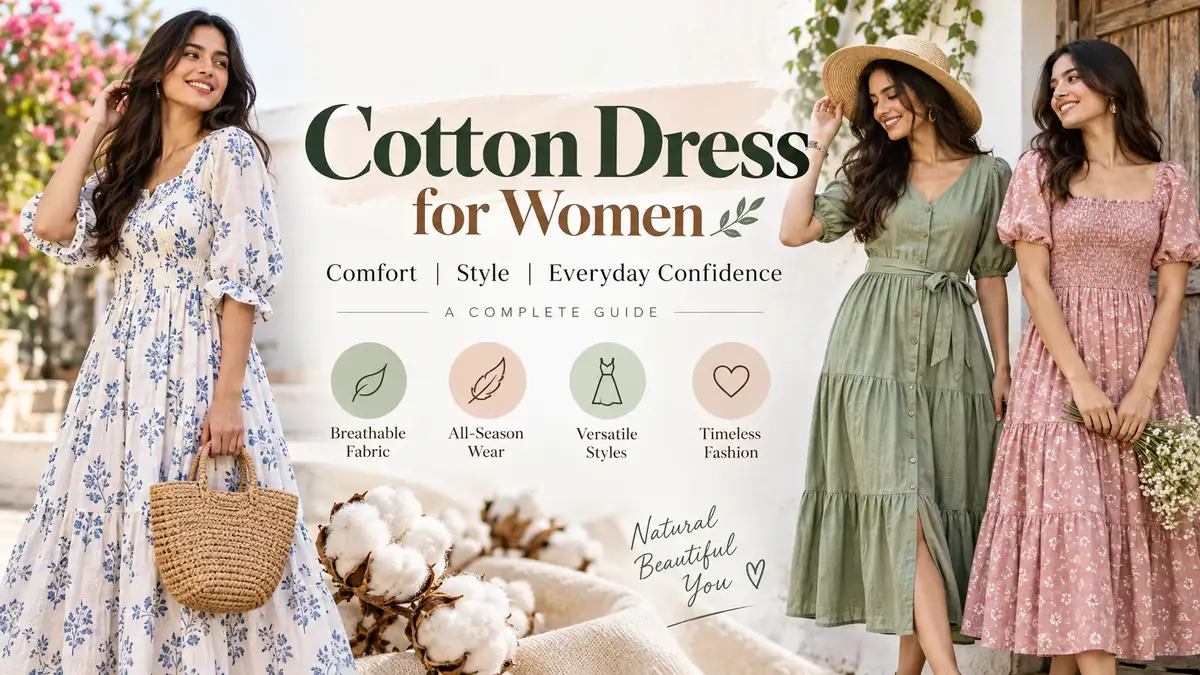
A cotton dress for women can look simple on the hanger, yet fabric weight, weave, cut, lining, and construction can completely change how it feels once worn. One cotton dress may be light enough for a humid summer afternoon, while another is structured enough for work or cool-weather layering.
Cotton remains popular because it combines softness, breathability, moisture absorption, versatility, and relatively straightforward care. Modern cotton dresses range from crisp poplin shirt dresses and airy voile maxis to textured gauze styles, cotton lawn dresses, embroidered pieces, and heavier twill designs.
Quick answer: A cotton dress for women is a dress made entirely or partly from cotton fiber. The best option depends on the weave, fabric weight, fit, opacity, and intended use. Lightweight lawn, voile, mulmul, and gauze suit warm weather, while poplin, sateen, chambray, and twill provide more structure for everyday or workwear.
Why a Cotton Dress for Women Is So Practical
Cotton is a natural cellulose fiber. Its comfort comes partly from its ability to absorb moisture and from the breathability possible in many cotton constructions.
That distinction matters: cotton fiber does not automatically mean a cool dress. The weave, thickness, lining, finish, fit, and fabric density all influence airflow and comfort.
A loose cotton voile dress can feel dramatically cooler than a tightly woven, lined cotton twill dress even though both contain the same basic fiber.
Breathability in Warm Weather
Lightweight cotton fabrics allow air to circulate around the body, particularly when the garment itself has a relaxed silhouette.
This makes cotton especially useful for:
- Summer clothing
- Hot and humid climates
- Everyday dresses
- Travel outfits
- Casual workwear
- Beach and vacation clothing
- Layered transitional outfits
Current cotton-dress guides consistently emphasize breathability and warm-weather comfort as major reasons for choosing the fabric.
For very hot weather, however, don’t judge a dress by fiber content alone. A relaxed cut in lightweight cotton usually feels more comfortable than a fitted dress made from dense cotton.
Softness and Skin Comfort
Many cotton fabrics have a soft hand and become softer through repeated washing and wearing.
People who dislike the slick or clingy sensation of some synthetic fabrics may particularly appreciate cotton. Seams, dyes, finishes, embellishments, and laundry products can still affect skin comfort, so “100% cotton” should not automatically be interpreted as irritation-proof.
Everyday Versatility
One reason cotton survives changing fashion trends is that it isn’t tied to a single silhouette.
The same fiber can produce a crisp shirt dress, flowing maxi, casual T-shirt dress, traditional printed outfit, structured midi, or relaxed kaftan.
That versatility makes fabric construction almost as important as dress design.
Quick Takeaway: When comparing cotton dresses, check the weave and weight before focusing on the print. Those characteristics have a major effect on breathability, opacity, drape, durability, and structure.
Types of Cotton Fabric Used for Women’s Dresses
“Cotton” on a product description tells only part of the story.
Different cotton fabrics can behave so differently that two 100% cotton dresses may barely feel related. Current guides and collections feature everything from lawn and mulmul to khadi, poplin, twill, sateen, chambray, cotton slub, and Kota fabrics.
Cotton Lawn
Cotton lawn is finely woven, smooth, and lightweight. It is particularly associated with warm-weather clothing and is widely used for spring and summer outfits in South Asia.
It works particularly well for:
- Summer dresses
- A-line silhouettes
- Printed dresses
- Tunic-style designs
- Midi dresses
- Everyday warm-weather clothing
Because lawn can be thin, pale colors may require lining or an appropriate underlayer.
Cotton Voile
Voile is lightweight, airy, and often slightly sheer.
Its soft drape makes it useful for flowing maxi dresses, gathered skirts, relaxed silhouettes, and summer layers.
The trade-off is transparency. Always check a voile dress in natural light because a fabric that appears opaque indoors can become noticeably sheer in direct sunlight.
Mulmul or Muslin
Mulmul is valued for its soft, light feel. It works beautifully when comfort and movement matter more than strong structure.
It suits relaxed summer dresses, flowing silhouettes, and garments intended for very warm conditions.
Very lightweight versions may need lining.
Cotton Poplin
Poplin feels crisper than voile or gauze and holds a silhouette more effectively.
It is especially useful for:
- Shirt dresses
- Fit-and-flare dresses
- Workwear
- Button-front designs
- Structured summer dresses
The clean surface also takes prints well.
Cotton Cambric
Cambric offers a useful middle ground between very light summer cottons and heavier structured materials.
It has a smooth appearance and enough body for A-line dresses, everyday midis, tunics, and printed clothing.
Cotton Gauze
Gauze has an airy, textured construction and relaxed appearance.
Double-gauze dresses are especially comfortable when you want softness without the extremely sheer quality of some lightweight fabrics. Their naturally crinkled surface also means they don’t need to look perfectly pressed.
Chambray
Chambray often gives the visual impression of lightweight denim but typically feels much softer and lighter.
It is useful for casual shirt dresses, utility-inspired styles, relaxed midis, and transitional clothing.
Cotton Sateen
Sateen has a smoother surface and subtle sheen.
It can make cotton appear more polished, which makes it suitable for office dresses and occasions where basic lawn or gauze might feel too casual.
Cotton Twill
Twill has a characteristic diagonal weave and tends to provide greater body and durability.
It works well for utility dresses, structured shirt dresses and transitional-season clothing. The trade-off is that heavier twill generally doesn’t feel as airy as lawn or voile.
Khadi and Cotton Slub
Khadi is traditionally hand-spun and handwoven and is known for visible texture and character. Cotton slub similarly uses yarn irregularities to create a textured surface.
Both can give a simple dress much more visual depth without relying on elaborate prints.
Cotton Flannel and Corduroy
Cotton isn’t restricted to summer.
Flannel uses a brushed surface for warmth, while cotton corduroy provides pronounced ribs and greater weight. Both are better suited to autumn, winter, or cool transitional conditions than peak summer.
| Cotton fabric | General feel | Structure | Best suited to |
|---|---|---|---|
| Lawn | Fine and lightweight | Light | Summer, everyday wear |
| Voile | Airy and soft | Very light | Hot weather, maxis |
| Mulmul | Soft and breathable | Very light | Relaxed summer wear |
| Poplin | Smooth and crisp | Medium | Shirt dresses, workwear |
| Cambric | Smooth | Light-medium | Everyday dresses |
| Gauze | Soft and textured | Light | Casual summer wear |
| Chambray | Soft, denim-like look | Medium | Casual dresses |
| Sateen | Smooth with slight sheen | Medium | Smart or dressier outfits |
| Twill | Firm and durable | Medium-heavy | Utility and structured styles |
| Khadi | Textured | Varies | Casual and artisanal designs |
| Flannel | Brushed and warm | Medium | Cooler weather |
| Corduroy | Ribbed and substantial | Heavy | Autumn and winter |
Popular Cotton Dress Styles and How They Fit
The best fabric can still feel wrong when paired with an unsuitable silhouette.
The goal isn’t to find a supposedly “perfect” dress for a particular body type. It is to understand what different cuts do so you can choose the amount of definition, movement, coverage, and structure you prefer.
A-Line Cotton Dresses
An A-line dress is narrower toward the upper body and gradually widens toward the hem.
It’s popular because the skirt has room for movement without requiring an oversized overall fit.
Lawn, cambric, poplin, and other light-to-medium cottons work particularly well with this silhouette.
Cotton Shirt Dresses
A shirt dress borrows features from a traditional shirt: collar, button placket, cuffs, and sometimes chest pockets.
Poplin, chambray, twill, and crisp medium-weight cottons help those details maintain their shape.
A belt can create waist definition, while leaving the dress unbelted produces a straighter silhouette.
Wrap Dresses
Wrap dresses cross one side of the garment over the other and are commonly secured with a tie.
They offer adjustable waist definition, although the neckline and overlap should be checked carefully for coverage when sitting and moving.
Softer cotton fabrics or cotton blends with better drape tend to work well.
Shift Dresses
A shift dress falls relatively straight from the shoulders.
Because it doesn’t rely heavily on waist shaping, fabric structure becomes particularly noticeable. Crisp cotton produces a cleaner architectural shape, while softer cotton creates a more relaxed effect.
Fit-and-Flare Dresses
A fitted bodice combined with a wider skirt creates the classic fit-and-flare silhouette.
Poplin and other cottons with some body help the skirt hold its shape.
When buying one, check the bust, waist, and armholes carefully because woven cotton normally provides much less stretch than jersey.
Cotton Midi Dresses
A midi generally ends between the knee and ankle.
It has become a practical everyday length because it can work with sandals, sneakers, flats, boots, or heels.
Current cotton collections frequently feature midi styles for office and daily wear.
Cotton Maxi Dresses
A maxi extends toward the ankles or floor.
Lightweight fabrics such as voile, lawn, gauze, and mulmul help prevent a full-length cotton dress from becoming unnecessarily heavy.
Check the finished garment length rather than relying solely on model photographs. The same maxi can sit at the ankle on one person and touch the floor on another.
Tiered Dresses
Tiered skirts use multiple gathered fabric panels to create volume and movement.
They work especially well with lightweight cotton because heavier fabrics can make multiple tiers bulky.
Kaftan and Relaxed Dresses
Loose kaftan-inspired cuts prioritize airflow and freedom of movement.
They can be especially practical in hot climates because the garment doesn’t sit tightly against much of the body.
How to Choose the Right Cotton Dress for Women
A good cotton dress isn’t necessarily the most expensive or the one carrying the highest cotton percentage.
Look at how the entire garment is constructed.
1. Read the Fiber Label
Start by checking whether the dress is:
- 100% cotton
- Cotton-rich
- Cotton-linen
- Cotton-elastane
- Cotton-polyester
- Cotton-viscose or another blend
A blend isn’t automatically inferior.
A small amount of elastane can add stretch. Polyester may increase wrinkle resistance and durability but can change moisture and heat management. Linen can add texture and airflow while increasing the tendency to crease.
Choose according to what you actually want from the garment.
2. Examine Fabric Weight and Density
Very lightweight cotton can feel wonderful in summer but may be transparent.
Dense cotton provides greater coverage and structure but can feel warmer.
GSM, or grams per square metre, is one measure of fabric weight. Some clothing sellers provide it, although many don’t. When GSM isn’t listed, product descriptions, close-up photographs, customer reviews, and lining information can offer useful clues.
Avoid treating any single GSM number as a universal threshold for quality or opacity. Fiber, yarn, weave, color, finishing, and construction all affect the result.
3. Check Transparency
This deserves more attention than it receives.
White, pastel, or very lightweight cotton may look completely opaque under indoor lighting and become translucent outdoors.
If you’re examining a dress in person, hold a single layer toward a bright light. Online, check whether the product specifies:
- Lined or unlined construction
- Fabric weight
- Sheerness
- Double layers
- Slip included
Reviews can also reveal whether buyers found the material see-through.
4. Check the Size Chart
Don’t assume your normal size will fit every brand.
Measure your bust, waist, and hips, then compare those measurements with the garment’s size chart.
Pay particular attention to fitted woven-cotton dresses. Unlike knitted jersey, woven cotton may have little or no stretch. Several current cotton-dress guides consequently emphasize fit and size charts rather than relying on the model’s appearance alone.
5. Consider Ease
Ease is the difference between body measurements and garment measurements.
A dress needs enough ease to allow comfortable movement unless the fabric itself stretches.
Try mentally testing the garment against real activities: Can you sit comfortably? Raise your arms? Walk quickly? Climb stairs?
Those questions often reveal more than a flattering front-view photograph.
6. Inspect Construction
Good stitching can make an inexpensive cotton dress last surprisingly well.
Look for:
- Straight seams
- Secure buttons
- Neatly finished hems
- Reinforced stress points
- Smooth zipper installation
- Matching seams on obvious prints
- Properly finished inside edges
- Secure pockets
Loose threads alone aren’t always a serious defect, but unraveling seams and uneven stitching are stronger warning signs.
Quick Takeaway: Fiber content tells you what a dress contains. Weave, weight, construction, fit, and finishing tell you how it is likely to perform.
Cotton Dress for Women in Summer: What Actually Keeps You Cooler?
Cotton has a strong reputation as a summer fabric, but choosing a summer dress requires more than looking for “100% cotton.”
Prioritize lightweight fabric plus a cut that encourages airflow.
A loose lawn or voile dress will generally be more appropriate for extreme heat than a close-fitting, heavily lined cotton dress.
Look for Airy Silhouettes
Useful warm-weather designs include:
- Relaxed A-line dresses
- Sleeveless midis
- Loose shirt dresses
- Tiered maxis
- Kaftan dresses
- Shift dresses
- Short-sleeve day dresses
Very tight clothes reduce the air space between skin and fabric, which can make hot conditions feel less comfortable.
Consider Color
Light-colored clothing absorbs less solar radiation than darker clothing under many outdoor conditions, although overall thermal comfort also depends on fabric, fit, airflow, humidity, and exposure.
White, cream, pale blue, soft pink, beige, and other light colors remain popular summer choices partly for this reason.
Don’t Forget the Lining
A breathable outer fabric can lose some of its advantage if it has a dense synthetic lining.
When possible, check the lining composition separately.
This is particularly relevant for white cotton dresses and lightweight maxis, which often need extra opacity.
Cotton Dresses for Work, Casual Wear and Special Occasions
The same cotton dress doesn’t have to serve every situation.
Choosing fabric and structure according to the setting creates better results than simply changing accessories.
Everyday Casual Wear
For daily wear, prioritize comfort, washability, and practical details.
Relaxed midis, A-line dresses, shirt dresses, printed cotton dresses, and styles with pockets are straightforward choices.
Sneakers, flat sandals, a tote, or a crossbody bag keep the outfit functional.
Office and Smart-Casual Wear
Workwear usually benefits from slightly more structure.
Poplin, sateen, chambray, and light twill can create a cleaner shape than very thin gauze.
A collared shirt dress or solid-color midi can be combined with flats, loafers, a belt, cardigan, or blazer depending on the workplace dress code.
Travel
Cotton can work well for travel because it is comfortable and usually straightforward to wash, though pure cotton can wrinkle.
For long journeys, a relaxed silhouette gives you more freedom of movement. Pockets are particularly useful.
Textured gauze, printed fabrics, and cotton blends can also make wrinkles less noticeable.
Dressier Occasions
Cotton doesn’t automatically mean casual.
Sateen, embroidery, hand block printing, Ikkat, Kalamkari, Ajrakh, and other decorative textile traditions can give cotton clothing much greater visual richness. Contemporary collections also use embroidery and zari details for festive cotton pieces.
The fabric can then be paired with more refined footwear, jewelry, and structured accessories.
Prints, Colors and Traditional Cotton Techniques
Cotton provides an excellent surface for both printed and woven patterns.
That has made it important across many regional textile traditions.
Floral Prints
Floral cotton dresses range from tiny repeating motifs to large botanical patterns.
Smaller prints can create a subtle everyday look, while larger motifs have greater visual impact.
Block Printing
Hand block printing involves applying designs to fabric with carved blocks.
Small variations are normal in handcrafted textiles and can be part of their character rather than evidence of faulty production.
Kalamkari and Ajrakh
Kalamkari is associated with traditional painted or block-printed textile techniques, while Ajrakh is known for complex block printing and repeated geometric or floral patterns.
These techniques turn a basic cotton garment into something strongly connected to textile craftsmanship.
Ikkat
Ikkat patterns are created by resist-dyeing yarns before weaving.
The characteristic edges of the pattern come from the process itself rather than conventional surface printing.
Embroidery
Embroidery adds texture but also changes garment care.
Heavily embroidered cotton may require a gentler wash than a plain everyday dress. Turning an embroidered garment inside out before washing can help reduce friction on decorative areas; always prioritize its care label.
Cotton, Linen, Rayon and Polyester: What’s the Difference?
People looking at cotton dresses often encounter these alternatives.
None is automatically best for every situation.
| Fabric | Typical strengths | Common drawbacks |
|---|---|---|
| Cotton | Soft, absorbent, versatile, breathable in suitable weaves | Can wrinkle and shrink |
| Linen | Airy, strong, distinctive texture | Wrinkles easily |
| Rayon/viscose | Soft drape, smooth feel | Care and durability vary |
| Polyester | Durable, quick-drying, wrinkle-resistant | Can feel less comfortable in heat depending on construction |
| Cotton-linen | Combines characteristics of both fibers | Still tends to crease |
| Cotton-elastane | Adds stretch and recovery | Less purely natural-fiber content |
A cotton-linen blend can be excellent for a relaxed summer dress. A small percentage of elastane can improve comfort in a fitted design.
The key is to match the material to the purpose rather than assuming a particular fiber name guarantees performance.
Organic Cotton: What the Label Should Mean
An organic cotton dress is made with cotton produced according to organic agricultural requirements, but vague environmental language deserves scrutiny.
“Natural,” “eco-friendly,” “green,” and “sustainable” aren’t interchangeable with certified organic.
If environmental sourcing matters to you, look for specific, verifiable information about fiber certification, processing, dyes, manufacturing, and supply-chain standards instead of relying only on marketing language.
This distinction is useful because sustainability involves more than the raw fiber. Durability matters too: a garment worn repeatedly for years has a different consumption pattern from one quickly discarded.
How to Style Cotton Dresses Without Overcomplicating Them
One of cotton’s advantages is that it rarely needs elaborate styling.
The easiest approach is to change one or two elements according to the occasion.
Casual
Pair a printed midi or A-line dress with sneakers or flat sandals.
Add a crossbody bag and simple jewelry.
Polished Daywear
Use a structured shirt dress with loafers or flats and a belt.
A lightweight cardigan or blazer adds another layer without completely changing the outfit.
Vacation
A relaxed maxi, woven bag, comfortable sandals, sunglasses, and a sun hat create a practical warm-weather combination.
Cooler Weather
Cotton can continue into autumn and mild winter conditions through layering.
Try a cardigan, denim jacket, blazer, tights, boots, or an appropriate coat. Heavier cotton twill, corduroy, and flannel naturally work better when temperatures fall.
Evening
Choose a cotton sateen dress or a design with embroidery or a more structured silhouette.
Changing from everyday footwear to dressier shoes and adding more prominent jewelry can shift the overall effect without making the outfit unnecessarily complicated.
Do Cotton Dresses Shrink?
They can.
Cotton fibers and fabric structures may contract during washing and drying, especially when exposed to heat. The amount varies with the fabric and how it was manufactured or pre-shrunk.
The safest approach is simple: follow the garment’s care label.
Cold or cool washing and air drying are commonly recommended for cotton garments when minimizing shrinkage and color fading is a priority. Current care guides similarly caution against excessive heat.
If the garment is fitted and hasn’t been pre-shrunk, be particularly careful with high-temperature washing and tumble drying.
How to Wash and Care for a Cotton Dress
A good dress can lose its shape, color, or softness surprisingly quickly when washed incorrectly.
Care should begin with the label because dyes, trims, linings, embroidery, and blends can change the appropriate washing method.
1. Sort Before Washing
Separate whites, darks, and strongly colored garments where appropriate.
New dark or printed cotton may release excess dye during its first few washes.
2. Turn Printed and Embroidered Dresses Inside Out
This reduces direct abrasion against the visible surface.
It is particularly useful for embroidery, prints, and decorative details.
3. Use an Appropriate Wash Temperature
Cool water is often a conservative choice for preserving color and limiting shrinkage.
Some cotton garments tolerate warmer temperatures, but the manufacturer’s label should take priority.
4. Choose a Mild Detergent
More detergent doesn’t necessarily produce cleaner clothes.
Excess product can leave residue, so use the recommended quantity for the load size and water conditions.
5. Air Dry When Appropriate
Air drying can reduce exposure to the heat that contributes to shrinkage.
For colored garments, prolonged strong sunlight can accelerate fading, so shaded, ventilated drying is often useful.
6. Iron According to the Label
Cotton usually responds well to ironing and steam.
Slightly damp cotton can be easier to press. Printed, embroidered, blended, or decorated garments may require lower temperatures or ironing from the reverse side.
Common Mistakes When Choosing Cotton Dresses
Some problems aren’t obvious until after the first wear.
Knowing what to check beforehand saves frustration.
Assuming All Cotton Is Lightweight
Cotton describes the fiber, not the weight.
Twill and corduroy can be substantially heavier than lawn, voile, or gauze.
Ignoring Opacity
A beautiful lightweight fabric can become inconvenient if you discover outdoors that it is transparent.
Check lining and sheerness before wearing.
Buying Only by Body-Type Rules
Traditional style advice often assigns certain silhouettes to apple, pear, rectangle, or hourglass body shapes. Those categories can be useful for understanding proportions, but they don’t need to dictate what someone wears.
Instead, decide what you want the dress to do: define the waist, skim the body, create volume, provide coverage, or remain loose.
Then choose the silhouette accordingly.
Assuming Cotton Has Stretch
Most woven cotton has limited natural stretch.
A fitted garment may therefore need more precise sizing than a relaxed one. Check for elastane if stretch matters.
Ignoring Pockets
A practical detail can change how often you wear a dress.
Check pocket depth and placement. Poorly positioned side pockets can add unwanted bulk, while well-constructed pockets can make an everyday dress much more functional.
Ignoring Care Requirements
White cotton, embroidery, dark prints, and blended fabrics may all require different treatment.
Read the label before the first wash rather than after something shrinks or fades.
How to Tell Whether a Cotton Dress Is Good Quality
Price alone isn’t a reliable indicator.
A better evaluation combines fabric, construction, finishing, and fit.
Run through these checks:
- Feel the fabric. It should suit the intended purpose rather than simply feeling thick.
- Look through it toward light. Check opacity and consistency.
- Inspect seams. They should be secure and reasonably straight.
- Check hems. Uneven or twisting hems may indicate poor construction.
- Test buttons and zippers. They should operate smoothly.
- Check pattern placement. Obvious mismatches can indicate rushed manufacturing.
- Examine stress points. Armholes, pockets, waist seams, and closures should feel secure.
- Read the composition label. Don’t rely solely on a product title saying “cotton.”
- Read the care label. Consider whether its maintenance requirements fit your routine.
- Check movement. A dress isn’t truly well-fitting if you can’t comfortably sit, walk, or raise your arms.
Online, zoom into fabric photographs and look for garment measurements rather than relying exclusively on generic S/M/L sizing.
Customer reviews are particularly useful for discovering recurring issues such as shrinkage, transparency, inconsistent sizing, color bleeding, or weak stitching.
Quick Takeaway: Quality cotton isn’t simply “thick cotton.” A summer voile and a winter twill can both be excellent quality while having completely different weights and purposes.
Are Cotton Dresses Suitable for All Seasons?
Cotton can be worn throughout much of the year, but the correct construction changes with the weather.
For summer, choose lawn, voile, mulmul, gauze, or other lightweight weaves.
During spring and autumn, poplin, chambray, medium-weight cambric, and twill offer more structure.
For cooler conditions, consider heavier twill, brushed cotton, flannel, or corduroy, then add suitable layers.
This is why describing cotton as either a “summer fabric” or an “all-season fabric” is only partly useful. Fabric construction determines seasonality more accurately than fiber content alone.
What Is the Best Cotton Dress for Women?
There isn’t one silhouette or cotton fabric that works best for everyone.
A useful choice starts with five questions:
- What temperature will you wear it in?
- How much structure do you want?
- How much movement do you need?
- Does the fabric need to be fully opaque?
- How much garment care are you willing to do?
For extreme summer heat, lightweight lawn, voile, mulmul, or gauze in a relaxed silhouette is a sensible starting point. For office wear, poplin, chambray, sateen, or light twill can provide a cleaner structure. For travel and daily use, prioritize comfortable ease, secure construction, manageable care, and useful pockets.
A well-chosen cotton dress for women isn’t defined by a trend or a particular body shape. It is one where the fiber, weave, weight, cut, size, opacity, and care requirements all match how the dress will actually be worn. Check those details first, and color, print, length, and accessories become much easier decisions.