
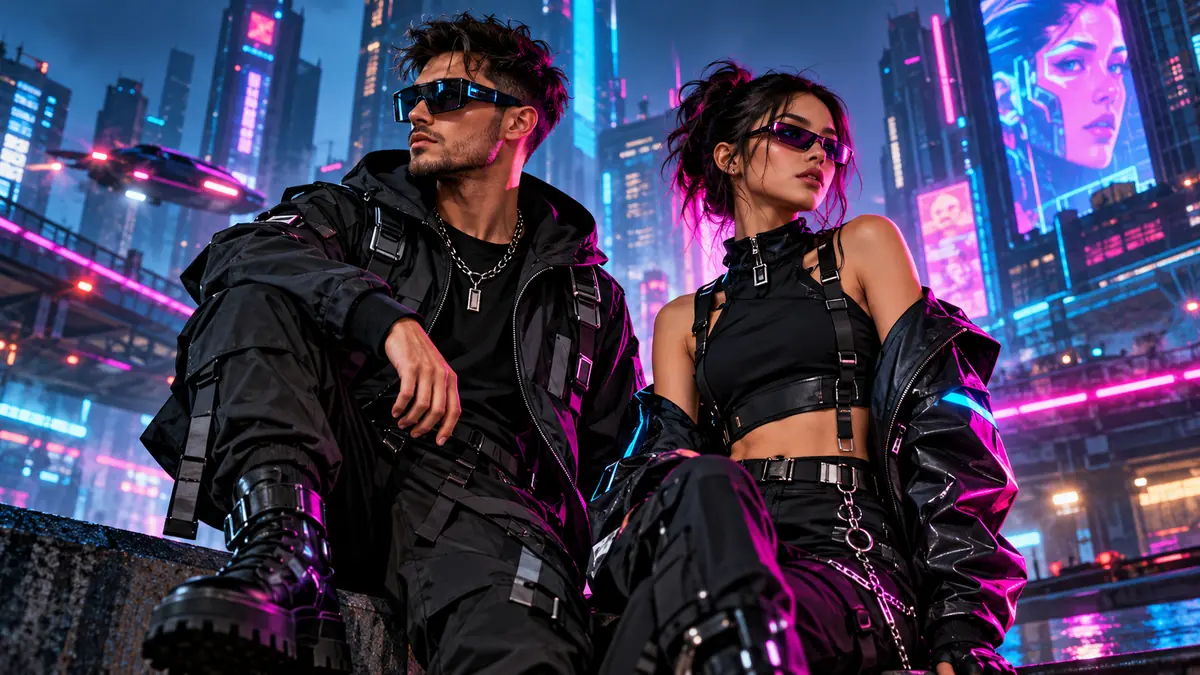
Cyberpunk fashion looks like clothing built for a future that is technologically advanced but socially unstable. Dark layers, technical fabrics, industrial hardware, asymmetric silhouettes, reflective surfaces, and carefully controlled neon accents turn ordinary streetwear into something that feels futuristic without necessarily becoming a costume.
The aesthetic grew from cyberpunk science fiction and its familiar tension between advanced technology and troubled urban life. Today, those ideas appear in streetwear, techwear, alternative fashion, runway collections, festival clothing, and everyday outfits.
Cyberpunk fashion is a futuristic clothing aesthetic that combines punk rebellion, technical utility, industrial details, dark streetwear, and technology-inspired design. Typical outfits use black or charcoal foundations, layered silhouettes, cargo clothing, synthetic materials, visible hardware, futuristic footwear, and small neon, metallic, reflective, or digital-looking accents.
The interesting part is that you do not need an entire science-fiction wardrobe to make the style work. A carefully chosen jacket, unusual silhouette, technical bag, or piece of metallic hardware can provide enough visual information to make an otherwise simple outfit feel cyberpunk.
What Is Cyberpunk Fashion?
Cyberpunk fashion translates the visual language of cyberpunk fiction into clothing.
The genre is often summarized through the tension between high technology and difficult, gritty everyday life. Its fictional worlds frequently feature enormous cities, powerful corporations, artificial intelligence, cybernetic modification, surveillance, digital networks, social inequality, and people surviving outside established systems.
Fashion based on those worlds carries the same contrast.
Instead of polished futuristic minimalism, cyberpunk clothing often looks functional, modified, layered, worn, protective, or improvised. Smooth technical fabrics might appear beside distressed materials. Matte black clothing may be interrupted by chrome hardware or bright cyan. A sleek pair of futuristic glasses can sit above a rugged utility jacket.
That contradiction is fundamental to the aesthetic.
Modern interpretations commonly combine influences from punk, goth, industrial fashion, streetwear, techwear, tactical clothing, and science-fiction costume design.
Cyberpunk therefore isn’t simply “wearing black.”
The silhouette, materials, construction, hardware, layering, and technological references are what transform dark clothing into a recognizably cyberpunk outfit.
Where Did Cyberpunk Fashion Come From?
Understanding the clothing becomes easier when you understand the fiction behind it.
Cyberpunk emerged prominently as a science-fiction movement during the late twentieth century. Writers imagined futures in which computing and biotechnology had advanced dramatically while society remained unequal, chaotic, commercialized, and increasingly controlled by powerful institutions.
William Gibson’s 1984 novel Neuromancer became one of the genre’s defining works. Gibson’s fictional world of hackers, cyberspace, corporations, implants, and dense urban environments helped establish ideas that remain strongly associated with cyberpunk.
Cinema provided an equally important visual foundation.
Ridley Scott’s Blade Runner (1982) presented a rainy, crowded, technologically saturated Los Angeles filled with monumental advertising, industrial architecture, cultural mixtures, and distinctive clothing.
Japanese cyberpunk added another major visual direction. Akira and Ghost in the Shell became influential examples of futuristic urban environments where humans, machines, governments, corporations, and technology intersect.
Later, The Matrix introduced another widely recognized futuristic wardrobe vocabulary through long coats, dark clothing, sleek sunglasses, leather-like surfaces, and minimalist silhouettes.
More recently, games such as Cyberpunk 2077 brought these influences to a much larger contemporary audience. Modern fashion commentary continues to connect the aesthetic with Blade Runner, Ghost in the Shell, The Matrix, and present-day techwear.
The result is not one historical uniform.
Cyberpunk fashion is an evolving interpretation of how people might dress when advanced technology collides with dense cities, corporate power, underground cultures, and individual rebellion.
The Essential Elements of Cyberpunk Fashion
You can recognize most successful cyberpunk outfits through several recurring design principles.
1. A Dark Foundation
Black dominates cyberpunk clothing because it provides the ideal background for unusual construction, hardware, reflective materials, and bright accents.
Common foundation colors include:
- Black
- Charcoal
- Graphite
- Gunmetal
- Dark grey
- Deep navy
These colors also make layering easier because multiple pieces can be combined without making an outfit visually chaotic.
An entirely black outfit, however, does not automatically become cyberpunk.
Texture and construction matter.
A plain black T-shirt with standard jeans reads very differently from a black asymmetric jacket over technical cargo trousers with metal hardware and structured boots.
2. Technical and Synthetic Materials
Material choice can instantly push clothing toward a futuristic appearance.
Common options include nylon, ripstop, coated fabrics, mesh, technical knits, faux leather, vinyl, reflective materials, and water-resistant textiles. Similar material choices repeatedly appear in contemporary cyberpunk and techwear styling guides.
Mixing surfaces works particularly well.
For example:
matte nylon + mesh + polished metal
creates more visual depth than using one identical black fabric throughout an outfit.
Technical fabrics also connect the aesthetic to functionality. Weather resistance, stretch, lightweight construction, ventilation, and durability can make futuristic-looking clothing genuinely practical.
3. Layering
Layering is one of the easiest ways to create a cyberpunk silhouette.
A basic combination might include:
Base layer → mid layer → outer layer → accessories
The base could be a fitted black shirt.
The mid layer might introduce a vest, overshirt, harness-inspired element, or lightweight utility piece.
A technical shell, asymmetric jacket, bomber, or long coat can become the outer layer.
Accessories then introduce smaller technological or industrial details.
The objective isn’t simply to wear as many garments as possible. Each layer should contribute either shape, texture, function, or contrast.
4. Asymmetry
Traditional clothing often aims for visual balance.
Cyberpunk frequently disrupts it.
Asymmetric zippers, diagonal closures, uneven hems, offset pockets, one-sided straps, unusual panels, and irregular layering create the impression that clothing has been engineered or modified rather than conventionally tailored.
Recent style guides identify deliberate asymmetry as one of the strongest ways to separate wearable cyberpunk from ordinary dark streetwear.
A single asymmetric garment can therefore do more for an outfit than five random futuristic accessories.
5. Utility Details
Cyberpunk clothing frequently borrows functional elements from workwear, outdoor clothing, military-inspired fashion, and technical apparel.
You might see:
- Cargo pockets
- Modular storage
- Webbing
- Straps
- Buckles
- Clips
- Zippers
- Utility belts
- Crossbody bags
- Detachable components
Function should ideally have some purpose.
Too many unused straps, oversized harnesses, and unnecessary attachments can quickly make an outfit look theatrical.
6. Industrial Hardware
Metal and hardware add mechanical character.
Zippers, D-rings, buckles, chains, snaps, carabiner-style clips, metallic jewelry, exposed fasteners, and reinforced closures can all contribute.
The best approach is restraint.
If the jacket already contains several prominent buckles and zippers, you probably don’t need a large chain, complicated harness, metallic belt, and hardware-covered bag at the same time.
Choose a visual hierarchy.
7. Futuristic Accents
Small details can suggest advanced technology without requiring actual electronics.
Reflective strips, holographic surfaces, translucent materials, chrome jewelry, unusual eyewear, geometric graphics, glitch-inspired prints, and LED elements are common possibilities.
Contemporary cyberpunk aesthetic guides commonly use neon, metallic, holographic, and reflective details against dark foundations.
The trick is making the accent look intentional rather than decorative.
The Cyberpunk Color Palette
The stereotypical cyberpunk image is black illuminated by neon.
That formula works, but the palette can be considerably broader.
| Role | Useful Colors |
|---|---|
| Foundation | Black, charcoal, graphite |
| Industrial | Gunmetal, steel, silver |
| Electric accents | Cyan, electric blue |
| Warm neon | Magenta, hot pink |
| Alternative accents | Purple, acid green |
| Neutral contrast | White, grey |
Neon pink, cyan, blue, green, and purple are especially associated with cyberpunk imagery because they create dramatic contrast against dark backgrounds.
But neon should normally behave like an accent.
Imagine an outfit consisting of black cargo trousers, black boots, a charcoal technical jacket, and one cyan detail.
That single bright element becomes much more powerful because everything around it is restrained.
Cover every garment in neon and the visual hierarchy disappears.
Do Cyberpunk Clothes Have to Be Black?
No.
Black is useful rather than mandatory.
Grey, olive, dark brown, white, metallic silver, washed colors, and muted industrial tones can work when the silhouette and details communicate the aesthetic.
You could build a cyberpunk outfit from grey cargo pants, an off-white technical jacket, silver hardware, and futuristic glasses without relying heavily on black.
Think in terms of technology + utility + rebellion, rather than one mandatory color.
Essential Cyberpunk Clothing
A cyberpunk wardrobe can be built gradually.
You don’t need every item below. In fact, choosing a few versatile pieces usually produces better everyday outfits.
Technical Jackets
Outerwear often becomes the visual anchor.
Good options include shell jackets, cropped utility jackets, bombers, asymmetric coats, modular jackets, technical parkas, and structured long coats.
Look for interesting construction rather than simply searching for something labeled “cyberpunk.”
An unusual zipper placement or paneled silhouette can communicate more than a giant futuristic graphic.
Cargo Pants
Cargo trousers naturally fit the aesthetic because they combine utility with strong visual structure.
Technical cargos may include articulated knees, adjustable hems, waterproof fabrics, multiple pockets, webbing, or unconventional closures.
For a cleaner interpretation, choose tapered cargos with only a few functional pockets.
For a more aggressive streetwear silhouette, wider cargos can work well with heavy footwear.
Base Layers
Simple base layers keep complex outfits under control.
Useful choices include fitted tees, long-sleeve technical tops, mock necks, compression-style shirts, mesh layers, bodysuits, and minimal hoodies.
If your outerwear is visually complicated, keep the base simple.
Vests
Utility vests provide storage, texture, and layering without requiring a heavy jacket.
A streamlined vest can be particularly useful in warm weather when full technical outerwear becomes uncomfortable.
Long Coats
Long coats introduce movement and drama.
Their connection with science-fiction cinema makes them one of the most immediately recognizable options, but proportions matter. A clean coat with subtle technical details is usually more wearable than something designed like a literal costume.
Footwear
Shoes determine how grounded the outfit feels.
Cyberpunk footwear often includes:
- Combat boots
- Tactical-inspired boots
- Platform boots
- Chunky sneakers
- Technical sneakers
- Futuristic high-tops
Heavy footwear works especially well with wide cargo pants and oversized outerwear.
Slimmer technical sneakers suit cleaner, modern outfits.
Cyberpunk Accessories That Actually Work
Accessories are where a basic dark outfit can acquire futuristic character.
Contemporary guides emphasize eyewear, bags, gloves, hardware, jewelry, and technology-inspired accessories as effective finishing elements.
Futuristic Eyewear
Angular sunglasses, wraparound lenses, narrow frames, mirrored surfaces, and unusual geometric shapes provide one of the fastest visual transformations.
You don’t need literal science-fiction goggles.
Modern sport sunglasses can produce a surprisingly convincing effect.
Utility Bags
Crossbody bags and compact technical backpacks combine function with the aesthetic naturally.
Look for:
- Waterproof materials
- Modular straps
- Multiple compartments
- Geometric construction
- Reflective details
- Matte hardware
Because these are practical objects, they often feel more authentic than purely decorative accessories.
Jewelry
Silver and gunmetal jewelry works particularly well.
Chains, geometric rings, industrial pendants, cuffs, ear jewelry, and minimalist metallic pieces can provide a mechanical edge.
Chrome-like surfaces stand out particularly well against matte black clothing.
Gloves
Fingerless, technical, or structured gloves can reinforce the aesthetic, although they’re easier to overdo.
Use them when they make sense for the setting rather than treating them as compulsory.
Masks and Face Coverings
Masks became strongly associated with futuristic street imagery, but they push an outfit toward costume territory faster than most accessories.
For everyday styling, futuristic eyewear usually achieves a similar effect more subtly.
Wearable Technology
Smartwatches, headphones, illuminated accessories, and other actual technology can fit naturally into cyberpunk fashion.
There is an interesting advantage here: the object isn’t pretending to be futuristic technology.
It actually is technology.
Cyberpunk Fashion vs. Techwear
Cyberpunk and techwear overlap heavily, but they aren’t identical.
| Cyberpunk Fashion | Techwear |
|---|---|
| Primarily an aesthetic and cultural language | Primarily rooted in technical clothing |
| Inspired heavily by science fiction | Influenced by performance and utility |
| May use neon, chrome, glitch graphics | Often uses restrained palettes |
| Can include intentionally theatrical elements | Usually prioritizes real-world function |
| Punk and dystopian influences are important | Technical construction is central |
| Can imitate fictional technology | Usually focuses on usable features |
Techwear often emphasizes performance: weather protection, mobility, storage, breathable fabrics, and ergonomic construction.
Cyberpunk can borrow all of those characteristics but add narrative.
A waterproof black shell jacket is techwear.
Combine it with asymmetric layers, futuristic eyewear, industrial hardware, metallic accents, and a dystopian visual language, and the result may read as cyberpunk.
This overlap is one reason contemporary cyberpunk fashion increasingly feels familiar outside science-fiction fandom. Fashion commentary has traced its tactical silhouettes, technical layering, and dark futuristic styling into modern techwear and runway fashion.
Cyberpunk vs. Goth Fashion
Both aesthetics use black heavily, so they’re sometimes confused.
Goth fashion, however, developed from its own music and subcultural history and often incorporates romantic, Victorian, occult, post-punk, or dark historical references depending on the particular goth style.
Cyberpunk looks forward rather than backward.
Its visual references tend to involve technology, industrial environments, artificial materials, digital culture, megacities, surveillance, and futuristic utility.
The two can certainly overlap.
Black platform boots, mesh, dark makeup, leather-like materials, and metallic accessories can belong comfortably in both wardrobes.
The difference usually comes from the surrounding context and styling.
Cyberpunk vs. Steampunk
These aesthetics imagine technology through opposite historical lenses.
Steampunk usually imagines advanced technology through a Victorian or industrial-age world. Brass, gears, leather, corsetry, waistcoats, goggles, mechanical devices, and antique styling are common visual references.
Cyberpunk imagines technology through computers, networks, artificial intelligence, cybernetics, dense modern cities, synthetic materials, and digital culture.
A simplified distinction is:
Steampunk: retro technology imagined forward.
Cyberpunk: modern technology pushed into a dystopian future.
How to Build a Cyberpunk Outfit
The easiest mistake is trying to add every recognizable cyberpunk feature at once.
Don’t.
Build from a foundation.
Step 1: Start With a Dark Base
Choose one simple foundation:
black tee + cargo pants
or
fitted top + dark trousers.
You now have a neutral canvas.
Step 2: Add One Structural Piece
Choose something with an unusual silhouette.
This might be an asymmetric jacket, technical vest, oversized shell, cropped utility jacket, or long coat.
One strong structural piece is usually enough.
Step 3: Introduce Utility
Add something functional.
A crossbody bag, cargo pocket, belt, modular pouch, or technical backpack works well.
Step 4: Add Hardware
Introduce one metallic or industrial element.
That could be jacket hardware, a chain, silver jewelry, buckles, or a metal clip.
Step 5: Add One Futuristic Signal
Finish with reflective eyewear, a cyan accent, holographic detail, unusual sneaker, or another element that pushes the outfit beyond conventional streetwear.
A useful everyday formula is:
dark foundation + technical silhouette + functional detail + futuristic accent
That is usually enough.
Easy Cyberpunk Outfit Ideas
Different situations require different intensity levels.
Minimal Everyday Cyberpunk
Try:
Black T-shirt
Tapered cargo trousers
Technical sneakers
Crossbody utility bag
Silver ring or bracelet
This works because the overall outfit remains familiar while the materials and accessories suggest the aesthetic.
Cyberpunk Streetwear Outfit
Try:
Oversized graphic or technical top
Wide cargo pants
Cropped utility jacket
Chunky sneakers
Wraparound sunglasses
Crossbody bag
Keep graphics controlled. One strong graphic is more effective than competing prints.
Tech-Noir Outfit
Try:
Black mock-neck top
Straight dark trousers
Long structured coat
Black boots
Minimal silver jewelry
Narrow sunglasses
This version draws more heavily from cinematic cyberpunk and avoids bright neon almost completely.
Neon Cyberpunk Outfit
Try:
Black technical jacket
Black cargo trousers
Dark boots
Reflective bag
One cyan, magenta, or acid-green accent
The neon should attract attention because it is rare.
Industrial Cyberpunk Outfit
Try:
Charcoal layered shirt
Coated black pants
Heavy boots
Utility vest
Gunmetal hardware
Structured backpack
Focus on texture rather than bright color.
How to Wear Cyberpunk Fashion Without Looking Like a Costume
This is where many outfits go wrong.
Cyberpunk originates partly in fictional worlds, so copying those worlds literally can produce clothing that looks designed for cosplay rather than daily life.
Modern cyberpunk styling guides increasingly emphasize controlled layering and a few deliberate futuristic signals instead of piling on random neon accessories.
A practical rule is to make most of your outfit recognizable everyday clothing.
Then alter one or two dimensions.
For example:
Normal silhouette + unusual material
or
Normal materials + unusual silhouette
or
Simple outfit + futuristic accessory
You don’t need all three simultaneously.
Avoid Too Many Straps
Straps are associated with technical and tactical clothing, but they lose impact quickly.
If they serve no practical or structural purpose, ask whether they actually improve the outfit.
Don’t Use Neon Everywhere
Cyberpunk environments use neon dramatically because it appears against darkness.
The same principle applies to clothing.
One neon accent against an otherwise muted outfit has far greater visual impact than six fluorescent colors competing for attention.
Avoid Copying One Character Exactly
Use fictional characters as references, not templates.
Take the long coat from one influence, the color palette from another, and modern technical sneakers from contemporary streetwear.
The result becomes personal style instead of imitation.
Prioritize Fit
No amount of hardware can rescue poor proportions.
Pay attention to how tops, jackets, trousers, and shoes interact.
Wide pants often benefit from substantial footwear. Oversized outerwear may work better with a simpler base. A cropped jacket can create structure when worn with wider trousers.
Silhouette comes first.
How to Build a Cyberpunk Wardrobe on a Budget
Cyberpunk fashion doesn’t require expensive designer clothing.
In fact, customization fits the genre’s DIY spirit remarkably well.
Start with clothes you already own.
Black jeans, cargo trousers, boots, hoodies, jackets, and basic shirts can become foundations.
Then add inexpensive details gradually.
Thrift Strategically
Search for construction rather than labels.
Useful secondhand finds include:
- Utility jackets
- Military-inspired outerwear
- Old cargo trousers
- Oversized coats
- Motorcycle jackets
- Workwear
- Unusual sunglasses
- Technical sportswear
- Silver-tone jewelry
- Industrial belts and bags
A $20 secondhand jacket with excellent proportions may work better than an expensive garment covered in decorative straps.
Modify Existing Clothing
Simple DIY modifications can include replacing hardware, adding reflective details, changing zipper pulls, altering hems, attaching patches, distressing appropriate fabrics, or adding removable utility elements.
Keep modifications intentional.
Randomly attaching chains and buckles rarely produces convincing design.
Spend More on Versatile Pieces
If you eventually invest more money, prioritize items you can wear repeatedly.
Good boots, technical outerwear, durable cargo trousers, and a functional bag provide much more value than highly specialized costume-like accessories.
Cyberpunk Fashion for Warm Weather
One overlooked problem with the aesthetic is climate.
Most cyberpunk imagery seems to assume permanent nighttime rain.
Real people sometimes have to dress for summer.
Instead of heavy jackets and multiple layers, concentrate on silhouette and accessories.
Use:
- Lightweight technical shirts
- Breathable nylon
- Mesh panels
- Cargo shorts
- Lightweight trousers
- Utility vests
- Crossbody bags
- Futuristic sunglasses
- Minimal metallic jewelry
A black sleeveless technical top with lightweight cargos and unusual eyewear can communicate cyberpunk more successfully than wearing an uncomfortable coat in hot weather.
Function matters.
Cyberpunk Fashion for Cold Weather
Cold weather makes layering much easier.
Start with thermal or fitted base layers, then add a hoodie, technical mid-layer, insulated jacket, shell, or long coat depending on conditions.
Weather-resistant outerwear naturally complements the aesthetic.
Boots also become practical rather than purely visual.
The result can look futuristic while functioning like legitimate winter clothing—which is arguably more faithful to cyberpunk’s utilitarian spirit.
The Role of Punk and Rebellion
Removing punk from cyberpunk leaves only futuristic fashion.
The genre has historically been concerned with power: who controls technology, who benefits from it, who gets excluded, and how individuals survive within those systems.
That is why cyberpunk clothing frequently appears modified, personal, improvised, underground, or resistant to uniformity.
The punk component doesn’t require spikes or patches.
It can appear through customization, repaired garments, unconventional combinations, DIY alterations, anti-polished styling, or simply rejecting standardized fashion.
This is also why perfectly matching “cyberpunk sets” can sometimes feel less convincing than wardrobes assembled from unrelated pieces.
A believable cyberpunk outfit often looks collected rather than purchased as a complete uniform.
How Cyberpunk Fashion Became More Wearable
The boundaries between fictional cyberpunk clothing and contemporary fashion have gradually narrowed.
Technical outerwear is normal.
Cargo pants are mainstream.
Wraparound sunglasses have repeatedly returned to fashion.
Wearable electronics are ordinary consumer products.
Performance sneakers increasingly use futuristic construction.
Water-resistant synthetics, laser cutting, bonded seams, reflective materials, and engineered fabrics no longer belong exclusively to science-fiction costumes.
Fashion institutions and contemporary commentary have also highlighted the movement of cyberpunk visual codes from Blade Runner, Ghost in the Shell, and The Matrix toward techwear and runway fashion, including designers associated with dark, futuristic silhouettes.
That creates an interesting situation.
The future imagined by older cyberpunk media hasn’t arrived exactly as predicted, but many of its visual ingredients no longer look particularly futuristic.
Common Cyberpunk Styling Mistakes
A convincing outfit usually depends as much on what you remove as what you add.
Mistake 1: Treating Black as the Entire Aesthetic
Black clothing is a foundation.
Construction, texture, silhouette, and technological references create the rest.
Mistake 2: Adding Every Cyberpunk Symbol
Neon glasses, mask, harness, chains, LEDs, platform boots, giant cargos, gloves, and a futuristic coat simultaneously can overwhelm the wearer.
Choose focal points.
Mistake 3: Ignoring Function
A dozen dangling straps may look technical in a photograph but become annoying in daily life.
Practicality actually strengthens the aesthetic.
Mistake 4: Buying Only “Cyberpunk” Products
Search outside the label.
Outdoor clothing, motorcycle apparel, workwear, sportswear, military surplus, vintage pieces, and contemporary streetwear can all contribute.
Mistake 5: Forgetting Personal Style
You should still look like yourself.
Someone who normally prefers minimalism might build cyberpunk outfits around clean black tailoring and futuristic eyewear.
Someone who likes punk might emphasize distressed materials and hardware.
A streetwear fan might choose oversized cargos and technical sneakers.
Cyberpunk works best as a design language rather than a uniform.
Is Cyberpunk Fashion the Same as Cosplay?
No.
Cosplay generally aims to represent a specific character or fictional universe accurately.
Cyberpunk fashion borrows visual principles from the genre and incorporates them into personal clothing.
There can obviously be overlap.
An elaborate cyberpunk outfit may work beautifully for conventions, festivals, clubs, photography, performances, or themed events.
Everyday cyberpunk simply turns the intensity down.
Instead of dressing like someone directly from a fictional megacity, imagine what parts of that person’s wardrobe would still make sense while buying groceries, commuting, meeting friends, or going to a concert.
That’s usually where the most wearable interpretation appears.
A Simple Cyberpunk Fashion Formula
If the entire aesthetic feels complicated, reduce it to five decisions:
- Choose a dark foundation.
- Add one technical or asymmetric garment.
- Introduce a useful utility element.
- Add one industrial or metallic detail.
- Finish with one futuristic accent.
Then stop.
Look at the outfit before adding anything else.
If it already communicates the idea, another accessory probably isn’t necessary.
That restraint is what separates deliberate styling from costume.
Final Thoughts on Cyberpunk Fashion
Cyberpunk fashion works because it combines contradictions: technology and decay, utility and experimentation, darkness and electric color, individuality and mass urban culture.
Its strongest outfits don’t depend on covering the body in neon or copying a science-fiction character. They use recognizable clothing—cargo trousers, technical jackets, boots, coats, bags, eyewear—and alter the visual language through asymmetric construction, synthetic materials, industrial hardware, functional layering, and carefully chosen futuristic details.
The aesthetic’s roots in works such as Neuromancer, Blade Runner, Akira, Ghost in the Shell, and The Matrix remain visible, while modern techwear and streetwear have made many of those once-fictional ideas increasingly wearable.
If you want to experiment with cyberpunk fashion, don’t begin by replacing your entire wardrobe. Start with what you already own, establish a dark foundation, add one technically interesting piece, and introduce a single futuristic signal.
The best cyberpunk outfit doesn’t look like you’re wearing the future as a costume.
It looks like the future has quietly become part of what you already wear.