
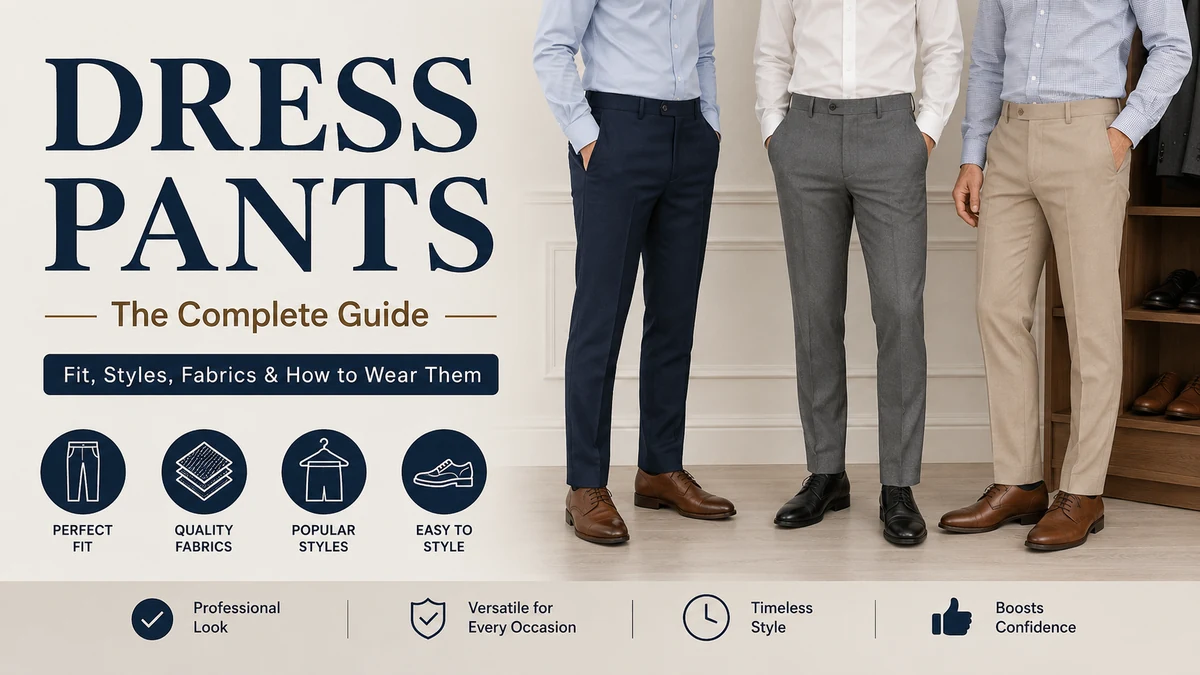
A good pair of dress pants can make an ordinary shirt look intentional, while a badly fitting pair can make even expensive clothing feel awkward. The difference usually comes down to three things: fabric, proportion, and fit.
Dress pants are tailored trousers designed to create a clean, polished appearance for professional, business-casual, semi-formal, and some formal settings. Unlike jeans or casual chinos, they typically use smoother woven fabrics, cleaner construction, structured waistbands, and carefully shaped legs. They can be worn independently, whereas suit pants are specifically made to match a suit jacket.
Understanding the details matters because terms such as trousers, slacks, chinos, and suit pants are frequently used as though they mean the same thing. They overlap, but they are not always identical.
What Are Dress Pants?
Dress pants are tailored trousers intended to look smarter and more refined than everyday casual pants. They generally have a structured waistband, smooth front, side pockets, carefully finished seams, and either a straight, tapered, slim, or wide-leg silhouette.
Wool and wool blends are traditional choices, but modern versions also use cotton, linen, polyester, viscose, elastane, and blended fabrics.
A pair does not need to belong to a suit.
That distinction is useful. If charcoal trousers are sold and worn independently with different shirts, knitwear, or jackets, they can function as dress pants. If those exact trousers were manufactured from the same cloth as a matching charcoal jacket, they would normally be described as suit pants when worn as part of that set.
Modern tailoring has also become less rigid. Relaxed and wide-leg trousers now coexist with classic straight and slim silhouettes, while clean flat-front construction remains a common option.
Common Features of Dress Trousers
Construction varies considerably, but typical details include:
- A structured or shaped waistband
- Belt loops or side adjusters
- A zipper fly
- Slanted or vertical side pockets
- Welt or buttoned back pockets
- Flat-front or pleated construction
- A pressed center crease
- Finished or unfinished hems
- Smooth woven fabric
- Minimal decorative stitching
- Enough seam allowance for at least minor alterations on better-made pairs
The overall objective is simple: the fabric should fall cleanly from the waist toward the shoes.
That clean drape matters more than whether a label calls the cut “slim,” “classic,” or “tailored.”
Dress Pants vs. Slacks, Chinos, and Suit Pants
Clothing terminology becomes confusing because the meaning changes between brands, countries, and generations. In North American English, “slacks” and “dress pants” are sometimes used interchangeably, while “trousers” is a broader term in British English and international menswear.
There is no universally enforced technical definition separating every category. Even contemporary style guides disagree on exactly where slacks end and dress pants begin.
A practical distinction is more useful:
| Type | Typical Fabric | Appearance | Typical Formality | Matching Jacket Required? |
|---|---|---|---|---|
| Dress pants | Wool, blends, cotton, linen | Clean and tailored | Business casual to formal | No |
| Slacks | Wool or softer blends | Tailored but often relaxed | Smart casual to business | No |
| Suit pants | Matching suiting fabric | Structured and refined | Business to formal | Part of a matching suit |
| Chinos | Cotton twill | Clean but casual | Casual to business casual | No |
| Jeans | Denim | Casual | Casual | No |
Are Slacks the Same as Dress Pants?
Sometimes.
“Slacks” traditionally describes standalone tailored trousers and often suggests a slightly more relaxed garment. In everyday American usage, however, someone asking for dress slacks may simply mean dress pants.
Trying to establish an absolute difference can therefore create more confusion than it solves.
Pay attention to the actual garment—its material, cut, crease, waistband, pockets, and construction—rather than relying entirely on the name printed on the tag.
Dress Pants vs. Suit Pants
This distinction is clearer.
Suit pants are made as part of a matching suit. Dress pants can stand alone.
Suit trousers normally share exactly the same cloth, color, weave, and pattern as their corresponding jacket. Separating them is possible stylistically in some situations, but frequent independent wear can cause the trousers to fade or wear faster than the jacket.
Standalone trousers are designed to coordinate with different garments.
A navy blazer, for example, can work naturally with medium-gray dress trousers without pretending to be a navy suit.
Dress Pants vs. Chinos
Chinos are traditionally constructed from cotton twill. Their texture, stitching, pockets, and overall construction usually give them a more casual character.
Dress trousers tend to have smoother fabric and sharper lines.
That does not mean chinos cannot be worn to an office. Many modern workplaces accept them. They simply sit farther toward the casual end of the clothing spectrum.
How Should Dress Pants Fit?
Fit determines whether trousers look polished far more than the price tag does.
The best general rule is that dress pants should hang cleanly without pulling, sagging, twisting, or clinging unnecessarily. Tailoring specialists commonly look for disruptions such as flaring pockets, wrinkles around the rise, or fabric catching on the calves as signs of an incorrect fit.
Check each area separately.
Waist
The waistband should stay comfortably in position without requiring a tightly fastened belt.
You should be able to sit, stand, and breathe normally. A waistband that leaves significant empty space is too loose; one that digs deeply into the body or creates strong horizontal pulling is too tight.
A belt can complement trousers, but it should not be responsible for keeping substantially oversized pants on your waist.
Seat and Hips
The seat should follow the body without stretching tightly across it.
Watch the pockets.
If side pockets flare open while you are standing naturally, the trousers may be too tight across the hips or upper seat. Excess fabric sagging beneath the seat suggests the opposite problem or an unsuitable rise.
A tailor can correct some issues, but major seat and rise problems are harder to repair than simple waist or hem adjustments.
Rise
The rise describes the distance between the crotch area and waistband and influences where the trousers sit on your body.
Common options include:
- Low rise
- Mid rise
- High rise
Mid-rise trousers are familiar to many wearers, while higher rises are strongly associated with traditional tailoring and can visually lengthen the legs.
The crotch should sit comfortably without pulling upward or hanging noticeably low. If fabric forms persistent horizontal tension lines around this area, changing size alone may not solve the problem; you may need a different trouser pattern.
Thighs
Dress pants need enough room for walking and sitting.
They should not cling to the thighs like stretch jeans. Even a slim silhouette benefits from a small amount of ease because tailored trousers rely on drape.
If the pockets flare, creases disappear, or horizontal wrinkles form across the upper legs, try a roomier cut.
Knee and Calf
The leg can narrow below the knee, but it should continue to fall naturally.
Overly narrow calves cause fabric to catch rather than drop after you stand up. This is particularly noticeable in lightweight wool trousers.
A straight or gently tapered leg is usually easier to fit than an aggressively narrow cut.
Hem and Trouser Break
The break is the fold created where the trouser hem meets the shoe.
Common approaches include:
| Break | Appearance | Works Well With |
|---|---|---|
| No break | Hem barely touches shoe | Contemporary, tapered trousers |
| Slight break | Small crease at front | Versatile tailored outfits |
| Half break | Noticeable controlled fold | Classic trousers |
| Full break | Deeper fold above shoe | Wider traditional cuts |
There is no single correct break for every silhouette.
Slim trousers generally look cleaner with little or no break. Fuller trousers can handle more length because their wider opening falls around the shoe more naturally.
Current fashion also includes intentionally long, pooling trousers, but that should be understood as a deliberate styling choice rather than a traditional tailoring standard.
Quick Takeaway: Start with the waist, seat, rise, and thighs. Those areas are comparatively difficult to correct. Hem length is one of the easiest things for a tailor to change.
Best Fabrics for Dress Pants
Fabric affects nearly everything: drape, comfort, durability, warmth, breathability, wrinkle resistance, and how formal the trousers appear.
There is no universally “best” material. The right one depends on climate and use.
Wool
Wool remains a classic trouser material because high-quality wool combines structure with excellent drape.
It does not necessarily mean thick winter fabric.
Lightweight and midweight worsted wool can be comfortable across much of the year. Worsted cloth has a relatively smooth surface, making it especially useful for office and tailored clothing.
Benefits include:
- Clean drape
- Good shape retention
- Refined appearance
- Natural breathability
- Multiple weights for different seasons
Its disadvantages are price and care. Depending on the garment, wool trousers may require professional cleaning and more careful storage than machine-washable synthetics.
Wool Blends
Combining wool with polyester, elastane, viscose, or other fibers can change performance and cost.
A small amount of stretch may improve mobility. Synthetic fibers can increase durability and reduce wrinkling, while wool preserves some of the drape and texture expected from traditional tailoring.
Always read the actual fiber percentages rather than assuming every “wool blend” performs alike.
Cotton
Cotton trousers are comfortable and familiar, especially in mild or warm conditions.
They generally look more relaxed than fine worsted wool because cotton tends to crease differently and may not drape as fluidly.
That makes cotton dress pants particularly useful when the dress code falls between traditional tailoring and business casual.
Linen
Linen is highly valued in hot weather because it feels light and breathable.
The tradeoff is obvious: wrinkles.
Trying to keep pure linen completely crease-free is usually unrealistic. Its relaxed texture is part of the appeal. A linen blend can provide some warm-weather comfort while maintaining a slightly more controlled appearance.
Polyester and Synthetic Blends
Polyester is common in affordable and easy-care trousers because it can offer durability, shape retention, and wrinkle resistance.
Modern synthetic fabrics are substantially more sophisticated than many older versions, and stretch blends can be particularly comfortable for travel or long workdays.
Still, inexpensive synthetic cloth can sometimes look shiny or drape stiffly.
Judge the fabric itself rather than the fiber name alone.
Viscose and Elastane
Viscose is frequently blended into contemporary trousers to produce a softer hand and fluid drape.
Elastane—also called spandex in some markets—is usually present in relatively small quantities to provide stretch.
Stretch is useful, but it cannot compensate for poor sizing. Pants that only fit because the material is constantly stretched are still too tight.
Flat-Front vs. Pleated Dress Pants
One of the most visible design choices is whether the front is flat or pleated.
Flat-Front Pants
Flat-front trousers have no folds opening from the waistband.
They create a simple, streamlined appearance and became especially prominent alongside slimmer modern tailoring.
They work particularly well when:
- You prefer minimal detailing
- The trousers have a slim or straight cut
- You want an easy business-casual appearance
Pleated Pants
Pleats are intentional folds near the waistband that provide additional fabric through the upper portion of the trousers.
Common configurations include single and double pleats, while the direction of the fold can also vary.
Well-cut pleats are not simply decorative. They can provide useful room through the hips and thighs, particularly when sitting.
Fuller, higher-rise trousers often work naturally with pleats because the proportions allow the extra fabric to fall cleanly.
Trends move between pleated and flat-front designs, so neither construction should automatically be considered universally superior.
Common Dress Pants Fits and Silhouettes
Fit labels are not standardized. A “slim” trouser from one manufacturer may resemble another company’s regular fit.
Focus on measurements and silhouette instead.
Slim Fit
Slim dress pants narrow through the seat, thigh, and lower leg.
They create a sharp outline but need enough room to drape. When a slim fit starts producing tension around the pockets, thighs, or calves, moving to a larger size may not be enough—a different cut may be better.
Straight Fit
Straight-leg trousers maintain a relatively consistent line from the thigh toward the hem.
This is one of the easiest silhouettes to wear because it balances traditional tailoring with modern simplicity.
Tapered Fit
Tapered pants become gradually narrower toward the ankle.
The taper can be subtle or pronounced. A gentle taper creates shape without causing the fabric to catch on the calves.
Relaxed and Wide-Leg Fit
Modern dress trousers increasingly use fuller legs.
Wide-leg trousers should still look intentional. More fabric does not mean uncontrolled bagginess. The waistband and seat need to fit correctly, while the wider leg should fall vertically.
Recent fashion coverage continues to show wide-leg and relaxed tailored trousers as prominent contemporary alternatives to very narrow pants.
How to Choose Dress Pants for Your Body
The objective is not to hide your body. It is to find proportions that allow the garment to hang correctly.
For Larger Thighs
Look for:
- More room through the seat and thigh
- Straight or gently tapered legs
- Pleats when additional upper-leg room is helpful
- Fabric with good drape
Avoid sizing up dramatically just to gain thigh room. Doing so can create an oversized waist and poor seat fit.
For a Slim Build
Straight, tapered, and moderately slim trousers can all work.
Extremely narrow pants may exaggerate a very slender frame. A little additional leg width often creates a more balanced silhouette.
For Shorter Wearers
Consistent vertical lines can make the legs appear longer.
Consider:
- Mid- or higher-rise trousers
- Little excess fabric at the hem
- A straight or moderate taper
- Minimal bunching around the shoes
Long trousers with multiple folds can visually interrupt that line.
For Taller Wearers
Pay special attention to the rise and inseam rather than merely increasing the waist size.
Tall-specific sizing can make a major difference because proportions such as knee placement and rise are not always corrected by simply buying trousers with a longer hem.
Dress Pants Colors: Where to Start
Color affects versatility almost as much as fit.
Charcoal Gray
Charcoal is one of the most adaptable choices for tailored trousers.
It works with white, pale blue, pink, burgundy, navy, black, and numerous patterned shirts and jackets.
Medium and Light Gray
Medium gray is especially versatile because it creates visible contrast with dark jackets while remaining professional.
Lighter gray feels less formal and can work particularly well in warmer seasons.
Navy
Navy trousers are easy to coordinate with white and light-colored shirts.
One practical consideration: pairing navy pants with a navy blazer requires care. If the fabrics are close but not identical, the combination can resemble a mismatched suit.
Black
Black dress pants create a sharp, simple appearance and are widely used for work, uniforms, evening outfits, and certain formal occasions.
For everyday classic menswear, however, charcoal can sometimes be easier to combine with textured jackets and brown footwear.
Brown, Beige, and Earth Tones
Brown, taupe, cream, olive, and beige can soften the formality of tailored pants without making them casual.
These colors are particularly effective in smart-casual wardrobes and with textured fabrics.
How to Wear Dress Pants
Dress pants are more versatile than the traditional dress-shirt-and-tie combination suggests.
The key is keeping the formality of each garment reasonably compatible.
Business and Professional Settings
A straightforward combination is:
- Wool or wool-blend trousers
- Dress shirt
- Leather belt if the trousers require one
- Oxford or Derby shoes
- Blazer when appropriate
Charcoal or medium-gray trousers provide a particularly flexible foundation.
Business Casual
Remove some of the structure without abandoning the tailored silhouette.
Try dress pants with:
- Oxford cloth shirts
- Polo shirts
- Fine-gauge knitwear
- Cardigans
- Unstructured blazers
- Loafers
- Minimal leather shoes
The trousers keep the outfit polished while the upper half makes it more relaxed.
Smart Casual
A knit polo or simple crew-neck sweater can work well with tailored trousers.
Clean minimalist sneakers may also work when the setting is genuinely casual enough, although loafers and suede shoes create a smoother transition between casual and tailored clothing.
Semi-Formal Events
Dress pants can be suitable for many dinners, celebrations, and semi-formal events when combined with a dress shirt and tailored jacket.
But check the stated dress code.
If an invitation requires a matching suit, tuxedo, black tie, or another defined formal standard, standalone trousers should not automatically be treated as a substitute.
What Shoes Go With Dress Pants?
Footwear establishes the lower boundary of the outfit, so it should complement the trousers rather than fight them.
Oxford Shoes
Oxfords are among the most formal conventional choices.
Their closed-lacing construction creates a clean appearance that pairs naturally with refined wool trousers.
Derby Shoes
Derbies have open lacing and generally feel slightly less formal than Oxfords.
That versatility makes them excellent for office clothing.
Loafers
Loafers pair especially well with tapered, straight, and slightly cropped trousers.
Leather models can look quite polished, while suede versions usually push the outfit toward smart casual.
Monk Straps
Monk-strap shoes replace conventional laces with one or more buckled straps.
They occupy a useful space between traditional dress shoes and more distinctive styling.
Minimal Sneakers
Clean sneakers can work with modern tailored pants in casual environments.
Keep the rest of the outfit similarly relaxed. Highly polished formal trousers paired with bulky athletic running shoes usually create an unintended clash.
Belt or No Belt?
If the trousers have conventional belt loops and you tuck in your shirt, a belt often provides a finished appearance.
Match leather tones rather than obsessing over an exact color match. Brown shoes with a reasonably similar brown belt are usually enough.
Tailored trousers with side adjusters are different.
Side tabs allow the waistband to be tightened without a belt and create a cleaner uninterrupted waistline. Suspenders can also be appropriate when trousers are specifically constructed to accommodate them.
Avoid wearing both a belt and suspenders for the same functional purpose.
How to Judge Dress Pants Quality
Price alone does not reveal quality.
Inspect construction.
Fabric Drape
Hold the trousers naturally and watch how the material falls.
Good trouser cloth should form controlled vertical lines rather than appearing excessively stiff or flimsy. Fabric weight also influences drape; very lightweight cloth can sometimes struggle to maintain the clean shape of heavier material.
Seams and Stitching
Look for straight stitching without loose threads, puckering, or irregular seam lines.
Patterned trousers require extra attention. Checks or stripes that align thoughtfully around important seams generally indicate more careful construction.
Waistband
A well-constructed waistband should retain its shape without feeling unnecessarily rigid.
Check the inside finishing as well as the visible exterior.
Inlay and Seam Allowance
One overlooked quality feature is extra material inside the seat and side seams.
This inlay gives a tailor room to let the trousers out later. Higher-quality makers often leave more alteration allowance, while aggressively cost-cut construction may leave very little.
This matters because bodies and preferred fits change.
Hem Allowance
Extra fabric inside the hem can make length adjustments easier.
If you frequently struggle to find the correct inseam, unfinished trousers can actually be an advantage because a tailor can establish the length specifically for you.
Common Dress Pants Fit Mistakes
Many problems blamed on “bad style” are actually simple fit problems.
Wearing Them Too Tight
Dress trousers should not fit like skinny denim.
Common warning signs include:
- Open or flaring pockets
- Horizontal lines across the hips
- Fabric pulling around the crotch
- Thighs visibly stretching the cloth
- Pants catching on the calves
More stretch is not the solution. More room is.
Wearing Them Too Long
Excessive fabric collecting around the ankle can make otherwise clean trousers look untidy.
Have the hem adjusted according to both your leg length and the width of the trouser opening.
Wearing Them Too Low
Trousers designed for a mid or high rise can look distorted when deliberately pulled down onto the hips.
Wear the waistband where the pattern was intended to sit.
Ignoring the Seat
People often judge pants only from the front.
Use a three-way mirror or check photographs from the side and back. Excess fabric, pulling, and wrinkles beneath the seat can reveal problems invisible from the front.
Expecting a Tailor to Fix Everything
Tailoring is powerful, but not magical.
Hemming and modest waist adjustments are routine. Completely changing the rise, seat, or fundamental proportion of a trouser can be difficult, expensive, or impossible.
Starting with the closest possible fit generally produces the cleanest final result.
How to Get Dress Pants Tailored
Few people match ready-to-wear clothing measurements perfectly.
A tailor can often improve:
- Hem length
- Waist circumference
- Seat within reasonable limits
- Leg taper
- Trouser opening
- Suspender buttons
- Cuffs
When trying trousers before alterations, wear the shoes you expect to pair with them. Shoe height and shape influence how the hem falls.
Do not automatically ask a tailor to make the legs as narrow as possible. Ask for a clean line instead.
That distinction prevents over-tapering.
How to Care for Dress Pants
Proper care preserves both the cloth and the shape.
Check the Care Label
Fiber content alone does not determine the correct washing method. Linings, interfacing, dyes, and construction can affect what the finished garment tolerates.
Follow the manufacturer’s garment-care instructions first.
Hang Them Properly
Use a trouser hanger that supports the garment without creating unnecessary marks.
Hanging trousers neatly after wear can allow minor wrinkles to relax before the next use.
Avoid Unnecessary Washing
Not every short wear requires immediate washing.
Unless the trousers are stained, heavily perspired in, or otherwise dirty, airing them between wears may reduce unnecessary stress on the fabric.
Press Carefully
A center crease can make traditional trousers look much sharper.
Use an iron temperature appropriate for the fabric, and consider a pressing cloth when dealing with delicate wool or materials prone to shine.
Rotate Your Pants
Wearing the same pair every day accelerates wear at the seat, crotch, knees, and waistband.
Rotation gives fabric time to recover and can extend the useful life of a tailored wardrobe.
Building a Practical Dress Pants Wardrobe
You do not need a closet full of trousers to cover most situations.
Start with versatility.
For a traditional professional wardrobe, charcoal or medium gray is an excellent first direction. Navy can follow, while lighter gray, brown, beige, olive, or patterned trousers expand your options.
Prioritize in this order:
- Correct waist and seat
- Comfortable rise
- Enough thigh room
- Clean leg line
- Appropriate fabric
- Correct hem
- Color and secondary details
That order prevents a common mistake: choosing trousers because the color looks great and then tolerating a poor fit.
One excellent pair that fits correctly will usually be more useful than several pairs that require constant adjustment.
Dress Pants Should Look Effortless, Not Restrictive
The strongest dress pants are not necessarily the narrowest, most expensive, or most formal trousers you can find. They are the ones that fit their intended setting and hang cleanly on your body.
Start with the waist, rise, seat, and thighs. Choose wool, cotton, linen, polyester, viscose, or a blend according to climate and purpose. Then decide whether a straight, tapered, slim, pleated, or wide-leg silhouette suits the look you want.
Most importantly, pay attention to drape.
When trousers fall naturally from the waist, the pockets stay flat, the legs remain clean, and the hem interacts neatly with your shoes, almost everything else becomes easier. That is what well-fitting dress pants are supposed to do.