
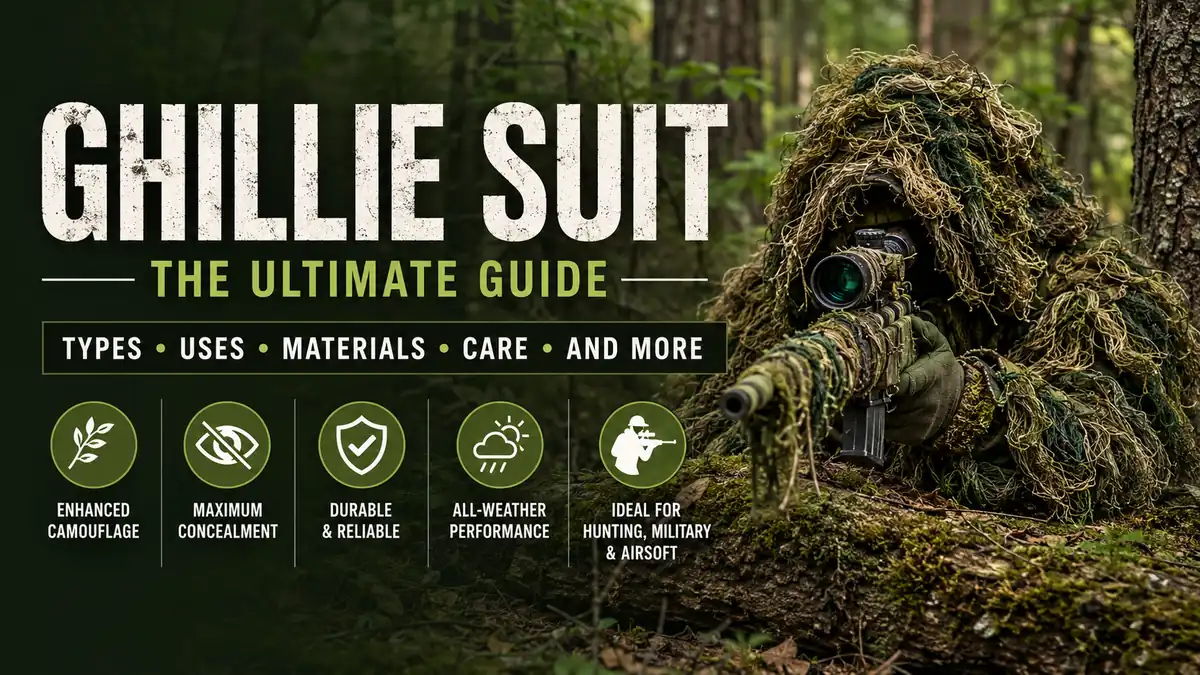
A person wearing ordinary camouflage may still look unmistakably human. Add irregular texture, dangling fibers, broken edges, and vegetation, however, and that recognizable silhouette becomes much harder to pick out.
That is the basic idea behind a ghillie suit—one of the most distinctive forms of three-dimensional camouflage.
A ghillie suit is camouflage clothing designed to break up the shape of the human body and help the wearer visually blend with surrounding vegetation or terrain. Traditional versions use netting or fabric covered with jute, burlap, twine, cloth strips, and sometimes local foliage. They are associated with military personnel and hunters but are also used by wildlife photographers and outdoor-sport participants.
The concept has roots in the Scottish Highlands and later became strongly associated with military reconnaissance and snipers. Modern versions range from traditional heavy jute garments to lightweight synthetic leaf suits.
This guide explains what a ghillie suit actually does, where it came from, the major designs, why three-dimensional camouflage works, and the practical limitations people often overlook.
What Is a Ghillie Suit?
A ghillie suit is a specialized camouflage garment that uses irregular colors, textures, fibers, and shapes to disguise the recognizable outline of its wearer.
Cambridge Dictionary describes it as clothing covering the body and head with numerous hanging strips of material, particularly associated with soldiers, snipers, and hunters seeking concealment among vegetation.
Typical construction starts with a base such as:
- Mesh or netting
- A jacket and trousers
- A poncho-style garment
- A hood
- A lightweight camouflage uniform
Textured material is then attached to that base.
Traditional materials include jute, hessian or burlap, cloth strips, string, and twine. Contemporary designs may instead use synthetic fibers, laser-cut fabric leaves, mesh, raffia-like material, or lightweight three-dimensional foliage.
The Smithsonian’s National Museum of American History describes ghillie camouflage as a net or cloth garment covered with materials such as burlap, cloth, or twine and sometimes supplemented with foliage from the immediate area.
That last detail matters.
A suit is not effective simply because it looks bushy. Successful camouflage depends heavily on whether its colors, shapes, texture, and movement make sense in the environment where it is being worn.
Why Is It Called a Ghillie Suit?
The name has Scottish roots.
The English term ghillie comes from the Scottish Gaelic gille, historically referring to a boy, lad, servant, or outdoor attendant. In the Scottish Highlands, ghillies became particularly associated with assisting people involved in fishing, shooting, stalking, and other countryside activities.
This background explains why the garment’s history is connected to Scottish gamekeepers and stalkers rather than beginning as purely military equipment.
There is also a folklore connection sometimes mentioned in histories of the garment: the Ghillie Dhu, a figure from Scottish folklore associated with woodland and vegetation. However, the practical connection to Highland ghillies, stalkers, and gamekeepers provides the more direct historical context.
How Does a Ghillie Suit Work?
A ghillie suit works primarily by disrupting visual recognition.
Human beings have a fairly predictable silhouette: a round head above shoulders, a vertical torso, two arms, and two legs. Even patterned camouflage cannot completely eliminate those recognizable lines.
Three-dimensional camouflage attacks that problem.
Instead of simply printing green, brown, tan, or woodland shapes onto fabric, loose material extends beyond the body and creates irregular edges.
The result is known as outline breakup or silhouette disruption.
National Geographic notes that ghillie suits combine camouflage colors with elements resembling or incorporating vegetation such as leaves, branches, and twigs.
1. It Breaks Up the Human Silhouette
Imagine someone standing behind vegetation while wearing a plain green jacket.
The color may match reasonably well, but the shoulders and head can still reveal that a person is there.
A textured camouflage garment makes those edges less obvious.
Loose strands, synthetic leaves, and irregular pieces of material interrupt the body’s recognizable shape. Cambridge’s examples similarly emphasize that breaking up the wearer’s outline is a central purpose of the suit.
2. It Adds Three-Dimensional Texture
Ordinary printed camouflage is primarily two-dimensional.
A ghillie system adds depth.
Fibers and leaf-shaped pieces can protrude from the garment, creating highlights, shadows, gaps, and overlapping surfaces.
That helps the garment visually interact with vegetation instead of appearing like a flat patterned object placed in front of it.
3. It Uses Irregular Colors
Natural environments rarely contain one uniform shade of green or brown.
Woodland might include:
- Olive green
- Dark green
- Dead brown leaves
- Tan grass
- Gray branches
- Dark shadows
- Pale vegetation
Effective camouflage therefore relies on variation rather than a single color.
The right combination also changes with terrain and season.
4. Local Vegetation Can Improve the Match
Some ghillie designs provide attachment points for suitable vegetation from the surrounding environment.
Historically and in military contexts, locally appropriate foliage has been used to make the garment better resemble its immediate surroundings. The Smithsonian notes this practice, while historical descriptions similarly mention adapting the camouflage to the landscape.
Natural material has an advantage: it already possesses the local environment’s exact colors and texture.
It also has an obvious weakness—it wilts, dries, changes color, and may fall off.
5. Movement Still Matters
Camouflage does not make a person literally invisible.
Movement can reveal something that is otherwise difficult to recognize.
This is why the popular description of a ghillie suit as an “invisibility suit” is misleading. It is better understood as visual concealment designed to make recognition more difficult under appropriate conditions.
Quick Takeaway: A ghillie suit does not hide someone through color alone. Its major advantage over ordinary camouflage is the combination of color, irregular texture, depth, and silhouette breakup.
History of the Ghillie Suit
The story of the ghillie suit begins long before modern synthetic camouflage fabrics.
Its roots are usually traced to Scotland, where gamekeepers, stalkers, and ghillies needed to approach or observe wildlife without standing out against Highland vegetation.
The Scottish Gamekeepers Association describes the garment as having developed among Scottish gamekeepers, stalkers, and fishermen as a form of portable concealment.
From Scottish Gamekeepers to Military Camouflage
Early versions were considerably simpler than many modern designs.
Rough material and irregular fabric could help disguise a person’s outline while stalking game. The concept eventually attracted military interest because observation and reconnaissance create a similar problem: how do you prevent a distant observer from immediately identifying the human form?
The Lovat Scouts became particularly significant in this development.
The unit was formed during the Second Boer War and recruited men with Highland fieldcraft experience, including stalkers and gamekeepers. Historical accounts identify the Lovat Scouts as the first known military unit associated with the use of ghillie-style camouflage.
World War I and Sniper Use
The connection became even stronger during World War I.
By 1916, the Lovat Scouts had established a significant reputation for scouting and observation and became associated with Britain’s early organized sniper capability.
That military history explains why ghillie camouflage remains so strongly linked in popular culture with snipers.
Yet the garment never became exclusively military equipment.
The same basic principle—disguising the recognizable human outline—can be useful anywhere visual concealment matters.
Who Uses Ghillie Suits?
Modern ghillie suits appear in several very different settings.
Military Personnel
Military applications are the best-known.
Specialized camouflage can be relevant to observation and reconnaissance roles where remaining visually inconspicuous is important. Modern military camouflage may also need to account for sensors beyond normal human vision, making signature management substantially more complicated than simply attaching green fibers to clothing.
Hunters
Hunters also use three-dimensional camouflage.
The objective is different from military concealment, but the underlying visual principle remains similar: reducing the obvious human silhouette against natural surroundings.
Suit suitability depends on the hunting method and local regulations. A bulky garment that works while stationary may be inconvenient when covering significant distances.
Hunters must also consider legally required high-visibility clothing in jurisdictions or seasons where it applies.
Wildlife Photographers
Wildlife photographers sometimes need to remain relatively unobtrusive while waiting for animals to appear or approach.
Camouflage clothing, hides, blinds, and textured garments can all serve that purpose.
A ghillie suit may help reduce visual disturbance, although ethical wildlife photography still requires appropriate distance and behavior. Camouflage should never become an excuse to disturb nests, dens, protected areas, or stressed animals.
Airsoft and Paintball Players
Three-dimensional camouflage has also become popular in recreational outdoor games, particularly airsoft.
Lightweight synthetic leaf suits are common because they provide the visual appearance of traditional ghillie camouflage without necessarily carrying the same weight and bulk as jute-heavy designs.
Game rules, field restrictions, visibility requirements, and safety equipment still take priority over concealment.
Main Types of Ghillie Suit
There is no single universal design.
A modern ghillie suit can describe anything from a heavily textured full-body garment to a small camouflage hood covering the head and shoulders.
| Type | Coverage | Typical Characteristics | Main Limitation |
|---|---|---|---|
| Full-body suit | Head to legs | Maximum visual breakup | Hotter and bulkier |
| Jacket and trousers | Most of body | Flexible two-piece design | More equipment to manage |
| Poncho | Upper and lower body | Loose, simple construction | Can snag or shift |
| Ghillie hood | Head and shoulders | Lightweight and compact | Limited coverage |
| Viper-style hood | Head, shoulders, upper torso | Modular attachment surface | Less lower-body concealment |
| 3D leaf suit | Most of body | Lightweight synthetic foliage | Less traditional texture |
| Ghillie blanket | Variable | Flexible camouflage screen | Not conventional clothing |
Traditional Jute or Burlap Ghillie
This is the classic appearance most people imagine.
Lengths of jute, burlap, hessian, string, or similar fibers are attached to netting or clothing.
The result can provide excellent three-dimensional texture.
The tradeoff is weight.
Traditional materials can also absorb moisture, snag vegetation, retain heat, and potentially create a fire hazard if the material has not been appropriately treated.
Synthetic 3D Leaf Suit
Modern leaf suits use lightweight fabric pieces shaped and printed to resemble leaves.
They are usually much lighter than traditional jute-heavy garments.
This makes them popular among hunters, wildlife photographers, and recreational users who value ventilation and portability.
However, lightweight fabric foliage can behave differently from natural vegetation and may look less convincing if the pattern strongly conflicts with the environment.
Ghillie Hood
Sometimes full-body coverage is unnecessary.
A hood concentrates camouflage around the head, neck, and shoulders—the areas containing some of the body’s most recognizable outlines.
Hoods also tend to be lighter and easier to manage.
Modular Camouflage Systems
Modern systems increasingly emphasize modularity.
Instead of permanently covering every surface with fixed material, a garment may provide mesh or attachment points where different camouflage material can be added or removed.
This allows one base system to adapt more easily to changing vegetation and seasons.
Ghillie Suit vs Regular Camouflage
The difference is primarily dimensional.
Traditional camouflage uniforms use printed colors and patterns to reduce contrast with the environment.
Ghillie camouflage adds physical texture.
| Feature | Regular Camouflage | Ghillie Suit |
|---|---|---|
| Printed pattern | Yes | Often |
| 3D texture | Usually minimal | Major feature |
| Silhouette breakup | Moderate | Strong |
| Weight | Usually lower | Often higher |
| Ventilation | Generally better | Varies |
| Snagging risk | Lower | Higher |
| Mobility | Generally easier | Can be restricted |
| Local customization | Limited | Often possible |
Neither is automatically “better.”
A lightweight camouflage uniform may be much more practical when someone needs to walk long distances, move through dense brush, or operate in hot weather.
A full ghillie garment becomes more useful when three-dimensional visual concealment justifies the added bulk.
That distinction is often lost in popular discussions.
The most elaborate camouflage is not necessarily the most appropriate camouflage.
Materials Used in a Ghillie Suit
Traditional and contemporary designs use very different materials.
Jute
Jute produces the long, fibrous texture associated with classic ghillie suits.
It can be separated into strands and combined in different natural-looking colors.
Its disadvantages include bulk, moisture retention, tangling, and potential flammability.
Burlap or Hessian
Burlap—also called hessian in many countries—is another traditional material.
It can be cut or separated into irregular strips and fibers.
Like jute, untreated natural material needs careful consideration around heat and ignition sources.
Netting and Mesh
Netting provides a foundation onto which camouflage material can be attached.
Modern mesh bases can significantly reduce weight and improve ventilation compared with covering a heavy uniform directly.
Synthetic Fibers
Polyester and other synthetic materials have become common because manufacturers can produce lightweight, weather-resistant textures in specific colors and shapes.
Synthetic construction does not automatically mean a garment is fire-resistant, however. Material specifications still matter.
Artificial Leaves
Laser-cut or fabric leaves create depth without requiring large quantities of heavy jute.
Their irregular edges can also move slightly with airflow, adding visual variation.
Natural Foliage
Leaves, grass, or other suitable local vegetation may supplement artificial camouflage.
The goal is environmental matching rather than simply adding as much vegetation as possible.
Matching Ghillie Camouflage to the Environment
One of the biggest misconceptions about ghillie camouflage is that “green equals hidden.”
It doesn’t.
The dominant color of an environment can change dramatically across seasons and even within a few hundred meters.
Woodland
Woodland environments often combine greens with brown leaf litter, gray trunks, dark shadows, and dead vegetation.
A uniformly bright-green suit may therefore stand out.
Grassland
Long grass creates narrow vertical textures and often contains much more tan, straw, yellow, and light brown than forest camouflage.
Season makes an enormous difference.
Spring grass and late-summer grass may require completely different color balances.
Dry Terrain
Dry environments favor muted tan, brown, gray, and straw tones.
Dense green synthetic leaves can become visually obvious rather than concealing.
Snow
Winter camouflage presents another challenge.
Pure white can work poorly where exposed branches, rocks, shadows, and vegetation create strong contrast.
Specialized winter ghillie systems therefore tend to combine pale backgrounds with disruptive darker elements rather than creating one featureless white shape.
Urban Areas
A conventional foliage-based ghillie suit generally performs poorly in urban surroundings.
Cambridge specifically notes the limited usefulness of conventional ghillie camouflage in urban environments.
Buildings create straight lines, concrete textures, repeating geometry, glass, metal, asphalt, and artificial colors—the opposite of the organic texture that woodland-style camouflage is designed to imitate.
Quick Takeaway: The best camouflage is not the pattern that looks most impressive by itself. It is the one that looks least unusual in its actual surroundings.
How Effective Is a Ghillie Suit?
A well-matched ghillie suit can provide substantial visual concealment because it addresses one of the biggest weaknesses of ordinary patterned clothing: recognizable body shape.
But effectiveness depends on several factors.
These include:
- Environmental color matching
- Texture matching
- Silhouette breakup
- Lighting
- Background
- Movement
- Distance
- Condition of the camouflage material
A forest pattern placed in dry grass can fail badly.
Likewise, an excellent pattern cannot compensate for constant conspicuous movement.
Another consideration is observation technology.
Traditional ghillie camouflage was designed primarily around human vision. Modern thermal imaging, night vision, and near-infrared systems introduce completely different detection challenges. Specialist modern military equipment may incorporate materials intended to manage some of these signatures, but a conventional commercial leaf or jute suit should not be assumed to provide such protection.
Ghillie Suit Safety and Practical Limitations
The dramatic appearance of a ghillie suit can make its disadvantages easy to overlook.
They are significant.
Heat Buildup
A dense layer of fibers acts like insulation.
Combined with clothing underneath, physical activity, and warm weather, that can increase thermal stress.
Heavy traditional suits are particularly uncomfortable in hot conditions. Modern lightweight mesh construction improves ventilation, but it does not eliminate the need to consider temperature and exertion.
Fire Risk
Traditional burlap and jute deserve particular caution around flame, sparks, and other ignition sources.
Historical military designs recognized this issue, and fire-resistant materials have been developed to reduce the danger associated with traditional fibers.
A garment should never be assumed to be flame-resistant merely because it is marketed for outdoor or tactical use.
Water Absorption
Traditional natural fibers can absorb substantial moisture.
A suit that feels manageable when dry can become considerably heavier after rain, crawling through wet vegetation, or crossing damp ground.
Cold and wet conditions also introduce additional concerns.
Snagging
Loose strands and artificial leaves readily catch on:
- Branches
- Thorny plants
- Fences
- Dense brush
- Equipment
That makes elaborate ghillie camouflage poorly suited to some forms of movement.
Reduced Visibility
Material around the face can interfere with peripheral vision.
This is particularly important when walking near roads, navigating difficult terrain, participating in recreational games, or working around other people.
Wildlife and Hunting Safety
Concealment can itself become hazardous.
Other hunters or outdoor users may not recognize someone wearing effective camouflage. Local hunting regulations, blaze-orange requirements, private-property rules, and field safety procedures should always take precedence.
Does a Ghillie Suit Make You Invisible?
No.
This is probably the simplest misconception to correct.
A ghillie suit reduces visual recognition; it does not eliminate visibility.
The wearer can still be detected through:
- Movement
- Poor color matching
- Shadows
- Sound
- Smell
- Exposed skin or equipment
- Contrasting backgrounds
- Thermal or electronic observation systems
The garment’s real strength is much less mysterious: it makes a familiar human shape look less immediately recognizable.
That is camouflage—not invisibility.
Why Modern Ghillie Suits Look Different From Traditional Ones
Classic suits were frequently associated with dense bundles of jute or burlap.
Modern designs increasingly use lighter materials.
There are practical reasons.
Heavy fiber creates good texture but imposes penalties in:
- Weight
- Heat
- Drying time
- Mobility
- Storage
- Snag resistance
Synthetic mesh and three-dimensional fabric leaves address some of those problems.
The result is a spectrum rather than one standard design. At one end sits the traditional heavily garnished suit. At the other is an ultralight mesh garment with scattered artificial leaves.
Neither approach is universally superior.
The right balance depends on how much coverage, ventilation, mobility, and durability are required.
Ghillie Suit Care and Maintenance
Three-dimensional camouflage requires more attention than an ordinary jacket because it contains so many exposed fibers and attachment points.
After outdoor use, inspect it for:
- Mud and debris
- Thorns
- Damaged mesh
- Torn attachment loops
- Loose fibers
- Insects
- Moisture
- Mold or mildew
- Foreign vegetation
Wet camouflage should be allowed to dry thoroughly according to the manufacturer’s care instructions before long-term storage.
Stuffing damp natural fibers into a closed bag is an easy way to create odors and deterioration.
Washing also requires care.
A washing machine can damage loose camouflage material or cause severe tangling, so the manufacturer’s instructions should determine whether a particular garment can be machine washed, hand cleaned, or only spot cleaned.
Fire-resistant treatments are another reason not to improvise with aggressive detergents or chemicals. Cleaning methods can affect specialized material properties.
Common Ghillie Suit Mistakes
The first common mistake is using too much material.
More texture does not automatically mean better camouflage. Excessive fibers increase heat, weight, and snagging while sometimes creating an unnaturally dense shape.
The second is ignoring the background.
Camouflage should make sense against what is behind the wearer, not simply match a generic idea of a forest.
Third is forgetting seasonal color.
Bright green artificial leaves can be excellent in one month and conspicuous several months later.
Fourth is assuming camouflage replaces good field behavior.
Even excellent visual concealment becomes much less useful when movement repeatedly attracts attention.
Finally, many people underestimate comfort and safety.
A lighter camouflage system that can actually be worn comfortably may be more useful than an elaborate full-body suit that becomes exhausting after a short period.
What Makes a Good Ghillie Suit?
For ordinary legal outdoor uses such as wildlife observation, photography, hunting where permitted, or recreational sports, quality comes down to practical characteristics rather than how dramatic the garment looks.
Useful qualities include breathable construction, manageable weight, appropriate colors, irregular three-dimensional texture, secure stitching, durable mesh, adequate visibility, and enough flexibility to move safely.
Material choice matters too.
A lightweight synthetic leaf suit may suit a photographer walking between observation locations. A more textured design may provide greater silhouette breakup for someone remaining stationary for long periods.
There is always a tradeoff between concealment and usability.
The better question is therefore not simply, “How much camouflage does this provide?”
It is, “Does this amount of camouflage make sense for the environment and activity?”
The Lasting Idea Behind the Ghillie Suit
More than a century after ghillie-style camouflage moved from Scottish fieldcraft into military use, its core principle has barely changed.
The human eye is extremely good at recognizing familiar shapes.
A ghillie suit tries to make that recognition harder by replacing clean human outlines with irregular texture, contrasting colors, depth, and shapes that resemble the surrounding environment.
Its history runs from Scottish ghillies and gamekeepers through the Lovat Scouts and early military sniping to today’s hunters, wildlife photographers, military personnel, airsoft players, and outdoor enthusiasts.
Modern materials have made these garments lighter and more adaptable, but they have not removed their basic limitations. Ghillie camouflage can be hot, bulky, prone to snagging, poorly suited to the wrong terrain, and potentially hazardous when visibility to other people matters.
The key to understanding a ghillie suit is therefore simple: it is not an invisibility cloak. It is a specialized form of three-dimensional camouflage built around one powerful visual principle—break up the recognizable human silhouette so it becomes less distinct from its surroundings.