
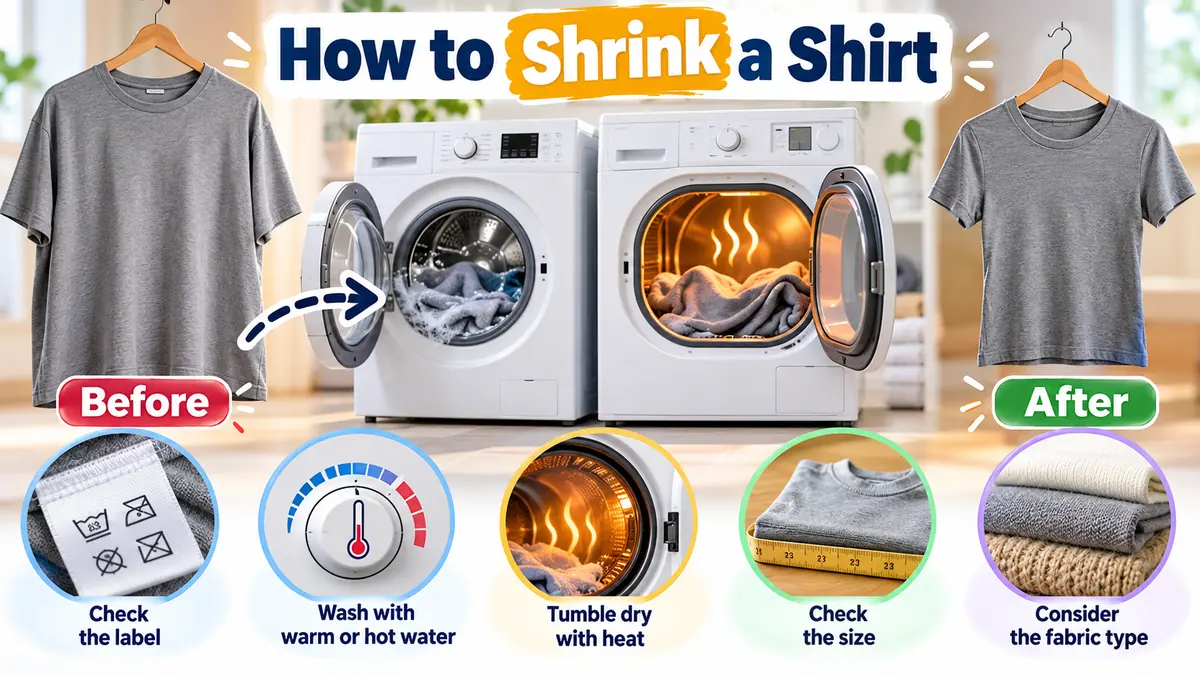
A shirt that is slightly too large does not always need to be returned, replaced, or altered. Depending on the fabric, controlled exposure to heat, moisture, and agitation can make it noticeably smaller.
The simplest way to shrink a shirt is to check its care label, wash it in warm or hot water, and tumble-dry it with heat. Cotton generally responds best, while polyester and other synthetic fibers resist shrinking. Work gradually and check the shirt frequently because excessive heat can damage fabric, prints, elastic, and color. Martha Stewart
The important part is knowing what your shirt is made from. A method that works well on a 100% cotton T-shirt can produce disappointing—or damaging—results on polyester, wool, rayon, or a blended fabric.
How to Shrink a Shirt Before You Start
Before putting the shirt anywhere near hot water, read its care label.
Look for the fiber composition as well as washing and drying instructions. Natural fibers such as cotton tend to respond more readily to intentional shrinking, while synthetic fibers such as polyester are designed to retain their shape. Martha Stewart
Also check whether the shirt is labeled pre-shrunk. Manufacturers may pre-shrink fabric during production specifically to reduce dimensional changes after purchase. You may still get some additional shrinkage, but usually less than you would with untreated fabric. Vogue
Before beginning:
- Read the care label.
- Identify the fabric composition.
- Measure the shirt across the chest and from shoulder to hem.
- Turn printed or graphic shirts inside out.
- Decide whether you need slight shrinkage or a substantial size change.
- Use the gentlest effective method first.
Taking measurements matters because visual differences can be difficult to judge after a single laundry cycle.
What Actually Makes a Shirt Shrink?
Fabric shrinkage is largely influenced by heat, moisture, and mechanical action.
During textile manufacturing, fibers and yarns can be placed under tension. Washing, drying, moisture, heat, and agitation may allow some materials to contract or return toward a less stretched state.
Cotton is especially receptive because it readily absorbs moisture. Synthetic fibers generally absorb less water and may be heat-set during manufacturing, making them considerably more resistant to shrinkage. Martha Stewart
This explains why simply turning up the dryer temperature does not produce identical results on every shirt.
How to Shrink a Shirt in the Washer and Dryer
For an ordinary washable cotton T-shirt, the washer-and-dryer method is usually the most practical place to start.
Step 1: Check the Label
Confirm that the garment can be machine washed and tumble dried.
If the label specifies cold washing, low-temperature drying, hand washing, or dry cleaning, deliberately ignoring those instructions increases the possibility of permanent damage.
Step 2: Turn the Shirt Inside Out
This is especially worthwhile for:
- Screen-printed T-shirts
- Graphic tees
- Embroidered shirts
- Dark-colored clothing
- Vintage shirts
Turning a shirt inside out cannot eliminate heat damage, but it reduces direct abrasion on the visible surface.
Step 3: Wash With Heat
Wash the shirt using the warmest temperature that you are comfortable using for that particular fabric and garment.
Heat and moisture encourage susceptible fibers to contract, while the movement of the washing machine adds mechanical action.
If you only need a small adjustment, there is little reason to immediately choose the most aggressive treatment possible.
Step 4: Tumble Dry
Transfer the shirt to the dryer and select an appropriate heated cycle.
For shrink-prone cotton, higher dryer heat generally encourages more contraction. However, high temperatures can also accelerate fading, damage graphics, and shorten a garment’s lifespan.
Check the shirt periodically rather than simply leaving it in the dryer indefinitely. HGTV similarly recommends monitoring a shrinking garment during drying so it can be removed when the desired size is reached. HGTV
Step 5: Let It Cool and Try It On
Once the shirt reaches the desired size, remove it and let it cool.
Try it on before repeating the process.
If it remains slightly loose, another controlled cycle may produce additional contraction. Just remember that the amount of additional shrinkage generally decreases after the first treatments.
Quick takeaway: Use heat progressively. It is much easier to run another controlled cycle than to restore a shirt that has become too small.
How to Shrink a Cotton Shirt
If you are specifically trying to learn how to shrink a shirt made from cotton, you have the best candidate for the job.
Cotton is a natural cellulose fiber that readily absorbs water and responds to heat and mechanical action. This makes 100% cotton generally easier to shrink than polyester-rich blends. Martha Stewart
For a cotton shirt:
- Check whether it is pre-shrunk.
- Turn it inside out.
- Wash it in warm-to-hot water.
- Transfer it to a heated dryer.
- Inspect the shirt periodically.
- Remove it when the dimensions are right.
- Let it cool before judging the final fit.
How Much Does a Cotton Shirt Shrink?
There is no universal percentage.
The result depends on the construction, weave, manufacturing treatment, original fiber tension, finishing process, and whether the garment was pre-shrunk.
Martha Stewart’s laundry experts note that shrinkage can be only a few percent for some garments, while other sources report substantially greater changes in untreated cotton. Martha Stewart
That variation is exactly why you should not rely on a promised percentage.
Measure the actual garment instead.
Can You Shrink a Cotton Shirt One Size?
Sometimes, but it is not guaranteed.
A relatively untreated 100% cotton shirt gives you a better chance than a pre-shrunk cotton/polyester blend. Trying to transform a dramatically oversized shirt into a precisely fitted one is much less predictable.
If a shirt is several sizes too large, alterations are usually more controllable than repeated high-heat treatments.
How to Shrink a Shirt With Boiling Water
Boiling-water methods appear frequently in clothing-care guides because intense heat can encourage shrinkage in suitable natural-fiber garments. Vogue
However, boiling is considerably more aggressive than ordinary washing.
If you choose this method for a suitable washable cotton shirt:
- Bring enough water to a boil to submerge the garment.
- Remove the pot from the active heat source.
- Carefully place the shirt into the hot water.
- Allow it to soak.
- Remove it safely with suitable utensils.
- Let it cool before handling.
- Remove excess water without aggressively twisting the fabric.
- Dry it and check its dimensions.
The longer and hotter the treatment, the less control you have over the outcome.
Boiling water is therefore not the ideal first choice for an expensive shirt, delicate material, heat-sensitive graphic, glued decoration, or garment with uncertain construction.
How to Shrink a Shirt in the Dryer
Already washed the shirt?
The dryer may still provide some shrinkage, particularly when the garment is damp and made from a shrink-prone natural fiber.
Heat during tumble drying helps encourage dimensional changes. The tumbling action also contributes mechanical agitation.
For a cotton shirt, start with a normal heated drying cycle and inspect it periodically.
Avoid assuming that twice the drying time means twice the shrinkage. Fibers have physical limits, and repeated heat exposure eventually creates more risk than useful contraction.
Once the shirt fits properly, return to gentler washing and drying habits to reduce further unintended changes.
How to Shrink a Shirt Without a Dryer
You can attempt to shrink a shirt without owning a tumble dryer.
For washable natural fibers, hot-water treatment followed by air drying may cause some contraction, although the effect can be subtler than combining hot washing with tumble drying. Martha Stewart’s guidance notes that a natural-fiber shirt can be soaked in hot water and air-dried when a dryer is unavailable. Martha Stewart
Another option is steam.
Steam introduces heat and moisture together and may be useful when you want a more controlled treatment. However, the effect still depends heavily on the fiber.
Never hold a steamer directly against fabric unless the garment and appliance instructions permit it.
How to Shrink a Polyester Shirt
Polyester presents a much bigger challenge.
Unlike cotton, polyester is a synthetic thermoplastic fiber engineered for dimensional stability. Pure polyester therefore tends to resist ordinary laundry shrinkage. Arm & Hammer
You may see minor changes after heated washing and drying, but attempting to force significant shrinkage with increasingly extreme temperatures creates another problem: heat damage.
Excessive heat may cause:
- Warping
- Discoloration
- Shiny patches
- Damaged prints
- Distorted seams
- Reduced elasticity
A polyester blend behaves according to all of its component fibers.
For example, a 60% cotton/40% polyester shirt may shrink somewhat because of its cotton content, but generally not in exactly the same way as a comparable 100% cotton garment.
If a polyester shirt is substantially too large, tailoring is usually more predictable than trying to force it several sizes smaller with extreme heat.
How Different Shirt Fabrics Respond to Shrinking
| Fabric | Shrink Potential | Suggested Approach | Main Risk |
|---|---|---|---|
| 100% cotton | High compared with synthetics | Warm/hot wash + heated dryer | Over-shrinking, fading |
| Pre-shrunk cotton | Low to moderate | Gradual heat | Limited results |
| Cotton/polyester blend | Low to moderate | Controlled wash and dry | Uneven/limited shrinkage |
| Polyester | Low | Cautious heat | Heat damage |
| Linen | Moderate to high | Controlled washing/drying | Wrinkling, excessive contraction |
| Wool | High but difficult to control | Very cautious moisture, heat and agitation | Felting |
| Rayon/viscose | Variable | Follow care label closely | Distortion |
| Spandex/elastane blend | Limited/variable | Avoid extreme temperatures | Elastic damage |
| Silk | Risky | Professional care preferred | Texture, sheen, shape damage |
Wool deserves particular caution. Heat, moisture, and agitation can cause wool fibers to interlock and felt, potentially producing dramatic and irreversible changes rather than a neat reduction in size. HGTV
How to Shrink a Shirt Without Ruining It
The goal is not maximum heat. The goal is controlled shrinkage.
A common mistake is starting with boiling water and maximum dryer heat because the shirt needs to become only slightly smaller.
Instead, use progressive treatment.
Start with a less aggressive cycle, inspect the result, and increase the temperature only if the fabric can tolerate it and additional shrinkage is actually necessary.
Protect Graphic T-Shirts
Graphic tees require extra caution.
High heat may affect:
- Screen printing
- Vinyl transfers
- Adhesives
- Decorative coatings
- Heat-applied lettering
Turn the garment inside out before washing and drying. If the print is valuable or already cracking, consider whether intentional shrinkage is worth the risk.
Watch the Collar and Seams
A shirt does not necessarily contract uniformly.
Fabric panels, ribbed collars, stitching thread, interfacing, and decorative components may respond differently to heat. You could therefore end up with a shorter body but a distorted collar or twisted side seam.
This is another reason gradual treatment works better than extreme heat.
Be Careful With Vintage Shirts
Vintage clothing may have weakened fibers, older prints, unknown dyes, or previous repairs.
If a vintage shirt has monetary or sentimental value, professional alterations are safer than experimenting with boiling water or repeated high-temperature drying.
Can You Shrink Only Part of a Shirt?
This sounds appealing: shrink the waist but leave the length unchanged, or tighten the sleeves without changing the chest.
Unfortunately, controlled spot shrinking is unreliable.
Applying moisture, steam, or heat to one area might cause some local contraction, but fabric construction means the result can be uneven or temporary. One current clothing-care guide describes intentional shrinking as a relatively blunt method rather than a precise alteration technique. Connfi Clothing
If you need the waist taken in, sleeves shortened, shoulders narrowed, or hem raised, sewing is the more accurate solution.
Does Hot Water Shrink Clothes?
Hot water can contribute to shrinkage, particularly with natural fibers, but water temperature is only part of the process.
Moisture makes susceptible fibers more responsive, heat encourages dimensional change, and agitation adds mechanical action. Heated tumble drying can further encourage contraction.
That is why a hot wash followed by heated drying tends to be more effective on cotton than simply soaking a shirt and hanging it outside.
But hotter is not automatically better.
Excessive temperatures may fade dyes, degrade elastic components, damage decorative finishes, or distort synthetic fibers.
Can You Shrink a Pre-Shrunk Shirt?
Yes, sometimes—but expect less dramatic results.
A pre-shrunk shirt has already undergone manufacturing processes intended to minimize later dimensional changes. It does not necessarily mean that absolutely no further shrinkage is possible. Vogue
A pre-shrunk cotton T-shirt may still contract slightly when exposed to heat and tumble drying.
Repeatedly subjecting it to extreme temperatures, however, will eventually provide diminishing returns while continuing to stress the fabric.
If two careful attempts produce almost no difference, the garment may simply have reached its practical shrinkage limit.
Can You Shrink a Shirt More Than Once?
You can repeat the process, but additional cycles usually become less productive.
Natural fibers tend to undergo much of their available contraction during early wash-and-dry treatments. Martha Stewart’s expert guidance notes that subsequent attempts generally produce less shrinkage after the first or second treatment. Martha Stewart
A sensible approach is:
wash → dry → cool → measure → try on → repeat only if necessary.
Do not judge the result while the garment is still extremely hot or wet.
What to Do If You Shrink a Shirt Too Much
Over-shrinking is much harder to correct than under-shrinking.
For some cotton and wool garments, soaking the item in lukewarm water with a small amount of hair conditioner or gentle baby shampoo may relax the fibers enough for careful reshaping.
After soaking, gently remove excess water, place the garment flat on a towel, and gradually reshape it toward its previous dimensions.
However, this should be considered an attempt to recover some size—not a guaranteed reversal. Severely felted wool and synthetics damaged by excessive heat may not return to their original shape. Priority Clean
Prevention is therefore far easier than repair.
Common Mistakes When Shrinking a Shirt
Using Maximum Heat Immediately
More heat increases risk as well as potential shrinkage.
Start conservatively when you care about the garment.
Ignoring the Fabric Label
A method recommended for cotton should not automatically be applied to wool, polyester, silk, or rayon.
The fiber content determines your strategy.
Expecting Several Sizes of Shrinkage
Intentional shrinkage works best for relatively modest fit adjustments.
If an XL shirt needs to fit like a medium, relying on heat alone is unpredictable. Vogue similarly cautions against expecting a dramatically oversized shirt to reliably contract multiple sizes. Vogue
Repeating High-Heat Cycles Indefinitely
Eventually, the garment stops becoming meaningfully smaller while heat exposure continues damaging it.
Know when to stop.
Forgetting About Prints and Decorations
The fabric may tolerate a temperature that the graphic, adhesive, elastic, button, or decorative finish cannot.
Treat the whole garment—not just its primary fiber—as part of your decision.
Is Shrinking Better Than Tailoring?
It depends on the problem.
Shrinking makes the most sense when a washable, shrink-prone shirt is simply a little too large overall.
Tailoring makes more sense when:
- Only the waist is loose.
- The shoulders are too wide.
- The sleeves need shortening.
- The shirt is several sizes too large.
- The fabric barely responds to heat.
- The garment is expensive.
- Precise dimensions matter.
A washing machine cannot distinguish between the chest, waist, sleeves, and length. A tailor can.
For an inexpensive oversized cotton T-shirt, controlled shrinking may be worth trying. For a valuable dress shirt requiring precise alterations, professional tailoring is the lower-risk approach.
How to Keep the Shirt at Its New Size
Once you successfully shrink a shirt, stop using aggressive heat unnecessarily.
Wash according to its care instructions and use lower drying temperatures where appropriate. If you repeatedly expose a shrink-prone cotton shirt to hot washing and high-temperature drying, additional dimensional changes and fabric wear may occur.
Take new measurements after the shirt reaches the fit you want. Those measurements give you a useful reference when laundering it later.
Final Takeaway: How to Shrink a Shirt Successfully
Learning how to shrink a shirt comes down to matching the method to the material.
For a washable 100% cotton shirt, controlled warm-to-hot washing followed by heated tumble drying is generally the most effective starting point. Polyester is far more resistant, pre-shrunk garments may change only slightly, and delicate materials require much greater caution. Martha Stewart
Most importantly, shrink gradually. Check the care label, measure before you begin, inspect the garment between treatments, and stop once you reach the fit you want. If the shirt needs major or highly targeted resizing, alteration is more predictable than trying to force the fabric smaller with additional heat.