
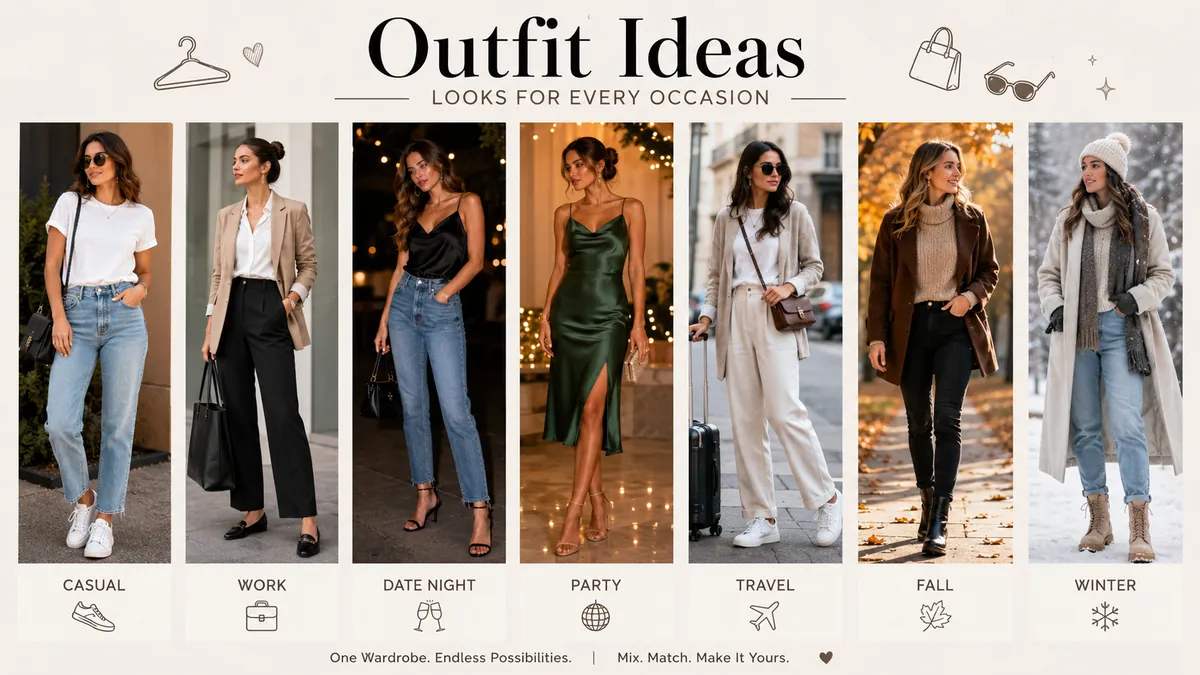
A closet can be full of clothes and still leave you wondering what to wear. Usually, the problem is not a lack of clothing. It is a lack of easy combinations you can repeat without having to reinvent your style every morning.
The best outfit ideas start with three things: where you are going, what the weather is like, and one piece you already want to wear. Build around that anchor with balanced proportions, comfortable footwear, simple layers, and one intentional finishing detail. The result feels styled without looking overdone.
Instead of treating every outfit as a completely new creation, think in formulas. Jeans plus a fitted top and blazer is a formula. A midi dress plus sneakers is another. Once you know which combinations work for your lifestyle, getting dressed becomes much easier.
Current fashion coverage continues to emphasize wearable layering, relaxed tailoring, denim, versatile knitwear, matching separates, loafers, ballet flats, and transitional pieces that move easily between seasons.
This guide focuses on practical outfit ideas you can recreate with clothes you may already own, along with simple ways to adapt them for different occasions, seasons, dress codes, and personal styles.
Outfit Ideas for Everyday Casual Style
A good casual outfit should survive real life. You should be able to walk, sit, commute, run errands, meet someone for coffee, and spend several hours in it without constantly adjusting your clothes.
That does not mean casual dressing has to look basic.
The easiest approach is combining one relaxed item with one more structured piece.
For example:
- Straight-leg jeans + fitted T-shirt + oversized blazer + sneakers
- Wide-leg trousers + tank top + cardigan + flat sandals
- Relaxed button-down + denim + loafers
- Midi skirt + simple tee + sneakers
- Linen trousers + sleeveless top + lightweight shirt
- Dark jeans + crewneck sweater + ankle boots
- Matching knit set + structured handbag
- Denim jacket + simple dress + trainers
The contrast between relaxed and polished pieces is what makes these outfits feel intentional.
A loose shirt with equally loose trousers can work, but some definition often helps. Try a tucked front, rolled sleeves, a visible waistline, or a more structured shoe.
The Jeans-and-T-Shirt Formula
Few combinations are more useful than jeans and a T-shirt.
The trick is changing the surrounding pieces.
Start with straight-leg or relaxed jeans and a plain white, black, gray, navy, or striped tee. Then choose the mood.
For a sporty look, add sneakers and a baseball cap.
For something polished, switch to loafers, a leather belt, and a blazer.
For an evening version, try a fitted tee, dark denim, pointed flats or heels, jewelry, and a small shoulder bag.
One base combination can produce several completely different looks.
Casual Outfit Ideas Without Jeans
Denim is convenient, but it should not become your only casual option.
Try:
Wide-leg trousers + fitted tank + sneakers. The trousers create structure while the simple top keeps the outfit relaxed.
Midi skirt + oversized T-shirt + sandals. Tuck or knot the shirt slightly if you want more waist definition.
Linen pants + button-down shirt. Leave several buttons open over a tank for an easy warm-weather layer.
Knit dress + sneakers. Comfortable enough for everyday wear but more finished than leggings and a sweatshirt.
Cargo pants + simple knit. Keep the top streamlined so the pockets and volume of the trousers remain the main visual feature.
These formulas also make it easier to build a wardrobe that does not depend on dozens of separate statement pieces.
Outfit Ideas for Work and Business Casual Dressing
Workwear has changed considerably from the days when office dressing automatically meant matching suits and formal pumps.
Many workplaces now sit somewhere between casual and traditional professional dress. The safest strategy is relaxed tailoring: comfortable clothes with enough structure to look deliberate.
A strong business-casual formula is:
Tailored trousers + simple top + blazer + loafers
From there, you can change almost every component.
Try straight trousers with a fine-knit sweater, wide-leg pants with a tucked shirt, or an A-line midi skirt with a cardigan.
Recent fashion coverage has particularly highlighted blazers, striped shirts, trousers, midi skirts, dark-wash denim, loafers and refined knitwear as adaptable work-to-everyday pieces.
Simple Office Outfit Formulas
For a traditional office:
Tailored trousers + button-down + blazer + loafers
For a creative workplace:
Midi skirt + knit top + statement flats
For a relaxed office:
Dark straight-leg jeans + blouse + blazer + loafers
For hot weather:
Linen trousers + sleeveless blouse + lightweight jacket
For colder days:
Turtleneck + wide-leg trousers + wool coat + ankle boots
For an important meeting:
Monochrome trousers and top + structured blazer + understated accessories
Monochromatic dressing is particularly useful when you need to look put-together quickly. Black, navy, beige, gray, chocolate brown, cream, and other tonal combinations create visual continuity without requiring complicated styling.
Can You Wear Jeans for Business Casual?
Sometimes.
If denim is accepted in your workplace, darker washes with minimal distressing generally look more polished than faded or heavily ripped jeans.
Straight-leg, slim-straight, flare, and clean wide-leg silhouettes can all work.
Pair the jeans with something structured: a blazer, collared shirt, fine knit, sophisticated flats, loafers, or boots.
The jeans become the casual element while everything around them raises the formality.
Cute Outfit Ideas for Dates, Dinner and Going Out
Going-out outfits work best when they still resemble your normal style.
If you never wear very fitted clothing, forcing yourself into a bodycon dress probably will not make you feel more confident. If you usually love tailoring, an oversized blazer might feel much more natural.
Start with one feature you want to emphasize.
It could be the silhouette, neckline, shoes, color, jewelry, or fabric.
Then let the rest of the outfit support it.
Date Night Outfit Formulas
For casual coffee:
Straight jeans + fitted knit + ballet flats + shoulder bag
For dinner:
Midi dress + heeled sandals + simple jewelry
For a relaxed evening:
Dark denim + camisole + blazer + slingback flats
For a dressier restaurant:
Wide-leg trousers + satin blouse + pointed shoes
For a daytime date:
Midi skirt + tank + cardigan + sneakers
For colder weather:
Knit dress + long coat + knee-high boots
The camisole-and-denim combination remains especially useful during transitional weather because it can be worn alone while warm and layered with a blazer or cardigan when temperatures fall. Similar combinations have appeared prominently in recent seasonal styling coverage.
How Do You Make a Simple Outfit Look Dressier?
You usually do not need to replace the entire outfit.
Change the finishing pieces.
Swap sneakers for loafers, slingbacks, boots, or heels. Replace a canvas tote with a structured handbag. Add earrings or a necklace. Introduce a belt. Wear a blazer instead of a sweatshirt.
Fabric matters too.
Satin, silk-like textures, leather, suede, structured wool, crisp cotton, and fine knits tend to appear more polished than highly casual jersey or athletic fabrics.
Outfit Ideas for Parties and Special Occasions
Special-occasion dressing becomes easier when you first determine the expected level of formality.
A birthday dinner and a formal wedding may both be celebrations, but they require completely different clothes.
Think about four factors:
Venue. A restaurant, garden, hotel ballroom, beach, and private home have different expectations.
Time. Daytime events usually tolerate lighter fabrics and softer styling. Evening occasions can support richer colors, shine, and more dramatic accessories.
Dress code. Casual, cocktail, semi-formal, business, black tie, and other dress codes should influence your starting point.
Comfort. An outfit that prevents you from walking, sitting, eating, or enjoying the event is rarely a successful choice.
Birthday Outfit Ideas
A birthday gives you more freedom than many formal occasions.
Try a mini or midi dress with statement shoes, tailored trousers with an interesting top, a matching set, or dark jeans with a standout blazer.
You can also keep your clothes simple and make accessories the focus.
A black dress can look entirely different with metallic shoes, colorful earrings, a bold bag, or minimal monochrome accessories.
Party Outfit Ideas Without a Dress
You never need a dress to look dressed up.
Consider:
Satin trousers + fitted knit
Wide-leg tailored pants + corset-inspired or structured top
Matching blazer-and-trouser set
Jumpsuit + heels
Midi skirt + camisole
Dark denim + statement blouse
A well-cut trouser outfit can be every bit as sophisticated as a dress while providing considerably more coverage and flexibility.
Seasonal Outfit Ideas You Can Actually Wear
Seasonal dressing is less about changing your entire wardrobe four times a year and more about changing fabrics, layers, footwear, and color combinations.
A white shirt, for instance, can appear in almost every season.
Wear it over a tank with shorts in summer, with jeans during spring, under a sweater in autumn, and beneath a wool coat in winter.
Spring Outfit Ideas
Spring is ideal for light layering.
Useful combinations include:
Trench coat + tee + straight jeans + ballet flats
Cardigan + midi skirt + sneakers
Button-down + tailored trousers + loafers
Lightweight sweater + jeans + sneakers
Midi dress + denim jacket + ankle boots
A trench coat is especially useful because it adds structure without the bulk of heavy winter outerwear.
Summer Outfit Ideas
Heat changes the priorities.
Breathable materials and comfortable silhouettes become more important than complicated layering.
Try:
Linen shirt + linen trousers + sandals
Cotton sundress + flat sandals
Tank + midi skirt + sneakers
Oversized cotton shirt + shorts + sandals
Lightweight matching set
Loose trousers + sleeveless top
Linen, cotton and other breathable fabrics can help make warm-weather dressing more comfortable. Loose silhouettes also allow better airflow than multiple tight layers.
During very hot weather, the simplest outfit often works best. Instead of adding several accessories and layers, focus on the cut, fabric and color.
Fall Outfit Ideas
Autumn is arguably the easiest season for outfit experimentation because you can combine lightweight summer pieces with heavier layers.
Recent Fall 2026 fashion coverage emphasizes trench coats, leather jackets and coats, blazers, knitwear, cargo pants, tonal layers and relaxed denim, alongside seasonal shades such as earthy brown, clay red and green.
Try:
Straight jeans + crewneck sweater + loafers
Midi skirt + knit + ankle boots
T-shirt + leather jacket + trousers
Trench coat + capri pants + ballet flats
Denim shirt + jeans + sandals or loafers
Dress + cardigan + knee-high boots
Blazer + T-shirt + dark denim
One of the simplest fall styling tricks is keeping your summer base layer while changing the shoe and outer layer.
A slip dress worn with sandals feels summery. Add boots and a cardigan and the same dress moves comfortably into autumn.
Winter Outfit Ideas
Winter styling depends heavily on layering.
Build from thin to thick rather than putting several bulky pieces together.
Start with a close-fitting base layer, add a shirt or sweater, and finish with outerwear.
Useful combinations include:
Turtleneck + trousers + long wool coat + boots
Straight jeans + chunky knit + puffer jacket + sneakers
Midi skirt + sweater + tights + boots
Knit dress + long coat + knee-high boots
Button-down + sweater + tailored trousers + coat
Proportion becomes especially useful in winter because coats and heavy knits add visual volume.
If your sweater is oversized, consider straighter trousers. If you wear a large puffer with wide-leg pants, a fitted inner layer can restore some definition.
Outfit Ideas Based on Clothes You Already Own
One of the biggest mistakes people make when searching for style inspiration is assuming every new outfit requires new clothes.
It does not.
Most wardrobes contain considerably more combinations than their owners actually wear.
The easiest way to discover them is choosing one anchor piece and creating several outfits around it.
How to Style a White Shirt
A white button-down can become:
Work: tailored trousers + loafers
Weekend: jeans + sneakers
Summer: shorts + sandals
Dinner: satin skirt + heels
Layering: open over a tank + wide-leg pants
Winter: under a crewneck sweater + coat
The shirt stays the same. The surrounding silhouette changes its function.
How to Style Black Trousers
Black trousers can move through almost every dress code.
Wear them with a T-shirt and sneakers casually.
Add a knit and loafers for work.
Pair them with a satin top and heels for dinner.
Wear them with a monochrome black top and dramatic jewelry for evening.
This adaptability is why neutral trousers are so valuable in a capsule wardrobe.
How to Style a Blazer
A blazer does much more than office duty.
Pair it with:
Jeans and a tee for everyday wear.
A tank and wide-leg trousers for dinner.
A midi dress for transitional weather.
Shorts and a simple top during warmer months.
A turtleneck and trousers during winter.
Recent street-style and editorial coverage continues to show blazers moving freely between casual, office and transitional outfits rather than functioning only as formal tailoring.
How to Style a Midi Dress
A midi dress is another useful wardrobe multiplier.
Change only your shoe and layer:
Sneakers make it casual.
Ballet flats make it polished.
Loafers give it a preppy feel.
Boots move it into cooler weather.
Sandals make it summery.
A denim jacket relaxes it, while a blazer adds structure.
That is the principle behind a versatile wardrobe: fewer items with more possible combinations.
How to Build Better Outfit Ideas With Color and Proportion
You do not need to memorize complicated fashion rules.
Two concepts make the biggest difference: color coordination and proportion.
Use the Three-Color Approach
When an outfit feels visually chaotic, reduce the number of dominant colors.
A simple combination might be:
Cream + brown + black
White + denim blue + tan
Gray + black + burgundy
Navy + white + camel
Beige + chocolate + gold
These are not rigid rules. Prints and colorful outfits can include far more shades.
The principle simply gives you an easy starting point when you want an outfit to feel cohesive.
Try Tonal Dressing
Tonal dressing uses related shades from the same color family.
Think cream trousers, an ivory top and a camel coat.
Or chocolate trousers with a lighter brown sweater.
The pieces do not have to match exactly. Slight differences in shade and texture actually make tonal outfits more interesting.
Balance Your Silhouette
If an outfit looks slightly wrong but you cannot explain why, proportion is often the reason.
Try balancing volume.
Wide-leg trousers can look sharp with a fitted or tucked top.
An oversized sweater often works well with straight or slim bottoms.
A fitted dress can be balanced by a larger coat.
An oversized blazer can work with a shorter or more streamlined inner layer.
These are starting points rather than body-type restrictions. Anyone can wear any silhouette.
The goal is simply understanding what visual effect each combination creates.
Use the One-Statement-Piece Rule
When you want an outfit to feel interesting without becoming overwhelming, choose one focal point.
It could be leopard-print shoes, a brightly colored bag, a patterned jacket, sculptural jewelry, unusual trousers, or a striking top.
Keep most of the other elements quieter.
Current seasonal styling has also leaned toward using individual accessories—such as distinctive bags, jewelry and statement footwear—to refresh familiar basics rather than replacing an entire wardrobe.
How to Create Stylish Outfit Ideas in Five Minutes
When you have no idea what to wear, avoid looking at your whole closet at once.
That creates too many choices.
Use a simple sequence instead.
Start with the occasion. Decide whether the outfit needs to be casual, professional, active, dressy, or formal.
Next, check the weather. This immediately eliminates unsuitable fabrics and layers.
Then select one anchor item. It might be jeans, trousers, a dress, a favorite shirt, or a pair of shoes.
Choose a complementary silhouette. If your anchor is very loose, experiment with a more streamlined second piece. If it is fitted, you might add a relaxed layer.
Finally, add one finishing element: jewelry, a belt, a jacket, a handbag, sunglasses, or an interesting shoe.
Then stop.
Over-styling is one of the easiest ways to turn a good outfit into a complicated one.
The Reliable Outfit Formula
When inspiration completely disappears, use this:
Base + layer + practical shoe + finishing detail
For example:
Straight jeans + white tee + blazer + loafers + belt.
Or:
Midi dress + cardigan + sneakers + shoulder bag.
Or:
Wide-leg trousers + tank + button-down + sandals + earrings.
This is essentially how many strong outfits are constructed.
The specific clothes change. The structure does not.
How to Build a Wardrobe That Makes Outfits Easier
The most useful wardrobe is not necessarily the largest one.
It is the wardrobe in which pieces cooperate with one another.
That is the thinking behind a capsule wardrobe: building around versatile items that can be mixed repeatedly instead of keeping dozens of unrelated garments.
You do not need to follow a strict capsule system, but the principle is valuable.
A practical everyday wardrobe might include dependable jeans, tailored trousers, simple T-shirts, a button-down shirt, knitwear, a blazer, a versatile dress, a casual jacket, comfortable sneakers, polished flats or loafers, and seasonal outerwear.
The exact pieces should reflect your own life.
Someone working from home has different wardrobe needs from someone working in a corporate office. A student, frequent traveler, parent, creative professional, and person attending regular formal events will all need different proportions of casual and dressy clothes.
Build Around Your Actual Week
Before buying another item, think about the previous seven days.
What did you actually do?
If most of your week involves work, commuting, errands and casual social plans, those activities deserve most of your wardrobe.
A closet filled with special-occasion clothes will not solve an everyday dressing problem.
This is also why scene-based outfit planning—choosing looks according to work, weekends, dinners, weather and other real activities—is increasingly common in contemporary styling guides.
Repeat Your Best Outfits
There is no prize for never repeating clothes.
When a combination works, photograph it.
Keep a small album of outfits you genuinely enjoyed wearing. Include everyday looks, work clothes, dinner outfits and seasonal combinations.
Within a few weeks you will have your own personal style reference library.
This is much more useful than saving hundreds of inspirational images featuring clothes you do not own.
Common Outfit Mistakes and Easy Fixes
Sometimes you have the right clothing but the outfit still feels unfinished.
Before replacing anything, look for one of a few common problems.
Everything Is Competing
Statement shoes, patterned trousers, a bright bag, large jewelry and dramatic outerwear can all be good individually.
Together, they may have no clear focal point.
Fix: Decide which item should attract attention and simplify the pieces surrounding it.
Everything Has the Same Volume
An extremely oversized top, huge trousers and oversized outerwear can overwhelm the silhouette when that effect was not intentional.
Fix: Introduce contrast through a fitted layer, tuck, shorter jacket, defined waist, or more streamlined shoe.
The Outfit Is Too Perfectly Matched
Matching every accessory to exactly the same shade can sometimes make an outfit feel dated or overly coordinated.
Fix: Work with related tones instead of exact matches.
Brown shoes can work with a burgundy bag. Cream can mix with white. Gray can sit beside navy.
The Clothes Fit the Trend but Not Your Life
A trend only deserves wardrobe space if you will actually wear it.
Recent fashion reporting may feature capri pants, ponchos, polo sweaters, track pants, peplum tops, ballet flats and other trend-driven pieces, but no single trend is essential to being well dressed.
Fix: Treat trends as optional ideas rather than instructions.
Choose the ones that fit your lifestyle and ignore the rest.
The Outfit Is Uncomfortable
Shoes that hurt, trousers you constantly pull up, a neckline that needs adjusting, or fabric that makes you overheat will affect how confidently you carry the outfit.
Fix: Treat comfort as part of style rather than something separate from it.
The strongest outfit is one you can forget about once you leave the house.
Finding Your Personal Style Instead of Copying Every Trend
Good outfit ideas provide inspiration, not a uniform.
You can admire minimalist fashion, streetwear, quiet luxury, romantic dressing, preppy outfits, vintage style, athleisure and contemporary tailoring without adopting every aesthetic simultaneously.
Pay attention to patterns in what you repeatedly choose.
Maybe you always save oversized blazers.
Maybe you prefer long skirts instead of jeans.
Perhaps you consistently choose monochrome clothes, sneakers, structured handbags, vintage denim, colorful jewelry, or relaxed tailoring.
Those repetitions reveal more about your personal style than trend labels do.
Try describing your ideal wardrobe with three words.
Examples might include:
“Relaxed, polished, minimal.”
“Colorful, feminine, playful.”
“Classic, practical, modern.”
“Sporty, simple, comfortable.”
“Tailored, neutral, sophisticated.”
When considering an outfit, ask whether it fits those words.
You will still experiment, but your wardrobe will gradually feel more coherent.
Final Thoughts on Outfit Ideas
The most useful outfit ideas are not complicated looks that require an entirely new wardrobe. They are repeatable combinations that work with your weather, schedule, comfort level and personal style.
Start with an occasion, choose one anchor piece, balance the silhouette, coordinate the colors, and finish with one thoughtful detail.
More importantly, notice which combinations make you feel comfortable and put-together. Save those outfits and wear them again.
Once you develop a handful of dependable formulas—jeans with a blazer, trousers with a knit, a midi dress with sneakers, a skirt with a simple tee, or a button-down with relaxed pants—you stop needing a completely new idea every morning.
Your best source of outfit inspiration eventually becomes your own wardrobe.