
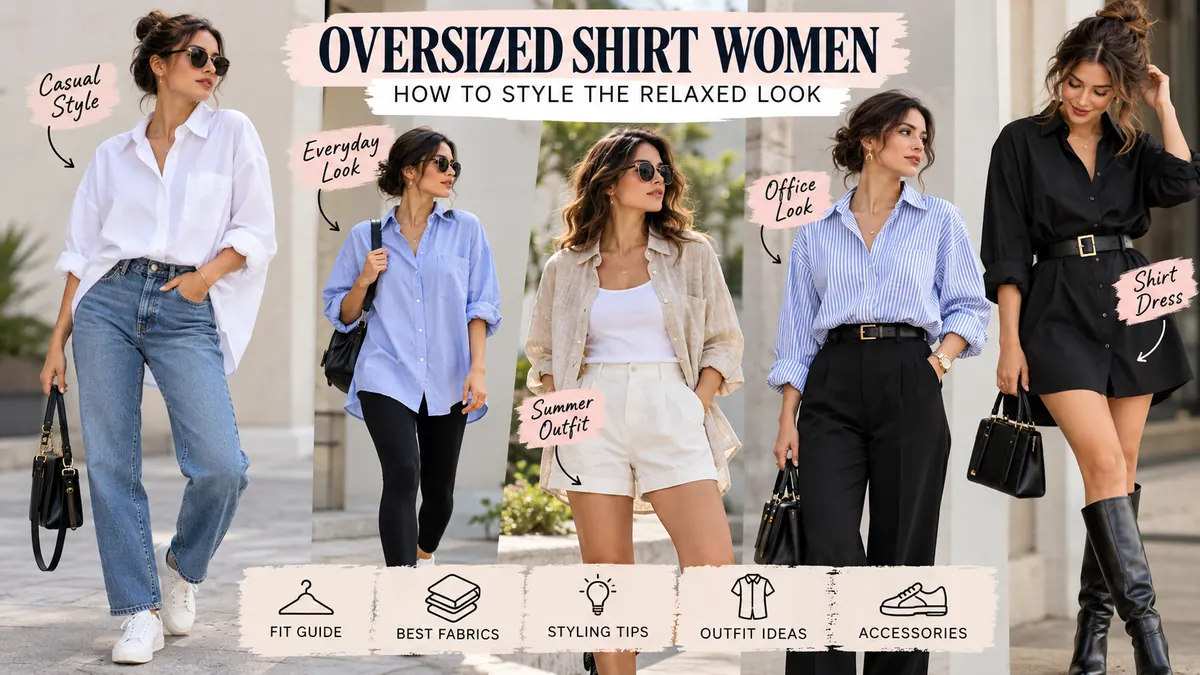
An oversized shirt can be one of the easiest pieces in a woman’s wardrobe—or one of the trickiest. The extra fabric creates comfort and movement, but without the right proportions, a relaxed outfit can quickly feel shapeless.
For anyone searching oversized shirt women styling ideas, the key is not simply buying a shirt several sizes larger. A good oversized shirt combines deliberate volume, suitable fabric, balanced proportions, and thoughtful styling. It can work with jeans, trousers, leggings, skirts, shorts, or layered pieces while moving easily between casual and polished outfits.
This guide explains how oversized shirts should fit, which fabrics work best, how to style them for different occasions, and how to prevent a loose silhouette from overwhelming your frame.
What Is an Oversized Shirt for Women?
An oversized shirt is designed to create more volume than a conventional fitted shirt. It usually has a wider body, relaxed sleeves, extra length, and shoulders that extend beyond the natural shoulder line.
That does not mean every large shirt is truly oversized.
A deliberately designed oversized button-down often uses dropped shoulders, wider sleeves, boxier proportions, longer hems, or strategically placed pleats. Simply buying a standard shirt several sizes larger can sometimes make the neckline, cuffs, and sleeves disproportionately big.
Common oversized styles include:
- Oversized button-down shirts
- Boyfriend shirts
- Oversized T-shirts
- Longline shirts
- Tunic shirts
- Shirt dresses
- Linen shirts
- Flannel shirts
- Denim and chambray shirts
- Boxy cotton shirts
- Rugby shirts
- Striped button-downs
Current fashion coverage continues to treat the oversized button-down as a versatile wardrobe piece rather than a single-season novelty. Styling often focuses on intentionally playing with proportion instead of trying to disguise the garment’s volume.
How Should an Oversized Shirt Fit Women?
The difference between oversized and simply too big usually comes down to proportion.
A well-chosen oversized shirt should look intentionally relaxed. The body can be loose and the shoulder seam can sit beyond your natural shoulder, but the garment should still have recognizable structure.
Check the shoulders
Dropped shoulders are a common feature of oversized clothing. A little extra width creates the relaxed effect.
However, extremely low shoulder seams combined with very long sleeves can make a shirt look accidentally oversized rather than deliberately styled.
Look at the sleeve length
Sleeves can be generous, but your hands should not disappear completely unless exaggerated sleeves are part of the intended design.
Rolling or pushing up the sleeves is an easy way to expose the wrists and visually break up the volume.
Consider the hem
Mid-hip lengths are versatile because they can be tucked or worn loose. Longer shirts can work as tunics, layering pieces, or—in sufficiently long designs—shirt dresses.
Curved hems can also create movement while making a long shirt feel less heavy.
Leave room for movement
The shirt should not pull across your shoulders, upper arms, bust, or back.
Oversized clothing is supposed to provide ease. If the fabric stretches between buttons or restricts movement, the shirt may be roomy in some areas without fitting properly in others.
Oversized Shirt Women Styling Starts With Proportion
Proportion is the most useful principle to understand.
An oversized top creates visual volume. You can either contrast that volume with a more defined bottom or deliberately continue it through the rest of the outfit.
Both approaches can work.
Fashion styling advice frequently pairs oversized shirts with defined waistlines, streamlined pieces, or intentional tucking to prevent the silhouette from appearing accidental. Other contemporary looks embrace loose trousers and similarly relaxed pieces, provided the proportions appear deliberate.
Easy formula: loose top + defined bottom
Try an oversized shirt with:
- Straight-leg jeans
- Slim trousers
- Leggings
- Denim shorts
- A pencil skirt
- A fitted midi skirt
The contrast gives the outfit an obvious focal point.
Advanced formula: loose top + loose bottom
Oversized shirts can also work with:
- Wide-leg trousers
- Relaxed jeans
- Cargo pants
- Maxi skirts
- Loose shorts
Here, definition can come from a full tuck, front tuck, exposed wrists, structured shoes, a belt, or a fitted layer underneath.
The objective is not necessarily to make your body look smaller. It is to make the relationship between the garments appear intentional.
How to Style an Oversized Shirt With Jeans
Jeans are probably the simplest starting point.
A crisp white, blue, striped, or neutral button-down paired with denim creates a combination that can be adjusted from very casual to relatively polished.
With straight-leg jeans
Try a front tuck and leave the sides and back loose.
This exposes the waistband, gives the outfit some structure, and preserves the relaxed character of the shirt.
Finish with sneakers for a casual look or loafers, ballet flats, ankle boots, or low heels for something sharper.
With skinny jeans
A longer oversized shirt naturally contrasts with close-fitting denim.
You can leave the shirt untucked, particularly when it extends below the hips. Rolling the sleeves can prevent the top half from looking excessively heavy.
With wide-leg jeans
This combination creates much more volume.
Instead of automatically avoiding it, create one point of definition. A full tuck into high-waisted jeans can establish a clear waistline. You could also wear the shirt open over a fitted tank.
A shorter boxy shirt is another option because it provides width without excessive length.
With distressed denim
An oversized button-down can make distressed jeans feel more balanced. The clean collar and cuffs introduce structure while the denim keeps the outfit casual.
Quick takeaway: If an oversized shirt and jeans combination feels shapeless, expose the waistband, wrists, or neckline before changing the entire outfit.
How to Wear an Oversized Shirt With Leggings
An oversized shirt with leggings is a straightforward combination because the silhouettes naturally contrast.
Longline button-downs and tunic-style shirts work particularly well because their extra length creates visual balance against fitted leggings.
For everyday wear, try:
- A long white or striped shirt
- Black leggings
- Sneakers or ankle boots
- A crossbody or structured shoulder bag
Leave the shirt loose for maximum ease or add a partial tuck when the shirt is not extremely long.
In colder weather, layer a sweater, cardigan, vest, or jacket over the shirt and allow part of the collar, cuffs, or hem to remain visible.
How to Style an Oversized Shirt With Shorts
An oversized shirt and shorts create an easy warm-weather combination.
Denim shorts provide a casual foundation, while tailored shorts make the same shirt look more polished.
You can wear the shirt:
- Completely open over a fitted tank
- Buttoned with a front tuck
- Tied loosely at the waist
- Untucked with visible shorts underneath
- With rolled sleeves for a lighter silhouette
Linen is particularly useful in warm weather because of its breathable feel and naturally relaxed appearance.
Cotton poplin offers a crisper alternative when you want more structure.
Oversized Shirt Women Office Outfit Ideas
Oversized does not automatically mean casual.
A structured button-down can work in many business-casual wardrobes when the rest of the outfit is clean and deliberate.
Start with a cotton or cotton-poplin shirt rather than an extremely slouchy T-shirt. Pair it with tailored trousers and use a full or partial tuck.
A simple formula is:
Oversized button-down + tailored trousers + belt + loafers
A pencil or straight midi skirt can create a similar effect.
Keep cuffs relatively neat, and consider rolling the sleeves once or twice rather than allowing excessive fabric around the hands.
For a more structured layer, add a blazer or tailored vest.
Workplace dress codes vary considerably, so the appropriate level of looseness, shirt length, sheerness, and styling depends on your particular environment.
The Best Fabrics for Oversized Shirts
Fabric dramatically changes how an oversized silhouette behaves.
Two shirts with nearly identical measurements can look completely different if one is crisp cotton and the other is fluid silk.
Cotton
Cotton is one of the most versatile choices.
Crisp cotton and poplin hold their shape, making them particularly useful when you want volume without a shapeless appearance.
They work well with denim, tailored trousers, shorts, and skirts.
Linen
Linen has a softer, naturally relaxed character.
It works particularly well for summer outfits, beach layering, travel, and casual warm-weather dressing.
Wrinkles are part of linen’s appearance, so it generally looks less formal than crisp poplin.
Silk and satin
Silk and satin-like fabrics create a more fluid silhouette.
Rather than standing away from the body, they tend to drape, which can make an oversized cut feel softer and dressier.
Denim and chambray
Denim provides more structure and visual weight.
Chambray can produce a similar denim-inspired look while generally feeling lighter.
Flannel
Oversized flannel shirts work naturally as transitional layers.
Wear one buttoned as a shirt or open like a lightweight jacket over a tank or T-shirt.
Fabric options commonly discussed for oversized shirts include cotton, linen, denim, corduroy, chiffon, and silky materials, each producing a different amount of structure and drape.
How to Tuck an Oversized Shirt
You do not have to tuck an oversized shirt, but knowing a few methods gives you much more control over the silhouette.
Full tuck
Tuck the entire hem into your trousers, jeans, shorts, or skirt.
This creates the clearest waist definition and works especially well with high-waisted bottoms.
If the shirt contains a lot of fabric, distribute it evenly around the waistband rather than allowing all the excess material to gather in one area.
Front tuck
Tuck only the front portion of the shirt.
This shows the waistband while leaving the sides and back relaxed.
It works particularly well with jeans and casual trousers.
Half-tuck
Tuck one front side of a button-down while leaving the other side loose.
The result feels intentionally asymmetric and relaxed.
Knot
With a sufficiently long shirt, tie the lower front ends into a loose knot.
This shortens the garment and adds definition around the waist.
Tucking, tying, and cinching are all established ways to change the shape of an oversized shirt without altering the garment permanently.
Wearing an Oversized Shirt as a Layer
One reason oversized shirts are so useful is that they can function as both a top and a lightweight outer layer.
Unbutton the shirt and wear it over:
- A fitted tank
- A camisole
- A simple T-shirt
- A bodysuit
- A crop top
- A lightweight knit
The fitted base layer gives the eye a defined silhouette, while the open shirt adds movement.
This approach is particularly useful when you like oversized clothing but do not want your entire shape hidden by fabric.
In summer, try a linen shirt over a tank and shorts.
For transitional weather, switch to denim, flannel, or heavier cotton and combine it with jeans or trousers.
Can You Wear an Oversized Shirt as a Dress?
Sometimes—but length matters.
A shirt that is simply loose is not automatically long enough to function as a dress.
If you want the shirt-dress look, check the garment from every angle while standing, sitting, bending, and walking. A curved or side-slit hem can expose significantly more of the leg than the front view suggests.
Purpose-designed oversized shirt dresses are generally easier to style because their proportions account for coverage.
Depending on the length, you can add:
- A belt
- Knee-high boots
- Ankle boots
- Sneakers
- Ballet flats
- A structured bag
Shorts underneath can provide additional coverage when wearing a long shirt as a mini dress.
How to Make an Oversized Shirt Look More Feminine or Polished
An oversized silhouette does not belong to one particular aesthetic.
The same shirt can look minimalist, sporty, feminine, preppy, edgy, or professional depending on the surrounding pieces.
For a softer or more polished effect, try pairing it with:
- A midi skirt
- Pointed flats
- Delicate jewelry
- A slim belt
- Heeled boots
- A structured handbag
- A fitted camisole
- Tailored trousers
You can also leave a few upper buttons undone to open the neckline or push the sleeves above the wrist.
Vogue’s styling coverage similarly emphasizes exposed wrists or ankles, tailoring, fabric choice, and intentional structure as ways of balancing an oversized silhouette.
How to Style Oversized Shirts for Different Body Proportions
There is no body type that is automatically excluded from oversized clothing.
What changes is how you may want to distribute the volume.
Petite frames
If a very long shirt overwhelms your proportions, try:
- A shorter oversized cut
- A full or front tuck
- High-waisted bottoms
- Rolled sleeves
- A visible waistline
- Shoes that visually continue the leg line
You do not have to avoid oversized clothing. Adjusting where the garment ends often makes the biggest difference.
Tall frames
Longline shirts and exaggerated silhouettes can be particularly easy to experiment with because there is more vertical space for the garment.
Try long button-downs with straight or wide-leg trousers, or experiment with oversized shirt-dress proportions.
Curvy and plus-size figures
There is no requirement to hide curves under an oversized shirt.
You can wear the garment completely loose or introduce definition through a tuck, belt, structured fabric, or fitted bottom.
Plus-size styling guidance likewise emphasizes proportion, fabric structure, layering, and accessories rather than treating oversized clothing as something restricted to a particular body size.
Fuller bust
Very stiff oversized shirts can sometimes project outward from the bust rather than falling naturally.
Softer fabrics or shirts with enough width through the chest can create a smoother drape.
Check for pulling between buttons. If it occurs, the shirt may need more room through the bust even if the rest of the garment appears oversized.
What Shoes Go With an Oversized Shirt?
Shoes can change the character of an oversized shirt outfit almost instantly.
Sneakers
Ideal for casual and streetwear-inspired outfits.
Try them with denim, leggings, shorts, or relaxed trousers.
Loafers
Loafers introduce structure and work particularly well with oversized button-downs and tailored trousers.
Ballet flats
These create a lighter visual finish, especially with cropped trousers, straight jeans, or skirts.
Ankle boots
Useful in autumn and winter, especially with denim, leggings, or longline shirts.
Knee-high boots
Knee-high boots can complement oversized shirt dresses and longer button-downs.
Heels
A low heel or pointed pump can make a relaxed shirt feel more formal without changing the shirt itself.
Accessories That Work With Oversized Shirts
Accessories are useful when an outfit needs a stronger focal point.
A belt is the most obvious choice because it can completely change the silhouette.
Other options include:
- Structured handbags
- Crossbody bags
- Minimal necklaces
- Statement earrings
- Sunglasses
- Watches
- Baseball caps
- Scarves
Avoid assuming that oversized clothing requires oversized accessories. Sometimes a small structured bag or delicate jewelry provides exactly the contrast the outfit needs.
Common Oversized Shirt Styling Mistakes
Most styling problems come from proportion rather than the shirt itself.
Buying too large instead of buying oversized
A garment several sizes above your usual size may become excessively wide at the neckline, cuffs, and sleeves.
When possible, choose a shirt intentionally designed with an oversized cut.
Ignoring fabric
Stiff fabric creates architectural volume. Soft fabric drapes.
Choose according to the silhouette you actually want.
Hiding every point of definition
A long shirt, wide trousers, long sleeves, and bulky shoes can create a lot of visual volume simultaneously.
That may be exactly the look you want. If it is not, expose a wrist, ankle, neckline, or waistband to create contrast.
Over-accessorizing
An oversized shirt already creates a strong silhouette.
You rarely need a belt, statement necklace, large bag, dramatic sunglasses, and oversized footwear all competing at once.
Assuming oversized means untucked
A loose shirt can be tucked, belted, tied, layered, buttoned, or worn open.
Experimenting with those options is often what turns one shirt into several different outfits.
Building Outfits Around One Oversized White Shirt
A white button-down demonstrates how versatile the silhouette can be.
For a casual weekend, wear it open over a tank with straight jeans and sneakers.
For work, tuck it into tailored trousers and add loafers.
For summer, combine it with denim or tailored shorts and roll the sleeves.
For an evening outfit, try a silky skirt, fitted trousers, or darker denim with more refined shoes and jewelry.
For travel, wear it over a fitted base layer with comfortable trousers and sneakers.
The shirt itself barely changes. The proportions, texture, footwear, and accessories determine the final look.
Oversized Shirt Women: The Simplest Styling Formula
When you are unsure how to put an outfit together, use this three-part formula:
Choose your volume → create one point of definition → finish with intentional shoes.
Your point of definition could be the waist, wrists, ankles, neckline, or a fitted base layer.
That principle gives you considerably more freedom than rigid rules such as “never wear oversized with oversized.” Contemporary styling regularly combines relaxed shirts with everything from jeans and skirts to loose trousers; what makes those outfits successful is that the proportions look deliberate.
An oversized shirt women wardrobe staple should ultimately feel comfortable rather than complicated. Start with a shirt whose shoulders, sleeves, fabric, and length create intentional volume. Then experiment with tucking, layering, belts, denim, trousers, skirts, shorts, and different shoes.
Once you understand proportion, an oversized shirt stops being simply a loose piece of clothing. It becomes one of the most adaptable items in your wardrobe.
