
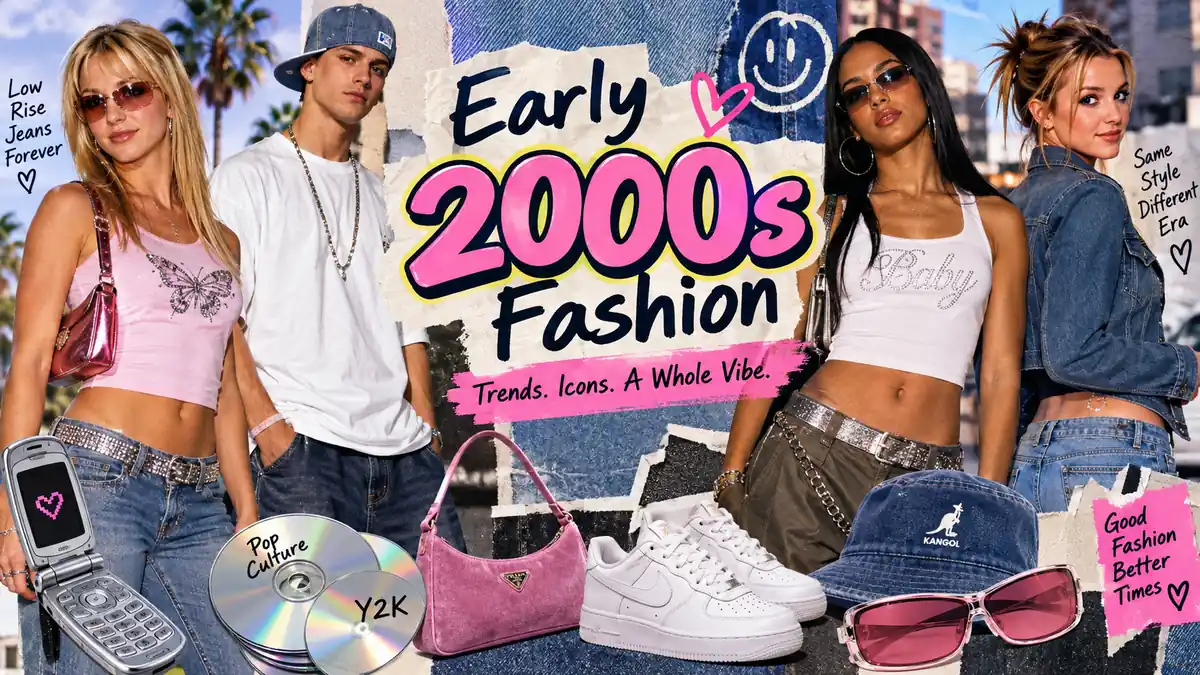
Few fashion eras are as instantly recognizable as the first years of the new millennium. Low-rise jeans, tiny shoulder bags, velour tracksuits, rhinestone logos, baby tees, cargo pants, trucker hats, and platform shoes turned everyday outfits into statements.
early 2000s fashion combined futuristic Y2K influences with celebrity culture, streetwear, logomania, denim, and deliberately flashy accessories. The defining wardrobe included low-rise jeans, crop tops, mini skirts, cargo pants, Juicy Couture tracksuits, Von Dutch hats, baguette bags, Ugg boots, chunky sneakers, and plenty of rhinestones and metallic finishes.
The style was never just one aesthetic. Pop stars, hip-hop artists, reality television, skate culture, luxury designers, and rapidly expanding internet culture all contributed to a decade in which fashion could be glamorous, sporty, futuristic, preppy, or deliberately excessive.
What Is early 2000s fashion?
The term early 2000s fashion generally describes clothing and styling associated with the opening years of the 2000s, particularly the styles now grouped under the broader Y2K revival.
Y2K literally refers to the year 2000, but Y2K fashion usually reaches beyond that single year. Many of the trends associated with the aesthetic emerged during the late 1990s and remained visible through the early-to-mid 2000s.
The period coincided with dramatic technological and cultural changes. Computers were becoming everyday household objects, mobile phones were evolving quickly, and digital media was beginning to change how people discovered celebrities and trends.
That fascination with the future appeared directly in clothes.
Metallic silver, shiny fabrics, tinted sunglasses, unusual synthetic materials, tiny accessories, and sleek black outfits reflected a technology-inspired aesthetic. The Fashion History Timeline at the Fashion Institute of Technology notes that turn-of-the-millennium fashion drew inspiration from new technology, including metallic silver and Matrix-like black styling.
At the same time, another side of the era moved in almost the opposite direction: distressed denim, graphic tees, casual tracksuits, trucker caps, and oversized streetwear.
That contradiction is essential to understanding the period. There was no single early-2000s uniform.
Y2K fashion vs. general 2000s fashion
The two terms are often used interchangeably, but they are not quite identical.
| Y2K Style | Broader 2000s Fashion |
|---|---|
| Futuristic influences | Covers the entire decade |
| Metallic fabrics | Includes later boho styles |
| Baby tees and crop tops | Includes skinny-jean era |
| Low-rise bottoms | Multiple denim silhouettes |
| Tiny bags | Oversized and hobo bags also appeared |
| Bright colors | Earthier colors became common later |
| Platform footwear | Ballet flats and boots also became prominent |
| Tech-inspired accessories | Indie and rock influences grew later |
Y2K is therefore better understood as one major chapter within 2000s fashion rather than a synonym for everything worn between 2000 and 2009.
The Most Iconic early 2000s fashion Trends
If you wanted to reconstruct an authentic early-2000s wardrobe, a few pieces would immediately establish the period.
Low-rise jeans changed the silhouette
Nothing represents early 2000s women’s fashion more clearly than low-rise jeans.
The waistline dropped dramatically compared with the high-waisted styles associated with many earlier periods. Jeans often sat directly on the hips and were paired with short tops to emphasize the midriff.
Alexander McQueen had experimented with extremely low “bumster” trousers during the 1990s, but by the early 2000s the low-rise silhouette had entered mainstream fashion. Vogue notes that Levi’s introduced a Superlow jean in 2001.
Britney Spears became particularly associated with low-rise denim and belly-baring tops.
Bootcut and flared legs were common, although cuts varied. Jeans could also be distressed, embroidered, embellished with rhinestones, or decorated across the back pockets.
Denim itself was everywhere.
Jeans were no longer restricted to purely casual outfits. Celebrities wore elaborate denim looks to major events, helping blur the distinction between everyday and statement dressing.
One of the most remembered examples arrived in 2001 when Britney Spears and Justin Timberlake appeared in coordinated head-to-toe denim outfits.
Baby tees and crop tops
Low-rise bottoms naturally encouraged shorter tops.
Fitted baby tees, ribbed tank tops, cropped cardigans, camisoles, tube tops, and graphic T-shirts became everyday wardrobe staples.
The proportions mattered. A tiny fitted top paired with wider or flared pants created one of the period’s most recognizable silhouettes.
Graphics ranged from brand logos and slogans to cartoon imagery, rhinestones, butterflies, and playful typography.
Layering was equally common. A camisole could sit over another tank, while a short cardigan might be worn over a fitted top.
Velour tracksuits made loungewear fashionable
Before modern athleisure became a massive fashion category, the early 2000s had the velour tracksuit.
Juicy Couture became virtually synonymous with the look. Matching zip-up hoodies and pants appeared in bright colors, often with visible logos or rhinestone lettering.
Celebrities wore tracksuits while shopping, traveling, and being photographed by paparazzi, transforming what was essentially comfortable leisurewear into an aspirational outfit. Vogue identifies Juicy Couture sweatsuits among the defining styles of the decade.
The outfit also illustrates an important early-2000s idea: casual clothing could still function as status dressing.
Cargo pants brought utility into Y2K
Cargo pants added a more relaxed counterpoint to the hyper-feminine side of Y2K fashion.
They appeared in khaki, camouflage, black, beige, and other neutral colors and were often worn low on the hips. Loose legs and oversized pockets made them particularly popular within casual and streetwear outfits.
A fitted tank or crop top balanced the volume.
This fitted-top-plus-baggy-bottom formula remains one of the easiest ways to recognize—and recreate—the era.
Mini skirts became even shorter
Denim mini skirts, pleated skirts, cargo minis, and fitted micro skirts appeared throughout early-2000s wardrobes.
Denim versions were especially versatile. They could be worn with a tank top and flip-flops during summer or layered with boots when temperatures dropped.
Pleated mini skirts leaned toward the era’s school-inspired and preppy styling, while metallic and embellished versions reflected the more futuristic Y2K aesthetic.
Logomania Made Brands Part of the Outfit
Subtle luxury was not the dominant philosophy of the era.
Logos were meant to be seen.
Vogue’s history of the decade describes logomania as a major 2000s phenomenon, appearing across handbags, bikinis, belts, and other accessories from houses such as Dior, Burberry, Gucci, and Louis Vuitton.
The trend wasn’t limited to traditional luxury fashion.
Von Dutch trucker hats became celebrity favorites. Ed Hardy brought tattoo-style graphics, rhinestones, and conspicuous decoration to T-shirts and accessories.
Brand recognition itself became part of the visual language.
A logo belt buckle, monogrammed handbag, branded tracksuit, or recognizable hat told observers what cultural group the wearer belonged to.
Rhinestones and embellishment
When logos weren’t enough, there was sparkle.
Rhinestones appeared on:
- Jeans and back pockets
- T-shirts and tank tops
- Tracksuits
- Handbags
- Belts
- Sunglasses
- Mobile-phone accessories
- Hair accessories
Studs, sequins, metallic prints, and embroidery added even more visual texture.
The result could look excessive by minimalist standards. That was largely the point.
Quick Takeaway: Early-2000s style favored visible personality. Logos, sparkle, exaggerated proportions, and recognizable accessories weren’t details hidden within an outfit—they often were the outfit.
The It Bag Era Changed Accessories
The early 2000s turned handbags into cultural objects.
Fendi had already introduced its Baguette in 1997, but its association with Carrie Bradshaw and Sex and the City helped make the small shoulder bag enormously influential.
Soon, nearly every major fashion house seemed to have a recognizable bag.
The Dior Saddle bag appeared at the spring/summer 2000 show. Balenciaga’s Motorcycle City Bag followed in 2001. Louis Vuitton released high-profile collaborations under Marc Jacobs, including Stephen Sprouse’s graffiti treatment in 2001 and Takashi Murakami’s colorful monogram work in 2003.
Louis Vuitton, Dior, Balenciaga and Fendi helped establish the handbag as a highly visible status symbol.
Baguette and shoulder bags
Small bags were particularly characteristic.
Instead of today’s emphasis on carrying everything, many fashionable bags sat tightly underneath the arm and provided barely enough room for essentials.
Popular details included:
- Monograms
- Metallic materials
- Rhinestones
- Bright colors
- Buckles
- Chain straps
- Denim
- Patent finishes
The bag didn’t necessarily need to be practical. It needed to complete the look.
Shoes That Defined Early 2000s Style
Early-2000s footwear was surprisingly diverse.
One outfit might feature chunky sneakers; another could use barely-there kitten heels.
Platform shoes
Platforms continued the height and drama inherited from late-1990s fashion.
Platform sandals, sneakers, and flip-flops worked especially well with long flared jeans because the extra height allowed pants to skim close to the ground.
Ugg boots
UGG boots became an unlikely fashion phenomenon.
Their appeal was partly based on contrast. Celebrities paired warm, bulky boots with mini skirts, denim shorts, and other outfits that weren’t necessarily designed for cold weather.
That slightly mismatched approach feels distinctly early 2000s.
Kitten heels and strappy sandals
At the opposite end were delicate kitten heels, pointy shoes, strappy sandals, and heeled mules.
These styles complemented slip dresses, going-out tops, and low-rise trousers while maintaining the slim proportions common to more glamorous Y2K looks. Vogue identifies kitten-heeled mules, strappy sandals, chunky sneakers, platform soles, and other contrasting footwear as parts of the broader Y2K vocabulary.
Ballet flats
As the decade progressed, ballet flats emerged as another important silhouette.
Their simple, low-profile shape offered a softer alternative to platforms and chunky sneakers and helped foreshadow some of the mid-to-late-2000s styling that followed.
Accessories Made the Outfit
An early-2000s outfit can look surprisingly modern until you add the accessories.
Then the decade becomes obvious.
Trucker hats
Few accessories carry as much Y2K nostalgia as the trucker hat.
Von Dutch became especially closely associated with the style, with celebrities including Paris Hilton wearing its caps during the height of their popularity.
Tinted and wraparound sunglasses
Sunglasses ranged from tiny colored lenses to sporty wraparound frames.
Futuristic styles reflected the technological optimism surrounding the millennium, while oversized celebrity sunglasses became increasingly important as paparazzi culture grew.
Butterfly clips
Hair was an accessory too.
Butterfly clips, colorful barrettes, headbands, bandanas, and strategically placed hairpins helped create the playful side of Y2K beauty.
Small clips could be arranged across multiple twisted sections of hair rather than simply being used functionally.
Statement belts
Belts didn’t always need to hold anything up.
Wide belts with oversized circular buckles were sometimes placed over dresses, long tops, or low-rise jeans purely for decoration.
The mid-2000s boho movement pushed this styling even further.
Celebrity Culture Drove early 2000s fashion
Fashion has always had famous tastemakers, but the early 2000s created a particularly powerful relationship between celebrities and everyday style.
MTV, music videos, reality television, tabloid magazines, red carpets, and paparazzi photography provided an almost constant stream of outfit inspiration.
Vogue describes the decade as heavily celebrity-driven, with reality TV, paparazzi imagery, blogs, and emerging digital platforms giving audiences unprecedented access to famous people’s lives and clothes.
Britney Spears
Britney Spears helped define the low-rise silhouette.
Crop tops, tiny tanks, denim, mini skirts, and exposed midriffs became closely associated with her public image.
Her matching denim appearance with Justin Timberlake in 2001 remains one of the decade’s most recognizable fashion moments.
Paris Hilton
Paris Hilton represented another side of the aesthetic: rhinestones, tiny bags, velour, miniskirts, trucker hats, logos, and unapologetic glamour.
Her appearances alongside Nicole Richie on The Simple Life helped turn celebrity casualwear into entertainment in its own right.
Jennifer Lopez
Jennifer Lopez produced one of the era’s defining red-carpet moments at the 2000 Grammy Awards in a green Versace dress.
Interest in seeing images of the dress online was so enormous that it became connected to the development of Google Image Search, making it an unusually fitting symbol of fashion entering the digital age.
Destiny’s Child and pop-star glamour
Destiny’s Child brought coordinated outfits, metallic finishes, denim, crop tops, and stage-ready glamour into mainstream pop culture.
Musicians were particularly powerful style influences because music television put their clothes directly in front of millions of young viewers.
Sarah Jessica Parker and Carrie Bradshaw
Sarah Jessica Parker influenced fashion through Carrie Bradshaw on Sex and the City.
Carrie’s attachment to designer shoes and handbags helped strengthen the cultural status of the It bag, especially the Fendi Baguette.
Designer Fashion Was Just as Bold
Popular Y2K fashion wasn’t created entirely in shopping malls and music videos.
Major designers were pushing many of the same ideas on runways.
Alexander McQueen helped lay groundwork for extremely low waistlines through his earlier bumster trousers.
At Gucci, Tom Ford helped define the sexually charged luxury aesthetic that carried into the beginning of the decade.
Donatella Versace, Roberto Cavalli, John Galliano, Marc Jacobs, Miuccia Prada, and other designers explored combinations of glamour, logos, sex appeal, embellishment, and unconventional proportions.
Fashion houses such as Versace, Prada, Miu Miu, Dolce & Gabbana, Burberry, Fendi, Gucci, Dior, Balenciaga, and Louis Vuitton consequently became part of the visual identity of the era.
Designer collaborations became cultural events
Louis Vuitton’s collaborations demonstrated another shift.
Marc Jacobs worked with artist Stephen Sprouse on graffiti-covered monograms and later with Takashi Murakami, whose colorful interpretation of the LV monogram became deeply associated with early-2000s pop luxury.
Luxury was becoming louder, more collectible, and more recognizable from a distance.
early 2000s fashion for Women
Women’s style during the period often played with extremes.
Pants sat exceptionally low while tops became exceptionally short. Bags became tiny while sunglasses could become huge. Casual tracksuits carried luxury associations while denim appeared at glamorous events.
A representative women’s wardrobe might include:
- Low-rise bootcut jeans
- Baby tees
- Ribbed tank tops
- Tube tops
- Crop tops
- Denim mini skirts
- Cargo pants
- Velour tracksuits
- Mini dresses
- Denim jackets
- Bolero cardigans
- Baguette bags
- Platform sandals
- Ugg boots
- Kitten heels
- Oversized belts
- Trucker hats
- Tinted sunglasses
- Butterfly clips
One frequently forgotten detail is layering.
The simplified modern version of Y2K tends to focus on a crop top and low-rise pants. Authentic outfits could be much busier: layered tanks, decorative belts, scarves, multiple necklaces, bags, hats, and embellished denim might all appear simultaneously.
early 2000s fashion for Men
Men’s early-2000s style was equally varied.
The beginning of the decade was dominated by relaxed silhouettes, music-driven streetwear, mall brands, sportswear, and experimentation.
Baggy jeans and cargo pants were foundational pieces.
Graphic tees could be layered underneath button-down shirts or jackets, while oversized jerseys reflected hip-hop’s enormous influence on mainstream fashion.
Hip-hop style
Hip-hop fashion helped popularize:
- Oversized jerseys
- Baggy denim
- Baseball caps
- Large chains
- Sneakers
- Sportswear
- Graphic clothing
Air Jordans and other sneaker styles became essential parts of the visual vocabulary.
Mall-prep style
Another influential men’s aesthetic was preppy mall fashion.
Abercrombie & Fitch represented the polo-shirt, layered-top, distressed-denim side of early-2000s youth style.
Multiple polo shirts were sometimes layered together, with popped collars becoming one of the decade’s most easily parodied styling tricks.
Skate and pop-punk influences
Skateboarding and pop-punk created yet another recognizable wardrobe.
Cargo shorts, loose jeans, hoodies, band shirts, studded belts, wristbands, and skate shoes appeared alongside brands such as Vans.
The result was less polished than mainstream celebrity fashion but just as culturally influential.
The silhouette eventually got slimmer
Men’s 2000s fashion didn’t remain baggy throughout the decade.
Hedi Slimane helped push menswear toward an extremely slim silhouette during his tenure at Dior Homme. Skinny trousers, narrow jackets, slim ties, and rock-inspired styling influenced the latter part of the decade and helped establish the look later associated with indie sleaze.
Bands such as The Strokes, The Killers, and The Libertines reflected that changing rock aesthetic.
This is another reason why treating all 2000s clothing as “Y2K” misses important distinctions.
From Futuristic Y2K to Boho Chic
By the middle of the decade, fashion began moving away from some of the most overtly futuristic millennium imagery.
Bohemian styling became increasingly visible.
Peasant blouses, prairie-inspired dresses, hobo bags, slouchy boots, skinny scarves, retro prints, and decorative belts produced a softer and more layered silhouette.
Sienna Miller became one of the style’s best-known representatives.
Mary-Kate and Ashley Olsen, Kate Moss, Mischa Barton, and Nicole Richie also helped popularize versions of the look, while celebrity stylist Rachel Zoe was influential in shaping the Hollywood boho aesthetic.
This transition matters because it explains why photographs from 2001 can look dramatically different from photographs taken only four or five years later.
Quick Takeaway: The 2000s were not one continuous aesthetic. Futuristic Y2K, McBling-style glamour, hip-hop streetwear, mall prep, boho chic, and eventually skinny indie-rock fashion overlapped and replaced one another surprisingly quickly.
How to Create an Authentic Early-2000s Outfit Today
The easiest mistake when recreating the period is wearing every famous Y2K trend simultaneously.
Actual outfits were often eclectic, but they still had a visual anchor.
A better approach is to start with one recognizable silhouette.
1. Choose your main Y2K piece
Start with something that establishes the era immediately:
low-rise jeans, cargo pants, a denim mini skirt, a velour tracksuit, or a fitted baby tee.
2. Balance fitted and loose proportions
For a classic women’s silhouette, pair a fitted top with relaxed cargo pants or bootcut jeans.
For an early-2000s men’s outfit, loose denim can work with a graphic tee and sneakers.
You don’t have to reproduce the era’s most extreme proportions. Mid-rise jeans, for example, can suggest the look without requiring an ultra-low waist.
3. Add one period-specific accessory
A small shoulder bag, trucker hat, tinted sunglasses, wide belt, skinny scarf, or butterfly clips can make an otherwise simple outfit read as unmistakably 2000s.
4. Get the footwear right
Try chunky sneakers, platforms, Ugg-style boots, ballet flats, kitten heels, or strappy sandals depending on the outfit.
Shoes can often establish the decade more convincingly than adding another logo.
5. Avoid making it look like a costume
A modern Y2K outfit generally works best when historical references are mixed with contemporary basics.
For example:
Baby tee + relaxed cargo pants + shoulder bag + sneakers
or:
Bootcut jeans + fitted tank + small baguette bag + kitten heels
For men:
Loose jeans + graphic tee + zip hoodie + retro sneakers
These combinations preserve the proportions and styling language without copying a celebrity photograph piece for piece.
Why Did Early 2000s Fashion Come Back?
Fashion operates in cycles, but nostalgia accelerated the Y2K revival.
By the early 2020s, younger consumers were rediscovering bootcut jeans, silk scarves, tiny bags, low-rise silhouettes, and other early-2000s references through TikTok and other social platforms. Vogue documented Gen Z’s renewed interest in these styles as early as 2021.
There is also a generational component.
For people who experienced the period firsthand, these clothes can feel nostalgic. For younger wearers, however, flip phones, paparazzi-era celebrity imagery, tiny handbags, and rhinestone-covered clothing belong to a world they never personally experienced.
That makes the period feel historical rather than merely outdated.
Brands associated with the original era have benefited as well. Juicy Couture, Baby Phat, and Ugg have all reappeared within contemporary conversations around Y2K style, while runway fashion repeatedly revisits low rises, ballet flats, cargo silhouettes, and other 2000s references.
Original Y2K Fashion vs. the Modern Revival
Today’s interpretation isn’t an exact recreation.
| Original Early 2000s | Modern Y2K Revival |
|---|---|
| Ultra-low-rise jeans | Low- and mid-rise options |
| Tight baby tees | Baby tees or fitted basics |
| Heavy visible branding | Logos used more selectively |
| Multiple Y2K trends together | Often one statement piece |
| Tiny impractical handbags | Small but more functional bags |
| Extreme bootcut denim | Relaxed flares and wide legs |
| Rhinestones everywhere | Strategic embellishment |
| Paparazzi-driven celebrity style | Social-media-driven styling |
| New mass-market clothing | Vintage and secondhand pieces |
The distinction explains why contemporary Y2K outfits often look cleaner than photographs from 2002 or 2003.
Modern styling tends to edit the past.
The original era frequently did not.
What Colors Defined Y2K Fashion?
There wasn’t one official palette.
The futuristic side emphasized silver, black, white, icy blue, and metallic finishes. Pop fashion introduced pink, purple, turquoise, lime green, and other saturated colors.
Denim supplied endless shades of blue.
Juicy tracksuits brought jewel tones and pastels, while later boho fashion leaned toward brown, cream, olive, tan, and other earthy shades.
Textures mattered just as much as color:
velour, distressed denim, patent finishes, metallic fabric, rhinestones, mesh, faux fur, leather, and shiny synthetics could all signal the era.
What Made early 2000s fashion So Distinctive?
The clothes themselves tell only half the story.
The era sits at an unusual moment between analog and digital culture.
People still bought fashion magazines, watched music videos on television, carried compact cameras, and used flip phones. At the same time, internet culture was beginning to transform how trends circulated.
Celebrity imagery could suddenly travel faster and farther.
Jennifer Lopez’s Versace Grammy dress demonstrated that shift particularly clearly: enormous online demand for pictures of a single outfit helped illustrate the need for better image search.
Fashion therefore became increasingly immediate.
A celebrity could wear something, appear online or in a tabloid, and rapidly turn a handbag, pair of jeans, or trucker hat into a cultural object.
That mechanism now feels completely normal. In the early 2000s, it was relatively new.
The period also embraced contradictions that contemporary fashion continues to rediscover: luxury mixed with loungewear, feminine pieces with utility clothing, futuristic materials with vintage references, and expensive designer bags with casual denim.
That is ultimately why early 2000s fashion remains more interesting than a collection of nostalgic trends. Low-rise jeans, velour tracksuits, baguette bags, cargo pants, trucker hats, platforms, and baby tees are memorable, but the real legacy of the era is its fearless mixture of pop culture, technology, celebrity, streetwear, and luxury.
To understand the style rather than simply imitate it, look beyond individual Y2K pieces and pay attention to the proportions, accessories, branding, layering, and cultural influences that made the original outfits unmistakably early 2000s.