
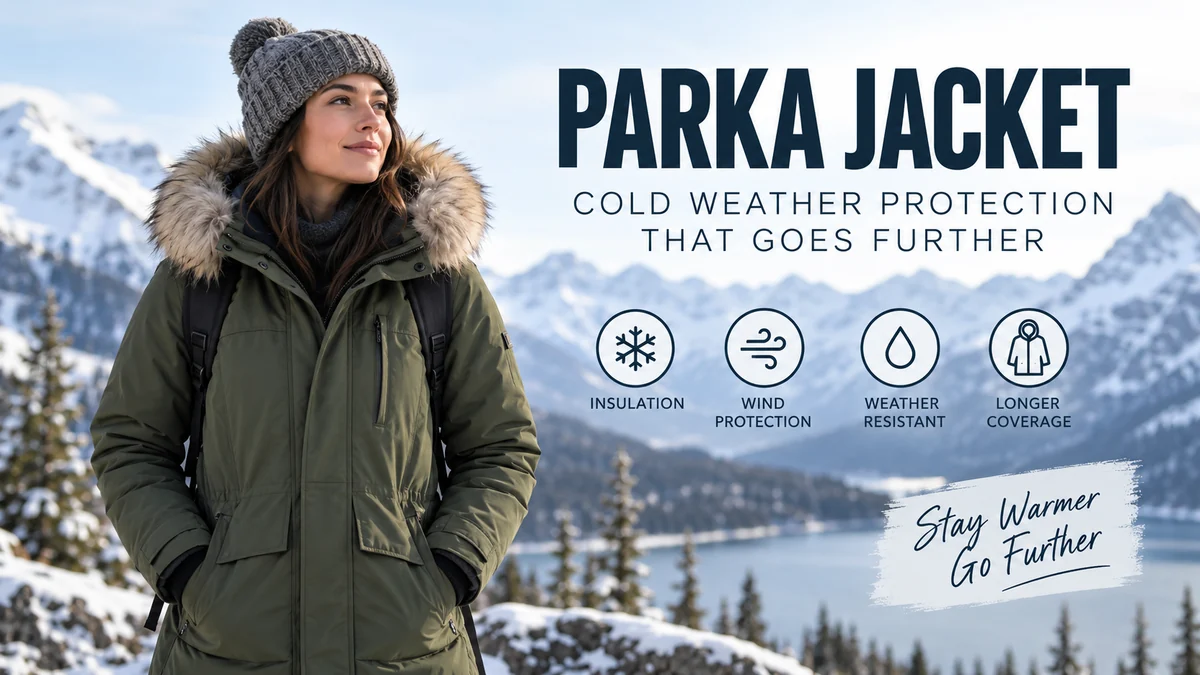
Cold weather exposes the weaknesses of ordinary outerwear quickly. A short jacket may leave your legs exposed, while inadequate insulation, loose cuffs, or a poorly designed hood can make wind and snow surprisingly uncomfortable.
A parka jacket addresses those problems with a longer cut, protective hood, weather-resistant outer shell, and, in many designs, substantial insulation. Although modern parkas range from lightweight urban coats to expedition-level outerwear, the basic idea remains the same: provide reliable protection against cold, wind, snow, and changing winter conditions.
Quick answer: A parka jacket is a hooded cold-weather coat that typically extends below the hips and combines insulation with wind and weather protection. Modern parkas may use down or synthetic insulation, water-resistant or waterproof shells, adjustable hoods, storm flaps, drawcords, and longer hems to retain warmth in winter conditions.
What Is a Parka Jacket?
A parka is a warm outer garment distinguished primarily by its protective hood and cold-weather design. Cambridge defines a parka as a warm, often waterproof jacket or coat with a hood, while modern outdoor versions commonly combine substantial coverage with insulation and protection from wind and precipitation.
Most contemporary parkas extend to the hips, thighs, or knees. That extra length distinguishes many parkas from conventional jackets and reduces heat loss around the lower torso and upper legs.
Common characteristics include:
- An attached or adjustable hood
- Hip-, thigh-, or knee-length coverage
- Down or synthetic insulation
- Wind-resistant outer fabric
- Water-resistant or waterproof construction
- High collar or insulated neck area
- Full-length front zipper
- Storm flap over or behind the zipper
- Adjustable cuffs
- Drawcords at the hood, waist, or hem
- Large hand or cargo pockets
Not every parka includes every feature. Lightweight fashion parkas, military-inspired fishtail designs, and expedition parkas can look and perform very differently.
The key concept is protection through coverage.
A parka places more material between your body and cold surroundings while reducing the number of areas where wind can enter.
Where Did the Parka Come From?
The modern parka is not simply a contemporary fashion invention. Its history is closely connected with Indigenous peoples of the Circumpolar North, who developed highly effective hooded garments for severe Arctic conditions.
Traditional parkas were made from locally available animal materials, including caribou and seal skins. Different communities developed their own construction methods according to climate, available resources, activities, and cultural traditions.
The Smithsonian describes historical examples in which inner garments used bird skins or animal pelts with hair facing inward, while outer layers could have hair facing outward. Waterproof hooded garments made from seal intestines or fish skin could also provide protection from rain and blowing snow.
The Anchorage Museum emphasizes an important point that simplified histories sometimes miss: parka traditions extend across Indigenous communities throughout the Circumpolar North, with distinctive regional construction, designs, and meanings. Parkas could communicate social identity as well as provide environmental protection.
From Arctic Clothing to Military Parkas
The functional principles of Arctic clothing eventually influenced modern cold-weather outerwear.
Military organizations needed garments capable of protecting personnel working in freezing temperatures for long periods. By the twentieth century, specialized military parkas had become important pieces of cold-weather equipment.
One particularly recognizable example is the N-3B parka, developed for U.S. military personnel operating in extremely cold environments. Its long body and large protective hood contributed to the familiar “snorkel parka” appearance.
Another influential design was the M-51 fishtail parka.
Unlike heavily insulated Arctic-style parkas, fishtail designs are recognized by the split extension at the back. Military-inspired fishtail parkas later became associated with British mod culture, helping transform functional military outerwear into an enduring fashion garment. Helly Hansen notes the M-51’s role in the parka’s adoption by mod culture during the 1960s.
Modern parkas therefore sit at the intersection of Indigenous cold-weather knowledge, military utility, outdoor performance clothing, and everyday fashion.
How Does a Parka Jacket Keep You Warm?
A warm parka doesn’t create heat. Your body does.
The garment’s job is to slow the rate at which that heat escapes.
Several components work together to accomplish this.
Insulation Traps Warm Air
Insulation creates tiny spaces where air becomes trapped. Because this trapped air does not circulate freely, heat transfers away from the body more slowly.
Modern insulated parkas generally use either:
- Down insulation
- Synthetic insulation
Both work by creating loft, but their behavior changes when exposed to moisture.
Longer Length Reduces Exposure
A waist-length jacket protects your torso but leaves more of your lower body exposed.
A thigh-length parka covers significantly more surface area.
That difference becomes noticeable when you’re standing outside rather than moving continuously. Longer parkas are particularly useful for activities such as commuting, watching outdoor events, waiting for transportation, or working in cold environments.
The Hood Protects a Vulnerable Area
A properly fitted hood shields the head, neck, ears, and parts of the face from wind and snow.
Many winter parkas use adjustable hoods so the opening can be tightened without excessively limiting visibility.
Historically, fur ruffs served a practical purpose beyond appearance. The Smithsonian notes that wolf and wolverine fur around Arctic parka hoods could help shield the face from cold wind and shed moisture from the wearer’s breath, reducing ice accumulation around the hood.
Modern manufacturers may instead use synthetic trim, insulated brims, structured hoods, or no trim at all.
Wind Protection Matters as Much as Insulation
A thick coat can still feel cold if wind penetrates its fabric or openings.
Effective parkas reduce drafts through features such as:
- Tight-weave shell fabrics
- Storm flaps
- High collars
- Adjustable cuffs
- Drawcord hems
- Insulated zipper areas
- Snug hood openings
This is why warmth cannot be judged from thickness alone.
Down vs Synthetic Insulation in a Parka Jacket
Insulation is one of the biggest differences between winter parkas.
| Feature | Down | Synthetic |
|---|---|---|
| Warmth-to-weight | Excellent | Good to excellent |
| Compressibility | Excellent | Usually lower |
| Performance when damp | Reduced unless treated | Generally better |
| Drying speed | Slower | Faster |
| Weight | Usually lighter | Often heavier for similar warmth |
| Maintenance | Requires more care | Generally easier |
| Best suited to | Cold, relatively dry conditions | Damp or variable conditions |
Down Insulation
Down consists of the fine insulating plumage found beneath the exterior feathers of ducks or geese.
Its major advantage is its exceptional ability to create loft without excessive weight.
You’ll often see fill power mentioned on down garments. Fill power describes the loft of down rather than simply telling you how much down is inside a jacket.
Higher-loft down can provide substantial insulation for its weight, but fill power should not be treated as a complete warmth rating.
A parka containing a small amount of high-fill-power down isn’t automatically warmer than one containing much more lower-fill-power down.
Construction, total fill weight, garment length, baffles, shell fabric, fit, and draft protection all affect real-world warmth.
Synthetic Insulation
Synthetic insulation typically uses polyester-based fibers designed to create insulating air spaces.
Its biggest practical advantage is moisture management.
Synthetic insulation generally maintains more useful insulating performance when damp and dries faster than untreated down. That makes it appealing for wet snow, humid winter weather, variable precipitation, and activities where perspiration is likely.
Its disadvantages can include greater bulk and weight for equivalent warmth.
Neither option is automatically superior. Climate and intended use matter more.
Quick Takeaway: Choose insulation according to conditions, not simply the biggest number printed on a product specification.
Is a Parka Jacket Waterproof?
Not necessarily.
This is one of the most common misunderstandings about parkas.
A parka can be:
- Water-resistant
- Highly water-resistant
- Waterproof
- Primarily wind-resistant with limited rain protection
Those descriptions are not interchangeable.
A water-resistant shell can handle light precipitation for a limited period but may eventually allow water through.
A waterproof shell is specifically engineered to prevent water penetration under defined conditions, normally using a waterproof membrane or coating alongside construction details designed to prevent leakage.
Seams matter too.
Even excellent waterproof fabric can allow moisture through needle holes if important seams are not sealed.
What Is DWR?
Many technical outerwear fabrics receive a durable water repellent (DWR) treatment.
DWR helps water bead and roll from the face fabric instead of immediately soaking into it.
However, DWR itself does not automatically make an entire garment waterproof. The underlying membrane, seams, zippers, construction, and design remain important.
Water repellency can also decline with dirt, abrasion, and repeated wear.
For occasional snowfall and short urban walks, strong water resistance may be sufficient. Prolonged rain, wet snow, or extended outdoor exposure calls for more substantial waterproof construction.
Parka Jacket vs Regular Jacket vs Coat
These words are sometimes used loosely, which makes the distinction confusing.
A jacket generally refers to shorter outerwear, while coat is a broader category that includes many longer outer garments. A parka is essentially a particular type of cold-weather coat characterized by its hood, coverage, and protective construction.
| Feature | Parka | Regular Jacket | General Coat |
|---|---|---|---|
| Typical length | Hip to knee | Waist to hip | Varies |
| Hood | Usually | Optional | Optional |
| Insulation | Often substantial | Varies | Varies |
| Wind protection | Usually strong | Varies | Varies |
| Winter focus | Strong | Depends on design | Depends on style |
| Lower-body coverage | Good | Limited | Moderate to good |
| Typical use | Cold/wind/snow | Broad everyday use | Broad outerwear category |
The boundaries aren’t absolute. Clothing manufacturers use terms differently, and modern fashion frequently mixes traditional design categories.
A hooded thigh-length insulated winter coat, however, comfortably fits the modern understanding of a parka.
Parka vs Anorak: What’s the Difference?
“Parka” and “anorak” are frequently treated as synonyms, especially in casual conversation.
Traditionally, there is a useful distinction.
An anorak is generally a hooded pullover garment associated with protection against wind and precipitation. A traditional anorak doesn’t have the full-length front opening found on most modern parkas.
A parka generally has:
- A full front opening
- Greater length
- More insulation
- Heavier cold-weather construction
An anorak commonly has:
- Pullover construction
- Shorter length
- Lighter insulation or no insulation
- Strong emphasis on wind and precipitation protection
Historical definitions are more complicated because both terms have Indigenous linguistic and cultural histories, and modern manufacturers use them inconsistently. Still, the pullover-versus-long-insulated-coat distinction remains useful when comparing contemporary garments.
Major Types of Parka Jacket
There is no single standard parka design.
The category has expanded considerably as outdoor brands, military designers, and fashion labels have adapted the concept for different conditions.
Insulated Winter Parka
This is what most people picture when hearing “parka.”
It normally includes substantial insulation, an attached hood, weather-resistant shell, multiple pockets, and a hem extending below the hips.
It’s designed primarily for warmth during everyday winter conditions.
Down Parka
A down parka uses duck or goose down as its primary insulation.
These garments can deliver excellent warmth relative to their weight and bulk.
Long down parkas are particularly common in very cold climates because they combine high-loft insulation with extensive body coverage.
Synthetic Parka
Synthetic parkas substitute man-made insulation for natural down.
They’re particularly practical in damp environments and for people who want simpler maintenance or prefer to avoid animal-derived insulation.
Expedition Parka
An expedition parka sits toward the extreme end of cold-weather outerwear.
These garments may feature:
- Heavy insulation
- Oversized hoods
- Long hems
- Reinforced fabrics
- Large glove-compatible pockets
- Substantial storm flaps
- Internal storage
- Adjustable cuffs
- High protective collars
Some are designed for polar research, mountaineering, or extended exposure rather than ordinary city winters.
Canada Goose, for example, says its Expedition Parka was developed around the requirements of scientists working at Antarctica’s McMurdo Station.
Fishtail Parka
The fishtail parka gets its name from its split, extended rear hem.
Its roots are military rather than contemporary technical mountaineering.
Many modern fishtail parkas are lighter than insulated winter parkas and function primarily as casual wind- and weather-resistant outer layers.
Snorkel Parka
The snorkel parka is strongly associated with the military N-3B design.
Its hood can surround much of the face, leaving a relatively small opening. That tunnel-like hood explains the “snorkel” nickname.
The design is particularly recognizable in military-inspired winter fashion.
Lightweight Parka
Not every parka is intended for subzero weather.
Some lightweight models preserve the longer cut and hood but use little or no insulation.
They’re useful for transitional seasons, wind, light precipitation, and layering.
Urban Parka
Urban parkas balance practical winter protection with less technical styling.
They often have cleaner silhouettes, less bulky insulation, concealed pockets, subdued fabrics, and enough warmth for commuting rather than prolonged exposure in remote environments.
What Materials Are Used in Parkas?
A modern parka is usually a multi-layer system rather than a single material.
Outer Shell
The shell faces the environment.
Common materials include:
- Nylon
- Polyester
- Cotton blends
- Cotton-nylon blends
- Ripstop fabrics
- Laminated waterproof textiles
Nylon and polyester are widely used because they can provide useful combinations of durability, low weight, wind resistance, and moisture management.
Cotton-blend parkas often have a softer, more traditional appearance but their weather performance depends heavily on construction and treatment.
Insulation
Common insulation options include:
- Goose down
- Duck down
- Recycled down
- Polyester fibers
- Other proprietary synthetic fills
The amount and distribution of insulation can matter just as much as its type.
Cold spots can develop where insulation shifts or where poorly designed seams compress the insulating layer.
Lining
The lining separates the wearer from insulation and internal construction.
Depending on the design, manufacturers may use smooth nylon or polyester, fleece, mesh, quilted fabric, or other textiles.
Smooth linings make layering easier because sweaters and fleece garments slide underneath without binding.
What Makes a Good Parka?
A good parka isn’t simply the thickest coat available.
The right design provides appropriate protection for the conditions where it will actually be worn.
1. Appropriate Warmth
Start with climate.
Someone experiencing mild winters with temperatures around freezing needs very different insulation from someone routinely exposed to deep subzero temperatures.
Also consider activity level.
Standing still requires more insulation than hiking because physical movement generates substantial body heat.
Helly Hansen similarly recommends selecting a parka according to climate, intended activity, and overall use, noting that parkas can be particularly useful for lower-intensity situations where the wearer needs warmth without generating much heat through movement.
2. Effective Wind Protection
Check areas where cold air commonly enters:
- Collar
- Hood opening
- Front zipper
- Sleeve cuffs
- Waist
- Hem
Adjustability in these areas can noticeably improve comfort.
3. Useful Length
Longer isn’t automatically better.
A knee-length parka provides excellent coverage but can feel restrictive during active movement. A mid-thigh design often offers a practical compromise between warmth and mobility.
4. Functional Hood
A winter hood should stay securely positioned when wind increases.
Useful features include:
- Volume adjustment
- Face opening adjustment
- Stiffened brim
- Insulation
- High collar integration
- Removable trim
Test whether you can turn your head without losing visibility.
5. Practical Pockets
Cold-weather pockets aren’t just storage.
Well-positioned hand-warmer pockets can protect exposed fingers, while internal pockets keep phones and batteries warmer.
For outdoor use, check whether pockets remain accessible while wearing a backpack or gloves.
6. Strong Closures
A front zipper is a major potential cold spot.
Look for construction that reduces direct wind penetration, such as internal draft tubes or external storm flaps.
Two-way zippers can be particularly useful on long parkas because opening the bottom slightly improves walking, sitting, and driving comfort.
How Should a Parka Jacket Fit?
A parka should feel comfortable with normal winter layers underneath.
Too tight, and insulation can become compressed while movement becomes restrictive. Too loose, and large internal air spaces can encourage drafts and reduce efficiency.
Try the parka over the clothing you expect to wear during winter rather than over a thin T-shirt.
Check four areas carefully.
Shoulders
Raise your arms forward and overhead.
The garment shouldn’t pull aggressively across your shoulders or upper back.
Chest and Torso
You should have enough space for a sweater or midlayer without the coat becoming excessively baggy.
Sleeves
Sleeves should continue covering the wrists when your arms extend forward.
Adjustable cuffs help seal the sleeve opening around gloves.
Hem
Make sure the length works while sitting.
A very long parka may provide excellent standing warmth but feel uncomfortable in a vehicle or during frequent movement.
Quick Takeaway: The best fit leaves enough room for layering without creating unnecessary bulk or allowing cold air to circulate freely.
How Warm Should Your Parka Be?
Temperature ratings can be useful, but they should never be interpreted as universal guarantees.
People experience cold differently.
Comfort depends on:
- Air temperature
- Wind speed
- Humidity
- Precipitation
- Activity level
- Exposure time
- Base layers
- Midlayers
- Metabolism
- Fit
- Insulation amount
- Hood and cuff design
A coat comfortable at -10°C while walking briskly may feel inadequate at the same temperature while standing still for an hour.
Instead of focusing exclusively on a claimed temperature rating, evaluate the entire clothing system.
For serious cold, combine:
- A moisture-managing base layer
- An insulating midlayer when required
- A weather-protective parka
- Insulated footwear
- Gloves or mittens
- Appropriate head and neck protection
Your coat is only one part of winter thermal management.
When Should You Wear a Parka Jacket?
Parkas work particularly well when cold exposure lasts long enough for additional insulation and coverage to matter.
Common uses include:
- Daily winter commuting
- Walking in snow
- Outdoor work
- Watching winter sports
- Travel in cold climates
- Camping
- Winter photography
- Low-intensity outdoor activities
- Standing or waiting outdoors
- Cold-weather fieldwork
Heavy parkas can become uncomfortable during intense exercise.
During hiking, climbing, snowshoeing, or other aerobic activity, the body can produce enough heat that excessive insulation causes sweating. Moisture accumulating inside clothing can later increase discomfort when activity stops.
For active winter use, layering often provides better temperature control than relying on one extremely heavy garment.
Parka Jacket Features Worth Understanding
Modern parkas can contain a surprisingly long list of technical features. Some are useful; others may add complexity without benefiting your particular use.
Storm Flap
A storm flap covers or backs the main zipper to reduce wind penetration and sometimes improve protection from precipitation.
Draft Tube
An insulated strip behind the zipper reduces heat loss through the closure.
Adjustable Cuffs
Velcro-style tabs, snaps, elastic, or internal knit cuffs help stop cold air from entering the sleeves.
Drawcord Waist
Tightening the waist reduces internal volume and limits drafts while changing the silhouette.
Adjustable Hem
A hem drawcord helps prevent wind from traveling upward beneath the coat.
Drop-Tail Hem
Some parkas extend farther down the back than the front, providing extra coverage without making the entire garment equally long.
Two-Way Zipper
This zipper can open from both the top and bottom.
It’s particularly valuable on thigh- or knee-length coats when sitting, climbing stairs, or driving.
Baffles
Down insulation is divided into compartments called baffles so the fill remains distributed rather than collecting at the bottom.
Baffle construction influences both insulation distribution and potential cold spots.
Hand-Warmer Pockets
These are positioned for warming hands rather than simply carrying objects.
Fleece or soft linings can improve comfort considerably in cold weather.
Common Mistakes When Choosing a Parka
A technically impressive coat can still be the wrong choice.
Buying Too Much Insulation
An expedition-style parka can be excessive for a relatively mild winter.
Overheating creates its own problems, particularly when sweat accumulates inside clothing.
Assuming Thick Means Warm
Visual bulk isn’t a reliable measurement of thermal performance.
Loft, construction, wind resistance, coverage, fit, and insulation quality all matter.
Ignoring Rain Protection
A very warm down parka with limited weather resistance may perform poorly in prolonged wet conditions.
Consider the type of winter you experience: dry cold, wet snow, freezing rain, and windy coastal weather require different priorities.
Choosing a Tight Fit
Insulated garments need enough room for their insulation to loft properly.
An excessively tight parka can compress insulation and leave little space for layering.
Choosing an Oversized Fit Without Purpose
Going too far in the opposite direction can also create problems.
Excess volume makes the garment heavier, less efficient, and more vulnerable to drafts.
Looking Only at Fill Power
High fill power sounds impressive, but it doesn’t tell the entire warmth story.
Total insulation quantity and garment construction remain crucial.
Ignoring Breathability
People often focus entirely on keeping moisture out.
Moisture generated inside the garment matters too.
If your activity level is high, a highly insulated coat can trap enough heat and perspiration to become uncomfortable.
How to Layer Under a Parka
Good layering makes a parka much more adaptable.
Base Layer
The layer against your skin should help manage moisture.
Synthetic materials and merino wool are common choices.
Heavy cotton is generally less suitable for demanding cold-weather activity because it absorbs moisture and dries slowly.
Midlayer
The middle layer provides additional insulation.
Options include:
- Fleece
- Wool sweater
- Synthetic insulated jacket
- Lightweight down jacket
You may not need a midlayer under a heavily insulated parka in moderate conditions.
Outer Layer
The parka becomes the primary barrier against cold, wind, and precipitation.
This modular approach lets you remove insulation when activity or temperature increases rather than being locked into one level of warmth.
How to Care for a Parka Jacket
Proper care helps insulation maintain loft and keeps the shell functioning as designed.
Always begin with the manufacturer’s care label because materials and construction vary significantly.
Cleaning Down Parkas
Down garments generally need gentle cleaning.
Use a detergent suitable for down when specified by the manufacturer, rinse thoroughly, and follow the recommended drying instructions.
Down must dry completely.
When appropriate under the garment’s care instructions, low-temperature tumble drying can help restore loft by separating damp down clusters.
Cleaning Synthetic Parkas
Synthetic insulation is generally less demanding, but excessive heat can still damage shell fabrics, coatings, adhesives, and insulation.
Avoid assuming that every polyester parka can tolerate high-temperature washing or drying.
Maintaining Water Repellency
If water stops beading on a technical shell, dirt or worn DWR may be responsible.
Cleaning the garment according to its instructions can sometimes restore performance. Eventually, an appropriate DWR treatment may need to be reapplied.
Storing Your Parka
Avoid leaving highly compressible insulated parkas tightly packed for long periods.
Store them clean and completely dry, ideally with enough room for the insulation to remain lofted.
Check pockets before storage and repair small tears before they become larger.
Are Fur-Trimmed Hoods Necessary?
No.
Historically, fur around the hood had practical value in Arctic conditions. As the Smithsonian documents, appropriate natural fur could shield the face from wind while reducing moisture and ice buildup around the hood opening.
Modern materials provide alternative approaches.
Synthetic fur, shaped hood brims, insulated face openings, adjustable cords, and technical fabrics can all contribute to protection.
Many modern consumers and manufacturers also choose faux fur or fur-free construction for ethical, environmental, personal, or maintenance reasons.
The key question is not whether a hood has fur. It’s whether the hood provides the protection, visibility, adjustability, and comfort required for the intended conditions.
Can You Wear a Parka in Rain?
It depends on the parka.
A waterproof parka with appropriately sealed construction can handle rain much better than a down coat whose shell provides only light water resistance.
For occasional light rain or snow, a DWR-treated water-resistant shell may be adequate.
For prolonged rainfall, look for:
- Waterproof fabric
- Sealed seams
- Protected zippers
- Effective hood coverage
- Storm flaps
- Adjustable cuffs
Remember that insulation and waterproofing are separate properties.
A parka can be extremely warm without being truly waterproof.
Is a Parka Good for Snow?
Yes, snow protection is one of the situations where the design works particularly well.
The long hem provides additional coverage, while the hood, cuffs, high collar, and weather-resistant shell can help keep blowing snow away from inner clothing.
But snow conditions vary.
Dry powder in extremely cold temperatures behaves differently from heavy, wet snow near freezing. In wetter conditions, waterproofing and moisture-resistant insulation become more significant.
For deep snow or prolonged outdoor exposure, footwear, gloves, trousers, and layering are just as important as the parka itself.
Is a Parka Warmer Than a Puffer Jacket?
Sometimes, but not automatically.
“Puffer” primarily describes a quilted construction used to hold insulation. “Parka” describes a broader cold-weather garment style.
A puffer can actually be a parka if it has the appropriate long, hooded design.
A long insulated parka often feels warmer than a short puffer because it covers more of the body and may provide stronger protection against wind. But a high-loft technical puffer can outperform a lightly insulated fashion parka.
Compare actual construction rather than relying on garment names.
Is a Parka Suitable for Everyday Wear?
For cold climates, absolutely.
One reason parkas remain popular is that their practical design translates easily from extreme environments to ordinary winter routines.
You don’t need to be exploring the Arctic to benefit from:
- Thigh coverage
- Insulated pockets
- Wind protection
- A large hood
- Warm insulation
- Weather-resistant fabric
The main drawback is bulk.
Heavy parkas can feel excessive inside heated buildings, crowded public transport, or vehicles. For frequent transitions between indoors and outdoors, a moderately insulated parka with easy ventilation can be more comfortable.
Parka Jacket Design: Function vs Fashion
The parka has moved far beyond purely technical outerwear.
Military designs such as the M-51 and N-3B helped establish silhouettes that later became recognizable fashion styles. Brands have since interpreted the parka through streetwear, luxury fashion, outdoor clothing, and minimalist urban outerwear.
Technical parkas emphasize performance.
Fashion-oriented versions may prioritize:
- Silhouette
- Fabric texture
- Color
- Oversized proportions
- Minimalist details
- Decorative hood trims
- Military styling
Neither approach is inherently wrong.
Problems arise when a fashion garment is assumed to provide technical protection simply because it resembles an expedition coat.
If warmth and weather resistance matter, examine specifications and construction rather than appearance.
Understanding Modern Parka Brands and Technology
Modern outdoor companies have pushed the parka toward increasingly specialized applications.
Helly Hansen emphasizes selecting parkas according to climate and intended activity, including insulation and weather protection.
Canada Goose has become strongly associated with cold-weather parkas and traces its manufacturing history to Toronto in 1957. Its development of products for extreme environments illustrates how the basic parka form has been adapted to modern technical insulation and fabrics.
Other outdoor brands, including Patagonia, The North Face, and Arc’teryx, operate within the broader modern technical-outerwear category where insulation, waterproof membranes, synthetic textiles, lightweight construction, and layering systems have changed how cold-weather garments are designed.
The important lesson for readers is that a brand name alone doesn’t determine suitability. Two parkas from the same manufacturer may be engineered for completely different temperatures and activities.
How to Evaluate a Parka Jacket for Your Climate
Instead of starting with style, begin with the environment.
Ask these questions in order:
- How cold does winter realistically get?
- Is the climate mostly dry or wet?
- How strong is the wind?
- How long will you normally remain outdoors?
- Will you be walking actively or standing still?
- Do you regularly encounter rain or wet snow?
- What layers will you wear underneath?
For mild, wet winters, prioritize waterproofing, breathability, and moderate insulation.
For cold, dry winters, insulation and wind resistance become more important.
For very cold, windy environments, look closely at coverage, hood design, cuffs, draft protection, insulation quantity, and exposed zipper areas.
For high-activity winter use, avoid excessive insulation and prioritize moisture management.
For urban commuting, comfort, pocket placement, sitting mobility, and manageable bulk may matter more than expedition-level specifications.
That approach is much more reliable than simply searching for the thickest coat available.
Final Thoughts on the Parka Jacket
The parka jacket has endured because its underlying design solves a straightforward cold-weather problem remarkably well: protect more of the body while limiting exposure to cold air, wind, snow, and moisture.
Its roots reach into sophisticated Indigenous Arctic clothing traditions, while later military designs such as the M-51 and N-3B helped shape the versions familiar today. Modern parkas now range from lightweight fishtail coats to highly insulated technical outerwear built for severe winter conditions.
When evaluating one, don’t judge warmth by thickness, fill power, price, or appearance alone. Consider insulation type and quantity, garment length, shell construction, waterproofing, wind resistance, hood design, fit, closures, activity level, and local climate together.
The right parka isn’t necessarily the warmest one. It’s the one that provides the right amount of protection for the conditions in which you’ll actually wear it.