
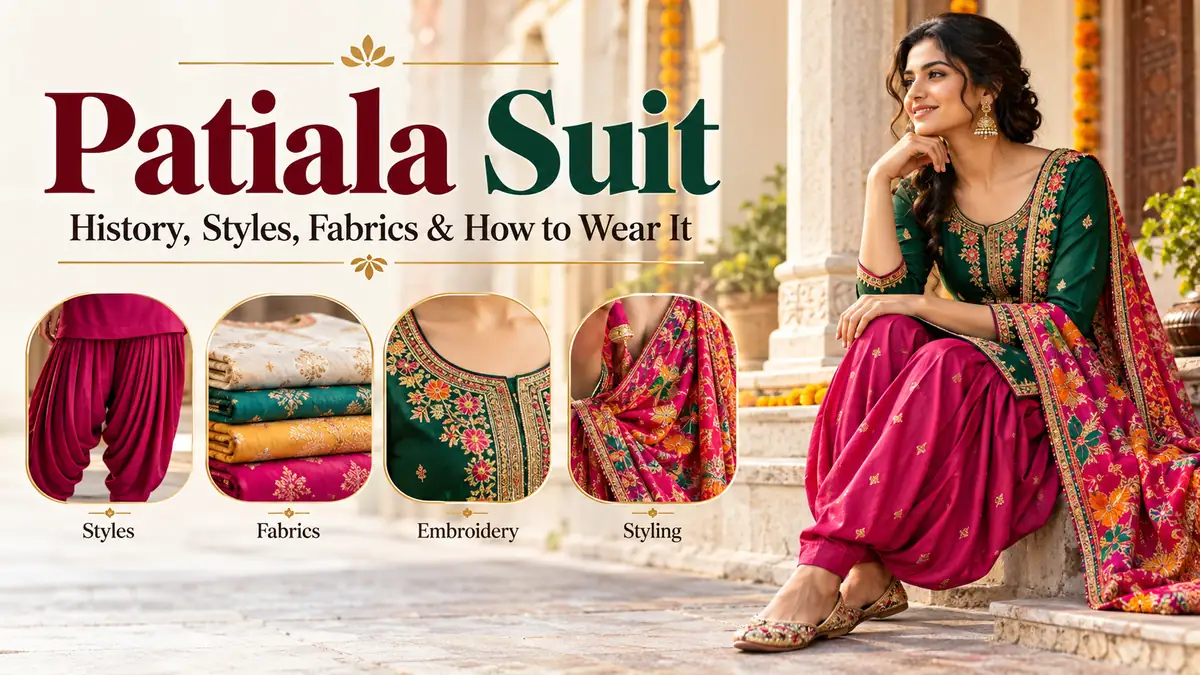
Few traditional outfits combine movement, comfort, and regional character as naturally as the patiala suit. Its generously pleated trousers create a silhouette that is instantly recognizable, while the kameez and dupatta leave plenty of room for changes in fabric, embroidery, color, and styling.
A patiala suit is a Punjabi salwar-kameez style built around a voluminous Patiala salwar with numerous pleats gathered at the waist and narrowing toward the ankles. It is generally worn with a kameez or kurti and a dupatta. The style takes its name from Patiala in Punjab and is valued for its distinctive drape and ease of movement.
What Is a Patiala Suit?
A traditional Patiala suit has three main components:
- Patiala salwar: Loose, heavily pleated trousers with a narrow finish near the ankles.
- Kameez or kurti: The upper garment, traditionally short enough to leave much of the salwar’s pleating visible.
- Dupatta: A scarf or stole that completes the three-piece outfit.
The lower garment is what separates the Patiala style from an ordinary salwar kameez. A standard salwar may have some gathering around the waist, but a Patiala salwar uses considerably more fabric to produce deeper, cascading folds.
These folds are not simply decorative. They give the wearer extra room through the hips and legs, making walking, sitting, and dancing relatively easy. This combination of volume and movement is one reason the style remains closely associated with Punjabi dress.
The terms Patiala suit, Patiala salwar suit, and Punjabi Patiala suit are therefore often used for the complete outfit, while “Patiala salwar” specifically describes the trousers.
History and Origin of the Patiala Suit
The name comes from Patiala, a historic city and former princely state in Punjab, India. Sources describing the garment consistently connect the distinctive salwar with Patiala and its royal clothing traditions. The style was historically associated with men’s royal dress before developing into a familiar form of women’s clothing.
This history helps explain the generous use of fabric. The original silhouette was not intended to resemble close-fitting trousers. Instead, abundant material created fullness, folds, and freedom of movement.
Over time, women adopted the style and it became strongly connected with Punjabi women’s dress. Today, the Patiala salwar is recognized well beyond its city of origin and appears in both traditional and contemporary South Asian wardrobes.
The broader salwar-kameez tradition is also deeply established across northern India and Pakistan. Its three core elements—salwar, kameez, and dupatta or chuni—can be altered significantly in shape and proportion while retaining the basic structure of the outfit.
Why Is It Called a Patiala Suit?
The answer is geographical rather than descriptive: it is named after Patiala in Punjab.
Many South Asian garments are closely linked with particular regions, textile traditions, or communities. In this case, the distinctive pleated salwar became so strongly identified with Patiala that the city’s name became the common name for the style itself.
What Makes a Patiala Salwar Different?
The easiest way to recognize a Patiala salwar is to look at its pleats and volume.
Instead of falling straight from the hips, the fabric is gathered into multiple folds. These folds create fullness through the seat and thighs before the garment narrows near the ankles.
A well-cut Patiala should therefore look intentionally voluminous rather than simply oversized.
Its defining characteristics include:
- Numerous pleats around the waist
- Deep folds running through the legs
- A loose seat and thigh area
- Tapering toward the ankles
- A relatively narrow ankle cuff
- Considerably more fabric than many ordinary salwar designs
- Enough room for comfortable movement
Traditional constructions can require substantial quantities of fabric, although published descriptions differ on exact amounts because width, size, cutting technique, and whether the design is a full or semi-Patiala all affect consumption.
That distinction matters when judging the silhouette. Fewer pleats usually produce a lighter, more streamlined garment; abundant fabric produces the dramatic drape associated with a traditional full Patiala.
Patiala Suit vs Regular Salwar Suit
Both garments belong to the broader salwar-kameez family, but their lower garments create noticeably different shapes.
| Feature | Patiala Suit | Regular Salwar Suit |
|---|---|---|
| Lower garment | Highly pleated Patiala salwar | Regular salwar |
| Volume | Very full | Moderate |
| Pleats | Numerous and prominent | Usually fewer |
| Leg shape | Loose, then tapered | Loose to moderately tapered |
| Visual focus | Draped lower garment | More balanced between top and bottom |
| Traditional top | Often shorter kameez | Short or long kameez |
| Movement | Very roomy | Comfortable but less voluminous |
The difference becomes particularly clear from the back and sides. A full Patiala produces layers of folds, while a standard salwar generally has a simpler fall.
A churidar is different again. It fits much closer to the legs and creates folds near the ankles rather than generous pleats through the entire lower garment.
A palazzo uses wide legs but normally falls more vertically. A sharara flares dramatically from each leg. A dhoti-style salwar relies on draped, curved folds inspired by the traditional dhoti silhouette.
Understanding these differences is useful because modern clothing is sometimes marketed loosely as “Patiala style” even when the lower garment has only minimal pleating.
Full Patiala vs Semi-Patiala Suit
One of the most practical modern variations is the semi-Patiala suit.
Full Patiala
A full Patiala uses generous fabric and extensive pleating. The result is a deep, layered fall that makes the salwar the visual centerpiece of the outfit.
It works particularly well when you want a distinctly traditional Punjabi silhouette.
Semi-Patiala
A semi-Patiala reduces the amount of fabric and number or depth of pleats. The basic idea remains recognizable, but the finished shape is less bulky.
This version can be easier for everyday wear because it is lighter, requires less fabric, and creates a cleaner outline. Descriptions of semi-Patiala styles consistently distinguish them from the traditional version by their reduced pleating.
Neither construction is automatically better. The choice depends on whether you prefer dramatic traditional volume or a simpler interpretation.
Popular Patiala Suit Styles
The basic construction provides plenty of room for variation.
Traditional Punjabi Patiala Suit
This is the classic combination: a highly pleated salwar, relatively short kameez, and dupatta.
Bright colors, contrasting pieces, embroidered necklines, and Punjabi textile details can give it a particularly traditional appearance.
Phulkari Patiala Suit
Phulkari, the celebrated embroidery tradition associated with Punjab, works especially well with Patiala clothing.
Instead of covering every part of the outfit with embroidery, a simple suit can be paired with a richly worked phulkari dupatta. This keeps the pleated structure visible while making the scarf the decorative focus.
Semi-Patiala Suit
The semi-Patiala retains the Punjabi character but reduces the lower garment’s volume.
It is useful for people who like the style but find a full Patiala too heavy for routine use.
Printed Cotton Patiala Suit
Cotton versions with floral, geometric, block-inspired, or other prints are practical for casual wear, particularly in warm weather.
The fabric’s breathability also suits the loose construction.
Embroidered Patiala Suit
Embroidery around the neckline, sleeves, hem, or dupatta can move the outfit from everyday clothing toward festive wear.
Depending on the design, decorative techniques may include thread embroidery, zari, gota-style details, sequins, or mirror-inspired work.
Contemporary Patiala Suit
Modern interpretations experiment with asymmetrical kurtis, jackets, unusual hemlines, restrained colors, contrasting fabrics, and simplified pleating.
These variations change the styling without removing the defining feature: the pleated Patiala lower garment.
Best Fabrics for a Patiala Suit
Fabric choice has an unusually strong effect on this outfit because the salwar contains so many folds.
A material that is too stiff can make the pleats look bulky, while an extremely slippery fabric may be harder to control during cutting, stitching, and wearing.
Cotton
Cotton is one of the most practical options for everyday Patiala suits.
It is breathable, comfortable in warm weather, relatively easy to maintain, and usually holds pleats clearly. It works particularly well for casual and daytime outfits.
Cotton Blends
Cotton blends can provide some of cotton’s breathability while changing the drape, wrinkle resistance, or durability.
Always check the actual fiber composition because two fabrics described as “cotton blend” may behave very differently.
Rayon or Viscose
These fabrics tend to have a softer, more fluid fall.
They can reduce the visual stiffness of a heavily pleated salwar, making them useful when you want volume without an overly structured appearance.
Georgette
Georgette is lighter and more fluid than many cotton fabrics. It works well for dressier Patiala outfits and can create soft movement through the pleats.
The fabric may need appropriate lining depending on its transparency.
Chiffon
Chiffon is most commonly useful for lightweight dupattas because of its airy appearance and flowing drape.
It requires more careful handling than everyday cotton.
Silk
Silk and silk-blend fabrics can give a Patiala suit a richer appearance suited to celebrations and formal occasions.
Because different silks vary significantly in weight and stiffness, the fabric should be selected with the desired pleat structure in mind.
Linen and Linen Blends
Linen offers breathability and visible texture, but pure linen can crease noticeably.
A linen blend may be easier to manage if you want a relatively understated contemporary look.
How a Patiala Salwar Is Constructed
A Patiala salwar looks effortless when worn, but its shape depends heavily on cutting and pleating.
The general process involves cutting generous fabric panels, arranging folds around the waist and legs, securing the pleats, shaping the lower portion, and finishing the ankles with narrow cuffs.
Exact patterns vary between tailors.
1. Measurements Are Taken
Important measurements usually include the waist, hip area, desired salwar length, and ankle opening.
Ease must also be considered because a Patiala is supposed to be roomy.
2. Generous Fabric Is Cut
A traditional Patiala needs substantially more material than simple straight trousers.
Fabric width is just as important as length when estimating how much material is required.
3. Pleats Are Formed
The extra fabric is folded into repeated pleats.
Their number, depth, direction, and distribution determine how the finished salwar falls.
4. Waistband Is Finished
Traditional and contemporary versions may use different waistband constructions. A secure waistband is particularly important because the pleated garment can contain a considerable amount of fabric.
5. Ankles Are Shaped
The broad upper portion narrows toward the bottom, where the ankle cuffs help control the volume.
Good tailoring creates fullness without leaving awkward lumps around the waist.
How Should a Patiala Suit Fit?
The ideal fit is neither tight nor shapeless.
The waistband should feel secure without digging into the body. Pleats should fall freely instead of pulling across the hips, and the lower garment should leave enough room for unrestricted movement.
The kameez requires a different approach.
Because the salwar already creates considerable volume, the upper garment usually benefits from a cleaner silhouette. A straight, lightly shaped, or modestly relaxed kurti can balance the lower half.
Traditionally, shorter tops are especially effective because they keep the salwar’s pleating visible. Contemporary styling sometimes uses longer tops, but covering too much of the salwar can hide the very feature that defines the outfit. Traditional style guides commonly associate Patiala salwars with shorter kurtas or kameez.
How to Style a Patiala Suit
The simplest styling rule is balance.
A Patiala salwar already provides texture, movement, and volume. Every other part of the outfit does not need to compete with it.
For Everyday Wear
Choose breathable cotton or a comfortable blend.
A lightly printed kurti, uncomplicated salwar, and soft dupatta create an easy daytime outfit. Flat sandals or traditional juttis keep the look practical.
Keep jewelry simple if the fabric already has a strong print.
For Festivals
Festive styling allows stronger color contrasts and more decorative details.
A plain or lightly embroidered kameez can be combined with a colorful Patiala and phulkari-inspired dupatta. Statement earrings, bangles, and Punjabi juttis complement the regional character.
For Weddings and Celebrations
For dressier events, choose fabrics with richer texture or controlled sheen.
Embroidery, zari details, gota-style embellishment, sequins, decorative borders, or an elaborate dupatta can provide formality.
The important point is not to overload every component. If the dupatta is heavily worked, the kameez and salwar can be comparatively restrained.
For a Contemporary Look
Try a limited color palette, subtle embroidery, an asymmetrical kurti, or a monochrome combination.
This lets the shape of the Patiala salwar provide most of the visual interest.
How to Wear a Dupatta With a Patiala Suit
The dupatta can change the entire character of the outfit.
Over Both Shoulders
Place the dupatta across both shoulders and allow it to fall naturally down the front.
This gives a balanced traditional appearance and displays decorative borders well.
Over One Shoulder
A one-shoulder drape is simple and practical.
It also keeps more of the kameez visible.
Across the Front
Bring the dupatta across the upper body and secure it on one or both shoulders.
This is useful when you want greater coverage or a more controlled drape.
Draped Over the Head
For religious, ceremonial, or personal reasons, the dupatta can also cover the head. Head covering with the dupatta has long been part of some salwar-kameez wearing traditions.
With a Phulkari Dupatta
If the dupatta contains detailed phulkari embroidery, give it enough open space to be seen.
Avoid folding an elaborate textile so tightly that its pattern disappears.
Colors and Embroidery That Work Well
Punjabi clothing is frequently associated with expressive color, but there is no rule requiring every Patiala suit to be bright.
Classic combinations can include contrasting kameez, salwar, and dupatta pieces, while contemporary outfits may use a single color in different shades.
Common decorative approaches include:
- Phulkari-inspired embroidery
- Thread work
- Gota-style trim
- Zari work
- Mirror-style embellishment
- Sequins
- Printed motifs
- Decorative borders
- Contrast piping
For a balanced result, decide which piece will be the focal point.
If the salwar is brightly printed, consider a quieter kameez. If the kameez has dense embroidery, a plain salwar may prevent the outfit from becoming visually crowded.
Footwear and Accessories for a Patiala Suit
Traditional Punjabi juttis are a natural partner because their low profile works with the loose trousers without distracting from the silhouette.
Flat sandals and simple slip-ons are good alternatives for casual outfits.
For dressier occasions, block heels can add height while remaining relatively stable.
Jewelry should reflect the outfit rather than follow a rigid formula. Options include:
- Jhumka-style earrings
- Bangles
- Statement earrings
- Traditional necklaces
- Maang tikka for formal styling
- Simple studs for everyday wear
A heavily embroidered suit usually needs fewer accessories than a plain cotton outfit.
Common Patiala Suit Styling Mistakes
The outfit is forgiving, but several choices can weaken its proportions.
Hiding All the Pleats
The pleated salwar is the defining feature. An excessively long kameez can cover most of it and make the outfit resemble a generic salwar suit.
Choosing Fabric That Is Too Stiff
Very rigid fabric may cause the pleats to project outward instead of falling naturally.
Test the material’s drape before having a full Patiala stitched.
Adding Too Much Volume Everywhere
A huge salwar, oversized top, heavily layered dupatta, and oversized accessories can compete with one another.
Keep at least one part of the outfit visually controlled.
Ignoring the Waist Fit
The lower garment may contain a large quantity of fabric. A poorly fitted waistband can make it uncomfortable or cause the salwar to sit incorrectly.
Using the Wrong Length
The salwar should finish neatly around the ankle rather than dragging on the floor.
Excess length can distort the pleats and make walking difficult.
Who Can Wear a Patiala Suit?
The Patiala silhouette is adaptable because its proportions can be changed through tailoring.
The number of pleats, fabric weight, kurti length, neckline, sleeve style, and color placement can all be adjusted.
For petite wearers, slightly reduced volume and a shorter kurti can keep the fabric from overwhelming the frame.
If you prefer a less voluminous shape, a semi-Patiala is an easy alternative.
If you enjoy dramatic traditional clothing, a full Patiala with deep pleats makes those folds the main feature.
The goal is not to follow a supposed body-type rule. Correct measurements, sensible proportions, and comfortable tailoring matter much more.
Is a Patiala Suit Suitable for Summer?
Yes, provided the fabric is appropriate.
The loose lower garment allows plenty of movement and does not cling closely to the legs. Cotton and other breathable fabrics make the style particularly practical in warm conditions. Historical and contemporary descriptions alike frequently emphasize the Patiala salwar’s comfort and suitability for warm weather.
For hot days, avoid unnecessary lining, dense synthetic fabrics, and excessive embellishment.
A lightweight cotton Patiala with a breathable kurti and simple dupatta is usually more comfortable than a heavily embroidered version.
How to Care for a Patiala Suit
Care depends primarily on fabric and embellishment.
Cotton
Wash according to the fabric’s care label, preferably separating strong colors until you know they are colorfast.
Avoid excessive heat if shrinkage is a concern.
Silk and Delicate Fabrics
Follow the manufacturer’s instructions. Some silk garments and heavily embellished pieces may require professional cleaning rather than routine washing.
Embroidered Suits
Turn suitable washable garments inside out and avoid aggressive rubbing over embroidery.
Heavy zari, phulkari, sequins, or other delicate handwork deserves extra care.
Storing the Salwar
Fold the salwar so its pleats are not crushed unnecessarily.
Very heavy pleated garments are often better stored folded than left hanging for long periods, because their own weight can pull on the waistband.
Store clean garments in a dry, breathable environment before long-term storage.
Patiala Suit and Punjabi Cultural Identity
The Patiala suit is not simply another variation of trousers and a tunic. Its continued recognition comes from its strong connection with Punjabi clothing traditions.
It appears in festive clothing, family celebrations, cultural events, everyday dress, and Punjabi folk aesthetics. Colorful Patiala-style outfits are also associated with performances such as Giddha, where a garment that allows easy movement has an obvious practical advantage.
Phulkari provides another connection to Punjabi textile culture. Pairing a pleated Patiala salwar with a phulkari dupatta brings two highly recognizable elements of Punjabi dress into the same ensemble.
At the same time, the outfit has never been frozen in one period.
Fabric choices change. Kameez lengths change. Tailors create semi-Patiala versions. Designers experiment with prints, asymmetrical cuts, simpler palettes, and fusion silhouettes.
Yet the essential visual language remains recognizable because of those characteristic pleats.
How to Choose the Right Patiala Suit
Rather than choosing only by color, consider how and where you intend to wear the outfit.
For everyday use, prioritize breathable material, manageable pleating, secure stitching, and easy-care fabric.
For festivals, color contrast, embroidery, and a decorative dupatta can create a more expressive look.
For weddings or formal events, richer textiles and detailed handwork may be appropriate, but comfort still matters—especially if the outfit will be worn for several hours.
Before choosing or tailoring a suit, check:
- Fabric drape: Does it form soft, attractive folds?
- Pleat volume: Do you want a full or semi-Patiala?
- Waist construction: Is it comfortable and secure?
- Kameez length: Does it reveal enough of the pleating?
- Ankle finish: Does the salwar taper cleanly?
- Dupatta weight: Can you carry it comfortably?
- Occasion: Is the embroidery appropriate for where you will wear it?
- Movement: Can you sit, walk, and climb stairs comfortably?
These details have more impact on the finished outfit than chasing a particular trend.
Why the Patiala Suit Remains Distinctive
Many fashion silhouettes survive because they look attractive. The patiala suit has another advantage: its most recognizable design feature is also practical.
The abundance of pleats gives the salwar its unmistakable Punjabi character while allowing considerable freedom of movement. A short or balanced kameez highlights that construction, while the dupatta, embroidery, fabric, and accessories can shift the outfit from everyday clothing to festive or formal dress.
That adaptability explains why the Patiala silhouette continues to appear in traditional and modern wardrobes.
If you are choosing one for the first time, focus on three things: good pleating, appropriate fabric, and balanced proportions. Get those right, and the qualities that made the Patiala suit distinctive in the first place—movement, comfort, and a strong connection to Punjabi dress—remain clearly visible.