
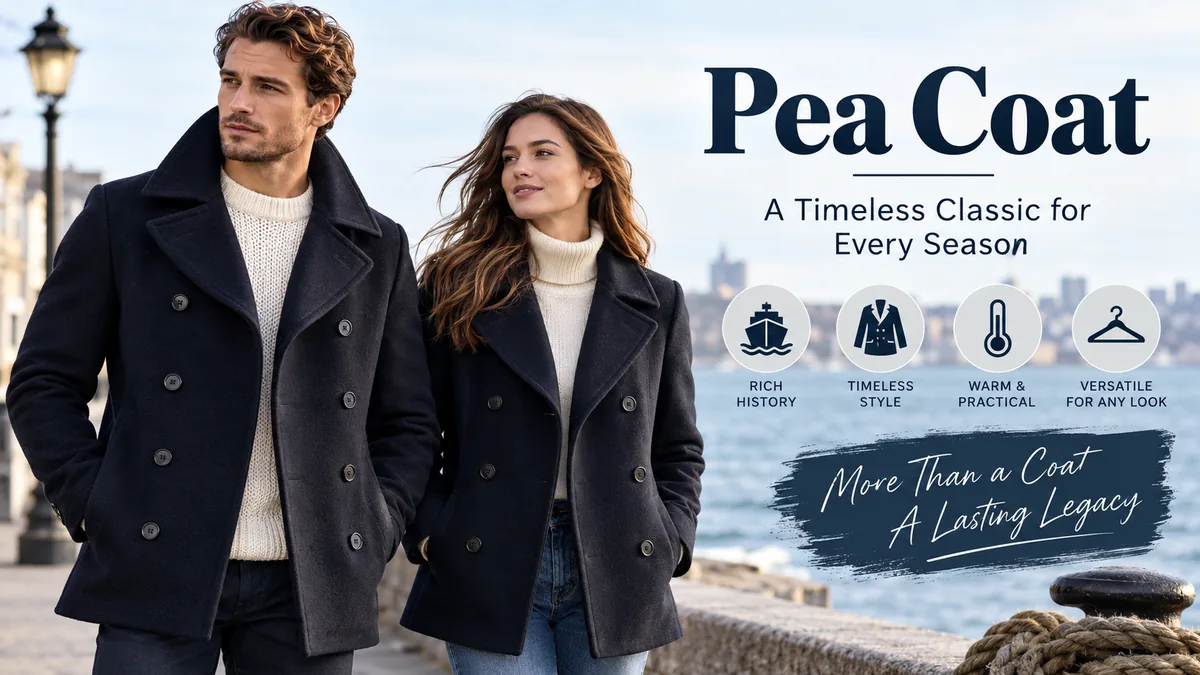
Few pieces of outerwear have changed as little—or lasted as long—as the pea coat. Its broad collar, heavy wool construction, short silhouette, and double-breasted front were originally practical features for sailors working in cold, windy conditions. Centuries later, the same basic design remains recognizable on city streets.
A pea coat is a short, warm, traditionally wool outer coat distinguished by a double-breasted front, broad lapels, substantial buttons, and hip-to-upper-thigh length. Developed as maritime clothing and closely associated with European and American navies, it combines insulation, wind protection, freedom of movement, and a structured appearance.
Understanding the coat’s naval origins explains almost every feature still found on modern versions—from its overlapping front to its large collar and hand-warmer pockets.
What Is a Pea Coat?
A pea coat, also written as peacoat and historically called a pea jacket, is a short outer coat traditionally made from dense wool. The classic version is navy blue and double-breasted, with a wide collar and two vertical rows of large buttons.
The American Heritage Dictionary describes it as a short, warm, double-breasted coat made from heavy wool and traditionally worn by sailors. Collins similarly identifies the garment as a hip-length, double-breasted heavy wool coat originally associated with seamen.
Several characteristics identify the traditional design:
- Heavy wool construction
- Double-breasted closure
- Broad lapels or convertible collar
- Hip or upper-thigh length
- Two rows of prominent buttons
- Vertical or slash hand pockets
- Dark navy or black coloring
- Structured shoulders and body
Modern designers sometimes alter the length, fabric, color, number of buttons, or silhouette. Even so, the recognizable naval foundation usually remains.
Is It Pea Coat or Peacoat?
Both spellings are commonly used.
Pea coat is the two-word form, while peacoat is the closed compound frequently used in dictionaries, fashion publications, and retail terminology. Pea jacket is another historical name.
These names generally describe the same basic style rather than separate types of outerwear.
Where Did the Pea Coat Come From?
The history of the pea coat is closely connected with sailors and naval uniforms.
References to pea jackets date to the early 18th century. Merriam-Webster records the first known use of pea jacket in 1721, while historical accounts show similar coats being worn by European and later American naval personnel.
Life aboard a sailing vessel created unusual clothing requirements.
Sailors needed protection from cold air, strong winds, sea spray, and rapidly changing weather. At the same time, a long coat could interfere with climbing, handling ropes, or moving around a crowded deck.
A short, dense wool coat solved both problems.
The double-breasted front placed overlapping layers of material across the torso. A broad collar could provide additional protection around the neck, while the relatively short body allowed considerably more freedom of movement than a long overcoat.
Why Is It Called a Pea Coat?
The name has nothing to do with green peas.
The strongest etymological explanation connects pea jacket with the Dutch pijjekker and related Frisian terminology. Pij referred to a type of coarse woolen cloth, while the second part referred to a jacket. The Online Etymology Dictionary dates the English expression to 1721.
Another traditional explanation connects the name with pilot cloth, sometimes shortened to P-cloth, from which a “P-jacket” supposedly became a “pea jacket.”
The Dutch/Frisian derivation has stronger linguistic support, although the pilot-cloth explanation has also circulated in naval accounts.
From Naval Uniform to Everyday Clothing
The design eventually moved far beyond naval service.
Its usefulness helped it survive after other historic military garments disappeared from ordinary wardrobes. The basic formula—short length, heavy wool, broad lapels, and double-breasted construction—has remained remarkably stable for roughly three centuries.
Today, variations are made for men and women in navy, black, charcoal, gray, camel, brown, cream, and other colors.
Yet dark navy remains the color most closely associated with the original maritime coat.
Why Does a Pea Coat Have Its Distinctive Design?
Many details that now seem decorative began as functional solutions.
Double-Breasted Front
The double-breasted construction is probably the coat’s most recognizable feature.
Unlike a single-breasted coat, the two sides overlap significantly before fastening. That puts additional material across the front of the torso, helping reduce exposure to wind.
It also creates the strong, symmetrical silhouette associated with naval outerwear.
Historical versions could have eight or ten front buttons. Many contemporary designs use six or eight.
Broad Lapels and Convertible Collar
A classic coat has broad lapels and a substantial collar.
When worn normally, these create the familiar open V shape. In severe weather, traditional designs could be closed higher around the neck, offering greater protection from wind and spray.
This is one reason the collar is proportionally larger than those found on many ordinary wool jackets.
Large Buttons
Traditional buttons were deliberately substantial.
Large buttons are easier to handle than tiny ones, particularly when someone is wearing gloves or working with cold hands.
Naval versions have often featured anchor motifs, while officer-related designs may use decorative metal or gold-colored buttons.
Vertical Hand Pockets
Vertical or slash pockets are another recognizable feature.
Their positioning allows the wearer to place their hands inside naturally for warmth. Historical accounts specifically identify these pockets as practical hand-warming features for seafarers.
Short Length
A traditional pea coat generally finishes around the hips or upper thigh.
That distinguishes it from long overcoats and reflects its working origins. Sailors needed to climb, bend, and move around a ship without a long coat restricting their legs.
This compact length remains one of the easiest ways to identify the style.
What Materials Are Pea Coats Made From?
Traditionally, wool is fundamental to the coat’s identity.
Dense wool provides insulation while resisting wind surprisingly well. Wool fibers can also handle modest amounts of moisture without immediately losing their insulating usefulness.
Kersey Wool
Historical U.S. Navy examples were made from dense Kersey wool.
Kersey is a tightly woven wool fabric with a relatively smooth surface. Historical material retained some natural lanolin, contributing to its resistance to moisture and its insulating performance.
The resulting fabric could be exceptionally dense and durable.
That also meant authentic military coats could feel considerably heavier than modern fashion versions.
Melton Wool
Melton wool later became another important material.
It is dense, heavily finished, and slightly felted in appearance. The tight construction helps block wind and gives the garment its substantial structure.
Kersey was gradually replaced in U.S. Navy production by rougher Melton cloth during the 20th century, particularly through the 1970s.
Wool Blends
Many modern coats use mixtures such as:
| Material | Main Advantage | Possible Drawback |
|---|---|---|
| 100% wool | Warm, breathable, traditional | Often heavier and more expensive |
| Wool-nylon blend | Durable and abrasion-resistant | Less traditional feel |
| Wool-polyester blend | Lower cost and easier maintenance | May breathe less well |
| Cashmere-wool blend | Softer, more refined texture | More delicate and expensive |
| Synthetic-heavy blend | Affordable and lightweight | Usually less insulating than dense wool |
Fabric percentage alone does not determine quality.
A dense, well-constructed wool blend can outperform a loosely woven fabric with a higher wool percentage. Fabric weight, weave, lining, construction, and finishing all matter.
Is a Pea Coat Waterproof?
Usually, no.
Traditional dense wool can resist light moisture and sea spray to a degree, but a classic wool coat should not be treated as a waterproof raincoat.
Extended heavy rain can eventually saturate the fabric.
For persistent wet weather, genuinely water-resistant outerwear is more appropriate.
Is a Pea Coat Warm Enough for Winter?
A traditional heavy-wool pea coat can be very warm, especially in cool, windy autumn and winter weather.
The warmth comes from several elements working together: dense wool traps air, the overlapping front adds insulation across the torso, and the substantial collar helps protect the upper chest and neck.
Actual performance varies considerably between coats.
A thick military-surplus coat and a lightweight fashion version may look almost identical while providing very different insulation.
What Determines Warmth?
Look beyond appearance and consider:
Fabric density: Dense Melton or Kersey-style wool blocks wind better than thin material.
Wool content: Higher wool content generally improves natural insulation, although construction still matters.
Lining: A substantial lining can noticeably improve comfort and wind resistance.
Fit: Excessively tight outerwear compresses underlying layers and leaves little room for a sweater.
Length: The short design leaves more of the legs exposed than a long overcoat.
Layering: A sweater, cardigan, wool knit, or thermal base layer can extend the coat’s useful temperature range.
There is no universal temperature at which every peacoat becomes too cold. Wind, humidity, activity level, fabric weight, and individual cold tolerance all affect comfort.
Quick Takeaway
A heavyweight wool version works particularly well in cold, windy conditions. For severe winter temperatures, prolonged outdoor exposure, or heavy snow, a longer insulated coat or technical parka may provide more complete protection.
How Should a Pea Coat Fit?
Fit has a major effect on both appearance and warmth.
The coat should look structured without fitting like a suit jacket.
Shoulders
Start with the shoulders.
The shoulder seams should sit close to the natural ends of your shoulders. Significant overhang makes the coat appear oversized, while shoulders that pull or buckle indicate insufficient room.
Because heavy wool is difficult to alter cleanly at the shoulder, this is one of the most important areas to get right initially.
Chest
Button the coat completely.
You should be able to move comfortably without the front pulling into an obvious X-shaped pattern around the buttons.
At the same time, excessive empty space around the chest can allow cold air inside and weaken the characteristic structured silhouette.
Sleeves
Sleeves should generally reach around the wrist and provide enough coverage when your arms move naturally.
Very short sleeves expose the wrists in cold weather. Excessively long sleeves can make an otherwise well-fitting coat appear sloppy.
Body Length
Traditional versions finish near the lower hip or upper thigh.
Contemporary versions may be slightly longer, but once the hem approaches the knee, the garment begins to resemble a bridge coat or conventional overcoat rather than the classic short naval design.
Leave Space for Layers
A common fitting mistake is trying on winter outerwear over only a thin T-shirt.
Instead, test the coat over clothing you are likely to wear in cold weather—a sweater, knit polo, sweatshirt, or jacket.
You should still be able to button it comfortably and move your arms.
Pea Coat vs. Trench Coat: What’s the Difference?
These two coats are sometimes grouped together because both have military roots and can feature double-breasted fronts. Functionally, however, they solve different problems.
| Feature | Pea Coat | Trench Coat |
|---|---|---|
| Traditional origin | Naval clothing | Military outerwear |
| Typical length | Hip to upper thigh | Around knee or longer |
| Classic material | Heavy wool | Cotton gabardine or similar fabric |
| Main purpose | Warmth and wind protection | Rain and wind protection |
| Front | Usually double-breasted | Single or double-breasted |
| Belt | Usually absent | Usually present |
| Best season | Autumn and winter | Spring, autumn, mild wet weather |
| Silhouette | Compact and structured | Longer and belted |
A pea coat primarily functions as warm cold-weather outerwear. A trench coat is traditionally lighter and built more specifically around protection from rain and wind.
If the weather is cold and dry, dense wool often makes more sense.
If conditions are mild but rainy, the trench coat’s longer, water-resistant construction generally has the advantage.
Pea Coat vs. Overcoat
An overcoat is a broader category of long outerwear designed to be worn over other clothing, including suits.
The biggest practical difference is length.
A pea coat typically ends around the hips or upper thigh. Traditional overcoats extend much farther down the body, commonly toward the knee.
That changes both appearance and function.
The shorter coat offers easier movement and a slightly more casual naval character. A long wool overcoat provides additional leg coverage and generally looks more formal.
For someone regularly wearing suits, the longer coat also protects more of the jacket underneath.
Pea Coat, Reefer Jacket and Bridge Coat
Several related maritime terms are easy to confuse.
Reefer Jacket
A reefer jacket is closely related to the traditional design and has historically been associated with naval officers and chief petty officers. Officer versions may feature gold buttons and epaulettes.
The terminology varies by period and naval tradition, so reefer is sometimes used more broadly for double-breasted nautical jackets.
Bridge Coat
A bridge coat takes the same naval idea and extends it farther down the body.
Rather than ending around the hip, it typically reaches toward the thigh or knee, providing greater coverage.
Historically, this longer style was associated with officers, who did not require the same unrestricted movement needed by sailors climbing rigging or performing physical deck work.
Greatcoat
A greatcoat is heavier and substantially longer.
It belongs to the wider family of military outerwear but should not be confused with the compact sailor’s jacket.
How to Wear a Pea Coat
One reason the design has survived outside the military is its versatility.
The structure is cleaner than most casual jackets but less formal than many long overcoats.
Casual Outfits
A simple combination works particularly well:
Pea coat + crew-neck sweater + jeans + boots
The structured outer layer gives an otherwise casual outfit more definition.
Dark indigo denim, charcoal trousers, chinos, knitwear, leather boots, and clean sneakers all work naturally with the naval silhouette.
Smart-Casual Outfits
For a slightly sharper appearance, combine it with:
- Oxford or button-down shirt
- Fine-gauge sweater
- Wool trousers or chinos
- Leather boots, loafers, or derbies
Navy is especially adaptable because it pairs easily with gray, cream, brown, burgundy, olive, and denim.
Can You Wear a Pea Coat With a Suit?
You can, but proportions matter.
The coat should completely cover the suit jacket underneath. Many traditional short versions do not.
If the suit jacket extends below the coat hem, the layers can look awkward. A longer bridge coat or conventional wool overcoat is usually a cleaner option for regular suit wear.
Can Women Wear Pea Coats?
Absolutely.
Although the garment grew out of naval uniforms historically worn by men, the design has long since become general fashion outerwear. Women’s versions may preserve the original straight naval silhouette or introduce shaping at the waist.
The fundamental characteristics remain recognizable: broad lapels, double-breasted closure, wool construction, and relatively short length.
Which Pea Coat Colors Are Most Versatile?
Navy
Navy blue is the historical standard and remains the most characteristic choice.
It works naturally with denim, gray wool, khaki, cream knitwear, brown leather, and black footwear.
Black
Black creates a sharper, more minimal appearance.
It is particularly easy to combine with monochrome wardrobes but lacks some of the maritime character of dark navy.
Charcoal
Charcoal offers a neutral middle ground.
It pairs easily with black, brown, navy, denim, and lighter gray clothing.
Camel
Camel makes the military silhouette feel less literal and more contemporary.
Because the color is lighter and warmer, the shape and button configuration become particularly visible.
The choice is mostly aesthetic; fabric and construction matter far more for performance than color.
What Makes a Good Pea Coat?
A high-quality coat should make sense as outerwear first and fashion second.
Dense Fabric
Hold the material up to strong light.
A tightly constructed wool fabric should feel substantial and relatively compact rather than loose and flimsy.
Density helps provide the wind resistance that made this garment useful at sea.
Strong Buttons
Double-breasted outerwear places repeated stress on its buttons.
They should feel securely attached. Loose buttons are relatively easy to repair, but weak attachment on a new garment can indicate poor finishing.
Functional Collar
Try turning the collar upward.
A well-designed broad collar should sit naturally around the neck rather than collapsing immediately.
Useful Pockets
Hand pockets should be comfortably positioned.
This sounds minor until you spend an hour outside. The vertical pockets on traditional designs exist partly because sailors could place their hands inside easily for warmth.
Durable Lining
Check seams, sleeve lining, pocket bags, and high-friction areas.
A coat may use excellent wool yet still age poorly if the lining and internal construction are weak.
Sensible Fit
Avoid judging quality solely by how slim the garment looks.
Outerwear needs room for movement and insulation. A coat that looks sharp while standing still but becomes uncomfortable over a sweater is simply too small.
Common Pea Coat Mistakes
The classic design is forgiving, but several mistakes reduce its usefulness.
Buying Too Tight
Slim outerwear can look attractive in photographs, but winter clothing needs layering room.
Try the coat with a realistic cold-weather outfit before judging the size.
Choosing Fabric by Wool Percentage Alone
“100% wool” sounds impressive, but percentage doesn’t tell you the fabric’s weight, density, finish, durability, or construction quality.
Evaluate the complete garment.
Expecting Full Rain Protection
Dense wool handles light precipitation better than many people expect, but it is not a substitute for a waterproof shell during prolonged rain.
Wearing an Extremely Short Version Over a Suit
If a suit jacket hangs beneath the outer coat, the proportions usually look unfinished.
Choose a longer outer layer for tailoring.
Ignoring Weight
Traditional military-inspired versions can be heavy.
That weight contributes to warmth and wind resistance, but someone commuting indoors and outdoors all day may prefer a lighter wool construction.
How to Care for a Wool Pea Coat
Proper care can dramatically extend the life of wool outerwear.
Brush It Regularly
A clothes brush removes dust, lint, and surface debris before they become embedded in the fibers.
Brush gently in the direction of the fabric.
Air It Out
Wool does not necessarily need cleaning after every wear.
After use, hang the coat in a ventilated area and allow moisture and odors to dissipate naturally.
Use a Strong Hanger
Heavy wool needs adequate shoulder support.
Thin wire hangers can distort the shoulder line over time. A broad, sturdy hanger distributes the garment’s weight more effectively.
Deal With Wet Wool Carefully
If the coat becomes wet, allow it to dry naturally in a ventilated space.
Avoid intense direct heat, which can damage or distort wool fibers.
Never store it while damp.
Follow the Care Label
Many structured wool coats require professional dry cleaning because their construction involves more than the outer fabric.
Cleaning too frequently can also wear the material unnecessarily, so follow the manufacturer’s instructions rather than cleaning automatically after a fixed number of wears.
Store It Properly
At the end of winter:
- Clean the coat if necessary.
- Make sure it is completely dry.
- Empty the pockets.
- Fasten or arrange it so the shape is supported.
- Use a substantial hanger.
- Store it in a breathable garment cover.
- Protect wool from moths during long-term storage.
Avoid tightly sealed plastic storage for long periods when moisture could become trapped.
Why Has the Pea Coat Remained Popular?
Fashion regularly revives military clothing, but few pieces retain their original identity as clearly as this one.
Its longevity comes from function.
The silhouette is short enough for easy movement. Heavy wool provides real insulation. The double-breasted construction creates extra protection across the torso. Broad lapels provide visual structure and can help shield the neck. Large buttons and accessible pockets make practical sense.
Those features also happen to create a balanced design.
It can sit comfortably between casual and formal clothing without looking completely tied to either.
There is also very little unnecessary decoration. Remove the naval associations and you are left with a compact, practical wool winter coat.
That simplicity makes the garment resistant to changing trends.
Is a Pea Coat Still in Style?
Yes, although describing it purely as a trend misses the point.
The pea coat has existed in recognizable form since the 18th century. Modern versions change proportions—sometimes oversized, sometimes slim, sometimes cropped or elongated—but the basic naval design persists. Historical sources note that the coat has changed relatively little across roughly three centuries.
That places it closer to enduring outerwear than seasonal fashion.
The most timeless version remains straightforward: dark navy, dense wool, double-breasted front, broad collar, simple pockets, and minimal embellishment.
Is a Pea Coat Worth Wearing?
For cold-weather use, the pea coat offers an unusually effective balance of warmth, mobility, durability, and appearance.
It is shorter and easier to move in than a traditional long overcoat, warmer than most lightweight jackets, and generally easier to incorporate into everyday clothing than highly technical winter outerwear.
Its limitations are equally clear.
The short hem provides less lower-body coverage than a long coat. Wool becomes heavy when saturated, and most versions are not designed for prolonged heavy rain. Extremely cold environments may require substantially more insulation.
Within the conditions it was designed for—cool to cold, windy weather—the design still works exceptionally well.
Final Thoughts on the Pea Coat
The pea coat began as practical maritime clothing, but nearly every feature that served sailors centuries ago remains useful today. Dense wool provides warmth, the double-breasted front protects the torso, broad lapels shield the upper body, and the short cut preserves freedom of movement.
A classic navy wool version is the clearest expression of the design, while modern wool blends, colors, and silhouettes offer plenty of variation.
When choosing one, focus on fabric density, shoulder fit, layering room, construction, and appropriate length rather than trends alone. Get those fundamentals right, care for the wool properly, and this centuries-old piece of naval outerwear can remain useful for many winters.