
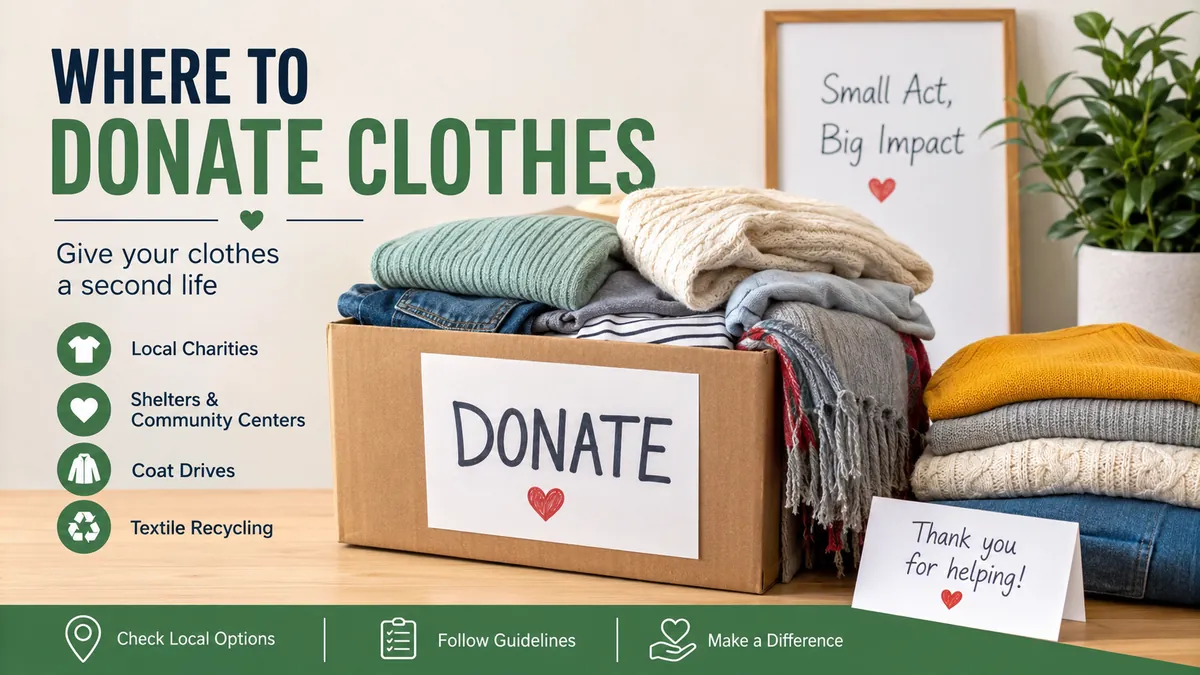
Cleaning out a closet usually leaves you with the same question: where to donate clothes so they actually get used rather than becoming somebody else’s waste?
The answer depends on what you have. Everyday clothing can work well for thrift-based nonprofits, professional attire is more useful to career-focused organizations, coats can go to winter clothing programs, and worn textiles may belong in textile recycling rather than a donation bag.
The quickest answer: Donate clean, wearable clothes to local shelters, community organizations, Goodwill, The Salvation Army, Vietnam Veterans of America, Dress for Success, or other nonprofits that currently accept clothing. For damaged clothing, look for a textile recycling program. Always check the organization’s current acceptance rules before dropping anything off.
Where to Donate Clothes: Choosing the Right Place
There isn’t one universally “best” clothing donation organization. A better approach is to match your clothes with an organization that can realistically use or resell them.
Here is a quick starting point:
| Type of clothing | Good place to check | Why |
|---|---|---|
| Everyday clothes | Goodwill or The Salvation Army | Broad clothing acceptance |
| Professional clothing | Dress for Success or local employment programs | Workwear can support job seekers |
| Men’s, women’s and children’s clothing | Local shelters and community charities | May address immediate local needs |
| Coats and jackets | One Warm Coat partner programs or local coat drives | Focused on cold-weather clothing |
| Clothing and household goods | Vietnam Veterans of America | Supports veterans-related programs |
| Clothes and shoes | Planet Aid | Textile reuse-focused collection |
| Baby and children’s clothes | Family shelters and community organizations | Useful for families experiencing hardship |
| Unwearable textiles | Textile recycling programs | Better destination for clothing that cannot be reused |
Acceptance policies vary by location and can change with storage capacity, season and local demand. A phone call or website check before loading the car can save volunteers from dealing with unusable donations.
Donate Everyday Clothes to Goodwill
Goodwill is one of the most familiar options for people wondering where to donate used clothes.
Local Goodwill organizations generally accept new and gently used clothing along with shoes, accessories and many household items. Donated goods can be sold through Goodwill stores, while revenue supports locally operated employment and community programs.
Goodwill can be particularly convenient when you’re clearing out several categories at once, such as:
- Shirts and T-shirts
- Pants and jeans
- Dresses
- Sweaters
- Jackets
- Children’s clothing
- Shoes
- Handbags
- Accessories
Acceptance isn’t identical at every location, so check your local organization’s guidelines first.
Is Goodwill better than throwing clothes away?
For wearable clothing, reuse generally makes far more sense than putting the garment directly into household trash. It gives the item an opportunity to remain in circulation instead of immediately entering the waste stream.
However, donating isn’t permission to empty your trash into somebody else’s sorting facility. Clothing should be in a condition appropriate for the specific program receiving it.
The Salvation Army Is Another Widely Available Option
The Salvation Army is another established organization worth checking when you have general clothing donations.
Its donation programs may accept men’s, women’s and children’s clothing along with shoes, accessories, furniture and other household goods. Depending on your area, you may find donation centers, thrift stores and pickup services.
This makes it useful when you’re decluttering more than your wardrobe.
The IRS also identifies The Salvation Army and Goodwill Industries among examples of organizations that may qualify to receive deductible charitable contributions in the United States. Tax deductions still depend on applicable IRS requirements and your individual circumstances.
Donate Professional Clothing to Dress for Success
A blazer you no longer wear could be more valuable to a specialized clothing program than it would be mixed into a large general donation.
Dress for Success focuses on helping women with professional development and employment. Local affiliates may accept contemporary, work-appropriate clothing that clients can wear for interviews and in the workplace.
Appropriate items can include:
- Business suits
- Blazers
- Professional dresses
- Work-appropriate pants and skirts
- Handbags
- Professional shoes
- Scarves and accessories
- Professional outerwear
Think about the recipient rather than simply the fact that an item is technically wearable.
A useful test is: Would someone feel comfortable wearing this to a job interview tomorrow?
If the answer is no because the garment is badly outdated, damaged or stained, a professional clothing program probably isn’t the right destination.
Dress for Success affiliates can also have different donation schedules and requirements. Check the nearest affiliate before visiting.
Give Coats to Winter Clothing Programs
Coats deserve special consideration because cold-weather clothing can meet a specific seasonal need.
One Warm Coat works to provide coats to children and adults who need them while supporting coat drives and nonprofit partners. Its network can be useful when you have wearable winter coats rather than a mixed bag of ordinary clothing.
Local options can be equally valuable. During colder months, check:
- Homeless shelters
- Family shelters
- Refugee support organizations
- Churches and faith communities
- Schools
- Community centers
- Local coat drives
- Mutual-aid groups
Winter demand is highly regional. A heavy parka may have considerably more immediate value in a cold-weather community than somewhere with a warm climate.
Quick Takeaway: Match specialized clothing with specialized demand. Coats should ideally reach cold-weather programs, while interview-ready clothing is better suited to employment-focused organizations.
Donate Clothes to Local Homeless and Family Shelters
Large national organizations are convenient, but they’re not always the only—or most direct—answer to where to donate clothes.
A local homeless shelter, women’s shelter, family shelter or community assistance organization may distribute clothing directly to people who need it.
Commonly requested items can include:
- Clean T-shirts
- Sweatshirts
- Jeans and casual pants
- Warm socks
- Coats
- Gloves
- Hats
- Children’s clothing
- Practical shoes
But don’t assume a shelter accepts clothing simply because its residents might need it.
Storage space is a major issue for many small organizations. A shelter might urgently need men’s winter coats while having no room for women’s summer dresses. Some facilities accept only new underwear and socks for hygiene reasons.
Contacting the organization first allows your donation to match its current needs.
What clothes do homeless shelters need most?
Practical, durable and seasonally appropriate clothing is often more useful than formalwear or highly specialized fashion.
The exact need varies. During winter, jackets, hoodies, gloves and warm layers may be priorities. Family shelters may need children’s sizes. Other programs may need work clothes for residents preparing for employment.
Ask for a current wish list whenever possible.
Consider Domestic Violence and Women’s Shelters
Women’s and domestic violence shelters can be another meaningful local option, particularly for clothing suitable for women and children.
People entering emergency accommodation may arrive with limited personal belongings, making clothing potentially useful. However, security and privacy considerations mean many shelters do not publicly advertise their physical locations.
Instead of arriving unannounced, contact the organization through its official public channel and ask what it currently accepts.
Possible needs can include everyday clothes, children’s clothing, coats, pajamas, shoes and new personal essentials.
Again, current needs matter more than assumptions.
Donate Clothes to Vietnam Veterans of America
If convenience matters because you have several bags of clothing or household items, Vietnam Veterans of America is another organization to investigate.
ClothingDonations.org is a donation service of Vietnam Veterans of America and accepts used clothing and various household goods in supported locations. Its donation program includes pickup services in eligible areas.
Accepted categories can include clothing, shoes, baby items, kitchenware, small appliances and other household goods.
Availability depends on location, so enter your ZIP code through the organization’s service before preparing a pickup.
This can be particularly practical for someone decluttering an entire home rather than donating only a few shirts.
Use Planet Aid for Clothes, Shoes and Other Textiles
Planet Aid provides clothing collection bins in parts of the United States and focuses heavily on textile reuse.
Its current donation-bin guidelines accept clean clothing and shoes as well as certain textiles such as:
- Bedding
- Towels
- Curtains
- Sleeping bags
- Socks
- Underwear
- Bras
Interestingly, Planet Aid says some items with minor stains, tears or imperfections can still be accepted. However, textiles that are wet, dirty, moldy or tattered beyond repair aren’t accepted.
That distinction matters because donation requirements differ significantly among organizations.
Planet Aid reports having nearly 10,000 collection bins across 14 U.S. states, primarily in the Northeast, Mid-Atlantic and Midwest, so it isn’t available everywhere.
Look for Community Clothing Closets and Mutual-Aid Programs
Some of the best places to donate clothes aren’t national organizations at all.
Community clothing closets, schools, religious organizations, refugee assistance groups and mutual-aid networks may distribute goods locally.
Search your area for terms such as:
- Community clothing closet
- Free clothing center
- Refugee clothing donations
- Family assistance clothing
- School clothing drive
- Church clothing closet
- Free store
- Mutual-aid clothing exchange
Free stores and community exchange programs are particularly interesting because usable items can move directly from one household to another without a conventional retail transaction.
Green America has highlighted community models such as Really Really Free Markets and Free Stores, where clothes and other usable goods can be given and taken freely.
These programs won’t exist everywhere, but they’re worth checking if your priority is local reuse.
Give Clothes Directly Through Community Sharing Networks
Charitable organizations aren’t your only option.
If you have something another person could immediately use, consider a neighborhood sharing network, community swap or free-goods group.
For example, you might have:
- A child’s barely worn winter coat
- School uniforms
- Maternity clothing
- A formal dress
- Work boots
- Baby clothes
- Sports clothing
- A suit
These items may be especially useful when offered to someone specifically looking for them.
Community exchanges and clothing swaps can extend the life of garments while reducing demand for new clothing. Green America also recommends secondhand use, swaps and community reuse as alternatives to unnecessary new purchases.
The trade-off is convenience. Giving clothes individually usually requires more coordination than dropping several bags at a donation center.
What Clothes Should You Donate?
A common mistake is treating a charity donation bin as a garbage bin.
For most traditional donation programs, a good rule is to donate clothing that another person could realistically wear.
Before putting something in your donation pile, ask:
- Is it reasonably clean?
- Is it dry?
- Is it wearable?
- Does it have severe stains?
- Are important buttons and zippers functional?
- Would I feel comfortable giving this directly to another person?
- Does the receiving organization actually accept it?
Vogue’s guide to clothing donations similarly emphasizes checking acceptance policies and avoiding unusable items that create extra sorting costs for donation organizations.
Should you wash clothes before donating?
Generally, yes.
Clean clothing is easier for organizations to handle and more respectful to whoever may eventually wear it. Some specialized organizations explicitly request washed or dry-cleaned garments.
Dress for Success Montreal, for example, asks donors to provide clothing washed or dry-cleaned because the organization doesn’t have resources to clean donations itself.
Remove personal belongings from pockets and make sure garments are completely dry before packing them.
What Clothes Should You Not Donate?
Different organizations have different standards, but several categories frequently cause problems.
Avoid placing the following into ordinary clothing donation bags unless the organization specifically says it accepts them:
- Wet clothing
- Moldy textiles
- Heavily soiled garments
- Clothing contaminated with chemicals
- Items with strong persistent odors
- Severely damaged garments
- Unusable shoes
- Items prohibited by that specific organization
Minor damage is different from complete unusability.
Some textile-focused programs accept clothing with small tears or imperfections because the material may still have reuse potential. Planet Aid, for example, specifically accepts certain imperfect items while rejecting textiles that are wet, moldy, dirty or tattered beyond repair.
This is why checking the recipient’s guidelines beats following one universal rule.
What to Do With Clothes That Can’t Be Donated
Suppose your old T-shirt has holes, your jeans are badly worn or a sweater is too damaged for another person to wear.
Don’t automatically put it in a charity donation bag.
Look for textile recycling options instead.
Textile recycling and recovery programs may be able to process certain garments that aren’t suitable for traditional reuse. Availability varies substantially by city and region, so check municipal recycling programs and specialized textile collectors.
Some clothing can also be repurposed at home.
Old cotton garments, for example, can become cleaning cloths. Repairable pieces might be patched, altered or used for craft projects.
A useful hierarchy is:
Keep and wear → repair → give directly → donate for reuse → recycle textiles → dispose only when no practical alternative exists.
That approach reduces the chance that unusable clothing becomes a sorting burden for a charity.
Why Clothing Donation Doesn’t Guarantee Reuse
Putting something into a donation bin doesn’t necessarily mean someone nearby will receive and wear it.
Donation systems can involve sorting, thrift-store resale, wholesale markets, export and textile recycling. Some garments may never be suitable for resale at all.
Vogue’s reporting on the secondhand clothing system notes that significant portions of donated clothing don’t ultimately achieve direct reuse, which is why the condition and suitability of what people donate matters.
The practical lesson isn’t to stop donating.
It’s to donate better.
Choose organizations based on what they need. Don’t disguise garbage as charity. And when something isn’t wearable, look for a recycler that explicitly accepts damaged textiles.
Is Donating Clothes Better for the Environment?
Keeping wearable clothing in use can help prevent it from entering the waste stream prematurely.
Planet Aid describes textile reuse as part of its environmental mission and says its collection system diverts used textiles from the U.S. waste stream.
Secondhand clothing can also reduce the need for a usable garment to be replaced immediately with a newly manufactured one.
But donation isn’t a complete solution to clothing overconsumption.
If someone continually buys unnecessary clothes, wears them briefly and then donates them, the environmental impacts associated with producing those garments have already occurred.
A more sustainable wardrobe combines several habits:
- Buy fewer unnecessary pieces.
- Choose clothes you’ll actually wear.
- Take care of garments.
- Repair items when practical.
- Buy secondhand when appropriate.
- Give usable clothing a second life.
- Recycle textiles that genuinely cannot be reused.
Quick Takeaway: Donation works best as part of a reuse system—not as justification for buying more clothing.
How to Prepare Clothes for Donation
Once you’ve decided where to donate clothes, a little preparation makes the process easier for both you and the receiving organization.
1. Empty Your Closet by Category
Rather than deciding randomly, work through categories such as shirts, pants, coats, shoes and accessories.
2. Create Separate Piles
Use four basic groups:
Keep: Clothes you genuinely wear.
Donate: Clean, wearable garments another person could use.
Sell or give directly: Higher-value or specialized items that may be useful to a particular person.
Recycle: Textiles too worn for ordinary donation but accepted by an appropriate recycling program.
3. Inspect Every Donated Item
Check pockets, buttons, zippers, stains, odors and overall condition.
4. Wash and Dry Clothing
Unless an organization instructs otherwise, donate clean and completely dry clothing.
5. Match Special Items With the Right Program
Don’t automatically put everything into one bag.
Send professional attire to employment-related organizations, winter coats to coat drives and damaged textiles to recycling programs where available.
6. Check Current Acceptance Rules
Visit the organization’s current website or contact the local branch.
This step matters because local branches may have different storage capacity, operating hours and donation needs.
7. Pack Clothes Properly
Use sturdy bags or boxes according to the organization’s instructions. Don’t leave donations outside a closed facility where they can become wet, damaged or scattered.
Can You Get a Tax Deduction for Donating Clothes?
In the United States, qualifying clothing donations may be deductible under federal tax rules, but simply dropping clothes somewhere doesn’t automatically create a deduction.
The IRS states that charitable contributions generally must be made to a qualified organization to qualify for a deduction. Taxpayers generally need to itemize deductions on Schedule A rather than take the standard deduction to claim charitable contributions under the usual rules.
For donated property, the relevant value is generally its fair market value, not what you originally paid.
The IRS also says donated clothing and household items generally must be in good used condition or better to qualify for a deduction, subject to a limited exception involving certain items valued above $500 and a qualified appraisal.
Documentation requirements increase with the amount claimed. For example, the IRS describes additional acknowledgment and reporting requirements for certain noncash contributions.
Keep appropriate records and receipts if you intend to claim a deduction, and consult current IRS guidance or a qualified tax professional for your particular circumstances.
Should You Donate Clothes or Sell Them?
Both options extend the useful life of clothing, but they serve different goals.
| Donate clothes | Sell clothes |
|---|---|
| Usually faster for large quantities | Requires more time |
| Can support nonprofit programs | Allows you to recover some value |
| Good for ordinary wearable clothes | Better for higher-value pieces |
| Minimal individual listing effort | Requires photos, listings and communication |
| May qualify for a tax deduction in some circumstances | Sale proceeds may have tax considerations depending on circumstances |
A mixed approach often works best.
Sell a designer jacket that’s worth the effort, give a child’s coat directly to a family that needs it, donate ordinary wearable clothes and recycle damaged textiles.
You don’t have to force every garment through the same channel.
How to Find Clothing Donation Centers Near You
For someone searching where to donate clothes near me, local availability matters more than any national list.
Start by checking:
- Local nonprofit thrift stores.
- Homeless and family shelters.
- Women’s and domestic violence support organizations.
- Refugee assistance programs.
- Community clothing closets.
- Churches, mosques, synagogues and other faith communities.
- Schools and universities running clothing drives.
- Veterans organizations.
- Coat drives.
- Textile recycling programs.
For national organizations, use the organization’s official location finder rather than relying on an old directory listing.
Planet Aid, for example, maintains a donation-bin locator for its service areas. Vietnam Veterans of America’s ClothingDonations.org allows donors to check pickup availability by ZIP code.
Searching locally is especially worthwhile if you want your clothing to address a specific community need.
Which Donation Option Is Best?
The best destination depends on the item.
For ordinary wearable clothing, a nonprofit thrift organization such as Goodwill or The Salvation Army can be convenient.
For professional women’s clothing, check Dress for Success or a similar employment-support organization.
For winter coats, look for One Warm Coat partners or local winter clothing drives.
For clothing and household donations with pickup, check services such as Vietnam Veterans of America where available.
For direct local impact, contact shelters, refugee programs, clothing closets and community assistance organizations.
For damaged textiles, find a textile recycling program that explicitly accepts the material.
And for a particularly useful item—a school uniform, maternity clothes, work boots or children’s winter wear—giving it directly through a community sharing network may give it the clearest path to another person.
Final Thoughts on Where to Donate Clothes
Deciding where to donate clothes is easier once you stop treating every unwanted garment the same way.
Clean everyday clothing can go to general nonprofit donation programs. Professional attire, coats and other specialized garments may have greater impact through organizations serving a particular need. Local shelters and community programs can be excellent options when they’re actively requesting clothing, while worn-out textiles should go to an appropriate recycling program rather than being passed off as usable donations.
Before donating, wash what needs washing, inspect each item and check the recipient’s current guidelines. That small amount of effort gives your clothes a much better chance of getting a useful second life instead of simply becoming someone else’s waste.