
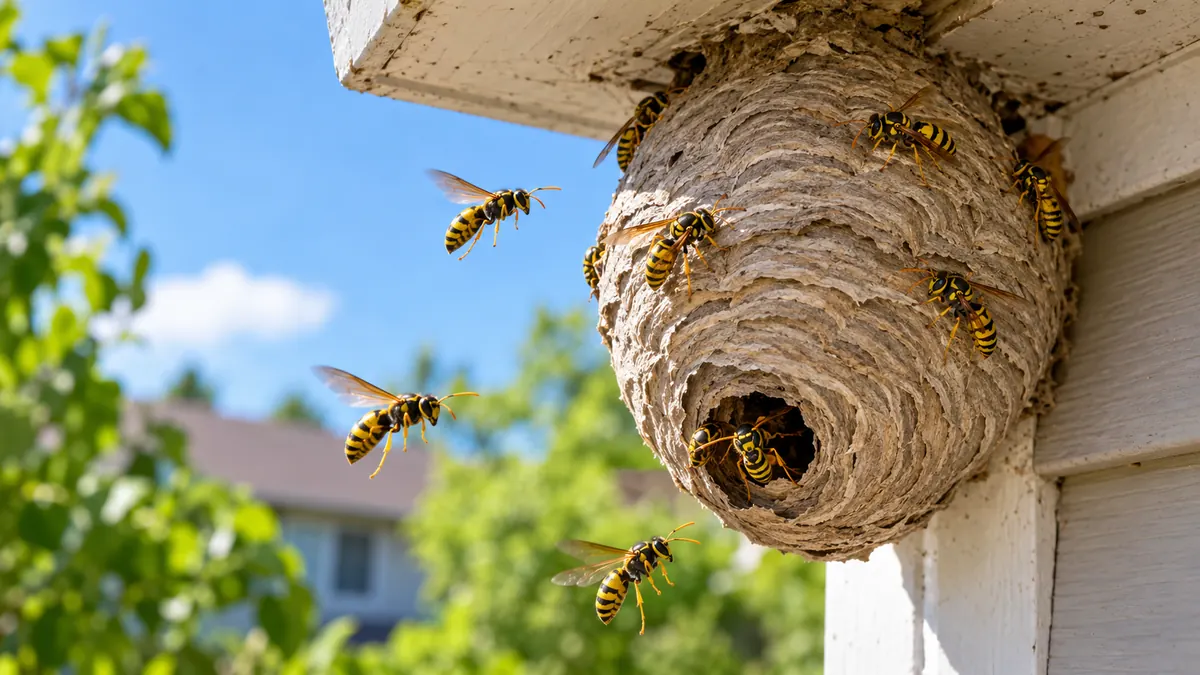
A yellow jacket nest can be surprisingly difficult to spot. You may notice wasps repeatedly disappearing into a small hole in the lawn, a gap beside the foundation, or an opening under siding long before you see the nest itself. That matters because yellow jackets vigorously defend an active colony and can sting repeatedly when disturbed.
A yellow jacket nest is a paper structure made from chewed wood fibers mixed with saliva. Most nests are hidden underground or inside protected cavities such as wall voids, hollow logs, landscape timbers, and attics. Colonies begin with one queen in spring, grow through summer, peak around late summer or early fall, and normally die after freezing weather.
Understanding where the colony is located—and whether it actually needs to be removed—is more useful than simply reaching for a spray can.
What Does a Yellow Jacket Nest Look Like?
The appearance depends heavily on where you find it.
Yellow jackets construct their nests from a paper-like pulp created by chewing weathered wood fibers and mixing them with saliva. Inside are multiple rounded combs arranged in tiers. These combs contain brood cells where eggs develop into larvae and eventually adult wasps. An outer paper envelope surrounds and protects the combs.
An excavated mature nest can look somewhat like a large layered paper ball. In real-world situations, however, homeowners often never see that structure because it is concealed underground or inside another cavity.
What Does a Yellow Jacket Nest Entrance Look Like?
For a ground nest, the entrance may be little more than a small hole in the soil.
The stronger clue is traffic.
Watch from a safe distance. If numerous yellow-and-black wasps repeatedly enter and leave the same hole, especially during warm daylight hours, a colony may be inside.
The visible opening does not necessarily tell you exactly where the paper nest sits. Underground yellow jackets often use existing cavities such as abandoned rodent burrows, so the nest itself can be positioned away from the entrance.
A colony may also have more than one opening. That is one reason plugging the first hole you notice is not a reliable solution.
How Big Can a Yellow Jacket Nest Get?
Size varies considerably by species, climate, available space, food supply, and time of year.
A new spring colony begins with a single queen and a very small nest. Once her first workers mature, they take over foraging and construction while the queen concentrates on egg laying.
The result can be rapid seasonal growth. By late summer, a colony may contain hundreds of workers, while some yellowjacket species can develop colonies numbering into the thousands.
Quick Takeaway: A tiny entrance hole does not mean there is a tiny colony behind it. Judge an active nest by wasp traffic and location rather than the diameter of the opening.
Where Do Yellow Jackets Build Nests?
Unlike the familiar hanging nests associated with some hornets, many yellowjacket species prefer enclosed, protected spaces.
Common locations include:
- abandoned rodent burrows
- underground cavities
- gaps beside foundations
- cracks in stone walls
- landscape timbers
- hollow logs
- tree cavities
- wall voids
- attics and roof spaces
- concrete blocks
- areas beneath decks or porches
- other sheltered structural cavities
University extension guidance consistently identifies below-ground cavities and protected structural voids as typical yellowjacket nesting locations.
Yellow Jacket Nest in the Ground
An underground yellow jacket nest is one of the most common—and easiest to accidentally disturb.
The colony often takes advantage of a cavity that already exists rather than creating the entire underground chamber from scratch. Old rodent burrows are particularly suitable.
This creates an obvious hazard in lawns and gardens. Someone mowing grass, trimming vegetation, digging, playing, or simply walking across the area can approach the entrance without realizing a colony is below.
If you discover a suspicious hole, don’t poke it with a stick, dig around it, run equipment over it, or stand directly beside the opening trying to inspect it.
Observe from farther away instead.
Yellow Jacket Nest in a Wall
Wall voids provide the enclosed protection yellow jackets seek, but structural colonies create a different management problem.
You might see workers repeatedly entering through:
- siding gaps
- cracks around trim
- openings beneath eaves
- gaps around utility penetrations
- damaged exterior materials
- roof or soffit openings
The external hole may only be a passage. The actual colony could be deeper inside the wall.
You may occasionally hear activity from a large concealed colony. Pest professionals can also use tools such as infrared equipment to help locate heat generated by a nest inside a structure.
Most importantly, do not immediately seal an active exterior entrance.
Blocking the normal route can cause surviving wasps to search for another way out. If the colony is inside a building, that alternative route can potentially lead into living spaces. Penn State recommends dealing with an interior entry before the exterior one when yellow jackets are entering a building.
Nests in Logs, Timbers, and Other Cavities
Yellow jackets can also occupy hollow wood, landscaping structures and similar protected spaces.
A recent Oregon State University Extension case involving yellow jackets in railroad ties illustrates this behavior: repeated wasp traffic through an opening in the timber was consistent with a concealed colony.
These nests can be particularly difficult to assess because the visible opening reveals little about the size or exact position of the colony.
Yellow Jacket Nest vs. Other Wasp and Bee Nests
Correct identification comes before deciding what to do.
Not every yellow-and-black flying insect is a yellow jacket, and not every paper nest belongs to one.
| Insect | Typical Nest | Common Location | Defensive Behavior |
|---|---|---|---|
| Yellow jacket | Enclosed paper comb | Ground cavities, walls, logs, structures | Strong around nest |
| Paper wasp | Exposed open paper comb | Eaves, overhangs, sheltered surfaces | Usually defensive near nest |
| Bald-faced hornet | Enclosed paper nest | Trees, shrubs, exposed aerial sites | Strong near colony |
| European hornet | Paper nest in protected cavity | Hollow trees, buildings, wall voids | Defensive around nest |
| Honey bee | Wax comb | Tree cavities, structures, hives | Different nesting biology |
| Bumble bee | Wax-like cells/nest material | Ground cavities and sheltered spaces | Generally less defensive than yellow jackets |
Yellow jackets, paper wasps and hornets all use wood-derived paper for nest construction, which can make identification confusing when only nest material is visible.
Yellow Jacket vs. Paper Wasp
Paper wasps commonly construct an exposed comb underneath an eave or other protected overhang. You can usually see the individual open cells.
Yellowjacket combs, by contrast, are typically surrounded by a paper envelope and often hidden inside the ground or another cavity.
Body shape can provide another clue. Paper wasps generally appear more slender with longer legs, while yellow jackets have a compact wasp-like appearance.
Yellow Jacket vs. Bald-Faced Hornet
Bald-faced hornets are actually closely related social wasps rather than true hornets. They are recognized by conspicuous ivory-white markings and commonly make enclosed aerial paper nests.
A large gray paper structure hanging from a tree is therefore more likely to be an aerial-nesting social wasp colony than the typical underground yellowjacket colony.
Yellow Jacket vs. Honey Bee
This distinction is particularly important around buildings.
Honey bees make wax comb and store resources within their colonies. Yellow jackets make paper nests and do not maintain honey and pollen stores in the same way. Yellowjacket colonies are also normally annual, while honey bee colonies have very different life cycles.
If identification is uncertain, avoid treating the insects until you know what they are.
How a Yellow Jacket Nest Develops Through the Year
A yellowjacket colony follows an annual cycle.
Understanding that cycle explains why a nest that seems insignificant in spring can become a serious concern months later.
Spring: One Queen Starts the Colony
A fertilized queen that survived winter emerges when conditions become favorable.
She searches for a suitable nesting cavity, begins making the first paper cells, lays eggs, and raises the first generation herself.
At this point, the colony is tiny.
Early to Mid-Summer: Workers Take Over
Once the first sterile female workers emerge, the colony’s growth accelerates.
Workers handle jobs such as:
- collecting food
- gathering nest material
- enlarging the paper structure
- feeding larvae
- maintaining the nest
- defending the colony
The queen can then devote most of her effort to laying eggs.
Late Summer and Early Fall: Peak Activity
This is often when homeowners first recognize the problem.
Colony populations generally reach their highest levels around late summer or early autumn. The nest now contains many workers, and activity around its entrance becomes much easier to notice.
The colony also begins producing reproductive males and new queens.
Workers commonly become conspicuous around picnics, garbage, fruit and sugary drinks during this part of the season. Adults consume sugary liquids, while workers also hunt or scavenge protein-rich foods to feed developing larvae.
Winter: The Colony Dies
Social wasp colonies generally last only one year.
After mating, new fertilized queens leave and seek protected places where they can overwinter. The original queen, workers and males eventually die as cold weather arrives.
The abandoned nest is normally not reused the following spring. New queens start new colonies from scratch.
That means an out-of-the-way colony discovered close to the end of the season may sometimes be safely avoided until freezing conditions naturally eliminate it.
Is a Yellow Jacket Nest Dangerous?
A nest is not automatically an emergency, but its location can make it hazardous.
Yellow jackets defend their colony when they perceive a threat. Unlike a honey bee worker, a yellowjacket can deliver multiple stings.
Risk is especially high when the colony is:
- beside a doorway or walkway
- next to a children’s play area
- in frequently used lawn
- near outdoor seating
- beside a workplace or public space
- inside a building
- close to people with known severe insect-sting allergies
A nest hidden far from regular human activity is a different situation.
Will Yellow Jackets Attack If You Walk Near Their Nest?
Simply seeing yellow jackets does not mean they will attack everyone nearby. Problems usually arise when the colony perceives a threat.
The difficult part is that an underground entrance can be easy to overlook.
Vibration, mowing, digging or accidentally stepping close to an entrance may disturb the colony. Once workers begin defending it, repeatedly swatting at them can make the situation worse.
If you accidentally disturb an active nest, move away from the area promptly rather than stopping beside the entrance to investigate it. Oregon State University Extension specifically recommends leaving the area immediately after accidental disturbance.
Why Yellow Jackets Seem Worse in Late Summer
There are simply more workers around a mature colony, and their seasonal behavior changes.
During spring, a nest starts with a queen and relatively few offspring. By late summer or fall, the population can reach hundreds or considerably more depending on species. Workers also become highly visible around human food as the season progresses.
That combination makes late-season encounters much more noticeable.
Should You Remove a Yellow Jacket Nest?
Not necessarily.
Yellow jackets have an ecological role. Workers prey on insects including caterpillars, aphids and flies, helping suppress some garden and agricultural pests. Adults also visit flowers and can contribute to pollination.
The practical question is therefore not simply, “Is there a nest?”
Ask instead:
Does the location create an unacceptable sting risk?
If an active colony is far from paths, buildings, pets and areas people regularly use, leaving it alone may be reasonable. University of Minnesota Extension similarly advises that an out-of-the-way nest can often simply be ignored.
Removal becomes more appropriate when avoiding the area isn’t realistic.
Quick Takeaway: Location matters more than the mere presence of yellow jackets. A remote colony can be beneficial; a colony beside the front door can be a significant safety problem.
How to Get Rid of a Yellow Jacket Nest Safely
The safest strategy depends on whether the nest is underground, exposed, or hidden inside a building.
There is no single removal technique appropriate for every situation.
Penn State Extension emphasizes assessing the insect species, nest position, accessibility and approximate colony size before choosing a management method.
1. Identify the Insect First
Observe activity from a safe distance.
Confirm that you’re dealing with yellow jackets rather than honey bees, bumble bees, paper wasps or another insect.
Pay attention to where workers repeatedly enter and exit rather than trying to physically expose the nest.
2. Decide Whether Treatment Is Necessary
If the colony is isolated and easily avoided, leaving it until cold weather may be the lowest-risk approach.
Treatment makes more sense when the nest creates regular contact between yellow jackets and people.
Anyone with a known allergy to insect stings should not attempt nest removal. Penn State Extension specifically recommends against DIY colony removal for people who know they are allergic to stings.
3. Treat Active Nests at the Right Time
Where DIY pesticide treatment is legal and appropriate, extension guidance generally favors late evening or early morning, when yellow jackets are less active and more members of the colony are inside.
Always follow the pesticide label exactly. The label determines where a product can legally and safely be used, required protective equipment, application instructions, and other precautions.
Do not improvise with household chemicals, fire, gasoline or other unapproved substances.
4. Match the Method to the Nest
For underground colonies, products specifically labeled for yellowjacket nests may use insecticidal dust, foam, or an appropriate soil treatment depending on the product and circumstances. Dust can be carried farther into protected nest areas by workers moving through the entrance.
Concealed structural nests require more care. Aerosol sprays may have poor penetration into large hidden colonies, and disturbing a wall nest can cause surviving wasps to seek alternative exits.
For that reason, a yellow jacket nest inside a wall, attic or difficult structural cavity is generally a job for a qualified pest management professional.
5. Confirm That Activity Has Stopped
Do not assume a colony is gone because activity temporarily decreases.
Observe the entrance from a safe distance. Extension recommendations note that continued traffic after treatment may indicate additional control is necessary.
Structural openings should generally be repaired and sealed only after the colony has been eliminated and there is no continuing activity.
What Not to Do With a Yellow Jacket Nest
Some common reactions can make the problem considerably more dangerous.
Don’t Plug an Active Wall Entrance Immediately
This is one of the most consequential mistakes.
If yellow jackets can no longer use their normal opening, they may search for another route. With a structural nest, that route could lead toward the interior of the building.
Eliminate the colony first, then repair entry points.
Don’t Dig Up an Active Ground Nest
Digging directly into a functioning colony exposes you to defensive workers at very close range.
The entrance may also be some distance from the actual nest chamber, so excavating around the visible hole may not even reach the colony immediately.
Don’t Pour Gasoline Into the Ground
Gasoline, diesel and similar fuels are not appropriate yellowjacket treatments. They introduce unnecessary fire, health and environmental hazards.
Use only pest-control products explicitly labeled for the intended application—or leave treatment to a licensed professional.
Don’t Use Fire
Trying to burn a nest can create a fire emergency without reliably eliminating the colony, particularly when the nest is underground or within a structure.
Don’t Flood the Nest and Assume the Problem Is Solved
A ground nest can extend through a protected cavity, and the entrance may not lead straight down into the paper structure. Simply pouring liquid into the hole therefore may not reach the colony effectively. University of Minnesota Extension notes that liquid pesticide poured into an entrance may be less effective when it cannot reach the nest.
Don’t Stand at the Entrance During the Day
Repeatedly approaching the hole to “check” whether it is still active increases your exposure to returning workers.
Observe from farther away.
What Happens to an Abandoned Yellow Jacket Nest?
Once winter kills the colony, the old paper nest is generally abandoned permanently.
New queens overwinter somewhere else rather than remaining inside the old colony. The following spring, each surviving queen searches for a new location and begins building from scratch.
An underground nest may simply deteriorate and the cavity can eventually collapse. Penn State notes that abandoned underground cavities may sometimes result in localized ground sinking and can also be excavated by animals searching for remaining larvae or pupae.
Structural nests deserve additional consideration.
When a large colony dies inside a wall or roof, remains can sometimes create odor, staining, scavenging-insect or insulation problems. Removing accessible nest material and repairing structural damage after the colony has been eliminated can prevent these secondary issues.
How to Prevent Yellow Jackets From Nesting Around Your Home
You cannot prevent every queen from exploring your property, but you can make buildings and outdoor living spaces less inviting.
Seal Structural Entry Points
After confirming that no active colony remains, inspect the exterior for:
- damaged siding
- cracks and gaps
- openings around pipes and cables
- loose soffits
- gaps around roof edges
- damaged screens
- holes around vents
- openings into wall cavities
Seal appropriate gaps before queens begin establishing new colonies.
Never use this strategy to trap an active colony inside a wall.
Manage Outdoor Food Sources
Yellow jackets are attracted to sugary foods and drinks and may scavenge protein-rich foods as well.
To reduce activity around people:
- keep garbage containers covered
- clean food spills promptly
- cover outdoor drinks
- remove fallen or overripe fruit
- clean grills and eating areas
- keep food waste away from gathering spaces
These measures become especially useful during late summer and fall, when foraging workers are often conspicuous around human food.
Inspect High-Risk Areas
Pay attention to repeated wasp traffic around:
- foundations
- decks
- porches
- sheds
- landscape timbers
- retaining walls
- rooflines
- siding
- utility openings
Finding a developing problem early is easier than discovering a mature colony after someone accidentally disturbs it.
When Should You Call a Professional?
Professional help is the safer choice when the colony is difficult to reach or the consequences of disturbing it are high.
Consider professional pest management when:
- the nest is inside a wall or attic
- the entrance is near a doorway or busy walkway
- the colony appears large
- there are multiple entrances
- reaching it requires a ladder
- children or pets regularly use the area
- you cannot confidently identify the insect
- previous treatment has failed
- anyone at risk has a history of severe sting reactions
Hidden nests in buildings are particularly challenging, and University of Minnesota Extension recommends professional control as the usual best option for these colonies.
A professional can determine where the colony actually sits, choose an appropriate treatment, and advise when entry points can safely be sealed.
Living Safely Around a Yellow Jacket Nest
Finding a yellow jacket nest doesn’t always mean it must be destroyed. Yellow jackets are predators of other insects and play a useful ecological role, while their annual colonies naturally disappear with cold weather.
The deciding factor is usually location.
A colony at the distant edge of a property may be safely avoided. One underneath a lawn used by children, beside a doorway, or inside a wall presents a very different risk.
Learn to recognize repeated entrance traffic, avoid disturbing an active colony, and never seal a structural entrance while yellow jackets are still using it. If the nest is concealed, large, difficult to access, or located where stings could have serious consequences, professional control is the safer next step.