
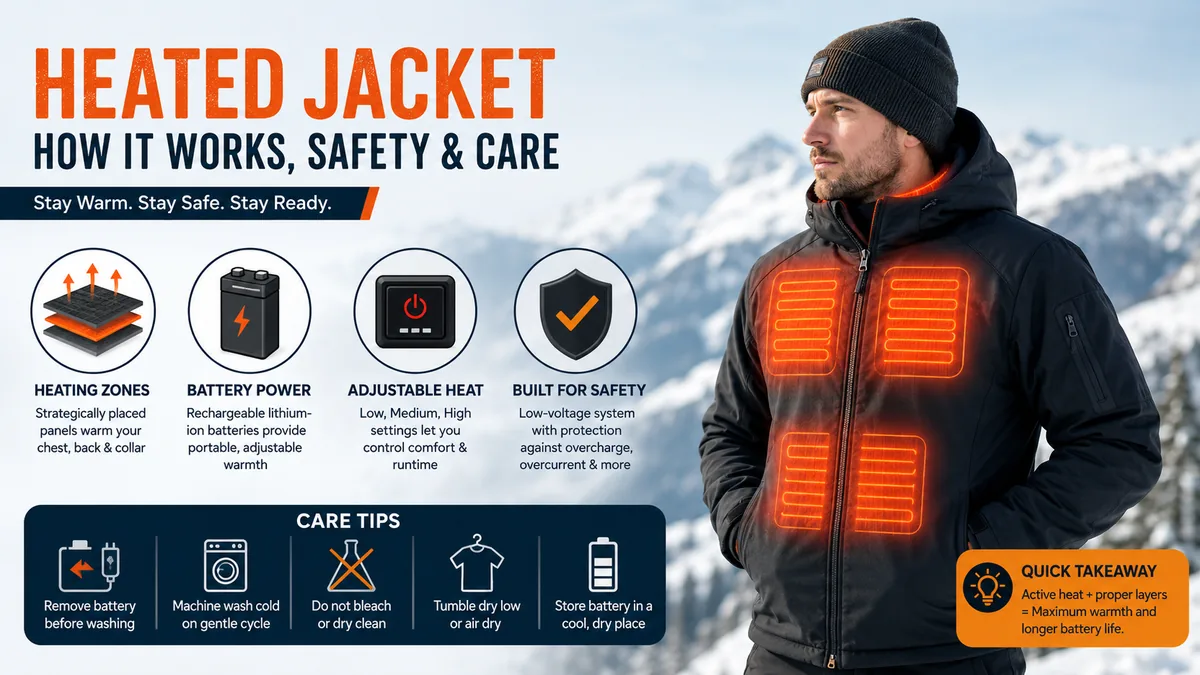
Cold weather can overwhelm ordinary insulation when you spend hours outside, especially when wind, moisture, and inactivity are involved. A heated jacket approaches the problem differently: instead of only trapping body heat, it uses battery-powered heating elements to actively add warmth around key areas of your torso.
A heated jacket is an insulated or soft-shell garment with electrical heating elements built into the fabric. A rechargeable lithium-ion battery supplies low-voltage electricity to heating zones—commonly across the chest and back—while a controller lets the wearer select different heat levels. Runtime depends on battery capacity, temperature setting, ambient conditions, and the number of heating zones in use.
What Is a heated jacket?
A heated jacket combines conventional cold-weather clothing with a small wearable heating system. It still uses familiar materials—such as fleece, synthetic insulation, wind-resistant shells, or water-resistant fabrics—but adds heating elements, internal wiring, a controller, and a removable power source.
The basic components are:
- Rechargeable battery pack
- Heating elements or heating panels
- Insulated electrical wiring
- Battery connection port
- Power and temperature controller
- Conventional outer shell and insulation
Carbon fiber is commonly used for heating elements because it can be incorporated into flexible garments. Other designs may use metallic or specialized heating wires.
The concept is simple: your jacket provides passive insulation while its heating system supplies active warmth.
That distinction matters. A normal winter coat cannot create heat; it can only reduce the rate at which your existing body heat escapes.
How Does a heated jacket Work?
The heating process relies on electrical resistance.
When the battery is connected and the jacket is switched on, electrical current travels through the internal heating elements. Resistance in those elements converts electrical energy into thermal energy, warming the surrounding fabric and eventually your body.
The process typically follows five steps:
- Charge the lithium-ion battery.
- Connect it to the jacket’s power cable.
- Turn on the heating system.
- Select low, medium, or high heat.
- Allow the heating panels to warm the targeted areas.
Many models place heating zones across the left and right chest and mid-back. Some add heat around the collar, abdomen, pockets, shoulders, or sleeves.
For example, DEWALT describes one of its 20V heated jackets as having four core heating zones covering the left chest, right chest, mid-back, and collar, controlled through three temperature settings.
Why are heating zones concentrated around the torso?
Your torso contains major organs and represents a large portion of the body’s core mass. Heating this region can make cold conditions feel considerably more manageable without placing heating elements everywhere.
More heating zones do not automatically mean a better garment, though. Every active element consumes energy.
A jacket with many heating panels may provide broader coverage but can also drain its battery faster when all zones operate simultaneously.
What do the heat settings actually change?
Most systems offer approximately three modes:
| Heat level | Typical purpose | Battery impact |
|---|---|---|
| Low | Maintaining warmth for longer periods | Lowest power consumption |
| Medium | General cold-weather use | Moderate consumption |
| High | Rapid warming or severe cold | Highest consumption |
The exact temperature associated with each mode varies considerably by manufacturer.
Rather than focusing exclusively on advertised maximum temperature, consider how evenly the garment distributes warmth. A comfortable moderate temperature across useful locations can be more practical than one extremely hot panel.
Quick Takeaway: A heated jacket does not warm the entire coat uniformly. Its battery sends electricity to specific heating zones, while the jacket’s insulation helps retain the generated warmth.
heated jacket Battery Systems Explained
The battery is one of the biggest differences between heated garments.
Consumer jackets commonly use rechargeable lithium-ion batteries, but voltage, capacity, connector design, dimensions, and compatibility vary.
You may encounter systems such as:
- 5V USB-powered designs
- 7.4V dedicated battery systems
- 12V systems
- Power-tool battery platforms
- Higher-voltage systems such as 20V tool batteries
Voltage alone does not tell you how long a jacket will operate.
Battery capacity, electrical load, efficiency, ambient temperature, heating level, and number of active zones all influence runtime.
5V vs. 7.4V vs. 12V and 20V systems
Lower-voltage systems can use relatively compact power banks, making them attractive for casual clothing.
Dedicated 7.4V systems are common in purpose-built heated apparel. Higher-voltage designs may be used where greater heating output or compatibility with existing power-tool batteries is desirable.
Tool manufacturers provide another approach. Some heated workwear uses the same lithium-ion battery platform as cordless tools, which can be convenient for tradespeople who already own compatible batteries and chargers.
Higher voltage, however, should not automatically be interpreted as “warmer” or “better.” The complete electrical design determines heating performance.
How long does a heated jacket battery last?
There is no universal runtime.
Some manufacturers advertise several hours of operation, particularly on low settings. DEWALT, for example, lists up to 5.5 hours on low for one configuration using its compact 20V MAX 1.5 Ah battery, while another portion of its product information lists up to seven hours under specified conditions.
Actual runtime can differ because of:
- Selected heat level
- Battery capacity
- Battery age
- Outside temperature
- Number of heating zones
- Electrical efficiency
- How frequently the heat is adjusted
- Battery chemistry and condition
Cold itself matters because lithium-ion batteries generally perform less efficiently at low temperatures.
That means a runtime measured indoors should not automatically be expected during an entire day outdoors in freezing weather.
Understanding mAh and Wh
Battery specifications can be confusing because capacity is often advertised in milliamp-hours (mAh).
Comparing mAh figures between batteries operating at different voltages can be misleading.
Watt-hours (Wh) provide a more useful measure of stored energy:
Watt-hours = voltage × amp-hours
For example, a nominal 7.4V, 5Ah battery contains approximately:
7.4 × 5 = 37Wh
This still cannot predict exact runtime because the jacket’s electrical consumption changes with its operating mode, but it provides a better basis for comparing energy capacity.
What is a battery management system?
Quality rechargeable battery packs commonly incorporate electronic protection circuitry, often referred to as a battery management system or BMS.
Depending on the design, protection may address conditions such as:
- Overcharging
- Excessive discharge
- Overcurrent
- Short circuits
- Abnormal temperature
These safeguards are especially relevant because a heated garment places the power source close to the body.
Is a heated jacket Safe?
A properly designed heated jacket used according to its manufacturer’s instructions is intended to provide controlled, low-voltage heat. But it remains an electrical garment powered by a lithium-ion battery, so condition, battery quality, charging practices, and correct use matter.
The biggest practical rule is simple:
Do not continue using heated clothing that shows signs of electrical or battery damage.
Inspect the garment periodically for damaged wiring, unusual hot spots, torn areas around heating panels, damaged connectors, or a malfunctioning controller.
A battery requires similar attention.
Stop using a battery if you notice swelling, significant physical damage, leaking, unusual odor, abnormal overheating, or other behavior inconsistent with the manufacturer’s instructions.
Can a heated jacket overheat?
The system is designed to operate within controlled temperature ranges, but a malfunctioning, damaged, modified, or incompatible system should not be treated as normal.
Avoid:
- Using an incompatible battery
- Modifying electrical connections
- Crushing or puncturing the battery
- Using visibly damaged wiring
- Charging with an unapproved charger
- Operating a jacket that develops unusually hot areas
Temperature settings also exist for comfort. High heat may feel pleasant initially but can become uncomfortable when combined with strenuous physical activity and heavy insulation.
Use enough heat to remain comfortable rather than automatically leaving the system at maximum output.
Can you wear one in rain or snow?
This depends on the specific garment.
A heated jacket may have a water-resistant shell, but water-resistant is not the same as waterproof.
DEWALT, for example, describes its soft-shell heated jacket as water- and wind-resistant.
Weather protection therefore needs to be evaluated separately from heating capability.
For wet environments, examine the manufacturer’s stated shell construction, waterproofing, seam design, connector protection, and care instructions. Never assume that electrical apparel can be submerged simply because it tolerates light rain.
heated jacket vs. Regular Winter Jacket
Heated clothing and conventional insulated clothing solve the same problem in different ways.
| Feature | Heated jacket | Traditional insulated jacket |
| Produces heat | Yes | No |
| Requires battery | Yes | No |
| Adjustable warmth | Usually | Limited to ventilation/layering |
| Heating zones | Usually chest/back; varies | None |
| Maintenance | More specialized | Usually simpler |
| Runtime limitation | Yes | No |
| Weight | Battery adds weight | Depends on insulation |
| Cold-weather usefulness | Active + passive warmth | Passive insulation |
A high-quality down or synthetic winter coat can remain warm indefinitely without electricity. Its limitation is that it depends on your body to generate the heat being retained.
A battery-powered jacket can actively supply additional warmth, but once its battery is depleted it essentially becomes conventional outerwear. How useful it remains at that point depends heavily on the garment’s insulation and wind resistance.
That is why the underlying jacket matters just as much as its electronics.
Heated Jacket, Heated Vest, or Heated Hoodie?
Battery-powered clothing now comes in several forms.
Heated vest
A heated vest concentrates warmth around the core while leaving the arms unrestricted.
This can work particularly well underneath another jacket because the heating elements sit relatively close to the torso while the outer layer traps the warmth.
It is also less bulky around the shoulders and arms.
Heated hoodie
Heated hoodies blend powered warmth with the comfort and mobility of ordinary sweatshirts.
They can be useful in cool workshops or relatively dry conditions, but typical hoodie fabrics provide less wind and rain protection than technical outerwear.
Heated jacket
A full jacket generally offers the most complete standalone combination of heating, insulation, wind protection, and coverage.
For outdoor work, commuting, hunting, walking, spectator sports, or other prolonged cold-weather activities, this combination can be especially useful.
The right choice depends less on maximum advertised temperature and more on how the garment fits into your overall layering system.
How to Choose the Right Heating System
Because heated clothing mixes electronics and apparel, evaluating only one side of the product can lead to disappointment.
Consider the entire system.
Heating-zone placement
Look at where the heating elements are rather than simply counting them.
Common locations include:
- Upper chest
- Mid-back
- Lower back
- Collar
- Abdomen
- Pockets
- Shoulders
- Sleeves
Chest and back panels generally target core warmth, while a heated collar can make cold wind around the neck more tolerable.
Hand-pocket heating may be useful if your activity involves periods of standing still.
Battery position
Battery placement is easy to overlook.
A large power pack sitting against your side or lower back can become uncomfortable while sitting in a vehicle, bending, climbing, or wearing a backpack.
Power-tool batteries can be especially noticeable because they were originally designed for tools rather than clothing.
Check both battery weight and pocket location.
Fit
Heating panels work best when the garment sits reasonably close to your body.
If the jacket is extremely loose, much of the generated warmth first heats an air gap. If it is too tight, movement becomes uncomfortable and insulation can be compressed.
Your normal winter layers should therefore be considered when determining fit.
Wind resistance
Wind can remove warmth rapidly.
A jacket with powerful heating elements but poor wind protection may feel less effective outside than a moderately heated garment with a good wind-resistant shell.
This becomes particularly noticeable when cycling, working in exposed locations, or riding open vehicles.
Insulation
Heating elements should supplement rather than replace good insulation.
Fleece, synthetic fill, down, and other insulating materials slow heat loss after the heating panels warm the interior.
This can also improve battery efficiency because you may remain comfortable on a lower setting.
Controls
Controls should be easy to operate while wearing gloves.
Some jackets use one illuminated button to cycle through high, medium, and low modes. More complex systems may independently control different heating zones.
Independent controls can conserve energy when you only need warmth in one area.
How to Layer a heated jacket Correctly
Heating performance is strongly affected by what you wear underneath and over the garment.
A practical cold-weather system usually has three functions:
Base layer → heated or insulating mid-layer → weather-resistant outer layer
The base layer manages moisture. The heated layer provides warmth. The outer shell blocks wind, rain, or snow.
If the heated jacket itself has sufficient insulation and weather protection, it may serve as both warming layer and outer shell.
Should a heated jacket be worn directly against skin?
Generally, no.
Follow the garment manufacturer’s instructions, but heated outerwear is normally worn over a base layer or ordinary clothing rather than directly against bare skin.
A thin base layer also helps manage perspiration.
Does thicker clothing underneath improve warmth?
Not necessarily.
Placing a thick insulating layer between your body and the heating elements can reduce how quickly you feel their warmth.
A better arrangement may be:
- Moisture-managing base layer
- Heated garment
- Insulating or weatherproof outer layer when necessary
This keeps the heat relatively close to your torso while limiting heat loss to the environment.
Quick Takeaway: Heated clothing works best as part of a layering system. Blocking wind and retaining generated heat can be more effective than simply selecting the highest temperature.
How to Use a heated jacket Efficiently
The highest setting is not always the most effective way to use battery-powered clothing.
For many situations, a more efficient approach is to start on high while the jacket and surrounding layers are cold, then reduce the setting once you are comfortable.
This lowers power consumption.
Practical steps for longer runtime
- Fully charge the battery before extended outdoor use.
- Start heating before you become extremely cold.
- Use high heat temporarily rather than continuously when possible.
- Switch to medium or low once comfortable.
- Block wind with an appropriate shell.
- Keep the battery protected from extreme cold according to manufacturer guidance.
- Turn heating off when moving indoors or becoming physically active.
Physical activity produces considerable metabolic heat. Someone hiking uphill may need much less electrical heating than someone sitting motionless at an outdoor event.
Your heat setting should change accordingly.
How to Wash a heated jacket Safely
One of the most common questions is whether heated clothing can actually be washed.
Often it can—but the manufacturer’s care label takes priority over generic instructions because washing and drying requirements differ between models.
DEWALT explicitly instructs users to disconnect the power source and remove the battery before washing, avoid bleach and dry cleaning, and follow the garment’s care label.
Some other manufacturer instructions allow a gentle cold-water machine cycle and low tumble drying, while other garments require air drying.
That difference is precisely why one universal washing method should never override the label.
General washing process
Where permitted by the manufacturer:
- Turn the heating system off.
- Disconnect and completely remove the battery.
- Remove other objects from the pockets.
- Secure the power connector as directed.
- Close zippers and fasteners.
- Follow the care label’s specified washing method.
- Use appropriate mild detergent where instructed.
- Avoid bleach and other prohibited chemicals.
- Dry exactly as specified on the label.
- Reconnect the battery only after the garment and connector are completely dry.
Never put the removable lithium-ion battery into the washing machine.
Why shouldn’t you dry-clean heated clothing?
Cleaning solvents can damage components or insulation surrounding the heating system.
DEWALT specifically warns against dry cleaning and states that cleaning solvents may damage or reduce the effectiveness of the insulated heating element.
The same caution appears in instructions for other heated garments.
Can you put a heated jacket in the dryer?
Sometimes—but not universally.
Certain garments permit low-temperature tumble drying, while others explicitly prohibit machine drying.
Follow the exact model’s label rather than assuming that advice for another heated garment applies to yours.
Avoid ironing unless the manufacturer specifically permits it. Direct high heat can damage technical fabrics and internal components.
Battery Charging and Storage
Battery maintenance influences both runtime and long-term reliability.
Lithium-ion batteries gradually lose capacity with age and charge cycles. Extreme temperatures can accelerate degradation.
Basic battery practices include:
- Use the specified or manufacturer-approved charger.
- Keep battery contacts clean and dry.
- Protect the battery from impact.
- Avoid storing it in very hot locations.
- Follow manufacturer instructions for long-term charge level.
- Inspect it before the cold season.
- Keep it separate from the garment during washing.
For extended off-season storage, battery manufacturers commonly provide specific guidance about temperature and state of charge. Follow the instructions supplied with your particular battery rather than relying on a universal percentage.
Common heated jacket Problems
Electrical clothing adds several failure points that ordinary coats do not have.
Jacket doesn’t heat
Start with the simplest possibilities:
- Battery is discharged
- Battery is not properly connected
- Power button was not held long enough
- Connector is loose
- Battery protection circuitry has activated
- Heating zone has been disabled
- Battery or jacket is damaged
Recharge the battery and reconnect it according to the manual.
If the system remains nonfunctional, avoid dismantling or modifying the internal wiring yourself.
One heating zone feels colder
Different zones may naturally feel different because of placement, insulation, or contact with the body.
However, a zone that suddenly stops working while the others remain functional can indicate an electrical problem.
If the behavior is abnormal for the garment, discontinue use and consult the manufacturer’s support guidance.
Runtime suddenly becomes shorter
Several factors can explain reduced runtime:
- Lower outdoor temperature
- Higher heat setting
- More heating zones activated
- Aging battery cells
- Incomplete charging
- Battery damage
Test the jacket with a fully charged battery under comparable conditions before concluding that the heating elements are faulty.
Jacket gets too hot
Reduce the heat setting immediately.
If one area becomes abnormally hot, the controller behaves unpredictably, or the garment shows other signs of malfunction, switch it off, disconnect the battery when safe to do so, and stop using it until it has been inspected according to the manufacturer’s guidance.
Where Heated Clothing Makes the Most Sense
Active heating is especially useful when exposure lasts long enough for ordinary clothing to become uncomfortable.
Common applications include:
- Construction and outdoor trades
- Warehouses and unheated workshops
- Hunting
- Fishing
- Camping
- Hiking
- Motorcycle riding
- Winter commuting
- Outdoor sporting events
- Dog walking
- Snow clearing
- Photography and other stationary outdoor work
The biggest advantage often appears during low-activity cold exposure.
Someone standing at a job site, waiting at a train station, sitting in a hunting blind, or watching a winter sporting event generates relatively little extra metabolic heat.
Battery-powered warmth can make a noticeable difference in those situations.
During vigorous exercise, however, powered heating may become unnecessary and can contribute to excessive warmth and perspiration.
Advantages and Limitations
Heated outerwear offers genuine benefits, but it also introduces compromises.
Advantages
Adjustable warmth: Temperature controls let you respond to changing conditions.
Active heat: The garment does not rely exclusively on retaining body-generated warmth.
Targeted heating: Panels concentrate warmth around areas such as the chest and back.
Potentially lighter layering: Under suitable conditions, active heating may reduce the need for extremely bulky insulation.
Useful during inactivity: Powered heat can be particularly helpful when standing or sitting outside for extended periods.
Limitations
Finite runtime: Once the battery runs out, active heating stops.
Battery weight: Larger batteries can feel bulky.
Charging requirement: The system must be recharged between uses.
Special care: Washing requires more attention than ordinary outerwear.
Electronic failure points: Connectors, controllers, wires, and batteries can eventually fail.
Cold affects batteries: Low temperatures can reduce lithium-ion battery performance.
Compatibility issues: Replacement batteries are not necessarily interchangeable between brands or voltage systems.
These limitations explain why the quality of the underlying jacket should never be ignored.
What Actually Matters Most in a heated jacket?
Marketing often focuses on the number of heating zones or maximum temperature. In practical use, several less dramatic characteristics matter just as much.
First, consider heat distribution. Panels should warm useful areas rather than create isolated hot spots.
Second, consider insulation and wind resistance. Electricity cannot compensate efficiently for a shell that loses heat rapidly.
Third, examine battery comfort. A powerful battery is less appealing if its position makes sitting or working uncomfortable.
Fourth, look at runtime at the setting you will actually use. An impressive low-mode runtime tells you little about how long the jacket will operate continuously on high.
Fifth, check care requirements and battery availability. Heated apparel is a system, not merely a coat. Eventually you may need another battery, charger, or replacement component.
Is a heated jacket Worth Using?
A heated jacket can be an effective cold-weather tool for people who spend substantial time outdoors, particularly during activities involving long periods of limited movement. Carbon-fiber or similar heating elements provide targeted warmth, lithium-ion batteries make the system portable, and adjustable settings let the wearer balance comfort against runtime.
It should not replace the fundamentals of cold-weather clothing, though.
Good insulation, moisture management, proper fit, wind protection, and appropriate layering still determine how effectively your body retains heat. The electrical system simply adds another controllable source of warmth.
For the best experience, treat the garment as both technical outerwear and a battery-powered device: understand its heating zones, use lower settings when they are sufficient, follow the exact washing instructions, protect the lithium-ion battery, and inspect the system whenever something feels abnormal.
Used that way, a heated jacket can provide practical, adjustable warmth without abandoning the principles that make ordinary winter clothing effective.