
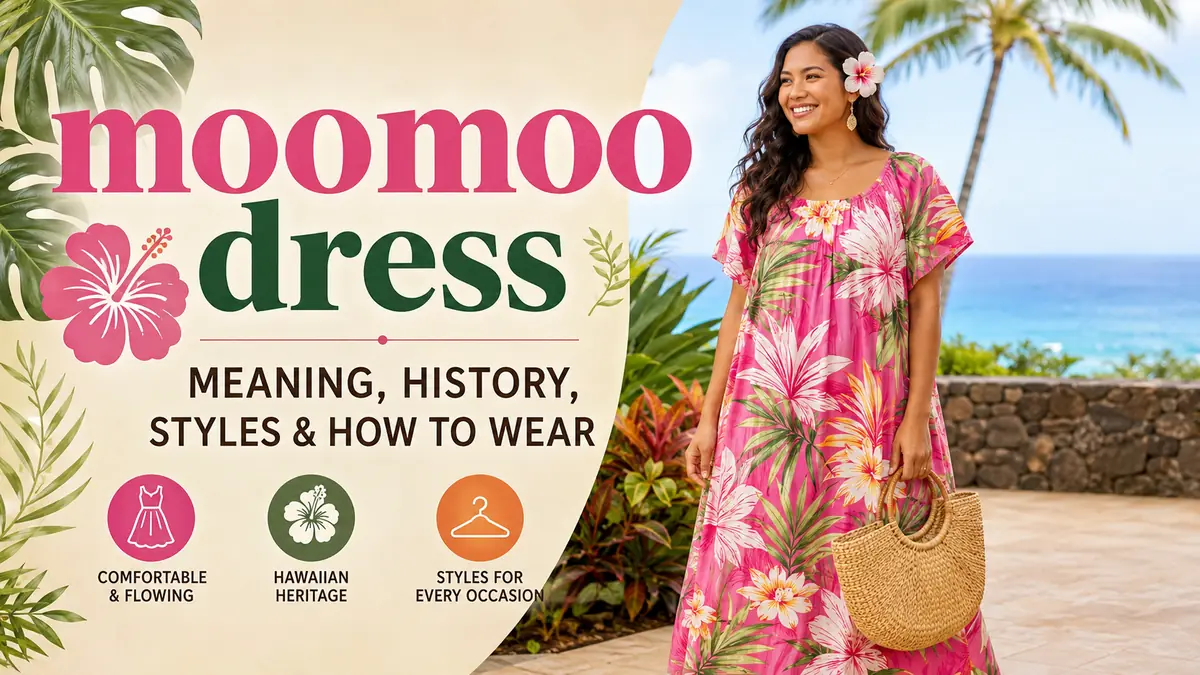
Few garments combine comfort, airflow, color, and cultural history quite like the moomoo dress. Its relaxed shape may look simple, but the garment behind the popular “moomoo” spelling has a much richer story than an ordinary oversized dress.
The traditional name is muʻumuʻu, commonly written muumuu in English. “Moomoo” and “mumu” are alternative spellings people often use when searching for the same general style. The garment developed in Hawaiʻi and is closely connected with Hawaiian clothing traditions, including the holokū.
A moomoo dress is a loose-fitting dress that hangs freely from the shoulders rather than closely following the waist and hips. Traditionally associated with Hawaiʻi, muumuus are often long, lightweight, brightly colored, and decorated with floral or tropical prints. Modern versions range from casual house dresses to elegant garments worn for gatherings and celebrations.
Understanding the difference between the traditional garment and today’s loose fashion dresses makes it much easier to recognize, wear, and describe a moomoo correctly.
What Is a moomoo dress?
A moomoo dress, more accurately spelled muumuu, is a loose, generally unbelted dress designed to fall freely from the shoulders. It typically provides generous room through the bust, waist, hips, and skirt.
Dictionary definitions consistently emphasize this relaxed construction. Merriam-Webster describes the muumuu as a loose, often long dress associated with bright colors and patterns, while the American Heritage Dictionary describes it as a long, loose dress hanging freely from the shoulders.
Common characteristics include:
- A loose or flowing silhouette
- Minimal waist definition
- Lightweight fabric
- Knee, midi, calf, or ankle length
- Short, elbow-length, sleeveless, or occasionally longer sleeves
- Floral, botanical, Polynesian-inspired, or colorful prints
- An easy pullover construction
- Plenty of room for movement
The absence of a tightly defined waist is particularly important. A fitted floral maxi dress isn’t automatically a muumuu simply because it has a tropical pattern.
Traditional and modern examples can also look quite different. Contemporary designers may add structured necklines, ruffles, gathered panels, pockets, side slits, or more tailored proportions while maintaining the garment’s recognizable flowing character.
Is moomoo the correct spelling?
The historically appropriate Hawaiian spelling is muʻumuʻu. In English, muumuu is the widely established spelling found in major dictionaries. Alternative forms including “moomoo,” “moo-moo,” “mumu,” and “muu-muu” also appear in usage.
The variations make sense when you hear the word pronounced. English speakers often reproduce the sound phonetically as “moo moo.”
For writing specifically about Hawaiian history or culture, muʻumuʻu is the most culturally precise form. For general English writing, muumuu is well established.
Where Did the moomoo dress Come From?
The history of the moomoo dress is rooted in Hawaiʻi rather than modern resort fashion.
Its development is connected to the holokū, a loose, full-length garment influenced by the Mother Hubbard-style dresses associated with Protestant missionaries who arrived in Hawaiʻi during the 1820s. Historical accounts describe the holokū as having a high-necked yoke, long sleeves, and a long silhouette.
The muʻumuʻu developed as a less restrictive garment associated with this clothing tradition.
The Hawaiian word muʻumuʻu relates to the idea of something being “cut off” or “shortened.” Dictionaries trace the English word to Hawaiian, and historical descriptions connect the name with differences such as shortened sleeves or construction compared with longer forms of dress.
Early versions were not necessarily the vivid floral garments many people picture today. Historical accounts describe lightweight white cotton versions that could function as garments worn beneath the holokū as well as comfortable clothing around the home.
As fabrics and fashions changed, the muʻumuʻu evolved.
Printed textiles brought stronger colors and patterns into Hawaiian fashion. Over time, the garment became associated with the vibrant botanical and island-inspired designs now familiar around the world.
From practical garment to Hawaiian fashion
Calling the muʻumuʻu simply an old-fashioned house dress misses much of its cultural development.
In Hawaiʻi, it became part of aloha wear and could be worn beyond the home. Muumuus have been associated with social gatherings, church, cultural events, and festivals, including the Merrie Monarch hula competition.
The garment continues to evolve rather than existing only as historical clothing.
January is now celebrated by some in Hawaiʻi as Muʻumuʻu Month, an initiative started by Kauaʻi designer Shannon Hiramoto of Machinemachine to encourage people to wear and appreciate the classic aloha dress. Modern Hawaiian designers have also reworked vintage silhouettes with contemporary proportions and styling.
Quick takeaway: The muʻumuʻu has Hawaiian cultural significance. Modern loose dresses may borrow its silhouette, but the traditional garment has a specific history that deserves recognition.
What Does a Traditional moomoo dress Look Like?
There isn’t one mandatory pattern that every muumuu must follow.
Still, several design features make the silhouette recognizable.
Loose silhouette
The defining feature is room.
Rather than pulling inward at the natural waist, the fabric usually falls downward from the shoulders or upper bodice. This creates an airy shape with considerable freedom of movement.
That relaxed construction is why the garment works particularly well in warm climates.
Bright prints and colors
Traditional and Hawaiian-inspired muumuus frequently feature strong botanical imagery.
Common motifs include:
- Hibiscus-style flowers
- Tropical leaves
- Palm-inspired designs
- Large botanical prints
- Polynesian-influenced motifs
- Contrasting borders
- Repeating island florals
Bright patterns are strongly associated with the style, although solid-color muumuus also exist.
Lightweight materials
A flowing silhouette works best when the material can move naturally.
Cotton has historical relevance and remains practical in warm weather. Modern garments may also use rayon, viscose, linen blends, polyester, or other lightweight woven fabrics.
Fabric dramatically changes how the same basic shape behaves.
| Fabric | Typical Feel | Breathability | Draping Quality | Common Use |
|---|---|---|---|---|
| Cotton | Soft, crisp or relaxed | High | Moderate | Everyday wear |
| Linen/blend | Textured and airy | High | Moderate | Hot-weather wear |
| Rayon/viscose | Soft and fluid | Good | High | Flowing casual styles |
| Polyester | Smooth and durable | Varies | Good | Easy-care dresses |
| Cotton blends | Balanced | Good | Moderate | General everyday wear |
For genuinely hot and humid conditions, breathability matters more than simply choosing the loosest possible silhouette.
Longer length
The classic image is generally a long dress, although length varies.
Merriam-Webster describes it as often long, while other dictionary definitions acknowledge variations in length. Modern designs can finish around the knee, calf, ankle, or floor.
Length alone therefore doesn’t determine whether something belongs to the style.
Different Types of moomoo dress
Modern fashion uses “moomoo” rather broadly, so you’ll encounter dresses ranging from traditional Hawaiian styles to generic loose summer dresses.
Traditional Hawaiian muʻumuʻu
This version has the strongest connection with Hawaiian dress culture.
Expect flowing construction, substantial length, colorful prints, and decorative details influenced by Hawaiian fashion.
Authentic Hawaiian makers may use locally meaningful textile patterns and construction details rather than simply putting generic palm-tree graphics on an oversized dress.
Floral muumuu
Large floral prints have become one of the garment’s most recognizable visual features.
The loose silhouette gives oversized flowers and botanical patterns a large uninterrupted surface, allowing prints to become part of the overall design.
Short moomoo dress
Contemporary versions sometimes end around the knee.
They retain the roomy shoulder-to-hem construction while reducing the traditional length. This can make them practical as casual warm-weather clothing.
Maxi muumuu
A maxi version reaches the ankles or floor.
It provides the sweeping appearance most people associate with traditional long muumuus while still allowing contemporary necklines, sleeves, and prints.
House dress
The terms house dress and muumuu sometimes overlap, particularly in American popular usage.
A house dress prioritizes comfort for everyday activities at home. It might have pockets, simple closures, inexpensive fabric, and an uncomplicated shape.
A muumuu can certainly function as a house dress, but that doesn’t mean every house dress is a muumuu.
Contemporary or tailored muumuu
Modern Hawaiian fashion demonstrates that loose doesn’t have to mean shapeless.
Designers may use:
- Gathered shoulders
- Decorative yokes
- Flutter sleeves
- Ruffled hems
- Side slits
- Structured necklines
- Contrasting prints
- More controlled volume
These details retain the flowing identity while creating a more deliberate silhouette.
moomoo dress vs. Kaftan, Caftan, House Dress and Maxi Dress
Several garments resemble the muumuu enough to cause confusion.
Their similarities are real, but their histories and construction aren’t identical.
| Garment | Typical Shape | Waist | Common Length | Main Distinction |
|---|---|---|---|---|
| Muumuu | Loose and flowing | Usually undefined | Knee to floor | Hawaiian origin |
| Kaftan/caftan | Wide, robe-like | Loose or belted | Usually long | Different cultural origins and construction |
| House dress | Varies | Loose to fitted | Varies | Designed mainly for practical home wear |
| Maxi dress | Any silhouette | Fitted or loose | Ankle/floor | Defined mainly by length |
| Shift dress | Straight | Undefined | Usually shorter | Narrower, simpler straight cut |
Is a muumuu the same as a kaftan?
No.
They can look similar because both may be long, loose, and comfortable. But kaftans have their own historical traditions extending through regions including the Middle East and beyond. Treating all flowing dresses as interchangeable erases those distinctions.
Modern American fashion has blurred the terminology considerably. In some communities, loose kaftan-like house dresses have colloquially been called “mumus.” That overlap helps explain why online images for the terms can look nearly identical.
Is a moomoo just a maxi dress?
Not necessarily.
“Maxi” primarily describes length. A body-skimming sleeveless dress can be a maxi dress even if it looks nothing like a muumuu.
The muumuu is better identified by a combination of origin, loose construction, shoulder-to-hem flow, and traditional styling.
Why Is the moomoo dress So Comfortable?
The answer comes down to construction.
Conventional fitted clothing creates shape by bringing fabric closer to the body at places such as the bust, waist, and hips. A muumuu does almost the opposite.
Extra fabric creates room for:
- Air circulation. The garment doesn’t remain pressed against as much of the body.
- Movement. A wide skirt and generous body make walking and sitting easier.
- Minimal waist restriction. Traditional versions generally don’t depend on tight waistbands.
- Easy dressing. Many contemporary styles can simply be pulled over the head.
- Adaptability. The relaxed shape can accommodate normal changes in body measurements more easily than highly fitted garments.
The material still matters, though.
A very loose dress made from thick, poorly breathable fabric may feel warmer than a moderately loose cotton dress. For hot weather, combining a roomy silhouette with breathable material generally gives the best result.
How Should a moomoo dress Fit?
One of the most common mistakes is assuming that bigger automatically means better.
A muumuu should have volume, but its upper portion still needs to sit properly.
Start with the shoulders.
The garment should feel comfortable without constantly sliding out of position. The neckline shouldn’t pull backward or gape excessively unless that is deliberately part of the design.
Next, check the bust.
There should be enough ease that the fabric falls naturally rather than stretching across the chest.
Then look at overall volume.
A good loose dress creates movement without making ordinary activities awkward. Excess fabric around the sleeves or hem can become inconvenient even when the garment technically fits.
Finally, consider length. A floor-length style shouldn’t drag beneath your feet.
How do you choose a flattering muumuu?
Instead of trying to make the dress appear smaller, focus on proportion.
A well-proportioned neckline creates visual structure around the face. Sleeve length can balance the width of the garment, while a hem positioned deliberately at the knee, calf, ankle, or floor keeps the volume looking intentional.
Print scale matters too.
Large botanical patterns create a bold statement. Smaller repeating patterns tend to produce a quieter visual effect. Neither is inherently more flattering—the better option depends on the appearance you want.
Quick takeaway: A muumuu is supposed to be loose. Proper fit comes from comfortable shoulders, adequate bust room, manageable volume, and the right hem length—not from making the waist fitted.
How to Wear a moomoo dress
A traditional muumuu doesn’t need complicated styling. The dress itself can provide most of the visual interest.
1. Keep it relaxed for everyday wear
For an uncomplicated daytime outfit, allow the garment to hang naturally.
Pairing a colorful dress with simple footwear and minimal accessories keeps attention on the fabric and silhouette.
2. Use accessories to create structure
A necklace, earrings, bracelet, bag, or structured shoe can add definition without changing the garment itself.
This works particularly well with solid-colored or minimally patterned dresses.
3. Add a belt carefully
Can you belt a moomoo dress? Yes, especially with modern fashion versions.
However, a belt changes the characteristic silhouette. If you want the traditional flowing appearance, leave the waist unrestricted.
For contemporary styling, a soft belt can temporarily create waist definition without permanently altering the garment.
4. Dress up a longer style
Long muumuus can work beyond casual home wear.
Historically and culturally, these garments have been worn in Hawaiʻi for social occasions, church, festivals, and other gatherings—not merely as loungewear.
A more refined fabric, intentional jewelry, polished footwear, and an elegant neckline can make the flowing silhouette suitable for a dressier setting.
5. Let bold prints lead the outfit
If the fabric already contains large flowers, tropical leaves, and multiple bright colors, adding several competing accessories usually isn’t necessary.
Choose one or two supporting pieces instead.
Who Can Wear a moomoo dress?
Anyone who enjoys the silhouette can wear a modern loose-fitting dress.
The garment has sometimes been stereotyped as clothing intended only for older women, larger bodies, or people lounging around the house. That stereotype doesn’t accurately represent either its Hawaiian cultural history or its modern use.
Current interest has helped challenge that image.
In 2025, Love Island USA contestant Amaya Espinal drew renewed attention to the style by wearing a flowing muumuu, contributing to online discussion about the garment’s history and its relationship to contemporary “auntie-core” or “grandma-core” fashion.
Fashion cycles change, but comfort rarely stops being useful.
That helps explain why roomy dresses continually reappear under labels such as resort wear, vacation dresses, house dresses, oversized maxis, caftans, and muumuus.
When Can You Wear a moomoo dress?
Context depends heavily on the particular garment.
A lightweight everyday version can suit:
- Relaxing at home
- Warm-weather errands
- Beach or resort environments
- Casual lunches
- Travel
- Summer gatherings
More formal or culturally specific Hawaiian versions may be appropriate for celebrations, church, cultural gatherings, and other social events.
The key distinction is fabric and construction.
A thin cotton house dress and a beautifully constructed Hawaiian muʻumuʻu may share a loose silhouette, yet serve very different purposes.
How to Choose Fabric for Hot Weather
Because the style is strongly associated with warm climates, fabric deserves special attention.
Cotton
Cotton is dependable for everyday wear because it is generally breathable, familiar, and relatively easy to maintain.
Crisper cotton gives a muumuu more architectural volume, while softer cotton produces a relaxed drape.
Rayon and viscose
These materials are popular when fluid movement is the priority.
They can produce a softer, more cascading silhouette than crisp cotton. Care requirements vary, so checking the garment label matters.
Linen
Linen is particularly useful in heat because of its airy feel.
Its natural wrinkles are part of its character, although linen blends can provide some of the same texture with easier maintenance.
Polyester
Polyester can be durable, wrinkle-resistant, and easy to wash, but comfort varies substantially depending on the weave and weight.
For very humid weather, don’t assume a garment will feel cool merely because it has a wide cut.
Common Misconceptions About the moomoo dress
The simplicity of the silhouette has produced several persistent misconceptions.
“It’s just an oversized nightgown.”
No.
Some inexpensive modern versions are marketed as sleepwear or house dresses, but the traditional Hawaiian garment has a much broader cultural and social role.
“It’s only for older women.”
Again, no.
Age isn’t part of the garment’s definition. Contemporary interest in vintage muumuus and updated Hawaiian designs demonstrates how easily the silhouette moves between generations. Hawaiʻi Magazine, for example, has documented renewed enthusiasm for vintage and modernized versions through Muʻumuʻu Month.
“All tropical maxi dresses are muumuus.”
A floral pattern doesn’t determine garment identity.
A fitted tropical maxi dress is still fundamentally a fitted maxi dress. A muumuu is associated with a much looser, free-hanging construction.
“Loose means badly fitted.”
Intentional volume and incorrect sizing aren’t the same thing.
A properly designed oversized garment controls volume through its shoulders, neckline, sleeve proportions, fabric weight, and hem.
Caring for a moomoo dress
Care should always follow the fabric rather than the name of the garment.
Check the manufacturer’s label first.
For washable cotton garments, cooler water and gentle washing can help protect printed colors. Turning heavily printed pieces inside out before washing may also reduce unnecessary abrasion.
Rayon and viscose require more caution because some versions can shrink or distort when wet.
Linen can usually tolerate regular wear well but naturally wrinkles. Polyester tends to be comparatively easy-care, although excessive heat can damage synthetic fibers.
For vintage Hawaiian garments, take additional care.
Older textiles, elastic, seams, buttons, and decorative trims can be more fragile than they initially appear. If a vintage piece has historical, sentimental, or monetary value, aggressive machine washing may not be appropriate.
How the moomoo dress Fits Into Modern Fashion
The continuing appeal of the muumuu makes sense when viewed alongside today’s interest in relaxed silhouettes.
People increasingly encounter wide dresses through resort wear, oversized maxis, caftans, smock dresses, and loose summer clothing. The muumuu fits comfortably into that visual vocabulary while retaining its own Hawaiian identity.
Modern designers have also demonstrated that the silhouette can be refined rather than simply oversized.
Waikīkī businesses specializing in Hawaiian fashion continue to present handcrafted muʻumuʻu as part of contemporary island design, while established names such as Princess Kaiulani Fashions connect present-day clothing with Hawaiʻi’s longer fashion tradition.
That distinction matters.
There is nothing wrong with wearing a generic loose floral dress for comfort. But understanding the word muʻumuʻu means recognizing that it refers to more than a convenient shape.
The Cultural Significance Behind the Style
Fashion terminology often travels farther than its original context.
As the muumuu became familiar outside Hawaiʻi, simplified stereotypes sometimes reduced it to a joke about oversized clothing, body size, aging, or unfashionable housewear.
Its actual story is considerably more interesting.
The garment reflects historical change in Hawaiian clothing, interactions between Indigenous Hawaiian culture and Western missionary influence, adaptation to climate and daily life, evolving textile traditions, and generations of Hawaiian fashion design.
It also shows how communities can transform an introduced clothing concept into something culturally distinctive.
Today, vintage collectors and Hawaiian designers continue to preserve and reinterpret the muʻumuʻu. Its presence at cultural events and initiatives such as Muʻumuʻu Month shows that the garment remains connected to living Hawaiian fashion rather than simply surviving as a costume from the past.
Final Thoughts on the moomoo dress
The moomoo dress is best understood as the commonly searched name for the muumuu or Hawaiian muʻumuʻu: a loose, flowing garment traditionally associated with Hawaiʻi and often recognized by its comfortable construction, longer silhouette, lightweight fabric, and colorful patterns.
Its appeal is easy to understand. A well-made muumuu offers airflow, movement, versatility, and a striking canvas for beautiful textiles.
But comfort is only half the story.
Behind the simple silhouette is a history connected with the holokū, Mother Hubbard-style missionary clothing, Hawaiian adaptation, aloha wear, textile design, social gatherings, and contemporary cultural fashion. Learning that background turns the moomoo dress from “just a loose dress” into what it really is: a distinctive garment with an evolving Hawaiian story.