
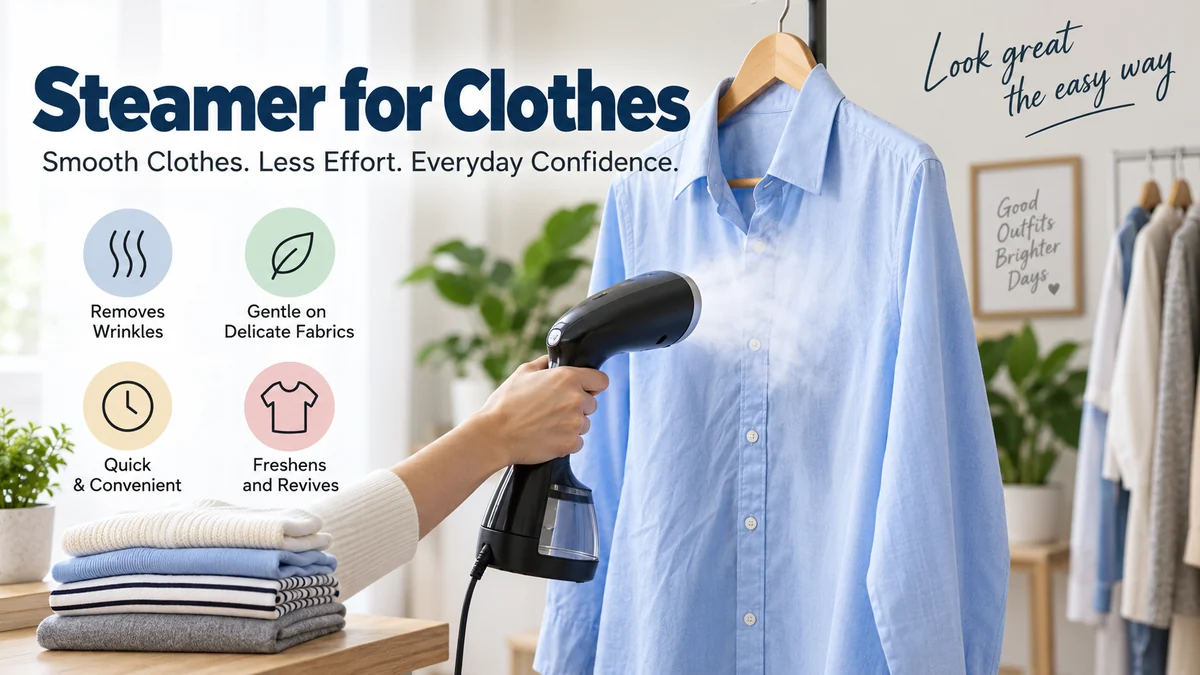
A wrinkled shirt can make an otherwise polished outfit look unfinished. Yet pulling out an ironing board every time a dress, blouse, jacket, or pair of trousers develops a few creases is hardly convenient. That is where a steamer for clothes becomes useful.
A clothes steamer uses heated water to produce steam that relaxes textile fibers, allowing many wrinkles to fall out while the garment hangs vertically. It is especially useful for quick touch-ups, delicate or textured fabrics, dresses, knits, jackets, and awkward areas that are difficult to press with an iron.
The important part is knowing what steaming can—and cannot—do. A garment steamer is excellent at creating a smooth, naturally draped finish, but it does not completely replace an iron when you need crisp collars, sharp trouser creases, or heavily pressed cotton and linen.
What Is a Steamer for Clothes?
A clothes steamer, also called a garment steamer, is an appliance that heats water and directs the resulting hot vapor toward fabric.
Instead of placing a heated metal soleplate directly against clothing, as you do with an iron, you normally hold the steamer head close to the hanging garment. Heat and moisture help relax fibers that have become distorted by washing, drying, folding, packing, or sitting in a wardrobe.
The weight of a hanging garment can then help the relaxed fibers return to a smoother position. This combination explains why steaming works particularly well on garments designed to hang and drape naturally.
There are two main designs.
Handheld garment steamers
A handheld clothes steamer combines the water reservoir, heating system, and steam head in one relatively compact appliance.
These models make sense for:
- Quick morning touch-ups
- Small wardrobes
- Apartments with limited storage
- Occasional steaming
- Business trips and vacations
- One or two garments at a time
Their main compromise is capacity. A compact water tank usually means a shorter steaming session before refilling.
Standing garment steamers
A standing or upright steamer typically has a larger water tank in a base, with steam delivered through a hose to a separate steaming head. Many include a pole and hanger.
They are better suited to:
- Several garments at once
- Frequent steaming
- Dresses and long garments
- Larger households
- Wardrobes containing many delicate pieces
- Curtains and some other suitable household textiles
They take up more storage space but generally make long steaming sessions more convenient.
How Does a Clothes Steamer Remove Wrinkles?
Wrinkles are changes in the arrangement of textile fibers. Moisture, heat, movement, and pressure can all influence how those fibers sit.
A garment steamer adds heat and moisture without relying heavily on pressure.
Water inside the appliance is heated and converted into steam. The steam reaches the fabric and helps relax its fibers. With the garment hanging vertically, gravity and gentle tension help straighten the material.
An iron works differently.
It combines direct heat with pressure against a flat ironing board. Steam irons add moisture too, but physical pressing remains an important part of the process. That pressure is why an iron can produce a sharply defined crease that a conventional steamer usually cannot.
Quick takeaway
Think of the difference this way:
Steamer = relax and smooth.
Iron = flatten and press.
Neither approach is universally better. The correct tool depends on the fabric and the finish you want.
How to Use a Steamer for Clothes Properly
A garment steamer is fairly simple to operate, but technique matters. Moving the steamer randomly around the garment often produces disappointing results.
A more reliable process is:
- Read the garment care label. Confirm that heat and steaming are appropriate for the fabric.
- Fill the water tank. Follow the appliance manufacturer’s instructions regarding water type and maximum fill level.
- Allow the steamer to heat completely. Trying to use it before it is ready can contribute to inconsistent steam or water droplets.
- Hang the garment securely. Give yourself enough space to work without steaming walls, furniture, or another person.
- Test a hidden area first. This is especially sensible with delicate materials, finishes, dyes, or unfamiliar fabrics.
- Hold the garment gently taut where appropriate. Keep your free hand well away from the path of the hot steam.
- Move the steamer in controlled passes. Work systematically rather than repeatedly attacking one spot.
- Give stubborn wrinkles another pass. Avoid holding concentrated steam on one location unnecessarily.
- Let the garment dry and cool. Do not immediately fold or tightly pack freshly steamed clothing.
Steam can cause serious burns, so never direct a garment steamer toward your skin or another person.
Should you steam from the inside or outside?
Both techniques can work.
For ordinary shirts and dresses, steaming the outside is often enough. For some stubborn areas, steaming from inside the garment lets the steam push outward through the fabric.
Delicate surfaces, embellishments, and unusual finishes deserve more caution. Test first rather than assuming the fabric will react well.
Should the steamer touch the fabric?
That depends on the appliance and textile.
Some steamer heads or heated plates are specifically designed for controlled contact, while other situations call for a small gap between the steamer and material. Follow the instructions supplied with the particular machine.
With sensitive fabrics, beginning slightly farther away and testing the result is safer than immediately pressing the steaming head firmly against the garment.
Which Fabrics Can You Steam?
One reason a steamer for clothes is so versatile is that many common wardrobe fabrics respond well to steam.
Good Housekeeping notes that many fabrics, including delicate ones such as silk, can tolerate appropriate light steaming, while textured materials such as velvet, corduroy, and lace may benefit from steaming because pressing can flatten their surface. However, vinyl, wax-finished materials, and heat-sensitive plastic trims require particular caution.
Here is a practical starting point:
| Fabric or garment | Steamer suitability | What to know |
|---|---|---|
| Cotton | Usually good | Heavy wrinkles may still need an iron |
| Linen | Useful for relaxed finish | Iron is stronger for a crisp finish |
| Silk | Often suitable with care | Use gentle steam and test first |
| Wool | Often good | Particularly useful for light wrinkles |
| Cashmere | Use carefully | Avoid soaking or excessive heat |
| Polyester | Usually suitable | Keep heat-sensitive details in mind |
| Viscose/rayon | Use cautiously | Avoid excessive moisture or stretching |
| Velvet | Often preferable to pressing | Helps preserve pile |
| Lace | Often useful | Avoid excessive steam around trims |
| Chiffon | Gentle steaming | Test first |
| Denim | Limited for deep creases | Ironing may be more effective |
| Leather/suede | High caution | Follow specialist care guidance |
| Vinyl | Generally avoid | Heat can damage the material |
| Wax-coated fabric | Generally avoid | Steam may affect the finish |
These are general guidelines, not replacements for a garment’s care label.
Construction matters too. A dress may have a steam-friendly outer fabric but contain adhesive interlining, plastic decoration, special coatings, or trims that respond differently to heat.
Is a Steamer Good for Delicate Clothes?
Often, yes—and this is one of its strongest uses.
An iron’s soleplate physically contacts and presses material. Incorrect temperature or technique can scorch, shine, flatten, or otherwise mark sensitive textiles.
A steamer can reduce that direct-contact problem.
That makes steaming useful for flowing dresses, soft blouses, knits, lined jackets, lace, and garments decorated with certain beads or sequins. Good Housekeeping specifically highlights knits, structured jackets, soft garments, and embellishments among applications where steamers can be useful.
But “steaming is gentle” should not be interpreted as “steam cannot damage clothes.”
Steam is extremely hot. Excess heat or moisture can affect certain dyes, adhesives, coatings, plastics, and finishes. Always inspect the care label and test uncertain garments inconspicuously.
Steamer for Clothes vs Iron: What’s the Difference?
This is the most important distinction for anyone deciding how to remove wrinkles.
Both appliances use heat, and many irons also produce steam. What separates them is pressure and contact.
| Feature | Clothes steamer | Steam iron |
|---|---|---|
| Main action | Steam relaxes fibers | Heat, steam, and pressure flatten fibers |
| Garment position | Usually hanging | Usually flat |
| Ironing board | Not normally required | Usually required |
| Quick touch-ups | Excellent | Less convenient |
| Delicate fabrics | Often excellent | Requires careful temperature control |
| Dresses and flowing garments | Excellent | More awkward |
| Jackets | Often convenient | Requires careful pressing |
| Sharp collars | Limited | Excellent |
| Trouser creases | Limited | Excellent |
| Pleats | Can refresh existing structure | Better for setting sharp pleats |
| Heavy cotton | Moderate | Excellent |
| Linen | Good for relaxed wrinkles | Better for crisp pressing |
| Travel | Handheld models are convenient | Travel irons can work too |
| Large batches | Upright models can work well | Effective but requires board setup |
Laundry experts generally draw the same distinction: steamers suit soft, draped finishes and delicate garments, whereas irons are preferable when the objective is a crisp, pressed result.
Is steaming better than ironing?
Not universally.
Use a steamer when you want to release wrinkles quickly without flattening the fabric.
Use an iron when the garment needs pressure and precision.
A silk dress that needs a gentle refresh is an obvious steaming candidate. A formal cotton shirt with a crisp collar and cuffs is usually better suited to ironing.
For many wardrobes, the two appliances complement rather than replace each other.
What Clothes Are Best for Steaming?
A garment steamer is particularly convenient for clothing that is awkward to position on an ironing board.
Dresses and skirts
Long dresses, flowing skirts, gathered material, and layered garments can take considerable time to arrange and rearrange on an ironing board.
Hanging them lets you work naturally from top to bottom.
Blouses
Soft blouses often need wrinkle removal without the hard pressed appearance produced by aggressive ironing.
Steam can restore a smoother drape.
Suit jackets and blazers
Jackets contain lapels, linings, padding, seams, and shaped construction. Flattening every part against an ironing board is not necessarily desirable.
A steamer can be useful for refreshing light wrinkles while preserving the garment’s three-dimensional structure.
Knitwear
Knits usually do not need razor-sharp pressing.
Gentle steaming can help release minor wrinkles, although the garment should not be stretched while warm and damp.
Embellished clothing
Sequins, beads, lace, embroidery, and similar details make conventional ironing awkward.
Steaming may let you work around those details without pressing a hot soleplate directly onto them. Always check whether the decorations themselves are heat-sensitive.
Curtains and drapes
A garment steamer can also be useful for suitable hanging household textiles because the material may be treated without taking it down and placing it on an ironing board.
When a Clothes Steamer Does Not Work as Well
Steamers are convenient, but they have real limitations.
Deep wrinkles in heavy fabric
Thick cotton, denim, and heavily wrinkled linen can resist steam alone.
The missing ingredient is pressure.
An iron physically presses relaxed fibers into a flatter position, which often makes it more effective on stubborn creases and dense woven textiles.
Crisp dress shirts
You can certainly steam a dress shirt if you simply want it smoother.
But if you want a sharply flattened collar, cuffs, placket, and seams, an iron normally gives greater control.
Trouser creases
A traditional garment steamer is designed to remove wrinkles rather than create sharply defined lines.
Formal trousers requiring a precise crease are therefore usually better pressed with an iron, although some steamers offer accessories intended to assist with creasing.
Sewing and garment construction
Ironing and pressing are important parts of sewing because seams, hems, interfacing, and construction details often require targeted heat and pressure.
A steamer is not a direct substitute for a proper pressing setup.
Handheld vs Standing Clothes Steamer
Choosing between the two main types depends more on your routine than on which design appears more powerful.
Choose a handheld steamer when:
- You steam only a few pieces at a time
- Storage space is limited
- You frequently travel
- You mainly want quick touch-ups
- Portability matters more than water capacity
Choose a standing steamer when:
- You steam several garments regularly
- You want a larger reservoir
- Long continuous sessions are common
- Dresses and full-length clothing make up much of your wardrobe
- You have dedicated storage space
Water-tank capacity and continuous-steam operation become particularly useful when steaming multiple garments because frequent refilling interrupts the process.
What Features Matter in a Clothes Steamer?
Specifications can look impressive without necessarily telling you how well an appliance handles actual clothing.
A few practical characteristics matter more.
Consistent steam output
Consistency is crucial.
Strong steam for several seconds followed by weak bursts makes wrinkle removal frustrating. Continuous, even output allows controlled passes across a garment.
Heat-up time
If the purpose of your steamer is to fix a wrinkled shirt immediately before leaving home, a long warm-up period defeats some of the convenience.
Faster heat-up is particularly valuable in handheld units.
Water tank capacity
A small reservoir makes the steamer lighter, but it also reduces runtime.
Think about your normal session. Someone steaming one blouse has very different requirements from someone preparing ten garments.
Weight and balance
This is easy to underestimate.
A handheld unit becomes noticeably heavier once its reservoir is full. A poorly balanced appliance can become uncomfortable during a long session even when its total weight seems reasonable on paper.
Continuous steam
Some appliances produce steam continuously. Others require a button or trigger.
Continuous operation can make larger jobs easier, while a trigger provides more direct control.
Cord length
You need enough freedom to move from the top to the bottom of hanging clothes without pulling awkwardly against the electrical outlet.
Removable reservoir
A detachable, transparent tank can simplify filling, emptying, and checking the remaining water level.
Automatic shutoff and safety design
Hot steam is the biggest hazard associated with these appliances. Stable construction, appropriate heat protection, and automatic safety features are worth considering.
How to Get Better Results From a Garment Steamer
Technique can make a bigger difference than simply applying more steam.
Start at the top
Working downward prevents you from repeatedly handling areas you have already smoothed.
Create gentle tension
A hanging garment responds better when the material is reasonably straight.
You can carefully create light tension at a safe distance from the steam path, but never put your hand behind the area being steamed. Hot vapor can pass through fabric.
Slow down on wrinkles
One smooth controlled pass is usually more useful than rapidly waving the steamer back and forth.
Give the heat and moisture time to affect the fibers without saturating the material.
Work in sections
On shirts, for example, treat the body, sleeves, collar area, and back systematically.
This makes missed creases easier to spot.
Give clothes time to dry
Steam introduces moisture.
Allowing the garment to cool and dry before wearing, folding, or returning it to a crowded wardrobe helps prevent new wrinkles from immediately forming.
Common Clothes-Steaming Mistakes
A steamer is forgiving, but a few habits make it far less effective.
Ignoring the care label
Fabric type alone does not tell you everything about a garment. Finishes, adhesives, decorations, and construction methods can alter how it responds to steam.
Overfilling the reservoir
Respect the manufacturer’s maximum fill line. Overfilling can interfere with normal operation.
Using the wrong water
Mineral buildup can accumulate inside steam-producing appliances. Follow the manufacturer’s instructions on whether your model should use tap, filtered, demineralized, or distilled water.
Do not automatically assume one type is correct for every steamer.
Steaming while wearing the garment
Never do this.
Steam capable of relaxing textile fibers is hot enough to injure skin. Hang the clothing securely before steaming.
Putting your hand behind the fabric
This is another common safety mistake.
Steam travels through textiles. Your hand should never act as the backing surface for the garment.
Expecting iron-like results
Repeating the same steaming pass for ten minutes will not necessarily produce a razor-sharp trouser crease.
When the desired result requires pressure, switch tools.
Can a Steamer for Clothes Kill Bacteria?
This claim needs more nuance than it often receives.
Hot steam can affect microorganisms under appropriate combinations of temperature, exposure time, distance, and surface conditions. But a household garment steamer is primarily a wrinkle-removal and fabric-refreshing appliance, not automatically a validated disinfection system.
Real-world steaming technique varies enormously. A fast pass over a jacket does not prove that every part of the fabric reached a particular temperature for a specified amount of time.
Treat claims such as “steaming sanitizes everything” cautiously unless the appliance manufacturer provides validated instructions for that particular use.
Steaming can help refresh garments, but it does not replace proper washing, professional cleaning, or an appropriate disinfection method when those are actually required.
Does Steaming Remove Odors?
Steaming can make some clothing smell fresher, especially when the problem is associated with a garment that has been sitting in storage.
But it is not equivalent to washing.
Sweat, body oils, food residues, smoke deposits, and other contaminants may remain in the fibers even if the odor becomes less noticeable.
Think of steaming as refreshing between appropriate cleanings, not as a way to make genuinely dirty clothes clean.
Can You Travel With a Clothes Steamer?
A compact handheld garment steamer can be extremely convenient for travel.
Clothes inevitably become creased when compressed inside suitcases, and a portable steamer allows you to hang a shirt or dress and refresh it without finding an ironing board.
Before traveling internationally, however, check the appliance’s electrical requirements.
Voltage and plug compatibility vary between countries. A simple plug adapter changes the plug connection; it does not necessarily convert voltage. Only use the appliance according to its electrical specifications.
Also allow the unit to cool and empty it before packing it again.
How Often Should You Clean a Garment Steamer?
There is no universal schedule because mineral buildup depends on the appliance, frequency of use, and water supply.
Instead, follow the manufacturer’s cleaning and descaling instructions.
Possible warning signs include:
- Reduced steam output
- Irregular steam
- Visible mineral deposits
- Spitting or droplets
- Longer-than-normal steaming sessions
Avoid pouring vinegar, chemical descalers, fragrances, fabric softener, essential oils, or other substances into the reservoir unless the manufacturer explicitly approves them.
A water tank designed for water is not automatically designed for cleaning solutions or scented additives.
How to Store a Clothes Steamer
Once you have finished:
- Turn the appliance off and unplug it.
- Let it cool completely.
- Empty remaining water if recommended by the manufacturer.
- Allow wet components to dry.
- Store the cord without severe bending or crushing.
- Keep the appliance upright or in its specified storage position.
- Store it away from children.
Leaving water sitting inside an appliance for long periods can contribute to deposits or other maintenance problems, depending on the water and steamer design.
Is a Steamer for Clothes Worth Using?
For many wardrobes, yes.
A steamer for clothes is especially useful when your goal is fast wrinkle removal with minimal setup. It works particularly well with dresses, blouses, knits, jackets, flowing garments, textured textiles, and other clothing that does not need a hard pressed finish.
An iron remains the stronger tool for crisp cotton shirts, cuffs, collars, trouser creases, pleats, seams, and stubborn wrinkles in heavier materials. Current laundry-care guidance consistently distinguishes steamers as useful for softer, hanging-garment finishing and irons as superior when pressure and precision are required.
The most useful approach is therefore not to think of a garment steamer as a modern replacement for an iron. They solve related but different problems.
If you mainly want clothes to look smooth, naturally draped, and presentable with little setup, steaming is hard to beat. If you need clothing to look sharply pressed and precisely creased, keep the iron within reach. Start with the care label, use the correct technique for the fabric, and choose the tool based on the finish the garment actually needs.