
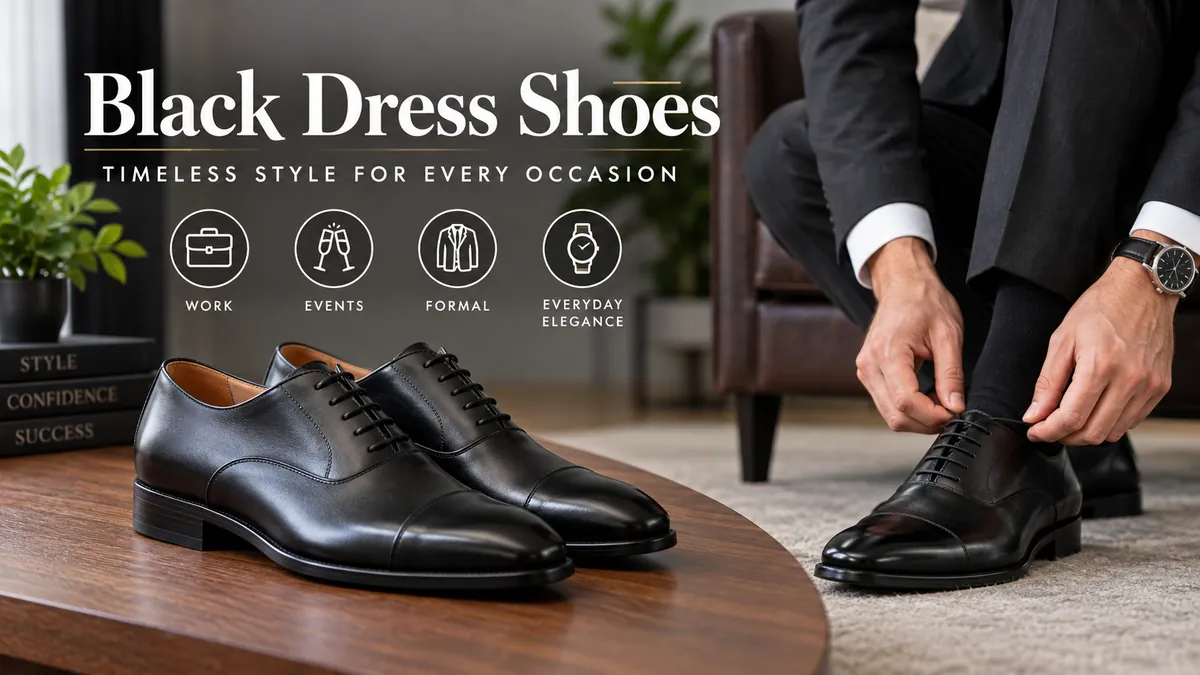
A pair of black shoes can look perfectly polished with one outfit and strangely out of place with another. The difference usually comes down to the shoe’s design, leather, decoration, sole, and the formality of the clothes around it.
Black dress shoes are refined footwear designed for formal, professional, business, and smart-casual clothing. Common styles include Oxfords, Derbies, loafers, monk straps, and dress boots. Smooth black leather, minimal decoration, a streamlined shape, and a thin sole generally make a shoe more formal, while broguing, heavier soles, and relaxed shapes make it less formal.
Understanding those details makes choosing black footwear much easier. Instead of relying on labels alone, you can look at the construction of a shoe and judge where it belongs.
What Are Black Dress Shoes?
Black dress shoes are polished footwear intended primarily for tailored, business, semi-formal, or formal clothing. The category includes several shoe families rather than one specific design.
Traditional examples are made from smooth leather and use a relatively refined last—the three-dimensional form around which a shoe is constructed. Modern versions may also use patent leather, suede, synthetic materials, or rubber components.
For men’s footwear, the most familiar categories are:
- Oxford shoes
- Derby or Blucher shoes
- Loafers
- Monk straps
- Dress boots
- Chelsea boots in suitably refined designs
Terms such as brogue, wingtip, cap toe, and plain toe need a little more explanation. They often describe the toe or decoration rather than an entirely separate fastening system or shoe family. Broguing, for example, refers to decorative perforations that can appear on an Oxford or Derby.
Black itself also influences formality. Because it is neutral, restrained, and traditionally associated with formal evening and business clothing, black generally looks dressier than lighter brown, tan, or more colorful footwear.
Types of Black Dress Shoes and How They Differ
The easiest way to identify black dress shoes is to start with their fastening system and then look at the toe, decoration, material, and sole.
| Style | Main identifying feature | Typical formality | Common use |
|---|---|---|---|
| Oxford | Closed lacing | Very formal | Suits, business, formal events |
| Derby/Blucher | Open lacing | Formal to smart casual | Office, suits, tailored separates |
| Wholecut | Upper cut mainly from one piece | Very formal | Formal business, evening events |
| Monk strap | Buckle closure | Formal to smart casual | Business, weddings, tailored outfits |
| Loafer | Slip-on construction | Semi-formal to smart casual | Office, weddings, social occasions |
| Brogued shoe | Decorative perforations | Varies | Business and smart casual |
| Dress boot | Ankle-height refined construction | Varies | Business and cooler-weather tailoring |
| Chelsea boot | Elastic side panels | Smart casual to dressy | Tailored casual outfits |
These categories overlap. A black Oxford can have broguing, for instance, while a black Derby can have a cap toe.
Oxford Shoes
The Oxford is one of the most recognizable formal shoes. Its defining characteristic is closed lacing: the eyelet tabs are attached beneath the vamp rather than sitting freely on top of it. This produces a clean, streamlined appearance.
Black Oxfords are especially useful with suits and traditional business clothing.
Within the Oxford family, decoration changes the level of formality.
A plain-toe Oxford has almost no visual interruption and therefore looks exceptionally clean. A cap-toe Oxford adds a horizontal seam across the toe but remains highly appropriate for professional clothing. Brogued Oxfords introduce perforated decoration and generally move slightly down the formality scale.
For someone trying to understand classic men’s black dress shoes, a smooth-leather black Oxford is the reference point against which many other designs can be compared.
Derby and Blucher Shoes
Derbies look similar to Oxfords until you examine the lacing.
A Derby uses open lacing, meaning its eyelet tabs sit on top of the vamp rather than being closed underneath it. That creates a more relaxed appearance and allows the lacing area to open more freely.
This small construction difference has practical consequences. Derby shoes can be easier to accommodate for some feet, particularly when more adjustment is needed over the instep.
They are also slightly less formal than comparable Oxfords.
A sleek black leather Derby can still look perfectly professional with a business suit. Add a chunkier sole, wider shape, grainy leather, or extensive broguing, however, and it moves toward business-casual or smart-casual territory.
Wholecut Black Shoes
A wholecut is usually made with an upper cut primarily from a single piece of leather, resulting in very few visible seams.
That minimalism gives the shoe an exceptionally clean appearance.
Wholecuts are often Oxfords, although “wholecut” technically describes how the upper is constructed rather than simply the lacing system.
A smooth black wholecut with a refined sole works especially well when understated formality is the goal.
Monk Strap Shoes
Monk straps replace traditional laces with one or two buckled straps.
A single monk has one strap and buckle, while a double monk uses two.
They occupy useful middle ground. They are more distinctive than conservative Oxfords without becoming inherently casual.
A streamlined black single monk with minimal decoration can complement a suit. Chunkier double monks or heavily brogued versions tend to work better with less formal tailoring.
Black Loafers
Loafers have no laces. You simply slip the foot into the shoe.
Common variations include:
- Penny loafers
- Tassel loafers
- Bit loafers
- Dress loafers
- Formal evening loafers
Their formality varies enormously.
A chunky penny loafer with a thick rubber sole is very different from a slim black leather or patent evening loafer. That is why “loafer” alone does not tell you whether a shoe is appropriate for a particular dress code.
For normal business and smart-casual clothing, sleek leather loafers can be an elegant alternative to lace-ups. Traditional black-tie conventions are more restrictive, although formal pumps and suitably refined evening loafers have their own place in evening dress.
Brogues and Wingtips
One of the most persistent footwear misconceptions is that every brogue represents its own fundamental shoe type.
Broguing is decoration.
The term refers to perforations punched into the leather. Those perforations can decorate an Oxford, Derby, or other shoe.
Common levels include quarter brogues, semi-brogues, full brogues, and longwings. A full brogue commonly features the familiar W-shaped wingtip design across the toe.
As a general rule, more decoration makes a shoe appear less formal.
So a plain black Oxford is typically dressier than a heavily brogued black Oxford, even though both share the same closed-lacing construction.
How Formal Are Black Dress Shoes?
Color is only one part of shoe formality.
A useful principle is:
dark + smooth + simple + slim = more formal
Black already provides the dark component. The remaining features determine where an individual shoe sits on the spectrum.
Shoes tend to look more formal when they have smooth leather, minimal stitching, little or no broguing, a refined toe, a thinner sole, discreet laces, and an uncluttered upper.
They become progressively more casual as you add heavy perforations, contrasting stitching, suede, thick rubber soles, rugged welts, oversized shapes, or pronounced texture.
A simplified men’s formality spectrum looks something like this:
Patent evening shoe → plain/wholecut Oxford → cap-toe Oxford → sleek Derby → monk strap → refined loafer → heavily brogued shoe → chunky loafer
This isn’t a rigid mathematical ranking. Two shoes from different categories can switch places depending on their design.
What Are the Most Formal Black Dress Shoes?
For conventional formal dressing, black Oxfords with minimal decoration remain among the safest options.
Patent leather raises the level further for traditional evening wear.
For a tuxedo and true black-tie dress code, traditional footwear includes black patent opera pumps and black lace-up Oxfords in patent leather or highly polished calfskin. Decorative broguing and casual open-laced shoes are traditionally avoided.
That distinction matters because “black” does not automatically mean “black tie.”
A chunky black Derby may be black and technically dressy, yet still look too casual beside a tuxedo.
Black Dress Shoes for Different Occasions
Choosing footwear becomes simpler when you judge the event first and the shoe second.
| Occasion | Reliable black shoe | What to watch |
|---|---|---|
| Black tie | Patent or highly polished formal Oxford | Avoid heavy broguing and chunky soles |
| Formal wedding | Oxford or refined Derby | Match the overall dress code |
| Business formal | Cap-toe or plain Oxford | Keep decoration restrained |
| Job interview | Conservative Oxford or Derby | Clean, polished condition matters |
| Business casual | Derby, loafer, monk strap | Avoid an overly ceremonial look |
| Smart casual | Loafer, Derby, Chelsea boot | Balance shoes with relaxed clothing |
| Funeral | Simple black Oxford or Derby | Understatement is preferable |
With a Business Suit
A black cap-toe Oxford is a traditional match for conservative business tailoring.
Black Derbies can also work, particularly when the workplace isn’t exceptionally formal. Monk straps and certain refined loafers are possibilities in more flexible professional environments.
The key is visual consistency.
A sharply tailored charcoal suit and crisp dress shirt usually look better with streamlined footwear than with a thick, rugged shoe.
For a Job Interview
The objective with interview footwear is normally to look polished without making the shoes the focal point.
A simple black Oxford or Derby accomplishes that well in traditional professional industries. Current interview style guidance similarly treats black shoes as a conservative formal option.
Condition matters as much as style. Scuffed toes, dirty welts, badly frayed laces, or neglected leather can undermine an otherwise carefully prepared outfit.
For Weddings
Wedding footwear depends on the dress code.
A formal evening wedding may call for highly polished black footwear, while a daytime semi-formal wedding leaves considerably more freedom.
If you’re wearing a dark suit, Oxfords, Derbies, monk straps, and certain loafers can all work depending on the event.
For Black Tie
Black tie is where traditional rules become much narrower.
A tuxedo calls for black formal footwear. Patent leather is traditionally associated with evening dress, while highly polished black calfskin Oxfords are a widely recognized alternative.
Keep the design sleek.
Heavy wingtips, rugged rubber soles, casual suede, and chunky everyday footwear fight against the clean lines of a dinner suit.
Quick Takeaway: Don’t choose formal shoes by color alone. Look at the complete design. A plain black Oxford and chunky black brogue may share a color while belonging to very different levels of dress.
What Colors Can You Wear With Black Dress Shoes?
Black footwear is often described as universally versatile, but some combinations are stronger than others.
Black Shoes With a Black Suit
This is the simplest pairing.
Black shoes preserve the monochromatic formality of a black suit and are the standard choice when the occasion itself calls for conservative dress.
Keep the belt black when wearing a conventional leather belt.
Black Shoes With a Charcoal or Gray Suit
Charcoal and black are natural partners.
Black footwear maintains the seriousness of charcoal tailoring, making the combination useful for business, ceremonies, funerals, and evening occasions.
Medium gray also works well and provides slightly more contrast.
Can You Wear Black Shoes With a Navy Suit?
Yes.
Black shoes with navy tailoring create a conservative, professional combination. This is especially effective when the navy is dark and the occasion is business-oriented or formal.
Dark brown footwear can make navy appear warmer and slightly less severe, whereas black keeps the overall effect sharper.
Black Shoes With Chinos
This requires more judgment.
Chinos are inherently more relaxed than formal trousers. A highly polished black wholecut Oxford can therefore look too severe.
A black Derby, loafer, or less formal brogued shoe usually creates a smoother transition.
The same principle applies to jeans: instead of asking only whether black shoes “match,” ask whether the formality levels of the shoes and trousers make sense together.
How to Choose the Right Black Dress Shoes
Once you’ve identified the appropriate style, pay attention to material, shape, fit, construction, and sole.
These characteristics affect comfort and longevity as well as appearance.
Start With the Upper Material
Smooth calfskin is a classic material for traditional dress footwear because it can produce a clean surface and respond well to polishing.
Full-grain leather retains the natural grain surface and can develop character with use. Quality depends on much more than a marketing label, however, including hide selection, tanning, clicking, construction, and finishing.
Patent leather has a glossy coated surface. Its pronounced shine makes it particularly associated with formal evening footwear.
Suede has a soft, textured surface and generally reads as more casual, even when the shoe itself has an elegant shape.
Synthetic uppers vary considerably in appearance, breathability, flexibility, and durability.
Look at the Toe Shape
Toe shape strongly affects how dress shoes look on the foot.
Common options include:
- Round toe
- Almond toe
- Soft square toe
- Pointed toe
- Chisel toe
A moderate round or almond shape is usually the easiest to wear across changing fashions.
Extremely long pointed toes can look disproportionate, while aggressively squared shapes can make an otherwise refined shoe appear heavier.
The shape should also suit your actual foot. A stylish silhouette isn’t useful if your toes are being compressed inside it.
Understand the Sole
Traditional dress shoes frequently use leather soles, but rubber is now common across many levels of footwear.
Leather soles can create a slim, elegant profile and are strongly associated with classic shoemaking. Their disadvantages can include reduced grip on some wet or polished surfaces and greater sensitivity to prolonged moisture.
Rubber soles generally provide better traction and weather resistance.
A thin, discreet rubber sole can still look highly refined. A thick lug sole changes the character considerably and pushes the shoe toward casual territory.
Understand Shoe Construction
Construction describes how the upper, insole, and outsole are assembled.
You may encounter terms such as:
Goodyear welt: A welt helps connect the upper and sole structure. This method is associated with many traditionally made, potentially resoleable shoes.
Blake stitch: The outsole is stitched more directly through the shoe’s interior structure. Blake-stitched footwear can achieve a slim, flexible profile.
Cemented construction: The sole is attached primarily with adhesive. This can make production simpler and lighter, although repairability depends on the individual shoe.
Construction alone doesn’t prove quality. A well-made cemented shoe can outperform a poorly executed welted one.
Instead, treat construction as one piece of evidence alongside leather quality, finishing, fit, internal components, and workmanship.
How Should Black Dress Shoes Fit?
Good dress shoes should feel secure without creating painful pressure.
Your heel should remain reasonably stable as you walk. The widest part of your foot should correspond with the widest portion of the shoe, and your toes need enough space to sit naturally.
Do not rely on the idea that painfully tight leather shoes will eventually “stretch into the right size.”
Leather can soften and conform somewhat with wear, but the underlying length and structure of the shoe will not magically become a different size.
Try Shoes at a Realistic Time
Feet can change slightly in volume over the course of a day, so testing footwear later rather than immediately after waking can provide a more realistic impression.
Wear the type of socks you expect to use with the shoes.
Then walk.
Pay attention to:
- Heel movement
- Toe pressure
- Pressure across the ball of the foot
- Instep tightness
- Arch position
- Flex point
- Left-to-right differences
Sizing labels are only a starting point. Different lasts from the same manufacturer can fit differently.
Oxford vs. Derby Fit
People with a higher instep or who need more adjustment across the top of the foot may sometimes find open-laced Derbies easier to accommodate.
Closed-laced Oxfords create a cleaner visual line but can be less forgiving when the last does not match the wearer’s foot.
That doesn’t mean wide feet cannot wear Oxfords. The solution is finding the appropriate last and width rather than simply choosing a larger size.
Quick Takeaway: Fit the shoe to the foot you have, not the size printed on another pair in your wardrobe. Last shape and width can matter just as much as nominal length.
How to Tell if Black Dress Shoes Are Well Made
Price is not a perfect measure of quality.
Instead, inspect the actual shoe.
Start with the leather. Look for consistency and examine how the material bends when the shoe is flexed naturally. Then inspect stitching, seams, edge finishing, lining, heel attachment, and the transition between upper and sole.
Ask practical questions:
Does the shoe flex where your foot flexes?
Does the heel feel stable?
Are the two shoes symmetrical?
Is the interior smooth around pressure points?
Can the sole realistically be repaired or replaced?
Does the shape fit your foot?
A beautifully constructed shoe on the wrong last is still the wrong shoe.
Don’t Confuse Stiffness With Quality
New leather footwear may feel structured, but extreme stiffness isn’t automatically evidence of superior craftsmanship.
Likewise, immediate softness does not necessarily indicate poor construction.
Comfort comes from a combination of last design, upper material, lining, insole, sole flexibility, heel structure, and correct sizing.
A short break-in period is normal for some traditionally constructed shoes. Significant pain is not something you should accept as part of the process.
How to Care for Black Dress Shoes
Black leather has one major practical advantage: regular maintenance can restore much of its visual depth and shine.
The basic routine is straightforward.
- Brush away surface dirt. Use a clean horsehair shoe brush, particularly around seams and the welt.
- Clean when necessary. Don’t aggressively strip the leather every time you wear it.
- Condition periodically. Leather conditioner helps maintain flexibility when the upper begins feeling dry.
- Apply black shoe cream. Cream can nourish the surface while refreshing color and covering minor scuffs.
- Polish strategically. Wax polish can produce a higher shine, particularly around the toe and heel.
- Let the shoes rest. Avoid wearing the same leather pair continuously when possible.
- Use shoe trees. Properly sized cedar or wooden shoe trees can help absorb moisture and maintain shape.
- Store them dry. Don’t trap damp shoes in an unventilated space.
Black leather shoes do require polishing and maintenance to preserve their appearance.
How Often Should You Polish Them?
There is no useful universal schedule.
Someone walking several kilometers through a rainy city will need to maintain shoes differently from someone who wears them twice a month indoors.
Use their condition as the guide.
Brush frequently. Apply cream when the leather looks dry, faded, or lightly scuffed. Use wax when you want additional protection or shine.
Too much product can build up, so more polish is not necessarily better.
What About Patent Leather?
Patent leather needs different treatment from ordinary smooth calfskin.
Its glossy coating creates the characteristic mirror-like surface, so traditional wax-polishing techniques designed for regular leather are generally unnecessary.
Remove dust gently and use products specifically suitable for patent surfaces. Avoid harsh abrasives that could damage or cloud the finish.
Common Mistakes With Black Dress Shoes
The most frequent mistake is assuming that every black shoe is formal.
It isn’t.
A chunky lug-sole loafer and a patent Oxford communicate completely different levels of formality despite sharing the same color.
Another mistake is treating brogues, wingtips, and Oxfords as mutually exclusive categories. Remember that Oxford and Derby describe fundamental construction around the lacing, while broguing describes decorative perforations.
Other mistakes are more practical:
- Wearing heavily scuffed shoes with formal tailoring
- Using the wrong shoe size to compensate for an unsuitable width
- Choosing an excessively long or bulky toe
- Wearing thick casual socks with refined formal footwear
- Ignoring the dress code of the event
- Pairing very formal Oxfords with extremely casual clothing
- Applying excessive polish without cleaning old buildup
- Wearing damp leather shoes again before they have dried
- Assuming expensive shoes automatically fit better
One especially useful habit is to view shoes as part of the entire outfit rather than as an isolated accessory.
Are Black Dress Shoes Still Versatile?
Yes, but their versatility comes primarily from formality, not from working equally well with every casual outfit.
Black remains one of the strongest footwear colors for dark suits, professional clothing, formal ceremonies, interviews, evening events, and traditional dress codes.
Brown and burgundy footwear may provide more flexibility with casual chinos, denim, earthy colors, and textured tailoring. Black’s strength is different: it creates a cleaner, sharper, more restrained impression.
For someone who regularly wears dark business suits or attends formal occasions, that makes black exceptionally useful.
The most versatile design within the category is usually something restrained enough for tailoring without being overly ceremonial. A black cap-toe Oxford is a classic example for formal and business wardrobes, while a sleek black Derby offers a little more flexibility for less formal settings.
Choosing Black Dress Shoes With Confidence
The easiest way to understand black dress shoes is to stop treating them as a single type of footwear.
First identify the construction: Oxford, Derby, loafer, monk strap, or boot. Then consider the upper material, toe shape, broguing, sole thickness, finish, and overall silhouette. Those details reveal how formal the shoe really is.
For traditional formal dressing, smooth black Oxfords with minimal decoration remain a dependable benchmark. For everyday professional use, Oxfords and sleek Derbies provide plenty of range. Loafers, monk straps, brogued designs, and refined boots extend that range into less formal clothing.
Above all, prioritize correct fit and appropriate formality. A modest pair that fits properly, suits the occasion, and receives regular care will usually look better than an expensive pair chosen purely for its label.