
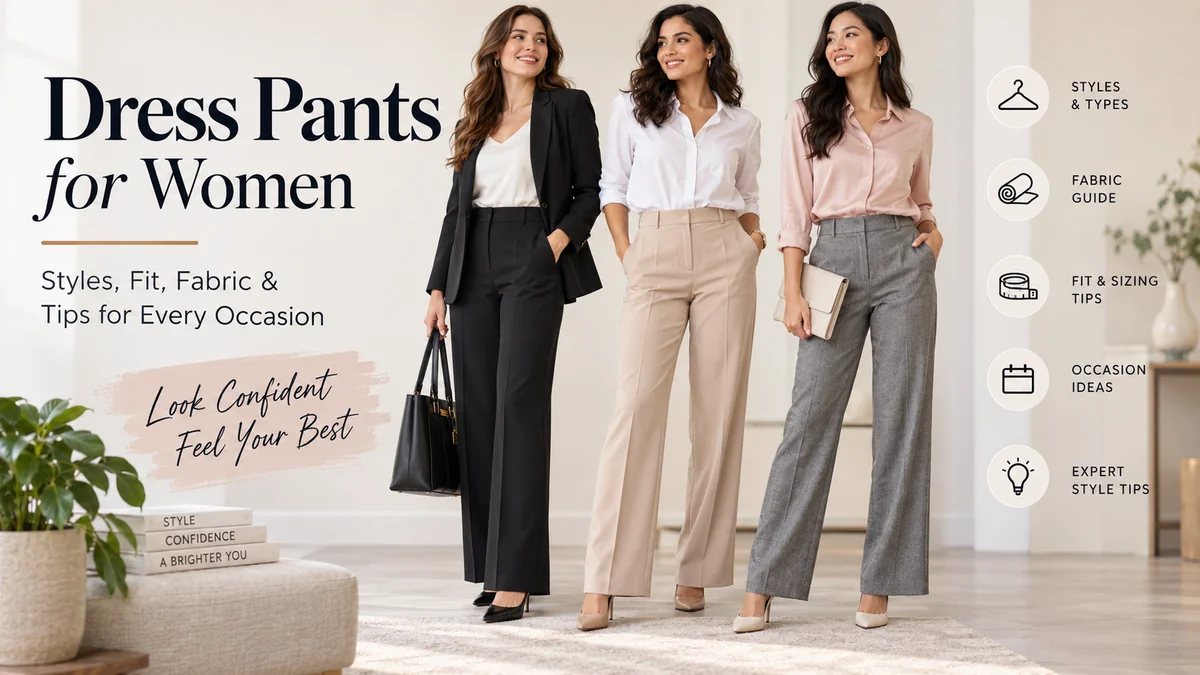
Finding dress pants for women that look polished is easy in theory. Finding a pair that sits smoothly at the waist, fits comfortably through the hips, hangs cleanly through the legs, and still feels good after several hours is much harder.
The difference usually comes down to a few details: rise, inseam, silhouette, fabric, waistband construction, and how the trousers interact with your shoes. Modern women’s trousers range from traditional wool-blend tailoring to stretch ponte and relaxed wide-leg designs, so understanding these elements is more useful than relying on a size number alone.
Dress pants for women are tailored or semi-tailored trousers designed to create a polished appearance for work, business-casual, formal, and smart everyday settings. Common styles include straight-leg, wide-leg, tapered, bootcut, flare, and ankle pants, while fabrics range from wool and crepe to polyester, viscose, cotton, linen, and stretch blends.
What Are Dress Pants for Women?
Dress pants occupy the space between casual everyday pants and highly formal clothing. They’re often called trousers, tailored pants, work pants, suit pants, or slacks, although these terms can describe slightly different garments depending on the brand and region.
What separates dress pants from jeans or casual leggings is primarily their construction and fabric.
Typical details include:
- A structured or partially structured waistband
- Front or back darts
- Pressed creases
- Pleated or flat-front construction
- Welt, slash, or side-seam pockets
- Belt loops or a clean waistband
- Tailored hems
- Woven suiting fabric or polished knit material
- A defined rise and carefully shaped hip area
Some contemporary designs use elasticated or pull-on waistbands while preserving a tailored appearance. This approach has become particularly useful for people who want workwear that combines stretch and freedom of movement with a professional silhouette.
The term “dress pants” therefore describes a category rather than one specific cut.
Dress Pants for Women Styles Explained
Leg shape has one of the biggest effects on how trousers look and move. Modern tailoring includes straight, wide, tapered and slim silhouettes, while bootcut and flare designs remain useful alternatives.
Here’s how the main styles differ.
| Style | Shape | Typical Appearance | Length Consideration |
|---|---|---|---|
| Straight-leg | Similar width toward hem | Classic and balanced | Usually full or ankle length |
| Wide-leg | Roomy from hip downward | Fluid and relaxed | Precise hemming matters |
| Tapered | Narrows toward ankle | Clean and streamlined | Often ankle length |
| Slim | Follows leg more closely | Sharp and fitted | Avoid excess bunching |
| Bootcut | Fitted above knee, wider below | Subtle flare | Usually works best longer |
| Flare | Noticeably expands below knee | Defined silhouette | Hem should coordinate with shoes |
| Ankle | Ends near ankle | Modern and versatile | Intentionally shorter |
| Cropped | Ends above ankle | Relaxed or contemporary | Proportion is especially important |
Straight-Leg Dress Pants
Straight-leg pants maintain a relatively consistent line toward the hem rather than narrowing sharply or dramatically flaring outward.
They’re one of the easiest styles to incorporate into a professional wardrobe because the silhouette is neither particularly fitted nor oversized. COS describes its straight trouser silhouette as having more room through the thigh and a straight shape at the ankle.
A properly fitted pair should fall smoothly rather than gripping the calf or creating excessive folds around the ankle.
Straight trousers also accommodate a broad range of footwear, including loafers, flats, pumps, ankle boots, and minimalist sneakers where the dress code allows them.
Wide-Leg Dress Pants
Wide-leg trousers provide considerably more room through the leg and rely heavily on drape.
They can have:
- High or mid rises
- Flat or pleated fronts
- Structured or fluid fabrics
- Full or cropped lengths
- Conventional or elasticated waistbands
Because there’s more fabric below the hip, length becomes particularly noticeable. A full-length wide-leg trouser generally looks cleaner when the fabric approaches the shoe without dragging on the floor.
Wide-leg dress pants shouldn’t automatically be confused with palazzo pants. Palazzo designs are typically very wide and flowing, while tailored wide-leg trousers can have considerably more structure.
Tapered and Slim Dress Pants
Tapered trousers gradually narrow toward the ankle.
This creates a neat lower-leg profile and makes the shoes more visible. Slim pants follow the body more closely but shouldn’t necessarily fit as tightly as skinny jeans.
Watch the thigh area carefully. If horizontal wrinkles appear across the hips or upper thighs, the garment may be too tight even when the waistband seems correct.
Bootcut and Flare Pants
Both silhouettes widen toward the bottom, but the degree differs.
A bootcut usually has a modest opening below the knee. Flared trousers create a more noticeable expansion.
Because the bottom of the pants is wider, these styles generally need enough length to preserve the intended line. Pants that are dramatically too short can make the flare appear disconnected from the rest of the silhouette.
Pleated vs. Flat-Front Dress Pants
Pleats introduce controlled folds of fabric at the front waistband.
They provide additional volume around the hip and upper thigh while also changing the visual character of the trousers. Current wide-leg tailoring frequently combines a high rise with front pleats.
Flat-front trousers remove that additional volume and create a smoother front.
Neither construction is universally better. The choice depends on the desired silhouette, fabric, and how the trousers fit your waist-to-hip proportions.
Quick Takeaway: Start with leg shape rather than trends. Straight-leg trousers offer a neutral silhouette, wide-leg pants prioritize drape and room, tapered styles create a narrow ankle, and bootcut or flare trousers widen below the knee.
How Should Dress Pants for Women Fit?
A good fit isn’t simply “tight enough to stay up.”
Dress pants need enough ease for sitting, walking, bending, and climbing stairs while maintaining the clean lines associated with tailoring.
A well-fitting pair should generally:
- Sit securely at its intended waist position.
- Lie relatively smoothly through the front.
- Follow the hips without pulling sharply.
- Provide enough room through the seat for sitting.
- Hang cleanly through the thighs.
- Keep the crotch area smooth rather than excessively tight or dropped.
- Finish at an intentional length.
- Remain comfortable while you’re moving.
Petite Dressing similarly recommends a waist that isn’t excessively tight or loose and enough room through the seat to sit comfortably.
How Should the Waist Fit?
You shouldn’t have to continuously pull your trousers upward throughout the day.
At the same time, the waistband shouldn’t dig deeply into your body when sitting.
A small waistband gap at the back can occur when someone’s waist-to-hip ratio doesn’t closely match the proportions used by a particular pattern. Going down a size isn’t necessarily the answer because that can make the hips too tight.
This is where tailoring can be valuable. Taking in a waistband is generally more realistic than trying to create room where insufficient fabric exists.
How Should Dress Pants Fit Around the Hips?
The fabric should follow your hips without creating strong horizontal tension lines.
Look at the pants from the front, side, and back.
Common warning signs include:
- Pockets pulling open
- Deep horizontal wrinkles
- Fabric pulling toward the crotch
- Side seams moving forward
- Excess material collapsing beneath the seat
- A visibly strained zipper or closure
Don’t judge fit while standing still alone. Sit in a chair and walk around for a few minutes.
A pair that looks perfect while standing but becomes uncomfortable the moment you sit isn’t properly fitted for everyday use.
What Should the Crotch and Rise Look Like?
The rise describes the vertical relationship between the crotch and waistband.
Rise and leg shape are two fundamental variables in trouser construction.
A rise that’s too short can cause pulling through the crotch and make the waistband feel restrictive. An excessively long rise can produce sagging or folds through the front.
This dimension deserves particular attention because rise alterations can be more complicated than simple hemming. Petite Dressing specifically identifies rise as an important fit factor that’s difficult for a tailor to correct later.
High-Rise vs. Mid-Rise vs. Low-Rise Dress Pants
Rise describes where the waistband sits relative to your body.
High-rise
High-rise pants sit around or above the natural waist.
They’re frequently paired with wide-leg, pleated, flare, and tailored silhouettes. They can also work particularly well with tucked shirts because the higher waistband creates a clearly defined transition between the top and trousers.
Mid-rise
Mid-rise pants sit lower than the natural waist but higher than traditional low-rise trousers.
For many people, this is an adaptable middle ground. It works across straight, tapered, bootcut, and wider silhouettes without making the waistband the dominant feature of an outfit.
Low-rise
Low-rise trousers sit lower around the hips.
They change both the visual proportions of the outfit and the amount of coverage through the torso. Because rise interacts with torso length and body proportions, the same measurement can look and feel different from one person to another.
Rather than assuming high-, mid-, or low-rise is inherently more flattering, prioritize where the waistband feels secure and where the crotch seam naturally sits.
How Long Should Dress Pants for Women Be?
There’s no universal ideal inseam.
The right length depends on three variables:
leg shape + shoe height + intended silhouette.
That’s why choosing trousers exclusively from an inseam number can be misleading.
Straight-leg length
Full-length straight pants should generally hang without excessive stacking over the foot.
A slight interaction with the shoe can work, but multiple folds around the ankle usually indicate unnecessary length.
Wide-leg length
Full-length wide-leg trousers can extend close to the floor, but they shouldn’t drag.
A practical reference point is approximately ½ to 1 inch from the floor for some full-length styles, although shoe design and trouser width will change the ideal result. Petite Dressing uses a similar guideline for petite wide-leg trousers.
The front of the shoe can remain partially visible.
Tapered and ankle length
Tapered trousers often look cleanest when the hem finishes around the ankle instead of collecting on top of the shoe.
Because the opening is narrow, even a relatively small amount of extra length can cause bunching.
Bootcut and flare length
These usually work better at a longer length.
The hem can cover much of the shoe while remaining high enough to avoid touching the ground. The wider the flare, the more noticeable incorrect hemming becomes.
Always test trousers with your actual shoes
This is one of the most practical dress-pant fitting habits.
Try full-length pants with the type of footwear you’ll actually use. Trousers hemmed for flats may appear noticeably shorter with heels, while pants hemmed around heels can drag when worn with flats.
If you regularly switch between substantially different heel heights, one trouser length may not work perfectly with both.
Choosing Dress Pants for Women by Fabric
Fabric changes virtually everything about trousers: structure, stretch, warmth, breathability, wrinkle resistance, drape, care requirements, and how formal they appear.
Wool and Wool Blends
Wool is a traditional suiting fiber because it can produce structured tailoring while maintaining an elegant drape.
Different wool fabrics vary enormously in weight and texture. Lightweight wool can work across several seasons, while heavier cloth is better suited to cold weather.
Blending wool with synthetic fibers can increase durability or reduce maintenance.
Check the care label carefully. Wool fibers can react poorly to heat and aggressive agitation, potentially causing irreversible shrinkage or felting.
Polyester
Polyester is common in work pants because it tends to be durable and relatively resistant to wrinkling.
Its characteristics depend heavily on fabric construction and what other fibers are blended with it.
Polyester trousers can be useful when easy maintenance matters, although some fabrics may retain heat or develop static more readily than natural fibers.
High ironing temperatures should also be avoided because excessive heat can damage synthetic fibers.
Viscose and Rayon
Viscose and rayon can give trousers a softer, more fluid drape.
They’re particularly useful in relaxed tailoring and wide-leg designs where movement is part of the desired appearance.
However, some regenerated cellulose fabrics become substantially weaker when wet, so laundering instructions deserve attention.
Cotton
Cotton provides breathability and can create anything from crisp structured trousers to relaxed chinos.
Cotton dress pants often occupy the boundary between business casual and traditional formal tailoring. Blending cotton with a small amount of elastane can add useful flexibility.
Linen
Linen is breathable and particularly useful in warm climates.
Its defining trade-off is wrinkling. Rather than expecting linen trousers to remain perfectly smooth all day, understand that natural creasing is part of the fabric’s character.
A linen blend can provide some of the breathability while reducing the severity of wrinkling.
Ponte
Ponte is a dense knit commonly made with a combination of synthetic or regenerated fibers and stretch.
Unlike thin leggings material, good ponte has enough substance to create a relatively smooth silhouette while remaining flexible.
Ponte dress pants can therefore be useful for long workdays, commuting, travel, or anyone who prioritizes freedom of movement. The trade-off is that a knit typically looks softer than crisp woven suiting.
Elastane or Spandex
Elastane is normally blended into another fabric rather than used by itself.
Even a modest stretch component can improve mobility and recovery, particularly in slim or fitted pants.
More stretch isn’t automatically better. Excessive elasticity can move the garment away from a traditional tailored appearance, while high dryer temperatures and chlorine bleach may shorten the life of elastane fibers.
Quick Takeaway: Choose wool or structured woven fabric for classic tailoring, polyester blends for easy maintenance, linen for warm conditions, fluid viscose for drape, and ponte or stretch blends when mobility is the priority.
Dress Pants for Women for Work and Business Casual Settings
The appropriate trouser depends partly on workplace expectations.
A conservative professional environment may call for traditional tailoring: neutral colors, restrained leg shapes, pressed creases, structured waistbands, and suiting fabrics.
Business-casual workplaces usually allow much greater flexibility.
That can include:
- Wide-leg trousers
- Cropped tailored pants
- Ponte pants
- Pleated trousers
- Belted pants
- Subtle patterns
- Relaxed tailoring
- Loafers or polished flats
Black, navy, charcoal, brown, camel, beige, and gray remain versatile because they’re easy to coordinate with shirts, blouses, knitwear, jackets, and blazers.
But color alone doesn’t determine formality.
A sharply tailored cream trouser can appear considerably more polished than poorly fitted black pants. Construction, fabric, fit, and styling work together.
Can dress pants be worn casually?
Yes.
Tailored trousers don’t need to stay inside an office wardrobe.
Straight or wide-leg trousers can be combined with a simple T-shirt, knit top, cardigan, casual button-down, or clean sneakers to reduce their formality.
This versatility is one reason tailored trousers can function effectively in a capsule wardrobe. Contemporary fashion coverage increasingly treats polished trousers as an alternative to jeans for everyday outfits rather than strictly office clothing.
How to Find Dress Pants for Petite Women
Petite sizing isn’t simply regular sizing with several inches removed from the hem.
Well-designed petite pants can adjust the rise, knee position, pocket scale, and overall proportions as well as inseam. A recent petite fit guide emphasizes that knee placement and rise can be just as significant as overall length.
That’s an important distinction.
If regular trousers are merely hemmed, the knee break may remain too low and the rise can still feel wrong.
What inseam works for petite women?
There isn’t one correct petite inseam because style and shoe height change the required length.
As a rough reference, recent petite fashion guidance places many pants somewhere around the mid-to-upper 20-inch range, with longer measurements needed for full-length wide-leg styles.
Treat those measurements as starting points rather than rules.
Someone who is 5’3″ can have longer legs than another person of the same height because overall height doesn’t reveal torso-to-leg proportions.
Measure a pair of trousers you already like.
Lay them flat and measure from the crotch seam down the inside leg to the hem. That gives you a useful personal inseam reference for comparing size charts.
Dress Pants for Tall Women
Tall shoppers face the opposite problem: pants that technically fit around the waist and hips but unintentionally look cropped.
Look beyond a generic “tall” label and check the actual inseam.
Also pay attention to:
- Rise depth
- Knee placement
- Pocket positioning
- Distance from waist to hip
- Overall leg proportions
Full-length wide-leg and flare trousers are particularly sensitive to insufficient length because their silhouettes depend on where the hem meets the shoe.
A tall-specific pattern is often preferable to simply sizing up, since a larger size changes circumference as well as length.
Dress Pants for Curvy and Plus-Size Figures
For curvier proportions, prioritize how the waist and hip measurements relate to each other rather than focusing on the size printed on the label.
If pants fit the hips but leave a substantial gap at the waist, a curvy-specific cut may provide a better starting point.
Features worth checking include:
- Contoured waistbands
- Adequate hip and thigh room
- Properly positioned darts
- Stretch recovery
- Pocket placement
- Rise depth
- Stable waist construction
Wide-leg doesn’t automatically mean better, nor does slim automatically mean worse. The goal is a silhouette that hangs correctly from your individual proportions without pulling or collapsing.
If alterations are necessary, choose pants that fit the largest or hardest-to-alter area correctly first. Removing excess fabric is usually more practical than trying to create material that isn’t there.
How to Measure Yourself for Women’s Dress Pants
Online size labels aren’t standardized enough to replace measurements.
You’ll get better results by recording at least your waist, hip, rise preference, and inseam.
1. Measure your waist
Measure around the location where you want the waistband to sit.
Don’t pull the tape excessively tight.
2. Measure your hips
Measure around the fullest portion of your hips and seat while keeping the tape approximately level.
3. Determine your preferred rise
Instead of relying entirely on labels such as “high rise,” compare the actual rise measurements of pants you already own.
The same advertised rise can sit differently depending on body proportions and garment construction.
4. Measure your inseam
Measure from the crotch seam to your preferred hem position.
For the easiest reference, measure trousers you already own that have the right length.
5. Consider your shoes
Decide whether the pants will primarily be worn with flats, loafers, sneakers, boots, pumps, or heels before finalizing the hem.
This matters most with full-length wide-leg, bootcut, and flared trousers.
Signs Your Dress Pants Don’t Fit Properly
Some fitting problems are easy to mistake for problems with your body or with an entire trouser style.
Often, it’s simply the wrong size, rise, or pattern.
| Problem | Possible Cause |
|---|---|
| Waistband digs in | Waist too small or unsuitable rise |
| Large gap at back waist | Waist-to-hip proportion mismatch |
| Pockets flare open | Insufficient room through hips |
| Horizontal thigh wrinkles | Thigh area may be too tight |
| Fabric pools at ankles | Inseam too long |
| Crotch pulls upward | Rise may be too short |
| Excess fabric under seat | Seat/rise may be too large |
| Hem drags | Pants too long for chosen shoes |
| Knees sit too low | Garment proportions may be too long |
| Pants twist | Fit, grain, or construction issue |
Don’t automatically solve every problem by moving up or down one size.
For example, increasing the size to solve tight thighs can create an unnecessarily large waist. A different cut may fit much better.
Dress Pants Alterations That Make the Biggest Difference
Perfect off-the-rack trousers aren’t always realistic.
Simple tailoring can turn an almost-right pair into something much more useful.
Hemming
This is the most straightforward alteration and often makes the greatest visual difference.
Bring your intended shoes when deciding the final length.
Waist adjustment
A slightly loose waistband can often be taken in.
This is particularly useful when trousers fit correctly through the hips but have excess room around the waist.
Tapering
A tailor can sometimes narrow the lower leg to create a cleaner silhouette.
How much is possible depends on the original construction.
More complicated alterations
Major changes to the rise, crotch, hips, or overall balance can be significantly more difficult.
That’s why the best alteration strategy is to start with trousers that already fit correctly through the hardest-to-change areas and adjust simpler details such as waist or hem afterward.
How to Style Dress Pants for Women
Good styling begins with proportion rather than complicated fashion rules.
With a blouse or button-down
This is the traditional professional combination.
A full or partial tuck can define the waistband, particularly with high-rise pants.
With a blazer
Matching trousers create a coordinated suit, while contrasting pants and jackets produce a more relaxed tailored look.
With knitwear
Fine-gauge sweaters work particularly well with tailored trousers because the soft texture contrasts with structured fabric.
Bulkier knitwear can work too, especially with wide-leg pants, but pay attention to how much volume you’re creating above and below the waist.
With a T-shirt
A simple fitted or relaxed T-shirt can make formal trousers feel more casual.
The contrast between an everyday top and tailored bottoms creates an easy smart-casual outfit.
With flats and loafers
Straight, tapered, cropped, and ankle pants generally coordinate easily with flats.
For full-length wide-leg trousers, verify that the hem remains off the floor.
With heels
Heels change where long pants meet the ground.
If a pair of wide-leg, bootcut, or flare trousers will primarily be worn with heels, determine the final hem while wearing shoes of a similar height.
How Many Pairs of Dress Pants Do You Actually Need?
There’s no universal number.
A small working wardrobe can cover many situations if each pair serves a distinct purpose rather than duplicating the same silhouette.
For example, someone who regularly wears business-casual clothing might use:
- One neutral straight-leg pair
- One wide-leg or pleated pair
- One comfortable stretch or ponte pair
- One seasonal option in linen or warmer wool
- One alternative neutral or subtle pattern
Someone who wears formal business clothing five days a week may need considerably more.
Think in terms of rotation, climate, laundering frequency, and how many tops and jackets coordinate with each pair.
How to Care for Dress Pants
Never assume every pair of dress pants can be washed the same way.
Start with the garment’s care label. Fiber composition and internal construction matter more than how similar two pairs look.
Wool
Many wool trousers require gentle cleaning or professional dry cleaning.
If the label permits washing, avoid excessive heat and agitation because wool can felt and shrink.
Polyester blends
Many polyester-blend pants are washable, but high heat can be damaging.
Lower-temperature washing and drying may also help preserve stretch fibers when elastane is present.
Viscose
Handle wet viscose carefully because the fiber can lose significant strength when saturated. Aggressive agitation can increase distortion or damage.
Linen
Linen naturally wrinkles.
Rather than trying to eliminate every crease, focus on correct washing, drying, and pressing according to the care label.
Stretch fabrics
Avoid unnecessary high dryer temperatures.
Heat can gradually compromise elastane’s recovery, contributing to stretched knees or a waistband that doesn’t return to its original shape.
Hanging trousers carefully between wears can also reduce wrinkles and preserve the pressed line.
Common Mistakes When Choosing Dress Pants for Women
The most common mistake is buying based on the waistband alone.
A waistband can be altered relatively easily; an incorrect rise or severely tight hip area is much harder to solve.
Another mistake is choosing length without considering footwear. A wide-leg trouser that looks perfect with heels can drag several inches when switched to flats.
Also avoid assuming:
A larger size automatically solves pulling.
Sometimes you need a different cut rather than additional overall volume.
Petite means simply shorter.
True petite patterns may adjust rise, knee placement, and proportions as well as inseam.
Stretch guarantees comfort.
Stretch helps movement, but incorrect rise or waistband construction can still make trousers uncomfortable.
Black automatically looks professional.
Fit and fabric have a greater effect on polish than color alone.
Wide-leg pants should touch the ground.
A long silhouette can look intentional without the hem actually dragging.
A Simple Way to Choose the Right Pair
Instead of trying dozens of random trousers, narrow your requirements before evaluating fit.
Start with the setting. Decide whether you need conservative business tailoring, business-casual trousers, special-event pants, or polished everyday clothing.
Then choose your preferred silhouette: straight, wide, tapered, bootcut, flare, or cropped.
Next, consider climate and maintenance. Wool may make sense for classic tailoring, linen for heat, ponte for movement, and polyester or blended fabrics when easy care matters.
Finally, evaluate the garment in this order:
- Rise and crotch
- Hips and seat
- Thighs
- Waist
- Leg shape
- Inseam and hem
This order is useful because the later issues are often easier to alter.
Walk, sit, bend, and check the trousers from multiple angles. Clothing is worn while moving, so fitting it only while standing perfectly still doesn’t tell you enough.
Final Thoughts on Dress Pants for Women
The best dress pants for women aren’t defined by one rise, one silhouette, or one fashionable leg width. They’re trousers whose construction works with your proportions, daily activities, shoes, climate, and dress code.
Start with fit through the rise, hips, seat, and thighs. Then evaluate silhouette and length. Straight-leg pants offer a versatile foundation; wide-leg trousers provide room and fluid drape; tapered cuts create a cleaner ankle; bootcut and flare designs introduce shape below the knee.
Fabric completes the equation. Wool and structured woven fabrics deliver traditional tailoring, linen offers warm-weather breathability, viscose creates fluid movement, and ponte or elastane blends add flexibility.
Most importantly, don’t let the size label make the decision. Measure yourself, check garment measurements where available, try the trousers with your intended shoes, and consider simple tailoring when the fundamental fit is already right. That’s a far more reliable route to dress pants that look polished and remain comfortable throughout the day.